Leaflet Writing
Success Criteria
Students will understand the
purpose and essential
features of a leaflet.
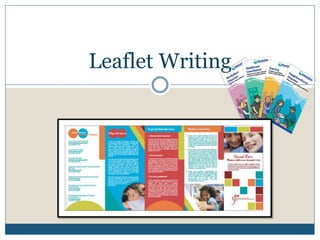
What is a Leaflet?
 Leaflets are a type of open letter which is designed to
be handed out to the people, either by hand, by post,
inserted in local newspapers for distribution, to grab
their attention.
Why to Write a Leaflet?
 To advertise a product
 To provide information about important issues and
events
 To draw attention to any organisation, cause or
event.
It spurs someone to take an action
Designing a Leaflet
STRUCTURAL FEATURES:
1) Title & a slogan
2) Introduction
3) Subheadings
4) Attractive illustrations and photographs
5) Include contact information, and where to get
further details
Title & Slogan
GET ATTENTION
Grab the reader’s attention
Start with a catchy heading, or Rhetorical questions
Catchy Slogans:
‘Saving your money every day.’
‘Every little helps!’
‘Try something new every day.’
Fancy a great holiday break?
Are you interested in
our maritime history?
You try…
 Write slogans for the following fake companies
Write your own slogan
Introduction
 Write the history, mission or vision of the
organisation here.
 Example:
The Humanitarian Reform Organisation
was introduced in 2008. It aims to make
humanitarian response more expected
and develop harmony among
humanitarians. The objective is also to
inculcate leadership qualities, improved
planning and enhanced accountability.
Write vision or mission statement for the
following companies
Write vision or mission statement for the
following companies
Subheadings
Give informative heading for different sections.
Sections provide information and facts about the topic.
BE LUCID:
 Give a clear idea of what the reader is expected to do
 Keep that idea in the reader's mind
 Persuade the reader to take action.
Subheadings
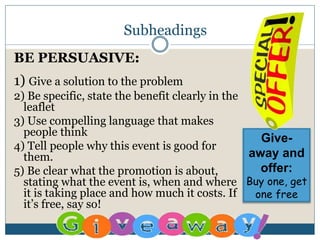
BE PERSUASIVE:
1) Give a solution to the problem
2) Be specific, state the benefit clearly in the
leaflet
3) Use compelling language that makes
people think
4) Tell people why this event is good for
them.
5) Be clear what the promotion is about,
stating what the event is, when and where
it is taking place and how much it costs. If
it’s free, say so!
Give-
away and
offer:
Buy one, get
one free
Designing a Leaflet
GRAMMATICAL FEATURES:
1) A range of different tenses
They are usually written in the present tense, employing
emotive language and often using metaphors and
similes.
2) Simple and direct language
3) Use of positive words
4) Use of non- discriminatory language
Use Superlatives
Biggest, brightest, tastiest, creamiest,
freshest, quickest etc.
Use Imperative
‘Buy this...’
‘Don’t miss this great offer...’
‘Don’t delay, buy today!’
Contact Information
 Include contact information, and where to get
further details ( phone/ cell number, email address
etc)
Task 1
 Read the given leaflet.
 Label the title, slogan, introduction and sub
headings.
 Underline the use of persuasive language.
 Encircle superlatives, imperatives.
Task 2
Answer the following questions:
1. What is purpose of this leaflet?
2. What benefits will you receive?
3. How will you contact them?
4. Are you persuaded? Why or Why not?
Leaflets.ppt

Leaflets.ppt

  • 1.
  • 2.
    Success Criteria Students willunderstand the purpose and essential features of a leaflet.
  • 3.
    What is aLeaflet?  Leaflets are a type of open letter which is designed to be handed out to the people, either by hand, by post, inserted in local newspapers for distribution, to grab their attention.
  • 4.
    Why to Writea Leaflet?  To advertise a product  To provide information about important issues and events  To draw attention to any organisation, cause or event. It spurs someone to take an action
  • 5.
    Designing a Leaflet STRUCTURALFEATURES: 1) Title & a slogan 2) Introduction 3) Subheadings 4) Attractive illustrations and photographs 5) Include contact information, and where to get further details
  • 6.
    Title & Slogan GETATTENTION Grab the reader’s attention Start with a catchy heading, or Rhetorical questions Catchy Slogans: ‘Saving your money every day.’ ‘Every little helps!’ ‘Try something new every day.’ Fancy a great holiday break? Are you interested in our maritime history?
  • 7.
    You try…  Writeslogans for the following fake companies
  • 8.
  • 9.
  • 10.
  • 11.
  • 12.
    Introduction  Write thehistory, mission or vision of the organisation here.  Example: The Humanitarian Reform Organisation was introduced in 2008. It aims to make humanitarian response more expected and develop harmony among humanitarians. The objective is also to inculcate leadership qualities, improved planning and enhanced accountability.
  • 13.
    Write vision ormission statement for the following companies
  • 14.
    Write vision ormission statement for the following companies
  • 15.
    Subheadings Give informative headingfor different sections. Sections provide information and facts about the topic. BE LUCID:  Give a clear idea of what the reader is expected to do  Keep that idea in the reader's mind  Persuade the reader to take action.
  • 16.
    Subheadings BE PERSUASIVE: 1) Givea solution to the problem 2) Be specific, state the benefit clearly in the leaflet 3) Use compelling language that makes people think 4) Tell people why this event is good for them. 5) Be clear what the promotion is about, stating what the event is, when and where it is taking place and how much it costs. If it’s free, say so! Give- away and offer: Buy one, get one free
  • 18.
    Designing a Leaflet GRAMMATICALFEATURES: 1) A range of different tenses They are usually written in the present tense, employing emotive language and often using metaphors and similes. 2) Simple and direct language 3) Use of positive words 4) Use of non- discriminatory language
  • 19.
    Use Superlatives Biggest, brightest,tastiest, creamiest, freshest, quickest etc. Use Imperative ‘Buy this...’ ‘Don’t miss this great offer...’ ‘Don’t delay, buy today!’
  • 20.
    Contact Information  Includecontact information, and where to get further details ( phone/ cell number, email address etc)
  • 21.
    Task 1  Readthe given leaflet.  Label the title, slogan, introduction and sub headings.  Underline the use of persuasive language.  Encircle superlatives, imperatives.
  • 22.
    Task 2 Answer thefollowing questions: 1. What is purpose of this leaflet? 2. What benefits will you receive? 3. How will you contact them? 4. Are you persuaded? Why or Why not?