Newsletter Date
Volume 1, Issue 1
Your Organization
How we use digital video
technology
INTRODUCTION TO THIS NEWS LETTER
Digital video technology has shaped the modern world we
live in the use of the internet has made every day things so
much easier to do. In this newsletter we will be covering how
the use of digital video technology helps a users interactive
experience on these few different delivery platforms. We will
be covering; the use of film trailers, user-generated content,
e-learning, and also platforms including www, kiosks and
mobile devices.
FILM TRAILORS
Film trailers have been a big part of the film world, in the
early years of film, trailers used to be shown at the end of a
film at the cinema which was generally the only place where
you could view trailers. Near the end of the 20th century tel-
evisions became more popular and trailer’s were often tele-
vised in advert breaks, but were still not easily accessible and
could not be viewed on demand. By the turn of the 21st cen-
tury the internet grew massively and sites like YouTube and
msn made the ability to view trailers accessible on demand.
Sites like YouTube where users could the upload home vide-
os and film trailers then grew further and became a world
wide access point to view things on demand online. Film
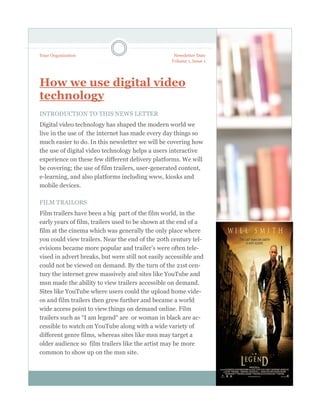
trailers such as “I am legend“ are or woman in black are ac-
cessible to watch on YouTube along with a wide variety of
different genre films, whereas sites like msn may target a
older audience so film trailers like the artist may be more
common to show up on the msn site.
Facebook common sense review- “Frictionless sharing”
USER GENERATED CONTENT
Some sites such as Facebook, Skype
and YouTube allow people to upload
pictures videos and even infor-
mation about someone or some-
thing new today, these people who
upload the things or use the site are
called the users who generate activi-
ty to each particular site, these sites
are very useful for similarly keeping
up with new information and as
mention earlier leisurely activities
such as viewing film trailers. Sites
like this tend to be accessible by
computer or a mobile phone. These
sites are almost completely depend-
ant on the “user” to share activity on
to the site.
KIOSK
Kiosks are commonly present in places such as large shopping
malls and in transport points such as Piccadilly train station and
Manchester airport. They can be used for various uses such as to
inform visitors about the place. They are also commonly used to
help visitors find places such as particular shops at a shopping
centre of to find a certain café or terminal at the airport. They have
become very popular recently as technology has advanced and
make shopping in particular much easier. Kiosks also make things
such as booking tickets for the cinema, as it allows you to book a
ticket online and just pick them up from kiosks. There are also
down sides to kiosks, as they can subside to technical faults and
may create a longer time trying to achieve your objective, for ex-
ample if you book a ticket at a cinema online and then the kiosk
doesn't work properly. This would often mean that you have to go
to a member of staff and wait for them to sort you out, which then
defeats the purpose of a kiosk at the cinema.
E-LEARNING
WWW.
WWW. (The world wide web) is now a dependant and crucial element to the modern day. It al-
lows us to apply for jobs, do our weekly shop, purchase luxuries online, learn information, con-
tact people, and even start up new business ‘s. the world wide web is used in every day life and
makes everyday day life a lot easier, however there re many cons to balance the excessive pros
of the WWW. The WWW is also a hazard to young people as it is a primary target for sex of-
fenders and paedophiles, it can be used to exploit other peoples issues and potentially import
offensive opinions and views. Once your personal information is on the world wide web it can
not be erased from it and many people have found ways to get hold of other peoples personal
information. All in all the world wide web is a very threatening and dangerous place.
MOBILE DEVICES
Many mobile devices such as phones and tablets come with the internet ac-
cess, generally on tablets they have a very limited access to the internet
where u can only use it in certain Wi-Fi spots. Many mobile phones however
have 3G which means that you can access the internet ant all times in that
country or region. There are negatives of using the internet using mobile de-
vices as it drains the battery much faster then normal if you are connected to
the internet. You can also get certain items such as apps on your phones,
such as games, learning apps, and leisurely fun apps such as “Fat Booth”. Phones
now often have built in cameras and even camcorders with MPX generally around
5 MPX.,
E learning is used to adopt new skills and learn new things
through the internet. There are many learning spaces set up
online which means learning new things are much easier,
user generated content are also very useful for learning
things such a YouTube where people often upload tutorial
videos on how to preform skills and learn information on a
certain subject for example “how to play football”. Face-
book is similarly good for this as users can exchange infor-
mation to each other via the internet. Not only user gener-
ated content is good for learning, some sites are set up to
provide information a bout a certain topic or place such as
the Cheadle & marple “Moodle” set up so viewers can
learn information about the college.
TECNOLOGY
Media player is a term typically
used to describe computer software
for playing back multimedia files.
While many media players can play
both audio and video, others focus
only on one media type or the oth-
er. These players are known as ei-
ther audio or video players, they
usually have a user interface tai-
lored for the specific media type.
Media players are generally used
for leisurely activities and allow us
to listen too music and view videos
and even films that we’ve created
using software such as windows
live movie maker. Sometimes me-
dia players can succumb to tech-
nical faults such as freezing or just
not registering a media file.
FILE SIZE
MEDIA PLAYERS
File size measures the size of a computer file. Bytes wit5h a
prefix is what its typically measured in The actual amount
of disk space consumed by the file depends on the file sys-
tem.
The maximum size of a file that a file system can hold de-
pends on the number of bits reserved to store size infor-
mation the total size of the file system. The bigger the file
size the more space is consumed but computers have a
physical maximum capacity so the larger the file size is the
smaller the space is left. Files can be sent over the internet
or stored to the computer.
4
“To catch the reader's attention, place an interesting sentence or quote
from the story here.”
There are many different types of digital image file types.
The main ones are as follows: JPG, GIF, TIFF, PNG and
BMP, MOV. These different file types depend on your cer-
tain camera or computer. Image files can be quite large,
and larger file types mean more disk space is taken up and
slower downloads. Compression is a term used to describe
ways of cutting the size of the file. Here are a few of the
most common file formats they differ greatly for there use
the MOV video file format is used commonly to save movies
and other video files, where as the JPEG (Joint Photo-
graphic Experts Group) is a means of digital image file
compression.
There are many different
areas of compression such
as Data compression , au-
dio compression and video
compression, however the
most common area of com-
pression used is image com-
pression.
There are two key different
types of image compression
Image compression may be
lossy or lossless. Lossless
compression is mainly used
for archival purposes and
often for medical imaging,
technical drawings, clip art,
or comics.
The other key type of image
compression is lossy, lossy
compression is a data en-
coding method that com-
presses data by discarding
some of it. The procedure
aims to minimize the
amount of data that needs
to be held.
DIGITAL FILE FORMATS
COMPRESSION
5

Leaflet 2

  • 1.
    Newsletter Date Volume 1,Issue 1 Your Organization How we use digital video technology INTRODUCTION TO THIS NEWS LETTER Digital video technology has shaped the modern world we live in the use of the internet has made every day things so much easier to do. In this newsletter we will be covering how the use of digital video technology helps a users interactive experience on these few different delivery platforms. We will be covering; the use of film trailers, user-generated content, e-learning, and also platforms including www, kiosks and mobile devices. FILM TRAILORS Film trailers have been a big part of the film world, in the early years of film, trailers used to be shown at the end of a film at the cinema which was generally the only place where you could view trailers. Near the end of the 20th century tel- evisions became more popular and trailer’s were often tele- vised in advert breaks, but were still not easily accessible and could not be viewed on demand. By the turn of the 21st cen- tury the internet grew massively and sites like YouTube and msn made the ability to view trailers accessible on demand. Sites like YouTube where users could the upload home vide- os and film trailers then grew further and became a world wide access point to view things on demand online. Film trailers such as “I am legend“ are or woman in black are ac- cessible to watch on YouTube along with a wide variety of different genre films, whereas sites like msn may target a older audience so film trailers like the artist may be more common to show up on the msn site.
  • 2.
    Facebook common sensereview- “Frictionless sharing” USER GENERATED CONTENT Some sites such as Facebook, Skype and YouTube allow people to upload pictures videos and even infor- mation about someone or some- thing new today, these people who upload the things or use the site are called the users who generate activi- ty to each particular site, these sites are very useful for similarly keeping up with new information and as mention earlier leisurely activities such as viewing film trailers. Sites like this tend to be accessible by computer or a mobile phone. These sites are almost completely depend- ant on the “user” to share activity on to the site. KIOSK Kiosks are commonly present in places such as large shopping malls and in transport points such as Piccadilly train station and Manchester airport. They can be used for various uses such as to inform visitors about the place. They are also commonly used to help visitors find places such as particular shops at a shopping centre of to find a certain café or terminal at the airport. They have become very popular recently as technology has advanced and make shopping in particular much easier. Kiosks also make things such as booking tickets for the cinema, as it allows you to book a ticket online and just pick them up from kiosks. There are also down sides to kiosks, as they can subside to technical faults and may create a longer time trying to achieve your objective, for ex- ample if you book a ticket at a cinema online and then the kiosk doesn't work properly. This would often mean that you have to go to a member of staff and wait for them to sort you out, which then defeats the purpose of a kiosk at the cinema.
  • 3.
    E-LEARNING WWW. WWW. (The worldwide web) is now a dependant and crucial element to the modern day. It al- lows us to apply for jobs, do our weekly shop, purchase luxuries online, learn information, con- tact people, and even start up new business ‘s. the world wide web is used in every day life and makes everyday day life a lot easier, however there re many cons to balance the excessive pros of the WWW. The WWW is also a hazard to young people as it is a primary target for sex of- fenders and paedophiles, it can be used to exploit other peoples issues and potentially import offensive opinions and views. Once your personal information is on the world wide web it can not be erased from it and many people have found ways to get hold of other peoples personal information. All in all the world wide web is a very threatening and dangerous place. MOBILE DEVICES Many mobile devices such as phones and tablets come with the internet ac- cess, generally on tablets they have a very limited access to the internet where u can only use it in certain Wi-Fi spots. Many mobile phones however have 3G which means that you can access the internet ant all times in that country or region. There are negatives of using the internet using mobile de- vices as it drains the battery much faster then normal if you are connected to the internet. You can also get certain items such as apps on your phones, such as games, learning apps, and leisurely fun apps such as “Fat Booth”. Phones now often have built in cameras and even camcorders with MPX generally around 5 MPX., E learning is used to adopt new skills and learn new things through the internet. There are many learning spaces set up online which means learning new things are much easier, user generated content are also very useful for learning things such a YouTube where people often upload tutorial videos on how to preform skills and learn information on a certain subject for example “how to play football”. Face- book is similarly good for this as users can exchange infor- mation to each other via the internet. Not only user gener- ated content is good for learning, some sites are set up to provide information a bout a certain topic or place such as the Cheadle & marple “Moodle” set up so viewers can learn information about the college.
  • 4.
    TECNOLOGY Media player isa term typically used to describe computer software for playing back multimedia files. While many media players can play both audio and video, others focus only on one media type or the oth- er. These players are known as ei- ther audio or video players, they usually have a user interface tai- lored for the specific media type. Media players are generally used for leisurely activities and allow us to listen too music and view videos and even films that we’ve created using software such as windows live movie maker. Sometimes me- dia players can succumb to tech- nical faults such as freezing or just not registering a media file. FILE SIZE MEDIA PLAYERS File size measures the size of a computer file. Bytes wit5h a prefix is what its typically measured in The actual amount of disk space consumed by the file depends on the file sys- tem. The maximum size of a file that a file system can hold de- pends on the number of bits reserved to store size infor- mation the total size of the file system. The bigger the file size the more space is consumed but computers have a physical maximum capacity so the larger the file size is the smaller the space is left. Files can be sent over the internet or stored to the computer. 4
  • 5.
    “To catch thereader's attention, place an interesting sentence or quote from the story here.” There are many different types of digital image file types. The main ones are as follows: JPG, GIF, TIFF, PNG and BMP, MOV. These different file types depend on your cer- tain camera or computer. Image files can be quite large, and larger file types mean more disk space is taken up and slower downloads. Compression is a term used to describe ways of cutting the size of the file. Here are a few of the most common file formats they differ greatly for there use the MOV video file format is used commonly to save movies and other video files, where as the JPEG (Joint Photo- graphic Experts Group) is a means of digital image file compression. There are many different areas of compression such as Data compression , au- dio compression and video compression, however the most common area of com- pression used is image com- pression. There are two key different types of image compression Image compression may be lossy or lossless. Lossless compression is mainly used for archival purposes and often for medical imaging, technical drawings, clip art, or comics. The other key type of image compression is lossy, lossy compression is a data en- coding method that com- presses data by discarding some of it. The procedure aims to minimize the amount of data that needs to be held. DIGITAL FILE FORMATS COMPRESSION 5