Leading a rebellion without
causing a revolt:
The small but mighty change maker
Marlies van Dijk
September 28, 2018
@tweetvandijk
@ZaynaKhayat Source: Kaiser Permanente CEO interview in press (2017); OECD and OTN study (2017)
Box1
Manage
the
present
Box2
Selectively
forget the
past
Box3
Create the
future
Vijay Govindarajan – 3 box solution
The Future
Opportunity Gap
Current
Performance Gap
Starts on the fringe
(at the edge)
Starts with the activists
Gary Hamel
always
Source Twitter @josinavink @experiolab
The Future The Status Quo
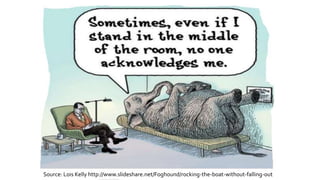
Source: Lois Kelly http://www.slideshare.net/Foghound/rocking-the-boat-without-falling-out
Christina Costello,
Babson Entrepreneur Experience Lab
Christina Costello, Babson Entrepreneur Experience Lab
Framing
• Connect with people’s hearts and minds
• Turning opportunity into action
• Hooks to pull people in
• Springboards for mobilizing support
• Need to be authentic and connect with reality
“I have a dream”
“I have some new
clinical guidelines
for you….”
Harvard Business ReviewRebel Assessment
Keep the ideas coming! Your different
lens on this is making me rethink how
we are doing things around here.
Lets try it out!
Leading a rebellion without causing a revolt

Leading a rebellion without causing a revolt

Editor's Notes

  • #3 21 years old Stroke at 6 years old Undiagnosed diabetes Hemipelegic She is this remarkable young woman Since I have known her she has bungee jumped, sky diven and is in love with skiing. She has fired one nurse (because she was focused on her computer and each time said “my name is … “ even though they had met 4 times, called a VP about not getting her A1C level over the phone and eventually has signed up to receive private care from Wello. Wello is a private health care org that is staffed by NPs – they do virtual visits – share netcare with her and even do home visits if she needs it. She knows more about diabetes than any nurse or doctor that you put in front of her. She is looking for a relationship and someone who appreciates who she is – and her biggest demon is likely mental health stuff. This is our consumer – and I am super happy to have her as an intern of the design lab.
  • #4 110 million visit for KP and 59 million are virtual
  • #5 Portable ultrasound device. New ultrasounds on a chip technology An ultrasound machine costs $50,000-$100,000 and other mobile devices around $7000 Use of semi conductor chip rather than piezoelectric crystals 4.7 billion people are unable to obtain medical imaging. Dr Eric Topol suggests that consumers would be performing their own ultrasounds in a few years
  • #6 Social isolation is now being talked about – and addressing social isolation – can reduce ER visits
  • #7 Medical costs location time, people – internet of medical things Democratization of medicine means the end of paternalism Democratization will lead to more peer to peer pressure medicine Networks can connect people and devices in ways that make the whole smarter than the sum of its parts 4) Democratization of medical knowledge – people with medical problems have the time that the medical establishment does not have 5) Open health movement (value based payment) 6) Medical education is near turmoil 7) Patients may ultimately be better at understanding risk than many physicians
  • #9 Change day 2017!
  • #10 30 countries are doing what matters to you
  • #13 We generally think that innovation starts with ideas.
  • #14 Box one is core business: Performance gap - restructuring Box two is adjacent space (both 2 and 3 are Opportunity gap Box three is the future
  • #15 From there are a number of steps … but once you have the idea – what do you think are the three killers of ideas? Bureacray Job descriptions Meetings
  • #16 From there are a number of steps … but once you have the idea – what do you think are the three killers of ideas? Bureacray Job descriptions Meetings I would like to talk to you about how we (as people who live in a bureaucracy) can make change happen.
  • #17 What do we usually do in healthcare when we want to make a change? We do an environmental scan – including a lit search – then we often survey people (a lot of surveys) – then we write a strategy plan – usually a couple of smart Masters prepared people have that job – and then it gets presented to a steering committee – the plan is laid out …. And then – are you ready – this is what we do next …
  • #19 This is likely what has happened in healthcare -
  • #20 Designed to maintain the status quo Millions of example …. My example is …. There is a certain order to things. My goal is to keep new ideas and evolution out of the hands of senior management. Why? Because if it goes there it might be at risk and it could get side railed. It might not but often it does. They say to me – hey marlies – do you want to bring a briefing note on this topic to Executive Leadership? … I say no – but how do I influence someone to redirect their course – how do I influence to see this unfold differently?
  • #24 Colleen
  • #25 Marlies How do you form teams New ventures – build a great team vs. perfecting an idea. Success is dependent on the quality of the idea – but deeply dependent of the ability of the team to execute. What if you have no control over the team? E’s become great relationship and engagement manager. To understand the ability of good team members. Those can be used to leverage the sense of co-ownership See the sense of co-ownership. They have ability to pull others along with them.
  • #26 Marlies Experimentation Wired for experimentation but the orgs they work for are not. Not surprising. Experimentation is hard to operationalize and support. Following rules and operating procedures – they do not see it as killing experimentation. Experimentation = google 20% of the time. First steps for experimentation is overcoming self doubt – getting challenged all the time can be tiring. Trick is figuring out what idea is a good one and which one is not. E are good at creative conflict as a way to experiment. Creative Conflict: Opposition to help shape opportunities – different from opposition that is resistant to change. Example: VP Brings early ideas to them – reiterate shape ideas E sees both success and failure as a learning opportunity. Uncomfortable if they sit on a success too long. They know someone will come along and challenge it.
  • #27 Colleen How do you learn to become an entreprenuer inside. Build 2 knowledge Domain knowledge: expertise in their industry in their product or field Organizational knowledge: “the know how” how an organization works. Tacid experiential experience on how an org works. Reading the landscape. Thinking like an anthrapologist – being able to learn about the history but respond to information coming in. A process of de- education. Unlearning prior behaviours that does not serve an E. If you a disengaged employee you are building habits that don’t serve you as an E. De educate yourself on perfectionism – does not serve you well if you are a E. Holding on to an idea to tightly. Working towards performance evaluation. Executing ideas of others. Build into habits – and other E muscles will atrophy. Those will atrophy other E muscles – you need to de-learning curve. Unlearn of things so you can build different habits.
  • #29 Marlies Live in a state of “manage discomfort’ – there might be an unease as they are entrepeneurs – or even to find space to be entrepreneurial Act entrepreurial outside of their job description. “capable of squeezing through the smallest of opportunity to build evidence that my idea is good” Official job title “change agent” – operate off the org chart – seek out places in nook and crannies in the organzation -then develop truth of the value of their idea Octopus – she says I can squeeze through the smallest opportunity to get my idea out there – or it would get killed Another guy: project manager – he showed value through other side projects and through a community of practice. Although his company thought he should do that through his day job Day it is broken out – one hour meetings not condusive to entrepreneurial thinking. Meeting culture – what can happen and not happen. Entrepreneurs get bigger blocks of time to do creative work Hour long meetings – not contusive to entrepreneurial behaviour. They look for ways to structure their days differently – larger blocs of time. An organization can have strong or weak entrepreneurial cultures
  • #30 Colleen Framing To connect with people’s hearts and minds Emotional heart tug Intrinsic motivation and values Key to turning opportunity into action Hooks to pull people in Springboards for mobilizing support Frames need to be authentic and connect with reality
  • #31 Colleen Framing is the process by which leaders construct, articulate and put across their message in a powerful and compelling way in order to win people to their cause and call them to action. Compare and contrast how we can frame our ideas….. “I have a dream” versus “I have some new clinical guidelines for you….”
  • #34 Resilience – how do you channel being awesome Vishen Lakhiani
  • #35 Negative spiral – not happy about where you are heading Content and happy in the now (no vision not growing and doing a disservice to the world) Stress and anxiety (vision but not happy) Flow – you have vision for the future and happy in the now – detach happiness from your goals Resilient – and bending reality. Great entrepreneurs “bend reality” – at the root of his reality distortion was his believe that rules did not apply to him.
  • #38 Break free from rules that hold you back