Developing Personal
Professional Online Learning
Networks

Presented by Debra Askanase,
Community Organizer 2.0
About the presenter
Former executive
director, community
organizer, business
consultant
“Engage, create trust,
move people to action”

Digital Engagement Strategist

debra@communityorganizer20.com

2
2
Today’s conversation
I: Making Sense of PLNs
– Definition
– Stages of growth
(Thought pause: Creating PLN learning objectives)
– Role of network weavers
– Integrating small world network theory
(Thought pause: role of weavers in Learning Networks)

II: Creating Your PLN
– Developing your own PLN: An action plan
– Practical tips
Part One:
Making Sense of PLNs
http://www.flickr.com/photos/42202689@N00/3104678445/
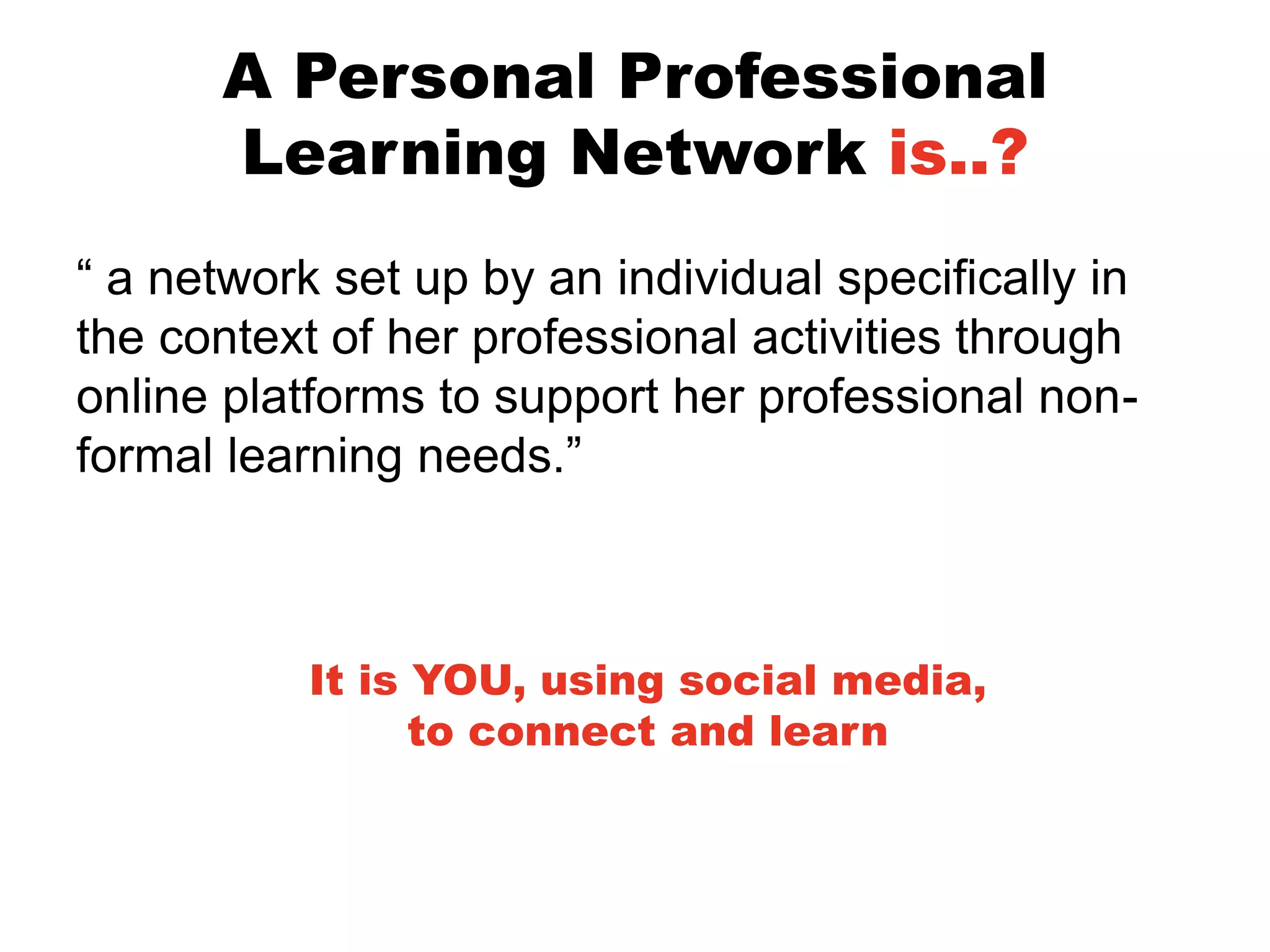
A Personal Professional
Learning Network is..?
“ a network set up by an individual specifically in
the context of her professional activities through
online platforms to support her professional nonformal learning needs.”

It is YOU, using social media,
to connect and learn
PLNs and
Leaders

http://www.flickr.com/photos/13522901@N00/382265924/
Your footer here

7
Your footer here

8
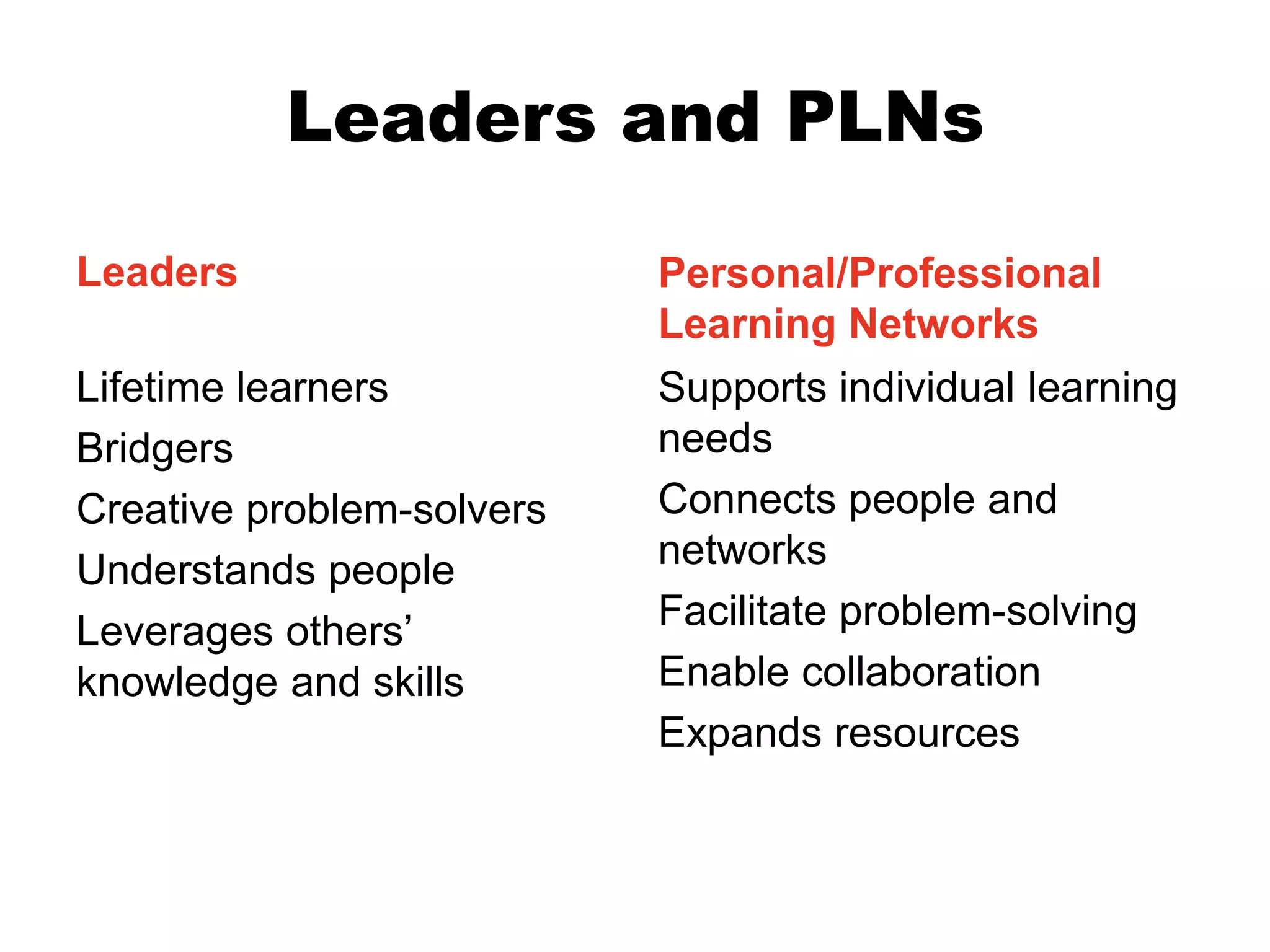
Leaders and PLNs
Leaders
Lifetime learners
Bridgers
Creative problem-solvers
Understands people
Leverages others’
knowledge and skills

Personal/Professional
Learning Networks
Supports individual learning
needs
Connects people and
networks
Facilitate problem-solving
Enable collaboration
Expands resources
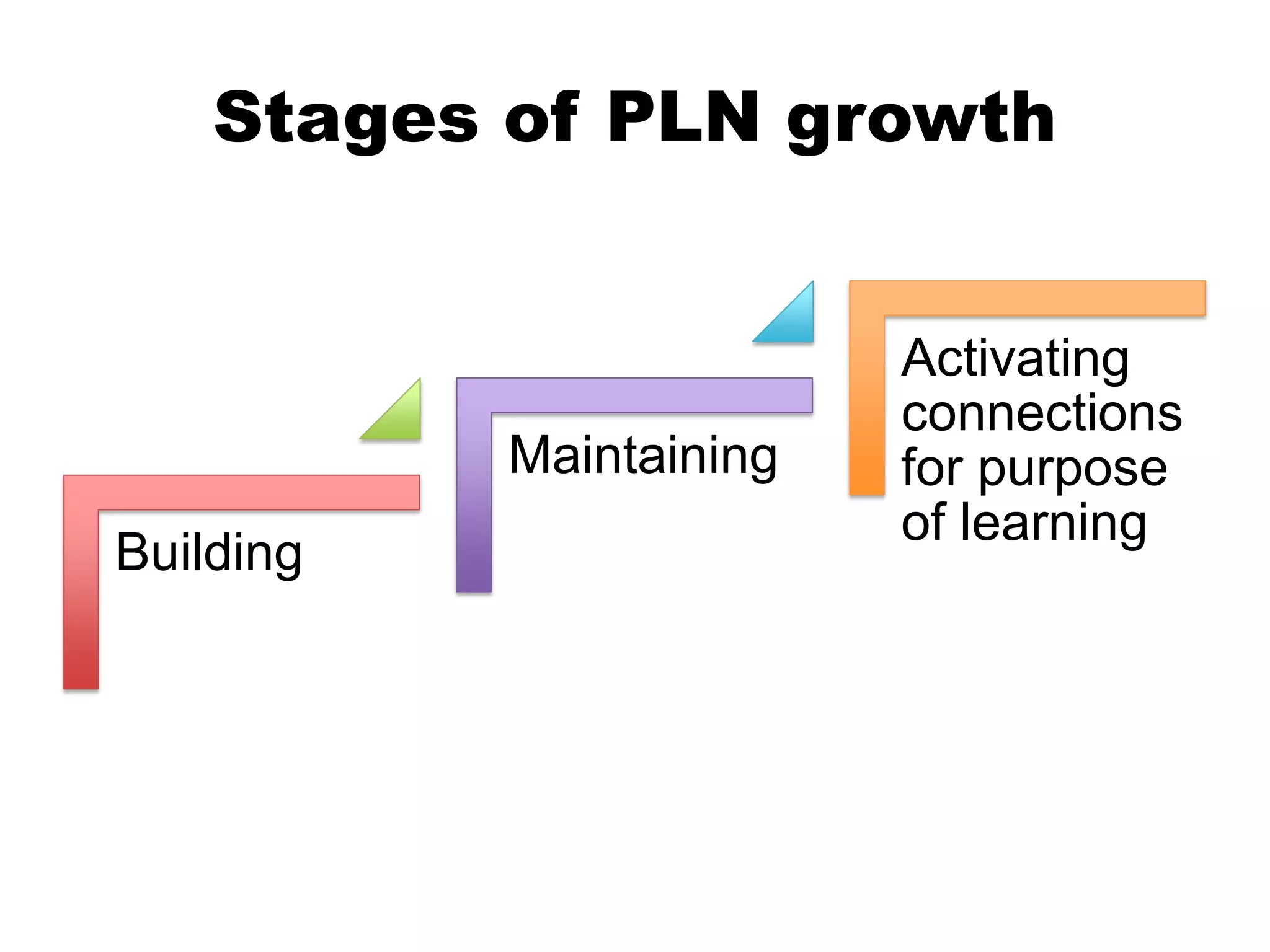
Stages of PLN growth

Maintaining
Building

Activating
connections
for purpose
of learning
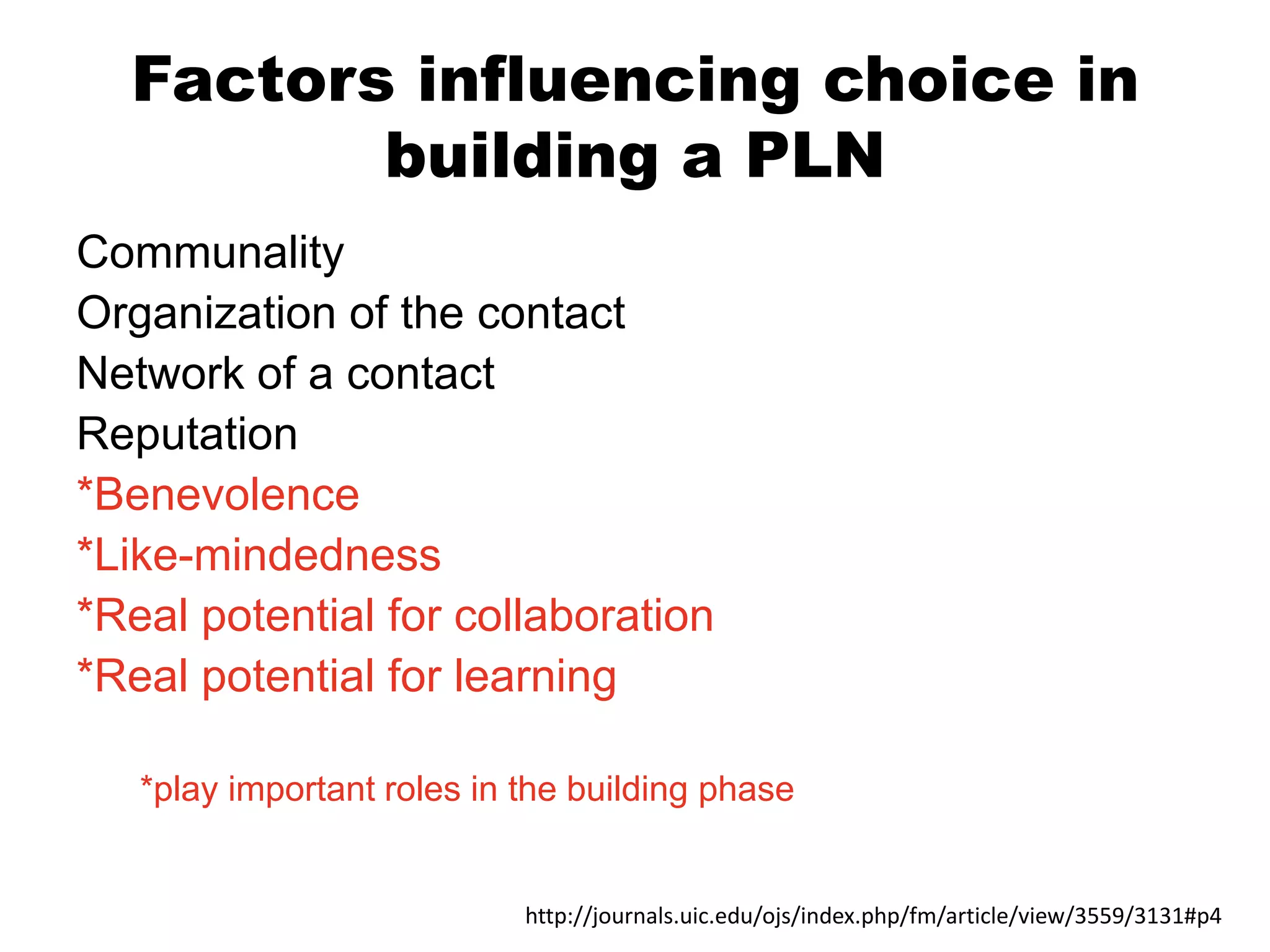
Factors influencing choice in
building a PLN
Communality
Organization of the contact
Network of a contact
Reputation
*Benevolence
*Like-mindedness
*Real potential for collaboration
*Real potential for learning
*play important roles in the building phase

http://journals.uic.edu/ojs/index.php/fm/article/view/3559/3131#p4
What are your PLN
objectives?
Consider:
– What do you want to learn?
– What is the value to you of learning this?

Take a moment and submit your PLN objectives in
the chat box.
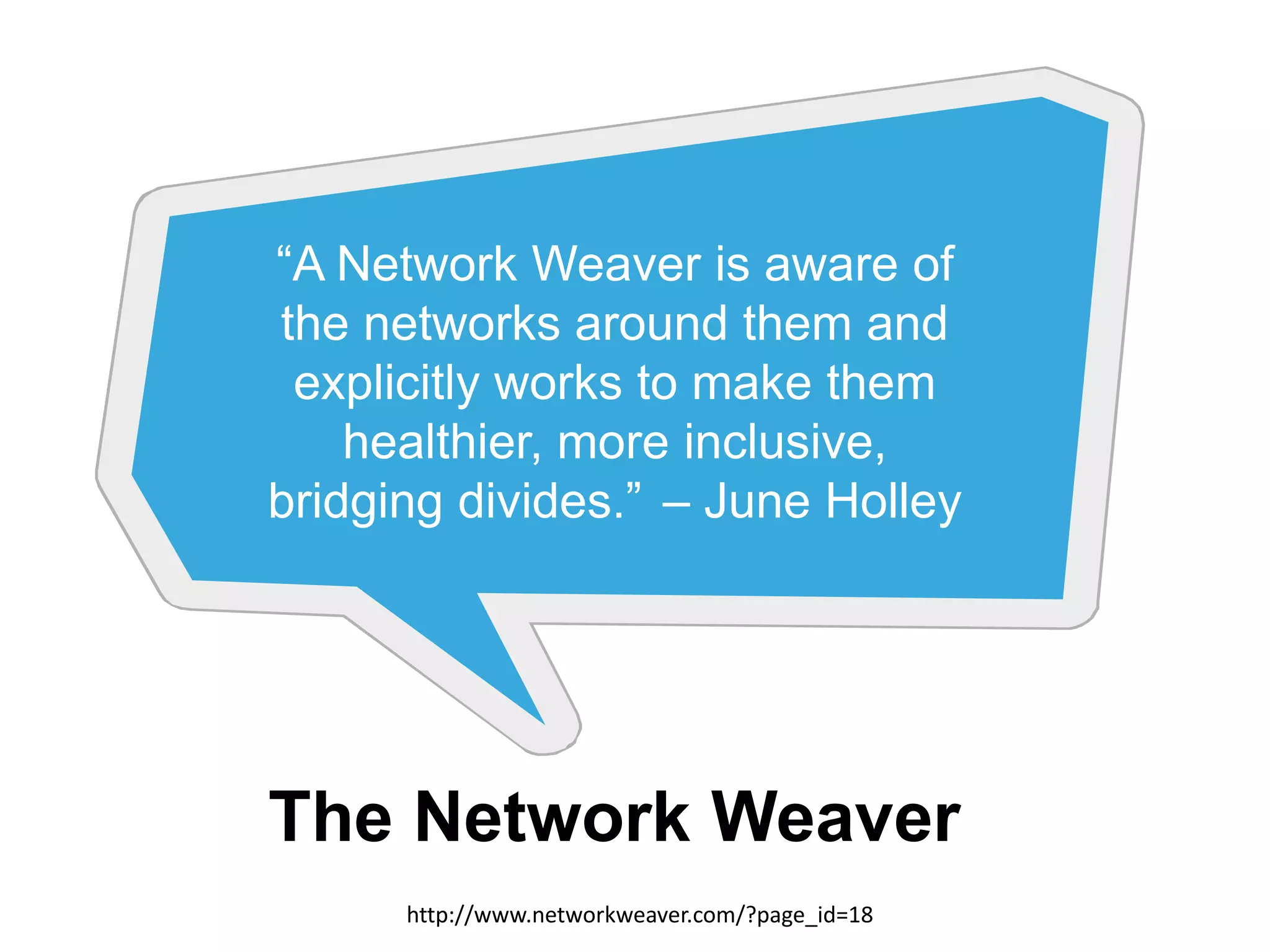
“A Network Weaver is aware of
the networks around them and
explicitly works to make them
healthier, more inclusive,
bridging divides.” – June Holley

The Network Weaver
http://www.networkweaver.com/?page_id=18

13
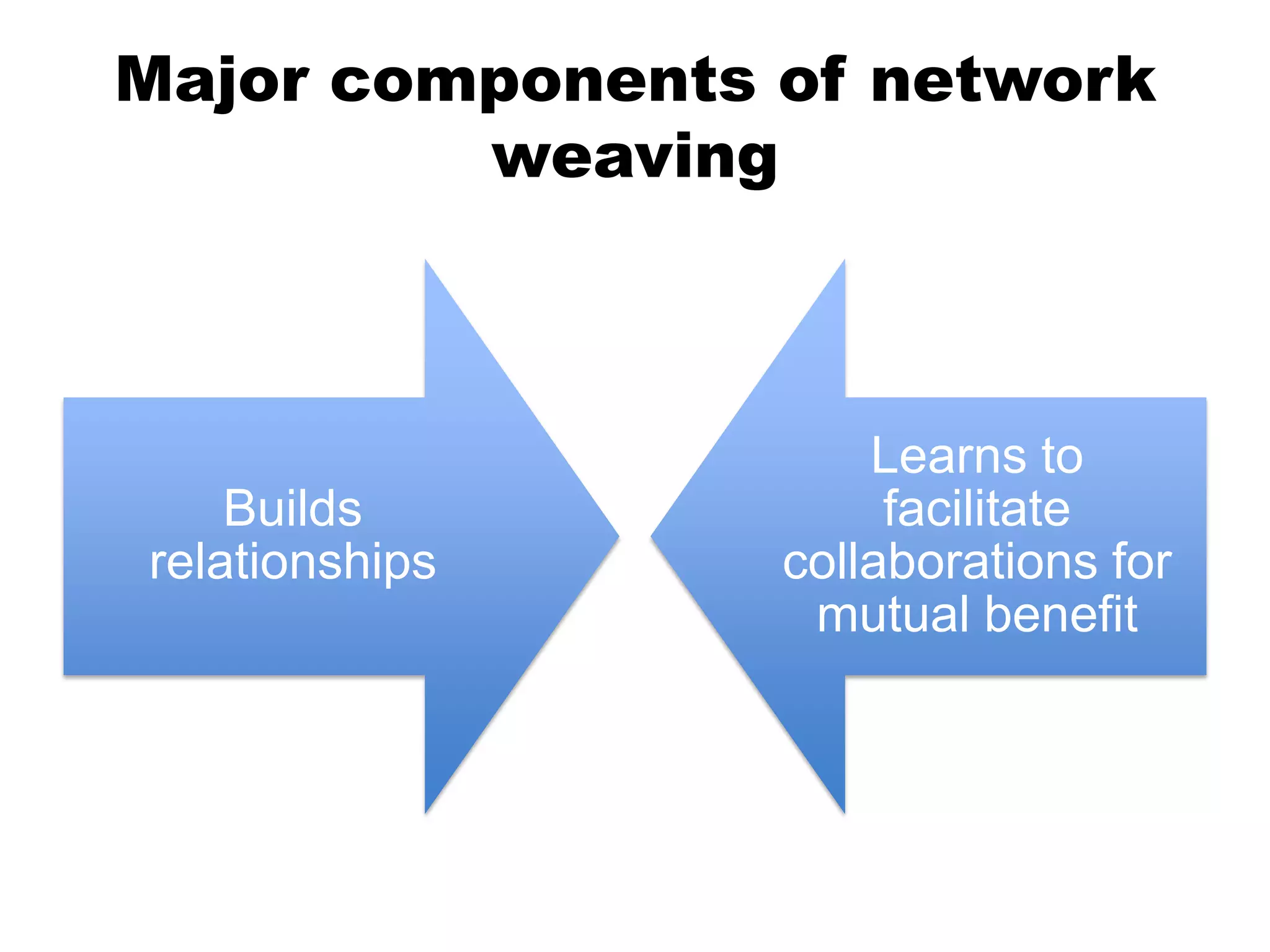
Major components of network
weaving

Builds
relationships

Learns to
facilitate
collaborations for
mutual benefit
*

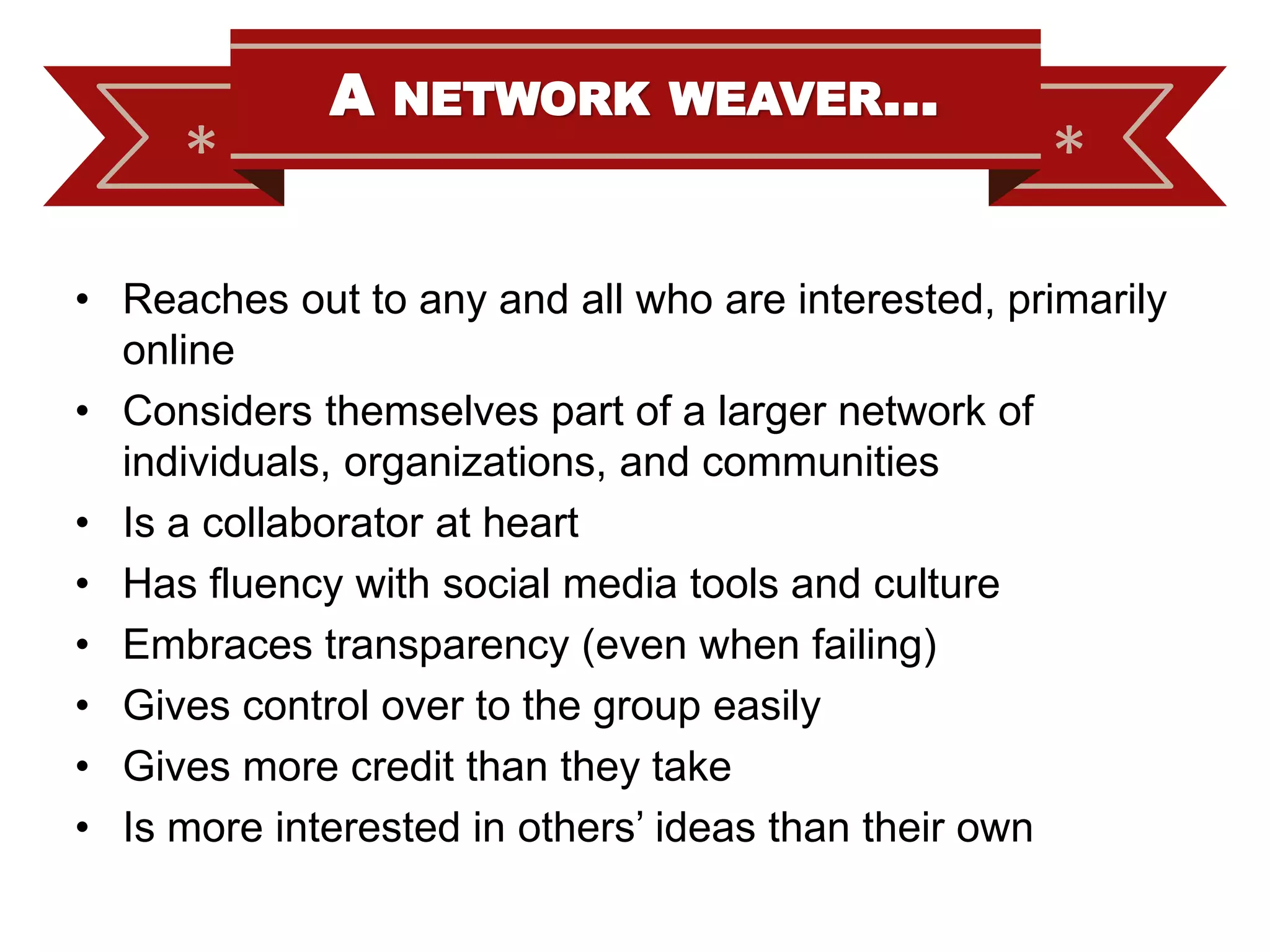
A

NETWORK WEAVER…

*

• Reaches out to any and all who are interested, primarily
online
• Considers themselves part of a larger network of
individuals, organizations, and communities
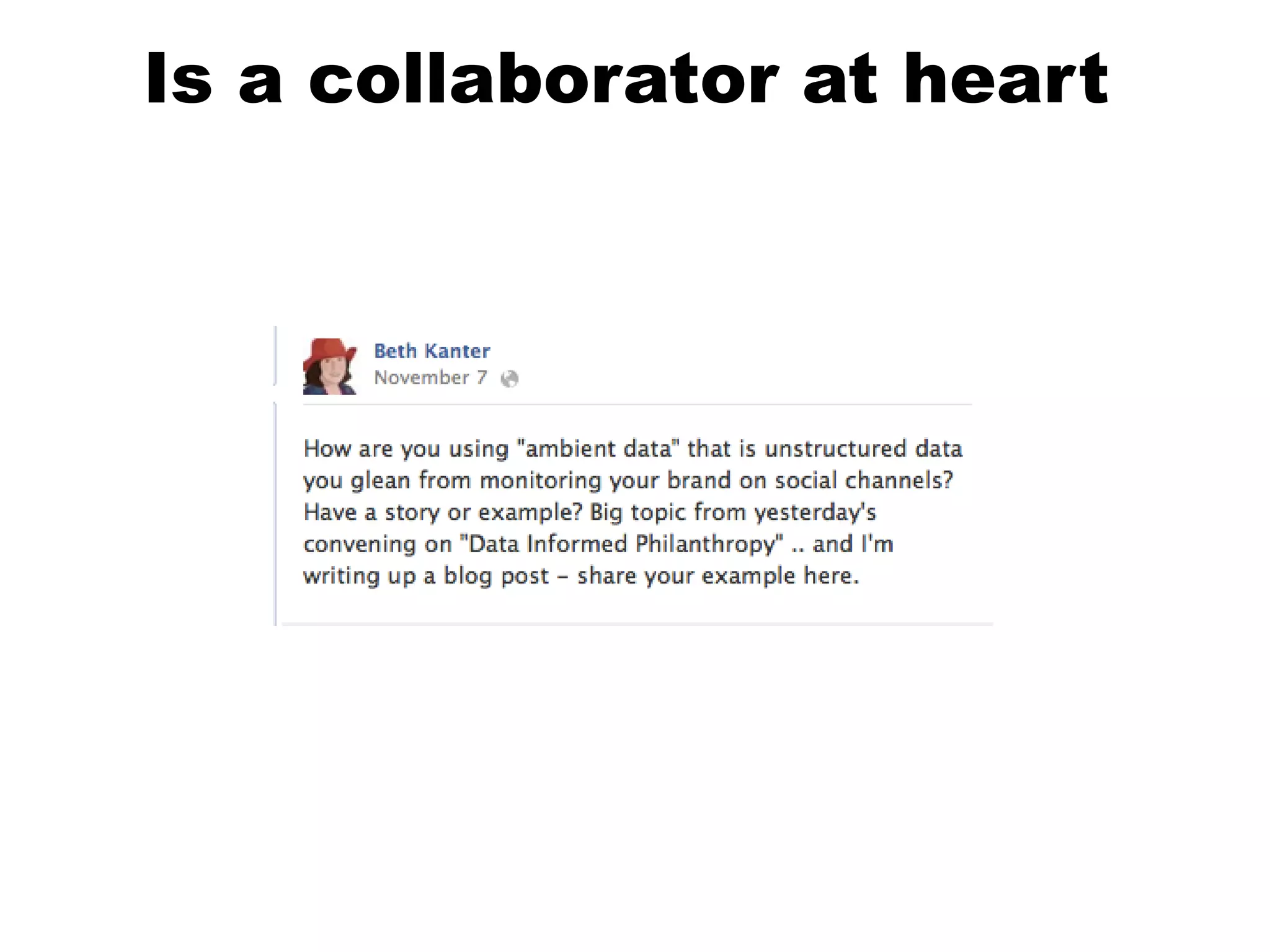
• Is a collaborator at heart
• Has fluency with social media tools and culture
• Embraces transparency (even when failing)
• Gives control over to the group easily
• Gives more credit than they take
• Is more interested in others’ ideas than their own
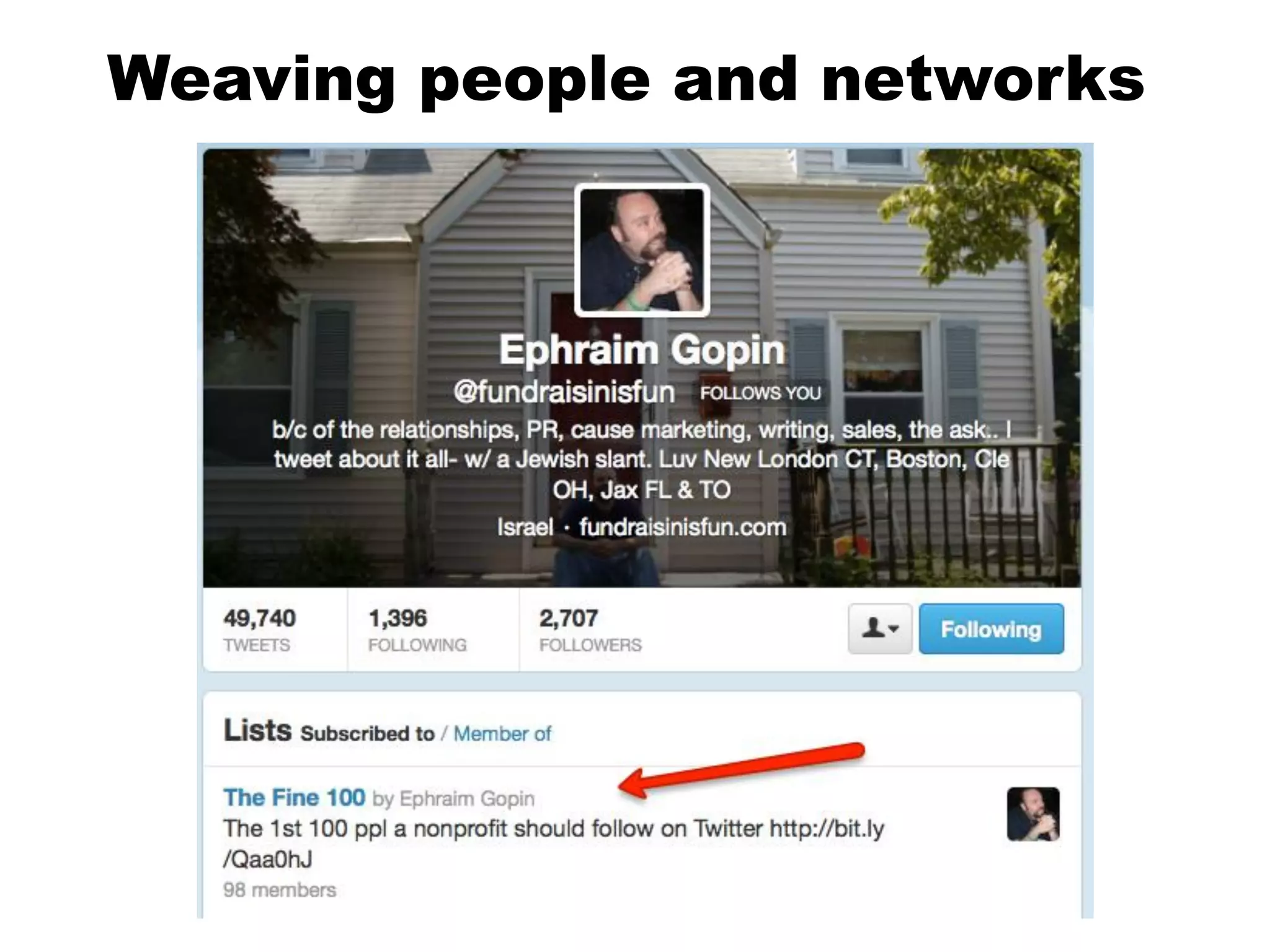
Weaving people and networks
17
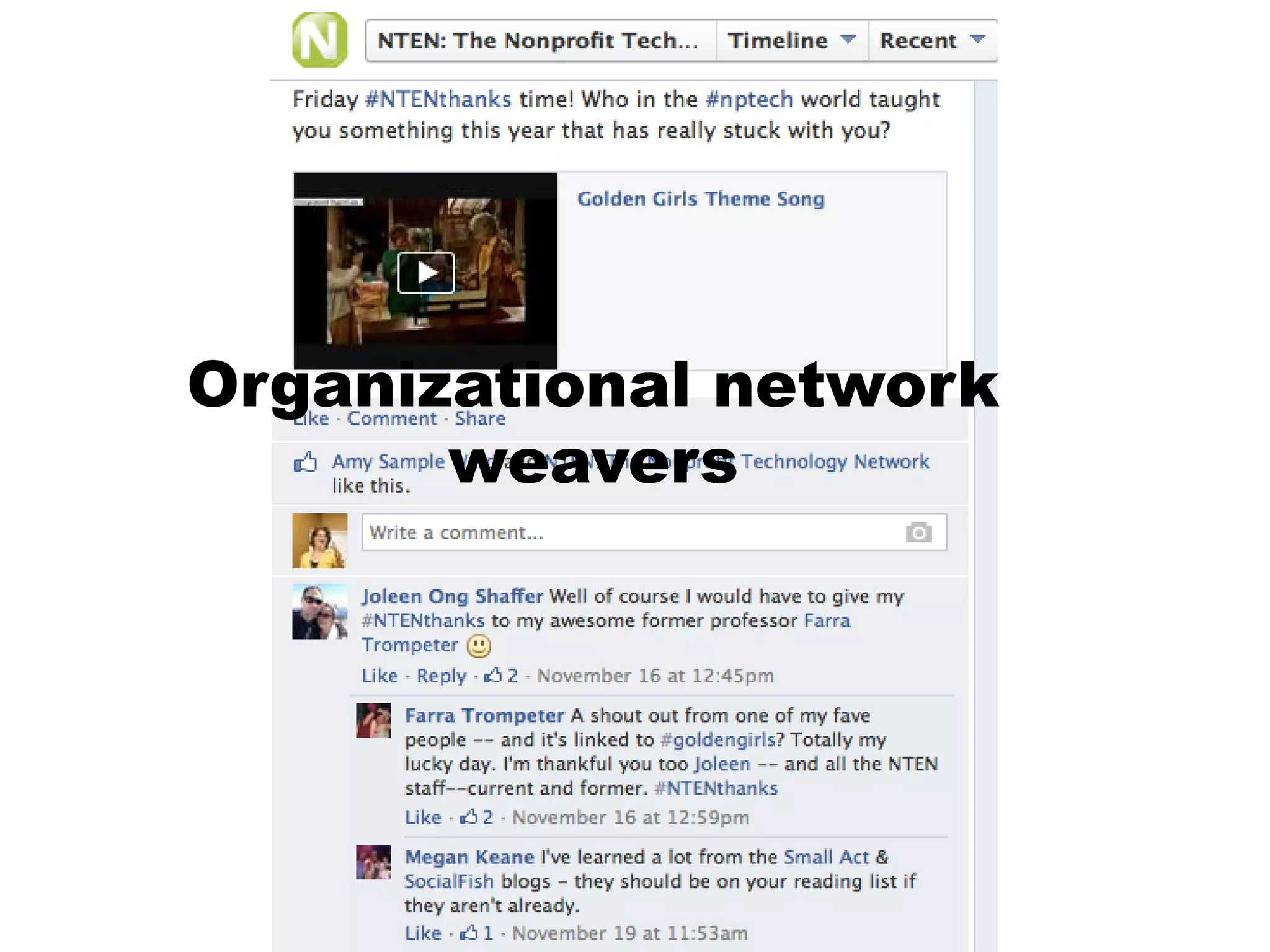
Organizational network
weavers
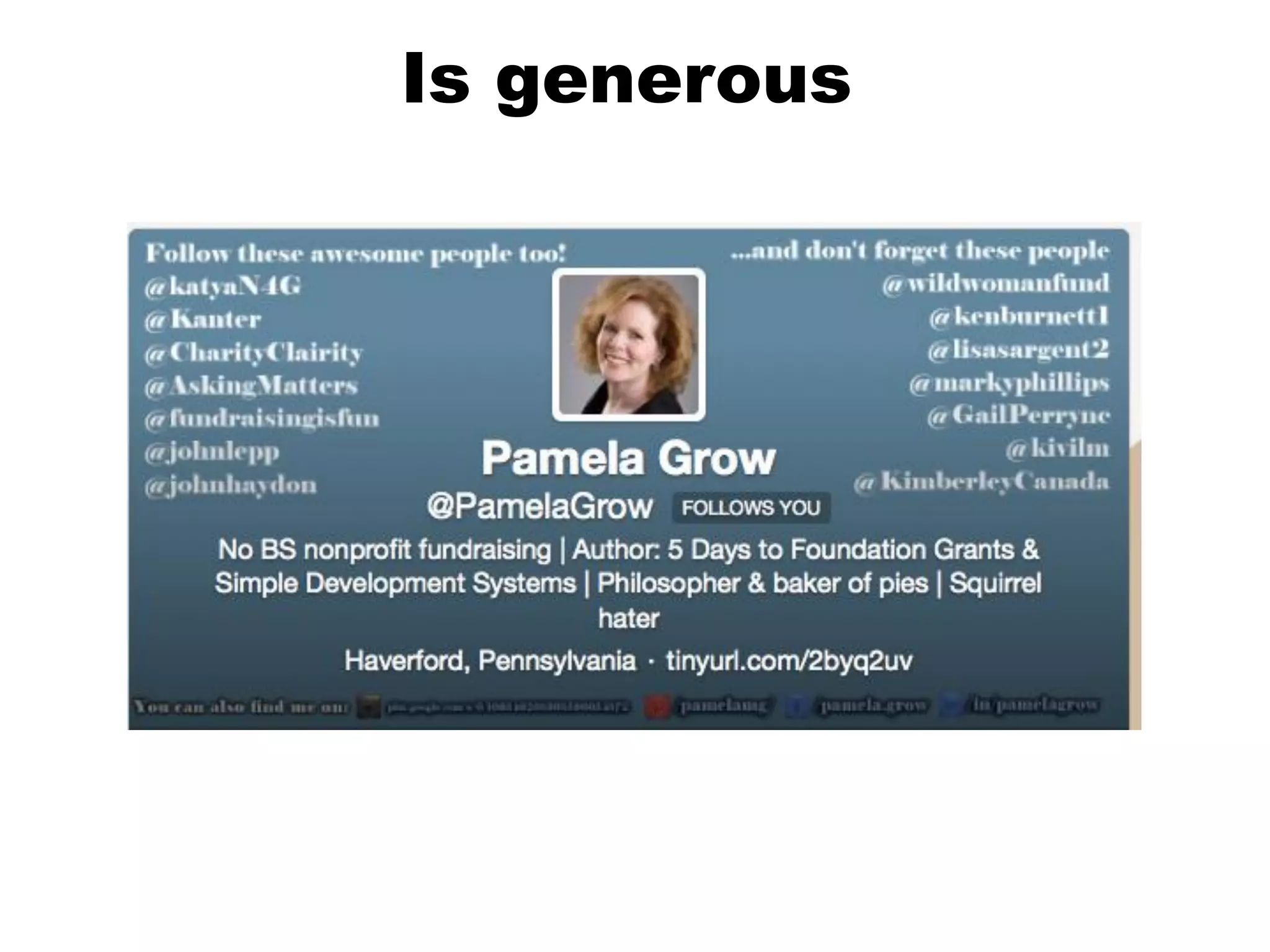
Is generous
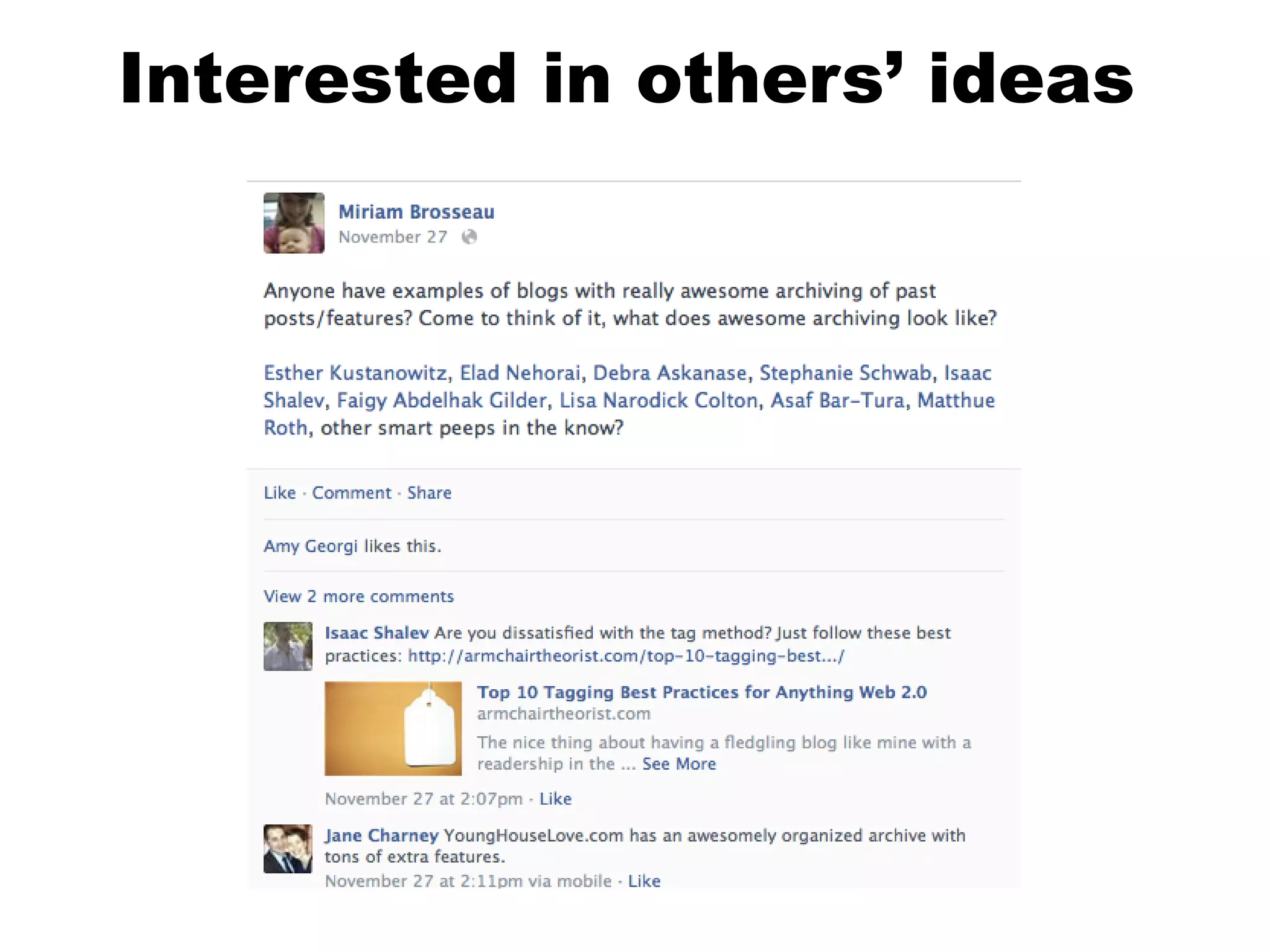
Interested in others’ ideas
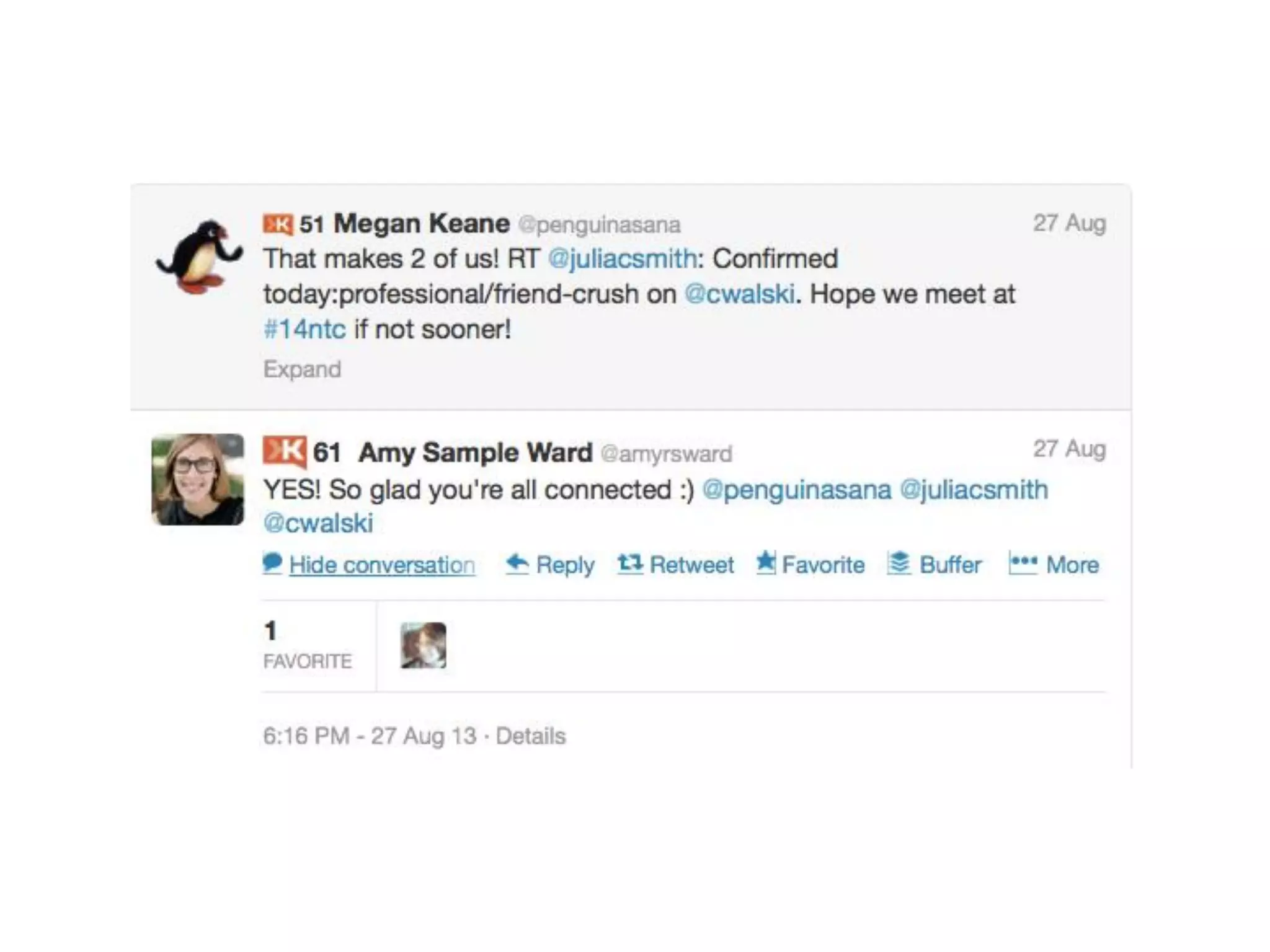
Is a collaborator at heart
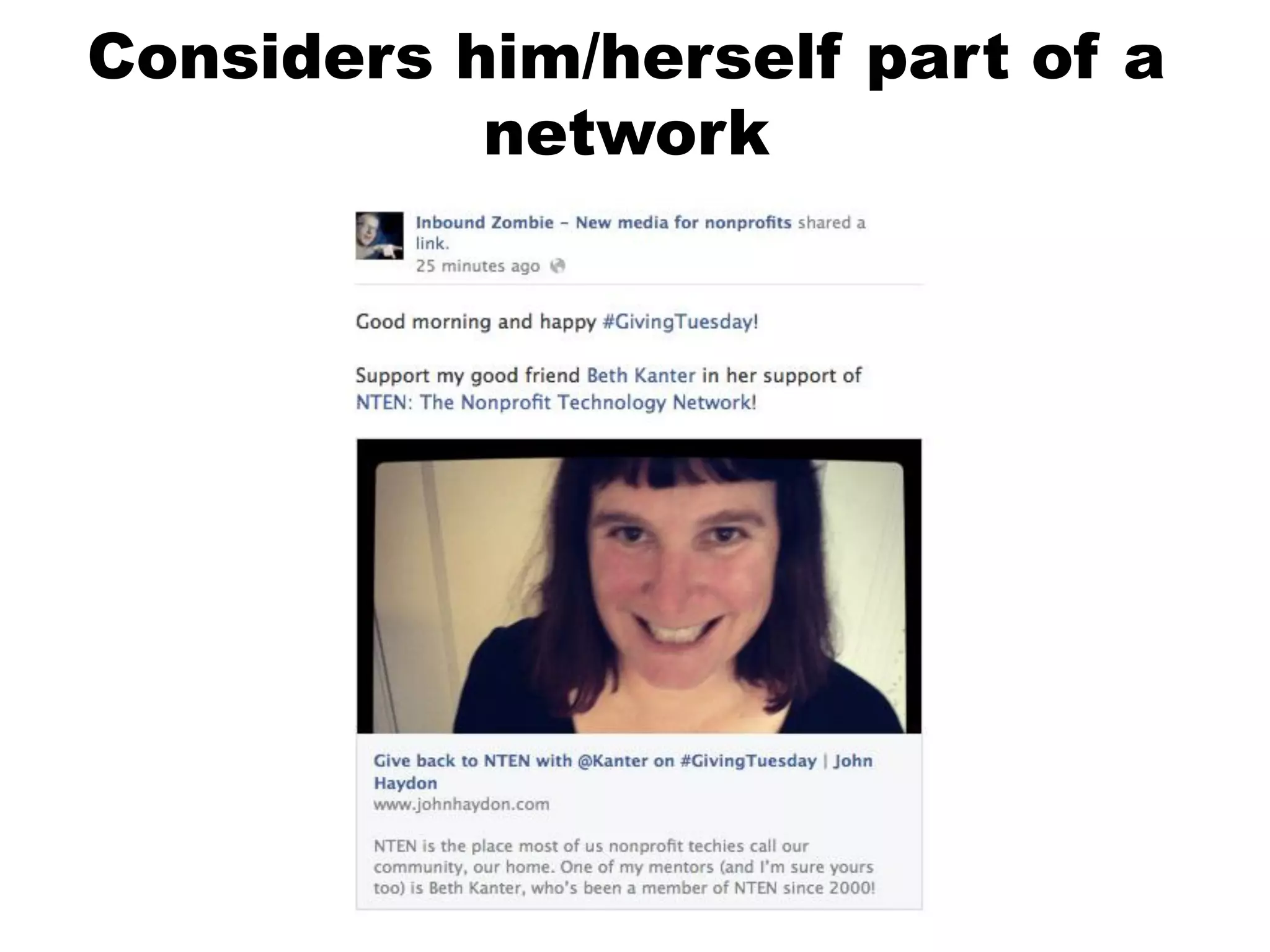
Considers him/herself part of a
network
How important is a network
weaver to your PLN?
Considerations when assessing network weavers:
•
•
•
•

Who does this person speak with regularly?
Which networks does this weaver bridge?
What is the intention of this network weaver?
Is this person really generous?
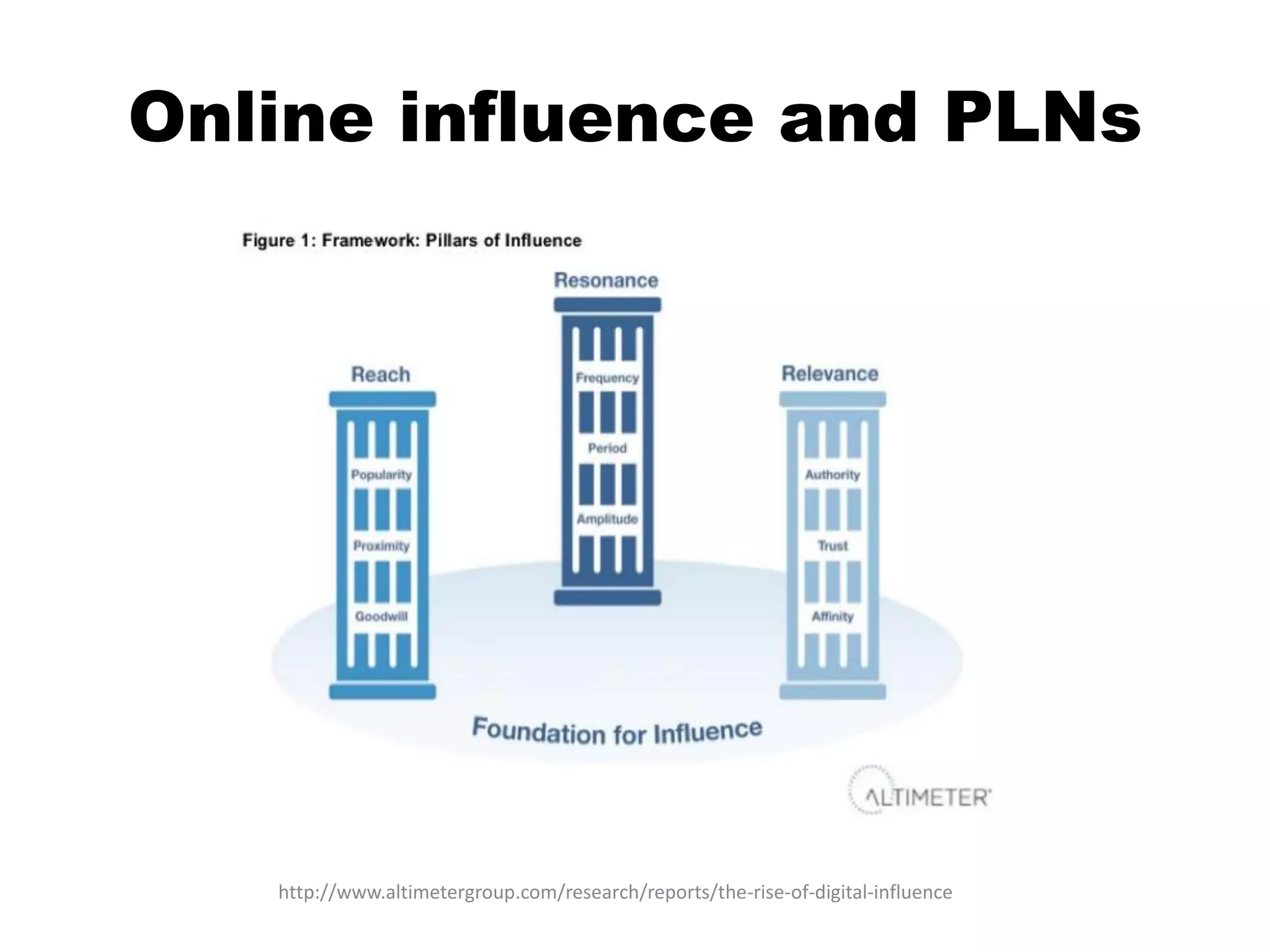
Online influence and PLNs

http://www.altimetergroup.com/research/reports/the-rise-of-digital-influence

24
One more note:
The Small World Network

“A small world network cheats by providing a
better-than-random trade-off between the number
of links required to connect a network, and that
network’s effectiveness in relaying messages.”
- Clay Shirky, Here Comes Everybody, p. 216
Network Weavers and Small
Worlds
“In a healthy community, the network weaver forms
relationships with many small clusters, and
eventually connects individuals and clusters who
may help each other.”
- Holly and Krebs, Understanding Personal Learning Networks
Be aware! Homophily
When left unmanaged, birds of a feather flock
together and those close by, form a tie.
- Network Theory
[Many small and dense nodes with little to no
diversity]
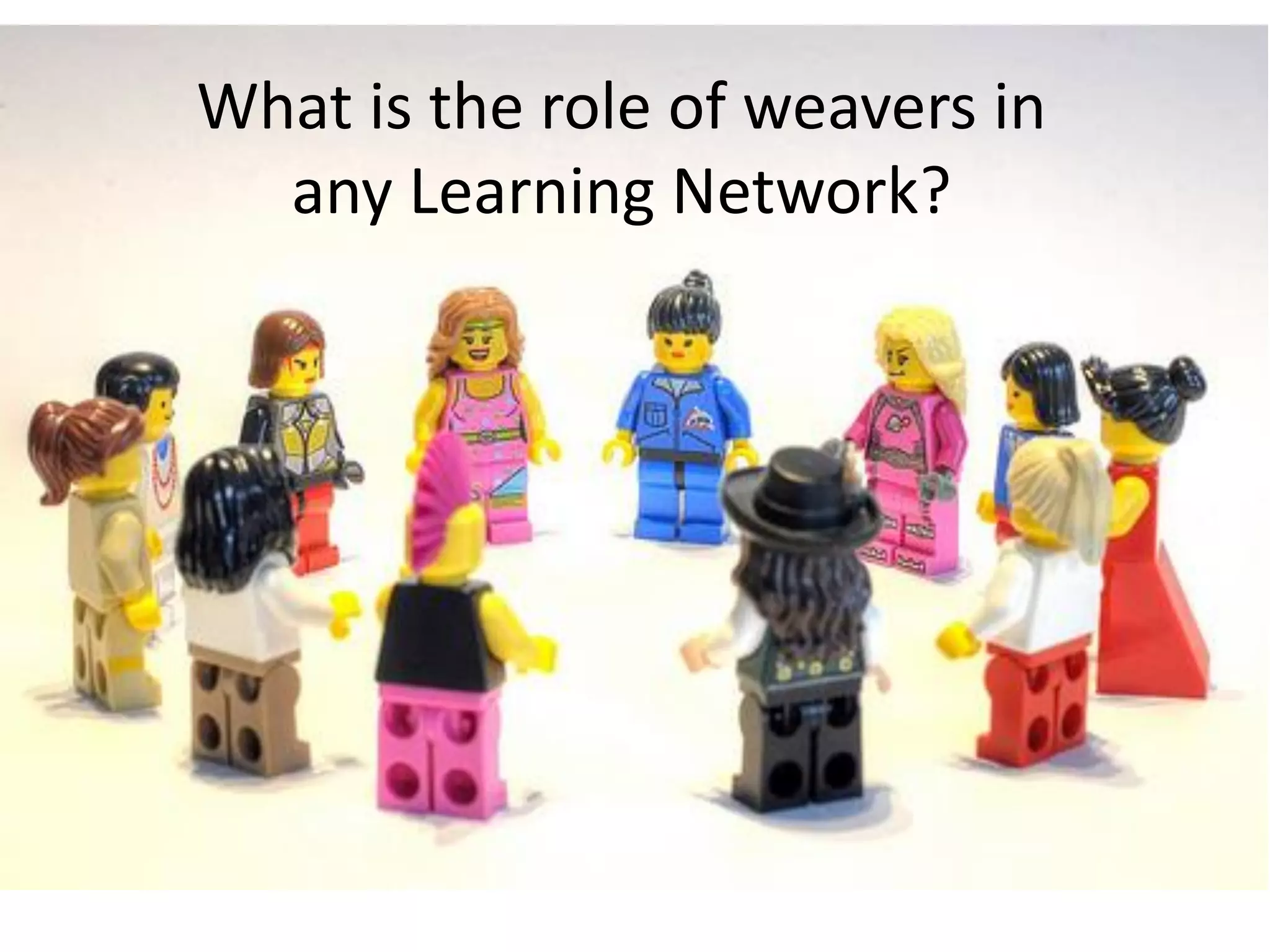
What is the role of weavers in
any Learning Network?
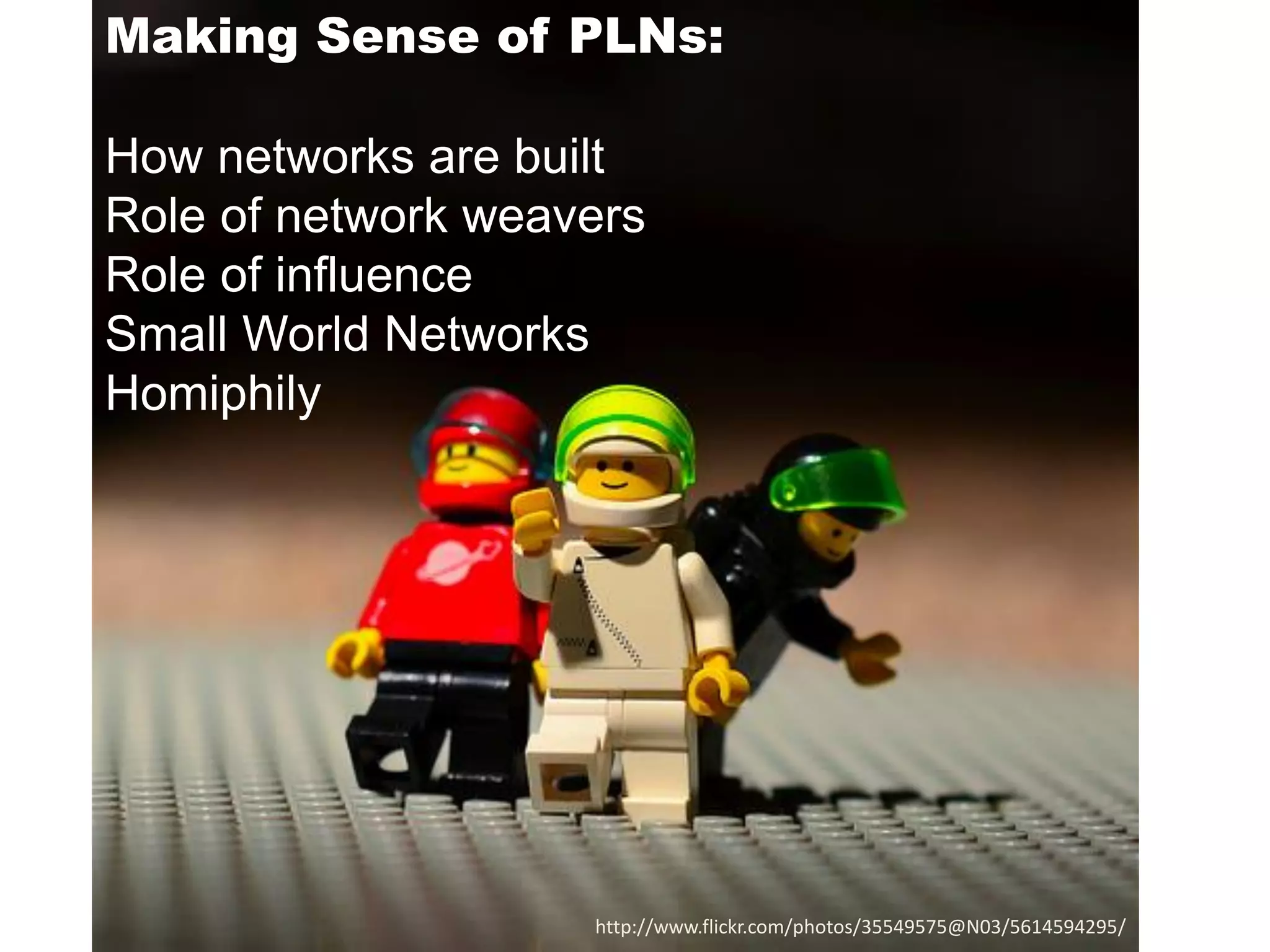
Making Sense of PLNs:
How networks are built
Role of network weavers
Role of influence
Small World Networks
Homiphily

http://www.flickr.com/photos/35549575@N03/5614594295/
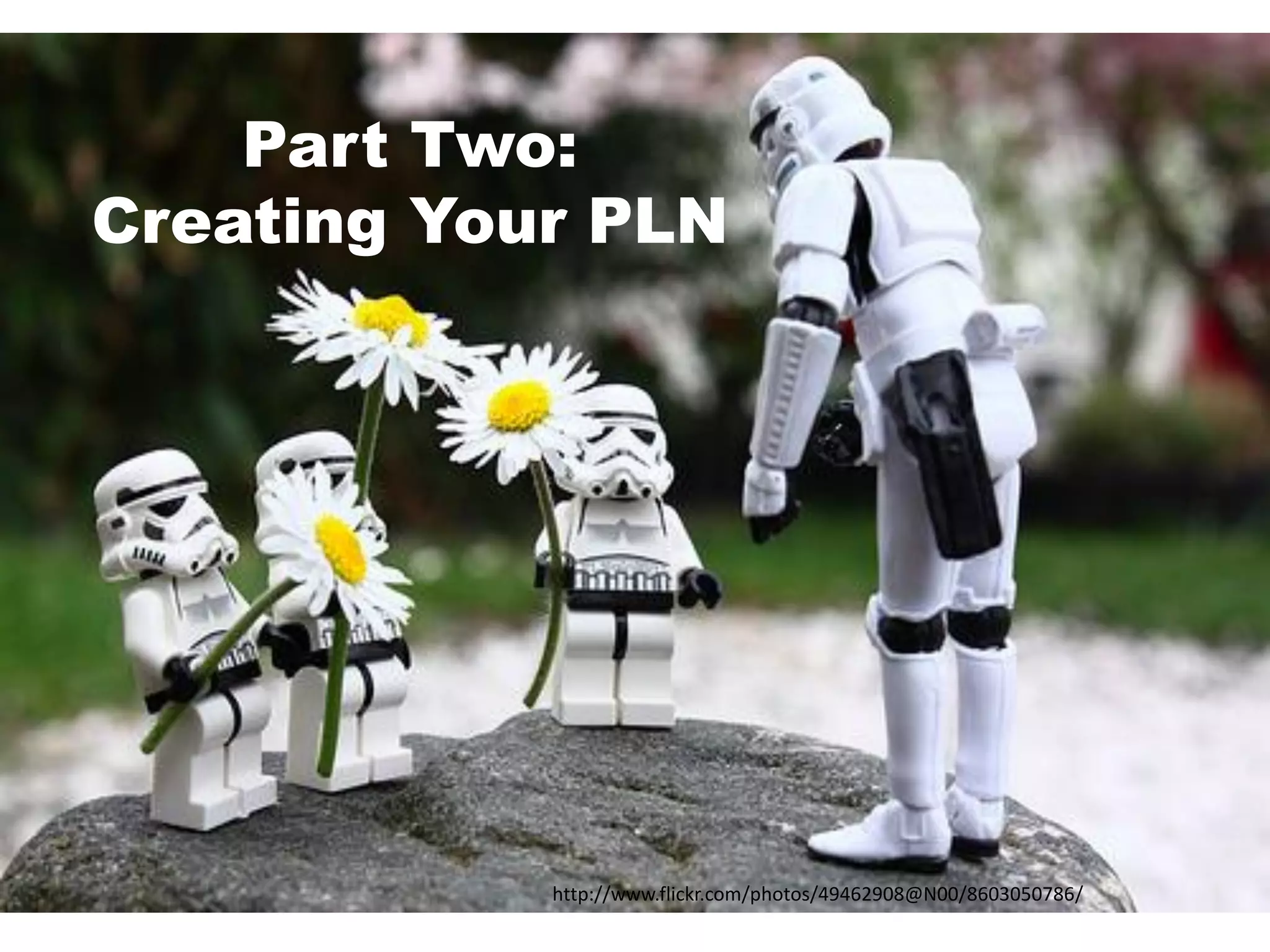
Part Two:
Creating Your PLN

http://www.flickr.com/photos/49462908@N00/8603050786/
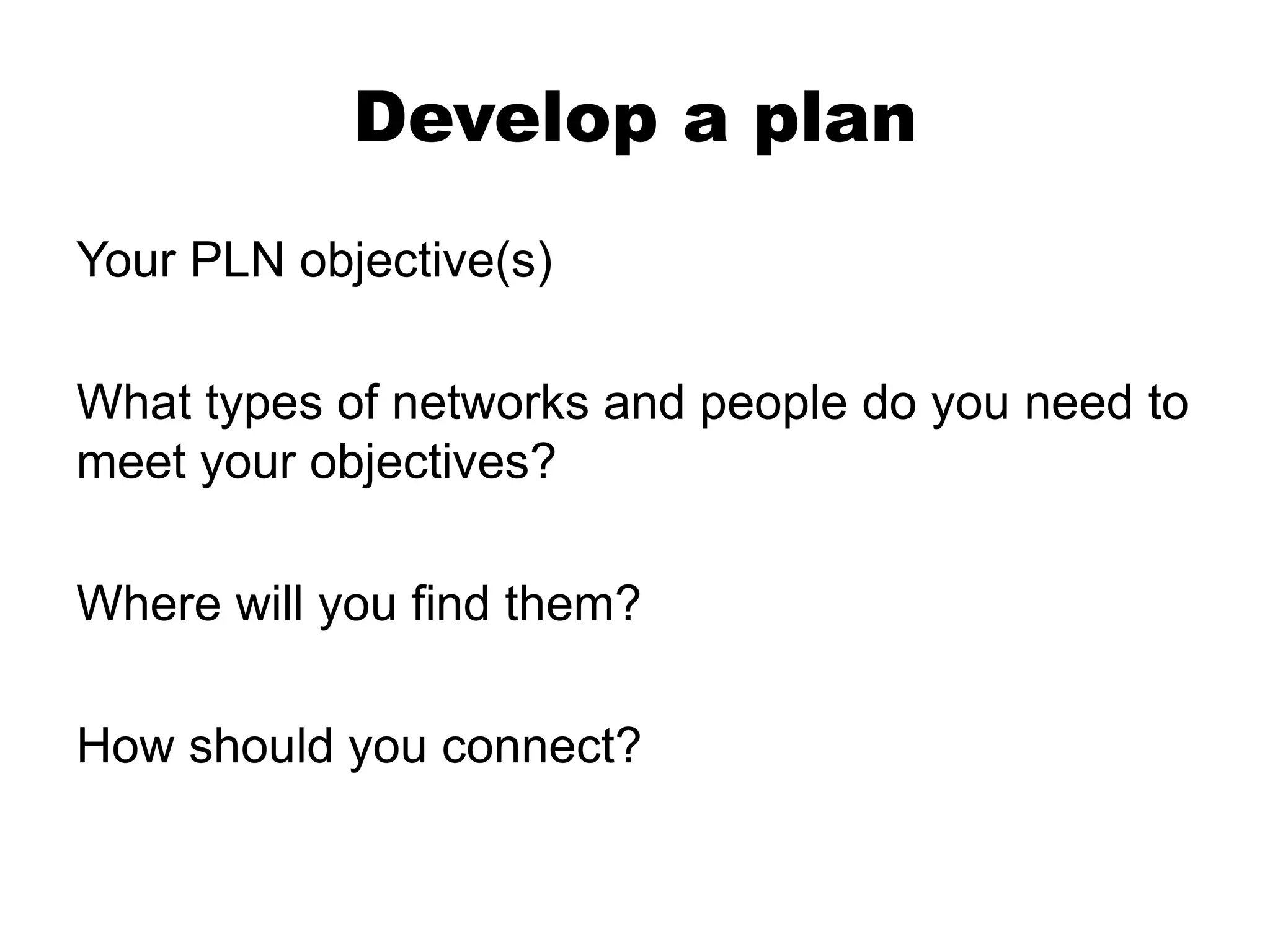
Develop a plan
Your PLN objective(s)
What types of networks and people do you need to
meet your objectives?
Where will you find them?
How should you connect?
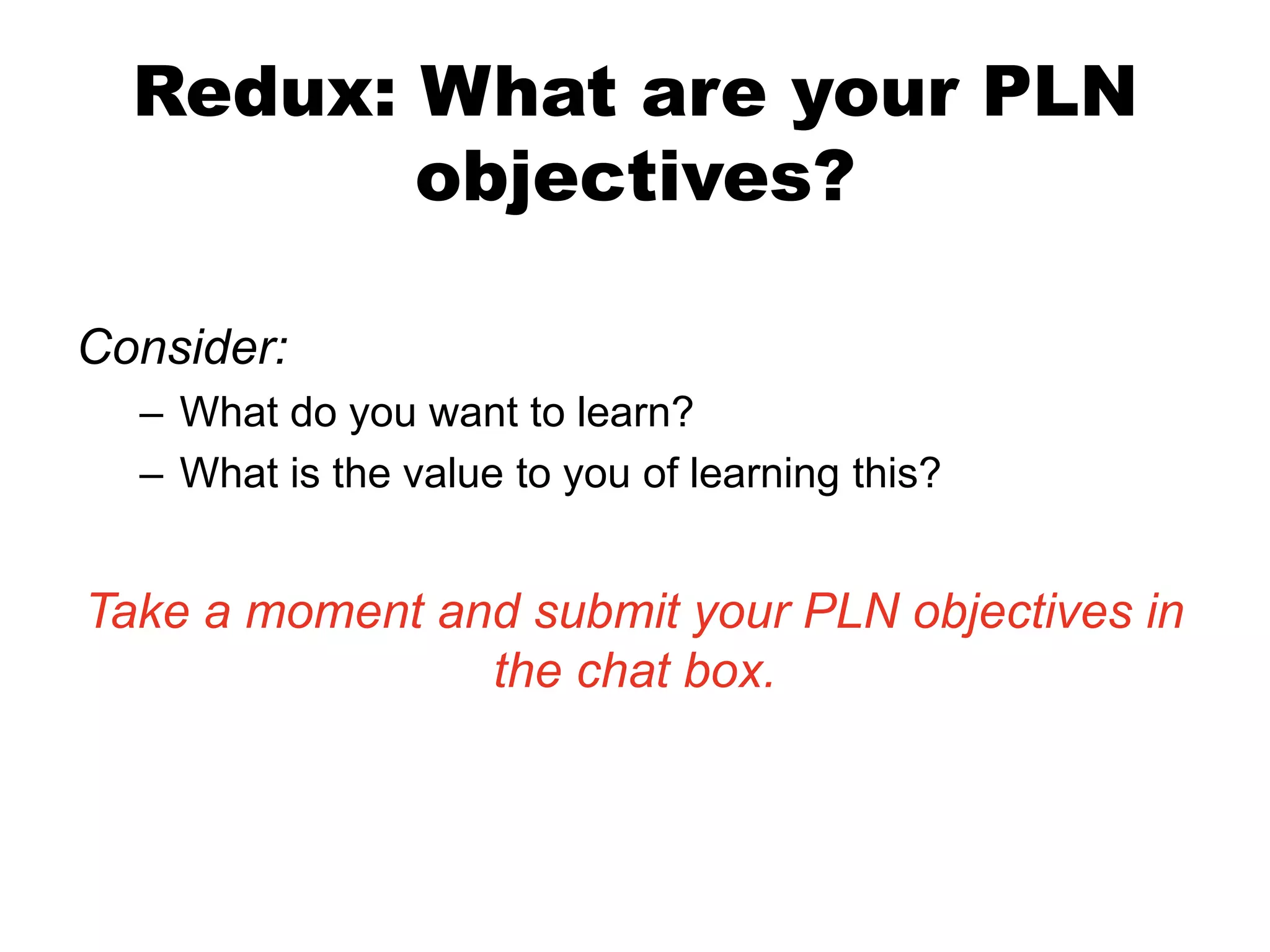
Redux: What are your PLN
objectives?
Consider:
– What do you want to learn?
– What is the value to you of learning this?

Take a moment and submit your PLN objectives in
the chat box.
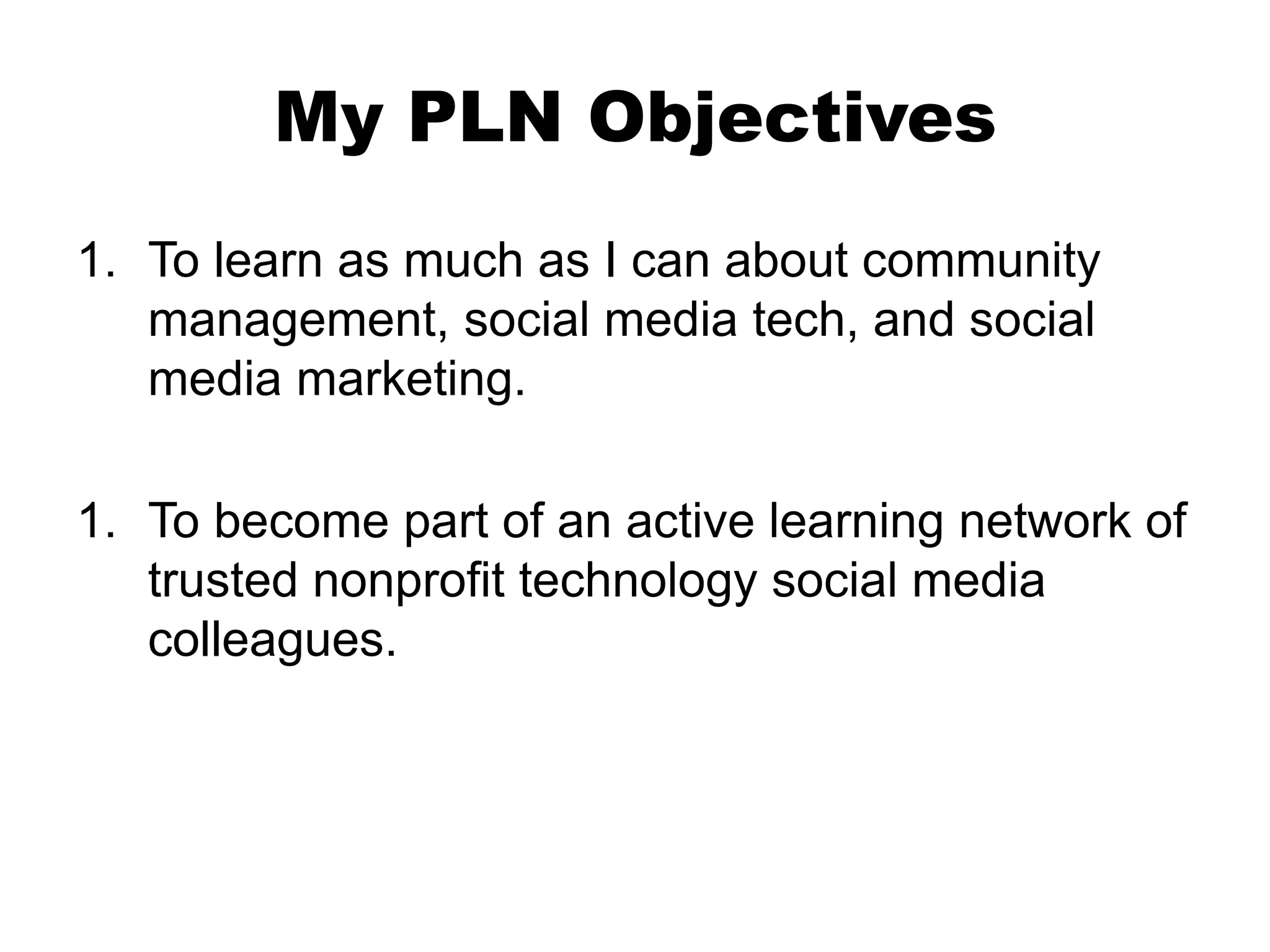
My PLN Objectives
1. To learn as much as I can about community
management, social media tech, and social
media marketing.
1. To become part of an active learning network of
trusted nonprofit technology social media
colleagues.
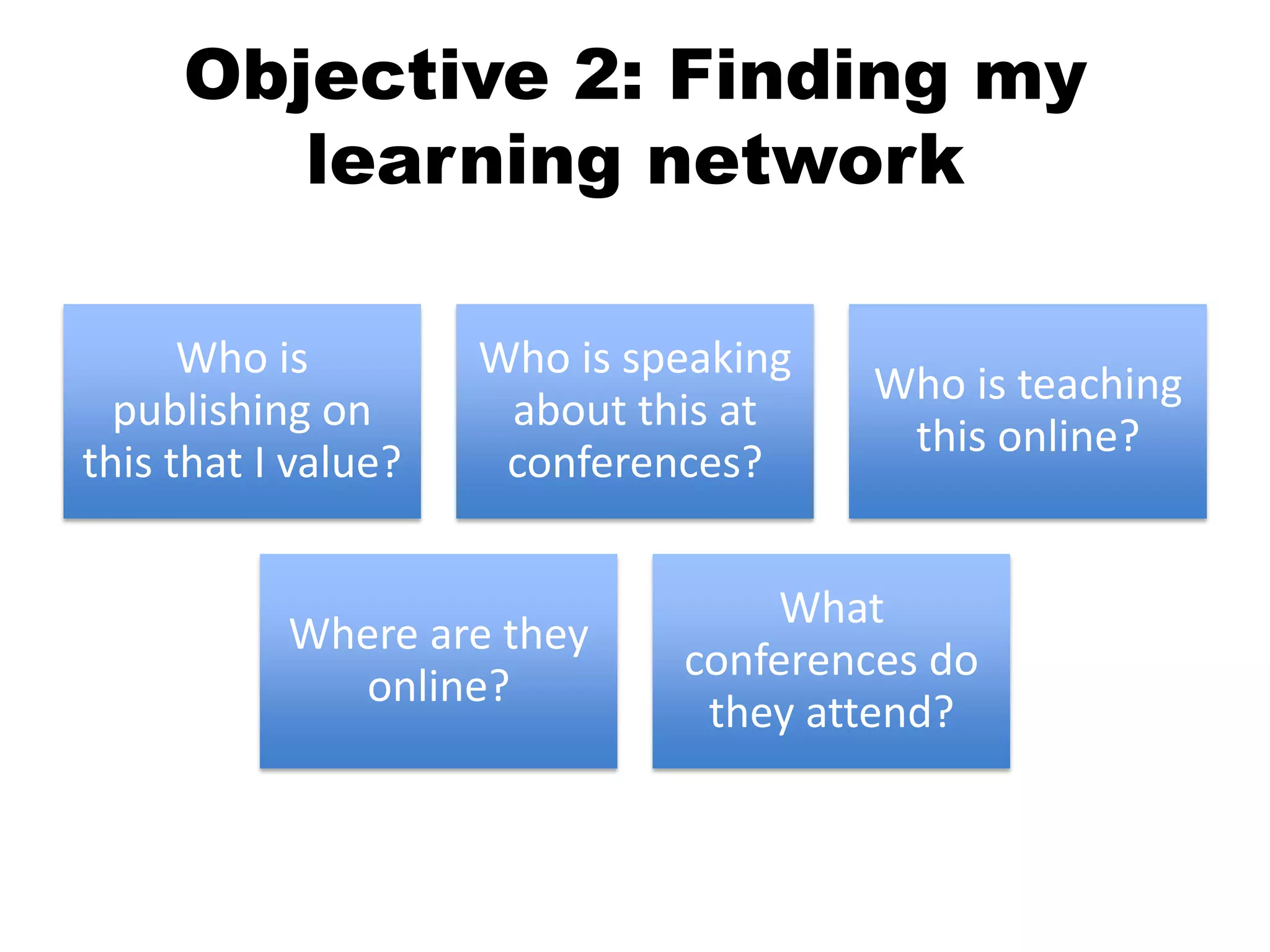
Objective 2: Finding my
learning network
Who is
publishing on
this that I value?

Who is speaking
about this at
conferences?

Where are they
online?

Who is teaching
this online?

What
conferences do
they attend?
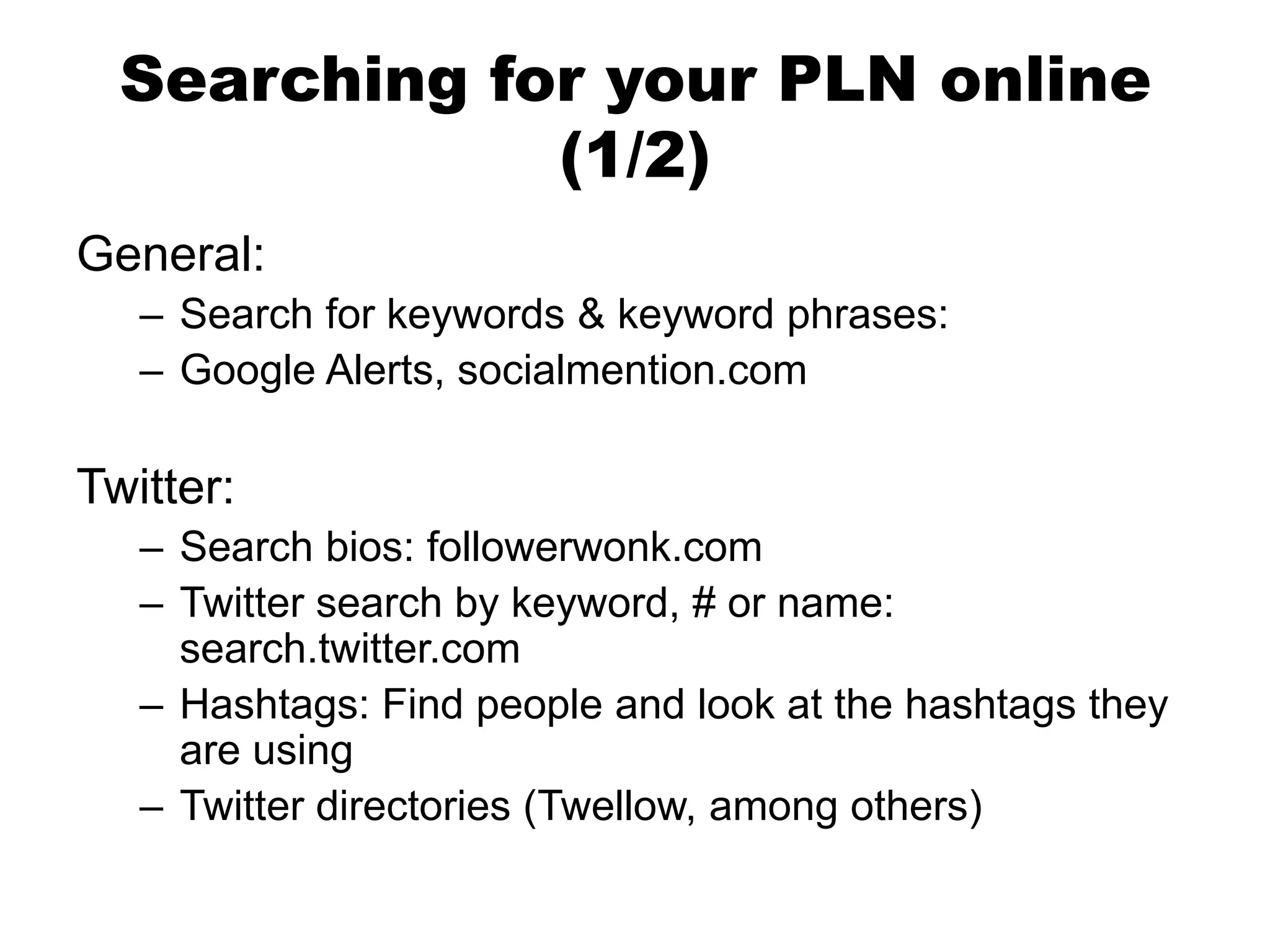
Searching for your PLN online
(1/2)
General:
– Search for keywords & keyword phrases:
– Google Alerts, socialmention.com

Twitter:
– Search bios: followerwonk.com
– Twitter search by keyword, # or name:
search.twitter.com
– Hashtags: Find people and look at the hashtags they
are using
– Twitter directories (Twellow, among others)
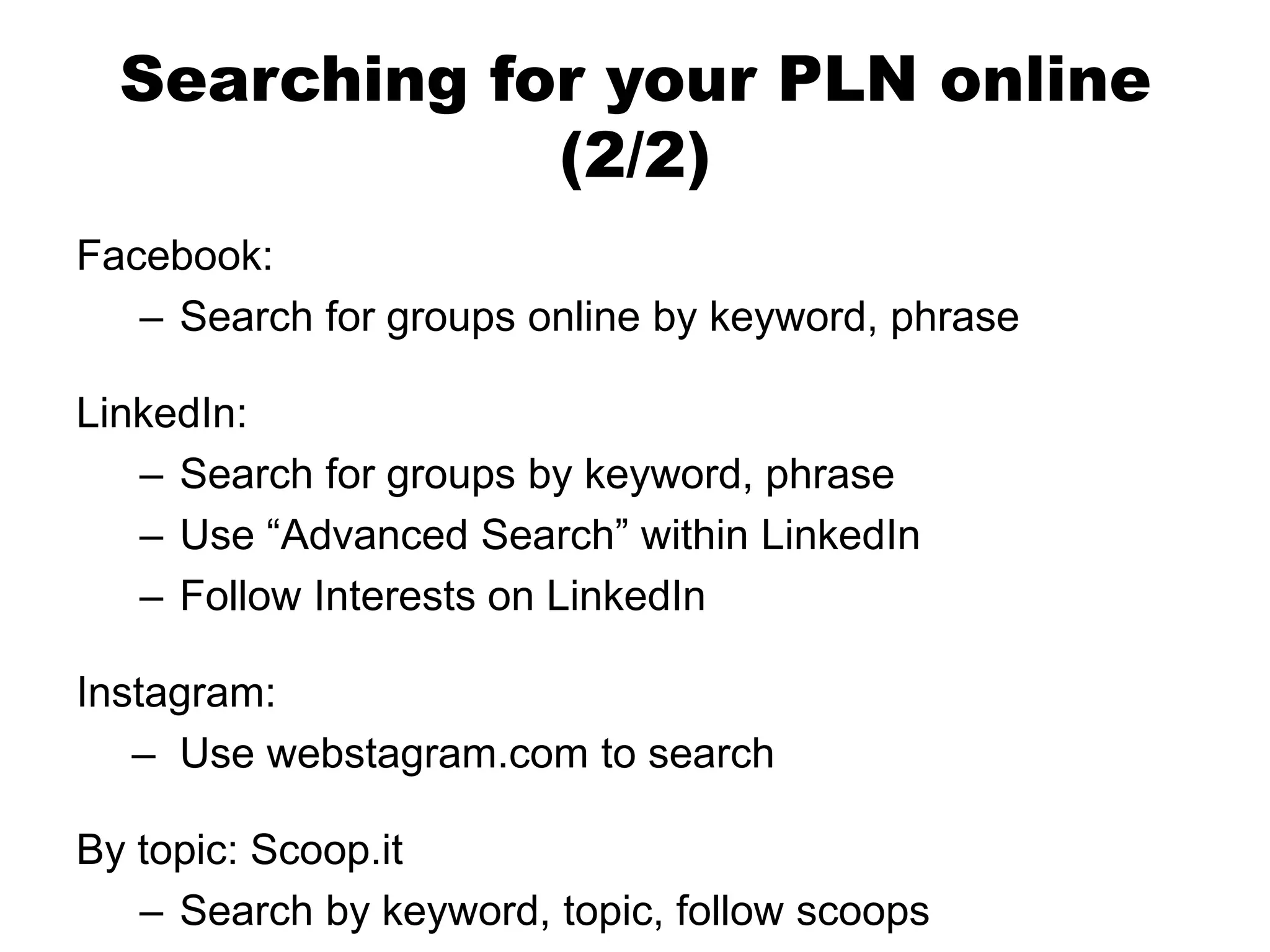
Searching for your PLN online
(2/2)
Facebook:
– Search for groups online by keyword, phrase
LinkedIn:
– Search for groups by keyword, phrase
– Use “Advanced Search” within LinkedIn
– Follow Interests on LinkedIn
Instagram:
– Use webstagram.com to search

By topic: Scoop.it
– Search by keyword, topic, follow scoops
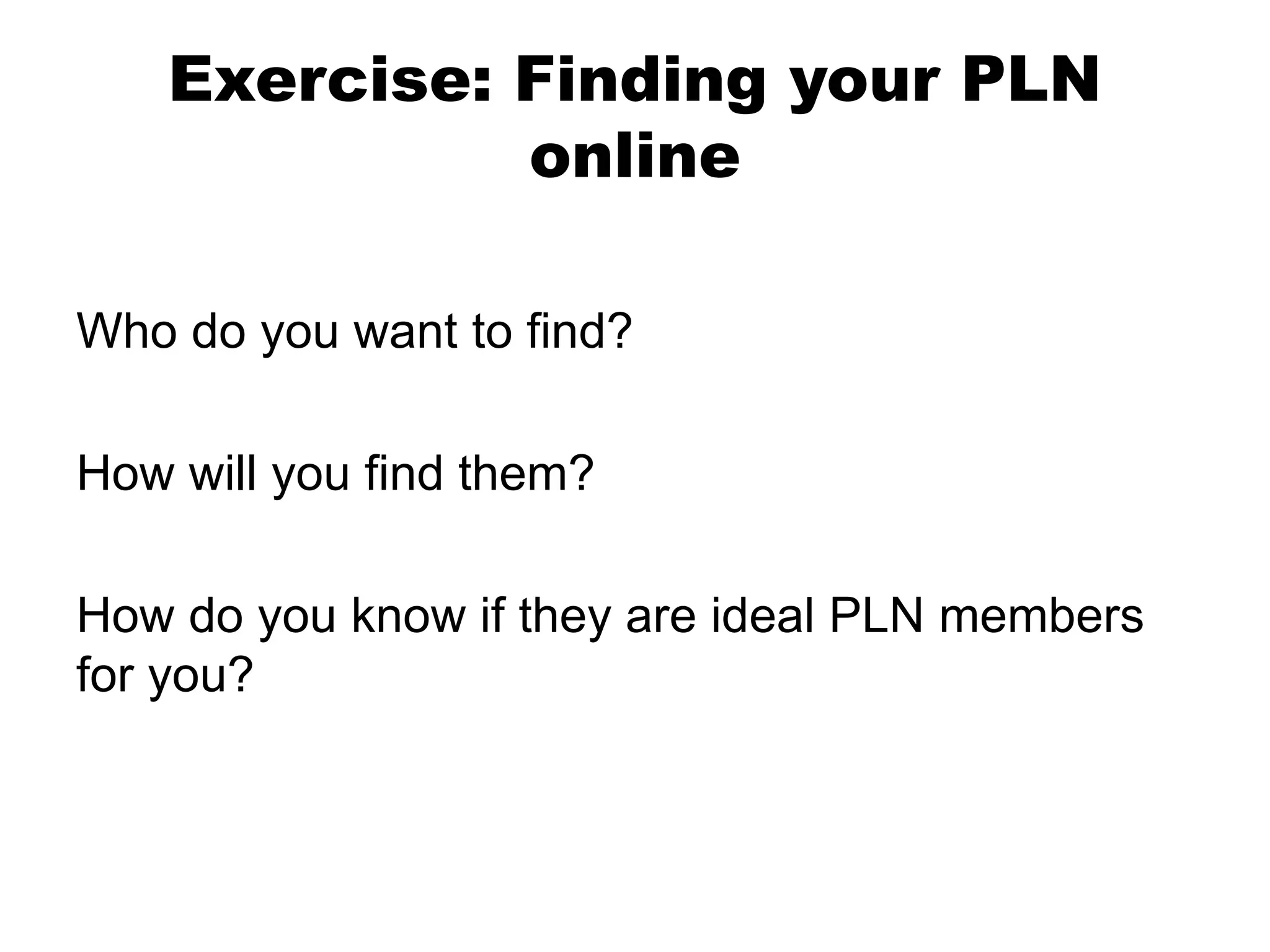
Exercise: Finding your PLN
online
Who do you want to find?

How will you find them?
How do you know if they are ideal PLN members
for you?
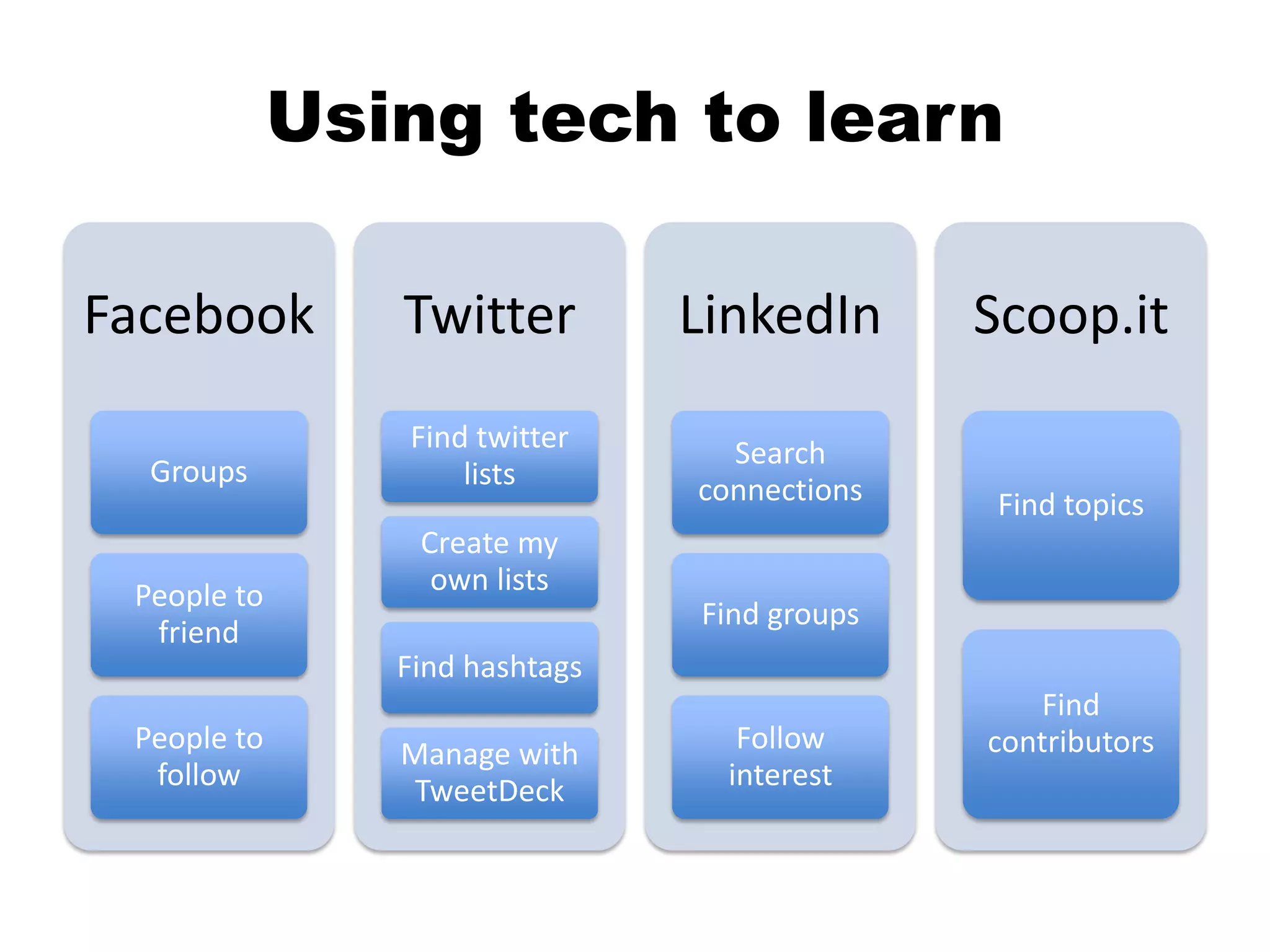
Using tech to learn
Facebook

Twitter

LinkedIn

Scoop.it

Groups

Find twitter
lists

Search
connections

Find topics

People to
friend

Create my
own lists
Find groups
Find hashtags

People to
follow

Manage with
TweetDeck

Follow
interest

Find
contributors
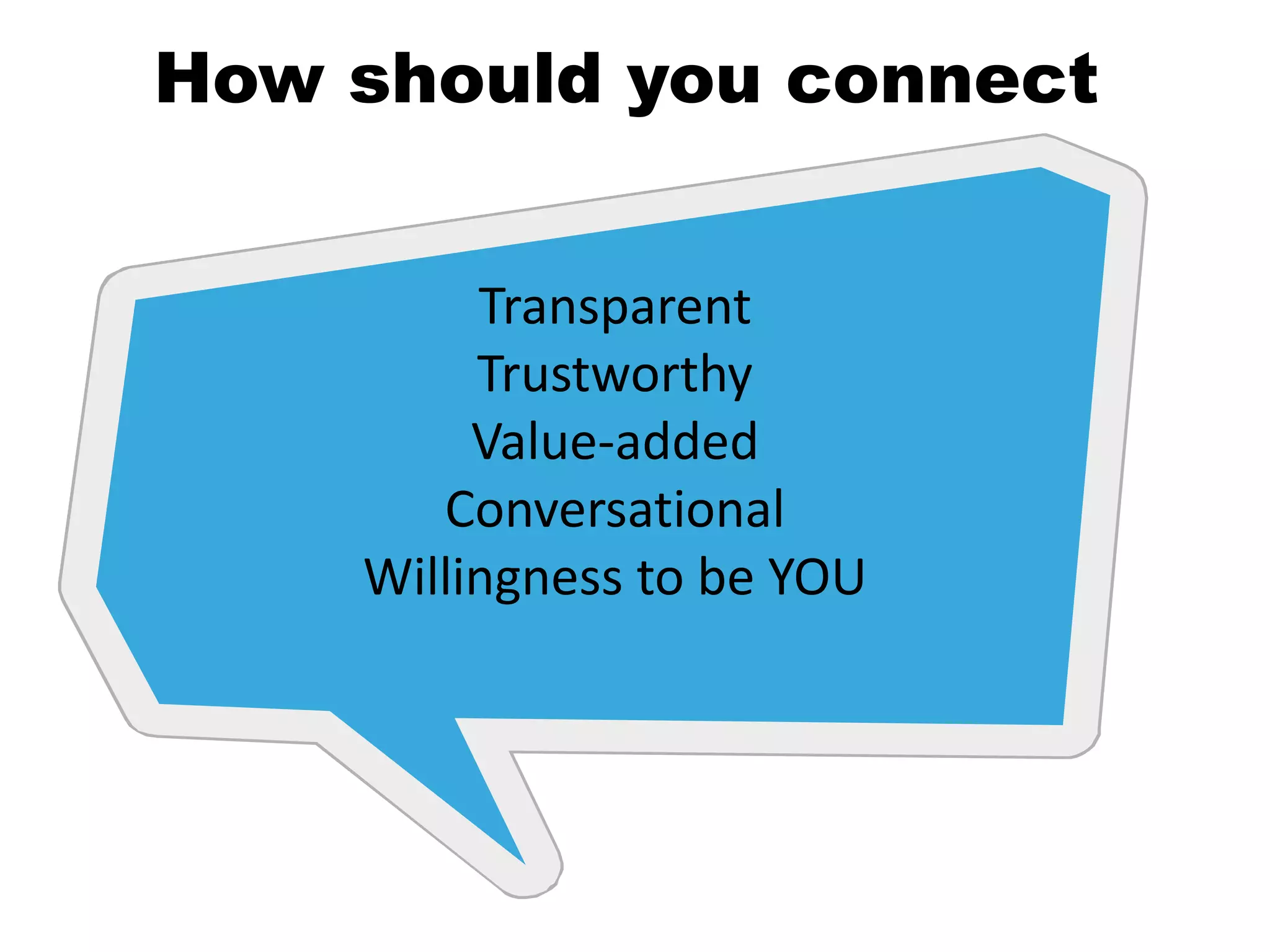
How should you connect
Transparent
Trustworthy
Value-added
Conversational
Willingness to be YOU
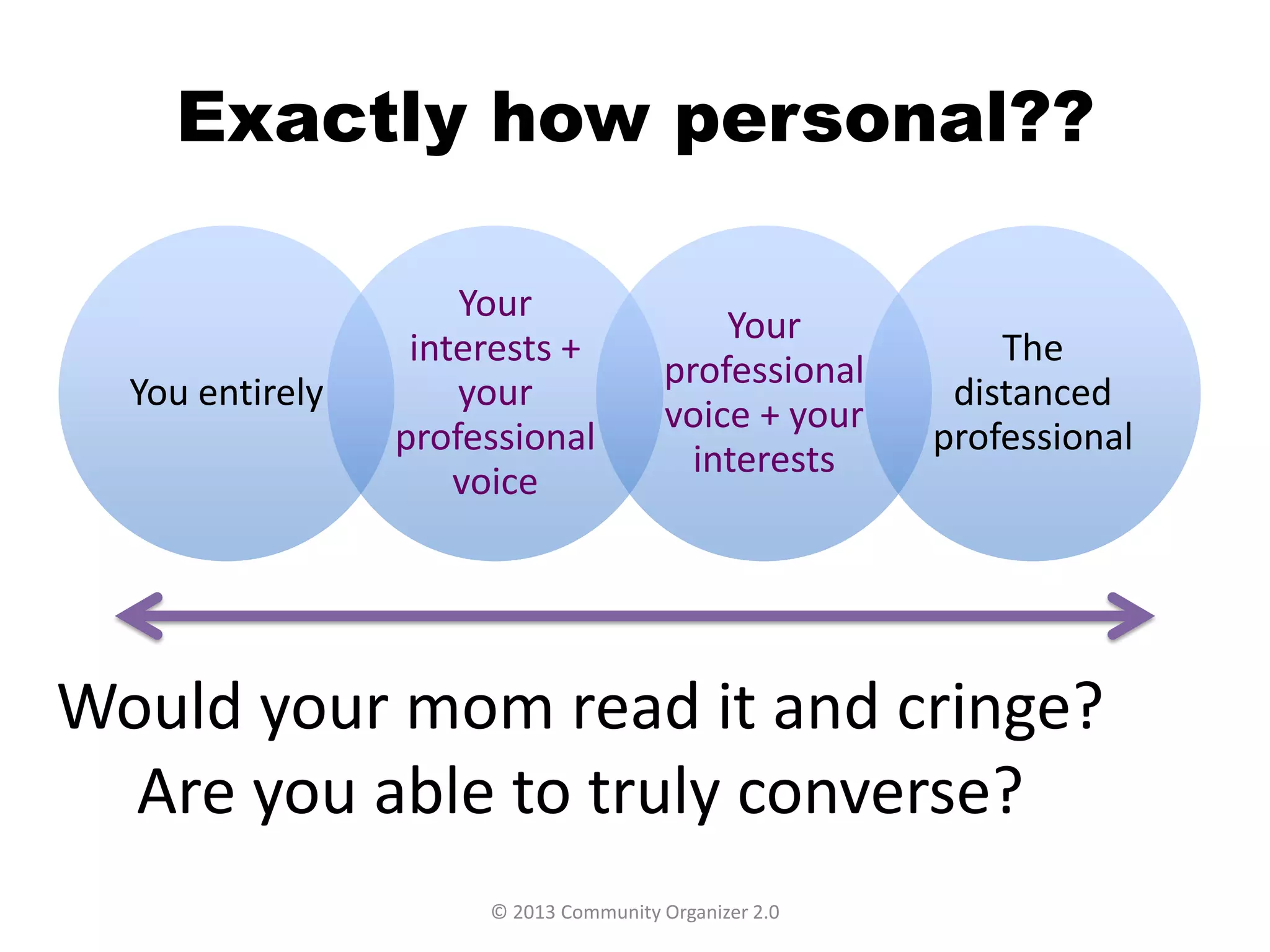
Exactly how personal??

You entirely

Your
interests +
your
professional
voice

Your
professional
voice + your
interests

The
distanced
professional

Would your mom read it and cringe?
Are you able to truly converse?
© 2013 Community Organizer 2.0

40
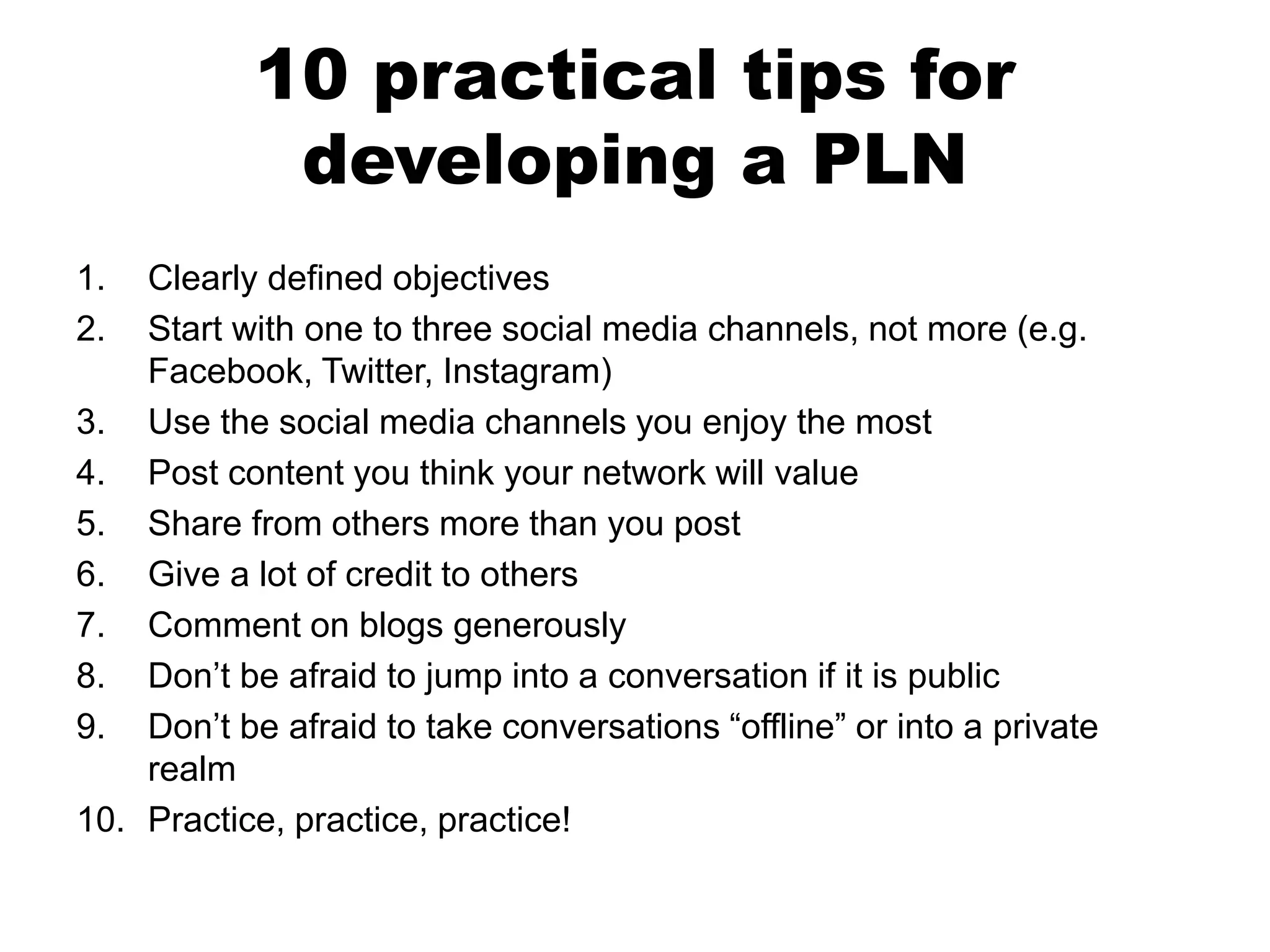
10 practical tips for
developing a PLN
1.
2.

Clearly defined objectives
Start with one to three social media channels, not more (e.g.
Facebook, Twitter, Instagram)
3. Use the social media channels you enjoy the most
4. Post content you think your network will value
5. Share from others more than you post
6. Give a lot of credit to others
7. Comment on blogs generously
8. Don’t be afraid to jump into a conversation if it is public
9. Don’t be afraid to take conversations “offline” or into a private
realm
10. Practice, practice, practice!
Don’t forget to have fun!

http://www.flickr.com/photos/83346641@N00/3578775702/
I’m always available to answer
Don’t forget to have fun!
follow-up questions!
Email: debra@communityorganizer20.com
Website: communityorganizer20.com
Blog: http://communityorganizer20.com
Linkedin: linked.com/in/debraaskanase
Twitter: @askdebra
Other slides: slideshare.net/debask
Telephone: (617) 682-2977

Developing Personal Professional Online Learning Networks

  • 1.
    Developing Personal Professional OnlineLearning Networks Presented by Debra Askanase, Community Organizer 2.0
  • 2.
    About the presenter Formerexecutive director, community organizer, business consultant “Engage, create trust, move people to action” Digital Engagement Strategist debra@communityorganizer20.com 2 2
  • 3.
    Today’s conversation I: MakingSense of PLNs – Definition – Stages of growth (Thought pause: Creating PLN learning objectives) – Role of network weavers – Integrating small world network theory (Thought pause: role of weavers in Learning Networks) II: Creating Your PLN – Developing your own PLN: An action plan – Practical tips
  • 4.
    Part One: Making Senseof PLNs http://www.flickr.com/photos/42202689@N00/3104678445/
  • 5.
    A Personal Professional LearningNetwork is..? “ a network set up by an individual specifically in the context of her professional activities through online platforms to support her professional nonformal learning needs.” It is YOU, using social media, to connect and learn
  • 6.
  • 7.
  • 8.
  • 9.
    Leaders and PLNs Leaders Lifetimelearners Bridgers Creative problem-solvers Understands people Leverages others’ knowledge and skills Personal/Professional Learning Networks Supports individual learning needs Connects people and networks Facilitate problem-solving Enable collaboration Expands resources
  • 10.
    Stages of PLNgrowth Maintaining Building Activating connections for purpose of learning
  • 11.
    Factors influencing choicein building a PLN Communality Organization of the contact Network of a contact Reputation *Benevolence *Like-mindedness *Real potential for collaboration *Real potential for learning *play important roles in the building phase http://journals.uic.edu/ojs/index.php/fm/article/view/3559/3131#p4
  • 12.
    What are yourPLN objectives? Consider: – What do you want to learn? – What is the value to you of learning this? Take a moment and submit your PLN objectives in the chat box.
  • 13.
    “A Network Weaveris aware of the networks around them and explicitly works to make them healthier, more inclusive, bridging divides.” – June Holley The Network Weaver http://www.networkweaver.com/?page_id=18 13
  • 14.
    Major components ofnetwork weaving Builds relationships Learns to facilitate collaborations for mutual benefit
  • 15.
    * A NETWORK WEAVER… * • Reachesout to any and all who are interested, primarily online • Considers themselves part of a larger network of individuals, organizations, and communities • Is a collaborator at heart • Has fluency with social media tools and culture • Embraces transparency (even when failing) • Gives control over to the group easily • Gives more credit than they take • Is more interested in others’ ideas than their own
  • 16.
  • 17.
  • 18.
  • 19.
  • 20.
  • 21.
  • 22.
  • 23.
    How important isa network weaver to your PLN? Considerations when assessing network weavers: • • • • Who does this person speak with regularly? Which networks does this weaver bridge? What is the intention of this network weaver? Is this person really generous?
  • 24.
    Online influence andPLNs http://www.altimetergroup.com/research/reports/the-rise-of-digital-influence 24
  • 25.
    One more note: TheSmall World Network “A small world network cheats by providing a better-than-random trade-off between the number of links required to connect a network, and that network’s effectiveness in relaying messages.” - Clay Shirky, Here Comes Everybody, p. 216
  • 26.
    Network Weavers andSmall Worlds “In a healthy community, the network weaver forms relationships with many small clusters, and eventually connects individuals and clusters who may help each other.” - Holly and Krebs, Understanding Personal Learning Networks
  • 27.
    Be aware! Homophily Whenleft unmanaged, birds of a feather flock together and those close by, form a tie. - Network Theory [Many small and dense nodes with little to no diversity]
  • 28.
    What is therole of weavers in any Learning Network?
  • 29.
    Making Sense ofPLNs: How networks are built Role of network weavers Role of influence Small World Networks Homiphily http://www.flickr.com/photos/35549575@N03/5614594295/
  • 30.
    Part Two: Creating YourPLN http://www.flickr.com/photos/49462908@N00/8603050786/
  • 31.
    Develop a plan YourPLN objective(s) What types of networks and people do you need to meet your objectives? Where will you find them? How should you connect?
  • 32.
    Redux: What areyour PLN objectives? Consider: – What do you want to learn? – What is the value to you of learning this? Take a moment and submit your PLN objectives in the chat box.
  • 33.
    My PLN Objectives 1.To learn as much as I can about community management, social media tech, and social media marketing. 1. To become part of an active learning network of trusted nonprofit technology social media colleagues.
  • 34.
    Objective 2: Findingmy learning network Who is publishing on this that I value? Who is speaking about this at conferences? Where are they online? Who is teaching this online? What conferences do they attend?
  • 35.
    Searching for yourPLN online (1/2) General: – Search for keywords & keyword phrases: – Google Alerts, socialmention.com Twitter: – Search bios: followerwonk.com – Twitter search by keyword, # or name: search.twitter.com – Hashtags: Find people and look at the hashtags they are using – Twitter directories (Twellow, among others)
  • 36.
    Searching for yourPLN online (2/2) Facebook: – Search for groups online by keyword, phrase LinkedIn: – Search for groups by keyword, phrase – Use “Advanced Search” within LinkedIn – Follow Interests on LinkedIn Instagram: – Use webstagram.com to search By topic: Scoop.it – Search by keyword, topic, follow scoops
  • 37.
    Exercise: Finding yourPLN online Who do you want to find? How will you find them? How do you know if they are ideal PLN members for you?
  • 38.
    Using tech tolearn Facebook Twitter LinkedIn Scoop.it Groups Find twitter lists Search connections Find topics People to friend Create my own lists Find groups Find hashtags People to follow Manage with TweetDeck Follow interest Find contributors
  • 39.
    How should youconnect Transparent Trustworthy Value-added Conversational Willingness to be YOU
  • 40.
    Exactly how personal?? Youentirely Your interests + your professional voice Your professional voice + your interests The distanced professional Would your mom read it and cringe? Are you able to truly converse? © 2013 Community Organizer 2.0 40
  • 41.
    10 practical tipsfor developing a PLN 1. 2. Clearly defined objectives Start with one to three social media channels, not more (e.g. Facebook, Twitter, Instagram) 3. Use the social media channels you enjoy the most 4. Post content you think your network will value 5. Share from others more than you post 6. Give a lot of credit to others 7. Comment on blogs generously 8. Don’t be afraid to jump into a conversation if it is public 9. Don’t be afraid to take conversations “offline” or into a private realm 10. Practice, practice, practice!
  • 42.
    Don’t forget tohave fun! http://www.flickr.com/photos/83346641@N00/3578775702/
  • 43.
    I’m always availableto answer Don’t forget to have fun! follow-up questions! Email: debra@communityorganizer20.com Website: communityorganizer20.com Blog: http://communityorganizer20.com Linkedin: linked.com/in/debraaskanase Twitter: @askdebra Other slides: slideshare.net/debask Telephone: (617) 682-2977