Presented by
–
Ayush Ranjan Ghosh ( 119023 )
Shubham Kumar ( 119103))
Leadership
What is leadership ?
Leadership is the interpersonal influence
exercised in a situation and directed
through communication process towards
the attainment of a specific goal .
In other words , leadership is the quality of
behavior of person where he is able to
persuade others to seek a group
goal enthusiastically.
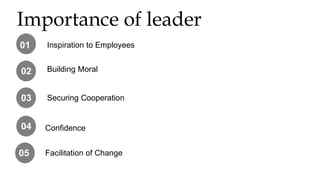
Importance of leader
01
02
03
04
05
Inspiration to Employees
Building Moral
Securing Cooperation
Confidence
Facilitation of Change
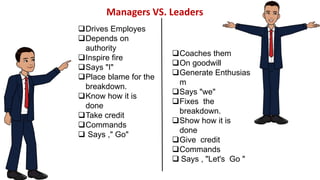
Managers VS. Leaders
Drives Employes
Depends on
authority
Inspire fire
Says "I"
Place blame for the
breakdown.
Know how it is
done
Take credit
Commands
 Says ," Go"
Coaches them
On goodwill
Generate Enthusias
m
Says "we"
Fixes the
breakdown.
Show how it is
done
Give credit
Commands
 Says , "Let's Go "
Types of Leadership
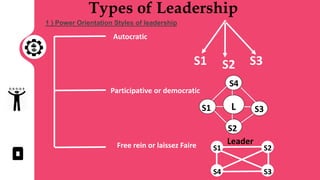
1 ) Power Orientation Styles of leadership
Autocratic
Participative or democratic
Free rein or laissez Faire
S2 S3
S1
L
S1 S3
S2
S4
Leader
S3
S4
S2
S1
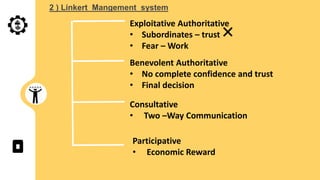
2 ) Linkert Mangement system
Exploitative Authoritative
• Subordinates – trust
• Fear – Work
Benevolent Authoritative
• No complete confidence and trust
• Final decision
Consultative
• Two –Way Communication
Participative
• Economic Reward
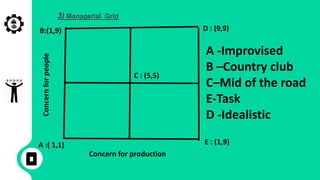
3) Managerial Grid
Concern
for
people
Concern for production
C : (5,5)
D : (9,9)
E : (1,9)
B:(1,9)
A :( 1,1)
A -Improvised
B –Country club
C–Mid of the road
E-Task
D -Idealistic
Leadership Case Study:
Steve Jobs - The Man
Who Ushered in the
Smartphone Revolution
The Transformational
Leadership of Steve Jobs
• Anyone and everyone who owns a Smartphone must be thankful to
Steve Jobs, the late legendary founder of the tech firm, Apple, who not
only ushered in the Smartphone revolution, but was also singlehandedly
responsible for changing our perceptions about what a mobile phone can
and could do.
• Indeed, one Summer Day in 2007, Steve Jobs, took the podium in a
special gathering summoned for the express purpose of announcing a
mini-revolution wherein he spoke about how at times, a product is
invented that combines technology, innovation, and ease of use to
change the way the world works.
• As he unveiled the Apple iPhone, Jobs made sure that the audience
assembled there as well as the wider world would know how the game
changing iPhone could now work as a mobile phone, a computer, and a
personal assistant all rolled into one. Moreover, for the first time, we had a
product that had more computing power than earlier era Satellites as well
as a pioneering personal assistant right in our hands.
• Thus, was born the Smartphone revolution that transformed the entire
tech industry and gave rise to a generation of entrepreneurs who based
their businesses around the concept of apps and other mobile telephony
as well as computing business lines.
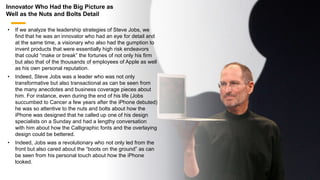
• If we analyze the leadership strategies of Steve Jobs, we
find that he was an innovator who had an eye for detail and
at the same time, a visionary who also had the gumption to
invent products that were essentially high risk endeavors
that could “make or break” the fortunes of not only his firm
but also that of the thousands of employees of Apple as well
as his own personal reputation.
• Indeed, Steve Jobs was a leader who was not only
transformative but also transactional as can be seen from
the many anecdotes and business coverage pieces about
him. For instance, even during the end of his life (Jobs
succumbed to Cancer a few years after the iPhone debuted)
he was so attentive to the nuts and bolts about how the
iPhone was designed that he called up one of his design
specialists on a Sunday and had a lengthy conversation
with him about how the Calligraphic fonts and the overlaying
design could be bettered.
• Indeed, Jobs was a revolutionary who not only led from the
front but also cared about the “boots on the ground” as can
be seen from his personal touch about how the iPhone
looked.
Innovator Who Had the Big Picture as
Well as the Nuts and Bolts Detail
Tech Titans Need to be
Socially Responsible Leaders
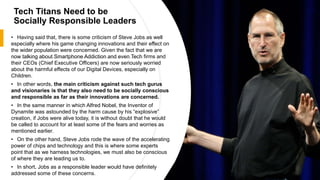
• Having said that, there is some criticism of Steve Jobs as well
especially where his game changing innovations and their effect on
the wider population were concerned. Given the fact that we are
now talking about Smartphone Addiction and even Tech firms and
their CEOs (Chief Executive Officers) are now seriously worried
about the harmful effects of our Digital Devices, especially on
Children.
• In other words, the main criticism against such tech gurus
and visionaries is that they also need to be socially conscious
and responsible as far as their innovations are concerned.
• In the same manner in which Alfred Nobel, the Inventor of
Dynamite was astounded by the harm cause by his “explosive”
creation, if Jobs were alive today, it is without doubt that he would
be called to account for at least some of the fears and worries as
mentioned earlier.
• On the other hand, Steve Jobs rode the wave of the accelerating
power of chips and technology and this is where some experts
point that as we harness technologies, we must also be conscious
of where they are leading us to.
• In short, Jobs as a responsible leader would have definitely
addressed some of these concerns.
Inspirational Leader
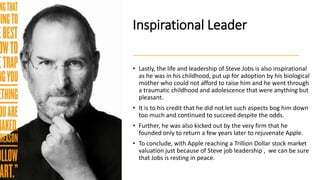
• Lastly, the life and leadership of Steve Jobs is also inspirational
as he was in his childhood, put up for adoption by his biological
mother who could not afford to raise him and he went through
a traumatic childhood and adolescence that were anything but
pleasant.
• It is to his credit that he did not let such aspects bog him down
too much and continued to succeed despite the odds.
• Further, he was also kicked out by the very firm that he
founded only to return a few years later to rejuvenate Apple.
• To conclude, with Apple reaching a Trillion Dollar stock market
valuation just because of Steve job leadership , we can be sure
that Jobs is resting in peace.
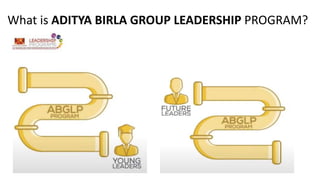
What is ADITYA BIRLA GROUP LEADERSHIP PROGRAM?
Leadership : Importance, types and Case study

Leadership : Importance, types and Case study

  • 1.
    Presented by – Ayush RanjanGhosh ( 119023 ) Shubham Kumar ( 119103)) Leadership
  • 2.
    What is leadership? Leadership is the interpersonal influence exercised in a situation and directed through communication process towards the attainment of a specific goal . In other words , leadership is the quality of behavior of person where he is able to persuade others to seek a group goal enthusiastically.
  • 3.
    Importance of leader 01 02 03 04 05 Inspirationto Employees Building Moral Securing Cooperation Confidence Facilitation of Change
  • 4.
    Managers VS. Leaders DrivesEmployes Depends on authority Inspire fire Says "I" Place blame for the breakdown. Know how it is done Take credit Commands  Says ," Go" Coaches them On goodwill Generate Enthusias m Says "we" Fixes the breakdown. Show how it is done Give credit Commands  Says , "Let's Go "
  • 5.
    Types of Leadership 1) Power Orientation Styles of leadership Autocratic Participative or democratic Free rein or laissez Faire S2 S3 S1 L S1 S3 S2 S4 Leader S3 S4 S2 S1
  • 6.
    2 ) LinkertMangement system Exploitative Authoritative • Subordinates – trust • Fear – Work Benevolent Authoritative • No complete confidence and trust • Final decision Consultative • Two –Way Communication Participative • Economic Reward
  • 7.
    3) Managerial Grid Concern for people Concernfor production C : (5,5) D : (9,9) E : (1,9) B:(1,9) A :( 1,1) A -Improvised B –Country club C–Mid of the road E-Task D -Idealistic
  • 8.
    Leadership Case Study: SteveJobs - The Man Who Ushered in the Smartphone Revolution
  • 9.
    The Transformational Leadership ofSteve Jobs • Anyone and everyone who owns a Smartphone must be thankful to Steve Jobs, the late legendary founder of the tech firm, Apple, who not only ushered in the Smartphone revolution, but was also singlehandedly responsible for changing our perceptions about what a mobile phone can and could do. • Indeed, one Summer Day in 2007, Steve Jobs, took the podium in a special gathering summoned for the express purpose of announcing a mini-revolution wherein he spoke about how at times, a product is invented that combines technology, innovation, and ease of use to change the way the world works. • As he unveiled the Apple iPhone, Jobs made sure that the audience assembled there as well as the wider world would know how the game changing iPhone could now work as a mobile phone, a computer, and a personal assistant all rolled into one. Moreover, for the first time, we had a product that had more computing power than earlier era Satellites as well as a pioneering personal assistant right in our hands. • Thus, was born the Smartphone revolution that transformed the entire tech industry and gave rise to a generation of entrepreneurs who based their businesses around the concept of apps and other mobile telephony as well as computing business lines.
  • 10.
    • If weanalyze the leadership strategies of Steve Jobs, we find that he was an innovator who had an eye for detail and at the same time, a visionary who also had the gumption to invent products that were essentially high risk endeavors that could “make or break” the fortunes of not only his firm but also that of the thousands of employees of Apple as well as his own personal reputation. • Indeed, Steve Jobs was a leader who was not only transformative but also transactional as can be seen from the many anecdotes and business coverage pieces about him. For instance, even during the end of his life (Jobs succumbed to Cancer a few years after the iPhone debuted) he was so attentive to the nuts and bolts about how the iPhone was designed that he called up one of his design specialists on a Sunday and had a lengthy conversation with him about how the Calligraphic fonts and the overlaying design could be bettered. • Indeed, Jobs was a revolutionary who not only led from the front but also cared about the “boots on the ground” as can be seen from his personal touch about how the iPhone looked. Innovator Who Had the Big Picture as Well as the Nuts and Bolts Detail
  • 11.
    Tech Titans Needto be Socially Responsible Leaders • Having said that, there is some criticism of Steve Jobs as well especially where his game changing innovations and their effect on the wider population were concerned. Given the fact that we are now talking about Smartphone Addiction and even Tech firms and their CEOs (Chief Executive Officers) are now seriously worried about the harmful effects of our Digital Devices, especially on Children. • In other words, the main criticism against such tech gurus and visionaries is that they also need to be socially conscious and responsible as far as their innovations are concerned. • In the same manner in which Alfred Nobel, the Inventor of Dynamite was astounded by the harm cause by his “explosive” creation, if Jobs were alive today, it is without doubt that he would be called to account for at least some of the fears and worries as mentioned earlier. • On the other hand, Steve Jobs rode the wave of the accelerating power of chips and technology and this is where some experts point that as we harness technologies, we must also be conscious of where they are leading us to. • In short, Jobs as a responsible leader would have definitely addressed some of these concerns.
  • 12.
    Inspirational Leader • Lastly,the life and leadership of Steve Jobs is also inspirational as he was in his childhood, put up for adoption by his biological mother who could not afford to raise him and he went through a traumatic childhood and adolescence that were anything but pleasant. • It is to his credit that he did not let such aspects bog him down too much and continued to succeed despite the odds. • Further, he was also kicked out by the very firm that he founded only to return a few years later to rejuvenate Apple. • To conclude, with Apple reaching a Trillion Dollar stock market valuation just because of Steve job leadership , we can be sure that Jobs is resting in peace.
  • 13.
    What is ADITYABIRLA GROUP LEADERSHIP PROGRAM?