INTRODUCTION
ENGINEERING
MANAGEMENT
By : Engr. Jovin A. Manarin
Eng. Ahmed Bakhsh
Course Outline
Understanding
Principles of Engineering Management
Applications of these Principles in Engineering Organizations
Learning
The importance of management to engineers,
Various forms and functions of organizations
Operation and Quality Management
Planning
Project Management
Engineering and Management
What is an Engineer?
Ingenium: Talent, natural capacity, or clever
invention.
Early applications of Clever Inventions
based on Military
Builders of Ingenious military machines??
Engineering and Management
The first issue (1866) of the English
Journal Engineering
The art of directing the great sources of power
in nature, for the use and convenience of man.
Is it an art or profession?
Engineering and Management
Modern Definition of Engineering
By ABET (Accrediting Board for
Engineering and Technology)
The profession in which a knowledge of the mathematical and natural
sciences gained by study, experience, and practice is applied with
judgment to develop ways to utilize, economically, the materials and
forces of the nature for the benefit of mankind.
Engineer: A person applying his mathematical and science
knowledge properly for mankind
It is a discipline not an art.
Engineering and Management
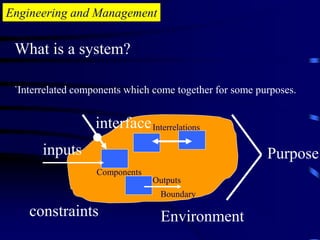
Interrelated components which come together for some purposes.
Components
Interrelations
Boundary
Environment
Purpose
inputs
Outputs
interface
constraints
What is a system?
.
Engineering and Management
What is Management?
• Directing the actions of a group to achieve a goal in
most efficient manner
• Getting things done through people
• Process of achieving organizational goals by working
with and through people and organizational resources
Engineering and Management
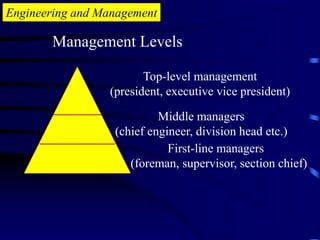
Top-level management
(president, executive vice president)
Middle managers
(chief engineer, division head etc.)
First-line managers
(foreman, supervisor, section chief)
Management Levels
Engineering and Management
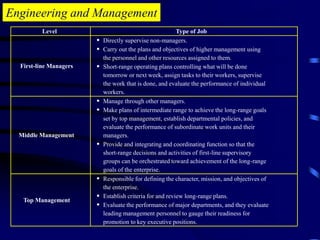
Level Type of Job
First-line Managers
 Directly supervise non-managers.
 Carry out the plans and objectives of higher management using
the personnel and other resources assigned to them.
 Short-range operating plans controlling what will be done
tomorrow or next week, assign tasks to their workers, supervise
the work that is done, and evaluate the performance of individual
workers.
Middle Management
 Manage through other managers.
 Make plans of intermediate range to achieve the long-range goals
set by top management, establish departmental policies, and
evaluate the performance of subordinate work units and their
managers.
 Provide and integrating and coordinating function so that the
short-range decisions and activities of first-line supervisory
groups can be orchestrated toward achievement of the long-range
goals of the enterprise.
Top Management
 Responsible for defining the character, mission, and objectives of
the enterprise.
 Establish criteria for and review long-range plans.
 Evaluate the performance of major departments, and they evaluate
leading management personnel to gauge their readiness for
promotion to key executive positions.
Engineering and Management
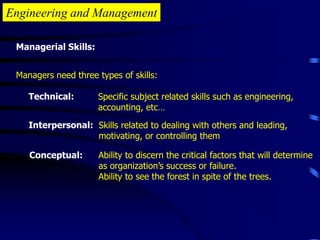
Managerial Skills:
Managers need three types of skills:
Technical: Specific subject related skills such as engineering,
accounting, etc…
Interpersonal: Skills related to dealing with others and leading,
motivating, or controlling them
Conceptual: Ability to discern the critical factors that will determine
as organization’s success or failure.
Ability to see the forest in spite of the trees.
Engineering and Management
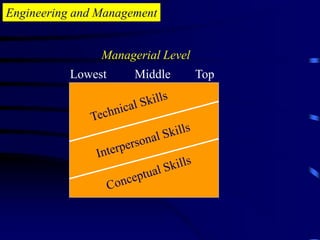
Lowest Middle Top
Managerial Level
Engineering and Management
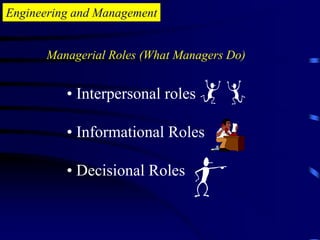
Managerial Roles (What Managers Do)
• Interpersonal roles
• Informational Roles
• Decisional Roles
Engineering and Management
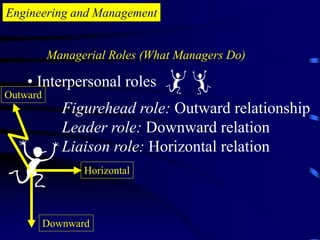
• Interpersonal roles
Figurehead role: Outward relationship
Leader role: Downward relation
Liaison role: Horizontal relation
Managerial Roles (What Managers Do)
Outward
Horizontal
Downward
Engineering and Management
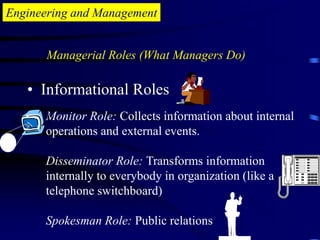
• Informational Roles
Monitor Role: Collects information about internal
operations and external events.
Disseminator Role: Transforms information
internally to everybody in organization (like a
telephone switchboard)
Spokesman Role: Public relations
Managerial Roles (What Managers Do)
Engineering and Management
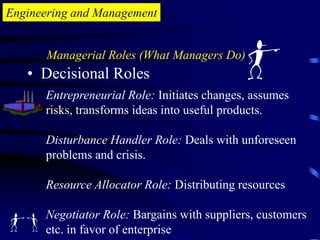
• Decisional Roles
Entrepreneurial Role: Initiates changes, assumes
risks, transforms ideas into useful products.
Disturbance Handler Role: Deals with unforeseen
problems and crisis.
Resource Allocator Role: Distributing resources
Negotiator Role: Bargains with suppliers, customers
etc. in favor of enterprise
Managerial Roles (What Managers Do)
Engineering and Management
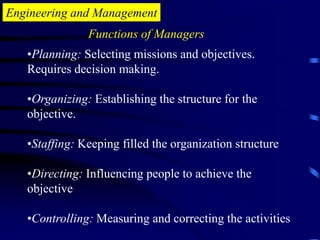
•Planning: Selecting missions and objectives.
Requires decision making.
•Organizing: Establishing the structure for the
objective.
•Staffing: Keeping filled the organization structure
•Directing: Influencing people to achieve the
objective
•Controlling: Measuring and correcting the activities
Functions of Managers
Engineering and Management
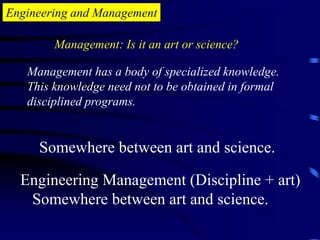
Management has a body of specialized knowledge.
This knowledge need not to be obtained in formal
disciplined programs.
Management: Is it an art or science?
Somewhere between art and science.
Engineering Management (Discipline + art)
Somewhere between art and science.
Engineering and Management
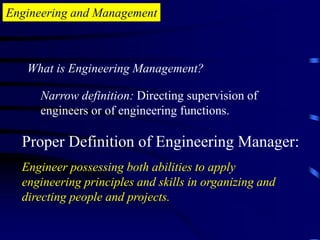
What is Engineering Management?
Narrow definition: Directing supervision of
engineers or of engineering functions.
Proper Definition of Engineering Manager:
Engineer possessing both abilities to apply
engineering principles and skills in organizing and
directing people and projects.
Engineering and Management
Why Engineering Managers?
Competition is global and companies need these people
to compete successfully
Engineering and Management
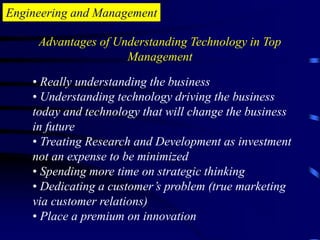
Advantages of Understanding Technology in Top
Management
• Really understanding the business
• Understanding technology driving the business
today and technology that will change the business
in future
• Treating Research and Development as investment
not an expense to be minimized
• Spending more time on strategic thinking
• Dedicating a customer’s problem (true marketing
via customer relations)
• Place a premium on innovation
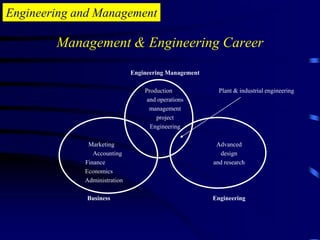
Management & Engineering Career
Engineering Management
Production Plant & industrial engineering
and operations
management
project
Engineering
Marketing Advanced
Accounting design
Finance and research
Economics
Administration
Business Engineering
Engineering and Management

Introduction-to-Engineering-Management.ppt

  • 1.
    INTRODUCTION ENGINEERING MANAGEMENT By : Engr.Jovin A. Manarin Eng. Ahmed Bakhsh
  • 2.
    Course Outline Understanding Principles ofEngineering Management Applications of these Principles in Engineering Organizations Learning The importance of management to engineers, Various forms and functions of organizations Operation and Quality Management Planning Project Management
  • 3.
    Engineering and Management Whatis an Engineer? Ingenium: Talent, natural capacity, or clever invention. Early applications of Clever Inventions based on Military Builders of Ingenious military machines??
  • 4.
    Engineering and Management Thefirst issue (1866) of the English Journal Engineering The art of directing the great sources of power in nature, for the use and convenience of man. Is it an art or profession?
  • 5.
    Engineering and Management ModernDefinition of Engineering By ABET (Accrediting Board for Engineering and Technology) The profession in which a knowledge of the mathematical and natural sciences gained by study, experience, and practice is applied with judgment to develop ways to utilize, economically, the materials and forces of the nature for the benefit of mankind. Engineer: A person applying his mathematical and science knowledge properly for mankind It is a discipline not an art.
  • 6.
    Engineering and Management Interrelatedcomponents which come together for some purposes. Components Interrelations Boundary Environment Purpose inputs Outputs interface constraints What is a system? .
  • 7.
    Engineering and Management Whatis Management? • Directing the actions of a group to achieve a goal in most efficient manner • Getting things done through people • Process of achieving organizational goals by working with and through people and organizational resources
  • 8.
    Engineering and Management Top-levelmanagement (president, executive vice president) Middle managers (chief engineer, division head etc.) First-line managers (foreman, supervisor, section chief) Management Levels
  • 9.
    Engineering and Management LevelType of Job First-line Managers  Directly supervise non-managers.  Carry out the plans and objectives of higher management using the personnel and other resources assigned to them.  Short-range operating plans controlling what will be done tomorrow or next week, assign tasks to their workers, supervise the work that is done, and evaluate the performance of individual workers. Middle Management  Manage through other managers.  Make plans of intermediate range to achieve the long-range goals set by top management, establish departmental policies, and evaluate the performance of subordinate work units and their managers.  Provide and integrating and coordinating function so that the short-range decisions and activities of first-line supervisory groups can be orchestrated toward achievement of the long-range goals of the enterprise. Top Management  Responsible for defining the character, mission, and objectives of the enterprise.  Establish criteria for and review long-range plans.  Evaluate the performance of major departments, and they evaluate leading management personnel to gauge their readiness for promotion to key executive positions.
  • 10.
    Engineering and Management ManagerialSkills: Managers need three types of skills: Technical: Specific subject related skills such as engineering, accounting, etc… Interpersonal: Skills related to dealing with others and leading, motivating, or controlling them Conceptual: Ability to discern the critical factors that will determine as organization’s success or failure. Ability to see the forest in spite of the trees.
  • 11.
    Engineering and Management LowestMiddle Top Managerial Level
  • 12.
    Engineering and Management ManagerialRoles (What Managers Do) • Interpersonal roles • Informational Roles • Decisional Roles
  • 13.
    Engineering and Management •Interpersonal roles Figurehead role: Outward relationship Leader role: Downward relation Liaison role: Horizontal relation Managerial Roles (What Managers Do) Outward Horizontal Downward
  • 14.
    Engineering and Management •Informational Roles Monitor Role: Collects information about internal operations and external events. Disseminator Role: Transforms information internally to everybody in organization (like a telephone switchboard) Spokesman Role: Public relations Managerial Roles (What Managers Do)
  • 15.
    Engineering and Management •Decisional Roles Entrepreneurial Role: Initiates changes, assumes risks, transforms ideas into useful products. Disturbance Handler Role: Deals with unforeseen problems and crisis. Resource Allocator Role: Distributing resources Negotiator Role: Bargains with suppliers, customers etc. in favor of enterprise Managerial Roles (What Managers Do)
  • 16.
    Engineering and Management •Planning:Selecting missions and objectives. Requires decision making. •Organizing: Establishing the structure for the objective. •Staffing: Keeping filled the organization structure •Directing: Influencing people to achieve the objective •Controlling: Measuring and correcting the activities Functions of Managers
  • 17.
    Engineering and Management Managementhas a body of specialized knowledge. This knowledge need not to be obtained in formal disciplined programs. Management: Is it an art or science? Somewhere between art and science. Engineering Management (Discipline + art) Somewhere between art and science.
  • 18.
    Engineering and Management Whatis Engineering Management? Narrow definition: Directing supervision of engineers or of engineering functions. Proper Definition of Engineering Manager: Engineer possessing both abilities to apply engineering principles and skills in organizing and directing people and projects.
  • 19.
    Engineering and Management WhyEngineering Managers? Competition is global and companies need these people to compete successfully
  • 20.
    Engineering and Management Advantagesof Understanding Technology in Top Management • Really understanding the business • Understanding technology driving the business today and technology that will change the business in future • Treating Research and Development as investment not an expense to be minimized • Spending more time on strategic thinking • Dedicating a customer’s problem (true marketing via customer relations) • Place a premium on innovation
  • 21.
    Management & EngineeringCareer Engineering Management Production Plant & industrial engineering and operations management project Engineering Marketing Advanced Accounting design Finance and research Economics Administration Business Engineering Engineering and Management