Introduction
Leadership istheoneofthemost
importantfunctionofmanagement.
Leadinginvolvesdirecting,
influencing&motivatingemployees
toperformessentialtasks.
Definition :
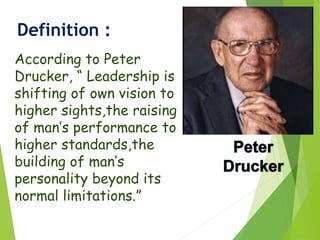
According to Peter
Drucker, “ Leadership is
shifting of own vision to
higher sights,the raising
of man’s performance to
higher standards,the
building of man’s
personality beyond its
normal limitations.”
Who is a
Leader......?
 One that leads or guides.
 One who is in charge or in command of
others.
 One who heads a political party or
organization.
 One who has influence or power,
especially of a political nature.
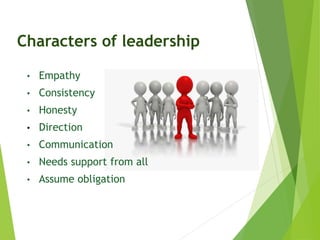
Characters of leadership
• Empathy
• Consistency
• Honesty
• Direction
• Communication
• Needs support from all
• Assume obligation
Difference between
Manager & Leader
Manager
 Oversees the current process well
 Must achieve balance
 Thinks execution
 Comfortable with control
 Problems are just that & need
resolusion ASAP
 Procedure is King
 Instructs as to technique &
process
 Impersonal, remote
Leader
 Wants to create the future
 Needs to make change
 Thinks ideal
 Welcomes risks
 Sees problems as opportunities
 Substance thumps the King
 Your best college professor
 High emotional intelligence
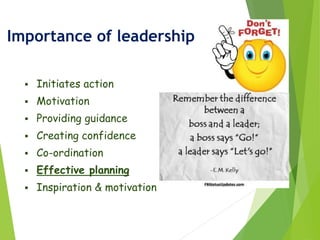
Importance of leadership
 Initiates action
 Motivation
 Providing guidance
 Creating confidence
 Co-ordination
 Effective planning
 Inspiration & motivation
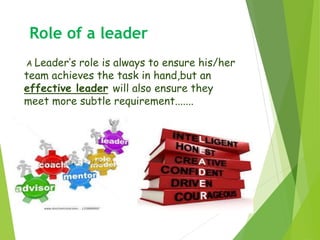
Role of a leader
A Leader’s role is always to ensure his/her
team achieves the task in hand,but an
effective leader will also ensure they
meet more subtle requirement.......
DIFFERENT LEADERSHIP STYLES
 1. Autocratic or Authoritarian leadership
An autocratic leader centralizes power and decision-making
in himself. He gives orders, assigns tasks and duties without
consulting the employees. The leader takes full authority and
assumes full responsibility.
(A) The hard-boiled autocrat
(B) The benevolent autocrat
 2. Democratic Leadership
Democratic leaders decentralize authority. It is
characterized by consultation with the subordinates and their
participation in the formulation of plans and policies. He
encourages participation in decision-making.
(A) Consultative
(b) Participative
DIRECTING…..
PARTICIPATING…..
 3. Paternalistic leadership
Under this management style the leader
assumes that his function is fatherly or
paternal. Paternalism means papa knows
best. The relationship between the leader
and his group is the same as the relationship
between the head of the family and the
members of the family. The leader guides and
protects his subordinates as members of his
family.
SUPPORTING…..
 4. The Laissez-faire or Free-rein
leadership
Free-rein leaders avoid power and responsibility.
The laissez-faire or non-interfering type of leader
passes on the responsibility for decision-making
to his subordinates and takes a minimum of
initiative in administration. He gives no direction
and allows the group to establish its own goals
and work out its own problems.
DELEGATING…..
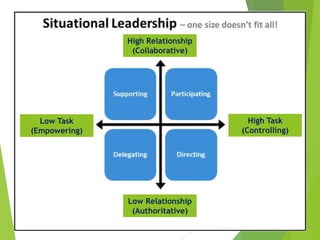
High Relationship
(Collaborative)
High Task
(Controlling)
Low Relationship
(Authoritative)
Low Task
(Empowering)
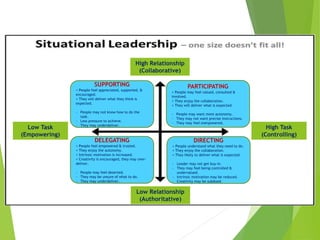
High Relationship
(Collaborative)
High Task
(Controlling)
Low Task
(Empowering)
Low Relationship
(Authoritative)
SUPPORTING
+ People feel appreciated, supported, &
encouraged.
+ They will deliver what they think is
expected.
- People may not know how to do the
task.
- Less pressure to achieve.
- They may underdeliver.
PARTICIPATING
+ People may feel valued, consulted &
involved.
+ They enjoy the collaboration.
+ They will deliver what is expected.
- People may want more autonomy.
- They may not want precise instructions.
- They may feel overpowered.
DELEGATING
+ People feel empowered & trusted.
+ They enjoy the autonomy.
+ Intrinsic motivation is increased.
+ Creativity is encouraged, they may over-
deliver.
- People may feel deserted.
- They may be unsure of what to do.
- They may underdeliver.
DIRECTING
+ People understand what they need to do.
+ They enjoy the collaboration.
+ They likely to deliver what is expected.
- Leader may not get buy-in.
- They may feel being controlled &
undervalued.
- Intrinsic motivation may be reduced.
- Creativity may be subdued.
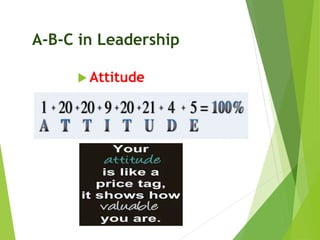
 Attitude
A-B-C in Leadership
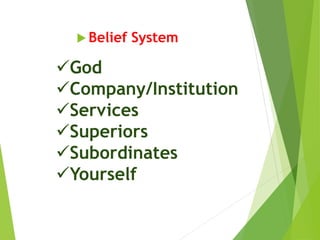
 Belief System
God
Company/Institution
Services
Superiors
Subordinates
Yourself
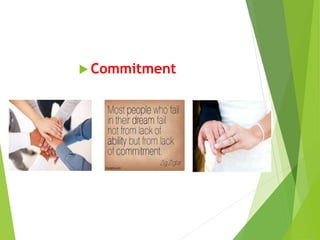
 Commitment
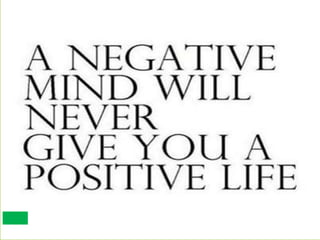
Being
Optimistic/
Positive
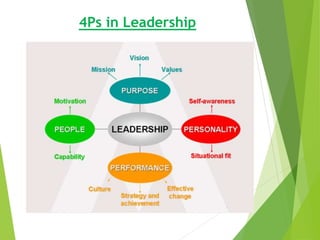
4Ps in Leadership
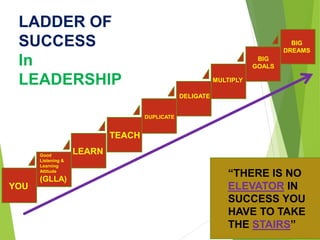
YOU
Good
Listening &
Learning
Attitude
(GLLA)
LEARN
TEACH
DUPLICATE
DELIGATE
MULTIPLY
BIG
GOALS
BIG
DREAMS
LADDER OF
SUCCESS
In
LEADERSHIP
“THERE IS NO
ELEVATOR IN
SUCCESS YOU
HAVE TO TAKE
THE STAIRS”
Leadership
Leadership

Leadership

  • 2.
  • 3.
    Definition : According toPeter Drucker, “ Leadership is shifting of own vision to higher sights,the raising of man’s performance to higher standards,the building of man’s personality beyond its normal limitations.”
  • 4.
    Who is a Leader......? One that leads or guides.  One who is in charge or in command of others.  One who heads a political party or organization.  One who has influence or power, especially of a political nature.
  • 5.
    Characters of leadership •Empathy • Consistency • Honesty • Direction • Communication • Needs support from all • Assume obligation
  • 7.
    Difference between Manager &Leader Manager  Oversees the current process well  Must achieve balance  Thinks execution  Comfortable with control  Problems are just that & need resolusion ASAP  Procedure is King  Instructs as to technique & process  Impersonal, remote Leader  Wants to create the future  Needs to make change  Thinks ideal  Welcomes risks  Sees problems as opportunities  Substance thumps the King  Your best college professor  High emotional intelligence
  • 8.
    Importance of leadership Initiates action  Motivation  Providing guidance  Creating confidence  Co-ordination  Effective planning  Inspiration & motivation
  • 9.
    Role of aleader A Leader’s role is always to ensure his/her team achieves the task in hand,but an effective leader will also ensure they meet more subtle requirement.......
  • 10.
    DIFFERENT LEADERSHIP STYLES 1. Autocratic or Authoritarian leadership An autocratic leader centralizes power and decision-making in himself. He gives orders, assigns tasks and duties without consulting the employees. The leader takes full authority and assumes full responsibility. (A) The hard-boiled autocrat (B) The benevolent autocrat  2. Democratic Leadership Democratic leaders decentralize authority. It is characterized by consultation with the subordinates and their participation in the formulation of plans and policies. He encourages participation in decision-making. (A) Consultative (b) Participative DIRECTING….. PARTICIPATING…..
  • 11.
     3. Paternalisticleadership Under this management style the leader assumes that his function is fatherly or paternal. Paternalism means papa knows best. The relationship between the leader and his group is the same as the relationship between the head of the family and the members of the family. The leader guides and protects his subordinates as members of his family. SUPPORTING…..
  • 12.
     4. TheLaissez-faire or Free-rein leadership Free-rein leaders avoid power and responsibility. The laissez-faire or non-interfering type of leader passes on the responsibility for decision-making to his subordinates and takes a minimum of initiative in administration. He gives no direction and allows the group to establish its own goals and work out its own problems. DELEGATING…..
  • 13.
    High Relationship (Collaborative) High Task (Controlling) LowRelationship (Authoritative) Low Task (Empowering)
  • 14.
    High Relationship (Collaborative) High Task (Controlling) LowTask (Empowering) Low Relationship (Authoritative) SUPPORTING + People feel appreciated, supported, & encouraged. + They will deliver what they think is expected. - People may not know how to do the task. - Less pressure to achieve. - They may underdeliver. PARTICIPATING + People may feel valued, consulted & involved. + They enjoy the collaboration. + They will deliver what is expected. - People may want more autonomy. - They may not want precise instructions. - They may feel overpowered. DELEGATING + People feel empowered & trusted. + They enjoy the autonomy. + Intrinsic motivation is increased. + Creativity is encouraged, they may over- deliver. - People may feel deserted. - They may be unsure of what to do. - They may underdeliver. DIRECTING + People understand what they need to do. + They enjoy the collaboration. + They likely to deliver what is expected. - Leader may not get buy-in. - They may feel being controlled & undervalued. - Intrinsic motivation may be reduced. - Creativity may be subdued.
  • 16.
  • 17.
  • 18.
  • 19.
  • 20.
  • 21.