Graduate
School
INTRODUCTION
TO
E-COMMERCE
Presentation
By
Raymart B.
Gallo
Marilou I.
Horlador
What is E-Commerce
Forces Fueling E-
Commerce
vs E-Business
Challenges in Electronic
Commerce
Model for E-Commerce
The Information
Superhighway
Types of E-
Commerce
Table Of Content
E-Bussiness Trident
Our Team
Raymart B.
Gallo
Marilou I.
Horlador
WHAT IS
E-COMMERS?
• Electronic commerce (E-commerce) refers to buying
and selling of goods and services over the internet
• Involves electronic funds transfer, online transaction
processing, and digital communications
• Transformed traditional business models into digital
frameworks
• Examples: Amazon, eBay, Shopify stores
E-Commerce
What Is E-commerce
?
E-commerce is crucial in today's business world
because it provides businesses with a highly
accessible, convenient way to reach a global
customer base 24/7, enabling them to expand market
reach, reduce costs, gather valuable customer data,
and ultimately drive sales through a streamlined
online shopping experience; making it a vital tool for
staying competitive in the digital age.
E-Commerce
Importance of E-
Commerce
E-Commerce
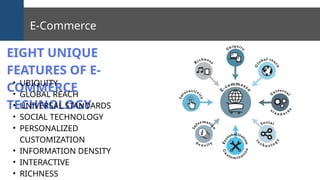
EIGHT UNIQUE
FEATURES OF E-
COMMERCE
TECHNOLOGY
• UBIQUITY
• GLOBAL REACH
• UNIVERSAL STANDARDS
• SOCIAL TECHNOLOGY
• PERSONALIZED
CUSTOMIZATION
• INFORMATION DENSITY
• INTERACTIVE
• RICHNESS
E-Commerce
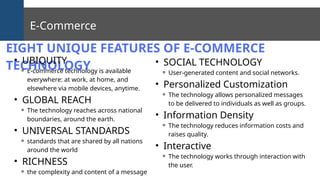
EIGHT UNIQUE FEATURES OF E-COMMERCE
TECHNOLOGY
• UBIQUITY
⚬ E-commerce technology is available
everywhere: at work, at home, and
elsewhere via mobile devices, anytime.
• GLOBAL REACH
⚬ The technology reaches across national
boundaries, around the earth.
• UNIVERSAL STANDARDS
⚬ standards that are shared by all nations
around the world
• RICHNESS
⚬ the complexity and content of a message
• SOCIAL TECHNOLOGY
⚬ User-generated content and social networks.
• Personalized Customization
⚬ The technology allows personalized messages
to be delivered to individuals as well as groups.
• Information Density
⚬ The technology reduces information costs and
raises quality.
• Interactive
⚬ The technology works through interaction with
the user.
FORCE
FUELING
E-
COMMERCE
VS
E-BUSINESS
the digital enabling of transactions and
processes within a firm, involving
information systems under the control
of the firm
Let's continue
Force Fueling E-Commerce vs E-Business
E-Bussiness
the online buying and selling of goods
and services, essentially the
transactional aspect of a business
conducted digitally
E-Commerce
Force Fueling E-Commerce vs E-Business
E-commerce primarily involves transactions that cross firm boundaries. E-
business primarily involves the application of digital technologies to
business processes within the firm.
E-commerce revolutionizes
commerce by reducing
information asymmetry
and allowing online
merchants to maximize
revenues. It eliminates
geographical and social
barriers, allowing
consumers to understand
costs and price
discrimination strategies.
This shift is shaping the
twenty-first century's
Force Fueling E-Commerce vs E-Business
The growth of e-commerce is primarily driven by a combination of factors including
widespread internet penetration, the increasing use of mobile devices, evolving
consumer behavior towards online shopping, the convenience of 24/7 access, price
comparison capabilities, and the growing availability of diverse products from global
markets, all contributing to a more accessible and personalized shopping
experience.
Key Drivers of E-Commerce
Growth:
• Increased Internet Penetration
• Mobile Device Adoption
• Changing Consumer Behavior
• Personalization and Customization
• Delivery Options and Logistics
• Social Commerce
• Price Competitiveness
• Global Reach
As internet access becomes more ubiquitous across the globe, more people are able
to shop online, creating a larger potential customer base for e-commerce
businesses.
Increased Internet Penetration
1
The rise of smartphones and tablets has significantly contributed to e-commerce growth,
allowing consumers to browse and purchase items on-the-go, fueling the trend of "mobile
commerce" (m-commerce).
Mobile Device Adoption
2
Contemporary consumers are increasingly comfortable shopping online, valuing the
convenience of comparing prices, reading reviews, and making purchases from the
comfort of their homes.
Changing Consumer Behavior
3
Force Fueling E-Commerce vs E-Business
E-commerce platforms can leverage data analytics to
provide personalized product recommendations and
targeted marketing, leading to a more engaging
shopping experience.
Personalization and
Customization
4
Improved delivery infrastructure, including faster
shipping options and convenient delivery windows,
enhances customer satisfaction and encourages more
online purchases.
Delivery Options and Logistics
5
The integration of social media platforms with e-commerce allows for seamless product discovery
and purchase, driving further online sales.
Social Commerce
6
Force Fueling E-Commerce vs E-Business
Online marketplaces often offer a wider
range of products at competitive prices,
enabling consumers to find the best deals.
Price Competitiveness
7
E-commerce platforms can reach a global
customer base, allowing businesses to
expand their market reach beyond
geographical boundaries.
Global Reach
8
E-commerce is rapidly capturing a larger share of the overall retail market,
with more people choosing to shop online for a variety of goods and services.
Increased Market Penetration
1
The rise of e-commerce has led to the emergence of new business models like
subscription services, flash sales, and direct-to-consumer brands.
New Business Models
2
Traditional brick-and-mortar stores are adapting to the digital age by integrating
online shopping options and offering omnichannel experiences.
Shift in Retail Landscape
3
Force Fueling E-Commerce vs E-Business
Impact of these Forces:
Force Fueling E-Commerce vs E-Business
E-Business Distinction:
E-business encompasses all digital aspects of business operations, including interna
processes, customer relationship management, supply chain management, and B2B
and B2C interactions, focusing on overall digital transformation.
Key points about E-business:
• Broader Scope
• Internal Processes
• Digital Transformation Focus
• B2B and B2C Activities
E-business goes beyond online sales to include all
digital aspects of a business, including internal
operations, marketing, customer service, and
supply chain management.
Unlike e-commerce, e-business actively incorporates
internal systems and processes within a company to
facilitate digital operations.
E-business aims to leverage digital
technologies to transform an entire
business, not just the sales channel.
E-business encompasses both business-
to-consumer (B2C) and business-to-
business (B2B) interactions through digital
TRADITIONAL COMMERCE E-COMMERCE
Heavy dependency on information exchange
from person to person
Information sharing is made easy via
electronic communication channels making
little dependency on person to person
information exhange
Communication/ transaction are done is
synchronous way. Manual intervention is
required for each communication of
transaction
Communication or transaction ca be done in
asynchronous way. Electronic system
automatically handles when to pass
communication to required person or do the
transaction
It is difficult to establish and maintain standard
practices
Uniform strategy can be easily established
and maintain
Force Fueling E-Commerce vs E-Business
TRADITIONAL COMMERCE E-COMMERCE
Communication of business depends upon
individual skills
There is no human intervention
Unavailability of a uniform platform depends
heavily on personal communication
Provides user a platform where AI
information is available at one place
No uniform platform for information sharing
as it depends heavily on personal
communication
Provides a universal platform to support
commercial/ business activities across globe.
Force Fueling E-Commerce vs E-Business
CHALLENGES
IN
ELECTRONIC
COMMERCE
Challenges in Electronic Commerce
THE TOP 10 TECHNICAL ISSUES
FOR EC (IN ORDER OF THEIR
IMPORTANCE) ARE:
• security
• adequate infrastructure
• virtualization
• back-end systems integration
• more intelligent software
• cloud computing
• data warehousing and mining
• scalability
• content distribution
THE TOP 10 MANAGERIAL ISSUES
FOR EC (IN ORDER OF THEIR
IMPORTANCE) ARE:
• justification
• budgets
• project deadlines
• keeping up with technology
• privacy issues
• unrealistic management
expectations
• training
• reaching new customers
Challenges in Electronic Commerce
INSUFFICIENT CUSTOMER
ENGAGEMENT
Engaging your customers requires a
careful balance between providing
them with helpful information without
overwhelming. It's like walking a
tightrope: you want to keep your
customers involved, but avoid giving
them too much so that they feel
bombarded. Finding this golden mean
can be a tricky challenge in e-
commerce, but when done right, lead
Challenges in Electronic Commerce
Solution:
To build relationships with potential customers,
you should provide them with relevant content at
each stage of their journey toward making a
purchase decision. You may start by segmenting
your audience into groups based on common
characteristics such as demographics or interests.
Once you've identified these segments, create
tailored messages for each group that provide
helpful advice or resources specific to their needs
rather than just trying to sell them something
directly.
Additionally, use email outreach campaigns or push notifications to make sure your
leads don’t miss out on any opportunities due to timing constraints or other factors
Challenges in Electronic Commerce
DATA SECURITY GAPS
In today’s digital world, data security
is among e-commerce problems that
can’t be ignored or neglected. With
the rise of online stores, issues such
as data breaches and identity theft
have become major concerns for
customers. As an e-commerce
business, it’s your responsibility to
ensure that customer data is safe
from malicious actors
Challenges in Electronic Commerce
Solution:
• Apply robust authentication measures such as
two-factor authentication or biometrics;
• Encrypt all sensitive information using industry-
standard encryption algorithms;
• Regularly monitor network activity for suspicious
behavior;
• Use secure payment gateways like PayPal or
Stripe instead of storing credit card details;
• Educate employees about cyber security best
practices so they know how to spot potential
threats quickly and efficiently.
MODEL FOR
E-
COMMERCE
Model for E-Commerce
E-commerce business
models are ways that
businesses and consumers
buy and sell online. Some
common models include
business-to-consumer
(B2C), business-to-business
(B2B), consumer-to-
business (C2B), and
consumer-to-consumer
Model for E-Commerce
A B2C (Business-to-Consumer) ecommerce model refers to a business selling
products or services directly to individual consumers through an online
platform, with the most common model being "direct sellers" where
customers purchase items directly from the company's website, with
examples like Amazon, Zappos, and Nike.
• A business sells products or services directly to consumers
• An example is buying something from Target
• B2C can include brick-and-mortar stores, or a combination of both
Business-to-Consumer (B2C)
Model for E-Commerce
Business-to-Consumer (B2C)
A B2B ecommerce model refers to a business selling products or services
directly to other businesses through an online platform, typically featuring
features like bulk ordering, personalized pricing, robust inventory
management, and dedicated account management to cater to the specific
needs of business customers, rather than individual consumers.
• A business sells products or services to other businesses
• An example is a software company selling its software to a large
corporation
• B2B usually involves larger transactions and long-term relationships
Model for E-Commerce
Business-to-Business (B2B)
Model for E-Commerce
Business-to-Business (B2B)
The consumer-to-business (C2B) e-commerce model allows businesses and
consumers to have a mutually beneficial relationship. It is the opposite of
the traditional business setup: In this relationship, the consumers create
value that an organization uses to engage in a business process or gain a
competitive advantage.
• A consumer sells products or services to businesses
• An example is a customer posting work they want to be completed and
having businesses bid for the opportunity
• C2B can help businesses obtain information from their consumers
Model for E-Commerce
Consumer-to-Business (C2B)
Model for E-Commerce
Consumer-to-Business (C2B)
A C2C (Consumer-to-Consumer) e-commerce model is an online marketplace
where individual consumers can directly sell their goods or services to other
consumers, with a platform facilitating the connection and transaction
between them, typically by charging a commission on each sale; essentially,
it's a system where buyers and sellers interact directly without a middle
business involved, like on platforms like eBay, Etsy, or Craigslist.
• A consumer sells products or services to another consumer
• C2C transactions are often carried out through a third party
Model for E-Commerce
Consumer-to-Consumer (C2C)
Model for E-Commerce
Consumer-to-Consumer (C2C)
THE
INFORMATION
SUPERHIGHWA
Y
The Information Superhighway
1
• The "INFORMATION SUPERHIGHWAY," often
referred to as the "I-Way," is a metaphorical
term describing a vast network of
interconnected telecommunications systems,
like the internet, that allows for high-speed
access and sharing of information globally
• it is crucial for E-commerce because it provides
the essential infrastructure needed to conduct
online transactions, enabling businesses to reach
a wide audience and customers to easily browse
and purchase goods and services across the
internet, essentially acting as the digital "road"
The Information Superhighway
1
• ACCESS TO INFORMATION
• GLOBAL REACH
• DIGITAL TRANSACTIONS
KEY POINTS ABOUT THE INFORMATION
SUPERHIGHWAY AND E-COMMERCE:
The I-Way provides easy access to a vast amount of product
information, allowing customers to compare prices and
features before making a purchase.
• MARKETING AND
ADVERTISING
• Customer interaction
By utilizing the internet, businesses can reach potential
customers worldwide, expanding their market reach
significantly.
The I-Way facilitates online payment systems, allowing
customers to securely pay for goods and services
Businesses can utilize the internet for digital
marketing campaigns, reaching consumers
directly through targeted advertising.
E-commerce platforms on the Information
Superhighway allow for direct
communication between businesses and
customers, enabling personalized service
and feedback.
The Information Superhighway
ENABLES ONLINE
MARKETPLACES
1
REDUCES BARRIERS TO ENTRY
2
IMPROVES CUSTOMER EXPERIENCE
3
The I-Way provides the platform for online shopping websites
where customers can browse and purchase products from
various vendors.
RELEVANCE TO E-COMMERCE:
Small businesses can easily enter the global market through
online platforms without needing a physical storefront.
Fast, convenient access to product information and online
ordering processes enhance customer satisfaction.
The Information Superhighway
The internet infrastructure acts as the backbone for E-Commerce activities by
providing a global network that allows businesses to showcase their products
and services online, enabling customers to browse, select, and purchase items
remotely, all while facilitating secure payment processing, order tracking, and
delivery information sharing, essentially creating a virtual marketplace
accessible from anywhere with an internet connection.
KEY ASPECTS OF HOW INTERNET INFRASTRUCTURE SUPPORTS E-
COMMERCE:
• WEBSITE HOSTING
• DATA TRANSFER
• SECURE
TRANSACTION
• PAYMENT GATEWAY
• SCALABILITY
• SEARCH ENGINE OPTIMIZATION (SEO)
• CUSTOMER RELATIONSHIP MANAGEMENT
(CRM)
• SOCIAL MEDIA INTEGRATION
The Information Superhighway
WEB HOSTING
Web servers housed within internet infrastructure allow businesses to create
and maintain online storefronts, displaying product information, images, and
pricing to potential customers.
DATA TRANSFER
The internet's network protocols enable efficient transfer of large amounts of
data like product descriptions, images, and videos, ensuring a smooth browsing
experience for customers.
SECURE TRANSACTIONS
Encryption protocols like SSL/TLS secure online payment information, allowing
customers to confidently enter credit card details on E-Commerce platforms.
The Information Superhighway
PAYMENT GATEWAYS
Integration with third-party payment gateways enables real-time processing of
online transactions, instantly confirming purchases and facilitating fund transfer
between the customer and the seller.
SCALABILITY
Cloud-based infrastructure allows businesses to scale their E-Commerce
operations quickly to meet fluctuating demand during peak shopping seasons.
SEARCH ENGINE OPTIMIZATION
(SEO)
The internet's search engines enable businesses to optimize their online
presence, making it easier for potential customers to discover their products
through relevant keywords.
The Information Superhighway
CUSTOMER RELATIONSHIP MANAGEMENT
(CRM)
E-Commerce platforms can leverage internet infrastructure to manage customer
interactions, track purchase history, and provide personalized shopping
experiences.
SOCIAL MEDIA INTEGRATION
Utilizing social media platforms hosted on the internet allows businesses to
promote products, engage with customers, and drive traffic to their online
stores.
Overall, the internet infrastructure plays a vital role in enabling E-Commerce
by providing a reliable platform for online transactions, facilitating customer
interaction, and allowing businesses to reach a global market with their
products and services.
TYPES OF
E-
COMMERCE
Types of E-Commerce
• B2B Commerce (Business-to-business)
• B2C Commerce (Business-to-consumer)
• C2C Commerce (Consumer-to-consumer)
• C2B Commerce (Consumer-to-business)
• B2G Commerce (Business-to-government)
• C2A Commerce (Consumer-to-
• Online businesses selling to other
businesses
• In B2B Commerce, the two parties
involved in business transactions are
both business firms. For example:
⚬ Heinz selling ketchup to Mc Donald's
• Both the businesses need to collaborate
with each other in order to be successful.
Types of E-Commerce
B2B Commerce
(Business-to-Business)
• Online businesses selling to individual
consumers.
• B2C commerce implies that the
interaction occurs between the business
owner and customer. In this type of
commerce, the goods and services
provided by the business is directly
consumed by the consumer.
• Example
⚬ McDonald's sells food and beverages
Types of E-Commerce
B2C Commerce
(Business-to-Consumer)
• Consumers selling to other consumers
• This type of business originates from the
customers and the end point of the
business is customers only. This type of
business is suitable for dealing with
products or goods where there is no
market mechanism involved.
• Example
⚬ individuals selling computers,
musical instruments, or personal
services online.
Types of E-Commerce
C2C Commerce
(Consumer-to-Consumer )
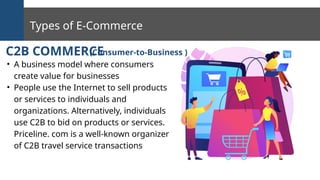
• A business model where consumers
create value for businesses
• People use the Internet to sell products
or services to individuals and
organizations. Alternatively, individuals
use C2B to bid on products or services.
Priceline. com is a well-known organizer
of C2B travel service transactions
Types of E-Commerce
C2B COMMERCE
(Consumer-to-Business )
• Businesses sell services to the
government
• Benefits of B2G
⚬ B2G contracts can be lucrative and long-
lasting.
⚬ B2G e-commerce can streamline
processes and increase transparency.
⚬ B2G can help businesses of all sizes.
Types of E-Commerce
B2G COMMERCE
(Business-to-Government )
• Consumers interact with the government or public administration
• Benefits of B2G
⚬ Saves time and effort for both the taxpayers and the government
⚬ Reduces the potential for errors in the filing process
⚬ Helps governments streamline their operations, reduce costs, and improve
the quality of their services
⚬ Makes it easier for consumers to access information and conduct transactions
online
Types of E-Commerce
C2A COMMERCE
(Consumer-to-Administration )
E-BUSINESS
TRIDENT
E-Business Trident
The "E-BUSINESS TRIDENT" refers to a conceptual framework
that highlights the three crucial pillars a company needs to
focus on when developing a successful online business
strategy: Customer Relationship Management (CRM),
Electronic Commerce (e-Commerce), and Internal Business
Processes (Operations), essentially emphasizing the need to
balance customer interaction, online sales transactions, and
efficient internal operations to achieve optimal e-business
performance.
E-Business Trident
CUSTOMER RELATIONSHIP MANAGEMENT
(CRM)
This aspect focuses on building and maintaining strong relationships with
customers through digital channels like websites, social media, and email
marketing, ensuring personalized experiences and effective customer
service.
E-Business Trident
CUSTOMER RELATIONSHIP MANAGEMENT
(CRM)
Customer Relationship Management
(CRM) refers to a system that allows
online businesses to collect, organize,
and analyze customer data across
various digital channels like websites,
emails, and social media, enabling them
to build stronger relationships with
customers, personalize their
experiences, and ultimately drive sales
and loyalty through targeted marketing
E-Business Trident
CUSTOMER RELATIONSHIP MANAGEMENT (CRM)
KEY ASPECTS:
CENTRALIZED CUSTOMER DATA
A CRM system stores all customer information (contact details,
purchase history, website interactions, social media activity) in
a single database, providing a comprehensive view of each
customer.
PERSONALIZED COMMUNICATION
By analyzing customer data, e-businesses can send targeted marketing
campaigns, personalized product recommendations, and relevant offers based on
individual customer needs and preferences.
E-Business Trident
CUSTOMER RELATIONSHIP MANAGEMENT (CRM)
KEY ASPECTS:
LEAD MANAGEMENT
CRM systems help identify and track potential customers
(leads) throughout the sales funnel, allowing for efficient lead
nurturing and conversion.
CUSTOMER SERVICE AUTOMATION
CRM can automate routine customer service tasks like email responses, order
tracking updates, and FAQs, improving customer support efficiency.
CUSTOMER BEHAVIOR ANALYSIS
By tracking customer interactions across different channels, e-businesses can
gain insights into customer behavior, identify trends, and make data-driven
E-Business Trident
BENEFITS OF USING CRM IN E-BUSINESS:
IMPROVED CUSTOMER
SATISFACTION
Personalized communication and efficient
customer service lead to a more positive
customer experience.
INCREASED SALES CONVERSION
Targeted marketing campaigns
based on customer data can
generate more qualified leads and
higher conversion rates.
ENHANCED CUSTOMER
RETENTION
By understanding customer needs and
providing relevant support, businesses
can foster customer loyalty and reduce
churn.
COST OPTIMIZATION
Automating repetitive tasks through
CRM can streamline operations and
reduce costs.
E-Business Trident
ELECTRONIC COMMERCE (E-COMMERCE)
"Electronic Commerce (e-Commerce)"
within the context of e-business
essentially refers to the specific activity of
buying and selling goods or services
online, representing a subset of broader
e-business operations which encompass
not only transactions but also other
digital business processes like customer
relationship management and supply
chain management; meaning, e-
E-Business Trident
BENEFITS OF USING E-COMMERCE IN E-BUSINESS:
INCREASED MARKET REACH
E-commerce removes geographical
barriers, enabling businesses to sell to
customers worldwide, significantly
expanding their potential customer base.
LOWER OPERATIONAL COSTS
By eliminating the need for physical
storefronts, e-commerce reduces
overhead costs like rent, utilities, and
staff associated with brick-and-
mortar stores.
CUSTOMER CONVENIENCE
Customers can shop online anytime,
anywhere, leading to increased
accessibility and satisfaction.
DATA ANALYTICS AND INSIGHTS
E-commerce platforms generate
valuable customer data on browsing
behavior, purchase history, and
demographics, allowing for targeted
marketing and improved product
E-Business Trident
BENEFITS OF USING E-COMMERCE IN E-BUSINESS:
FASTER TRANSACTIONS
Online transactions are usually quicker
and more efficient compared to
traditional sales methods, improving
customer experience.
PERSONALIZED MARKETING
With customer data, e-commerce
businesses can tailor marketing
campaigns to individual customer
needs and preferences.
SCALABILITY
Expanding an e-commerce business is
often easier than scaling a physical
store, allowing for rapid growth as
needed.
IMPROVED PRODUCT VISIBILITY
Online platforms allow businesses to
showcase a wider range of products with
detailed descriptions and images,
enhancing product discovery.
E-Business Trident
BENEFITS OF USING E-COMMERCE IN E-BUSINESS:
COST-EFFECTIVE MARKETING
Digital marketing channels like social media and email marketing can be more
cost-effective than traditional advertising methods.
E-Business Trident
INTERNAL BUSINESS PROCESSES
(OPERATIONS)
"Internal Business Processes (Operations) as
an e-business trader" refers to the set of
digital systems and procedures a company
uses to manage its core operations within an
online business environment, including tasks
like order processing, inventory
management, customer service, and
payment processing, all facilitated through
digital platforms and interconnected
systems, allowing for efficient transactions
E-Business Trident
BENEFITS OF USING INTERNAL BUSINESS PROCESSES IN
E-BUSINESS:
INCREASED EFFICIENCY
Faster order processing and fulfillment, leading to improved customer
satisfaction.
COST REDUCTION
Optimized inventory management and reduced manual data entry.
IMPROVED CUSTOMER
EXPERIENCE
Real-time order tracking, personalized communication, and seamless online
checkout.
DATA-DRIVEN INSIGHTS
Access to valuable customer data for informed decision-making.
Online Resources
• Laudon, K. (2022). E-Commerce
• Turban E. et al. (2000). Electronic Commerce—A Managerial
Perspective
• https://byjus.com/commerce/scope-of-e-business/
• https://solveit.dev/blog/e-commerce-challenges
References:
Thank you for your
attention
If you have any
questions about e-
commerce, welcome to
ask
Graduate
School

Unit 1 Introduction to E-commerce (1).pptx

  • 1.
  • 2.
    What is E-Commerce ForcesFueling E- Commerce vs E-Business Challenges in Electronic Commerce Model for E-Commerce The Information Superhighway Types of E- Commerce Table Of Content E-Bussiness Trident
  • 3.
  • 4.
  • 5.
    • Electronic commerce(E-commerce) refers to buying and selling of goods and services over the internet • Involves electronic funds transfer, online transaction processing, and digital communications • Transformed traditional business models into digital frameworks • Examples: Amazon, eBay, Shopify stores E-Commerce What Is E-commerce ?
  • 6.
    E-commerce is crucialin today's business world because it provides businesses with a highly accessible, convenient way to reach a global customer base 24/7, enabling them to expand market reach, reduce costs, gather valuable customer data, and ultimately drive sales through a streamlined online shopping experience; making it a vital tool for staying competitive in the digital age. E-Commerce Importance of E- Commerce
  • 7.
    E-Commerce EIGHT UNIQUE FEATURES OFE- COMMERCE TECHNOLOGY • UBIQUITY • GLOBAL REACH • UNIVERSAL STANDARDS • SOCIAL TECHNOLOGY • PERSONALIZED CUSTOMIZATION • INFORMATION DENSITY • INTERACTIVE • RICHNESS
  • 8.
    E-Commerce EIGHT UNIQUE FEATURESOF E-COMMERCE TECHNOLOGY • UBIQUITY ⚬ E-commerce technology is available everywhere: at work, at home, and elsewhere via mobile devices, anytime. • GLOBAL REACH ⚬ The technology reaches across national boundaries, around the earth. • UNIVERSAL STANDARDS ⚬ standards that are shared by all nations around the world • RICHNESS ⚬ the complexity and content of a message • SOCIAL TECHNOLOGY ⚬ User-generated content and social networks. • Personalized Customization ⚬ The technology allows personalized messages to be delivered to individuals as well as groups. • Information Density ⚬ The technology reduces information costs and raises quality. • Interactive ⚬ The technology works through interaction with the user.
  • 9.
  • 10.
    the digital enablingof transactions and processes within a firm, involving information systems under the control of the firm Let's continue Force Fueling E-Commerce vs E-Business E-Bussiness the online buying and selling of goods and services, essentially the transactional aspect of a business conducted digitally E-Commerce
  • 11.
    Force Fueling E-Commercevs E-Business E-commerce primarily involves transactions that cross firm boundaries. E- business primarily involves the application of digital technologies to business processes within the firm. E-commerce revolutionizes commerce by reducing information asymmetry and allowing online merchants to maximize revenues. It eliminates geographical and social barriers, allowing consumers to understand costs and price discrimination strategies. This shift is shaping the twenty-first century's
  • 12.
    Force Fueling E-Commercevs E-Business The growth of e-commerce is primarily driven by a combination of factors including widespread internet penetration, the increasing use of mobile devices, evolving consumer behavior towards online shopping, the convenience of 24/7 access, price comparison capabilities, and the growing availability of diverse products from global markets, all contributing to a more accessible and personalized shopping experience. Key Drivers of E-Commerce Growth: • Increased Internet Penetration • Mobile Device Adoption • Changing Consumer Behavior • Personalization and Customization • Delivery Options and Logistics • Social Commerce • Price Competitiveness • Global Reach
  • 13.
    As internet accessbecomes more ubiquitous across the globe, more people are able to shop online, creating a larger potential customer base for e-commerce businesses. Increased Internet Penetration 1 The rise of smartphones and tablets has significantly contributed to e-commerce growth, allowing consumers to browse and purchase items on-the-go, fueling the trend of "mobile commerce" (m-commerce). Mobile Device Adoption 2 Contemporary consumers are increasingly comfortable shopping online, valuing the convenience of comparing prices, reading reviews, and making purchases from the comfort of their homes. Changing Consumer Behavior 3 Force Fueling E-Commerce vs E-Business
  • 14.
    E-commerce platforms canleverage data analytics to provide personalized product recommendations and targeted marketing, leading to a more engaging shopping experience. Personalization and Customization 4 Improved delivery infrastructure, including faster shipping options and convenient delivery windows, enhances customer satisfaction and encourages more online purchases. Delivery Options and Logistics 5 The integration of social media platforms with e-commerce allows for seamless product discovery and purchase, driving further online sales. Social Commerce 6 Force Fueling E-Commerce vs E-Business Online marketplaces often offer a wider range of products at competitive prices, enabling consumers to find the best deals. Price Competitiveness 7 E-commerce platforms can reach a global customer base, allowing businesses to expand their market reach beyond geographical boundaries. Global Reach 8
  • 15.
    E-commerce is rapidlycapturing a larger share of the overall retail market, with more people choosing to shop online for a variety of goods and services. Increased Market Penetration 1 The rise of e-commerce has led to the emergence of new business models like subscription services, flash sales, and direct-to-consumer brands. New Business Models 2 Traditional brick-and-mortar stores are adapting to the digital age by integrating online shopping options and offering omnichannel experiences. Shift in Retail Landscape 3 Force Fueling E-Commerce vs E-Business Impact of these Forces:
  • 16.
    Force Fueling E-Commercevs E-Business E-Business Distinction: E-business encompasses all digital aspects of business operations, including interna processes, customer relationship management, supply chain management, and B2B and B2C interactions, focusing on overall digital transformation. Key points about E-business: • Broader Scope • Internal Processes • Digital Transformation Focus • B2B and B2C Activities E-business goes beyond online sales to include all digital aspects of a business, including internal operations, marketing, customer service, and supply chain management. Unlike e-commerce, e-business actively incorporates internal systems and processes within a company to facilitate digital operations. E-business aims to leverage digital technologies to transform an entire business, not just the sales channel. E-business encompasses both business- to-consumer (B2C) and business-to- business (B2B) interactions through digital
  • 17.
    TRADITIONAL COMMERCE E-COMMERCE Heavydependency on information exchange from person to person Information sharing is made easy via electronic communication channels making little dependency on person to person information exhange Communication/ transaction are done is synchronous way. Manual intervention is required for each communication of transaction Communication or transaction ca be done in asynchronous way. Electronic system automatically handles when to pass communication to required person or do the transaction It is difficult to establish and maintain standard practices Uniform strategy can be easily established and maintain Force Fueling E-Commerce vs E-Business
  • 18.
    TRADITIONAL COMMERCE E-COMMERCE Communicationof business depends upon individual skills There is no human intervention Unavailability of a uniform platform depends heavily on personal communication Provides user a platform where AI information is available at one place No uniform platform for information sharing as it depends heavily on personal communication Provides a universal platform to support commercial/ business activities across globe. Force Fueling E-Commerce vs E-Business
  • 19.
  • 20.
    Challenges in ElectronicCommerce THE TOP 10 TECHNICAL ISSUES FOR EC (IN ORDER OF THEIR IMPORTANCE) ARE: • security • adequate infrastructure • virtualization • back-end systems integration • more intelligent software • cloud computing • data warehousing and mining • scalability • content distribution THE TOP 10 MANAGERIAL ISSUES FOR EC (IN ORDER OF THEIR IMPORTANCE) ARE: • justification • budgets • project deadlines • keeping up with technology • privacy issues • unrealistic management expectations • training • reaching new customers
  • 21.
    Challenges in ElectronicCommerce INSUFFICIENT CUSTOMER ENGAGEMENT Engaging your customers requires a careful balance between providing them with helpful information without overwhelming. It's like walking a tightrope: you want to keep your customers involved, but avoid giving them too much so that they feel bombarded. Finding this golden mean can be a tricky challenge in e- commerce, but when done right, lead
  • 22.
    Challenges in ElectronicCommerce Solution: To build relationships with potential customers, you should provide them with relevant content at each stage of their journey toward making a purchase decision. You may start by segmenting your audience into groups based on common characteristics such as demographics or interests. Once you've identified these segments, create tailored messages for each group that provide helpful advice or resources specific to their needs rather than just trying to sell them something directly. Additionally, use email outreach campaigns or push notifications to make sure your leads don’t miss out on any opportunities due to timing constraints or other factors
  • 23.
    Challenges in ElectronicCommerce DATA SECURITY GAPS In today’s digital world, data security is among e-commerce problems that can’t be ignored or neglected. With the rise of online stores, issues such as data breaches and identity theft have become major concerns for customers. As an e-commerce business, it’s your responsibility to ensure that customer data is safe from malicious actors
  • 24.
    Challenges in ElectronicCommerce Solution: • Apply robust authentication measures such as two-factor authentication or biometrics; • Encrypt all sensitive information using industry- standard encryption algorithms; • Regularly monitor network activity for suspicious behavior; • Use secure payment gateways like PayPal or Stripe instead of storing credit card details; • Educate employees about cyber security best practices so they know how to spot potential threats quickly and efficiently.
  • 25.
  • 26.
    Model for E-Commerce E-commercebusiness models are ways that businesses and consumers buy and sell online. Some common models include business-to-consumer (B2C), business-to-business (B2B), consumer-to- business (C2B), and consumer-to-consumer
  • 27.
    Model for E-Commerce AB2C (Business-to-Consumer) ecommerce model refers to a business selling products or services directly to individual consumers through an online platform, with the most common model being "direct sellers" where customers purchase items directly from the company's website, with examples like Amazon, Zappos, and Nike. • A business sells products or services directly to consumers • An example is buying something from Target • B2C can include brick-and-mortar stores, or a combination of both Business-to-Consumer (B2C)
  • 28.
  • 29.
    A B2B ecommercemodel refers to a business selling products or services directly to other businesses through an online platform, typically featuring features like bulk ordering, personalized pricing, robust inventory management, and dedicated account management to cater to the specific needs of business customers, rather than individual consumers. • A business sells products or services to other businesses • An example is a software company selling its software to a large corporation • B2B usually involves larger transactions and long-term relationships Model for E-Commerce Business-to-Business (B2B)
  • 30.
  • 31.
    The consumer-to-business (C2B)e-commerce model allows businesses and consumers to have a mutually beneficial relationship. It is the opposite of the traditional business setup: In this relationship, the consumers create value that an organization uses to engage in a business process or gain a competitive advantage. • A consumer sells products or services to businesses • An example is a customer posting work they want to be completed and having businesses bid for the opportunity • C2B can help businesses obtain information from their consumers Model for E-Commerce Consumer-to-Business (C2B)
  • 32.
  • 33.
    A C2C (Consumer-to-Consumer)e-commerce model is an online marketplace where individual consumers can directly sell their goods or services to other consumers, with a platform facilitating the connection and transaction between them, typically by charging a commission on each sale; essentially, it's a system where buyers and sellers interact directly without a middle business involved, like on platforms like eBay, Etsy, or Craigslist. • A consumer sells products or services to another consumer • C2C transactions are often carried out through a third party Model for E-Commerce Consumer-to-Consumer (C2C)
  • 34.
  • 35.
  • 36.
    The Information Superhighway 1 •The "INFORMATION SUPERHIGHWAY," often referred to as the "I-Way," is a metaphorical term describing a vast network of interconnected telecommunications systems, like the internet, that allows for high-speed access and sharing of information globally • it is crucial for E-commerce because it provides the essential infrastructure needed to conduct online transactions, enabling businesses to reach a wide audience and customers to easily browse and purchase goods and services across the internet, essentially acting as the digital "road"
  • 37.
    The Information Superhighway 1 •ACCESS TO INFORMATION • GLOBAL REACH • DIGITAL TRANSACTIONS KEY POINTS ABOUT THE INFORMATION SUPERHIGHWAY AND E-COMMERCE: The I-Way provides easy access to a vast amount of product information, allowing customers to compare prices and features before making a purchase. • MARKETING AND ADVERTISING • Customer interaction By utilizing the internet, businesses can reach potential customers worldwide, expanding their market reach significantly. The I-Way facilitates online payment systems, allowing customers to securely pay for goods and services Businesses can utilize the internet for digital marketing campaigns, reaching consumers directly through targeted advertising. E-commerce platforms on the Information Superhighway allow for direct communication between businesses and customers, enabling personalized service and feedback.
  • 38.
    The Information Superhighway ENABLESONLINE MARKETPLACES 1 REDUCES BARRIERS TO ENTRY 2 IMPROVES CUSTOMER EXPERIENCE 3 The I-Way provides the platform for online shopping websites where customers can browse and purchase products from various vendors. RELEVANCE TO E-COMMERCE: Small businesses can easily enter the global market through online platforms without needing a physical storefront. Fast, convenient access to product information and online ordering processes enhance customer satisfaction.
  • 39.
    The Information Superhighway Theinternet infrastructure acts as the backbone for E-Commerce activities by providing a global network that allows businesses to showcase their products and services online, enabling customers to browse, select, and purchase items remotely, all while facilitating secure payment processing, order tracking, and delivery information sharing, essentially creating a virtual marketplace accessible from anywhere with an internet connection. KEY ASPECTS OF HOW INTERNET INFRASTRUCTURE SUPPORTS E- COMMERCE: • WEBSITE HOSTING • DATA TRANSFER • SECURE TRANSACTION • PAYMENT GATEWAY • SCALABILITY • SEARCH ENGINE OPTIMIZATION (SEO) • CUSTOMER RELATIONSHIP MANAGEMENT (CRM) • SOCIAL MEDIA INTEGRATION
  • 40.
    The Information Superhighway WEBHOSTING Web servers housed within internet infrastructure allow businesses to create and maintain online storefronts, displaying product information, images, and pricing to potential customers. DATA TRANSFER The internet's network protocols enable efficient transfer of large amounts of data like product descriptions, images, and videos, ensuring a smooth browsing experience for customers. SECURE TRANSACTIONS Encryption protocols like SSL/TLS secure online payment information, allowing customers to confidently enter credit card details on E-Commerce platforms.
  • 41.
    The Information Superhighway PAYMENTGATEWAYS Integration with third-party payment gateways enables real-time processing of online transactions, instantly confirming purchases and facilitating fund transfer between the customer and the seller. SCALABILITY Cloud-based infrastructure allows businesses to scale their E-Commerce operations quickly to meet fluctuating demand during peak shopping seasons. SEARCH ENGINE OPTIMIZATION (SEO) The internet's search engines enable businesses to optimize their online presence, making it easier for potential customers to discover their products through relevant keywords.
  • 42.
    The Information Superhighway CUSTOMERRELATIONSHIP MANAGEMENT (CRM) E-Commerce platforms can leverage internet infrastructure to manage customer interactions, track purchase history, and provide personalized shopping experiences. SOCIAL MEDIA INTEGRATION Utilizing social media platforms hosted on the internet allows businesses to promote products, engage with customers, and drive traffic to their online stores. Overall, the internet infrastructure plays a vital role in enabling E-Commerce by providing a reliable platform for online transactions, facilitating customer interaction, and allowing businesses to reach a global market with their products and services.
  • 43.
  • 44.
    Types of E-Commerce •B2B Commerce (Business-to-business) • B2C Commerce (Business-to-consumer) • C2C Commerce (Consumer-to-consumer) • C2B Commerce (Consumer-to-business) • B2G Commerce (Business-to-government) • C2A Commerce (Consumer-to-
  • 45.
    • Online businessesselling to other businesses • In B2B Commerce, the two parties involved in business transactions are both business firms. For example: ⚬ Heinz selling ketchup to Mc Donald's • Both the businesses need to collaborate with each other in order to be successful. Types of E-Commerce B2B Commerce (Business-to-Business)
  • 46.
    • Online businessesselling to individual consumers. • B2C commerce implies that the interaction occurs between the business owner and customer. In this type of commerce, the goods and services provided by the business is directly consumed by the consumer. • Example ⚬ McDonald's sells food and beverages Types of E-Commerce B2C Commerce (Business-to-Consumer)
  • 47.
    • Consumers sellingto other consumers • This type of business originates from the customers and the end point of the business is customers only. This type of business is suitable for dealing with products or goods where there is no market mechanism involved. • Example ⚬ individuals selling computers, musical instruments, or personal services online. Types of E-Commerce C2C Commerce (Consumer-to-Consumer )
  • 48.
    • A businessmodel where consumers create value for businesses • People use the Internet to sell products or services to individuals and organizations. Alternatively, individuals use C2B to bid on products or services. Priceline. com is a well-known organizer of C2B travel service transactions Types of E-Commerce C2B COMMERCE (Consumer-to-Business )
  • 49.
    • Businesses sellservices to the government • Benefits of B2G ⚬ B2G contracts can be lucrative and long- lasting. ⚬ B2G e-commerce can streamline processes and increase transparency. ⚬ B2G can help businesses of all sizes. Types of E-Commerce B2G COMMERCE (Business-to-Government )
  • 50.
    • Consumers interactwith the government or public administration • Benefits of B2G ⚬ Saves time and effort for both the taxpayers and the government ⚬ Reduces the potential for errors in the filing process ⚬ Helps governments streamline their operations, reduce costs, and improve the quality of their services ⚬ Makes it easier for consumers to access information and conduct transactions online Types of E-Commerce C2A COMMERCE (Consumer-to-Administration )
  • 51.
  • 52.
    E-Business Trident The "E-BUSINESSTRIDENT" refers to a conceptual framework that highlights the three crucial pillars a company needs to focus on when developing a successful online business strategy: Customer Relationship Management (CRM), Electronic Commerce (e-Commerce), and Internal Business Processes (Operations), essentially emphasizing the need to balance customer interaction, online sales transactions, and efficient internal operations to achieve optimal e-business performance.
  • 53.
    E-Business Trident CUSTOMER RELATIONSHIPMANAGEMENT (CRM) This aspect focuses on building and maintaining strong relationships with customers through digital channels like websites, social media, and email marketing, ensuring personalized experiences and effective customer service.
  • 54.
    E-Business Trident CUSTOMER RELATIONSHIPMANAGEMENT (CRM) Customer Relationship Management (CRM) refers to a system that allows online businesses to collect, organize, and analyze customer data across various digital channels like websites, emails, and social media, enabling them to build stronger relationships with customers, personalize their experiences, and ultimately drive sales and loyalty through targeted marketing
  • 55.
    E-Business Trident CUSTOMER RELATIONSHIPMANAGEMENT (CRM) KEY ASPECTS: CENTRALIZED CUSTOMER DATA A CRM system stores all customer information (contact details, purchase history, website interactions, social media activity) in a single database, providing a comprehensive view of each customer. PERSONALIZED COMMUNICATION By analyzing customer data, e-businesses can send targeted marketing campaigns, personalized product recommendations, and relevant offers based on individual customer needs and preferences.
  • 56.
    E-Business Trident CUSTOMER RELATIONSHIPMANAGEMENT (CRM) KEY ASPECTS: LEAD MANAGEMENT CRM systems help identify and track potential customers (leads) throughout the sales funnel, allowing for efficient lead nurturing and conversion. CUSTOMER SERVICE AUTOMATION CRM can automate routine customer service tasks like email responses, order tracking updates, and FAQs, improving customer support efficiency. CUSTOMER BEHAVIOR ANALYSIS By tracking customer interactions across different channels, e-businesses can gain insights into customer behavior, identify trends, and make data-driven
  • 57.
    E-Business Trident BENEFITS OFUSING CRM IN E-BUSINESS: IMPROVED CUSTOMER SATISFACTION Personalized communication and efficient customer service lead to a more positive customer experience. INCREASED SALES CONVERSION Targeted marketing campaigns based on customer data can generate more qualified leads and higher conversion rates. ENHANCED CUSTOMER RETENTION By understanding customer needs and providing relevant support, businesses can foster customer loyalty and reduce churn. COST OPTIMIZATION Automating repetitive tasks through CRM can streamline operations and reduce costs.
  • 58.
    E-Business Trident ELECTRONIC COMMERCE(E-COMMERCE) "Electronic Commerce (e-Commerce)" within the context of e-business essentially refers to the specific activity of buying and selling goods or services online, representing a subset of broader e-business operations which encompass not only transactions but also other digital business processes like customer relationship management and supply chain management; meaning, e-
  • 59.
    E-Business Trident BENEFITS OFUSING E-COMMERCE IN E-BUSINESS: INCREASED MARKET REACH E-commerce removes geographical barriers, enabling businesses to sell to customers worldwide, significantly expanding their potential customer base. LOWER OPERATIONAL COSTS By eliminating the need for physical storefronts, e-commerce reduces overhead costs like rent, utilities, and staff associated with brick-and- mortar stores. CUSTOMER CONVENIENCE Customers can shop online anytime, anywhere, leading to increased accessibility and satisfaction. DATA ANALYTICS AND INSIGHTS E-commerce platforms generate valuable customer data on browsing behavior, purchase history, and demographics, allowing for targeted marketing and improved product
  • 60.
    E-Business Trident BENEFITS OFUSING E-COMMERCE IN E-BUSINESS: FASTER TRANSACTIONS Online transactions are usually quicker and more efficient compared to traditional sales methods, improving customer experience. PERSONALIZED MARKETING With customer data, e-commerce businesses can tailor marketing campaigns to individual customer needs and preferences. SCALABILITY Expanding an e-commerce business is often easier than scaling a physical store, allowing for rapid growth as needed. IMPROVED PRODUCT VISIBILITY Online platforms allow businesses to showcase a wider range of products with detailed descriptions and images, enhancing product discovery.
  • 61.
    E-Business Trident BENEFITS OFUSING E-COMMERCE IN E-BUSINESS: COST-EFFECTIVE MARKETING Digital marketing channels like social media and email marketing can be more cost-effective than traditional advertising methods.
  • 62.
    E-Business Trident INTERNAL BUSINESSPROCESSES (OPERATIONS) "Internal Business Processes (Operations) as an e-business trader" refers to the set of digital systems and procedures a company uses to manage its core operations within an online business environment, including tasks like order processing, inventory management, customer service, and payment processing, all facilitated through digital platforms and interconnected systems, allowing for efficient transactions
  • 63.
    E-Business Trident BENEFITS OFUSING INTERNAL BUSINESS PROCESSES IN E-BUSINESS: INCREASED EFFICIENCY Faster order processing and fulfillment, leading to improved customer satisfaction. COST REDUCTION Optimized inventory management and reduced manual data entry. IMPROVED CUSTOMER EXPERIENCE Real-time order tracking, personalized communication, and seamless online checkout. DATA-DRIVEN INSIGHTS Access to valuable customer data for informed decision-making.
  • 64.
    Online Resources • Laudon,K. (2022). E-Commerce • Turban E. et al. (2000). Electronic Commerce—A Managerial Perspective • https://byjus.com/commerce/scope-of-e-business/ • https://solveit.dev/blog/e-commerce-challenges References:
  • 65.
    Thank you foryour attention If you have any questions about e- commerce, welcome to ask Graduate School