Ten mistakes not to make when
implementing ITAM/SAM
Yvette Mathews | @itam4life
Senior Consultant, ITS Partners
Patricia Adams | @patriciaadams
ITAM Evangelist, LANDESK
Section heading hereMistake 1: Governance
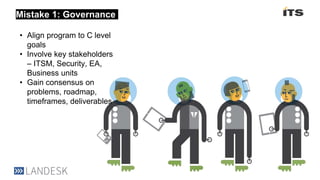
• Align program to C level
goals
• Involve key stakeholders
– ITSM, Security, EA,
Business units
• Gain consensus on
problems, roadmap,
timeframes, deliverables
Let’s talk about process…
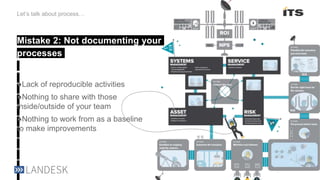
Mistake 2: Not documenting your
processes
Let’s talk about process…
●Lack of reproducible activities
●Nothing to share with those
inside/outside of your team
●Nothing to work from as a baseline
to make improvements
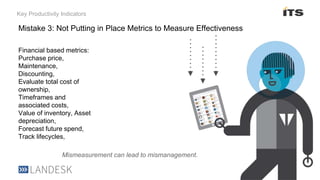
Key Productivity Indicators
Financial based metrics:
Purchase price,
Maintenance,
Discounting,
Evaluate total cost of
ownership,
Timeframes and
associated costs,
Value of inventory, Asset
depreciation,
Forecast future spend,
Track lifecycles,
Mismeasurement can lead to mismanagement.
Mistake 3: Not Putting in Place Metrics to Measure Effectiveness
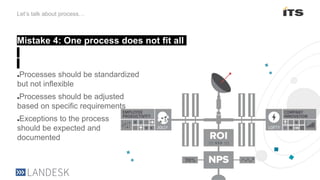
Mistake 4: One process does not fit all
Let’s talk about process…
●Processes should be standardized
but not inflexible
●Processes should be adjusted
based on specific requirements
●Exceptions to the process
should be expected and
documented
Effective policies? What exactly
does that mean?
Section heading here
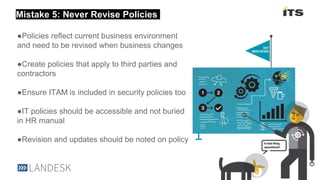
●Policies reflect current business environment
and need to be revised when business changes
●Create policies that apply to third parties and
contractors
●Ensure ITAM is included in security policies too
●IT policies should be accessible and not buried
in HR manual
●Revision and updates should be noted on policy
Mistake 5: Never Revise Policies
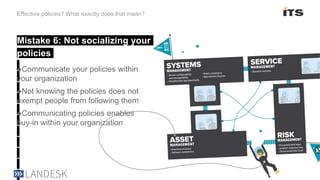
Mistake 6: Not socializing your
policies
Effective policies? What exactly does that mean?
●Communicate your policies within
your organization
●Not knowing the policies does not
exempt people from following them
●Communicating policies enables
buy-in within your organization
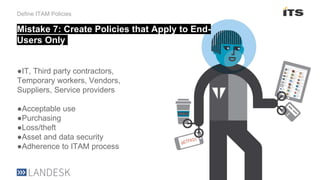
Define ITAM Policies
●IT, Third party contractors,
Temporary workers, Vendors,
Suppliers, Service providers
●Acceptable use
●Purchasing
●Loss/theft
●Asset and data security
●Adherence to ITAM process
Mistake 7: Create Policies that Apply to End-
Users Only
So you have a tool…now what?
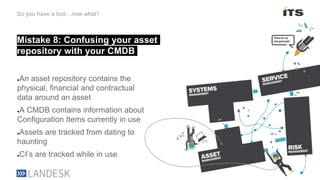
Mistake 8: Confusing your asset
repository with your CMDB
So you have a tool…now what?
●An asset repository contains the
physical, financial and contractual
data around an asset
●A CMDB contains information about
Configuration Items currently in use
●Assets are tracked from dating to
haunting
●CI’s are tracked while in use
Mistake 9: Relying on Discovery Data From a Tool that Isn’t
Fully Deployed
Now where did it go?
• Define which assets are in scope
• Ensure agent is deployed on all
assets and credential level access
for agentless
• Use bar code scanning, RFID,
sensors to detect assets not on
network
• Have a process for tracking new
and used spare parts
• Track assets by user, location,
project, cost center
Mistake 10: Never normalizing your data
So you have a tool…now what?
●Review for duplication:
oFoundational Data: Users, Departments,
Locations
oAsset data: Models – SW/HW
Thank you!
Yvette Mathews| @itam4life
Senior Consultant, ITS Partners
Patricia Adams | @patriciaadams
ITAM Evangelist, LANDESK

LDITSITAM WebinarSept2016

  • 1.
    Ten mistakes notto make when implementing ITAM/SAM Yvette Mathews | @itam4life Senior Consultant, ITS Partners Patricia Adams | @patriciaadams ITAM Evangelist, LANDESK
  • 2.
    Section heading hereMistake1: Governance • Align program to C level goals • Involve key stakeholders – ITSM, Security, EA, Business units • Gain consensus on problems, roadmap, timeframes, deliverables
  • 3.
  • 4.
    Mistake 2: Notdocumenting your processes Let’s talk about process… ●Lack of reproducible activities ●Nothing to share with those inside/outside of your team ●Nothing to work from as a baseline to make improvements
  • 5.
    Key Productivity Indicators Financialbased metrics: Purchase price, Maintenance, Discounting, Evaluate total cost of ownership, Timeframes and associated costs, Value of inventory, Asset depreciation, Forecast future spend, Track lifecycles, Mismeasurement can lead to mismanagement. Mistake 3: Not Putting in Place Metrics to Measure Effectiveness
  • 6.
    Mistake 4: Oneprocess does not fit all Let’s talk about process… ●Processes should be standardized but not inflexible ●Processes should be adjusted based on specific requirements ●Exceptions to the process should be expected and documented
  • 7.
    Effective policies? Whatexactly does that mean?
  • 8.
    Section heading here ●Policiesreflect current business environment and need to be revised when business changes ●Create policies that apply to third parties and contractors ●Ensure ITAM is included in security policies too ●IT policies should be accessible and not buried in HR manual ●Revision and updates should be noted on policy Mistake 5: Never Revise Policies
  • 9.
    Mistake 6: Notsocializing your policies Effective policies? What exactly does that mean? ●Communicate your policies within your organization ●Not knowing the policies does not exempt people from following them ●Communicating policies enables buy-in within your organization
  • 10.
    Define ITAM Policies ●IT,Third party contractors, Temporary workers, Vendors, Suppliers, Service providers ●Acceptable use ●Purchasing ●Loss/theft ●Asset and data security ●Adherence to ITAM process Mistake 7: Create Policies that Apply to End- Users Only
  • 11.
    So you havea tool…now what?
  • 12.
    Mistake 8: Confusingyour asset repository with your CMDB So you have a tool…now what? ●An asset repository contains the physical, financial and contractual data around an asset ●A CMDB contains information about Configuration Items currently in use ●Assets are tracked from dating to haunting ●CI’s are tracked while in use
  • 13.
    Mistake 9: Relyingon Discovery Data From a Tool that Isn’t Fully Deployed Now where did it go? • Define which assets are in scope • Ensure agent is deployed on all assets and credential level access for agentless • Use bar code scanning, RFID, sensors to detect assets not on network • Have a process for tracking new and used spare parts • Track assets by user, location, project, cost center
  • 14.
    Mistake 10: Nevernormalizing your data So you have a tool…now what? ●Review for duplication: oFoundational Data: Users, Departments, Locations oAsset data: Models – SW/HW
  • 15.
    Thank you! Yvette Mathews|@itam4life Senior Consultant, ITS Partners Patricia Adams | @patriciaadams ITAM Evangelist, LANDESK