Getting the Workforce to
Factor Enterprise Risk into Outsourcing Decisions
What is Supply Chain Risk Management?


• Supply chain risk management (SCRM) ensures that the enterprise’s
  sourced products (HW&SW) and services are functionally correct

• SCRM encompasses five different categories of risk*

    1. Installation of malicious logic in hardware or software
    2. Installation of counterfeit hardware or software
    3. Failure or disruption in the production or distribution of a critical
       product or service
    4. Reliance upon a malicious or unqualified supplier
    5. Installation of unintentional vulnerabilities

    * US General Accounting Office (GAO) March 23, 2012 p. 12
What is Supply Chain Risk Management?


• The key outcome of -SCRM is that it guarantees that an organization’s
  sourced products do what they are intended to do and only that

• SCRM is enforced through a system-of-systems Enterprise Security
  Framework (ESF) of controls

• Mitigations are designed and deployed through a formal criticality analysis
  and prioritization scheme (defense in depth)

• The aim of SCRM is to ensure that we fully understand all meaningful
  risks (to the enterprise) when arriving at a make-buy decision?
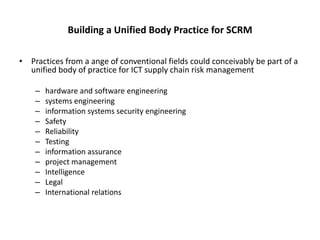
Building a Unified Body Practice for SCRM

• Practices from a ange of conventional fields could conceivably be part of a
  unified body of practice for ICT supply chain risk management

    –   hardware and software engineering
    –   systems engineering
    –   information systems security engineering
    –   Safety
    –   Reliability
    –   Testing
    –   information assurance
    –   project management
    –   Intelligence
    –   Legal
    –   International relations
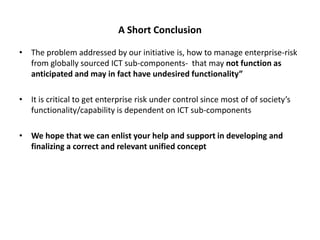
A Short Conclusion

• The problem addressed by our initiative is, how to manage enterprise-risk
  from globally sourced ICT sub-components- that may not function as
  anticipated and may in fact have undesired functionality”

• It is critical to get enterprise risk under control since most of of society’s
  functionality/capability is dependent on ICT sub-components

• We hope that we can enlist your help and support in developing and
  finalizing a correct and relevant unified concept
THANK YOU FOR YOUR ATTENTION


Dan Shoemaker, PhD, Director and Senior Research Scientist
Global EdICT - Supporting Don Davidson, Chief of Outreach Globalization
   Task Force (GTF) OASD-NII / DoD CIO

dan.shoemaker@att.net

2 ppt final dan shoemaker dd1 stockholm presentation

  • 1.
    Getting the Workforceto Factor Enterprise Risk into Outsourcing Decisions
  • 2.
    What is SupplyChain Risk Management? • Supply chain risk management (SCRM) ensures that the enterprise’s sourced products (HW&SW) and services are functionally correct • SCRM encompasses five different categories of risk* 1. Installation of malicious logic in hardware or software 2. Installation of counterfeit hardware or software 3. Failure or disruption in the production or distribution of a critical product or service 4. Reliance upon a malicious or unqualified supplier 5. Installation of unintentional vulnerabilities * US General Accounting Office (GAO) March 23, 2012 p. 12
  • 3.
    What is SupplyChain Risk Management? • The key outcome of -SCRM is that it guarantees that an organization’s sourced products do what they are intended to do and only that • SCRM is enforced through a system-of-systems Enterprise Security Framework (ESF) of controls • Mitigations are designed and deployed through a formal criticality analysis and prioritization scheme (defense in depth) • The aim of SCRM is to ensure that we fully understand all meaningful risks (to the enterprise) when arriving at a make-buy decision?
  • 4.
    Building a UnifiedBody Practice for SCRM • Practices from a ange of conventional fields could conceivably be part of a unified body of practice for ICT supply chain risk management – hardware and software engineering – systems engineering – information systems security engineering – Safety – Reliability – Testing – information assurance – project management – Intelligence – Legal – International relations
  • 5.
    A Short Conclusion •The problem addressed by our initiative is, how to manage enterprise-risk from globally sourced ICT sub-components- that may not function as anticipated and may in fact have undesired functionality” • It is critical to get enterprise risk under control since most of of society’s functionality/capability is dependent on ICT sub-components • We hope that we can enlist your help and support in developing and finalizing a correct and relevant unified concept
  • 6.
    THANK YOU FORYOUR ATTENTION Dan Shoemaker, PhD, Director and Senior Research Scientist Global EdICT - Supporting Don Davidson, Chief of Outreach Globalization Task Force (GTF) OASD-NII / DoD CIO dan.shoemaker@att.net