The Security-Enhanced PostgreSQL
 - "system wide" consistency in access controls -

           NEC OSS Promotion Center
                  KaiGai Kohei
            <kaigai@ak.jp.nec.com>


                                                1
Self Introduction


         Working for NEC, come from Tokyo, Japan
         Primary developer of SE-PostgreSQL
           I've forcused on the work for more than 2 years.
         6 year's experience in Linux kernel development
           Especially, SELinux and security related region
              SMP Scalability improvement (2.6.11)
              XATTR Support in JFFS (2.6.18)
              SELinux support in busybox
              Type boundary and Multithreading (2.6.28)


Page 2
The Background


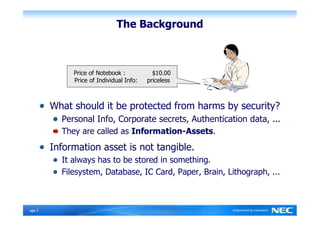
              Price of Notebook :           $10.00
              Price of Individual Info:   priceless


         What should it be protected from harms by security?
           Personal Info, Corporate secrets, Authentication data, ...
           They are called as Information-Assets.
         Information asset is not tangible.
           It always has to be stored in something.
           Filesystem, Database, IC Card, Paper, Brain, Lithograph, ...


Page 3
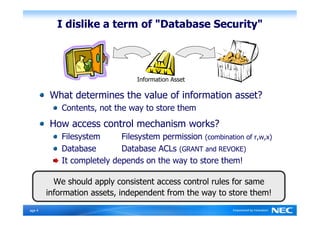
I dislike a term of "Database Security"


                                  Information Asset

         What determines the value of information asset?
             Contents, not the way to store them
         How access control mechanism works?
             Filesystem      Filesystem permission (combination of r,w,x)
             Database        Database ACLs (GRANT and REVOKE)
             It completely depends on the way to store them!

           We should apply consistent access control rules for same
         information assets, independent from the way to store them!
Page 4
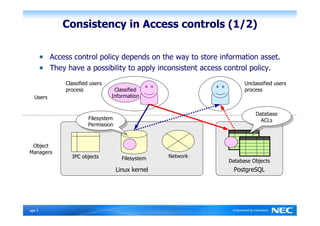
Consistency in Access controls (1/2)

           Access control policy depends on the way to store information asset.
           They have a possibility to apply inconsistent access control policy.
               Classified users                                      Unclassified users
               process             Classified                        process
   Users                          Information


                                                                         Database
                                                                          Database
                        Filesystem
                         Filesystem                                        ACLs
                        Permission                                          ACLs
                         Permission


  Object
 Managers
                 IPC objects            Filesystem   Network
                                                               Database Objects
                                      Linux kernel               PostgreSQL


Page 5
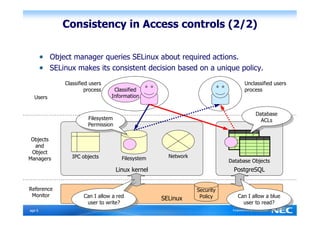
Consistency in Access controls (2/2)

           Object manager queries SELinux about required actions.
           SELinux makes its consistent decision based on a unique policy.
               Classified users                                                    Unclassified users
                        process    Classified                                      process
   Users                          Information


                                                                                       Database
                                                                                        Database
                         Filesystem
                          Filesystem                                                     ACLs
                         Permission                                                       ACLs
                          Permission

 Objects
  and
 Object
Managers          IPC objects            Filesystem     Network
                                                                             Database Objects
                                       Linux kernel                            PostgreSQL


Reference                                                         Security
 Monitor               Can I Iallow aared                          Policy       Can I Iallow aablue
                        Can allow red                 SELinux                    Can allow blue
                         user to write?
                          user to write?                                          user to read?
                                                                                   user to read?
Page 6
The Feature of SE-PostgreSQL


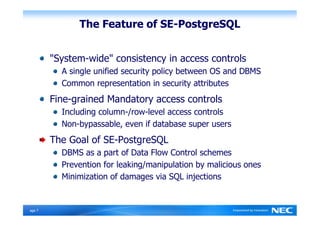
         "System-wide" consistency in access controls
           A single unified security policy between OS and DBMS
           Common representation in security attributes
         Fine-grained Mandatory access controls
           Including column-/row-level access controls
           Non-bypassable, even if database super users
         The Goal of SE-PostgreSQL
           DBMS as a part of Data Flow Control schemes
           Prevention for leaking/manipulation by malicious ones
           Minimization of damages via SQL injections


Page 7
"System-wide" consistency
    in Access Controls


                            8
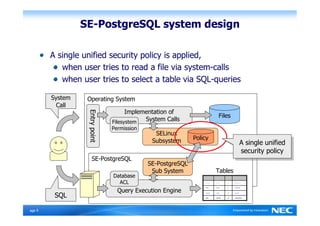
SE-PostgreSQL system design

         A single unified security policy is applied,
            when user tries to read a file via system-calls
            when user tries to select a table via SQL-queries

         System    Operating System
           Call
                                       Implementation of
                   Entry point


                                                                              Files
                                 Filesystem  System Calls
                                 Permission
                                                SELinux
                                               Subsystem      Policy
                                                                                             A single unified
                                                                                              A single unified
                                                                                             security policy
                                                                                              security policy
                      SE-PostgreSQL
                                              SE-PostgreSQL
                                               Sub System                  Tables
                                 Database
                                   ACL                            ------   ----   --   -------


                                   Query Execution Engine
                                                                  ***      ***    *    *****


          SQL
                                                                  +++      ++     +    +++

                                                                  ##       ###    #    #####


Page 9
How security policy works? (1/2)


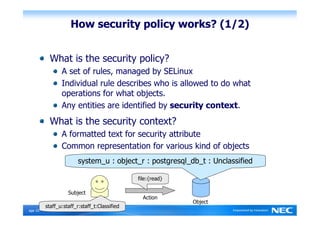
            What is the security policy?
                 A set of rules, managed by SELinux
                 Individual rule describes who is allowed to do what
                 operations for what objects.
                 Any entities are identified by security context.
            What is the security context?
                 A formatted text for security attribute
                 Common representation for various kind of objects
                         system_u : object_r : postgresql_db_t : Unclassified

                                               file:{read}

                    Subject
                                                 Action
                                                             Object
          staff_u:staff_r:staff_t:Classified
Page 10
How security policy works? (2/2)
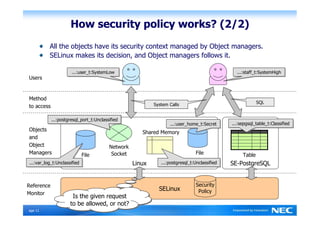
           All the objects have its security context managed by Object managers.
           SELinux makes its decision, and Object managers follows it.

                       ...:user_t:SystemLow
                        ...:user_t:SystemLow                                                       ...:staff_t:SystemHigh
                                                                                                    ...:staff_t:SystemHigh
 Users


 Method
                                                             System Calls                                     SQL
 to access

             ...:postgresql_port_t:Unclassified
              ...:postgresql_port_t:Unclassified
                                                                    ...:user_home_t:Secret
                                                                     ...:user_home_t:Secret      ...:sepgsql_table_t:Classified
                                                                                                  ...:sepgsql_table_t:Classified
 Objects
                                                        Shared Memory
 and
 Object                                    Network
 Managers                      File         Socket                                File                Table
 ...:var_log_t:Unclassified
  ...:var_log_t:Unclassified                         Linux      ...:postgresql_t:Unclassified
                                                                 ...:postgresql_t:Unclassified   SE-PostgreSQL


Reference                                                                         Security
                                                               SELinux             Policy
Monitor
                       Is the given request
                       Is the given request
                      to be allowed, or not?
                      to be allowed, or not?
Page 11
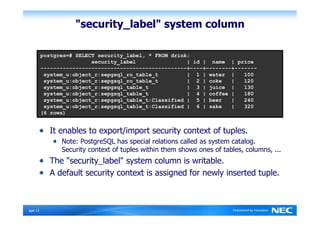
"security_label" system column

          p o s t g r e s = #                                     S E L E C T                    s e c           u r i           t y _           l a b           e l ,           *    F R O M      d r i n k ;
                                                                                        s e       c u r           i t y           _ l a           b e l                                                         |     i d    |        n a m          e      |      p r i c         e
          - - -           - - -          - - -         - - -         - - -         - - -           - - -           - - -           - - -           - - -         - - -         - - - - - - - - - - - - - + - - - - + - -               - - -         - - - +    - - - - -          - -
               s y         s t e          m _ u         : o b         j e c         t _ r           : s e           p g s           q l _           r o _         t a b         l e _ t                          |       1 | w          a t e        r      |           1 0        0
                s y         s t e          m _ u         : o b         j e c         t _ r           : s e           p g s           q l _           r o _         t a b         l e _ t                           |      2 | c          o k e              |            1 2       0
                 s y         s t e          m _ u         : o b         j e c         t _ r           : s e           p g s           q l _           t a b         l e _         t                                  |     3 | j          u i c      e      |             1 3      0
                  s y         s t e          m _ u         : o b         j e c         t _ r           : s e           p g s           q l _           t a b         l e _          t                                  |    4 | c          o f f     e e    |              1 8     0
                   s y         s t e          m _ u         : o b         j e c         t _ r           : s e           p g s           q l _           t a b         l e _           t : C l a s s i f i e d |              5 | b          e e r           |               2 4    0
                    s y         s t e          m _ u         : o b         j e c         t _ r           : s e           p g s           q l _           t a b         l e _           t : C l a s s i f i e d |              6 | s          a k e          |                3 2   0
           ( 6                   r o w          s )


                          It enables to export/import security context of tuples.
                                            Note: PostgreSQL has special relations called as system catalog.
                                            Security context of tuples within them shows ones of tables, columns, ...
                          The "security_label" system column is writable.
                          A default security context is assigned for newly inserted tuple.


Page 12
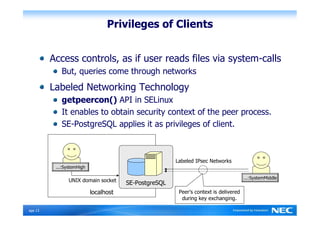
Privileges of Clients


          Access controls, as if user reads files via system-calls
             But, queries come through networks
          Labeled Networking Technology
             getpeercon() API in SELinux
             It enables to obtain security context of the peer process.
             SE-PostgreSQL applies it as privileges of client.


                                                        Labeled IPsec Networks
           ...:SystemHigh

                                                                                       ...:SystemMiddle
                 UNIX domain socket
                                        SE-PostgreSQL
                            localhost                    Peer's context is delivered
                                                          during key exchanging.

Page 13
Fine-Grained
Mandatory Access Controls


                            14
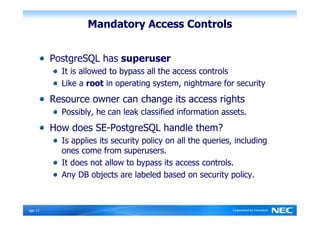
Mandatory Access Controls


          PostgreSQL has superuser
            It is allowed to bypass all the access controls
            Like a root in operating system, nightmare for security
          Resource owner can change its access rights
            Possibly, he can leak classified information assets.
          How does SE-PostgreSQL handle them?
            Is applies its security policy on all the queries, including
            ones come from superusers.
            It does not allow to bypass its access controls.
            Any DB objects are labeled based on security policy.


Page 15
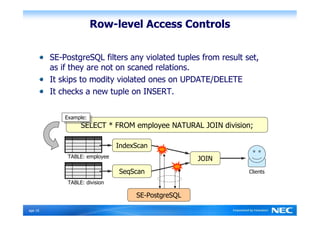
Row-level Access Controls


          SE-PostgreSQL filters any violated tuples from result set,
          as if they are not on scaned relations.
          It skips to modity violated ones on UPDATE/DELETE
          It checks a new tuple on INSERT.

              Example:
               Example:
                    SELECT * FROM employee NATURAL JOIN division;

                                 IndexScan
               TABLE: employee                        JOIN
                                 SeqScan                         Clients

               TABLE: division

                                      SE-PostgreSQL

Page 16
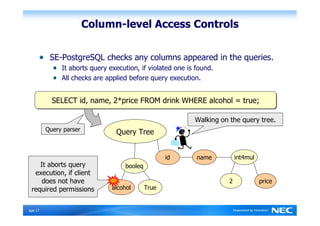
Column-level Access Controls


           SE-PostgreSQL checks any columns appeared in the queries.
               It aborts query execution, if violated one is found.
               All checks are applied before query execution.


            SELECT id, name, 2*price FROM drink WHERE alcohol = true;

                                                            Walking on the query tree.
          Query parser           Query Tree


                                                     id      name          int4mul
     It aborts query                 booleq
   execution, if client
     does not have                                                     2             price
  required permissions          alcohol       True


Page 17
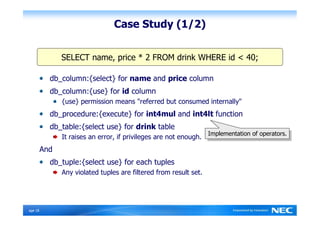
Case Study (1/2)


                SELECT name, price * 2 FROM drink WHERE id < 40;

            db_column:{select} for name and price column
            db_column:{use} for id column
                {use} permission means "referred but consumed internally"
            db_procedure:{execute} for int4mul and int4lt function
            db_table:{select use} for drink table
                                                                    Implementation of operators.
                                                                     Implementation of operators.
                It raises an error, if privileges are not enough.
          And
            db_tuple:{select use} for each tuples
                Any violated tuples are filtered from result set.


Page 18
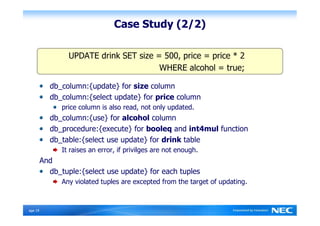
Case Study (2/2)

                  UPDATE drink SET size = 500, price = price * 2
                                         WHERE alcohol = true;

            db_column:{update} for size column
            db_column:{select update} for price column
                price column is also read, not only updated.
            db_column:{use} for alcohol column
            db_procedure:{execute} for booleq and int4mul function
            db_table:{select use update} for drink table
                It raises an error, if privilges are not enough.
          And
            db_tuple:{select use update} for each tuples
                Any violated tuples are excepted from the target of updating.


Page 19
Demonstration


                20
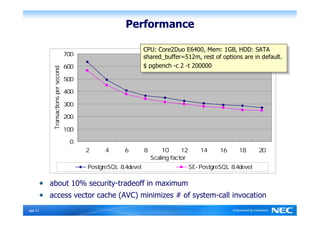
Performance

                                                                 CPU: Core2Duo E6400, Mem: 1GB, HDD: SATA
                                                                  CPU: Core2Duo E6400, Mem: 1GB, HDD: SATA
                                     700                         shared_buffer=512m, rest of options are in default.
                                                                  shared_buffer=512m, rest of options are in default.
                                     600                         $$pgbench -c 22-t 200000
                                                                    pgbench -c -t 200000
           Transactions per second


                                     500

                                     400

                                     300

                                     200

                                     100

                                       0
                                           2     4      6        8        10     12       14    16     18      20
                                                                     Scaling factor
                                           PostgreSQL 8.4devel                        SE-PostgreSQL 8.4devel

          about 10% security-tradeoff in maximum
          access vector cache (AVC) minimizes # of system-call invocation
Page 21
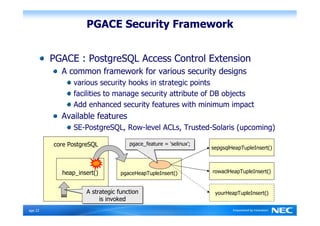
PGACE Security Framework


          PGACE : PostgreSQL Access Control Extension
            A common framework for various security designs
                various security hooks in strategic points
                facilities to manage security attribute of DB objects
                Add enhanced security features with minimum impact
            Available features
                SE-PostgreSQL, Row-level ACLs, Trusted-Solaris (upcoming)

          core PostgreSQL            pgace_feature = 'selinux';
                                     pgace_feature = 'selinux';
                                                                  sepgsqlHeapTupleInsert()


            heap_insert()        pgaceHeapTupleInsert()           rowaclHeapTupleInsert()


                     A strategic function
                     A strategic function                          yourHeapTupleInsert()
                          is invoked
                           is invoked
Page 22
The current status of SE-PostgreSQL


          Upstreaming status
            Currently, we are working under PostgreSQL v8.4
            development cycle.
             http://wiki.postgresql.org/wiki/CommitFest:2008-11
            It has been unclear whether we can enjoy SE-PostgreSQL
            on the next version of vanilla PostgreSQL, or not :(
          Distribution Support
            sepostgresql package is available on Fedora 8 or later.
            The default security policy also support SE-PostgreSQL.
          Resources
            http://code.google.com/p/sepgsql/
            http://wiki.postgresql.org/wiki/SEPostgreSQL
Page 23
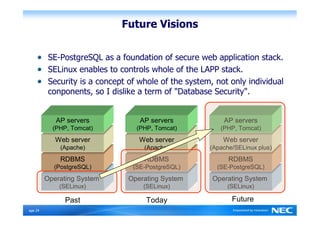
Future Visions


           SE-PostgreSQL as a foundation of secure web application stack.
           SELinux enables to controls whole of the LAPP stack.
           Security is a concept of whole of the system, not only individual
           conponents, so I dislike a term of "Database Security".


             AP servers             AP servers             AP servers
            (PHP, Tomcat)          (PHP, Tomcat)          (PHP, Tomcat)
             Web server             Web server             Web server
              (Apache)               (Apache)          (Apache/SELinux plus)
              RDBMS                  RDBMS                   RDBMS
            (PostgreSQL)          (SE-PostgreSQL)        (SE-PostgreSQL)
          Operating System       Operating System       Operating System
              (SELinux)              (SELinux)              (SELinux)

                Past                  Today                   Future
Page 24
Any Question?


                25
Thank you!


             26

The Security-Enhanced PostgreSQL - "system wide" consistency in access control

  • 1.
    The Security-Enhanced PostgreSQL - "system wide" consistency in access controls - NEC OSS Promotion Center KaiGai Kohei <kaigai@ak.jp.nec.com> 1
  • 2.
    Self Introduction Working for NEC, come from Tokyo, Japan Primary developer of SE-PostgreSQL I've forcused on the work for more than 2 years. 6 year's experience in Linux kernel development Especially, SELinux and security related region SMP Scalability improvement (2.6.11) XATTR Support in JFFS (2.6.18) SELinux support in busybox Type boundary and Multithreading (2.6.28) Page 2
  • 3.
    The Background Price of Notebook : $10.00 Price of Individual Info: priceless What should it be protected from harms by security? Personal Info, Corporate secrets, Authentication data, ... They are called as Information-Assets. Information asset is not tangible. It always has to be stored in something. Filesystem, Database, IC Card, Paper, Brain, Lithograph, ... Page 3
  • 4.
    I dislike aterm of "Database Security" Information Asset What determines the value of information asset? Contents, not the way to store them How access control mechanism works? Filesystem Filesystem permission (combination of r,w,x) Database Database ACLs (GRANT and REVOKE) It completely depends on the way to store them! We should apply consistent access control rules for same information assets, independent from the way to store them! Page 4
  • 5.
    Consistency in Accesscontrols (1/2) Access control policy depends on the way to store information asset. They have a possibility to apply inconsistent access control policy. Classified users Unclassified users process Classified process Users Information Database Database Filesystem Filesystem ACLs Permission ACLs Permission Object Managers IPC objects Filesystem Network Database Objects Linux kernel PostgreSQL Page 5
  • 6.
    Consistency in Accesscontrols (2/2) Object manager queries SELinux about required actions. SELinux makes its consistent decision based on a unique policy. Classified users Unclassified users process Classified process Users Information Database Database Filesystem Filesystem ACLs Permission ACLs Permission Objects and Object Managers IPC objects Filesystem Network Database Objects Linux kernel PostgreSQL Reference Security Monitor Can I Iallow aared Policy Can I Iallow aablue Can allow red SELinux Can allow blue user to write? user to write? user to read? user to read? Page 6
  • 7.
    The Feature ofSE-PostgreSQL "System-wide" consistency in access controls A single unified security policy between OS and DBMS Common representation in security attributes Fine-grained Mandatory access controls Including column-/row-level access controls Non-bypassable, even if database super users The Goal of SE-PostgreSQL DBMS as a part of Data Flow Control schemes Prevention for leaking/manipulation by malicious ones Minimization of damages via SQL injections Page 7
  • 8.
    "System-wide" consistency in Access Controls 8
  • 9.
    SE-PostgreSQL system design A single unified security policy is applied, when user tries to read a file via system-calls when user tries to select a table via SQL-queries System Operating System Call Implementation of Entry point Files Filesystem System Calls Permission SELinux Subsystem Policy A single unified A single unified security policy security policy SE-PostgreSQL SE-PostgreSQL Sub System Tables Database ACL ------ ---- -- ------- Query Execution Engine *** *** * ***** SQL +++ ++ + +++ ## ### # ##### Page 9
  • 10.
    How security policyworks? (1/2) What is the security policy? A set of rules, managed by SELinux Individual rule describes who is allowed to do what operations for what objects. Any entities are identified by security context. What is the security context? A formatted text for security attribute Common representation for various kind of objects system_u : object_r : postgresql_db_t : Unclassified file:{read} Subject Action Object staff_u:staff_r:staff_t:Classified Page 10
  • 11.
    How security policyworks? (2/2) All the objects have its security context managed by Object managers. SELinux makes its decision, and Object managers follows it. ...:user_t:SystemLow ...:user_t:SystemLow ...:staff_t:SystemHigh ...:staff_t:SystemHigh Users Method System Calls SQL to access ...:postgresql_port_t:Unclassified ...:postgresql_port_t:Unclassified ...:user_home_t:Secret ...:user_home_t:Secret ...:sepgsql_table_t:Classified ...:sepgsql_table_t:Classified Objects Shared Memory and Object Network Managers File Socket File Table ...:var_log_t:Unclassified ...:var_log_t:Unclassified Linux ...:postgresql_t:Unclassified ...:postgresql_t:Unclassified SE-PostgreSQL Reference Security SELinux Policy Monitor Is the given request Is the given request to be allowed, or not? to be allowed, or not? Page 11
  • 12.
    "security_label" system column p o s t g r e s = # S E L E C T s e c u r i t y _ l a b e l , * F R O M d r i n k ; s e c u r i t y _ l a b e l | i d | n a m e | p r i c e - - - - - - - - - - - - - - - - - - - - - - - - - - - - - - - - - - - - - - - - - - - - - - + - - - - + - - - - - - - - + - - - - - - - s y s t e m _ u : o b j e c t _ r : s e p g s q l _ r o _ t a b l e _ t | 1 | w a t e r | 1 0 0 s y s t e m _ u : o b j e c t _ r : s e p g s q l _ r o _ t a b l e _ t | 2 | c o k e | 1 2 0 s y s t e m _ u : o b j e c t _ r : s e p g s q l _ t a b l e _ t | 3 | j u i c e | 1 3 0 s y s t e m _ u : o b j e c t _ r : s e p g s q l _ t a b l e _ t | 4 | c o f f e e | 1 8 0 s y s t e m _ u : o b j e c t _ r : s e p g s q l _ t a b l e _ t : C l a s s i f i e d | 5 | b e e r | 2 4 0 s y s t e m _ u : o b j e c t _ r : s e p g s q l _ t a b l e _ t : C l a s s i f i e d | 6 | s a k e | 3 2 0 ( 6 r o w s ) It enables to export/import security context of tuples. Note: PostgreSQL has special relations called as system catalog. Security context of tuples within them shows ones of tables, columns, ... The "security_label" system column is writable. A default security context is assigned for newly inserted tuple. Page 12
  • 13.
    Privileges of Clients Access controls, as if user reads files via system-calls But, queries come through networks Labeled Networking Technology getpeercon() API in SELinux It enables to obtain security context of the peer process. SE-PostgreSQL applies it as privileges of client. Labeled IPsec Networks ...:SystemHigh ...:SystemMiddle UNIX domain socket SE-PostgreSQL localhost Peer's context is delivered during key exchanging. Page 13
  • 14.
  • 15.
    Mandatory Access Controls PostgreSQL has superuser It is allowed to bypass all the access controls Like a root in operating system, nightmare for security Resource owner can change its access rights Possibly, he can leak classified information assets. How does SE-PostgreSQL handle them? Is applies its security policy on all the queries, including ones come from superusers. It does not allow to bypass its access controls. Any DB objects are labeled based on security policy. Page 15
  • 16.
    Row-level Access Controls SE-PostgreSQL filters any violated tuples from result set, as if they are not on scaned relations. It skips to modity violated ones on UPDATE/DELETE It checks a new tuple on INSERT. Example: Example: SELECT * FROM employee NATURAL JOIN division; IndexScan TABLE: employee JOIN SeqScan Clients TABLE: division SE-PostgreSQL Page 16
  • 17.
    Column-level Access Controls SE-PostgreSQL checks any columns appeared in the queries. It aborts query execution, if violated one is found. All checks are applied before query execution. SELECT id, name, 2*price FROM drink WHERE alcohol = true; Walking on the query tree. Query parser Query Tree id name int4mul It aborts query booleq execution, if client does not have 2 price required permissions alcohol True Page 17
  • 18.
    Case Study (1/2) SELECT name, price * 2 FROM drink WHERE id < 40; db_column:{select} for name and price column db_column:{use} for id column {use} permission means "referred but consumed internally" db_procedure:{execute} for int4mul and int4lt function db_table:{select use} for drink table Implementation of operators. Implementation of operators. It raises an error, if privileges are not enough. And db_tuple:{select use} for each tuples Any violated tuples are filtered from result set. Page 18
  • 19.
    Case Study (2/2) UPDATE drink SET size = 500, price = price * 2 WHERE alcohol = true; db_column:{update} for size column db_column:{select update} for price column price column is also read, not only updated. db_column:{use} for alcohol column db_procedure:{execute} for booleq and int4mul function db_table:{select use update} for drink table It raises an error, if privilges are not enough. And db_tuple:{select use update} for each tuples Any violated tuples are excepted from the target of updating. Page 19
  • 20.
  • 21.
    Performance CPU: Core2Duo E6400, Mem: 1GB, HDD: SATA CPU: Core2Duo E6400, Mem: 1GB, HDD: SATA 700 shared_buffer=512m, rest of options are in default. shared_buffer=512m, rest of options are in default. 600 $$pgbench -c 22-t 200000 pgbench -c -t 200000 Transactions per second 500 400 300 200 100 0 2 4 6 8 10 12 14 16 18 20 Scaling factor PostgreSQL 8.4devel SE-PostgreSQL 8.4devel about 10% security-tradeoff in maximum access vector cache (AVC) minimizes # of system-call invocation Page 21
  • 22.
    PGACE Security Framework PGACE : PostgreSQL Access Control Extension A common framework for various security designs various security hooks in strategic points facilities to manage security attribute of DB objects Add enhanced security features with minimum impact Available features SE-PostgreSQL, Row-level ACLs, Trusted-Solaris (upcoming) core PostgreSQL pgace_feature = 'selinux'; pgace_feature = 'selinux'; sepgsqlHeapTupleInsert() heap_insert() pgaceHeapTupleInsert() rowaclHeapTupleInsert() A strategic function A strategic function yourHeapTupleInsert() is invoked is invoked Page 22
  • 23.
    The current statusof SE-PostgreSQL Upstreaming status Currently, we are working under PostgreSQL v8.4 development cycle. http://wiki.postgresql.org/wiki/CommitFest:2008-11 It has been unclear whether we can enjoy SE-PostgreSQL on the next version of vanilla PostgreSQL, or not :( Distribution Support sepostgresql package is available on Fedora 8 or later. The default security policy also support SE-PostgreSQL. Resources http://code.google.com/p/sepgsql/ http://wiki.postgresql.org/wiki/SEPostgreSQL Page 23
  • 24.
    Future Visions SE-PostgreSQL as a foundation of secure web application stack. SELinux enables to controls whole of the LAPP stack. Security is a concept of whole of the system, not only individual conponents, so I dislike a term of "Database Security". AP servers AP servers AP servers (PHP, Tomcat) (PHP, Tomcat) (PHP, Tomcat) Web server Web server Web server (Apache) (Apache) (Apache/SELinux plus) RDBMS RDBMS RDBMS (PostgreSQL) (SE-PostgreSQL) (SE-PostgreSQL) Operating System Operating System Operating System (SELinux) (SELinux) (SELinux) Past Today Future Page 24
  • 25.
  • 26.