LAYERING IN PLANTS
Dr. S.ANANDHI
Assistant Professor (Horticulture)
SRM College of Agricultural Sciences
Chengalpattu
Layering
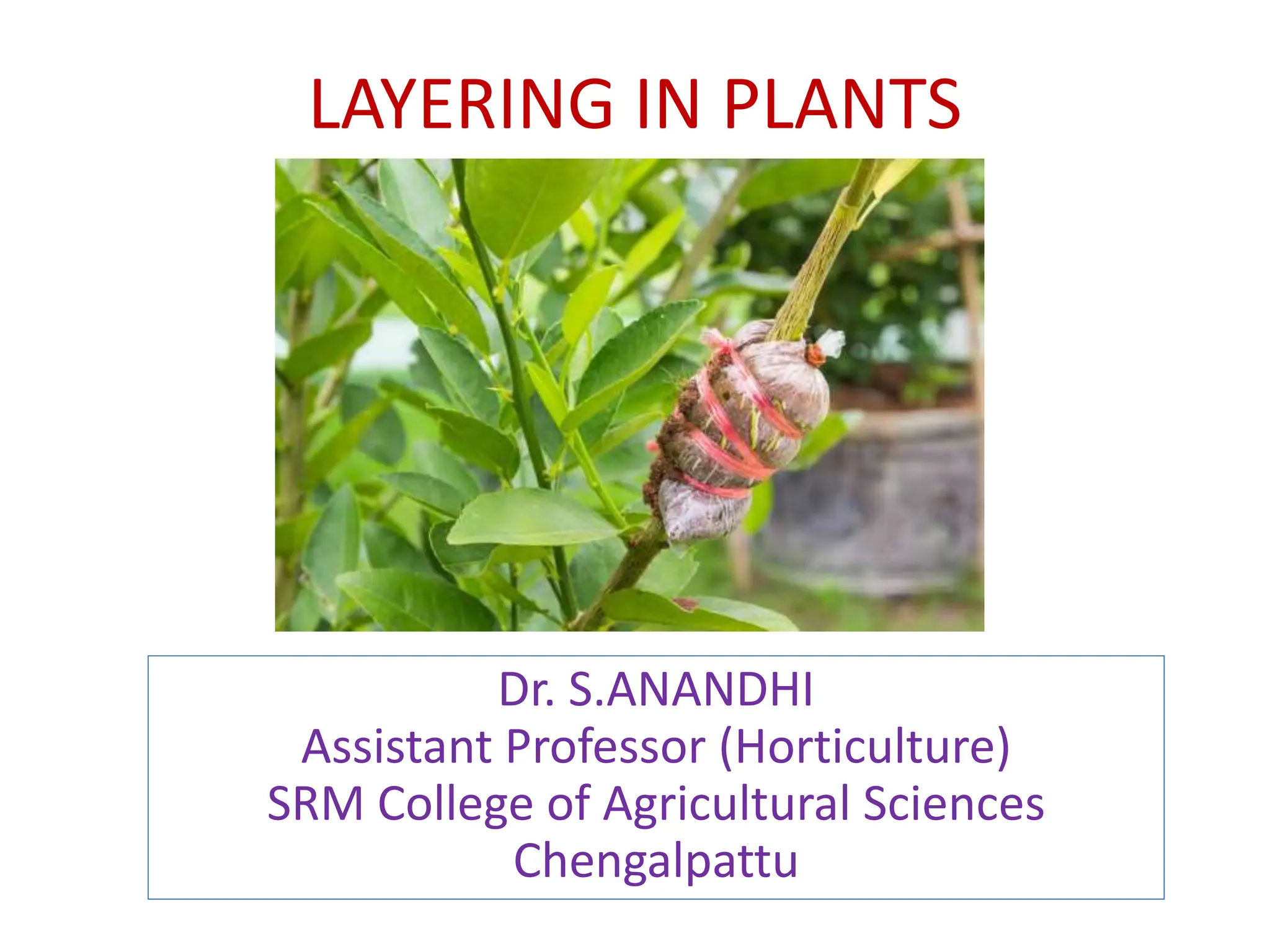
• A propagation technique where roots are formed prior
to the stem being removed from the parent plant.
PRINCIPLE OF LAYERING
• In layering, one must wound the stem such that
phloem, but not xylem, translocation is disrupted.
• The internal anatomy of dicot, gymnosperm and
monocot stems dictates the "ideal" type cut that is
made to get maximum disruption of translocation in
the phloem, while causing minimum disruption of
translocation in the xylem. If done properly, roots form
on the stem at the wounded site. The stem is then
cut-off with the attached roots.
• ANATOMICAL BASIS FOR THE TYPE CUTS USED IN
LAYERING
Woody Dicots and Gymnosperms
A ring of bark is removed from around the stem. The
phloem and cambium are attached to the inside of the
bark, so when the bark is removed the phloem is also
removed. This leaves the central cylinder of xylem and
upward water flow unaffected.
Serpentine layering
Air layering
THANK YOU

Different types of layering in Plants

  • 1.
    LAYERING IN PLANTS Dr.S.ANANDHI Assistant Professor (Horticulture) SRM College of Agricultural Sciences Chengalpattu
  • 2.
    Layering • A propagationtechnique where roots are formed prior to the stem being removed from the parent plant. PRINCIPLE OF LAYERING • In layering, one must wound the stem such that phloem, but not xylem, translocation is disrupted. • The internal anatomy of dicot, gymnosperm and monocot stems dictates the "ideal" type cut that is made to get maximum disruption of translocation in the phloem, while causing minimum disruption of translocation in the xylem. If done properly, roots form on the stem at the wounded site. The stem is then cut-off with the attached roots.
  • 4.
    • ANATOMICAL BASISFOR THE TYPE CUTS USED IN LAYERING Woody Dicots and Gymnosperms A ring of bark is removed from around the stem. The phloem and cambium are attached to the inside of the bark, so when the bark is removed the phloem is also removed. This leaves the central cylinder of xylem and upward water flow unaffected.
  • 7.
  • 9.
  • 11.