GALA presents:
Quality Control for Translations
The Best Plans, Processes, and People
Stacey Brown, Mindlink Resources
sbrown@mindlinkresources.com

@Mindlinker @gala_global @LavaCon
The Resource for the Language 
Industry
Globalization and Localization Association
2013
What is GALA?
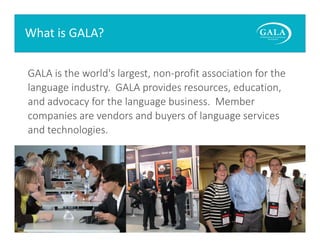
GALA is the world's largest, non‐profit association for the 
language industry.  GALA provides resources, education, 
and advocacy for the language business.  Member 
companies are vendors and buyers of language services 
and technologies. 

www.gala‐global.org
GALA Resources
Learn about translation trends, strategies, and 
technologies right from your desktop:

•
•
•
•

Free publications and articles
Industry blog 
Weekly webinars 
Conference recordings

www.gala‐global.org
Annual conference on multilingual strategy

Istanbul
March 23‐26, 2014
Istanbul

Buenos Aires

Delhi

Regional and Topic Focused Events
Local Networking Events
Collective Research, Innovation, and 
Standards Program (CRISP)
10 projects and initiatives to improve the 
translation industry
• Promotes effective use of standards
• Builds awareness of best practices
• Helps the localization community make open 
standards work

www.gala‐global.org
"We joined GALA because of the unique perspective its members
and conferences offers. GALA is about the business of localization
with great insights on not just how to localize, but about how to
run a localized business. Clients have a great deal to learn, and to
share, in an setting that steps outside the process and looks in.“
Wayne Bourland
Director, Global Localization Team
Dell
"Amway joined GALA because it is THE go-to association for the
industry. We wanted to participate in and belong to an
organization that supports localization standards and best
practices. Through GALA, we are able to provide feedback and
help guide the future of the industry.“
Catherine Guinon
Manager, Digital Operations
Amway Corporation

www.gala‐global.org/join
About the Speaker

• Stacey Brown
– Owner, Mindlink Resources, LLC

– Background as a technical trainer
– Worked as a Quality Manager for 14 years
– Blogs about language quality and other topics at
www.mindlinkresources.com
– Volunteers with GALA Standards Initiative
@mindlinker @gala_global @LavaCon
Goals

• What is localization quality and why is it
important?
• What are different actions at different stages
in localization production to produce highest
quality?
• What are different testing options?
Quality isn’t just a step in the
process. . .
@mindlinker @gala_global @LavaCon
What is Quality?

“The difficulty in defining quality is to translate future
needs of the user into measurable characteristics, so
that a product can be designed and turned out to give
satisfaction at a price that the user will pay.
This is not easy, and as soon as one feels fairly
successful in the endeavor, he finds that the needs of
the consumer have changed, competitors have moved
in, etc.”
–Deming

@mindlinker @gala_global @LavaCon
How you want your clients to
react to your product. . .

@mindlinker @gala_global @LavaCon
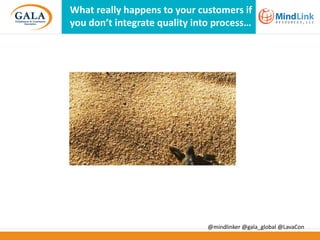
What really happens to your customers if
you don’t integrate quality into process…

@mindlinker @gala_global @LavaCon
Why is Quality Important?

• Benefits of good quality
–Customer satisfaction
–Schedule predictability
–Better team morale
–It’s cheaper!

@mindlinker @gala_global @LavaCon
Quality Ranks of 20 Countries
In the US, most software projects at 85% defect removal efficiency
(DRE) even after testing.
1.
2.
3.
4.
5.
6.
7.
8.
9.
10.

Japan
India
Denmark
South Korea
Switzerland
Israel
Canada
UK
Sweden
Norway

11.
12.
13.
14.
15.
16.
17.
18.
19.
20.

Netherlands
Hungary
Ireland
United States
Brazil
France
Australia
Austria
Belgium
Finland

Capers Jones, The Economics of Software Quality
@mindlinker @gala_global @LavaCon
What could possibly go wrong?

• Common problems seen in localization projects:
– Translation mistakes
– Graphics issues
– Cultural
inappropriateness
– Truncation
– Broken Links

– Wrong language
– Corrupted Characters
– Inconsistency
– Etc.

@mindlinker @gala_global @LavaCon
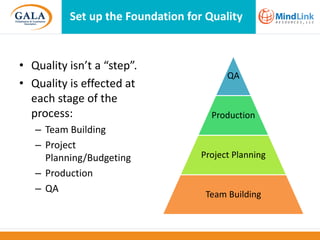
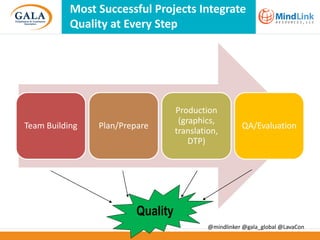
Set up the Foundation for Quality

• Quality isn’t a “step”.
• Quality is effected at
each stage of the
process:
– Team Building
– Project
Planning/Budgeting
– Production
– QA

QA

Production

Project Planning

Team Building
Most Successful Projects Integrate
Quality at Every Step

Team Building

Plan/Prepare

Production
(graphics,
translation,
DTP)

QA/Evaluation

Quality
@mindlinker @gala_global @LavaCon
Step 1: Team Building

• Quality Actions
Team Building

– Keep an updated database
– Qualify resources before the
project hits
– Prepare for human errors

@mindlinker @gala_global @LavaCon
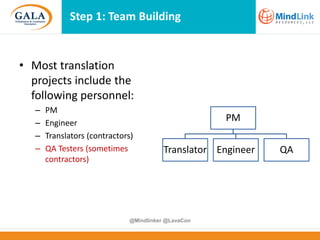
Step 1: Team Building

• Most translation
projects include the
following personnel:
–
–
–
–

PM
Engineer
Translators (contractors)
QA Testers (sometimes
contractors)

PM

Translator Engineer

@Mindlinker @LavaCon

QA
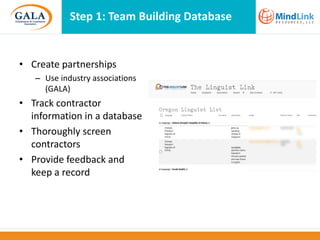
Step 1: Team Building Database

• Create partnerships
– Use industry associations
(GALA)

• Track contractor
information in a database
• Thoroughly screen
contractors
• Provide feedback and
keep a record
Step 1: Team Building
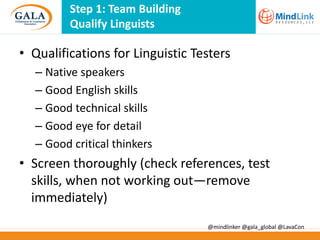
Qualify Linguists

• Qualifications for Linguistic Testers
– Native speakers
– Good English skills
– Good technical skills
– Good eye for detail
– Good critical thinkers

• Screen thoroughly (check references, test
skills, when not working out—remove
immediately)
@mindlinker @gala_global @LavaCon
Step 1: Team Building
Human Errors
• Human errors will happen. Have a plan for
dealing with them.
– Checks and balances
– Root cause analysis
– Automate repetitive tasks
– Use tools

@mindlinker @gala_global @LavaCon
Step 2: Project Planning

• Quality Actions
Plan/Prepare

– Use a project plan
– Determine project quality
expectations up front
– Use a test plan
– Follow a standard

@mindlinker @gala_global @LavaCon
Step 2: Project Planning
Create a Project Plan

• Create project plan
– Objective
– Estimates
– Stakeholders
– Structure
– Steps

@mindlinker @gala_global @LavaCon
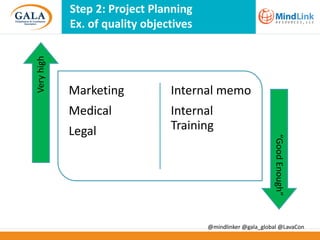
Very high

Step 2: Project Planning
Ex. of quality objectives

Marketing

Internal memo

Medical

Internal
Training
“Good Enough”

Legal

@mindlinker @gala_global @LavaCon
Step 2: Project Planning
Create a Test Plan

• Determine Test Passes/Schedule
– Pre Translation
• Psuedo Translation
• Internationalization

– Translation
• Editing (provides initial audience, critique)
• Proofread (look for punctuation, grammar)

– Post Translation
• Multiple Passes of Testing (functional)

@mindlinker @gala_global @LavaCon
Step 2: Project Planning
Follow a Standard
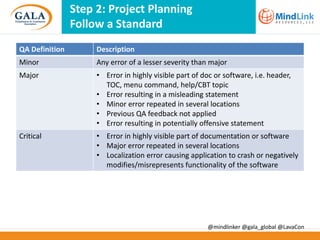
QA Definition

Description

Minor

Any error of a lesser severity than major

Major

• Error in highly visible part of doc or software, i.e. header,
TOC, menu command, help/CBT topic
• Error resulting in a misleading statement
• Minor error repeated in several locations
• Previous QA feedback not applied
• Error resulting in potentially offensive statement

Critical

• Error in highly visible part of documentation or software
• Major error repeated in several locations
• Localization error causing application to crash or negatively
modifies/misrepresents functionality of the software

@mindlinker @gala_global @LavaCon
Step 2: Project Planning
Follow a Standard
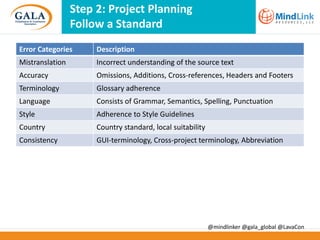
Error Categories

Description

Mistranslation

Incorrect understanding of the source text

Accuracy

Omissions, Additions, Cross-references, Headers and Footers

Terminology

Glossary adherence

Language

Consists of Grammar, Semantics, Spelling, Punctuation

Style

Adherence to Style Guidelines

Country

Country standard, local suitability

Consistency

GUI-terminology, Cross-project terminology, Abbreviation

@mindlinker @gala_global @LavaCon
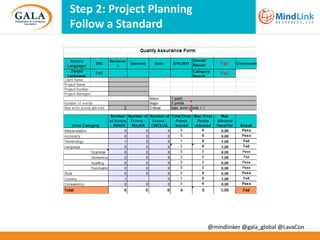
Step 2: Project Planning
Follow a Standard

@mindlinker @gala_global @LavaCon
Step 3: Production

Production
(graphics,
translation,
DTP)

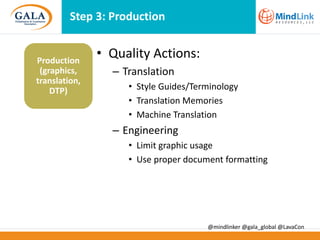
• Quality Actions:
– Translation
• Style Guides/Terminology
• Translation Memories
• Machine Translation

– Engineering
• Limit graphic usage
• Use proper document formatting

@mindlinker @gala_global @LavaCon
Step 4: Quality Assurance

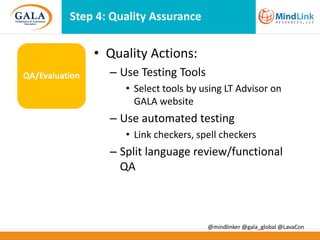
• Quality Actions:
QA/Evaluation

– Use Testing Tools
• Select tools by using LT Advisor on
GALA website

– Use automated testing
• Link checkers, spell checkers

– Split language review/functional
QA

@mindlinker @gala_global @LavaCon
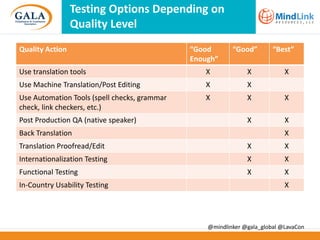
Testing Options Depending on
Quality Level
Quality Action

“Good
Enough”

“Good”

“Best”

Use translation tools

X

X

Use Machine Translation/Post Editing

X

X

Use Automation Tools (spell checks, grammar
check, link checkers, etc.)

X

X

X

X

X

Post Production QA (native speaker)
Back Translation

X

X

Translation Proofread/Edit

X

X

Internationalization Testing

X

X

Functional Testing

X

X

In-Country Usability Testing

X

@mindlinker @gala_global @LavaCon

Quality Control for Translations-The Best in Process, Plans and People

  • 1.
    GALA presents: Quality Controlfor Translations The Best Plans, Processes, and People Stacey Brown, Mindlink Resources sbrown@mindlinkresources.com @Mindlinker @gala_global @LavaCon
  • 2.
  • 3.
  • 4.
  • 5.
  • 6.
  • 7.
  • 8.
    "We joined GALAbecause of the unique perspective its members and conferences offers. GALA is about the business of localization with great insights on not just how to localize, but about how to run a localized business. Clients have a great deal to learn, and to share, in an setting that steps outside the process and looks in.“ Wayne Bourland Director, Global Localization Team Dell "Amway joined GALA because it is THE go-to association for the industry. We wanted to participate in and belong to an organization that supports localization standards and best practices. Through GALA, we are able to provide feedback and help guide the future of the industry.“ Catherine Guinon Manager, Digital Operations Amway Corporation www.gala‐global.org/join
  • 9.
    About the Speaker •Stacey Brown – Owner, Mindlink Resources, LLC – Background as a technical trainer – Worked as a Quality Manager for 14 years – Blogs about language quality and other topics at www.mindlinkresources.com – Volunteers with GALA Standards Initiative @mindlinker @gala_global @LavaCon
  • 10.
    Goals • What islocalization quality and why is it important? • What are different actions at different stages in localization production to produce highest quality? • What are different testing options? Quality isn’t just a step in the process. . . @mindlinker @gala_global @LavaCon
  • 11.
    What is Quality? “Thedifficulty in defining quality is to translate future needs of the user into measurable characteristics, so that a product can be designed and turned out to give satisfaction at a price that the user will pay. This is not easy, and as soon as one feels fairly successful in the endeavor, he finds that the needs of the consumer have changed, competitors have moved in, etc.” –Deming @mindlinker @gala_global @LavaCon
  • 12.
    How you wantyour clients to react to your product. . . @mindlinker @gala_global @LavaCon
  • 13.
    What really happensto your customers if you don’t integrate quality into process… @mindlinker @gala_global @LavaCon
  • 14.
    Why is QualityImportant? • Benefits of good quality –Customer satisfaction –Schedule predictability –Better team morale –It’s cheaper! @mindlinker @gala_global @LavaCon
  • 15.
    Quality Ranks of20 Countries In the US, most software projects at 85% defect removal efficiency (DRE) even after testing. 1. 2. 3. 4. 5. 6. 7. 8. 9. 10. Japan India Denmark South Korea Switzerland Israel Canada UK Sweden Norway 11. 12. 13. 14. 15. 16. 17. 18. 19. 20. Netherlands Hungary Ireland United States Brazil France Australia Austria Belgium Finland Capers Jones, The Economics of Software Quality @mindlinker @gala_global @LavaCon
  • 16.
    What could possiblygo wrong? • Common problems seen in localization projects: – Translation mistakes – Graphics issues – Cultural inappropriateness – Truncation – Broken Links – Wrong language – Corrupted Characters – Inconsistency – Etc. @mindlinker @gala_global @LavaCon
  • 17.
    Set up theFoundation for Quality • Quality isn’t a “step”. • Quality is effected at each stage of the process: – Team Building – Project Planning/Budgeting – Production – QA QA Production Project Planning Team Building
  • 18.
    Most Successful ProjectsIntegrate Quality at Every Step Team Building Plan/Prepare Production (graphics, translation, DTP) QA/Evaluation Quality @mindlinker @gala_global @LavaCon
  • 19.
    Step 1: TeamBuilding • Quality Actions Team Building – Keep an updated database – Qualify resources before the project hits – Prepare for human errors @mindlinker @gala_global @LavaCon
  • 20.
    Step 1: TeamBuilding • Most translation projects include the following personnel: – – – – PM Engineer Translators (contractors) QA Testers (sometimes contractors) PM Translator Engineer @Mindlinker @LavaCon QA
  • 21.
    Step 1: TeamBuilding Database • Create partnerships – Use industry associations (GALA) • Track contractor information in a database • Thoroughly screen contractors • Provide feedback and keep a record
  • 22.
    Step 1: TeamBuilding Qualify Linguists • Qualifications for Linguistic Testers – Native speakers – Good English skills – Good technical skills – Good eye for detail – Good critical thinkers • Screen thoroughly (check references, test skills, when not working out—remove immediately) @mindlinker @gala_global @LavaCon
  • 23.
    Step 1: TeamBuilding Human Errors • Human errors will happen. Have a plan for dealing with them. – Checks and balances – Root cause analysis – Automate repetitive tasks – Use tools @mindlinker @gala_global @LavaCon
  • 24.
    Step 2: ProjectPlanning • Quality Actions Plan/Prepare – Use a project plan – Determine project quality expectations up front – Use a test plan – Follow a standard @mindlinker @gala_global @LavaCon
  • 25.
    Step 2: ProjectPlanning Create a Project Plan • Create project plan – Objective – Estimates – Stakeholders – Structure – Steps @mindlinker @gala_global @LavaCon
  • 26.
    Very high Step 2:Project Planning Ex. of quality objectives Marketing Internal memo Medical Internal Training “Good Enough” Legal @mindlinker @gala_global @LavaCon
  • 27.
    Step 2: ProjectPlanning Create a Test Plan • Determine Test Passes/Schedule – Pre Translation • Psuedo Translation • Internationalization – Translation • Editing (provides initial audience, critique) • Proofread (look for punctuation, grammar) – Post Translation • Multiple Passes of Testing (functional) @mindlinker @gala_global @LavaCon
  • 28.
    Step 2: ProjectPlanning Follow a Standard QA Definition Description Minor Any error of a lesser severity than major Major • Error in highly visible part of doc or software, i.e. header, TOC, menu command, help/CBT topic • Error resulting in a misleading statement • Minor error repeated in several locations • Previous QA feedback not applied • Error resulting in potentially offensive statement Critical • Error in highly visible part of documentation or software • Major error repeated in several locations • Localization error causing application to crash or negatively modifies/misrepresents functionality of the software @mindlinker @gala_global @LavaCon
  • 29.
    Step 2: ProjectPlanning Follow a Standard Error Categories Description Mistranslation Incorrect understanding of the source text Accuracy Omissions, Additions, Cross-references, Headers and Footers Terminology Glossary adherence Language Consists of Grammar, Semantics, Spelling, Punctuation Style Adherence to Style Guidelines Country Country standard, local suitability Consistency GUI-terminology, Cross-project terminology, Abbreviation @mindlinker @gala_global @LavaCon
  • 30.
    Step 2: ProjectPlanning Follow a Standard @mindlinker @gala_global @LavaCon
  • 31.
    Step 3: Production Production (graphics, translation, DTP) •Quality Actions: – Translation • Style Guides/Terminology • Translation Memories • Machine Translation – Engineering • Limit graphic usage • Use proper document formatting @mindlinker @gala_global @LavaCon
  • 32.
    Step 4: QualityAssurance • Quality Actions: QA/Evaluation – Use Testing Tools • Select tools by using LT Advisor on GALA website – Use automated testing • Link checkers, spell checkers – Split language review/functional QA @mindlinker @gala_global @LavaCon
  • 33.
    Testing Options Dependingon Quality Level Quality Action “Good Enough” “Good” “Best” Use translation tools X X Use Machine Translation/Post Editing X X Use Automation Tools (spell checks, grammar check, link checkers, etc.) X X X X X Post Production QA (native speaker) Back Translation X X Translation Proofread/Edit X X Internationalization Testing X X Functional Testing X X In-Country Usability Testing X @mindlinker @gala_global @LavaCon