DISCRETE
MATHEMATICAL
STRUCTURES
DONE BY
M.HASISH
CSE-B 1ST
YEAR
What are Discrete Mathematical
structures
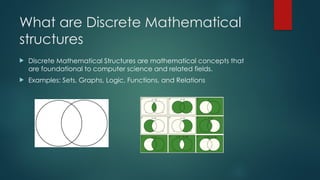
 Discrete Mathematical Structures are mathematical concepts that
are foundational to computer science and related fields.
 Examples: Sets, Graphs, Logic, Functions, and Relations
Why Study Discrete Mathematics?
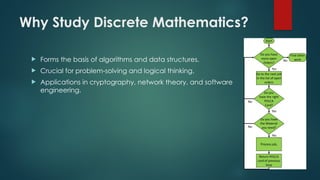
 Forms the basis of algorithms and data structures.
 Crucial for problem-solving and logical thinking.
 Applications in cryptography, network theory, and software
engineering.
Sets and Their Operations
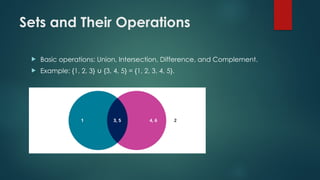
 Basic operations: Union, Intersection, Difference, and Complement.
 Example: {1, 2, 3} {3, 4, 5} = {1, 2, 3, 4, 5}.
∪
Introduction to Graph Theory
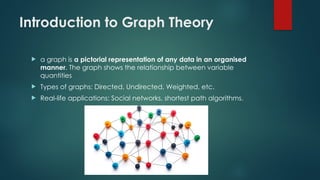
 a graph is a pictorial representation of any data in an organised
manner. The graph shows the relationship between variable
quantities
 Types of graphs: Directed, Undirected, Weighted, etc.
 Real-life applications: Social networks, shortest path algorithms.
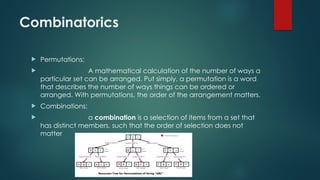
Combinatorics
 Permutations:
 A mathematical calculation of the number of ways a
particular set can be arranged. Put simply, a permutation is a word
that describes the number of ways things can be ordered or
arranged. With permutations, the order of the arrangement matters.
 Combinations:
 a combination is a selection of items from a set that
has distinct members, such that the order of selection does not
matter
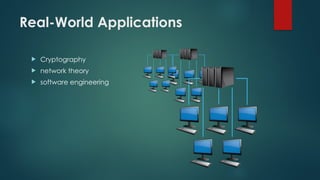
Real-World Applications
 Cryptography
 network theory
 software engineering
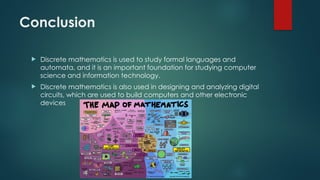
Conclusion
 Discrete mathematics is used to study formal languages and
automata, and it is an important foundation for studying computer
science and information technology.
 Discrete mathematics is also used in designing and analyzing digital
circuits, which are used to build computers and other electronic
devices
DMS.pptx for basic knowledge of discrete mathematical structures

  • 1.
  • 2.
    What are DiscreteMathematical structures  Discrete Mathematical Structures are mathematical concepts that are foundational to computer science and related fields.  Examples: Sets, Graphs, Logic, Functions, and Relations
  • 3.
    Why Study DiscreteMathematics?  Forms the basis of algorithms and data structures.  Crucial for problem-solving and logical thinking.  Applications in cryptography, network theory, and software engineering.
  • 4.
    Sets and TheirOperations  Basic operations: Union, Intersection, Difference, and Complement.  Example: {1, 2, 3} {3, 4, 5} = {1, 2, 3, 4, 5}. ∪
  • 5.
    Introduction to GraphTheory  a graph is a pictorial representation of any data in an organised manner. The graph shows the relationship between variable quantities  Types of graphs: Directed, Undirected, Weighted, etc.  Real-life applications: Social networks, shortest path algorithms.
  • 6.
    Combinatorics  Permutations:  Amathematical calculation of the number of ways a particular set can be arranged. Put simply, a permutation is a word that describes the number of ways things can be ordered or arranged. With permutations, the order of the arrangement matters.  Combinations:  a combination is a selection of items from a set that has distinct members, such that the order of selection does not matter
  • 7.
    Real-World Applications  Cryptography network theory  software engineering
  • 8.
    Conclusion  Discrete mathematicsis used to study formal languages and automata, and it is an important foundation for studying computer science and information technology.  Discrete mathematics is also used in designing and analyzing digital circuits, which are used to build computers and other electronic devices