Definition
Individuals lose their
 ability to respond to
their environment, the
  ability to speak and
ultimately the ability
 to control movement
           	
  
•  Often	
  lose	
  their	
  
   capacity	
  for	
  
   recognizable	
  speech	
  
•  Need	
  assistance	
  with	
  
   eating	
  and	
  toileting,	
  
   usually	
  incontinent	
  
•  Lose	
  ability	
  to	
  ambulate	
  
   without	
  assistance,	
  then	
  
   ability	
  to	
  sit	
  without	
  
   assistance	
  
•  Lose	
  ability	
  to	
  smile	
  or	
  
   hold	
  their	
  head	
  up	
  
•  Reflexes	
  become	
  
   abnormal	
  
•  Often	
  lose	
  their	
  capacity	
  
   for	
  recognizable	
  speech	
  
•  Need	
  assistance	
  with	
  
   eating	
  and	
  toileting,	
  
   usually	
  incontinent	
  
•  Lose	
  ability	
  to	
  ambulate	
  
   without	
  assistance,	
  then	
  
   ability	
  to	
  sit	
  without	
  
   assistance	
  
•  Lose	
  ability	
  to	
  smile	
  or	
  
   hold	
  their	
  head	
  up	
  
•  Reflexes	
  become	
  
   abnormal	
  
•  Often	
  lose	
  their	
  capacity	
  
   for	
  recognizable	
  speech	
  
•  Need	
  assistance	
  with	
  
   eating	
  and	
  toileting,	
  
   usually	
  incontinent	
  
•  Lose	
  ability	
  to	
  
   ambulate	
  without	
  
   assistance,	
  then	
  ability	
  
   to	
  sit	
  without	
  
   assistance	
  
•  Lose	
  ability	
  to	
  smile	
  or	
  
   hold	
  their	
  head	
  up	
  
•  Reflexes	
  become	
  
   abnormal	
  
•  Often	
  lose	
  their	
  capacity	
  
   for	
  recognizable	
  speech	
  
•  Need	
  assistance	
  with	
  
   eating	
  and	
  toileting,	
  
   usually	
  incontinent	
  
•  Lose	
  ability	
  to	
  ambulate	
  
   without	
  assistance,	
  then	
  
   ability	
  to	
  sit	
  without	
  
   assistance	
  
•  Lose	
  ability	
  to	
  smile	
  or	
  
   hold	
  their	
  head	
  up	
  
•  Reflexes	
  become	
  
   abnormal	
  
•  Often	
  lose	
  their	
  capacity	
  
   for	
  recognizable	
  speech	
  
•  Need	
  assistance	
  with	
  
   eating	
  and	
  toileting,	
  
   usually	
  incontinent	
  
•  Lose	
  ability	
  to	
  ambulate	
  
   without	
  assistance,	
  then	
  
   ability	
  to	
  sit	
  without	
  
   assistance	
  
•  Lose	
  ability	
  to	
  smile	
  or	
  
   hold	
  their	
  head	
  up	
  
•  Reflexes	
  become	
  
   abnormal	
  
How	
  does	
  the	
  
Alzheimer’s	
  Association	
  
defines	
  late	
  stage	
  
dementia	
  as:	
  
    Muscles	
  become	
  rigid	
  
    Swallowing	
  is	
  impaired	
  
    Reoccurring	
  infections	
  
    Lose	
  inability	
  to	
  express	
  
     needs/pain/illness	
  
How	
  does	
  the	
  
Alzheimer’s	
  Association	
  
defines	
  late	
  stage	
  
dementia	
  as:	
  
    Muscles	
  become	
  rigid	
  
    Swallowing	
  is	
  impaired	
  
    Reoccurring	
  infections	
  
    Lose	
  inability	
  to	
  express	
  
     needs/pain/illness	
  
How	
  does	
  the	
  
Alzheimer’s	
  Association	
  
defines	
  late	
  stage	
  
dementia	
  as:	
  
    Muscles	
  become	
  rigid	
  
    Swallowing	
  is	
  impaired	
  
    Reoccurring	
  infections	
  
    Lose	
  inability	
  to	
  express	
  
     needs/pain/illness	
  
How	
  does	
  the	
  
Alzheimer’s	
  Association	
  
defines	
  late	
  stage	
  
dementia	
  as:	
  
    Muscles	
  become	
  rigid	
  
    Swallowing	
  is	
  impaired	
  
    Reoccurring	
  infections	
  
    Lose	
  inability	
  to	
  
     express	
  needs/pain/
     illness	
  

Late stage dementia

  • 2.
  • 3.
    Individuals lose their ability to respond to their environment, the ability to speak and ultimately the ability to control movement  
  • 4.
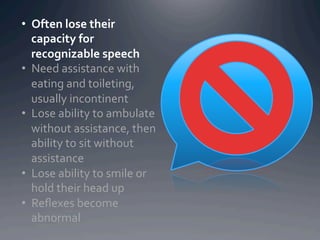
    •  Often  lose  their   capacity  for   recognizable  speech   •  Need  assistance  with   eating  and  toileting,   usually  incontinent   •  Lose  ability  to  ambulate   without  assistance,  then   ability  to  sit  without   assistance   •  Lose  ability  to  smile  or   hold  their  head  up   •  Reflexes  become   abnormal  
  • 5.
    •  Often  lose  their  capacity   for  recognizable  speech   •  Need  assistance  with   eating  and  toileting,   usually  incontinent   •  Lose  ability  to  ambulate   without  assistance,  then   ability  to  sit  without   assistance   •  Lose  ability  to  smile  or   hold  their  head  up   •  Reflexes  become   abnormal  
  • 6.
    •  Often  lose  their  capacity   for  recognizable  speech   •  Need  assistance  with   eating  and  toileting,   usually  incontinent   •  Lose  ability  to   ambulate  without   assistance,  then  ability   to  sit  without   assistance   •  Lose  ability  to  smile  or   hold  their  head  up   •  Reflexes  become   abnormal  
  • 7.
    •  Often  lose  their  capacity   for  recognizable  speech   •  Need  assistance  with   eating  and  toileting,   usually  incontinent   •  Lose  ability  to  ambulate   without  assistance,  then   ability  to  sit  without   assistance   •  Lose  ability  to  smile  or   hold  their  head  up   •  Reflexes  become   abnormal  
  • 8.
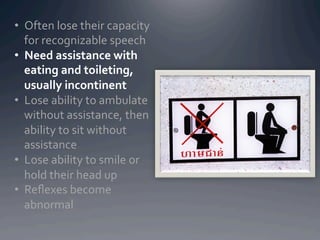
    •  Often  lose  their  capacity   for  recognizable  speech   •  Need  assistance  with   eating  and  toileting,   usually  incontinent   •  Lose  ability  to  ambulate   without  assistance,  then   ability  to  sit  without   assistance   •  Lose  ability  to  smile  or   hold  their  head  up   •  Reflexes  become   abnormal  
  • 9.
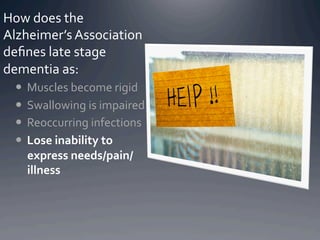
    How  does  the   Alzheimer’s  Association   defines  late  stage   dementia  as:     Muscles  become  rigid     Swallowing  is  impaired     Reoccurring  infections     Lose  inability  to  express   needs/pain/illness  
  • 10.
    How  does  the   Alzheimer’s  Association   defines  late  stage   dementia  as:     Muscles  become  rigid     Swallowing  is  impaired     Reoccurring  infections     Lose  inability  to  express   needs/pain/illness  
  • 11.
    How  does  the   Alzheimer’s  Association   defines  late  stage   dementia  as:     Muscles  become  rigid     Swallowing  is  impaired     Reoccurring  infections     Lose  inability  to  express   needs/pain/illness  
  • 12.
    How  does  the   Alzheimer’s  Association   defines  late  stage   dementia  as:     Muscles  become  rigid     Swallowing  is  impaired     Reoccurring  infections     Lose  inability  to   express  needs/pain/ illness