© Project Value Delivery - 2020
w w w . P r o j e c t V a l u e D e l i v e r y . c o m
Paris Rev 3.0
Large Complex Industrial Projects:
Owner specific role and associated
requirements
Oct 2020
© Project Value Delivery - 2020
w w w . P r o j e c t V a l u e D e l i v e r y . c o m
1. Problem statement
2. Owner role in industrial projects,
and what can be delegated
3. Owner role hygiene:
collaborative setups, internal
contractors
Contents
© Project Value Delivery - 2020
w w w . P r o j e c t V a l u e D e l i v e r y . c o m
The Owner Specific Role:
Problem Statement1
© Project Value Delivery - 2020
w w w . P r o j e c t V a l u e D e l i v e r y . c o m 4
• Owner: entity that finances the project and owns the asset / facility
• Operator: entity that operates and maintains the asset / facility
– The operator is often a department of the owner, but not always
• Contractor: entity providing services to the owner as part of the project or
operations
• Major difference between owner and contractor:
– The owner takes the full lifecycle view of the facility performance (ROI,
commercial, decommissioning…)
– Any contractor takes a much more limited timeframe viewpoint and seeks to
meet it’s objectives for the contract (financial performance, resource utilisation,
client satisfaction…)
Key definitions
• Projects and associated Capex are the
decisive long term success factor of
facilities and companies
• Projects are high risk endeavours: a large
proportion of projects fail to deliver the
expected value. Some projects might even
bring companies on the brink of
restructuring
• Weak or absent owners during the
project is an important cause of project
drift and failure
© Project Value Delivery - 2020
w w w . P r o j e c t V a l u e D e l i v e r y . c o m
© Project Value Delivery - 2020
w w w . P r o j e c t V a l u e D e l i v e r y . c o m 6
• Most industrial owners are primarily operators
– Many owners face a rare occurrence of large projects
– In-house project experience and capability may be absent or limited
– Executive management may lack actual project experience
• Many owners do not have full oversight of what scope they have to cover
themselves
– many activities can only be performed by the owner because of their full lifecycle
impact
– those activities need to be planned and resourced in advance
• Many owners do not understand the importance of the owner role in project
definition and implementation in order to manage their risk
 Clarity on owner role is essential, and also on what can be delegated or not
Industrial projects owner role – problem statement
© Project Value Delivery - 2020
w w w . P r o j e c t V a l u e D e l i v e r y . c o m
The owner role in industrial projects,
and what can be delegated2
© Project Value Delivery - 2020
w w w . P r o j e c t V a l u e D e l i v e r y . c o m 8
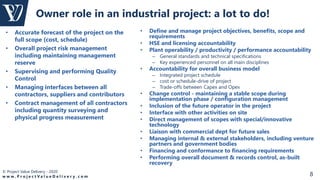
Owner role in an industrial project: a lot to do!
• Define and manage project objectives, benefits, scope and
requirements
• HSE and licensing accountability
• Plant operability / productivity / performance accountability
– General standards and technical specifications
– Key experienced personnel on all main disciplines
• Accountability for overall business model
– Integrated project schedule
– cost or schedule-drive of project
– Trade-offs between Capex and Opex
• Change control - maintaining a stable scope during
implementation phase / configuration management
• Inclusion of the future operator in the project
• Interface with other activities on site
• Direct management of scopes with special/innovative
technology
• Liaison with commercial dept for future sales
• Managing internal & external stakeholders, including venture
partners and government bodies
• Financing and conformance to financing requirements
• Performing overall document & records control, as-built
recovery
• Accurate forecast of the project on the
full scope (cost, schedule)
• Overall project risk management
including maintaining management
reserve
• Supervising and performing Quality
Control
• Managing interfaces between all
contractors, suppliers and contributors
• Contract management of all contractors
including quantity surveying and
physical progress measurement
© Project Value Delivery - 2020
w w w . P r o j e c t V a l u e D e l i v e r y . c o m 9
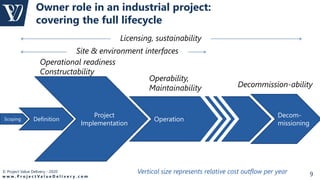
Owner role in an industrial project:
covering the full lifecycle
Scoping Definition
Project
Implementation
Operation
Decom-
missioning
Vertical size represents relative cost outflow per year
Operability,
Maintainability
Operational readiness
Constructability
Decommission-ability
Licensing, sustainability
Site & environment interfaces
© Project Value Delivery - 2020
w w w . P r o j e c t V a l u e D e l i v e r y . c o m 10
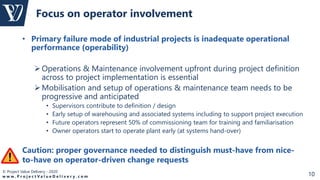
• Primary failure mode of industrial projects is inadequate operational
performance (operability)
Operations & Maintenance involvement upfront during project definition
across to project implementation is essential
Mobilisation and setup of operations & maintenance team needs to be
progressive and anticipated
• Supervisors contribute to definition / design
• Early setup of warehousing and associated systems including to support project execution
• Future operators represent 50% of commissioning team for training and familiarisation
• Owner operators start to operate plant early (at systems hand-over)
Caution: proper governance needed to distinguish must-have from nice-
to-have on operator-driven change requests
Focus on operator involvement
© Project Value Delivery - 2020
w w w . P r o j e c t V a l u e D e l i v e r y . c o m 11
• Owners may not have the professional resources in house to deliver the
owner scope
• Many owners would like to delegate part of their own scope to a
contractor acting “on behalf” (Project Management Contractor – PMC,
or specialised contractor support on certain key functions)
Can the owner scope be delegated?
© Project Value Delivery - 2020
w w w . P r o j e c t V a l u e D e l i v e r y . c o m 12
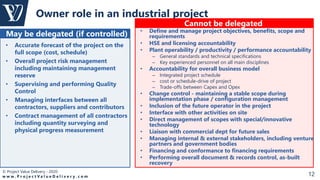
Owner role in an industrial project
• Accurate forecast of the project on the
full scope (cost, schedule)
• Overall project risk management
including maintaining management
reserve
• Supervising and performing Quality
Control
• Managing interfaces between all
contractors, suppliers and contributors
• Contract management of all contractors
including quantity surveying and
physical progress measurement
May be delegated (if controlled)
Cannot be delegated
• Define and manage project objectives, benefits, scope and
requirements
• HSE and licensing accountability
• Plant operability / productivity / performance accountability
– General standards and technical specifications
– Key experienced personnel on all main disciplines
• Accountability for overall business model
– Integrated project schedule
– cost or schedule-drive of project
– Trade-offs between Capex and Opex
• Change control - maintaining a stable scope during
implementation phase / configuration management
• Inclusion of the future operator in the project
• Interface with other activities on site
• Direct management of scopes with special/innovative
technology
• Liaison with commercial dept for future sales
• Managing internal & external stakeholders, including venture
partners and government bodies
• Financing and conformance to financing requirements
• Performing overall document & records control, as-built
recovery
© Project Value Delivery - 2020
w w w . P r o j e c t V a l u e D e l i v e r y . c o m 13
Caution notes and recommendations
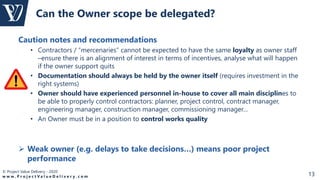
• Contractors / “mercenaries” cannot be expected to have the same loyalty as owner staff
–ensure there is an alignment of interest in terms of incentives, analyse what will happen
if the owner support quits
• Documentation should always be held by the owner itself (requires investment in the
right systems)
• Owner should have experienced personnel in-house to cover all main disciplines to
be able to properly control contractors: planner, project control, contract manager,
engineering manager, construction manager, commissioning manager…
• An Owner must be in a position to control works quality
 Weak owner (e.g. delays to take decisions…) means poor project
performance
Can the Owner scope be delegated?
© Project Value Delivery - 2020
w w w . P r o j e c t V a l u e D e l i v e r y . c o m 14
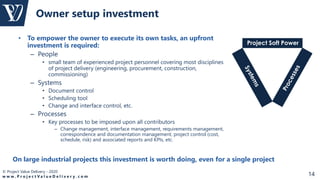
• To empower the owner to execute its own tasks, an upfront
investment is required:
– People
• small team of experienced project personnel covering most disciplines
of project delivery (engineering, procurement, construction,
commissioning)
– Systems
• Document control
• Scheduling tool
• Change and interface control, etc.
– Processes
• Key processes to be imposed upon all contributors
– Change management, interface management, requirements management,
correspondence and documentation management, project control (cost,
schedule, risk) and associated reports and KPIs, etc.
Owner setup investment
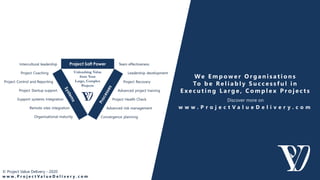
Project Soft Power
On large industrial projects this investment is worth doing, even for a single project
© Project Value Delivery - 2020
w w w . P r o j e c t V a l u e D e l i v e r y . c o m 15
• On industrial projects the owner scope is essential and significant
• A lot of this scope cannot be delegated without creating a significant risk for
the owner
 Owners need to be strong to defend their lifecycle interests
– Weak owner (e.g. delays to take decisions…) means poor project performance
 Owners need to invest early and hire a small team of experienced project
personnel to defend their interests and properly control the various contractors
– Delegation does not prevent control!
– Investment in relevant systems and processes is also required
Owner scope - summary
© Project Value Delivery - 2020
w w w . P r o j e c t V a l u e D e l i v e r y . c o m
Owner role hygiene: collaborative
setups, internal contractors3
© Project Value Delivery - 2020
w w w . P r o j e c t V a l u e D e l i v e r y . c o m 17
• In certain instances, owner – contractor collaborative approaches are used leading to
joint integrated teams. They can sometimes even be formalised as ‘Alliance’
– Innovative projects
– Fast-track projects
– Projects involving many contractors simultaneously with high level of interfaces
– Projects in mature technology areas looking for savings
• In other instances, the owner can have an internal contractor department (general
works) and a joint team may be setup, or the relationship between owner and
contractor may not be fully formalised
 It is extremely important in these setups to make sure the owner role is not diluted
 full facility lifecycle view must be maintained with the right authority to protect the owner
interests
Owner – contractor collaborative setups
© Project Value Delivery - 2020
w w w . P r o j e c t V a l u e D e l i v e r y . c o m 18
• Positive tension must be maintained between lifecycle view and short-term
project execution view to take the right decisions in the interest of the owner
– Capex vs Opex decisions
– Operator or site involvement
– Any other owner own scope (special technology…)
– Accounting for change of stakeholder perspective, market etc
– Avoid project execution concerned by aspects such as financing, client
relationship, etc.
 To allow this positive tension to happen, the owner representation must:
 have the means to independently assess the project status
 control any proposed changes
 have the authority to instruct the contractor as required
Basic rules of owner hygiene
© Project Value Delivery - 2020
w w w . P r o j e c t V a l u e D e l i v e r y . c o m 19
• The owner is taking strategic decisions and must be able to instruct contractors accordingly
– It is always recommended to have an arms-length agreement (= contract) between entities
even if part of the same group
– While commercial adjustments may be discussed later, the owner will need to be able to issue
instructions based on technical considerations
• The owner must maintain an independent project control capability. It is not duplication!
– Allows to have a positive challenge as to project status and forecast, taking into account the
full owner scope (including risk, cost, schedule)
– Maintenance of an integrated project schedule covering all scope from owner perspective
– Does not need to be as detailed as at contractor level
• The owner must control any change and oversee interface management
– Allows to control any scope creep and to drive change decisions based on the lifecycle view
• In joint or co-located teams, the owner must always reserve independent confidential space
to be able to discuss own issues
 We recommend that in all cases, a sufficiently strong owner team is mobilised with
independent processes for project control, document control etc so that it can effectively
play its role
Owner hygiene in practice
© Project Value Delivery - 2020
w w w . P r o j e c t V a l u e D e l i v e r y . c o m 20
Project team
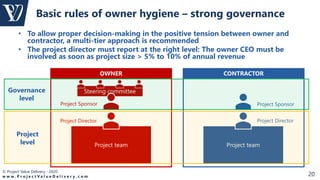
• To allow proper decision-making in the positive tension between owner and
contractor, a multi-tier approach is recommended
• The project director must report at the right level: The owner CEO must be
involved as soon as project size > 5% to 10% of annual revenue
Basic rules of owner hygiene – strong governance
OWNER CONTRACTOR
Steering committee
Project Director
Project Sponsor
Project team
Project Director
Project Sponsor
Governance
level
Project
level
© Project Value Delivery - 2020
w w w . P r o j e c t V a l u e D e l i v e r y . c o m 21
• It is essential for project success to maintain a positive tension between
the owner (defending the lifecycle view) and the contractor (short term
tactical focus)
• Even in collaborative settings or when owner and contractor are in the
same organisation, the owner must have the means to properly fulfil its
role – a sufficiently strong team with independent means to control the
project. It is not duplication because the focus is different.
• Governance must take care to maintain this positive tension throughout
project execution so that the interests of the organisation are effectively
safeguarded.
Owner hygiene - summary
© Project Value Delivery - 2020
w w w . P r o j e c t V a l u e D e l i v e r y . c o m
Conclusion
© Project Value Delivery - 2020
w w w . P r o j e c t V a l u e D e l i v e r y . c o m 23
• Projects never happen as originally planed. The success of any project relies on
a strong, visible and present owner that effectively takes the right decisions at
the right time
• In addition to keeping the full lifecycle view, a very substantial scope needs to
be covered by the owner that cannot be delegated to a contractor
– Do not neglect the owner scope.
– Do not subcontract the owner role.
• Only certain limited parts may be subcontracted with sufficient monitoring and control.
• To achieve this, the owner needs to mobilise and build a strong team backed up
with relevant processes and systems
– The team does not necessarily need to be large, but it needs to be experienced enough in
project management and cover all functions
• Even in internal or collaborative setups, a strong owner role needs to be
maintained and well identified to enable positive debates
Summary
© Project Value Delivery - 2020
w w w . P r o j e c t V a l u e D e l i v e r y . c o m 24
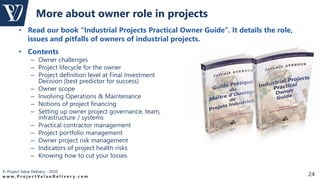
• Read our book “Industrial Projects Practical Owner Guide”. It details the role,
issues and pitfalls of owners of industrial projects.
More about owner role in projects
• Contents
– Owner challenges
– Project lifecycle for the owner
– Project definition level at Final Investment
Decision (best predictor for success)
– Owner scope
– Involving Operations & Maintenance
– Notions of project financing
– Setting up owner project governance, team,
infrastructure / systems
– Practical contractor management
– Project portfolio management
– Owner project risk management
– Indicators of project health risks
– Knowing how to cut your losses
Thank you!
© Project Value Delivery - 2020
w w w . P r o j e c t V a l u e D e l i v e r y . c o m
© Project Value Delivery - 2020
w w w . P r o j e c t V a l u e D e l i v e r y . c o m
We E m p o w e r O r g a n i s a t i o n s
To b e Re l i a b l y S u c c e s s f u l i n
E xe c u t i n g L a r g e , C o m p l e x P r o j e c t s
Discover more on
w w w . P r o j e c t V a l u e D e l i v e r y . c o m

Large Complex Industrial Projects:Owner specific role and associated requirements

  • 1.
    © Project ValueDelivery - 2020 w w w . P r o j e c t V a l u e D e l i v e r y . c o m Paris Rev 3.0 Large Complex Industrial Projects: Owner specific role and associated requirements Oct 2020
  • 2.
    © Project ValueDelivery - 2020 w w w . P r o j e c t V a l u e D e l i v e r y . c o m 1. Problem statement 2. Owner role in industrial projects, and what can be delegated 3. Owner role hygiene: collaborative setups, internal contractors Contents
  • 3.
    © Project ValueDelivery - 2020 w w w . P r o j e c t V a l u e D e l i v e r y . c o m The Owner Specific Role: Problem Statement1
  • 4.
    © Project ValueDelivery - 2020 w w w . P r o j e c t V a l u e D e l i v e r y . c o m 4 • Owner: entity that finances the project and owns the asset / facility • Operator: entity that operates and maintains the asset / facility – The operator is often a department of the owner, but not always • Contractor: entity providing services to the owner as part of the project or operations • Major difference between owner and contractor: – The owner takes the full lifecycle view of the facility performance (ROI, commercial, decommissioning…) – Any contractor takes a much more limited timeframe viewpoint and seeks to meet it’s objectives for the contract (financial performance, resource utilisation, client satisfaction…) Key definitions
  • 5.
    • Projects andassociated Capex are the decisive long term success factor of facilities and companies • Projects are high risk endeavours: a large proportion of projects fail to deliver the expected value. Some projects might even bring companies on the brink of restructuring • Weak or absent owners during the project is an important cause of project drift and failure © Project Value Delivery - 2020 w w w . P r o j e c t V a l u e D e l i v e r y . c o m
  • 6.
    © Project ValueDelivery - 2020 w w w . P r o j e c t V a l u e D e l i v e r y . c o m 6 • Most industrial owners are primarily operators – Many owners face a rare occurrence of large projects – In-house project experience and capability may be absent or limited – Executive management may lack actual project experience • Many owners do not have full oversight of what scope they have to cover themselves – many activities can only be performed by the owner because of their full lifecycle impact – those activities need to be planned and resourced in advance • Many owners do not understand the importance of the owner role in project definition and implementation in order to manage their risk  Clarity on owner role is essential, and also on what can be delegated or not Industrial projects owner role – problem statement
  • 7.
    © Project ValueDelivery - 2020 w w w . P r o j e c t V a l u e D e l i v e r y . c o m The owner role in industrial projects, and what can be delegated2
  • 8.
    © Project ValueDelivery - 2020 w w w . P r o j e c t V a l u e D e l i v e r y . c o m 8 Owner role in an industrial project: a lot to do! • Define and manage project objectives, benefits, scope and requirements • HSE and licensing accountability • Plant operability / productivity / performance accountability – General standards and technical specifications – Key experienced personnel on all main disciplines • Accountability for overall business model – Integrated project schedule – cost or schedule-drive of project – Trade-offs between Capex and Opex • Change control - maintaining a stable scope during implementation phase / configuration management • Inclusion of the future operator in the project • Interface with other activities on site • Direct management of scopes with special/innovative technology • Liaison with commercial dept for future sales • Managing internal & external stakeholders, including venture partners and government bodies • Financing and conformance to financing requirements • Performing overall document & records control, as-built recovery • Accurate forecast of the project on the full scope (cost, schedule) • Overall project risk management including maintaining management reserve • Supervising and performing Quality Control • Managing interfaces between all contractors, suppliers and contributors • Contract management of all contractors including quantity surveying and physical progress measurement
  • 9.
    © Project ValueDelivery - 2020 w w w . P r o j e c t V a l u e D e l i v e r y . c o m 9 Owner role in an industrial project: covering the full lifecycle Scoping Definition Project Implementation Operation Decom- missioning Vertical size represents relative cost outflow per year Operability, Maintainability Operational readiness Constructability Decommission-ability Licensing, sustainability Site & environment interfaces
  • 10.
    © Project ValueDelivery - 2020 w w w . P r o j e c t V a l u e D e l i v e r y . c o m 10 • Primary failure mode of industrial projects is inadequate operational performance (operability) Operations & Maintenance involvement upfront during project definition across to project implementation is essential Mobilisation and setup of operations & maintenance team needs to be progressive and anticipated • Supervisors contribute to definition / design • Early setup of warehousing and associated systems including to support project execution • Future operators represent 50% of commissioning team for training and familiarisation • Owner operators start to operate plant early (at systems hand-over) Caution: proper governance needed to distinguish must-have from nice- to-have on operator-driven change requests Focus on operator involvement
  • 11.
    © Project ValueDelivery - 2020 w w w . P r o j e c t V a l u e D e l i v e r y . c o m 11 • Owners may not have the professional resources in house to deliver the owner scope • Many owners would like to delegate part of their own scope to a contractor acting “on behalf” (Project Management Contractor – PMC, or specialised contractor support on certain key functions) Can the owner scope be delegated?
  • 12.
    © Project ValueDelivery - 2020 w w w . P r o j e c t V a l u e D e l i v e r y . c o m 12 Owner role in an industrial project • Accurate forecast of the project on the full scope (cost, schedule) • Overall project risk management including maintaining management reserve • Supervising and performing Quality Control • Managing interfaces between all contractors, suppliers and contributors • Contract management of all contractors including quantity surveying and physical progress measurement May be delegated (if controlled) Cannot be delegated • Define and manage project objectives, benefits, scope and requirements • HSE and licensing accountability • Plant operability / productivity / performance accountability – General standards and technical specifications – Key experienced personnel on all main disciplines • Accountability for overall business model – Integrated project schedule – cost or schedule-drive of project – Trade-offs between Capex and Opex • Change control - maintaining a stable scope during implementation phase / configuration management • Inclusion of the future operator in the project • Interface with other activities on site • Direct management of scopes with special/innovative technology • Liaison with commercial dept for future sales • Managing internal & external stakeholders, including venture partners and government bodies • Financing and conformance to financing requirements • Performing overall document & records control, as-built recovery
  • 13.
    © Project ValueDelivery - 2020 w w w . P r o j e c t V a l u e D e l i v e r y . c o m 13 Caution notes and recommendations • Contractors / “mercenaries” cannot be expected to have the same loyalty as owner staff –ensure there is an alignment of interest in terms of incentives, analyse what will happen if the owner support quits • Documentation should always be held by the owner itself (requires investment in the right systems) • Owner should have experienced personnel in-house to cover all main disciplines to be able to properly control contractors: planner, project control, contract manager, engineering manager, construction manager, commissioning manager… • An Owner must be in a position to control works quality  Weak owner (e.g. delays to take decisions…) means poor project performance Can the Owner scope be delegated?
  • 14.
    © Project ValueDelivery - 2020 w w w . P r o j e c t V a l u e D e l i v e r y . c o m 14 • To empower the owner to execute its own tasks, an upfront investment is required: – People • small team of experienced project personnel covering most disciplines of project delivery (engineering, procurement, construction, commissioning) – Systems • Document control • Scheduling tool • Change and interface control, etc. – Processes • Key processes to be imposed upon all contributors – Change management, interface management, requirements management, correspondence and documentation management, project control (cost, schedule, risk) and associated reports and KPIs, etc. Owner setup investment Project Soft Power On large industrial projects this investment is worth doing, even for a single project
  • 15.
    © Project ValueDelivery - 2020 w w w . P r o j e c t V a l u e D e l i v e r y . c o m 15 • On industrial projects the owner scope is essential and significant • A lot of this scope cannot be delegated without creating a significant risk for the owner  Owners need to be strong to defend their lifecycle interests – Weak owner (e.g. delays to take decisions…) means poor project performance  Owners need to invest early and hire a small team of experienced project personnel to defend their interests and properly control the various contractors – Delegation does not prevent control! – Investment in relevant systems and processes is also required Owner scope - summary
  • 16.
    © Project ValueDelivery - 2020 w w w . P r o j e c t V a l u e D e l i v e r y . c o m Owner role hygiene: collaborative setups, internal contractors3
  • 17.
    © Project ValueDelivery - 2020 w w w . P r o j e c t V a l u e D e l i v e r y . c o m 17 • In certain instances, owner – contractor collaborative approaches are used leading to joint integrated teams. They can sometimes even be formalised as ‘Alliance’ – Innovative projects – Fast-track projects – Projects involving many contractors simultaneously with high level of interfaces – Projects in mature technology areas looking for savings • In other instances, the owner can have an internal contractor department (general works) and a joint team may be setup, or the relationship between owner and contractor may not be fully formalised  It is extremely important in these setups to make sure the owner role is not diluted  full facility lifecycle view must be maintained with the right authority to protect the owner interests Owner – contractor collaborative setups
  • 18.
    © Project ValueDelivery - 2020 w w w . P r o j e c t V a l u e D e l i v e r y . c o m 18 • Positive tension must be maintained between lifecycle view and short-term project execution view to take the right decisions in the interest of the owner – Capex vs Opex decisions – Operator or site involvement – Any other owner own scope (special technology…) – Accounting for change of stakeholder perspective, market etc – Avoid project execution concerned by aspects such as financing, client relationship, etc.  To allow this positive tension to happen, the owner representation must:  have the means to independently assess the project status  control any proposed changes  have the authority to instruct the contractor as required Basic rules of owner hygiene
  • 19.
    © Project ValueDelivery - 2020 w w w . P r o j e c t V a l u e D e l i v e r y . c o m 19 • The owner is taking strategic decisions and must be able to instruct contractors accordingly – It is always recommended to have an arms-length agreement (= contract) between entities even if part of the same group – While commercial adjustments may be discussed later, the owner will need to be able to issue instructions based on technical considerations • The owner must maintain an independent project control capability. It is not duplication! – Allows to have a positive challenge as to project status and forecast, taking into account the full owner scope (including risk, cost, schedule) – Maintenance of an integrated project schedule covering all scope from owner perspective – Does not need to be as detailed as at contractor level • The owner must control any change and oversee interface management – Allows to control any scope creep and to drive change decisions based on the lifecycle view • In joint or co-located teams, the owner must always reserve independent confidential space to be able to discuss own issues  We recommend that in all cases, a sufficiently strong owner team is mobilised with independent processes for project control, document control etc so that it can effectively play its role Owner hygiene in practice
  • 20.
    © Project ValueDelivery - 2020 w w w . P r o j e c t V a l u e D e l i v e r y . c o m 20 Project team • To allow proper decision-making in the positive tension between owner and contractor, a multi-tier approach is recommended • The project director must report at the right level: The owner CEO must be involved as soon as project size > 5% to 10% of annual revenue Basic rules of owner hygiene – strong governance OWNER CONTRACTOR Steering committee Project Director Project Sponsor Project team Project Director Project Sponsor Governance level Project level
  • 21.
    © Project ValueDelivery - 2020 w w w . P r o j e c t V a l u e D e l i v e r y . c o m 21 • It is essential for project success to maintain a positive tension between the owner (defending the lifecycle view) and the contractor (short term tactical focus) • Even in collaborative settings or when owner and contractor are in the same organisation, the owner must have the means to properly fulfil its role – a sufficiently strong team with independent means to control the project. It is not duplication because the focus is different. • Governance must take care to maintain this positive tension throughout project execution so that the interests of the organisation are effectively safeguarded. Owner hygiene - summary
  • 22.
    © Project ValueDelivery - 2020 w w w . P r o j e c t V a l u e D e l i v e r y . c o m Conclusion
  • 23.
    © Project ValueDelivery - 2020 w w w . P r o j e c t V a l u e D e l i v e r y . c o m 23 • Projects never happen as originally planed. The success of any project relies on a strong, visible and present owner that effectively takes the right decisions at the right time • In addition to keeping the full lifecycle view, a very substantial scope needs to be covered by the owner that cannot be delegated to a contractor – Do not neglect the owner scope. – Do not subcontract the owner role. • Only certain limited parts may be subcontracted with sufficient monitoring and control. • To achieve this, the owner needs to mobilise and build a strong team backed up with relevant processes and systems – The team does not necessarily need to be large, but it needs to be experienced enough in project management and cover all functions • Even in internal or collaborative setups, a strong owner role needs to be maintained and well identified to enable positive debates Summary
  • 24.
    © Project ValueDelivery - 2020 w w w . P r o j e c t V a l u e D e l i v e r y . c o m 24 • Read our book “Industrial Projects Practical Owner Guide”. It details the role, issues and pitfalls of owners of industrial projects. More about owner role in projects • Contents – Owner challenges – Project lifecycle for the owner – Project definition level at Final Investment Decision (best predictor for success) – Owner scope – Involving Operations & Maintenance – Notions of project financing – Setting up owner project governance, team, infrastructure / systems – Practical contractor management – Project portfolio management – Owner project risk management – Indicators of project health risks – Knowing how to cut your losses
  • 25.
    Thank you! © ProjectValue Delivery - 2020 w w w . P r o j e c t V a l u e D e l i v e r y . c o m
  • 26.
    © Project ValueDelivery - 2020 w w w . P r o j e c t V a l u e D e l i v e r y . c o m We E m p o w e r O r g a n i s a t i o n s To b e Re l i a b l y S u c c e s s f u l i n E xe c u t i n g L a r g e , C o m p l e x P r o j e c t s Discover more on w w w . P r o j e c t V a l u e D e l i v e r y . c o m