LANGUAGE AND STYLE
„The medium is the message.”
(Marshall MacLuhan)
Three main aspects
Voice
Style and vocabulary
Rhetoric
Voice or paralanguage
Rythm
Speed
Loudness
Pitch
Pause
Different vocalisations
Expressions such as „er”, „wow”
Rythm and pause
Intensity and intonation (codes!)
Avoid monotony
Pause: interest and expectation
Speed
Vary your speed according to the text!
Use a code system
Voice quality, „loudness”,
pitch
Functions: emphasis,attention
Comfort!
Express attitude to topic
„My voice is me”. (Montágh)
Common problems:
„dynamic monotony”
„singing speech”
lack of emphasis
changing meaning by breaking the
sentence at wrong points
„A királynőt megölni nem kell félnetek jó lesz
ha mindnyájan beleegyeztek én nem
ellenzem. „
Breathing
- find your right voice!
- too types:
physiological
speaking
- posture
Expressions such as „er”, „wow”,
vocalisations
Style
Depends on sex and culture
Women use
- more „we” ( „I”)
- empty and exaggerating adjectives
(fantastic, exciting, great)
- personal intro phrases (I think)
- conditionals
- understatement
Central-Eastern European rhetoric
relies more on
„We” and communcal knowledge systems
empty and exaggerating adjectives
knowledge demonstration as opposed to
evaluation
the reader to infer hidden messages,
conlusion
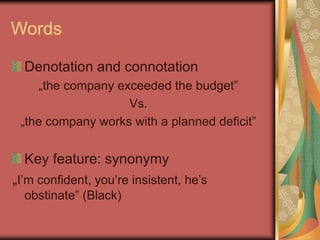
Words
Denotation and connotation
„the company exceeded the budget”
Vs.
„the company works with a planned deficit”
Key feature: synonymy
„I’m confident, you’re insistent, he’s
obstinate” (Black)
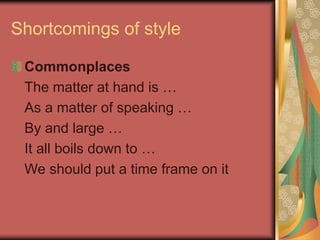
Shortcomings of style
Commonplaces
The matter at hand is …
As a matter of speaking …
By and large …
It all boils down to …
We should put a time frame on it
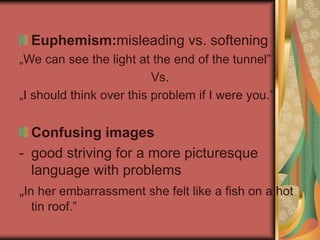
Euphemism:misleading vs. softening
„We can see the light at the end of the tunnel”
Vs.
„I should think over this problem if I were you.”
Confusing images
- good striving for a more picturesque
language with problems
„In her embarrassment she felt like a fish on a hot
tin roof.”
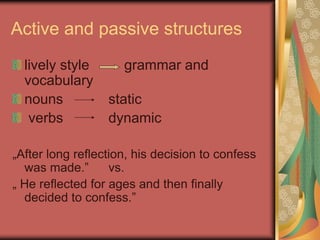
Active and passive structures
lively style grammar and
vocabulary
nouns static
verbs dynamic
„After long reflection, his decision to confess
was made.” vs.
„ He reflected for ages and then finally
decided to confess.”
„camuflaged verbs” (to give a
lecture)
use active voice
avoid conditionals and mitigators
Updike’s literary invention
Stimulate attention
And that’s not all …
But first you should know a few things
Now – and this is most important …
But there is one more thing you have
to do
You might be asking yourself …
Fulfill your promises!
How to develop your style
Strive for clarity, avoid
uncertainty in content
reference to assumed BGK
cramming too much info into a given time
frame
multiple subordinations in sentences
sidetracks „in brackets”.
Be concise
„Words are like leaves;
And where they most abund
Much fruit of sense
Beneath is rarely found.”
(Alexander Pope)
„Amint azt az eddig leírtakban is aláhúztuk, és
amint az a közelmúltban a Miskolci
Egyetemen megrendezésre került
konferencia felszólalásaiból is kiviláglott, az
új termékek bevezetése vállalatainknál nem
tűnik előnyben részesíthető alternatívának a
jelenlegi időperiódusban.”
„A Miskolci Egyetemen tartott konferencia
hozzászólásai is alátámasztották: az új
termékek bevezetése ma nem előnyös
vállalatainknak.”
How to express yourself
effectively: Rhetoric
Comparison
„Business is like riding a bicycle. Either
you keep moving or you fall down.”
- Illustration more familiar quality
than the real object
- Avoid overused images (pure as a
virgin)
Metaphore – analogy between ideas
„A man without judgement is like a car
without brakes; but a man without
enthusiasm is like a car without a motor.”
Personification – imagine that your
subject is a human being
„Are commercial banks an endangered
species?”
Hyperbole – intentional exaggeration
„I believe that with the new biotechnology
we can achieve anything that can be
achieved!”
Understatement – seemingly
lessening value, merit or importance
but implying the opposite
„The disadvantages should not be
overlooked either.”
Irony – stating the opposite with
implied negative evaluation
„No advertisement has ever bored a
reader. That’s because it requires little
effort and less time to turn the page.”
Antithesis – contrasting two opposing
views
„They promised prosperity and delivered
misery.”
Climax –arrangement of words/
phrases in order of increasing power
„He who loses wealth loses much;
he who loses a friend loses more;
but he who loses his courage loses all.”
Rhetorical question
„Is language change good? The answer is
yes.”
Anacoluthon - a break in sentence
structure for heightened effect
„Cleopatra’s nose, had it been shorter,
could have changed the face of the world.”
Antimetabole – repetition with inverted
order of items
„Ask not what your country can do for you,
but what you can do for your country.”
Do not:
Use long and complicated sentences
Use long and abstract words
Lie or trick your audience
Abuse cliches
Use too many figures of speech
Hum and haw with words like Well – Hum –
I mean – you know . Keep silent.
Talk about banal generalities (Everyone
knows)

LanguageStyle.ppt

  • 1.
  • 2.
    „The medium isthe message.” (Marshall MacLuhan)
  • 3.
    Three main aspects Voice Styleand vocabulary Rhetoric
  • 4.
    Voice or paralanguage Rythm Speed Loudness Pitch Pause Differentvocalisations Expressions such as „er”, „wow”
  • 5.
    Rythm and pause Intensityand intonation (codes!) Avoid monotony Pause: interest and expectation Speed Vary your speed according to the text! Use a code system
  • 6.
    Voice quality, „loudness”, pitch Functions:emphasis,attention Comfort! Express attitude to topic „My voice is me”. (Montágh)
  • 7.
    Common problems: „dynamic monotony” „singingspeech” lack of emphasis changing meaning by breaking the sentence at wrong points „A királynőt megölni nem kell félnetek jó lesz ha mindnyájan beleegyeztek én nem ellenzem. „
  • 8.
    Breathing - find yourright voice! - too types: physiological speaking - posture Expressions such as „er”, „wow”, vocalisations
  • 9.
    Style Depends on sexand culture Women use - more „we” ( „I”) - empty and exaggerating adjectives (fantastic, exciting, great) - personal intro phrases (I think) - conditionals - understatement
  • 10.
    Central-Eastern European rhetoric reliesmore on „We” and communcal knowledge systems empty and exaggerating adjectives knowledge demonstration as opposed to evaluation the reader to infer hidden messages, conlusion
  • 11.
    Words Denotation and connotation „thecompany exceeded the budget” Vs. „the company works with a planned deficit” Key feature: synonymy „I’m confident, you’re insistent, he’s obstinate” (Black)
  • 12.
    Shortcomings of style Commonplaces Thematter at hand is … As a matter of speaking … By and large … It all boils down to … We should put a time frame on it
  • 13.
    Euphemism:misleading vs. softening „Wecan see the light at the end of the tunnel” Vs. „I should think over this problem if I were you.” Confusing images - good striving for a more picturesque language with problems „In her embarrassment she felt like a fish on a hot tin roof.”
  • 14.
    Active and passivestructures lively style grammar and vocabulary nouns static verbs dynamic „After long reflection, his decision to confess was made.” vs. „ He reflected for ages and then finally decided to confess.”
  • 15.
    „camuflaged verbs” (togive a lecture) use active voice avoid conditionals and mitigators Updike’s literary invention
  • 16.
    Stimulate attention And that’snot all … But first you should know a few things Now – and this is most important … But there is one more thing you have to do You might be asking yourself … Fulfill your promises!
  • 17.
    How to developyour style Strive for clarity, avoid uncertainty in content reference to assumed BGK cramming too much info into a given time frame multiple subordinations in sentences sidetracks „in brackets”.
  • 18.
    Be concise „Words arelike leaves; And where they most abund Much fruit of sense Beneath is rarely found.” (Alexander Pope)
  • 19.
    „Amint azt azeddig leírtakban is aláhúztuk, és amint az a közelmúltban a Miskolci Egyetemen megrendezésre került konferencia felszólalásaiból is kiviláglott, az új termékek bevezetése vállalatainknál nem tűnik előnyben részesíthető alternatívának a jelenlegi időperiódusban.” „A Miskolci Egyetemen tartott konferencia hozzászólásai is alátámasztották: az új termékek bevezetése ma nem előnyös vállalatainknak.”
  • 20.
    How to expressyourself effectively: Rhetoric Comparison „Business is like riding a bicycle. Either you keep moving or you fall down.” - Illustration more familiar quality than the real object - Avoid overused images (pure as a virgin)
  • 21.
    Metaphore – analogybetween ideas „A man without judgement is like a car without brakes; but a man without enthusiasm is like a car without a motor.” Personification – imagine that your subject is a human being „Are commercial banks an endangered species?”
  • 22.
    Hyperbole – intentionalexaggeration „I believe that with the new biotechnology we can achieve anything that can be achieved!” Understatement – seemingly lessening value, merit or importance but implying the opposite „The disadvantages should not be overlooked either.”
  • 23.
    Irony – statingthe opposite with implied negative evaluation „No advertisement has ever bored a reader. That’s because it requires little effort and less time to turn the page.” Antithesis – contrasting two opposing views „They promised prosperity and delivered misery.”
  • 24.
    Climax –arrangement ofwords/ phrases in order of increasing power „He who loses wealth loses much; he who loses a friend loses more; but he who loses his courage loses all.” Rhetorical question „Is language change good? The answer is yes.”
  • 25.
    Anacoluthon - abreak in sentence structure for heightened effect „Cleopatra’s nose, had it been shorter, could have changed the face of the world.” Antimetabole – repetition with inverted order of items „Ask not what your country can do for you, but what you can do for your country.”
  • 26.
    Do not: Use longand complicated sentences Use long and abstract words Lie or trick your audience Abuse cliches Use too many figures of speech Hum and haw with words like Well – Hum – I mean – you know . Keep silent. Talk about banal generalities (Everyone knows)