University of Wah,Wah cantt Pakistan.
GROUP MEMBERS
• TOQEER QAYYUM
• ANAS SATTI
• ZEESHAN AKRAM
University of Wah,Wah cantt Pakistan.
LANGUAGE
TRANSLATION SYSTEM
University of Wah,Wah cantt Pakistan.
INTRODUCTION
Translator is a computer program that translates a program written in a given
programming language into a functionally equivalent program in a different
language.
Depending on the translator
 this may involve changing or simplifying the program flow
 without losing the essence of the program
 thereby producing a functionally equivalent program
University of Wah,Wah cantt Pakistan.
WHAT IS LANGUAGE TRANSLATOR
 Computers are digital devices
All types of commands, data and instructions required to be converted into
machine code which is the combination of 0’s and 1’s
We give instructions to the computer in a language which is similar to English
and easier for us to understand
 The computer translates these instructions into the machine language with
the help of language translators.
University of Wah,Wah cantt Pakistan.
TYPES
 Assembler
 An assembler is software that converts programs written in assembly
language to machine language
 Interpreter
 An interpreter is software that converts programs written in high level
language to machine language code. It converts one instruction at a time.
Compiler
A compiler is software that converts programs written in high level
language to machine code in a single operation.
University of Wah,Wah cantt Pakistan.
CONT….
If the translator translates target/machine code to source language it is
called a decompiler
Example
Reverse Engineering Compiler (REC).
If the translator translates machine code into assembly language it is called
a disassembler
University of Wah,Wah cantt Pakistan.
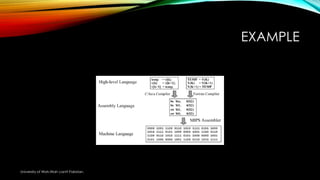
EXAMPLE
University of Wah,Wah cantt Pakistan.
HISTORY
The idea of machine translation may be traced back to the 17th century
Machine translation generally started in the 1950s, although work can be
found from earlier periods.
The Georgetown experiment in 1954 involved fully automatic translation of
more than sixty Russian sentences into English.
MT on the web started with SYSTRAN Offering free translation of small texts
(1996),
University of Wah,Wah cantt Pakistan.
In the 1960s, high-level programming languages using a compiler were
commonly called autocodes
a text/SMS translation service for mobiles in Japan (2008), and a mobile
phone with built-in speech-to-speech translation functionality for English
Google announced that Google Translate translates roughly enough text to
fill 1 million books in one day (2012).
University of Wah,Wah cantt Pakistan.
The human translation process may be described
as:
Decoding the meaning of the source text; and
Re-encoding this meaning in the target language.
University of Wah,Wah cantt Pakistan.
WORKING
Assembler
. Assembly language consists of mnemonics for machine opcodes so
assemblers perform a 1:1 translation from mnemonic to a direct instruction
For example:
LDA #4 converts to 0001001000100100
University of Wah,Wah cantt Pakistan.
CONT….
Conversely, one instruction in a high level language will translate to one or
more instructions at machine level.
Advantages of using an Assembler:
Very fast in translating assembly language to machine code as 1 to 1
relationship
Assembly code is often very efficient (and therefore fast) because it is a low
level language
University of Wah,Wah cantt Pakistan.
CONT…
Assembly code is fairly easy to understand due to the use of English-like
mnemonics
Disadvantages of using Assembler
Assembly language is written for a certain instruction set and/or processor
Assembly tends to be optimised for the hardware it's designed for, meaning
it is often incompatible with different hardware
Lots of assembly code is needed to do relatively simple tasks, and complex
programs require lots of programming time
University of Wah,Wah cantt Pakistan.
CONT…
Compiler
A compiler takes as input a program in some language, and translates that
program into some other language, which may serve as input to another
interpreter or another compiler
Notice that a compiler does not directly execute the program
Ultimately, in order to execute a program via compilation, it must be
translated into a form that can serve as input to an interpreter.
University of Wah,Wah cantt Pakistan.
Advantages of using a compiler
Source code is not included, therefore compiled code is more secure than
interpreted code
Tends to produce faster code than interpreting source code
Produces an executable file, and therefore the program can be run without
need of the source code
University of Wah,Wah cantt Pakistan.
Disadvantages of using a compiler
Object code needs to be produced before a final executable file, this can
be a slow process
The source code must be 100% correct for the executable file to be
produced
University of Wah,Wah cantt Pakistan.
Interpreter
An interpreter program executes other programs directly, running through
program code and executing it line-by-line.
 An interpreter is slower than running compiled code but it can take less time
to interpret program code than to compile and then run it — this is very
useful when prototyping and testing code
University of Wah,Wah cantt Pakistan.
Interpreters are written for multiple platforms
means code written once can be run immediately on different systems
without having to recompile for each
Examples of this include flash based web programs that will run on your PC,
MAC, games console and Mobile phone.
University of Wah,Wah cantt Pakistan.
Advantages of using an Interpreter
Easier to debug(check errors) than a compiler
Easier to create multi-platform code, as each different platform would have
an interpreter to run the same code
Useful for prototyping software and testing basic program logic

University of Wah,Wah cantt Pakistan.
Disadvantages of using an Interpreter
Source code is required for the program to be executed, and this source
code can be read making it insecure
Interpreters are generally slower than compiled programs due to the per-line
translation method
University of Wah,Wah cantt Pakistan.

Language translation system p

  • 1.
    University of Wah,Wahcantt Pakistan.
  • 2.
    GROUP MEMBERS • TOQEERQAYYUM • ANAS SATTI • ZEESHAN AKRAM University of Wah,Wah cantt Pakistan.
  • 3.
  • 4.
    INTRODUCTION Translator is acomputer program that translates a program written in a given programming language into a functionally equivalent program in a different language. Depending on the translator  this may involve changing or simplifying the program flow  without losing the essence of the program  thereby producing a functionally equivalent program University of Wah,Wah cantt Pakistan.
  • 5.
    WHAT IS LANGUAGETRANSLATOR  Computers are digital devices All types of commands, data and instructions required to be converted into machine code which is the combination of 0’s and 1’s We give instructions to the computer in a language which is similar to English and easier for us to understand  The computer translates these instructions into the machine language with the help of language translators. University of Wah,Wah cantt Pakistan.
  • 6.
    TYPES  Assembler  Anassembler is software that converts programs written in assembly language to machine language  Interpreter  An interpreter is software that converts programs written in high level language to machine language code. It converts one instruction at a time. Compiler A compiler is software that converts programs written in high level language to machine code in a single operation. University of Wah,Wah cantt Pakistan.
  • 7.
    CONT…. If the translatortranslates target/machine code to source language it is called a decompiler Example Reverse Engineering Compiler (REC). If the translator translates machine code into assembly language it is called a disassembler University of Wah,Wah cantt Pakistan.
  • 8.
  • 9.
    HISTORY The idea ofmachine translation may be traced back to the 17th century Machine translation generally started in the 1950s, although work can be found from earlier periods. The Georgetown experiment in 1954 involved fully automatic translation of more than sixty Russian sentences into English. MT on the web started with SYSTRAN Offering free translation of small texts (1996), University of Wah,Wah cantt Pakistan.
  • 10.
    In the 1960s,high-level programming languages using a compiler were commonly called autocodes a text/SMS translation service for mobiles in Japan (2008), and a mobile phone with built-in speech-to-speech translation functionality for English Google announced that Google Translate translates roughly enough text to fill 1 million books in one day (2012). University of Wah,Wah cantt Pakistan.
  • 11.
    The human translationprocess may be described as: Decoding the meaning of the source text; and Re-encoding this meaning in the target language. University of Wah,Wah cantt Pakistan.
  • 12.
    WORKING Assembler . Assembly languageconsists of mnemonics for machine opcodes so assemblers perform a 1:1 translation from mnemonic to a direct instruction For example: LDA #4 converts to 0001001000100100 University of Wah,Wah cantt Pakistan.
  • 13.
    CONT…. Conversely, one instructionin a high level language will translate to one or more instructions at machine level. Advantages of using an Assembler: Very fast in translating assembly language to machine code as 1 to 1 relationship Assembly code is often very efficient (and therefore fast) because it is a low level language University of Wah,Wah cantt Pakistan.
  • 14.
    CONT… Assembly code isfairly easy to understand due to the use of English-like mnemonics Disadvantages of using Assembler Assembly language is written for a certain instruction set and/or processor Assembly tends to be optimised for the hardware it's designed for, meaning it is often incompatible with different hardware Lots of assembly code is needed to do relatively simple tasks, and complex programs require lots of programming time University of Wah,Wah cantt Pakistan.
  • 15.
    CONT… Compiler A compiler takesas input a program in some language, and translates that program into some other language, which may serve as input to another interpreter or another compiler Notice that a compiler does not directly execute the program Ultimately, in order to execute a program via compilation, it must be translated into a form that can serve as input to an interpreter. University of Wah,Wah cantt Pakistan.
  • 16.
    Advantages of usinga compiler Source code is not included, therefore compiled code is more secure than interpreted code Tends to produce faster code than interpreting source code Produces an executable file, and therefore the program can be run without need of the source code University of Wah,Wah cantt Pakistan.
  • 17.
    Disadvantages of usinga compiler Object code needs to be produced before a final executable file, this can be a slow process The source code must be 100% correct for the executable file to be produced University of Wah,Wah cantt Pakistan.
  • 18.
    Interpreter An interpreter programexecutes other programs directly, running through program code and executing it line-by-line.  An interpreter is slower than running compiled code but it can take less time to interpret program code than to compile and then run it — this is very useful when prototyping and testing code University of Wah,Wah cantt Pakistan.
  • 19.
    Interpreters are writtenfor multiple platforms means code written once can be run immediately on different systems without having to recompile for each Examples of this include flash based web programs that will run on your PC, MAC, games console and Mobile phone. University of Wah,Wah cantt Pakistan.
  • 20.
    Advantages of usingan Interpreter Easier to debug(check errors) than a compiler Easier to create multi-platform code, as each different platform would have an interpreter to run the same code Useful for prototyping software and testing basic program logic  University of Wah,Wah cantt Pakistan.
  • 21.
    Disadvantages of usingan Interpreter Source code is required for the program to be executed, and this source code can be read making it insecure Interpreters are generally slower than compiled programs due to the per-line translation method University of Wah,Wah cantt Pakistan.