Josh
Speaking Unit 3
Part 1: Expansion
回答结构:
直接回答问题 + 拓展
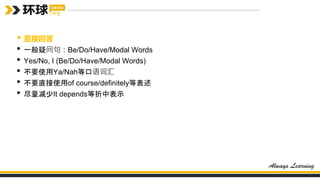
• 直接回答
• 一般疑问句:Be/Do/Have/Modal Words
• Yes/No, I (Be/Do/Have/Modal Words)
• 不要使用Ya/Nah等口语词汇
• 不要直接使用of course/definitely等表述
• 尽量减少It depends等折中表示
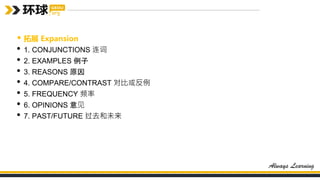
• 拓展 Expansion
• 1. CONJUNCTIONS 连词
• 2. EXAMPLES 例子
• 3. REASONS 原因
• 4. COMPARE/CONTRAST 对比或反例
• 5. FREQUENCY 频率
• 6. OPINIONS 意见
• 7. PAST/FUTURE 过去和未来
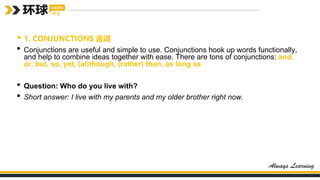
• 1. CONJUNCTIONS 连词
• Conjunctions are useful and simple to use. Conjunctions hook up words functionally,
and help to combine ideas together with ease. There are tons of conjunctions: and,
or, but, so, yet, (al)though, (rather) than, as long as
• Question: Who do you live with?
• Short answer: I live with my parents and my older brother right now.
Who do you live with?
I live with my parents and my older brother right now. My brother is getting
married next month, so his new wife will soon be moving in with us as well.
Do you like wearing t-shirts?
Yes i do, I like t-shirt and I have a lot of tshirts with me, I can wear different
tshirt everyday during the summer.
Do you often go to the library?
No i don’t, and I only go to the library once a month/once in a year.( I have
never gone to the library in my life). But maybe i will go to library more in the
future.
• 2. EXAMPLES 例子
• Examples are like your best friends, they make everything in life a little easier to
understand. You can give an example for almost anything, just make sure it’s relevant
to the question. To give an example, you can say: for example, for instance
• Question: How do you define volunteer work?
• Short answer: Volunteering means spending your free time to help others
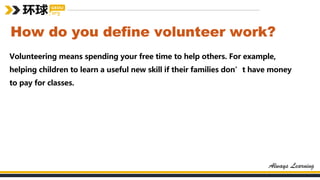
How do you define volunteer work?
Volunteering means spending your free time to help others. For example,
helping children to learn a useful new skill if their families don’t have money
to pay for classes.
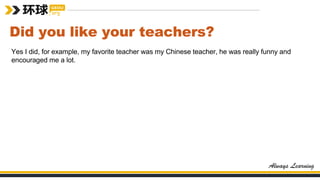
Did you like your teachers?
Yes I did, for example, my favorite teacher was my Chinese teacher, he was really funny and
encouraged me a lot.
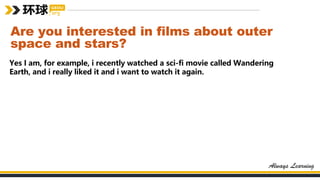
Are you interested in films about outer
space and stars?
Yes I am, for example, i recently watched a sci-fi movie called Wandering
Earth, and i really liked it and i want to watch it again.
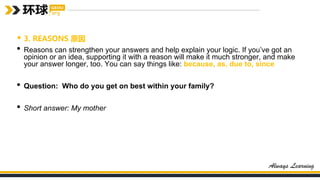
• 3. REASONS 原因
• Reasons can strengthen your answers and help explain your logic. If you’ve got an
opinion or an idea, supporting it with a reason will make it much stronger, and make
your answer longer, too. You can say things like: because, as, due to, since
• Question: Who do you get on best within your family?
• Short answer: My mother
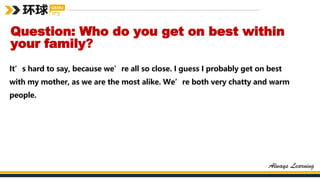
Question: Who do you get on best within
your family?
It’s hard to say, because we’re all so close. I guess I probably get on best
with my mother, as we are the most alike. We’re both very chatty and warm
people.
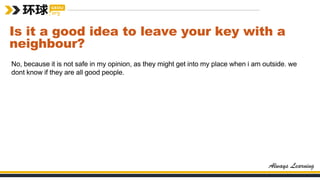
Is it a good idea to leave your key with a
neighbour?
No, because it is not safe in my opinion, as they might get into my place when i am outside. we
dont know if they are all good people.
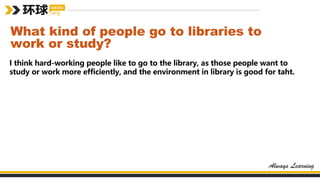
What kind of people go to libraries to
work or study?
I think hard-working people like to go to the library, as those people want to
study or work more efficiently, and the environment in library is good for taht.
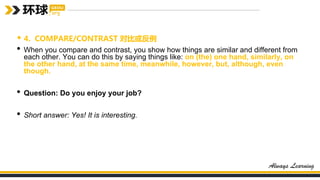
• 4. COMPARE/CONTRAST 对比或反例
• When you compare and contrast, you show how things are similar and different from
each other. You can do this by saying things like: on (the) one hand, similarly, on
the other hand, at the same time, meanwhile, however, but, although, even
though.
• Question: Do you enjoy your job?
• Short answer: Yes! It is interesting.
Do you enjoy your job?
My job is in customer-service, so it’s interesting to meet plenty of new
people each day. At the same time, it’s also a little exhausting to be on my
feet for hours.
Do you prefer shopping in big companies
or small shops?
I prefer shopping in big companies. because the big companies have a variety of different
products. I can have more choice. At the same time, small companies only have litmited
amount of things to buy.
Is it usually louder in the countryside or in
the city in your country?
it is the city, because there are a lot of transportation, at the same time, there
are only a few cars in the countryside, so the countryside is definitely more
quieter than the city.
• 5. FREQUENCY 频率
• Frequency tells how often makes things more clear. You can add more details to your
answer by mentioning the frequency of whatever you’re talking about. Frequency
words are usually adverbs, such as: sometimes, often, usually, from time to time,
on occasion,seldom,hardly,barely,never.
• Question: Do you lead an active life?
• Short answer: I don't lead an active life.
Do you lead an active life?
I’m not into playing sports much, but I go for walks with my family a few
times a week to stay active. Since I’m usually busy with school and other
things, I don’t exercise often. I think my daily life keeps me active enough.
How often do you eat chocolate?
I hardly eat chocolate, the last time i ate was two years ago, I think i have it maybe once a year.
because i think the calaries in Chocolate is very high, and it will make me fat.
Do you enjoy looking at the stars?
No, i dont, i barely look at the stars, the last time I looked at the stars was two
years ago. As i think it is a boring thing to do.
• 6. OPINIONS 意见
• Opinions show how you really feel about that. Even if the question doesn’t ask what
you think, it’s natural to offer your opinion on the subject. There are a few ways to
introduce your opinion: in my opinion, I think, I believe, as far as I’m concerned, if
you ask me, I’d say, from my perspective, my point is,
• Question: How many people live in your hometown?
• Short answer: There are less than 1,000 people total who live in my hometown.
How many people live in your hometown?
There are less than 1,000 people total who live in my hometown. If you ask
me, it’s more like a small village than a town.
Did you like the current learning
atmosphere at your school?
Yes i did, in my opinion, the learning atomosphere in my school is very good, because
everybody is so hard-working studying, i also think this is a very positive environment.
Would you ever like to go into space?
Yes i would, i think the space is very fantastic, there are a lot of special and
amazing things in the space, that’s why i want to go there to explore.
• 7. PAST/FUTURE 过去或将来
• If you add in information about your past and future, it adds depth to your answer.
People like to give background about themselves when speaking. You can do this in
some of the following ways: back then, since then, from the time that, going
forward, in the future, hopefully
• Question: Do you get on well with your coworkers?
• Short answer: My coworkers and I aren’t close.
Do you get on well with your coworkers?
My coworkers and I aren’t close, but we always work together in a
professional way. However, they seem very likeable, and I’d be open to
getting to know them better going forward.
Are libraries popular in your country?
No they are not, back then not every city has its library, so people did not have the chance to
visit the library. But in the future, maybe libraries will be popular when there are more.
Do you always take your keys when you
go out?
No i dont, back then we had to use the keys to open the door so that we can
get in, but now, we have electric doorlock that can be opened by fingerprints.
So i dont always take my keys with me.
• CONCLUSION:
• While keeping length and content in mind, you should remember that it’s not enough
to just give a complete answer. To perform well on this part of the IELTS, you’ll need
answers that flow, and sound conversational. Doing this, and doing it in a natural way,
will allow the IELTS examiner to get a better idea about the level of your speaking
ability in English. Now that you’ve learned more about a few ways to extend your
answers, your speaking can sound more natural, and your answers will be more
powerful.
01.Weekends
• Do you like weekends?
• Because my free time, a lot of time to do the things i like.
• What do you usually do on weekends?
• There are lots of things i can do weekends, for example, I usually go shopping with my friends, after
that we will go to cinema. In other time, I will study English for the whole weekends.
• What did you do last weekend?
• Last weekend was really fun for me, I played badminton with my friends, and then I just studied.
Back then, I just spent my whole weekend studying and doing nothing.
• Do you make plans for your weekends?
• Yes, I do, i usually plan only one day in the weekends, I often make plans to hang out with friends,
and also I will take some time to prepare the work for next week. I think this is very efficient for me.
02.Music
• What type of music do you dislike?
• I don’t like DJ music, because I think those songs are really noise and loud. It makes me annoyed
every time. I specifically don’t like those DJ songs played in the clubs, I don’t enjoy any of them.
• Do you often listen to a certain kind of music?
• I often listen to light music, because light music can help me to calm down. I will listen to light
music especially during my study, it can help me to focus on my work and boost my efficiency at
the same time.
• What's the most popular type of music where you live?
• In my opinion, the most popular type of music must be the pop music, because the people around
this area are mostly young people, who are easily attracted by the pop singers, so that they prefer
the pop music more than the others.
• Which singer or musician would you like to see in person?
• The singer i want to meet in person must be Li Ronghao, he is a famous chinese pop singer that I
often listen to his songs, I also have lots of his poster in my bedroom, i cant wait to meet him in
person.
Homework:
Complete the following topics:
(make sure you expend each answer properly)
 T-shirts
 Keys
 Libraries
 Schools

IELTS Speaking Unit 3.pptx

  • 1.
  • 2.
  • 3.
    • 直接回答 • 一般疑问句:Be/Do/Have/ModalWords • Yes/No, I (Be/Do/Have/Modal Words) • 不要使用Ya/Nah等口语词汇 • 不要直接使用of course/definitely等表述 • 尽量减少It depends等折中表示
  • 4.
    • 拓展 Expansion •1. CONJUNCTIONS 连词 • 2. EXAMPLES 例子 • 3. REASONS 原因 • 4. COMPARE/CONTRAST 对比或反例 • 5. FREQUENCY 频率 • 6. OPINIONS 意见 • 7. PAST/FUTURE 过去和未来
  • 5.
    • 1. CONJUNCTIONS连词 • Conjunctions are useful and simple to use. Conjunctions hook up words functionally, and help to combine ideas together with ease. There are tons of conjunctions: and, or, but, so, yet, (al)though, (rather) than, as long as • Question: Who do you live with? • Short answer: I live with my parents and my older brother right now.
  • 6.
    Who do youlive with? I live with my parents and my older brother right now. My brother is getting married next month, so his new wife will soon be moving in with us as well.
  • 7.
    Do you likewearing t-shirts? Yes i do, I like t-shirt and I have a lot of tshirts with me, I can wear different tshirt everyday during the summer.
  • 8.
    Do you oftengo to the library? No i don’t, and I only go to the library once a month/once in a year.( I have never gone to the library in my life). But maybe i will go to library more in the future.
  • 9.
    • 2. EXAMPLES例子 • Examples are like your best friends, they make everything in life a little easier to understand. You can give an example for almost anything, just make sure it’s relevant to the question. To give an example, you can say: for example, for instance • Question: How do you define volunteer work? • Short answer: Volunteering means spending your free time to help others
  • 10.
    How do youdefine volunteer work? Volunteering means spending your free time to help others. For example, helping children to learn a useful new skill if their families don’t have money to pay for classes.
  • 11.
    Did you likeyour teachers? Yes I did, for example, my favorite teacher was my Chinese teacher, he was really funny and encouraged me a lot.
  • 12.
    Are you interestedin films about outer space and stars? Yes I am, for example, i recently watched a sci-fi movie called Wandering Earth, and i really liked it and i want to watch it again.
  • 13.
    • 3. REASONS原因 • Reasons can strengthen your answers and help explain your logic. If you’ve got an opinion or an idea, supporting it with a reason will make it much stronger, and make your answer longer, too. You can say things like: because, as, due to, since • Question: Who do you get on best within your family? • Short answer: My mother
  • 14.
    Question: Who doyou get on best within your family? It’s hard to say, because we’re all so close. I guess I probably get on best with my mother, as we are the most alike. We’re both very chatty and warm people.
  • 15.
    Is it agood idea to leave your key with a neighbour? No, because it is not safe in my opinion, as they might get into my place when i am outside. we dont know if they are all good people.
  • 16.
    What kind ofpeople go to libraries to work or study? I think hard-working people like to go to the library, as those people want to study or work more efficiently, and the environment in library is good for taht.
  • 17.
    • 4. COMPARE/CONTRAST对比或反例 • When you compare and contrast, you show how things are similar and different from each other. You can do this by saying things like: on (the) one hand, similarly, on the other hand, at the same time, meanwhile, however, but, although, even though. • Question: Do you enjoy your job? • Short answer: Yes! It is interesting.
  • 18.
    Do you enjoyyour job? My job is in customer-service, so it’s interesting to meet plenty of new people each day. At the same time, it’s also a little exhausting to be on my feet for hours.
  • 19.
    Do you prefershopping in big companies or small shops? I prefer shopping in big companies. because the big companies have a variety of different products. I can have more choice. At the same time, small companies only have litmited amount of things to buy.
  • 20.
    Is it usuallylouder in the countryside or in the city in your country? it is the city, because there are a lot of transportation, at the same time, there are only a few cars in the countryside, so the countryside is definitely more quieter than the city.
  • 21.
    • 5. FREQUENCY频率 • Frequency tells how often makes things more clear. You can add more details to your answer by mentioning the frequency of whatever you’re talking about. Frequency words are usually adverbs, such as: sometimes, often, usually, from time to time, on occasion,seldom,hardly,barely,never. • Question: Do you lead an active life? • Short answer: I don't lead an active life.
  • 22.
    Do you leadan active life? I’m not into playing sports much, but I go for walks with my family a few times a week to stay active. Since I’m usually busy with school and other things, I don’t exercise often. I think my daily life keeps me active enough.
  • 23.
    How often doyou eat chocolate? I hardly eat chocolate, the last time i ate was two years ago, I think i have it maybe once a year. because i think the calaries in Chocolate is very high, and it will make me fat.
  • 24.
    Do you enjoylooking at the stars? No, i dont, i barely look at the stars, the last time I looked at the stars was two years ago. As i think it is a boring thing to do.
  • 25.
    • 6. OPINIONS意见 • Opinions show how you really feel about that. Even if the question doesn’t ask what you think, it’s natural to offer your opinion on the subject. There are a few ways to introduce your opinion: in my opinion, I think, I believe, as far as I’m concerned, if you ask me, I’d say, from my perspective, my point is, • Question: How many people live in your hometown? • Short answer: There are less than 1,000 people total who live in my hometown.
  • 26.
    How many peoplelive in your hometown? There are less than 1,000 people total who live in my hometown. If you ask me, it’s more like a small village than a town.
  • 27.
    Did you likethe current learning atmosphere at your school? Yes i did, in my opinion, the learning atomosphere in my school is very good, because everybody is so hard-working studying, i also think this is a very positive environment.
  • 28.
    Would you everlike to go into space? Yes i would, i think the space is very fantastic, there are a lot of special and amazing things in the space, that’s why i want to go there to explore.
  • 29.
    • 7. PAST/FUTURE过去或将来 • If you add in information about your past and future, it adds depth to your answer. People like to give background about themselves when speaking. You can do this in some of the following ways: back then, since then, from the time that, going forward, in the future, hopefully • Question: Do you get on well with your coworkers? • Short answer: My coworkers and I aren’t close.
  • 30.
    Do you geton well with your coworkers? My coworkers and I aren’t close, but we always work together in a professional way. However, they seem very likeable, and I’d be open to getting to know them better going forward.
  • 31.
    Are libraries popularin your country? No they are not, back then not every city has its library, so people did not have the chance to visit the library. But in the future, maybe libraries will be popular when there are more.
  • 32.
    Do you alwaystake your keys when you go out? No i dont, back then we had to use the keys to open the door so that we can get in, but now, we have electric doorlock that can be opened by fingerprints. So i dont always take my keys with me.
  • 33.
    • CONCLUSION: • Whilekeeping length and content in mind, you should remember that it’s not enough to just give a complete answer. To perform well on this part of the IELTS, you’ll need answers that flow, and sound conversational. Doing this, and doing it in a natural way, will allow the IELTS examiner to get a better idea about the level of your speaking ability in English. Now that you’ve learned more about a few ways to extend your answers, your speaking can sound more natural, and your answers will be more powerful.
  • 34.
    01.Weekends • Do youlike weekends? • Because my free time, a lot of time to do the things i like. • What do you usually do on weekends? • There are lots of things i can do weekends, for example, I usually go shopping with my friends, after that we will go to cinema. In other time, I will study English for the whole weekends. • What did you do last weekend? • Last weekend was really fun for me, I played badminton with my friends, and then I just studied. Back then, I just spent my whole weekend studying and doing nothing. • Do you make plans for your weekends? • Yes, I do, i usually plan only one day in the weekends, I often make plans to hang out with friends, and also I will take some time to prepare the work for next week. I think this is very efficient for me.
  • 35.
    02.Music • What typeof music do you dislike? • I don’t like DJ music, because I think those songs are really noise and loud. It makes me annoyed every time. I specifically don’t like those DJ songs played in the clubs, I don’t enjoy any of them. • Do you often listen to a certain kind of music? • I often listen to light music, because light music can help me to calm down. I will listen to light music especially during my study, it can help me to focus on my work and boost my efficiency at the same time. • What's the most popular type of music where you live? • In my opinion, the most popular type of music must be the pop music, because the people around this area are mostly young people, who are easily attracted by the pop singers, so that they prefer the pop music more than the others. • Which singer or musician would you like to see in person? • The singer i want to meet in person must be Li Ronghao, he is a famous chinese pop singer that I often listen to his songs, I also have lots of his poster in my bedroom, i cant wait to meet him in person.
  • 36.
    Homework: Complete the followingtopics: (make sure you expend each answer properly)  T-shirts  Keys  Libraries  Schools