Language and Literacy During Storytimes Emily S. Neal, M.S., CCC-SLP Rhian E. Vanderburg, M.S., CCC-SLP Charlotte Speech and Hearing Center
Pilot Program and Partnership Charlotte Speech and Hearing Center and Charlotte Mecklenburg Libraries teamed up to provide language and literacy experiences to at risk populations in Mecklenburg County Provided storytelling, language enrichment activities, and other pre-literacy activities to young children at 3 library branches
Children with language impairment are more likely to have reading difficulties as they get older. Catts, et al.
Who can benefit from Pre-Literacy skills? Babies- chewing books, holding books, turning pages Young children- following along with text, holding text the correct way, interacting with content, phonological awareness skills Pre-Kindergarten children- phonological awareness, comprehension, language expansion
What can we do to foster pre-literacy skills? Phonological Awareness Activities Language Enrichment and Enhancement Allow Learning by Doing
Phonological Awareness Skills Phonological awareness is the understanding of how a word is structured and built It allows for the manipulation of sounds and syllables in words Phonological awareness skills aid in word decoding skills and sound to letter correlation (which increases reading abilities)
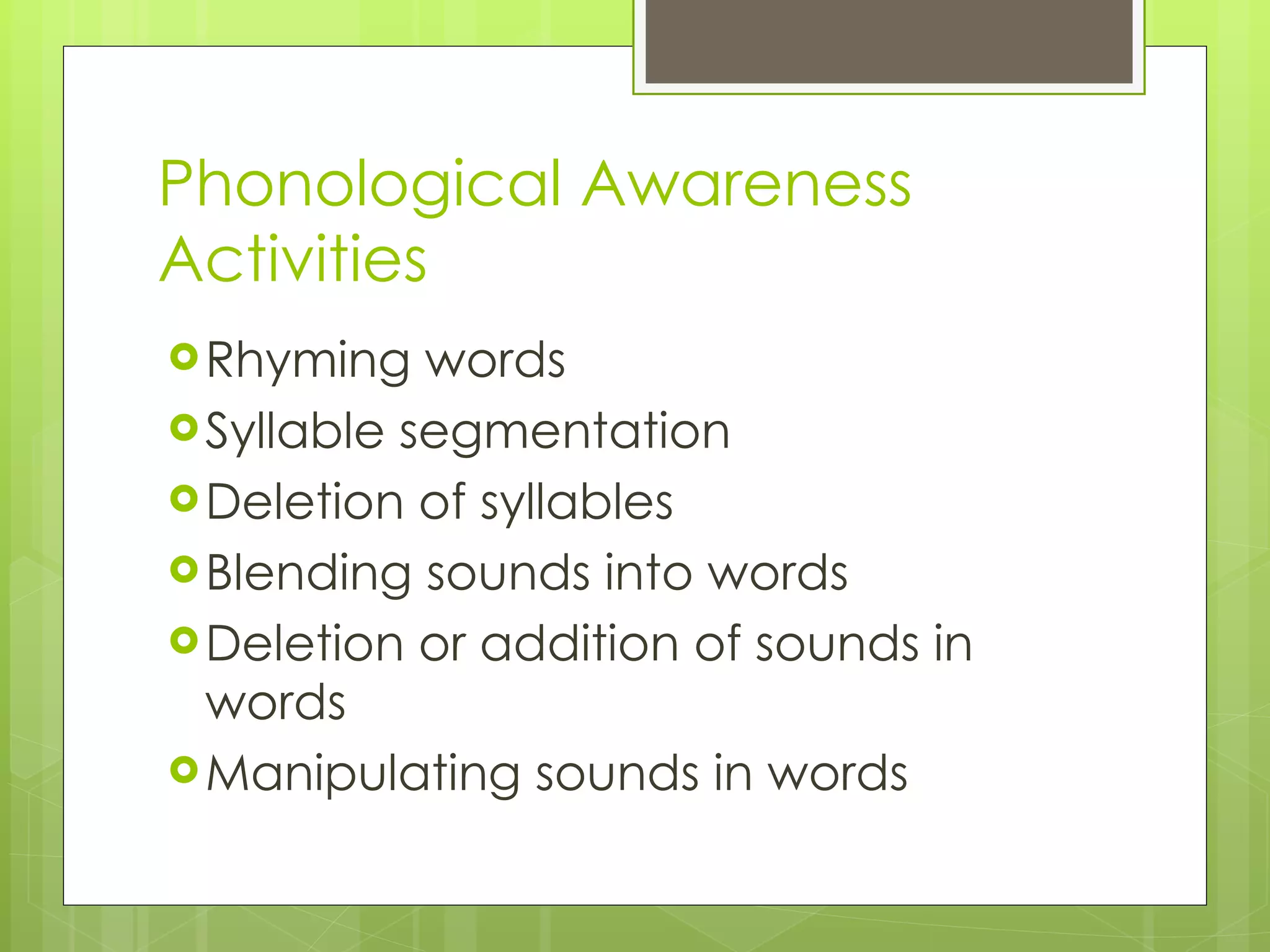
Phonological Awareness Activities Rhyming words Syllable segmentation Deletion of syllables Blending sounds into words Deletion or addition of sounds in words Manipulating sounds in words
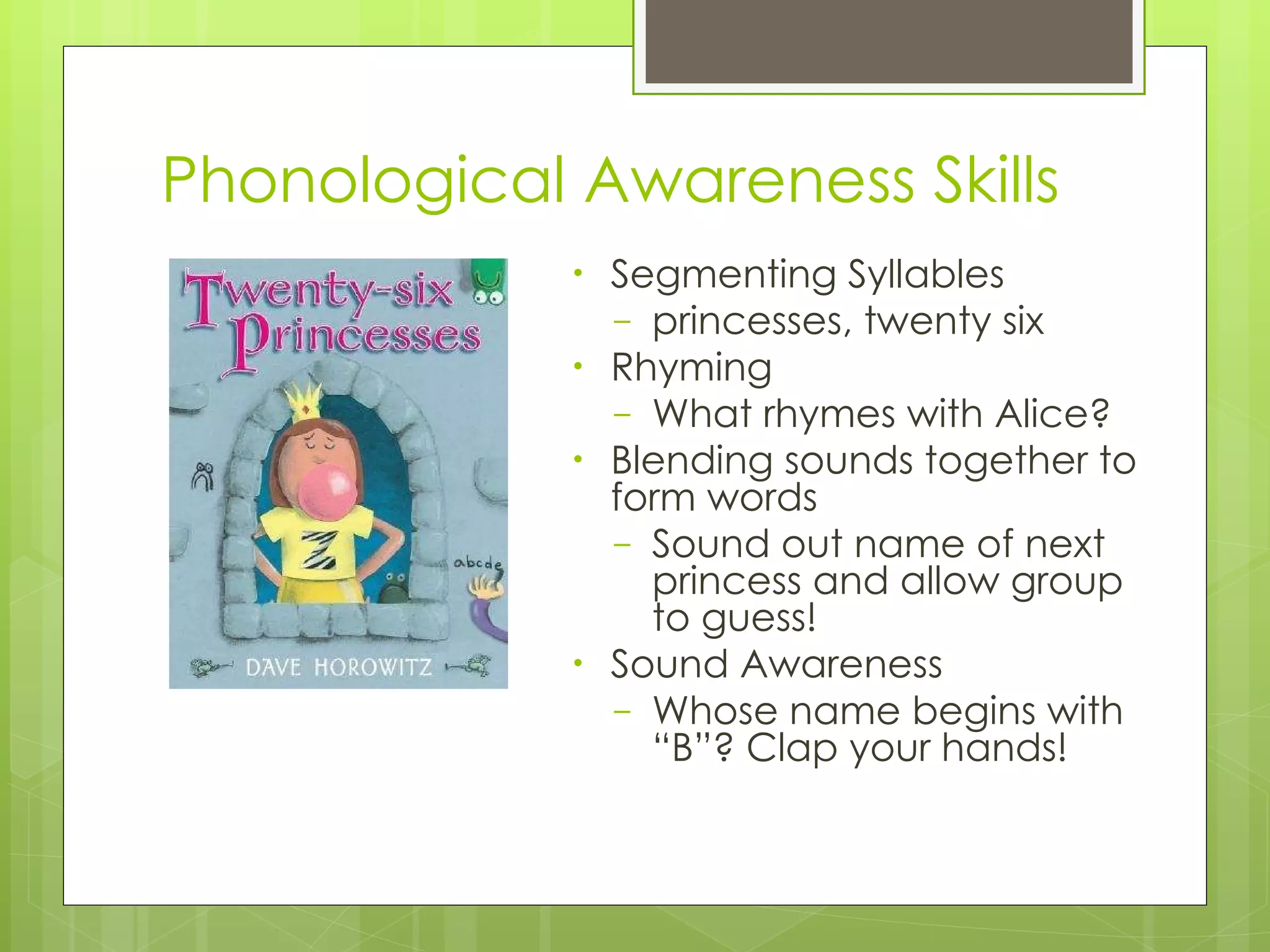
Phonological Awareness Skills Segmenting Syllables princesses, twenty six Rhyming What rhymes with Alice? Blending sounds together to form words Sound out name of next princess and allow group to guess! Sound Awareness Whose name begins with “B”? Clap your hands!
Language Enrichment and Expansion Not just “what’s that?” Example: If you are describing a “bear,” discuss its actions, appearance, motivations  “ the huge brown bear” “ it’s running quickly” “ What do you think will happen? It will sleep all winter.” Allow for prediction “ What do you think will happen next?”
Language Enrichment and Expansion Introduce basic concepts during reading Spatial concepts (in, on, under) Shapes (the barn is shaped like a square) Colors (describe objects) Actions (describe what characters are doing) Allow for imagination “ If you were a princess with a magic power, what would your power be?”
Allow Learning By Doing Looking, seeing, feeling, and smelling are all hands on approaches  that encourage learning and increase language skills Don’t just teach, but allow the child to learn  with  you Remember, language is best learned through experience
Language Activities: Farm Animal Book Phonological Awareness Rhyming, syllable segmentation, initial sound recognition and manipulation Basic Concepts Allow children to put animals “in, on, beside” barn Vocabulary Animal names, descriptive words
 
Language Activities: Ocean Themed Book Vocabulary Sandy, rough, sea shell, star fish, ocean life vocabulary Language Enrichment “ We  build  sandcastles,” “We  dig  in the sand” We take pictures with a camera “ What would you like to do at the beach?”
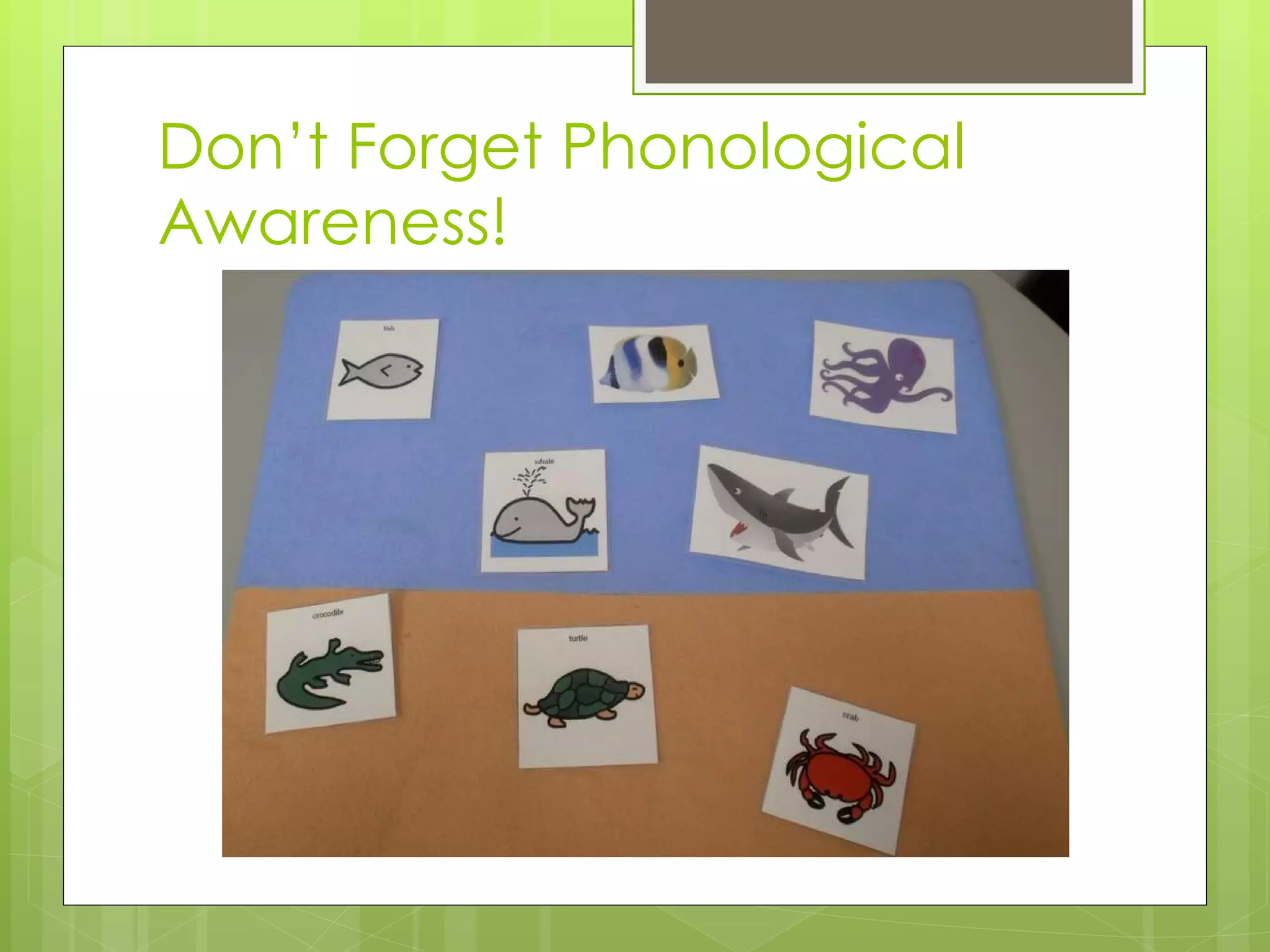
Don’t Forget Phonological Awareness!
What are adapted books? Adapted books are books that contain picture symbols.  These are often paired with symbol labels. Adapted books help students look for, understand, and identify (either by pointing or saying) the content of the illustrated page.
Why do adapted books work? Adapted books provide students with a pre-reading step that allows them to understand that the picture in the book is related to the picture symbol in which they are trying to communicate.
Why do children enjoy reading adapted books? Many of our students are often strong visual learners and benefit from having both picture and text! Note : After students have learned picture-symbol associations, it may be possible to simply fade out the picture and focus only on the printed word.
So how do you use adapted books? The following ideas will help you get started in creating a library full of adapted books: Select props that can be used within a story (i.e. plush caterpillar and food basket for  The Hungry Caterpillar ) Create adaptive songs or poems to go along with the book that you have chosen. Write additional complimentary stories using everyday routines or activities.
Ideas Continued… Write additional stories to teach new concepts. Make flashcards for key vocabulary and pictures. When selecting additional books, you want to choose predictable books with repetitive lines.  These are great for emergent readers! (i.e.  There was an old lady who swallowed a bat )
What do you need for making adapted books? The following are just a few examples of what you can use to make adapted books. 3 ring binders or binders with protective pages already in place. Lamination sheets to protect the book from tearing and soiling. LOTS of Velcro to adhere your pictures. Page fluffers (to help with turning the pages) (i.e. large paper clips, packing peanuts, popsicle sticks, hot glue dots, or square pieces of foam.)  Space each one evenly down the right side of the page.
The bottom line! Books can be adapted for motor, language, vocal output, vision, and hearing supports to allow for equal opportunities for literacy and language development. Anyone can adapt books!  It’s that easy! Be creative with resources!  You can recycle old children’s books, visit flea markets and garage sales, or even take a trip to your local dollar stores.
Adapted Books What kind of book should I adapt? Predictable, repetitive Rhyming books Large print Books with appropriate vocabulary words
Adapted Books Providing picture with word promotes visual and word correlation Easier word prediction Allows spoken word and written word relationship Hands-on approach encourages interest and learning
 
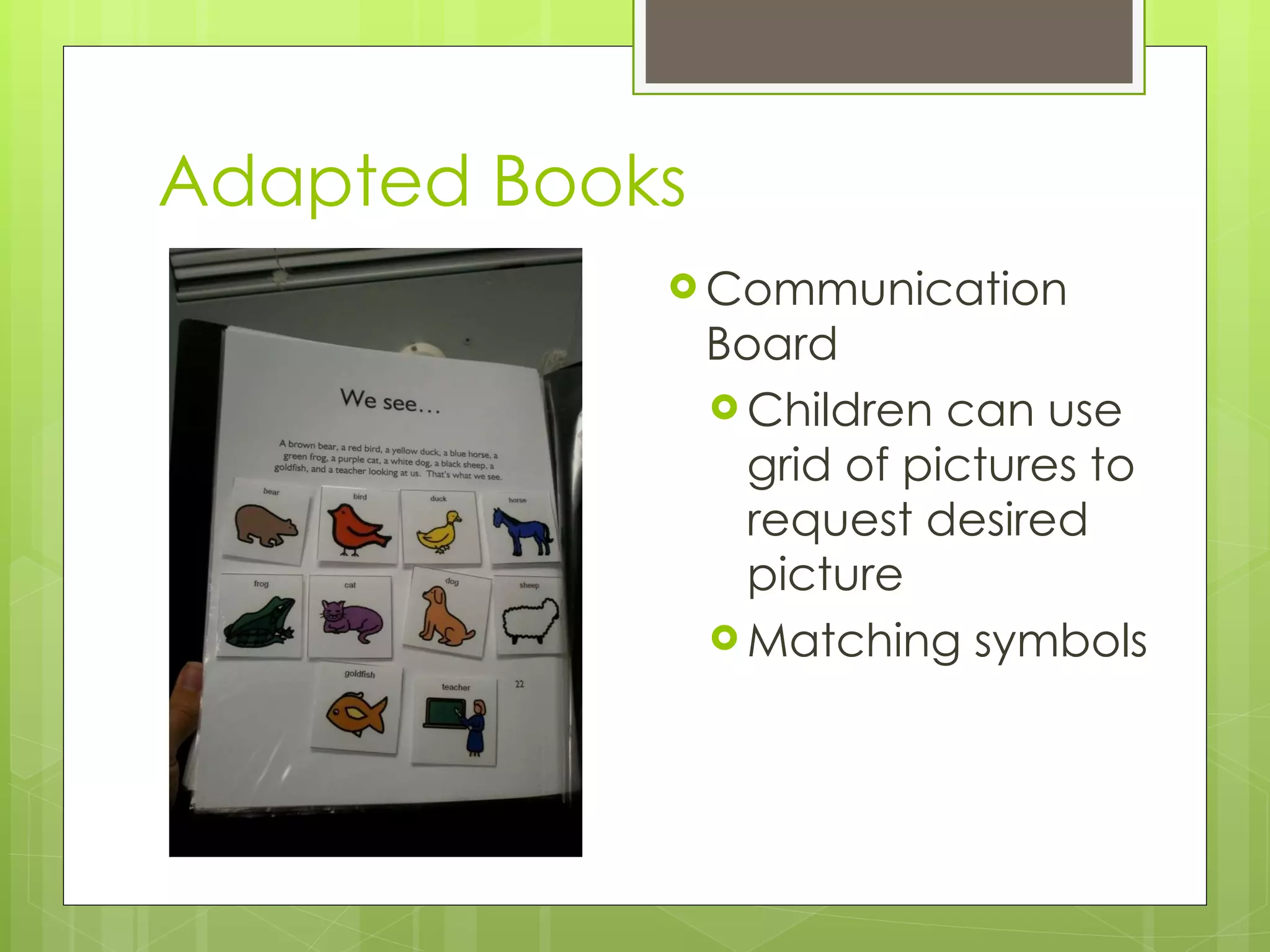
Adapted Books Communication Board Children can use grid of pictures to request desired picture Matching symbols
Adapted Books
In the end… Make reading fun! Make reading a language experience! Adapt to provide literacy opportunities for children of all ages and abilities!
References Catts, H. W., Bridges, M.S, Little, T.D., & Tomblin, J.B. (2008). “Reading Achievement Growth in Children with Language Impairments.”  Journal of Speech, Language, and Hearing Research, 51,  1569-1579. Gillon, G. (2002, December 03). Phonological Awareness Intervention for Children: From the Research Laboratory to the Clinic. The ASHA Leader. Glenn, M. “Using Adapted Books to Form a Bridge to Reading and Writing with Autism and Low Incidence.” Presentation. North Carolina Assistive Technology Program, 2006. Web. 26 Sep. 2011.

Language and literacy during storytimes

  • 1.
    Language and LiteracyDuring Storytimes Emily S. Neal, M.S., CCC-SLP Rhian E. Vanderburg, M.S., CCC-SLP Charlotte Speech and Hearing Center
  • 2.
    Pilot Program andPartnership Charlotte Speech and Hearing Center and Charlotte Mecklenburg Libraries teamed up to provide language and literacy experiences to at risk populations in Mecklenburg County Provided storytelling, language enrichment activities, and other pre-literacy activities to young children at 3 library branches
  • 3.
    Children with languageimpairment are more likely to have reading difficulties as they get older. Catts, et al.
  • 4.
    Who can benefitfrom Pre-Literacy skills? Babies- chewing books, holding books, turning pages Young children- following along with text, holding text the correct way, interacting with content, phonological awareness skills Pre-Kindergarten children- phonological awareness, comprehension, language expansion
  • 5.
    What can wedo to foster pre-literacy skills? Phonological Awareness Activities Language Enrichment and Enhancement Allow Learning by Doing
  • 6.
    Phonological Awareness SkillsPhonological awareness is the understanding of how a word is structured and built It allows for the manipulation of sounds and syllables in words Phonological awareness skills aid in word decoding skills and sound to letter correlation (which increases reading abilities)
  • 7.
    Phonological Awareness ActivitiesRhyming words Syllable segmentation Deletion of syllables Blending sounds into words Deletion or addition of sounds in words Manipulating sounds in words
  • 8.
    Phonological Awareness SkillsSegmenting Syllables princesses, twenty six Rhyming What rhymes with Alice? Blending sounds together to form words Sound out name of next princess and allow group to guess! Sound Awareness Whose name begins with “B”? Clap your hands!
  • 9.
    Language Enrichment andExpansion Not just “what’s that?” Example: If you are describing a “bear,” discuss its actions, appearance, motivations “ the huge brown bear” “ it’s running quickly” “ What do you think will happen? It will sleep all winter.” Allow for prediction “ What do you think will happen next?”
  • 10.
    Language Enrichment andExpansion Introduce basic concepts during reading Spatial concepts (in, on, under) Shapes (the barn is shaped like a square) Colors (describe objects) Actions (describe what characters are doing) Allow for imagination “ If you were a princess with a magic power, what would your power be?”
  • 11.
    Allow Learning ByDoing Looking, seeing, feeling, and smelling are all hands on approaches that encourage learning and increase language skills Don’t just teach, but allow the child to learn with you Remember, language is best learned through experience
  • 12.
    Language Activities: FarmAnimal Book Phonological Awareness Rhyming, syllable segmentation, initial sound recognition and manipulation Basic Concepts Allow children to put animals “in, on, beside” barn Vocabulary Animal names, descriptive words
  • 13.
  • 14.
    Language Activities: OceanThemed Book Vocabulary Sandy, rough, sea shell, star fish, ocean life vocabulary Language Enrichment “ We build sandcastles,” “We dig in the sand” We take pictures with a camera “ What would you like to do at the beach?”
  • 15.
  • 16.
    What are adaptedbooks? Adapted books are books that contain picture symbols. These are often paired with symbol labels. Adapted books help students look for, understand, and identify (either by pointing or saying) the content of the illustrated page.
  • 17.
    Why do adaptedbooks work? Adapted books provide students with a pre-reading step that allows them to understand that the picture in the book is related to the picture symbol in which they are trying to communicate.
  • 18.
    Why do childrenenjoy reading adapted books? Many of our students are often strong visual learners and benefit from having both picture and text! Note : After students have learned picture-symbol associations, it may be possible to simply fade out the picture and focus only on the printed word.
  • 19.
    So how doyou use adapted books? The following ideas will help you get started in creating a library full of adapted books: Select props that can be used within a story (i.e. plush caterpillar and food basket for The Hungry Caterpillar ) Create adaptive songs or poems to go along with the book that you have chosen. Write additional complimentary stories using everyday routines or activities.
  • 20.
    Ideas Continued… Writeadditional stories to teach new concepts. Make flashcards for key vocabulary and pictures. When selecting additional books, you want to choose predictable books with repetitive lines. These are great for emergent readers! (i.e. There was an old lady who swallowed a bat )
  • 21.
    What do youneed for making adapted books? The following are just a few examples of what you can use to make adapted books. 3 ring binders or binders with protective pages already in place. Lamination sheets to protect the book from tearing and soiling. LOTS of Velcro to adhere your pictures. Page fluffers (to help with turning the pages) (i.e. large paper clips, packing peanuts, popsicle sticks, hot glue dots, or square pieces of foam.) Space each one evenly down the right side of the page.
  • 22.
    The bottom line!Books can be adapted for motor, language, vocal output, vision, and hearing supports to allow for equal opportunities for literacy and language development. Anyone can adapt books! It’s that easy! Be creative with resources! You can recycle old children’s books, visit flea markets and garage sales, or even take a trip to your local dollar stores.
  • 23.
    Adapted Books Whatkind of book should I adapt? Predictable, repetitive Rhyming books Large print Books with appropriate vocabulary words
  • 24.
    Adapted Books Providingpicture with word promotes visual and word correlation Easier word prediction Allows spoken word and written word relationship Hands-on approach encourages interest and learning
  • 25.
  • 26.
    Adapted Books CommunicationBoard Children can use grid of pictures to request desired picture Matching symbols
  • 27.
  • 28.
    In the end…Make reading fun! Make reading a language experience! Adapt to provide literacy opportunities for children of all ages and abilities!
  • 29.
    References Catts, H.W., Bridges, M.S, Little, T.D., & Tomblin, J.B. (2008). “Reading Achievement Growth in Children with Language Impairments.” Journal of Speech, Language, and Hearing Research, 51, 1569-1579. Gillon, G. (2002, December 03). Phonological Awareness Intervention for Children: From the Research Laboratory to the Clinic. The ASHA Leader. Glenn, M. “Using Adapted Books to Form a Bridge to Reading and Writing with Autism and Low Incidence.” Presentation. North Carolina Assistive Technology Program, 2006. Web. 26 Sep. 2011.