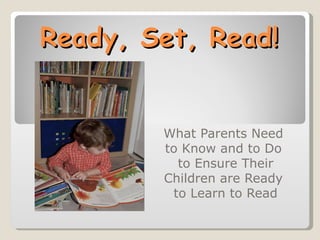
Ready, Set, Read!


        What Parents Need
        to Know and to Do
          to Ensure Their
        Children are Ready
         to Learn to Read
Learning Tools
and Resources
Games

   MeeGenius!                                            – Free
   Small Talk Phonemes                                   – Free
   Phonics Genius                                        – Free
   Mels Phonics NonPhonics Lite Part 1 & Part 2          – Free
   ABC Magic Phonics                                     – Free
   Zap Phonics Reading Games                             – Free
   Phonic Soup                                           – Free
   Match Phonics                                         – Free
   Phonics Fun 1, 2 & 3                                  – Free
   First Words with Phonics Lite                         – Free
   BaldiMatch:Phonics                                    - $ .99
   Little Reader                                         - $ .99
   Phonics Dojo                                          - $1.99
   Hi! Phonics                                           - $1.99
   Montessori Crosswords – Learn Spelling with Phonics   - $2.99
Websites

   www.smartyearsapps.com

   www.inov8-ed.com/2011/03/theres-a-special-app-for-that-part-7-apps-that-sup

   www.teams.lacoe.edu/documentation/classrooms/patti/k-1/activities/phonemic.

   www.proactiveparent.com

   www.colorincolorado.com/families

   www.readingrockets.org
Counting, Matching, and Naming Letters


                                       G
                                                                     F
 What You Need
 •Set of plastic alphabet letters-preferable capital letters
 •Mat that you make on an 11” x 17” piece of firm paper. Trace the plastic letters and fill them in, in an arc
 shape, so that the plastic letters will fit over the letters written on the arc. The arc should extend from the
 lower left to the lower right corner.
 •What You Do
 •Ask you child to count how many letters there are.
 •Then ask your child to place the plastic letters on the matching letters on the arc of the mat.
 •Teach her the name of each letter, introducing about four new letters per day. For example, “This is the
 letter A.”
 •After she can differentiate the letter shapes and has been taught the names of each letter, ask her to say
 the name of the letter as she places it in the position on the arc.
 •Repeat often, until your child can recognize each letter, place it over the corresponding symbol on the arc on
 the mat, and say the name of each letter. Generally, it takes several weeks for a child to master all the letters.
Learning The Sequence of the Alphabet


                                                                                     A
           ABCDEFGHIJKLMNOPQRSTUVWXYZ                                                         F
                                                                                     C
                                                                                                  X
                  E
What You Need
           C


 Set of plastic alphabet letters
 A slightly different mat made on an 11” x 17” piece of firm paper. List the letters in order in a straight line
  across the top to provide a reference for the child. This time, instead of the letters composing the arc, draw
  a line to form the arc. Then provide three “anchors” by writing the letter A at the lower left corner of the
  arc, the letter Z at the lower right, and M and N at the midway point at the top of the arc.
What You Do
 Ask your child to take the plastic letters out of the container and place them right side up in the center of
  the arc.
 Then ask her to find the A and place it.
 Next find the Z and place it, followed by the M and N.
 The child then begins with B, Then C, and so on, placing all the letters in order along the arc.
 When your child has finished sequencing the letters, ask her to check it by touching and naming each letter,
  starting with A and moving to Z. The alphabet across the top of the mat can serve as an additional reminder.
 Repeat this activity frequently until the child can place all the letters in the proper order within two minutes.
  Generally, it takes several weeks for a child to master this task.
Guess the Letter


What You Need
 Two sets of plastic alphabet letters-preferably capital letters
 Two 11” c 17” mats with or without the letters filled in on the arc
 Two brown paper bags, or cloth bags, big enough to hold the letters
What You Do
 This is a game that two children can play together or you can play with your child. The object is to
  try to correctly identify and name the letters based on felling them without looking. The winner is
  the first player to fill in all the letters on her arc.
 The first player reaches into a brown paper bag and feels a plastic letter without looking at it. If
  she can correctly name it, then she gets to place it on the arc on her mat and choose another letter.
  She continues choosing letters until she makes a mistake.
 Once a mistake is made, the turn rotates to the next player
   The player who successfully identifies and places all the letters on her arc is the winner.
Snaky Letters
What You Need
 Modeling clay or cookie dough
What You Do
 Roll the pieces of clay or dough into
  snake-shaped pieces for your child to use.
 Help your child form the pieces into the shapes of letters.
 If you cookie dough, make sure the letters with enclosed
  circles (i.e., o, b, d, q) have plenty of space inside the circle
  before baking. This will assure that the circles will not
  close up when baked.
Straight
Talk About
Reading
 Susan L. Hall Ed.D
 Louisa C. Moats, Ed.D
Parenting a
  Struggling
    Reader
Susan L. Hall, Ed.D
Louisa C. Moats, Ed.D
Road
                               to
Benita A. Blachman, Ph.D
                             the
                              Code
Eileen Wynne Ball, Ph.D
Rochella Black, M.S.

Darlene M. Tangel, Ph. D.
EAROBICS
PHONEMIC
                      AWARENESS
                      in Young Children

Marilyn Jager Adams
Barbara R. Foorman
Ingvar Lundberg
Terri Beeler
Bringing
                      Words
Isabel L. Beck
                          To
Margaret G. McKeown
Linda Kucan                Life
Books for a First-Grade Student
      Beginning Reader-First Stage
             Author   Title

Brown, Laura Krasny   •Rex and Lilly: Playtime
                      •Rex and Lilly :Family Time
Eastman, P.D.         Go, Dog Go!

Seuss, Dr.            Hop on Pop

Ziefert, Harriet      •Cat Games
                      •Harry Goes to Fun Land
                      •A New House for Mole and
                       Mouse
Picture Books to Read Aloud to an Infant or Toddler
                AUTHOR                                  TITLE
Ahlberg, Janet & Allen                 Each Peach Pear Plum
Arnold, Tedd                           No Jumping on the Bed
Barton, Byron                          Trucks
Brown, Margaret Wise                   Goodnight Moon
Bruna, Dick                            Miffy
Carlstrom, Nancy White                 Jesse Bear, What Will You Wear
Gibbons, Gail                          Trains
Hill, Eric                             Where’s Spot?
Martin, Bill Jr., & John Archambault   Chicka Chicka Boom Boom
Martin, Bill, Jr., & Eric Carle        Brown, Brown Bear, What Do You
                                       See?
Numeroff, Laura Joffe                  If you Give a Mouse a Cookie

Oxenbury, Helen                        Tom and Pippo Make a Friend
Other Books
   Beginning to Read: Thinking and Learning about Print- A
    Summary
         by Marilyn Jager Adams

   Help Me Help My Child: A Sourcebook for Parents of
    Learning Disabled Children
         by Jill Bloom

   Your Child’s Growing Mind: A Practical Guide to Brain
    Development and Learning from Birth to Adolescence
         by Jane M. Healy, PhD.

   About Dyslexia: Unraveling the Myth
        by Priscilla L. Vail

   The Educated Child
        by Bennett, Finn, & Cribb

Ready set-read learning-resources

  • 1.
    Ready, Set, Read! What Parents Need to Know and to Do to Ensure Their Children are Ready to Learn to Read
  • 2.
  • 3.
    Games  MeeGenius! – Free  Small Talk Phonemes – Free  Phonics Genius – Free  Mels Phonics NonPhonics Lite Part 1 & Part 2 – Free  ABC Magic Phonics – Free  Zap Phonics Reading Games – Free  Phonic Soup – Free  Match Phonics – Free  Phonics Fun 1, 2 & 3 – Free  First Words with Phonics Lite – Free  BaldiMatch:Phonics - $ .99  Little Reader - $ .99  Phonics Dojo - $1.99  Hi! Phonics - $1.99  Montessori Crosswords – Learn Spelling with Phonics - $2.99
  • 4.
    Websites  www.smartyearsapps.com  www.inov8-ed.com/2011/03/theres-a-special-app-for-that-part-7-apps-that-sup  www.teams.lacoe.edu/documentation/classrooms/patti/k-1/activities/phonemic.  www.proactiveparent.com  www.colorincolorado.com/families  www.readingrockets.org
  • 5.
    Counting, Matching, andNaming Letters G F What You Need •Set of plastic alphabet letters-preferable capital letters •Mat that you make on an 11” x 17” piece of firm paper. Trace the plastic letters and fill them in, in an arc shape, so that the plastic letters will fit over the letters written on the arc. The arc should extend from the lower left to the lower right corner. •What You Do •Ask you child to count how many letters there are. •Then ask your child to place the plastic letters on the matching letters on the arc of the mat. •Teach her the name of each letter, introducing about four new letters per day. For example, “This is the letter A.” •After she can differentiate the letter shapes and has been taught the names of each letter, ask her to say the name of the letter as she places it in the position on the arc. •Repeat often, until your child can recognize each letter, place it over the corresponding symbol on the arc on the mat, and say the name of each letter. Generally, it takes several weeks for a child to master all the letters.
  • 6.
    Learning The Sequenceof the Alphabet A ABCDEFGHIJKLMNOPQRSTUVWXYZ F C X E What You Need C  Set of plastic alphabet letters  A slightly different mat made on an 11” x 17” piece of firm paper. List the letters in order in a straight line across the top to provide a reference for the child. This time, instead of the letters composing the arc, draw a line to form the arc. Then provide three “anchors” by writing the letter A at the lower left corner of the arc, the letter Z at the lower right, and M and N at the midway point at the top of the arc. What You Do  Ask your child to take the plastic letters out of the container and place them right side up in the center of the arc.  Then ask her to find the A and place it.  Next find the Z and place it, followed by the M and N.  The child then begins with B, Then C, and so on, placing all the letters in order along the arc.  When your child has finished sequencing the letters, ask her to check it by touching and naming each letter, starting with A and moving to Z. The alphabet across the top of the mat can serve as an additional reminder.  Repeat this activity frequently until the child can place all the letters in the proper order within two minutes. Generally, it takes several weeks for a child to master this task.
  • 7.
    Guess the Letter WhatYou Need  Two sets of plastic alphabet letters-preferably capital letters  Two 11” c 17” mats with or without the letters filled in on the arc  Two brown paper bags, or cloth bags, big enough to hold the letters What You Do  This is a game that two children can play together or you can play with your child. The object is to try to correctly identify and name the letters based on felling them without looking. The winner is the first player to fill in all the letters on her arc.  The first player reaches into a brown paper bag and feels a plastic letter without looking at it. If she can correctly name it, then she gets to place it on the arc on her mat and choose another letter. She continues choosing letters until she makes a mistake.  Once a mistake is made, the turn rotates to the next player  The player who successfully identifies and places all the letters on her arc is the winner.
  • 8.
    Snaky Letters What YouNeed  Modeling clay or cookie dough What You Do  Roll the pieces of clay or dough into snake-shaped pieces for your child to use.  Help your child form the pieces into the shapes of letters.  If you cookie dough, make sure the letters with enclosed circles (i.e., o, b, d, q) have plenty of space inside the circle before baking. This will assure that the circles will not close up when baked.
  • 9.
    Straight Talk About Reading SusanL. Hall Ed.D Louisa C. Moats, Ed.D
  • 10.
    Parenting a Struggling Reader Susan L. Hall, Ed.D Louisa C. Moats, Ed.D
  • 11.
    Road to Benita A. Blachman, Ph.D the Code Eileen Wynne Ball, Ph.D Rochella Black, M.S. Darlene M. Tangel, Ph. D.
  • 12.
  • 13.
    PHONEMIC AWARENESS in Young Children Marilyn Jager Adams Barbara R. Foorman Ingvar Lundberg Terri Beeler
  • 14.
    Bringing Words Isabel L. Beck To Margaret G. McKeown Linda Kucan Life
  • 15.
    Books for aFirst-Grade Student Beginning Reader-First Stage Author Title Brown, Laura Krasny •Rex and Lilly: Playtime •Rex and Lilly :Family Time Eastman, P.D. Go, Dog Go! Seuss, Dr. Hop on Pop Ziefert, Harriet •Cat Games •Harry Goes to Fun Land •A New House for Mole and Mouse
  • 16.
    Picture Books toRead Aloud to an Infant or Toddler AUTHOR TITLE Ahlberg, Janet & Allen Each Peach Pear Plum Arnold, Tedd No Jumping on the Bed Barton, Byron Trucks Brown, Margaret Wise Goodnight Moon Bruna, Dick Miffy Carlstrom, Nancy White Jesse Bear, What Will You Wear Gibbons, Gail Trains Hill, Eric Where’s Spot? Martin, Bill Jr., & John Archambault Chicka Chicka Boom Boom Martin, Bill, Jr., & Eric Carle Brown, Brown Bear, What Do You See? Numeroff, Laura Joffe If you Give a Mouse a Cookie Oxenbury, Helen Tom and Pippo Make a Friend
  • 17.
    Other Books  Beginning to Read: Thinking and Learning about Print- A Summary by Marilyn Jager Adams  Help Me Help My Child: A Sourcebook for Parents of Learning Disabled Children by Jill Bloom  Your Child’s Growing Mind: A Practical Guide to Brain Development and Learning from Birth to Adolescence by Jane M. Healy, PhD.  About Dyslexia: Unraveling the Myth by Priscilla L. Vail  The Educated Child by Bennett, Finn, & Cribb

Editor's Notes

  • #12 This is one of several effective interventions for phonemic awareness and phonics..very inexpensive. Lessons do not have to be done in order but can be pulled out to respond to specifically identified skills children need.