The Document Engineering Company
LangChain Webinar: Lessons from
Deploying LLMs with LangSmith
Jean Paoli @jeanpaoli
Taqi Jaffri @tjaffri
Mike Palmer
Zubin Wadia @zubinwadia
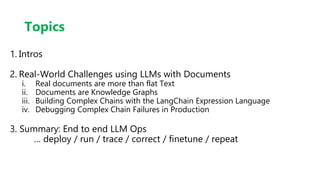
Topics
1. Intros
2. Real-World Challenges using LLMs with Documents
i. Real documents are more than flat Text
ii. Documents are Knowledge Graphs
iii. Building Complex Chains with the LangChain Expression Language
iv. Debugging Complex Chain Failures in Production
3. Summary: End to end LLM Ops
… deploy / run / trace / correct / finetune / repeat
Who we are...
• Generative AI for Business Documents. Founded 2018.
• Leverage open source and our own LLMs trained on millions of business documents to create a full
XML data representation of complex documents in their entirety, delivering immediate value to frontline
business users.
• Document as data can be used to generate insights and reports, create new documents, or drive line-
of-business applications. Free trial at www.docugami.com/trial
• Customers in many sectors, including insurance, real estate, health, professional services.
Jean Paoli
Co-founder, CEO
Pioneer in document engineering;
co-creator of XML, .docx, .xlsx, .pptx;
started four $1B+ businesses at Microsoft
Mike Palmer
Co-founder, Head of Technologies
Senior engineering manager at
Microsoft; co-created Microsoft
InfoPath.
Zubin Wadia
Product Manager
Making documents matter to people and
systems – 100+ products over 20 years. MIT,
ImageWork, CiviGuard.
Taqi Jaffri
Co-founder, Head of Product
Principal Product Manager at
Microsoft; co-created the AI driving
Microsoft presence in physical stores.
Challenge 1: Real documents are more than flat text
Real Documents are Structurally Complex: Headings, Lists, Tables, Headers/Footers, Complex Reading Orders, Figures, etc.
Mitigations:
1. Structurally chunk the
document to find
structural elements.
2. Stitch together reading
order flow with language
models.
3. Sub-chunk for RAG using
document structural
elements rather than
simple tiling or text
splitting.
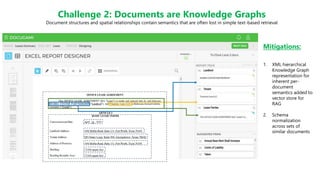
Challenge 2: Documents are Knowledge Graphs
Document structures and spatial relationships contain semantics that are often lost in simple text-based retrieval
Mitigations:
1. XML hierarchical
Knowledge Graph
representation for
inherent per-
document
semantics added to
vector store for
RAG
2. Schema
normalization
across sets of
similar documents
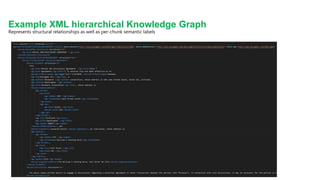
Example XML hierarchical Knowledge Graph
Represents structural relationships as well as per-chunk semantic labels
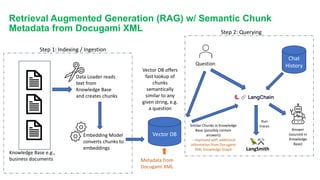
Retrieval Augmented Generation (RAG) w/ Semantic Chunk
Metadata from Docugami XML
Vector DB
Knowledge Base e.g.,
business documents
Step 1: Indexing / Ingestion
Embedding Model
converts chunks to
embeddings
Data Loader reads
text from
Knowledge Base
and creates chunks
Vector DB offers
fast lookup of
chunks
semantically
similar to any
given string, e.g.
a question
Question
Step 2: Querying
Similar Chunks in Knowledge
Base (possibly contain
answers)
-- improved with additional
information from Docugami
XML Knowledge Graph
Chat
History
Answer
(sourced in
Knowledge
Base)
Metadata from
Docugami XML
LangSmith
Run
traces
Challenges 1 & 2
CODE WALK-THROUGH
https://rebrand.ly/docugami_semantic_rag
Challenge 3: Building Complex Chains with the LangChain
Expression Language
Real-world chains can get complicated with parallel branches, output parsers, few shot examples, conditional sub-chains, etc.
Question
“What were the
total midmarket
gross sales for
Mexico in
2014?”
Generate
SQL Query
SQL DB
(read-only)
Table
schema and
sample rows
Run SQL
Query
Explainers
(in parallel)
Result
Explainer
Query
Explainer
(for non-
technical
users)
SELECT SUM("Gross
Sales") FROM
financial_data WHERE
Segment = "Midmarket"
AND Country = "Mexico"
AND Year = 2014;
Syntax
Error?
(pysqlite3.dbapi2.O
perationalError) no
such table:
financial_data
Attempt
Fixup
SELECT SUM("Gross
Sales") FROM "Financial
Data" WHERE Segment =
"Midmarket" AND Country
= "Mexico" AND Year =
2014;
"[(451890.0,)]"
The total
midmarket gross
sales for Mexico
in 2014 were
$451,890.
Sum of 'Gross
Sales' for the
'Midmarket' segment
in Mexico for the
year 2014.
Sample code: https://rebrand.ly/docugami_complex_chain
Challenge 3
LANGSMITH WALK-THROUGH
https://smith.langchain.com/public/ab8ef1ec-46d1-4d1f-980a-
6dcc8f1943e0/r
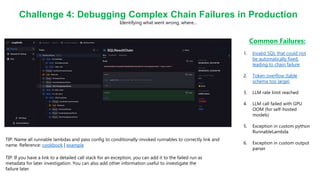
Challenge 4: Debugging Complex Chain Failures in Production
Identifying what went wrong, where…
Common Failures:
1. Invalid SQL that could not
be automatically fixed,
leading to chain failure
2. Token overflow (table
schema too large)
3. LLM rate limit reached
4. LLM call failed with GPU
OOM (for self-hosted
models)
5. Exception in custom python
RunnableLambda
6. Exception in custom output
parser
TIP: If you have a link to a detailed call stack for an exception, you can add it to the failed run as
metadata for later investigation. You can also add other information useful to investigate the
failure later.
TIP: Name all runnable lambdas and pass config to conditionally-invoked runnables to correctly link and
name. Reference: cookbook | example
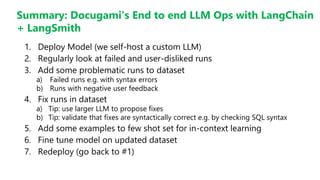
1. Deploy Model (we self-host a custom LLM)
2. Regularly look at failed and user-disliked runs
3. Add some problematic runs to dataset
a) Failed runs e.g. with syntax errors
b) Runs with negative user feedback
4. Fix runs in dataset
a) Tip: use larger LLM to propose fixes
b) Tip: validate that fixes are syntactically correct e.g. by checking SQL syntax
5. Add some examples to few shot set for in-context learning
6. Fine tune model on updated dataset
7. Redeploy (go back to #1)
Summary: Docugami’s End to end LLM Ops with LangChain
+ LangSmith
Q&A
The Document Engineering Company
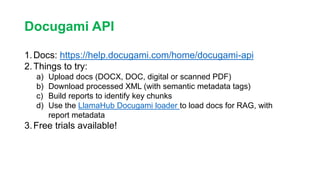
Docugami API
1.Docs: https://help.docugami.com/home/docugami-api
2.Things to try:
a) Upload docs (DOCX, DOC, digital or scanned PDF)
b) Download processed XML (with semantic metadata tags)
c) Build reports to identify key chunks
d) Use the LlamaHub Docugami loader to load docs for RAG, with
report metadata
3.Free trials available!
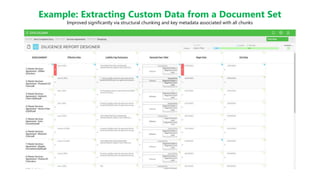
Example: Extracting Custom Data from a Document Set
Improved significantly via structural chunking and key metadata associated with all chunks
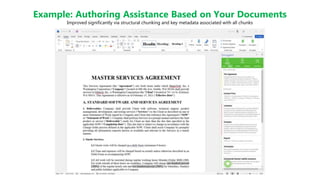
Example: Authoring Assistance Based on Your Documents
Improved significantly via structural chunking and key metadata associated with all chunks
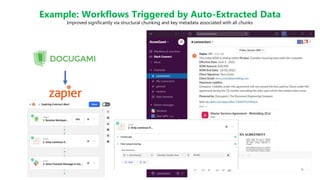
Example: Workflows Triggered by Auto-Extracted Data
Improved significantly via structural chunking and key metadata associated with all chunks

LangChain + Docugami Webinar

  • 1.
    The Document EngineeringCompany LangChain Webinar: Lessons from Deploying LLMs with LangSmith Jean Paoli @jeanpaoli Taqi Jaffri @tjaffri Mike Palmer Zubin Wadia @zubinwadia
  • 2.
    Topics 1. Intros 2. Real-WorldChallenges using LLMs with Documents i. Real documents are more than flat Text ii. Documents are Knowledge Graphs iii. Building Complex Chains with the LangChain Expression Language iv. Debugging Complex Chain Failures in Production 3. Summary: End to end LLM Ops … deploy / run / trace / correct / finetune / repeat
  • 3.
    Who we are... •Generative AI for Business Documents. Founded 2018. • Leverage open source and our own LLMs trained on millions of business documents to create a full XML data representation of complex documents in their entirety, delivering immediate value to frontline business users. • Document as data can be used to generate insights and reports, create new documents, or drive line- of-business applications. Free trial at www.docugami.com/trial • Customers in many sectors, including insurance, real estate, health, professional services. Jean Paoli Co-founder, CEO Pioneer in document engineering; co-creator of XML, .docx, .xlsx, .pptx; started four $1B+ businesses at Microsoft Mike Palmer Co-founder, Head of Technologies Senior engineering manager at Microsoft; co-created Microsoft InfoPath. Zubin Wadia Product Manager Making documents matter to people and systems – 100+ products over 20 years. MIT, ImageWork, CiviGuard. Taqi Jaffri Co-founder, Head of Product Principal Product Manager at Microsoft; co-created the AI driving Microsoft presence in physical stores.
  • 4.
    Challenge 1: Realdocuments are more than flat text Real Documents are Structurally Complex: Headings, Lists, Tables, Headers/Footers, Complex Reading Orders, Figures, etc. Mitigations: 1. Structurally chunk the document to find structural elements. 2. Stitch together reading order flow with language models. 3. Sub-chunk for RAG using document structural elements rather than simple tiling or text splitting.
  • 5.
    Challenge 2: Documentsare Knowledge Graphs Document structures and spatial relationships contain semantics that are often lost in simple text-based retrieval Mitigations: 1. XML hierarchical Knowledge Graph representation for inherent per- document semantics added to vector store for RAG 2. Schema normalization across sets of similar documents
  • 6.
    Example XML hierarchicalKnowledge Graph Represents structural relationships as well as per-chunk semantic labels
  • 7.
    Retrieval Augmented Generation(RAG) w/ Semantic Chunk Metadata from Docugami XML Vector DB Knowledge Base e.g., business documents Step 1: Indexing / Ingestion Embedding Model converts chunks to embeddings Data Loader reads text from Knowledge Base and creates chunks Vector DB offers fast lookup of chunks semantically similar to any given string, e.g. a question Question Step 2: Querying Similar Chunks in Knowledge Base (possibly contain answers) -- improved with additional information from Docugami XML Knowledge Graph Chat History Answer (sourced in Knowledge Base) Metadata from Docugami XML LangSmith Run traces
  • 8.
    Challenges 1 &2 CODE WALK-THROUGH https://rebrand.ly/docugami_semantic_rag
  • 9.
    Challenge 3: BuildingComplex Chains with the LangChain Expression Language Real-world chains can get complicated with parallel branches, output parsers, few shot examples, conditional sub-chains, etc. Question “What were the total midmarket gross sales for Mexico in 2014?” Generate SQL Query SQL DB (read-only) Table schema and sample rows Run SQL Query Explainers (in parallel) Result Explainer Query Explainer (for non- technical users) SELECT SUM("Gross Sales") FROM financial_data WHERE Segment = "Midmarket" AND Country = "Mexico" AND Year = 2014; Syntax Error? (pysqlite3.dbapi2.O perationalError) no such table: financial_data Attempt Fixup SELECT SUM("Gross Sales") FROM "Financial Data" WHERE Segment = "Midmarket" AND Country = "Mexico" AND Year = 2014; "[(451890.0,)]" The total midmarket gross sales for Mexico in 2014 were $451,890. Sum of 'Gross Sales' for the 'Midmarket' segment in Mexico for the year 2014. Sample code: https://rebrand.ly/docugami_complex_chain
  • 10.
  • 11.
    Challenge 4: DebuggingComplex Chain Failures in Production Identifying what went wrong, where… Common Failures: 1. Invalid SQL that could not be automatically fixed, leading to chain failure 2. Token overflow (table schema too large) 3. LLM rate limit reached 4. LLM call failed with GPU OOM (for self-hosted models) 5. Exception in custom python RunnableLambda 6. Exception in custom output parser TIP: If you have a link to a detailed call stack for an exception, you can add it to the failed run as metadata for later investigation. You can also add other information useful to investigate the failure later. TIP: Name all runnable lambdas and pass config to conditionally-invoked runnables to correctly link and name. Reference: cookbook | example
  • 12.
    1. Deploy Model(we self-host a custom LLM) 2. Regularly look at failed and user-disliked runs 3. Add some problematic runs to dataset a) Failed runs e.g. with syntax errors b) Runs with negative user feedback 4. Fix runs in dataset a) Tip: use larger LLM to propose fixes b) Tip: validate that fixes are syntactically correct e.g. by checking SQL syntax 5. Add some examples to few shot set for in-context learning 6. Fine tune model on updated dataset 7. Redeploy (go back to #1) Summary: Docugami’s End to end LLM Ops with LangChain + LangSmith
  • 13.
  • 14.
  • 15.
    Docugami API 1.Docs: https://help.docugami.com/home/docugami-api 2.Thingsto try: a) Upload docs (DOCX, DOC, digital or scanned PDF) b) Download processed XML (with semantic metadata tags) c) Build reports to identify key chunks d) Use the LlamaHub Docugami loader to load docs for RAG, with report metadata 3.Free trials available!
  • 16.
    Example: Extracting CustomData from a Document Set Improved significantly via structural chunking and key metadata associated with all chunks
  • 17.
    Example: Authoring AssistanceBased on Your Documents Improved significantly via structural chunking and key metadata associated with all chunks
  • 18.
    Example: Workflows Triggeredby Auto-Extracted Data Improved significantly via structural chunking and key metadata associated with all chunks