LANGUAGE
PROCESSING:
HUMANS and
COMPUTERS
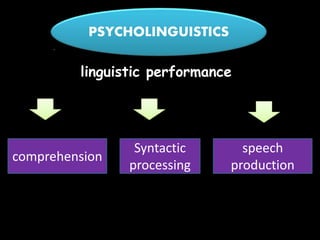
PSYCHOLINGUISTICS
linguistic performance
Syntactic
processing
comprehension
speech
production
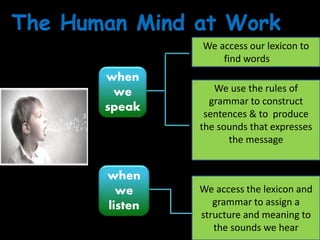
when
we
speak
when
we
listen
We access the lexicon and
grammar to assign a
structure and meaning to
the sounds we hear
We access our lexicon to
find words
We use the rules of
grammar to construct
sentences & to produce
the sounds that expresses
the message
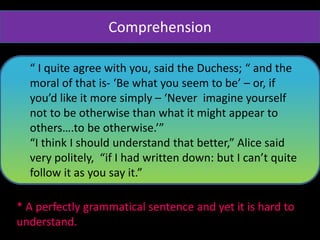
“ I quite agree with you, said the Duchess; “ and the
moral of that is- ‘Be what you seem to be’ – or, if
you’d like it more simply – ‘Never imagine yourself
not to be otherwise than what it might appear to
others….to be otherwise.’”
“I think I should understand that better,” Alice said
very politely, “if I had written down: but I can’t quite
follow it as you say it.”
* A perfectly grammatical sentence and yet it is hard to
understand.
Comprehension
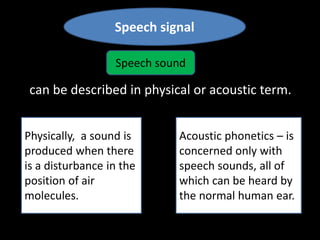
Speech signal
can be described in physical or acoustic term.
Speech sound
Physically, a sound is
produced when there
is a disturbance in the
position of air
molecules.
Acoustic phonetics – is
concerned only with
speech sounds, all of
which can be heard by
the normal human ear.
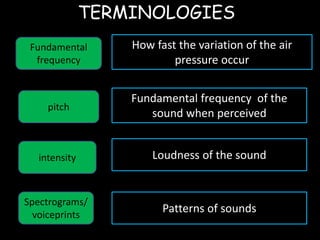
Fundamental
frequency
Spectrograms/
voiceprints
pitch
intensity
TERMINOLOGIES
How fast the variation of the air
pressure occur
Fundamental frequency of the
sound when perceived
Loudness of the sound
Patterns of sounds
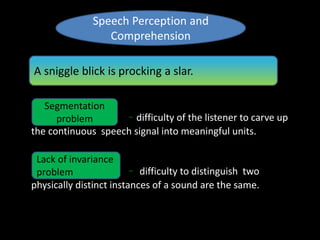
- difficulty of the listener to carve up
the continuous speech signal into meaningful units.
- difficulty to distinguish two
physically distinct instances of a sound are the same.
Speech Perception and
Comprehension
A sniggle blick is procking a slar.
Segmentation
problem
Lack of invariance
problem
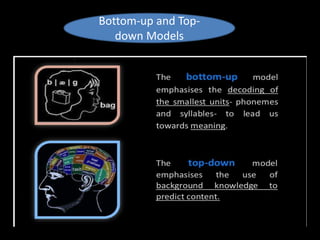
Bottom-up and Top-
down Models
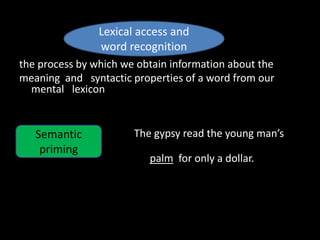
the process by which we obtain information about the
meaning and syntactic properties of a word from our
mental lexicon
The gypsy read the young man’s
palm for
palm for only a dollar.
Lexical access and
word recognition
Semantic
priming
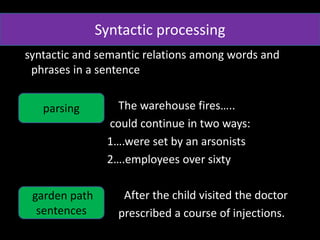
syntactic and semantic relations among words and
phrases in a sentence
The warehouse fires…..
could continue in two ways:
1….were set by an arsonists
2….employees over sixty
After the child visited the doctor
prescribed a course of injections.
parsing
Syntactic processing
garden path
sentences
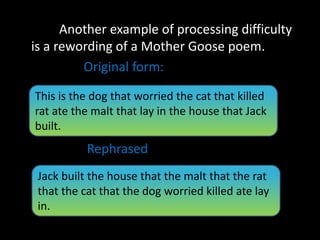
• AnotAnother example of processing difficulty
is a rewording of a Mother Goose poem.
Original form:
Rephrased
This is the dog that worried the cat that killed
rat ate the malt that lay in the house that Jack
built.
Jack built the house that the malt that the rat
that the cat that the dog worried killed ate lay
in.
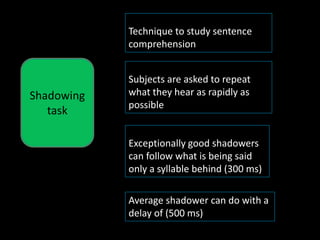
Shadowing
task
Average shadower can do with a
delay of (500 ms)
Speech sound
Subjects are asked to repeat
what they hear as rapidly as
possible
Exceptionally good shadowers
can follow what is being said
only a syllable behind (300 ms)
Technique to study sentence
comprehension
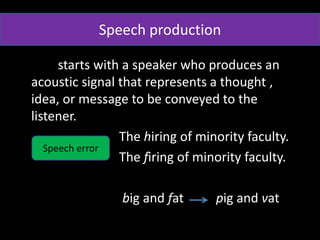
starts with a speaker who produces an
acoustic signal that represents a thought ,
idea, or message to be conveyed to the
listener.
The hiring of minority faculty.
The firing of minority faculty.
big and fat pig and vat
Speech error
Speech production
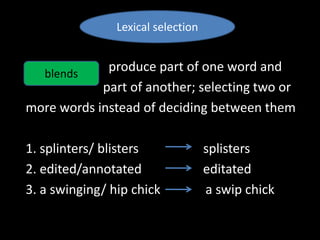
blends
• produce part of one word and
part of another; selecting two or
more words instead of deciding between them
1. splinters/ blisters splisters
2. edited/annotated editated
3. a swinging/ hip chick a swip chick
Lexical selection
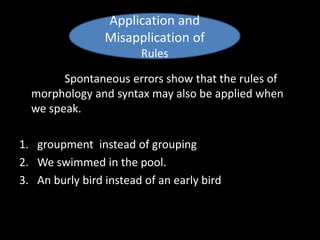
Spontaneous errors show that the rules of
morphology and syntax may also be applied when
we speak.
1. groupment instead of grouping
2. We swimmed in the pool.
3. An burly bird instead of an early bird
Application and
Misapplication of
Rules
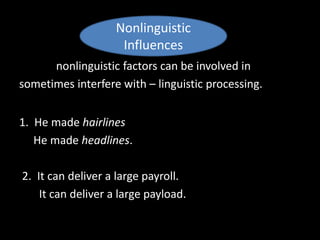
nonlinguistic factors can be involved in
sometimes interfere with – linguistic processing.
1. He made hairlines
He made headlines.
2. It can deliver a large payroll.
It can deliver a large payload.
Nonlinguistic
Influences
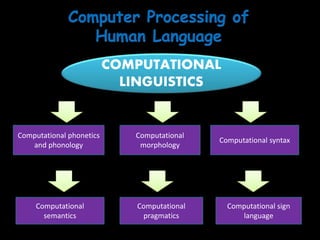
COMPUTATIONAL
LINGUISTICS
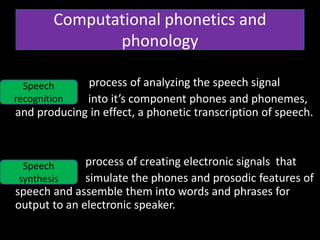
Computational phonetics
and phonology
Computational
morphology
Computational syntax
Computational sign
language
Computational
semantics
Computational
pragmatics
• 20
• process of analyzing the speech signal
into it’s component phones and phonemes,
and producing in effect, a phonetic transcription of speech.
process of creating electronic signals that
simulate the phones and prosodic features of
speech and assemble them into words and phrases for
output to an electronic speaker.
Computational phonetics and
phonology
Speech
recognition
Speech
synthesis
•

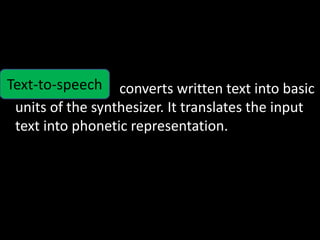
converts written text into basic
units of the synthesizer. It translates the input
text into phonetic representation.
Text-to-speech
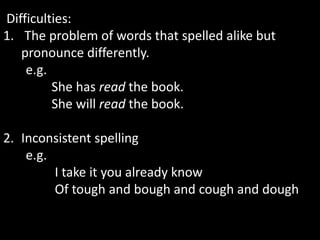
Difficulties:
1. The problem of words that spelled alike but
pronounce differently.
e.g.
She has read the book.
She will read the book.
2. Inconsistent spelling
e.g.
I take it you already know
Of tough and bough and cough and dough
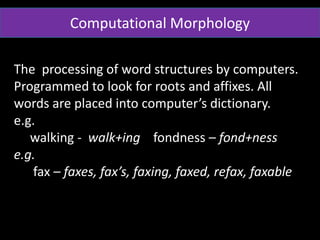
Computational Morphology
The processing of word structures by computers.
Programmed to look for roots and affixes. All
words are placed into computer’s dictionary.
e.g.
walking - walk+ing fondness – fond+ness
e.g.
fax – faxes, fax’s, faxing, faxed, refax, faxable
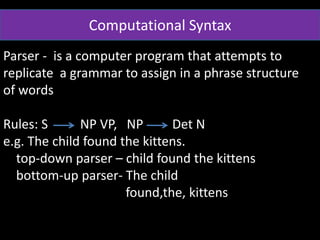
Computational Syntax
Parser - is a computer program that attempts to
replicate a grammar to assign in a phrase structure
of words
Rules: S NP VP, NP Det N
e.g. The child found the kittens.
top-down parser – child found the kittens
bottom-up parser- The child
found,the, kittens
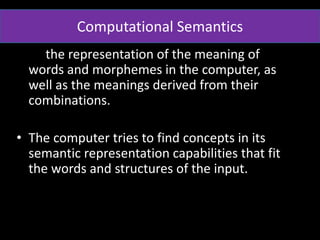
the representation of the meaning of
words and morphemes in the computer, as
well as the meanings derived from their
combinations.
• The computer tries to find concepts in its
semantic representation capabilities that fit
the words and structures of the input.
Computational Semantics
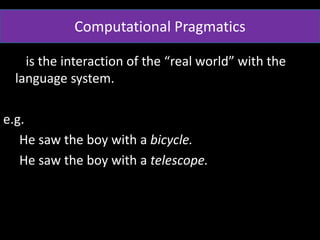
is the interaction of the “real world” with the
language system.
e.g.
He saw the boy with a bicycle.
He saw the boy with a telescope.
Computational Pragmatics
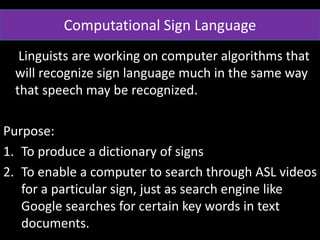
• Linguists are working on computer algorithms that
will recognize sign language much in the same way
that speech may be recognized.
Purpose:
1. To produce a dictionary of signs
2. To enable a computer to search through ASL videos
for a particular sign, just as search engine like
Google searches for certain key words in text
documents.
Computational Sign Language
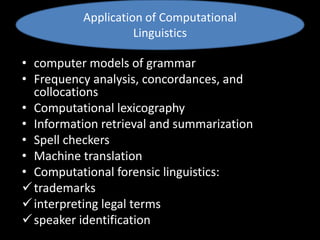
• computer models of grammar
• Frequency analysis, concordances, and
collocations
• Computational lexicography
• Information retrieval and summarization
• Spell checkers
• Machine translation
• Computational forensic linguistics:
trademarks
interpreting legal terms
speaker identification
Application of Computational
Linguistics

Lang process for human and comp

  • 1.
  • 2.
  • 3.
    when we speak when we listen We access thelexicon and grammar to assign a structure and meaning to the sounds we hear We access our lexicon to find words We use the rules of grammar to construct sentences & to produce the sounds that expresses the message
  • 4.
    “ I quiteagree with you, said the Duchess; “ and the moral of that is- ‘Be what you seem to be’ – or, if you’d like it more simply – ‘Never imagine yourself not to be otherwise than what it might appear to others….to be otherwise.’” “I think I should understand that better,” Alice said very politely, “if I had written down: but I can’t quite follow it as you say it.” * A perfectly grammatical sentence and yet it is hard to understand. Comprehension
  • 5.
    Speech signal can bedescribed in physical or acoustic term. Speech sound Physically, a sound is produced when there is a disturbance in the position of air molecules. Acoustic phonetics – is concerned only with speech sounds, all of which can be heard by the normal human ear.
  • 6.
    Fundamental frequency Spectrograms/ voiceprints pitch intensity TERMINOLOGIES How fast thevariation of the air pressure occur Fundamental frequency of the sound when perceived Loudness of the sound Patterns of sounds
  • 7.
    - difficulty ofthe listener to carve up the continuous speech signal into meaningful units. - difficulty to distinguish two physically distinct instances of a sound are the same. Speech Perception and Comprehension A sniggle blick is procking a slar. Segmentation problem Lack of invariance problem
  • 8.
  • 11.
    the process bywhich we obtain information about the meaning and syntactic properties of a word from our mental lexicon The gypsy read the young man’s palm for palm for only a dollar. Lexical access and word recognition Semantic priming
  • 12.
    syntactic and semanticrelations among words and phrases in a sentence The warehouse fires….. could continue in two ways: 1….were set by an arsonists 2….employees over sixty After the child visited the doctor prescribed a course of injections. parsing Syntactic processing garden path sentences
  • 13.
    • AnotAnother exampleof processing difficulty is a rewording of a Mother Goose poem. Original form: Rephrased This is the dog that worried the cat that killed rat ate the malt that lay in the house that Jack built. Jack built the house that the malt that the rat that the cat that the dog worried killed ate lay in.
  • 14.
    Shadowing task Average shadower cando with a delay of (500 ms) Speech sound Subjects are asked to repeat what they hear as rapidly as possible Exceptionally good shadowers can follow what is being said only a syllable behind (300 ms) Technique to study sentence comprehension
  • 15.
    starts with aspeaker who produces an acoustic signal that represents a thought , idea, or message to be conveyed to the listener. The hiring of minority faculty. The firing of minority faculty. big and fat pig and vat Speech error Speech production
  • 16.
    blends • produce partof one word and part of another; selecting two or more words instead of deciding between them 1. splinters/ blisters splisters 2. edited/annotated editated 3. a swinging/ hip chick a swip chick Lexical selection
  • 17.
    Spontaneous errors showthat the rules of morphology and syntax may also be applied when we speak. 1. groupment instead of grouping 2. We swimmed in the pool. 3. An burly bird instead of an early bird Application and Misapplication of Rules
  • 18.
    nonlinguistic factors canbe involved in sometimes interfere with – linguistic processing. 1. He made hairlines He made headlines. 2. It can deliver a large payroll. It can deliver a large payload. Nonlinguistic Influences
  • 19.
    COMPUTATIONAL LINGUISTICS Computational phonetics and phonology Computational morphology Computationalsyntax Computational sign language Computational semantics Computational pragmatics
  • 20.
    • 20 • processof analyzing the speech signal into it’s component phones and phonemes, and producing in effect, a phonetic transcription of speech. process of creating electronic signals that simulate the phones and prosodic features of speech and assemble them into words and phrases for output to an electronic speaker. Computational phonetics and phonology Speech recognition Speech synthesis
  • 21.
    • converts written textinto basic units of the synthesizer. It translates the input text into phonetic representation. Text-to-speech
  • 22.
    Difficulties: 1. The problemof words that spelled alike but pronounce differently. e.g. She has read the book. She will read the book. 2. Inconsistent spelling e.g. I take it you already know Of tough and bough and cough and dough
  • 23.
    Computational Morphology The processingof word structures by computers. Programmed to look for roots and affixes. All words are placed into computer’s dictionary. e.g. walking - walk+ing fondness – fond+ness e.g. fax – faxes, fax’s, faxing, faxed, refax, faxable
  • 24.
    Computational Syntax Parser -is a computer program that attempts to replicate a grammar to assign in a phrase structure of words Rules: S NP VP, NP Det N e.g. The child found the kittens. top-down parser – child found the kittens bottom-up parser- The child found,the, kittens
  • 25.
    the representation ofthe meaning of words and morphemes in the computer, as well as the meanings derived from their combinations. • The computer tries to find concepts in its semantic representation capabilities that fit the words and structures of the input. Computational Semantics
  • 26.
    is the interactionof the “real world” with the language system. e.g. He saw the boy with a bicycle. He saw the boy with a telescope. Computational Pragmatics
  • 27.
    • Linguists areworking on computer algorithms that will recognize sign language much in the same way that speech may be recognized. Purpose: 1. To produce a dictionary of signs 2. To enable a computer to search through ASL videos for a particular sign, just as search engine like Google searches for certain key words in text documents. Computational Sign Language
  • 28.
    • computer modelsof grammar • Frequency analysis, concordances, and collocations • Computational lexicography • Information retrieval and summarization • Spell checkers • Machine translation • Computational forensic linguistics: trademarks interpreting legal terms speaker identification Application of Computational Linguistics