Natural Language Processing
(NLP)
Prof. Carolina Ruiz
Computer Science
WPI
NLP - Prof. Carolina Ruiz
References
 The essence of Artificial Intelligence
– By A. Cawsey
– Prentice Hall Europe 1998
 Artificial Intelligence: Theory and Practice
– By T. Dean, J. Allen, and Y. Aloimonos.
– The Benjamin/Cummings Publishing Company, 1995
 Artificial Intelligence
– By P. Winston
– Addison Wesley, 1992
 Artificial Intelligence: A Modern Approach
– By Russell and Norvig
– Prentice Hall, 2003
NLP - Prof. Carolina Ruiz
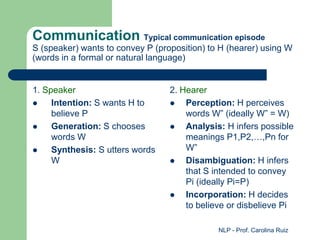
Communication Typical communication episode
S (speaker) wants to convey P (proposition) to H (hearer) using W
(words in a formal or natural language)
1. Speaker
 Intention: S wants H to
believe P
 Generation: S chooses
words W
 Synthesis: S utters words
W
2. Hearer
 Perception: H perceives
words W” (ideally W” = W)
 Analysis: H infers possible
meanings P1,P2,…,Pn for
W”
 Disambiguation: H infers
that S intended to convey
Pi (ideally Pi=P)
 Incorporation: H decides
to believe or disbelieve Pi
NLP - Prof. Carolina Ruiz
Natural Language Processing (NLP)
1. Natural Language Understanding
 Taking some spoken/typed sentence and
working out what it means
2. Natural Language Generation
 Taking some formal representation of what you
want to say and working out a way to express it
in a natural (human) language (e.g., English)
NLP - Prof. Carolina Ruiz
Applications of Nat. Lang. Processing
 Machine Translation
 Database Access
 Information Retrieval
– Selecting from a set of documents the ones that are relevant to
a query
 Text Categorization
– Sorting text into fixed topic categories
 Extracting data from text
– Converting unstructured text into structure data
 Spoken language control systems
 Spelling and grammar checkers
NLP - Prof. Carolina Ruiz
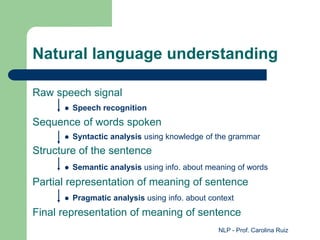
Natural language understanding
Raw speech signal
 Speech recognition
Sequence of words spoken
 Syntactic analysis using knowledge of the grammar
Structure of the sentence
 Semantic analysis using info. about meaning of words
Partial representation of meaning of sentence
 Pragmatic analysis using info. about context
Final representation of meaning of sentence
NLP - Prof. Carolina Ruiz
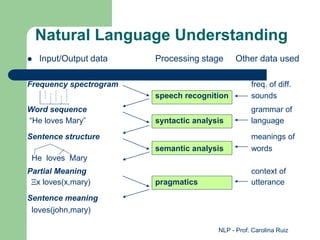
 Input/Output data Processing stage Other data used
Frequency spectrogram freq. of diff.
speech recognition sounds
Word sequence grammar of
“He loves Mary” syntactic analysis language
Sentence structure meanings of
semantic analysis words
He loves Mary
Partial Meaning context of
x loves(x,mary) pragmatics utterance
Sentence meaning
loves(john,mary)
Natural Language Understanding
NLP - Prof. Carolina Ruiz
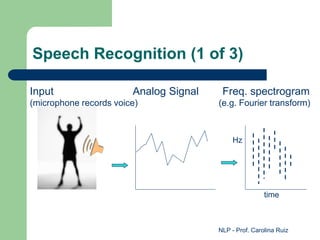
Speech Recognition (1 of 3)
Input Analog Signal Freq. spectrogram
(microphone records voice) (e.g. Fourier transform)
time
Hz
NLP - Prof. Carolina Ruiz
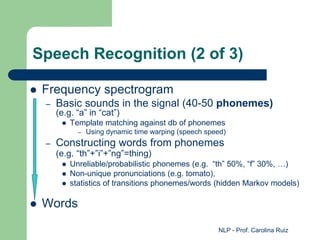
Speech Recognition (2 of 3)
 Frequency spectrogram
– Basic sounds in the signal (40-50 phonemes)
(e.g. “a” in “cat”)
 Template matching against db of phonemes
– Using dynamic time warping (speech speed)
– Constructing words from phonemes
(e.g. “th”+”i”+”ng”=thing)
 Unreliable/probabilistic phonemes (e.g. “th” 50%, “f” 30%, …)
 Non-unique pronunciations (e.g. tomato),
 statistics of transitions phonemes/words (hidden Markov models)
 Words
NLP - Prof. Carolina Ruiz
Speech Recognition - Complications
 No simple mapping between sounds and words
– Variance in pronunciation due to gender, dialect, …
 Restriction to handle just one speaker
– Same sound corresponding to diff. words
 e.g. bear, bare
– Finding gaps between words
 “how to recognize speech”
 “how to wreck a nice beach”
– Noise
NLP - Prof. Carolina Ruiz
Syntactic Analysis
 Rules of syntax (grammar) specify the possible
organization of words in sentences and allows us to
determine sentence’s structure(s)
– “John saw Mary with a telescope”
 John saw (Mary with a telescope)
 John (saw Mary with a telescope)
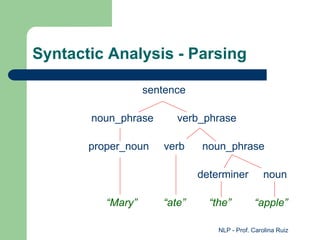
 Parsing: given a sentence and a grammar
– Checks that the sentence is correct according with the
grammar and if so returns a parse tree representing the
structure of the sentence
NLP - Prof. Carolina Ruiz
Syntactic Analysis - Grammar
 sentence -> noun_phrase, verb_phrase
 noun_phrase -> proper_noun
 noun_phrase -> determiner, noun
 verb_phrase -> verb, noun_phrase
 proper_noun -> [mary]
 noun -> [apple]
 verb -> [ate]
 determiner -> [the]
NLP - Prof. Carolina Ruiz
Syntactic Analysis - Parsing
sentence
noun_phrase verb_phrase
proper_noun verb noun_phrase
determiner noun
“Mary” “ate” “the” “apple”
NLP - Prof. Carolina Ruiz
Syntactic Analysis – Complications (1)
 Number (singular vs. plural) and gender
– sentence-> noun_phrase(n),verb_phrase(n)
– proper_noun(s) -> [mary]
– noun(p) -> [apples]
 Adjective
– noun_phrase-> determiner,adjectives,noun
– adjectives-> adjective, adjectives
– adjective->[ferocious]
 Adverbs, …
NLP - Prof. Carolina Ruiz
Syntactic Analysis – Complications (2)
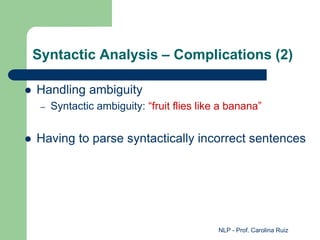
 Handling ambiguity
– Syntactic ambiguity: “fruit flies like a banana”
 Having to parse syntactically incorrect sentences
NLP - Prof. Carolina Ruiz
Semantic Analysis
 Generates (partial) meaning/representation of the
sentence from its syntactic structure(s)
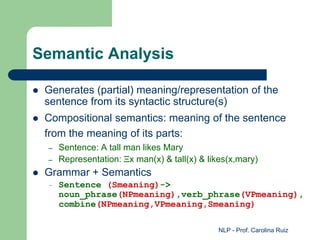
 Compositional semantics: meaning of the sentence
from the meaning of its parts:
– Sentence: A tall man likes Mary
– Representation: x man(x) & tall(x) & likes(x,mary)
 Grammar + Semantics
– Sentence (Smeaning)->
noun_phrase(NPmeaning),verb_phrase(VPmeaning),
combine(NPmeaning,VPmeaning,Smeaning)
NLP - Prof. Carolina Ruiz
Semantic Analysis – Complications
 Handling ambiguity
– Semantic ambiguity: “I saw the prudential building
flying into Boston”
NLP - Prof. Carolina Ruiz
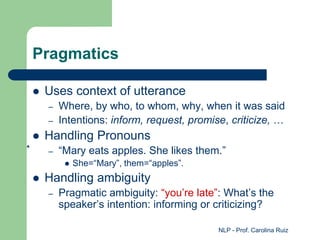
Pragmatics
 Uses context of utterance
– Where, by who, to whom, why, when it was said
– Intentions: inform, request, promise, criticize, …
 Handling Pronouns
– “Mary eats apples. She likes them.”
 She=“Mary”, them=“apples”.
 Handling ambiguity
– Pragmatic ambiguity: “you’re late”: What’s the
speaker’s intention: informing or criticizing?
NLP - Prof. Carolina Ruiz
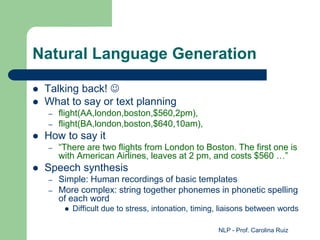
Natural Language Generation
 Talking back! 
 What to say or text planning
– flight(AA,london,boston,$560,2pm),
– flight(BA,london,boston,$640,10am),
 How to say it
– “There are two flights from London to Boston. The first one is
with American Airlines, leaves at 2 pm, and costs $560 …”
 Speech synthesis
– Simple: Human recordings of basic templates
– More complex: string together phonemes in phonetic spelling
of each word
 Difficult due to stress, intonation, timing, liaisons between words

natural-language-processing.ppt

  • 1.
    Natural Language Processing (NLP) Prof.Carolina Ruiz Computer Science WPI
  • 2.
    NLP - Prof.Carolina Ruiz References  The essence of Artificial Intelligence – By A. Cawsey – Prentice Hall Europe 1998  Artificial Intelligence: Theory and Practice – By T. Dean, J. Allen, and Y. Aloimonos. – The Benjamin/Cummings Publishing Company, 1995  Artificial Intelligence – By P. Winston – Addison Wesley, 1992  Artificial Intelligence: A Modern Approach – By Russell and Norvig – Prentice Hall, 2003
  • 3.
    NLP - Prof.Carolina Ruiz Communication Typical communication episode S (speaker) wants to convey P (proposition) to H (hearer) using W (words in a formal or natural language) 1. Speaker  Intention: S wants H to believe P  Generation: S chooses words W  Synthesis: S utters words W 2. Hearer  Perception: H perceives words W” (ideally W” = W)  Analysis: H infers possible meanings P1,P2,…,Pn for W”  Disambiguation: H infers that S intended to convey Pi (ideally Pi=P)  Incorporation: H decides to believe or disbelieve Pi
  • 4.
    NLP - Prof.Carolina Ruiz Natural Language Processing (NLP) 1. Natural Language Understanding  Taking some spoken/typed sentence and working out what it means 2. Natural Language Generation  Taking some formal representation of what you want to say and working out a way to express it in a natural (human) language (e.g., English)
  • 5.
    NLP - Prof.Carolina Ruiz Applications of Nat. Lang. Processing  Machine Translation  Database Access  Information Retrieval – Selecting from a set of documents the ones that are relevant to a query  Text Categorization – Sorting text into fixed topic categories  Extracting data from text – Converting unstructured text into structure data  Spoken language control systems  Spelling and grammar checkers
  • 6.
    NLP - Prof.Carolina Ruiz Natural language understanding Raw speech signal  Speech recognition Sequence of words spoken  Syntactic analysis using knowledge of the grammar Structure of the sentence  Semantic analysis using info. about meaning of words Partial representation of meaning of sentence  Pragmatic analysis using info. about context Final representation of meaning of sentence
  • 7.
    NLP - Prof.Carolina Ruiz  Input/Output data Processing stage Other data used Frequency spectrogram freq. of diff. speech recognition sounds Word sequence grammar of “He loves Mary” syntactic analysis language Sentence structure meanings of semantic analysis words He loves Mary Partial Meaning context of x loves(x,mary) pragmatics utterance Sentence meaning loves(john,mary) Natural Language Understanding
  • 8.
    NLP - Prof.Carolina Ruiz Speech Recognition (1 of 3) Input Analog Signal Freq. spectrogram (microphone records voice) (e.g. Fourier transform) time Hz
  • 9.
    NLP - Prof.Carolina Ruiz Speech Recognition (2 of 3)  Frequency spectrogram – Basic sounds in the signal (40-50 phonemes) (e.g. “a” in “cat”)  Template matching against db of phonemes – Using dynamic time warping (speech speed) – Constructing words from phonemes (e.g. “th”+”i”+”ng”=thing)  Unreliable/probabilistic phonemes (e.g. “th” 50%, “f” 30%, …)  Non-unique pronunciations (e.g. tomato),  statistics of transitions phonemes/words (hidden Markov models)  Words
  • 10.
    NLP - Prof.Carolina Ruiz Speech Recognition - Complications  No simple mapping between sounds and words – Variance in pronunciation due to gender, dialect, …  Restriction to handle just one speaker – Same sound corresponding to diff. words  e.g. bear, bare – Finding gaps between words  “how to recognize speech”  “how to wreck a nice beach” – Noise
  • 11.
    NLP - Prof.Carolina Ruiz Syntactic Analysis  Rules of syntax (grammar) specify the possible organization of words in sentences and allows us to determine sentence’s structure(s) – “John saw Mary with a telescope”  John saw (Mary with a telescope)  John (saw Mary with a telescope)  Parsing: given a sentence and a grammar – Checks that the sentence is correct according with the grammar and if so returns a parse tree representing the structure of the sentence
  • 12.
    NLP - Prof.Carolina Ruiz Syntactic Analysis - Grammar  sentence -> noun_phrase, verb_phrase  noun_phrase -> proper_noun  noun_phrase -> determiner, noun  verb_phrase -> verb, noun_phrase  proper_noun -> [mary]  noun -> [apple]  verb -> [ate]  determiner -> [the]
  • 13.
    NLP - Prof.Carolina Ruiz Syntactic Analysis - Parsing sentence noun_phrase verb_phrase proper_noun verb noun_phrase determiner noun “Mary” “ate” “the” “apple”
  • 14.
    NLP - Prof.Carolina Ruiz Syntactic Analysis – Complications (1)  Number (singular vs. plural) and gender – sentence-> noun_phrase(n),verb_phrase(n) – proper_noun(s) -> [mary] – noun(p) -> [apples]  Adjective – noun_phrase-> determiner,adjectives,noun – adjectives-> adjective, adjectives – adjective->[ferocious]  Adverbs, …
  • 15.
    NLP - Prof.Carolina Ruiz Syntactic Analysis – Complications (2)  Handling ambiguity – Syntactic ambiguity: “fruit flies like a banana”  Having to parse syntactically incorrect sentences
  • 16.
    NLP - Prof.Carolina Ruiz Semantic Analysis  Generates (partial) meaning/representation of the sentence from its syntactic structure(s)  Compositional semantics: meaning of the sentence from the meaning of its parts: – Sentence: A tall man likes Mary – Representation: x man(x) & tall(x) & likes(x,mary)  Grammar + Semantics – Sentence (Smeaning)-> noun_phrase(NPmeaning),verb_phrase(VPmeaning), combine(NPmeaning,VPmeaning,Smeaning)
  • 17.
    NLP - Prof.Carolina Ruiz Semantic Analysis – Complications  Handling ambiguity – Semantic ambiguity: “I saw the prudential building flying into Boston”
  • 18.
    NLP - Prof.Carolina Ruiz Pragmatics  Uses context of utterance – Where, by who, to whom, why, when it was said – Intentions: inform, request, promise, criticize, …  Handling Pronouns – “Mary eats apples. She likes them.”  She=“Mary”, them=“apples”.  Handling ambiguity – Pragmatic ambiguity: “you’re late”: What’s the speaker’s intention: informing or criticizing?
  • 19.
    NLP - Prof.Carolina Ruiz Natural Language Generation  Talking back!   What to say or text planning – flight(AA,london,boston,$560,2pm), – flight(BA,london,boston,$640,10am),  How to say it – “There are two flights from London to Boston. The first one is with American Airlines, leaves at 2 pm, and costs $560 …”  Speech synthesis – Simple: Human recordings of basic templates – More complex: string together phonemes in phonetic spelling of each word  Difficult due to stress, intonation, timing, liaisons between words