Landslide in Bangladesh
Landslide:
Landslide is the downward movement of soil, rock and
organic materials under the effects of gravity and also the
landform that results from such movement.It is one of the most
significant natural damaging disasters in hilly environments, which
includes a wide range of ground movements, such as rock falls,
deep failure of slopes and shallow debris flows.Rapid urbanization
and human development activities such as, building and road
construction through deforestation and excavation of hill slopes
have increased landslide in densely populated cities located in
mountainous areas.The cause is often infiltration of water that
makes the swelling soils(clays) more fluid .Landslides are a major
cause of erosion,causing the strongest degradation known,
10,000 tons per sq km in a year.Land use and land cover
changes have been recognized as world’s one of the most
important factors stirring rainfall triggered landslides. Land cover
changes(e.g. urbanization , deforestation ) causes large variations
in hydro- morphological functioning of hill-slopes, affecting rainfall
partitioning infiltration characteristics and runoff production.
Landslides in Bangladesh:
Bangladesh is a low-laying floodplain area of Ganges
delta in South Asia .Geologically it is part of the Bengal Basin
which has been filled by sediments washed down from the
highlands on three sides of it,especially from the Himalayas.
Because of the geographical location,Bangladesh experiences
highest amount of monsoon rainfall and annual average rainfall
among the SAARC countries.The whole country has two different
distinctive geographical features with flat land (82%) and hilly
regions (18%) in the North, North-East and South-East part.
According to geological data,hilly region of Bangladesh developed
in tertiary age. Bangladesh is highly vulnerable to different natural
hazards :flood, cyclone, landslides, drought, earthquakes are very
frequent. A significant number of landslide hazard locations exist
in those urban areas that make many communities vulnerable
to slide which may result in severe damages and socioeconomic
losses.The characteristics of soft sedimentary and unconsolidated
rocks in the hilly terrains,soil structure across the hilly area
makes the slope instable as a consequence caused fatal
landslides.Landslides event not only occurred in the south-
eastern part of the country but also hit consecutively in the
north-eastern part with massive damage.The hilly areas of the
southeastern parts have a long history of instability.Although
written records of landslide incidents are very rare, they have been
living there.Every year especially in the rainy season, landslides
take place in both natural and man induced slopes.
Triggering factors and causes:
The main contributing factors for the mass
movement in Bangladesh can be divided into natural and
human induced factors.
Natural factors : steepness of natural slopes,altitude of
bedding , lithology of rock,infiltration of water,tectonic settings,
strength of rock, climatic variation, topographic and
geomorphological conditions etc.
The human intervention : unscientific exploitation of the
Himalaya, deforestation, unplanned construction and settlement,
mining and quarrying activities combined with its complex
geological and heavy rainfall makes the slope instable.
The most common triggering factor is prolonged and intense
monsoon rainfall in Bangladesh perspective.
The major causes of landslide in Bangladesh which involves-
1) Removal of lateral support:
a)erosion by rivers,
b) previous slope movements such as slumps that create
new slopes,
c) human modifications of slopes such as cuts , pits and
canals.
2) Increase of load to the slopes:
a)accumulation of rain water
b) increase in vegetation,
c) construction on fill,
d)weight of buildings and other structures,
e)weight of water from leaking pipelines, sewers,
canals, and reservoirs
3) Earthquakes
4) Regional tilting
5) Removal of underlying support:
a) Undercutting by rivers and waves
b) Swelling of clays
6) Anthropogenic activities as jhum cultivation:
Government of Bangladesh has taken many initiatives to
reduce the landslide risk from the vulnerable area.
The mechanism of landslide is occurred by both internal
forces and external factors. When the gravitational force acting on
a slope exceeds its resisting force, slope failure and mass wasting
occurs. The usual type of soil at the hill slope is silty clay. At most
areas, the soil consists of different layers of sand and clay/shale.
Shear strength of silty clay type soil is much lower than regular
sand or clay soils. Again, excessive rainfall had saturated the soil
resulting increase of soil mass.
Landslide in Chittagong and
Chittagong Hill Tracts:
Landslide occurred frequently in Chittagong hilly region
due to extreme uninterrupted monsoon rainfall.The devastation
aggravates along with weak structure,unplanned and erratic use
of hills and settlement development.Because of its favorable
geographical location and easy accessibility for regional and
international trade,the city has developed as an important
commercial hub for the country. As a result population density is
increasing and demand of land going up.Thereby people in the
urban area occupied the vacant government and privately-owned
land both legally and illegally and built informal settlement without
following any rules and regulation. The development authorities of
Chittagong have identified 30 risky hills in this city namely
Matijhorna, Lalkhan Bazar, TankirPahar, Batali Hill, GolPahar AK
Khan Pahar high risk of landslides and associated damage.
Chittagong hills are degrading by different anthropogenic stresses
such as, hill cutting for construction, sand and clay mining,
establishment of settlement in foothills, deforestation etc.
Geology of Chittagong Hill Tracts:
The hill areas are underlain by tertiary and quaternary
sediments that have been folded, faulted and uplifted, then deeply
dissected by rivers and stream. These areas consist of
sandstones and shale and also with siltstone which have less
stability. The bedrock and soil structure of these hills are not
stable for which reason these areas are highly prone to landslide.
The composition of soil of these hilly regions is complex and the
young rocks have higher contents of easily-weatherable
feldspars. The hill soils are mainly yellowish brown to reddish
brown loams which grade into broken shale or sandstone as well
as mottled sand at a variable depth. The soils are very strongly
acidic. The soil of the hill slope is usually silty clay. The bedding of
the soil formation is almost horizontal. Alternate layer of sand and
very thin film of cementing clay/shale layer Rainwater seeps
through the layers and over the ages reduces the bond between
the sand and clay/shale layers. The region is rich in natural
resources .Recently many foreign companies are conducting
exploration programs for oil and gas in these regions. As a
developing country, well developed communication system is
required to exploit the natural resources. But areas prone to
landslide hazard and causes and factors of landslide were not
considered during construction of these roads. For these,every
year landslides take place along the roads and block
communications. The construction damages of the Mercantile
Marine Academy, Chittagong were caused due to the lateral
spreading movements in the hills formed of Dupi Tila Formatiion.
Three types of landslides and slope failures which are lateral
spreading movement, rotational and translational movements in
the hills formed of Dupi Tila Formation, planar or block movement
in Bokabil Formation and rotational, translational and planar or
block failures in Tipam Formation are responsible for the
erosional hazards of Chittagong city. The landslides of the Jhagar
beel area, Rangamati district is caused due to the huge loads of
the embankment resting on the weak stream fill sediments and
high slide slopes.
The main causes of landslide in this region are:
1. Access rainfall: Highest precipitation during monsoon.
2. Indiscriminate Hill cutting
3. Weak soli structure oh hills
4. Deforestation in the hilly area
5. Abnormal tidal flow
6. High population and urbanization growth
7. Other causes like seismic activity etc.
Landslides in Coastal Region (Cox’s
Bazar):
Landslides of different magnitudes occur along
Bangladesh’s coastal regions. The Cox’s Bazar coastal region is
one of these regions. The different sections of Cox’s Bazar suffer
many landslide problems.
Coastal cliff suffers from weathering and erosion which causes
many shallow failures of the loosely consolidated sandstones.
These are threating buildings and roads in the Bahar Chara
Area.The agricultural land and houses of local villages have been
badly affected by these slides.Houses and prawn culture forms
are affected by slides and incur considerable financial losses .
The lithological formation of different sections of cliff showed that
the cliff materials consisted of loosely consolidated massive
sandstones.
In this region, very steep cliffs are observed. The steeper cliffs
can reach an unstable condition faster than more gentle cliff as
their heights and slope inclinations change by an equal amount.
Tidal influences are also triggered landslides. Thus, coastal
regions are also vulnerable.
Impacts of landslide:
Landslide has huge impacts on the human being and
their environment, including-
• effects on people, their homes and possessions,
• farms and livestock,
• Industrial establishments and other structures.
• Block of roads and communication system
• block of drainage connection,
• loss of soil fertility and
• Loss of biodiversity of floral and faunal species and other
resources.
The major impact is related to destruction of human life,
economic loss, environmental problem and loss of
natural scenic beauty.
Landslide vulnerability is an important issue for people living in the
hilly areas. In the recent years, landslide is occurring regularly.
The main mitigation strategies suggested by the authority were
stopping of hill cutting, resettlement of the affected people,
vegetation and development of robust policy.
Possible measures:
The selection of appropriate measures should be based on
assessment of risk, uncertainty, possible consequences,
constructability, environmental impacts and costs. Usually two
types of approaches can be taken for the prevention of the
disaster:
1. structural solutions and
2. Nonstructural measures.
• Structural Measures:
Structural measures considering the safety measures,
building codes and better drainage facilities are inevitable for
mitigation of landslide disaster risk. In Bangladesh, retaining wall
is widely used to stabilize slope which is a costly technology.
Therefore, new affordable and sustainable technology should be
explored to stabilize slopes. The below table describes different
types of possible structural measures with their applicability in the
context of Bangladesh.
• Non-Structural Measures:
Soft engineering is as much important as structural
solutions.Land use vulnerability assessment and zoning, early
warning system,relocation of the foothill settlements,controlling hill
cutting through proper enforcement of legal provisions,real time
monitoring and early warning etc. measures can be taken for the
mitigation of landslides.Single method is not effective for
preventing landslides.Among the different methods,bio-
engineering with jute geo-textiles, soil nailing and proper drainage
is the most effective solution.With appropriate long rooted
vegetation (e.g. vetiver grass) and proper techniques landslide
occurrences can be effectively controlled.Warning system relating
with rainfall can also be developed so that people themselves will
be beware of probable landslides just knowing the precipitation of
that area.
Landslide Early Warning System
(EWS):
The early warning system is important for landslide risk
management which essentially could reduce the massive social
and economic losses.
Since most of the landslides in Bangladesh are triggered due to
intense rainfall.The monitoring of rainfall in the area can be used
to forecast the possibility of landslides in the area.
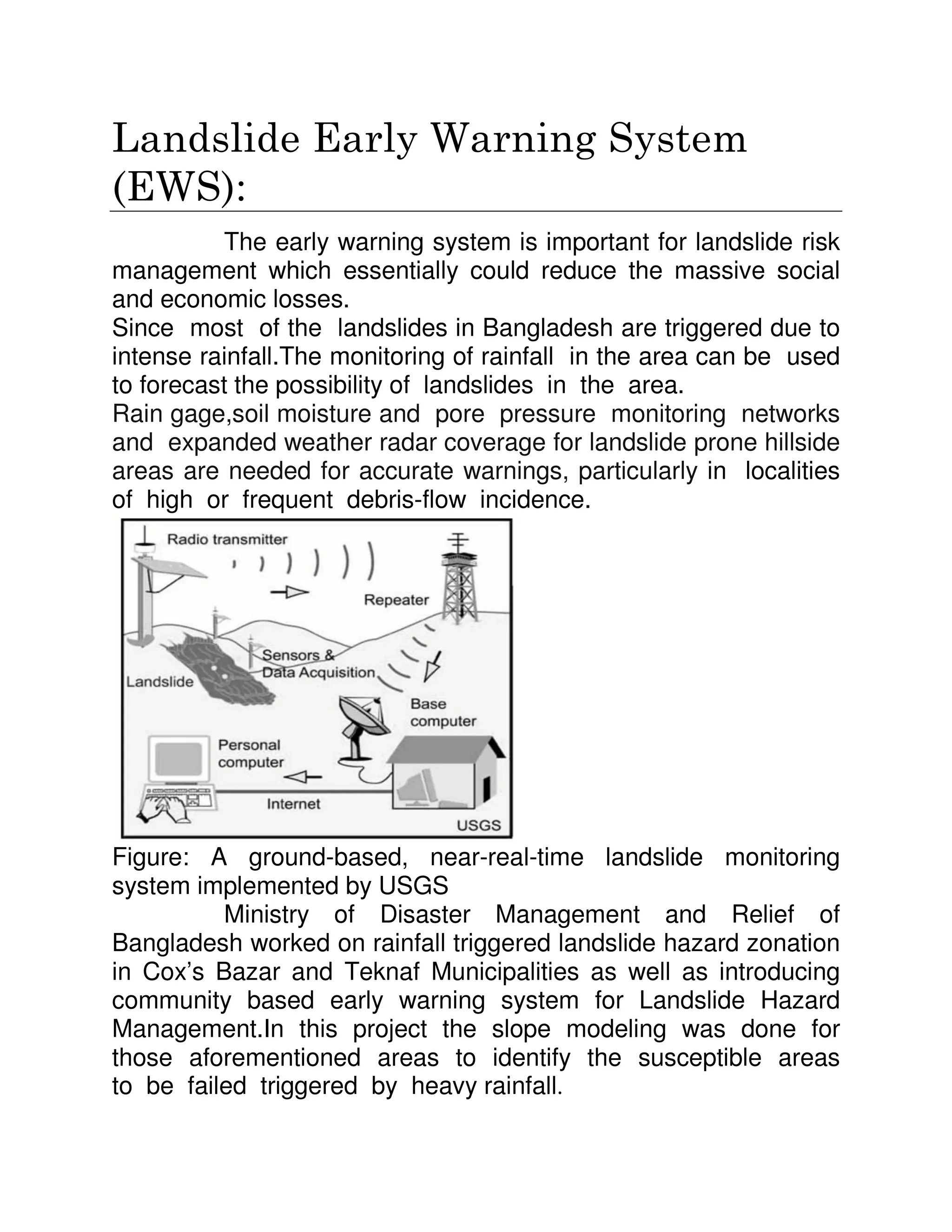
Rain gage,soil moisture and pore pressure monitoring networks
and expanded weather radar coverage for landslide prone hillside
areas are needed for accurate warnings, particularly in localities
of high or frequent debris-flow incidence.
Figure: A ground-based, near-real-time landslide monitoring
system implemented by USGS
Ministry of Disaster Management and Relief of
Bangladesh worked on rainfall triggered landslide hazard zonation
in Cox’s Bazar and Teknaf Municipalities as well as introducing
community based early warning system for Landslide Hazard
Management.In this project the slope modeling was done for
those aforementioned areas to identify the susceptible areas
to be failed triggered by heavy rainfall.
Prepared by:
IFFAT JAHAN SHAMMEE
Dept. of Disaster Science and Management
University of Dhaka

Landslide in Bangladesh

  • 1.
    Landslide in Bangladesh Landslide: Landslideis the downward movement of soil, rock and organic materials under the effects of gravity and also the landform that results from such movement.It is one of the most significant natural damaging disasters in hilly environments, which includes a wide range of ground movements, such as rock falls, deep failure of slopes and shallow debris flows.Rapid urbanization and human development activities such as, building and road construction through deforestation and excavation of hill slopes have increased landslide in densely populated cities located in mountainous areas.The cause is often infiltration of water that makes the swelling soils(clays) more fluid .Landslides are a major cause of erosion,causing the strongest degradation known, 10,000 tons per sq km in a year.Land use and land cover changes have been recognized as world’s one of the most important factors stirring rainfall triggered landslides. Land cover changes(e.g. urbanization , deforestation ) causes large variations in hydro- morphological functioning of hill-slopes, affecting rainfall partitioning infiltration characteristics and runoff production. Landslides in Bangladesh: Bangladesh is a low-laying floodplain area of Ganges delta in South Asia .Geologically it is part of the Bengal Basin which has been filled by sediments washed down from the highlands on three sides of it,especially from the Himalayas.
  • 2.
    Because of thegeographical location,Bangladesh experiences highest amount of monsoon rainfall and annual average rainfall among the SAARC countries.The whole country has two different distinctive geographical features with flat land (82%) and hilly regions (18%) in the North, North-East and South-East part. According to geological data,hilly region of Bangladesh developed in tertiary age. Bangladesh is highly vulnerable to different natural hazards :flood, cyclone, landslides, drought, earthquakes are very frequent. A significant number of landslide hazard locations exist in those urban areas that make many communities vulnerable to slide which may result in severe damages and socioeconomic losses.The characteristics of soft sedimentary and unconsolidated rocks in the hilly terrains,soil structure across the hilly area makes the slope instable as a consequence caused fatal landslides.Landslides event not only occurred in the south- eastern part of the country but also hit consecutively in the north-eastern part with massive damage.The hilly areas of the southeastern parts have a long history of instability.Although written records of landslide incidents are very rare, they have been living there.Every year especially in the rainy season, landslides take place in both natural and man induced slopes. Triggering factors and causes: The main contributing factors for the mass movement in Bangladesh can be divided into natural and human induced factors. Natural factors : steepness of natural slopes,altitude of bedding , lithology of rock,infiltration of water,tectonic settings, strength of rock, climatic variation, topographic and geomorphological conditions etc. The human intervention : unscientific exploitation of the Himalaya, deforestation, unplanned construction and settlement,
  • 3.
    mining and quarryingactivities combined with its complex geological and heavy rainfall makes the slope instable. The most common triggering factor is prolonged and intense monsoon rainfall in Bangladesh perspective. The major causes of landslide in Bangladesh which involves- 1) Removal of lateral support: a)erosion by rivers, b) previous slope movements such as slumps that create new slopes, c) human modifications of slopes such as cuts , pits and canals. 2) Increase of load to the slopes: a)accumulation of rain water b) increase in vegetation, c) construction on fill, d)weight of buildings and other structures, e)weight of water from leaking pipelines, sewers, canals, and reservoirs 3) Earthquakes 4) Regional tilting 5) Removal of underlying support: a) Undercutting by rivers and waves b) Swelling of clays 6) Anthropogenic activities as jhum cultivation: Government of Bangladesh has taken many initiatives to reduce the landslide risk from the vulnerable area. The mechanism of landslide is occurred by both internal forces and external factors. When the gravitational force acting on a slope exceeds its resisting force, slope failure and mass wasting occurs. The usual type of soil at the hill slope is silty clay. At most
  • 4.
    areas, the soilconsists of different layers of sand and clay/shale. Shear strength of silty clay type soil is much lower than regular sand or clay soils. Again, excessive rainfall had saturated the soil resulting increase of soil mass. Landslide in Chittagong and Chittagong Hill Tracts: Landslide occurred frequently in Chittagong hilly region due to extreme uninterrupted monsoon rainfall.The devastation aggravates along with weak structure,unplanned and erratic use of hills and settlement development.Because of its favorable geographical location and easy accessibility for regional and international trade,the city has developed as an important commercial hub for the country. As a result population density is increasing and demand of land going up.Thereby people in the urban area occupied the vacant government and privately-owned land both legally and illegally and built informal settlement without following any rules and regulation. The development authorities of Chittagong have identified 30 risky hills in this city namely Matijhorna, Lalkhan Bazar, TankirPahar, Batali Hill, GolPahar AK Khan Pahar high risk of landslides and associated damage. Chittagong hills are degrading by different anthropogenic stresses such as, hill cutting for construction, sand and clay mining, establishment of settlement in foothills, deforestation etc. Geology of Chittagong Hill Tracts: The hill areas are underlain by tertiary and quaternary sediments that have been folded, faulted and uplifted, then deeply dissected by rivers and stream. These areas consist of sandstones and shale and also with siltstone which have less stability. The bedrock and soil structure of these hills are not stable for which reason these areas are highly prone to landslide.
  • 5.
    The composition ofsoil of these hilly regions is complex and the young rocks have higher contents of easily-weatherable feldspars. The hill soils are mainly yellowish brown to reddish brown loams which grade into broken shale or sandstone as well as mottled sand at a variable depth. The soils are very strongly acidic. The soil of the hill slope is usually silty clay. The bedding of the soil formation is almost horizontal. Alternate layer of sand and very thin film of cementing clay/shale layer Rainwater seeps through the layers and over the ages reduces the bond between the sand and clay/shale layers. The region is rich in natural resources .Recently many foreign companies are conducting exploration programs for oil and gas in these regions. As a developing country, well developed communication system is required to exploit the natural resources. But areas prone to landslide hazard and causes and factors of landslide were not considered during construction of these roads. For these,every year landslides take place along the roads and block communications. The construction damages of the Mercantile Marine Academy, Chittagong were caused due to the lateral spreading movements in the hills formed of Dupi Tila Formatiion. Three types of landslides and slope failures which are lateral spreading movement, rotational and translational movements in the hills formed of Dupi Tila Formation, planar or block movement in Bokabil Formation and rotational, translational and planar or block failures in Tipam Formation are responsible for the erosional hazards of Chittagong city. The landslides of the Jhagar beel area, Rangamati district is caused due to the huge loads of the embankment resting on the weak stream fill sediments and high slide slopes. The main causes of landslide in this region are: 1. Access rainfall: Highest precipitation during monsoon. 2. Indiscriminate Hill cutting 3. Weak soli structure oh hills 4. Deforestation in the hilly area
  • 6.
    5. Abnormal tidalflow 6. High population and urbanization growth 7. Other causes like seismic activity etc. Landslides in Coastal Region (Cox’s Bazar): Landslides of different magnitudes occur along Bangladesh’s coastal regions. The Cox’s Bazar coastal region is one of these regions. The different sections of Cox’s Bazar suffer many landslide problems. Coastal cliff suffers from weathering and erosion which causes many shallow failures of the loosely consolidated sandstones. These are threating buildings and roads in the Bahar Chara Area.The agricultural land and houses of local villages have been badly affected by these slides.Houses and prawn culture forms are affected by slides and incur considerable financial losses . The lithological formation of different sections of cliff showed that the cliff materials consisted of loosely consolidated massive sandstones. In this region, very steep cliffs are observed. The steeper cliffs can reach an unstable condition faster than more gentle cliff as their heights and slope inclinations change by an equal amount. Tidal influences are also triggered landslides. Thus, coastal regions are also vulnerable.
  • 7.
    Impacts of landslide: Landslidehas huge impacts on the human being and their environment, including- • effects on people, their homes and possessions, • farms and livestock, • Industrial establishments and other structures. • Block of roads and communication system • block of drainage connection, • loss of soil fertility and • Loss of biodiversity of floral and faunal species and other resources. The major impact is related to destruction of human life, economic loss, environmental problem and loss of natural scenic beauty. Landslide vulnerability is an important issue for people living in the hilly areas. In the recent years, landslide is occurring regularly. The main mitigation strategies suggested by the authority were stopping of hill cutting, resettlement of the affected people, vegetation and development of robust policy. Possible measures: The selection of appropriate measures should be based on assessment of risk, uncertainty, possible consequences, constructability, environmental impacts and costs. Usually two types of approaches can be taken for the prevention of the disaster: 1. structural solutions and 2. Nonstructural measures.
  • 8.
    • Structural Measures: Structuralmeasures considering the safety measures, building codes and better drainage facilities are inevitable for mitigation of landslide disaster risk. In Bangladesh, retaining wall is widely used to stabilize slope which is a costly technology. Therefore, new affordable and sustainable technology should be explored to stabilize slopes. The below table describes different types of possible structural measures with their applicability in the context of Bangladesh.
  • 9.
    • Non-Structural Measures: Softengineering is as much important as structural solutions.Land use vulnerability assessment and zoning, early warning system,relocation of the foothill settlements,controlling hill cutting through proper enforcement of legal provisions,real time monitoring and early warning etc. measures can be taken for the mitigation of landslides.Single method is not effective for preventing landslides.Among the different methods,bio- engineering with jute geo-textiles, soil nailing and proper drainage is the most effective solution.With appropriate long rooted vegetation (e.g. vetiver grass) and proper techniques landslide occurrences can be effectively controlled.Warning system relating with rainfall can also be developed so that people themselves will be beware of probable landslides just knowing the precipitation of that area.
  • 10.
    Landslide Early WarningSystem (EWS): The early warning system is important for landslide risk management which essentially could reduce the massive social and economic losses. Since most of the landslides in Bangladesh are triggered due to intense rainfall.The monitoring of rainfall in the area can be used to forecast the possibility of landslides in the area. Rain gage,soil moisture and pore pressure monitoring networks and expanded weather radar coverage for landslide prone hillside areas are needed for accurate warnings, particularly in localities of high or frequent debris-flow incidence. Figure: A ground-based, near-real-time landslide monitoring system implemented by USGS Ministry of Disaster Management and Relief of Bangladesh worked on rainfall triggered landslide hazard zonation in Cox’s Bazar and Teknaf Municipalities as well as introducing community based early warning system for Landslide Hazard Management.In this project the slope modeling was done for those aforementioned areas to identify the susceptible areas to be failed triggered by heavy rainfall.
  • 11.
    Prepared by: IFFAT JAHANSHAMMEE Dept. of Disaster Science and Management University of Dhaka