Becoming a Professional
       Engineer

 Who is an Engineer ?


   Who is a Professional Engineer ?
Who is an Engineer?

 Engineers are the people who apply the principals of
  science and mathematics to develop economical
  solution to technical problems.
 Their work is he link between scientific discover less
  and the commercial applications that meet social and
  consumer needs.
 Most Engineers specialize in one particular discipline of Engineering.
There are 17 Engineering specialties covered by the Federal Government of
Standard Occupational classification system.


 Following are the most popular Engineering specializations.


                   Civil Engineering
                   Electrical Engineering
                   Electronics Engineering
                   Mechanical Engineering
Who is a Professional Engineer
 A Professional Engineer is an Engineer who is
  registered or licensed within an Engineering Authority
  to offer professional services to directly to the public.
 The professional statues and the actual practice of
  professional engineering is legally defined and
  protected by a government body
 A licensed or Registered Engineer is the authority to
  sign and seal or stamp engineering documents such as
  reports drawings and calculations.
Electrical Engineering Technicians

 Who is an Electrical Engineering Technicians ?

 What is the Educational Requirement for this Job ?

 Skills and abilities

 Duties

 What is the opportunity in this career ?
Who is an Electrical Engineering Technicians

 An electrical engineering technician is a specialist who
  applies electrical theory and related knowledge to test and
  modify developmental or operational electrical machinery
  and electrical control equipment or commercial plants and
  laboratories. .
 The work of engineering technician is more of application
  pointed and more limited in scope than that of engineers.
What is the Educational Requirement for
this Job?

  People who want to work as electrical engineering
  technicians need to minimum qualification like:
 Associate degree in electrical engineering technology.
 Course work varies for each specialized task.
 Courses in algebra, science and basic science are required.
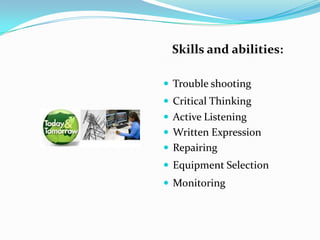
Skills and abilities:

 Trouble shooting
 Critical Thinking
 Active Listening
 Written Expression
 Repairing
 Equipment Selection
 Monitoring
Duties
 Install and maintain electrical control systems.
 Prepare project cost and work-time estimates.
 Build, maintain, troubleshoot and repair electrical
  instruments or testing equipment.
 Visit construction sites to observe conditions impacting
  design and to identify solutions to technical problems.
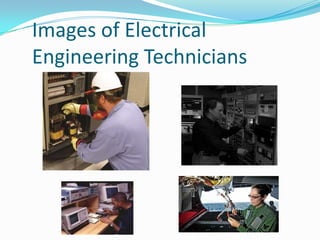
Images of Electrical
Engineering Technicians
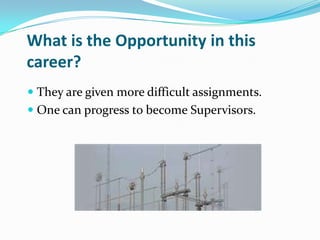
What is the Opportunity in this
career?
 They are given more difficult assignments.
 One can progress to become Supervisors.
The Professional Registers
 ICT Technician (ICTTech)


 Engineering Technician (EngTech)


 Incorporated Engineer (IEng)


 Chartered Engineer (CEng)
Incorporated Engineer

 Incorporated Engineers maintain and manage
  applications of current and developing
  technology, and many undertake engineering
  design, development, manufacture construction
  and operation.
 Incorporated Engineers are variously engaged in
  technical and commercial management and
  possess effective interpersonal skills
IEng
Education
 Knowledge and understanding are important
  components of professional
 Competence. Formal education is the usual, though
  not the only, way of
 Demonstrating the necessary knowledge and
  understanding, and the following Qualifications
  exemplify the required knowledge and understanding
  for Incorporated Engineers:
 An accredited Bachelors or honors degree in
  engineering or technology
 Or a Higher National Diploma (HND) or a
  Foundation Degree in engineering or
 Technology, plus appropriate further learning to
  degree level
 Or an NVQ4 or SVQ4 which has been approved for
  the purpose by a licensed
Engineering institution
 Applicants who do not have exemplifying qualifications
    may demonstrate
   the required knowledge and understanding in other ways,
    but must clearly
   demonstrate they have achieved the same level of
    knowledge and understanding
   as those with exemplifying qualifications.
   Ways to demonstrate this include:
   Taking further qualifications, in whole or in part, as
    specified by the institution to which they are applying
 Completing appropriate work-based or experiential
  learning
 Writing a technical report, based on their experience,
  and demonstrating their knowledge and
  understanding of engineering principles

 Until 2011, taking Engineering Council examinations.
 Applicants should consult their licensed professional
 engineering institution for advice on the most
 appropriate option.
Professional recognition
 Do you have the talent to apply technology in a
  practical and creative way? Do you see yourself?
 Working in an engineering role where on a daily
  basis it is your skills and know-how that ensure
  success?
 If the answer in both cases is yes, then you will
  also want to see your professionalism recognized
  – an ambition you can achieve by gaining the title
 Incorporated Engineer (IEng).
How to get Register in
Engineering Council UK
       (ECUK)
UK Engineering Council
 Engineering Council UK (ECUK) is a "designated
 authority", under the implementing.

 ECUK has professional registration routes .
 This is depending on the professions.

       Eg.   Chartered Engineer (CEng)
              Incorporated Engineer (IEng)
              Engineering Technician (EngTech)
Why have compulsory registration?
 Because the registration improve the quality.

 Further Same Profession has different grades.

   Eg. CEng – Electrical Engineering
        EngTech – Electrical Engineering
Typical Steps For the Registration
• Apply the membership through our professional
 engineering institution .

• Attached the CV and Job Qualification
 letters(mention electrical engineering qualification) to
 the application.

• Then Send the application to the Engineering Council.
Someone going to give an
engineering license to
you.
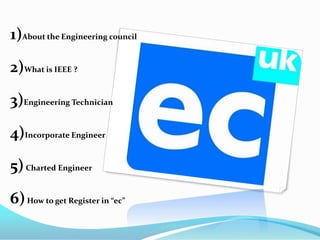
1)About the Engineering council

2)What is IEEE ?

3)Engineering Technician

4)Incorporate Engineer

5) Charted Engineer

6) How to get Register in “ec”
About the Engineering Council
 The Engineering Council is the UK regulatory body for the
  engineering profession. We hold the national registers of
  235,000 Engineering Technicians (EngTech), Information
  and Communications Technology Technicians (ICTTech),
  Incorporated Engineers (IEng) and Chartered Engineers
  (CEng).
 In addition, the Engineering Council sets and maintains
  the internationally recognised standards of professional
  competence and ethics that govern the award and retention
  of these titles. This ensures that employers, government
  and wider society - both in the UK and overseas - can have
  confidence in the knowledge, experience and commitment
  of registrants.
What is an IEEE ?
 IEEE is the world’s largest professional association
  dedicated to advancing technological innovation and
  excellence for the benefit of humanity. IEEE and its
  members inspire a global community through IEEE's
  highly cited publications, conferences, technology
  standards, and professional and educational activities.
 EngTechs solve practical engineering problems. They
 are professionals with supervisory or technical
 responsibility, and apply safe systems of working. They
 contribute to the design, development, manufacture,
 commissioning, decommissioning, operation or
 maintenance of products, equipment, processes or
 services.
 Professional registration as an Incorporated Engineer
 (IEng) recognises your proven competence,
 commitment, skills and experience. It is an important
 milestone in the career of any engineer or
 technologist. In particular, IEng registration shows
 your employer and peers that you have demonstrated a
 commitment to professional standards, and to
 developing and enhancing your competence.
 Chartered Engineers develop appropriate solutions to
 engineering problems. They may develop and apply
 new technologies, promote advanced designs and
 design methods and introduce new and more efficient
 production techniques, or pioneer new engineering
 services and management methods. The title CEng is
 protected by civil law and is one of the most
 recognisable international engineering qualifications
How to get register in “ec”
Gaining IEng or CEng status is just as straightforward for
engineers who are teachers or researchers as it is for an
engineer working in industry. Evidence of competence can
be provided in a variety of ways, such as course
development, involvement in research, managing research
projects, an industrial placement, working independently
on consultancy or voluntary engineering work.
A leaflet outlining how teachers and researchers can
achieve professional recognition and explaining the
benefits is available.
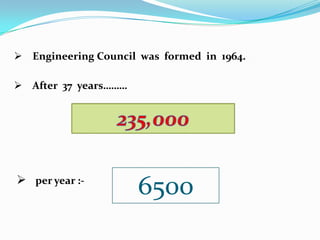
 Engineering Council was formed in 1964.

 After 37 years………


 per year :-
                      6500
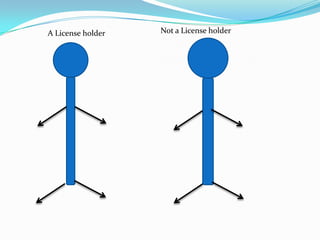
A License holder   Not a License holder
Motor vehicle
driving license
Our mission
     &
 Our vision
“one more thing”
“If you do anything you
should do best”


“Never give up’’
I can do it
Exercise

Q ) Fill in the blanks with the correct letter

                a,e,i ,o,u

Lakmal

  • 1.
    Becoming a Professional Engineer  Who is an Engineer ?  Who is a Professional Engineer ?
  • 2.
    Who is anEngineer?  Engineers are the people who apply the principals of science and mathematics to develop economical solution to technical problems.  Their work is he link between scientific discover less and the commercial applications that meet social and consumer needs.
  • 3.
     Most Engineersspecialize in one particular discipline of Engineering. There are 17 Engineering specialties covered by the Federal Government of Standard Occupational classification system.  Following are the most popular Engineering specializations.  Civil Engineering  Electrical Engineering  Electronics Engineering  Mechanical Engineering
  • 4.
    Who is aProfessional Engineer  A Professional Engineer is an Engineer who is registered or licensed within an Engineering Authority to offer professional services to directly to the public.  The professional statues and the actual practice of professional engineering is legally defined and protected by a government body  A licensed or Registered Engineer is the authority to sign and seal or stamp engineering documents such as reports drawings and calculations.
  • 6.
    Electrical Engineering Technicians Who is an Electrical Engineering Technicians ?  What is the Educational Requirement for this Job ?  Skills and abilities  Duties  What is the opportunity in this career ?
  • 7.
    Who is anElectrical Engineering Technicians  An electrical engineering technician is a specialist who applies electrical theory and related knowledge to test and modify developmental or operational electrical machinery and electrical control equipment or commercial plants and laboratories. .  The work of engineering technician is more of application pointed and more limited in scope than that of engineers.
  • 8.
    What is theEducational Requirement for this Job? People who want to work as electrical engineering technicians need to minimum qualification like:  Associate degree in electrical engineering technology.  Course work varies for each specialized task.  Courses in algebra, science and basic science are required.
  • 9.
    Skills and abilities: Trouble shooting  Critical Thinking  Active Listening  Written Expression  Repairing  Equipment Selection  Monitoring
  • 10.
    Duties  Install andmaintain electrical control systems.  Prepare project cost and work-time estimates.  Build, maintain, troubleshoot and repair electrical instruments or testing equipment.  Visit construction sites to observe conditions impacting design and to identify solutions to technical problems.
  • 11.
  • 12.
    What is theOpportunity in this career?  They are given more difficult assignments.  One can progress to become Supervisors.
  • 14.
    The Professional Registers ICT Technician (ICTTech)  Engineering Technician (EngTech)  Incorporated Engineer (IEng)  Chartered Engineer (CEng)
  • 15.
    Incorporated Engineer  IncorporatedEngineers maintain and manage applications of current and developing technology, and many undertake engineering design, development, manufacture construction and operation.  Incorporated Engineers are variously engaged in technical and commercial management and possess effective interpersonal skills
  • 16.
    IEng Education  Knowledge andunderstanding are important components of professional  Competence. Formal education is the usual, though not the only, way of  Demonstrating the necessary knowledge and understanding, and the following Qualifications exemplify the required knowledge and understanding for Incorporated Engineers:
  • 17.
     An accreditedBachelors or honors degree in engineering or technology  Or a Higher National Diploma (HND) or a Foundation Degree in engineering or  Technology, plus appropriate further learning to degree level  Or an NVQ4 or SVQ4 which has been approved for the purpose by a licensed
  • 18.
    Engineering institution  Applicantswho do not have exemplifying qualifications may demonstrate  the required knowledge and understanding in other ways, but must clearly  demonstrate they have achieved the same level of knowledge and understanding  as those with exemplifying qualifications.  Ways to demonstrate this include:  Taking further qualifications, in whole or in part, as specified by the institution to which they are applying
  • 19.
     Completing appropriatework-based or experiential learning  Writing a technical report, based on their experience, and demonstrating their knowledge and understanding of engineering principles  Until 2011, taking Engineering Council examinations.  Applicants should consult their licensed professional engineering institution for advice on the most appropriate option.
  • 20.
    Professional recognition  Doyou have the talent to apply technology in a practical and creative way? Do you see yourself?  Working in an engineering role where on a daily basis it is your skills and know-how that ensure success?  If the answer in both cases is yes, then you will also want to see your professionalism recognized – an ambition you can achieve by gaining the title  Incorporated Engineer (IEng).
  • 22.
    How to getRegister in Engineering Council UK (ECUK)
  • 23.
    UK Engineering Council Engineering Council UK (ECUK) is a "designated authority", under the implementing.  ECUK has professional registration routes .  This is depending on the professions.  Eg. Chartered Engineer (CEng) Incorporated Engineer (IEng) Engineering Technician (EngTech)
  • 24.
    Why have compulsoryregistration?  Because the registration improve the quality.  Further Same Profession has different grades.  Eg. CEng – Electrical Engineering EngTech – Electrical Engineering
  • 25.
    Typical Steps Forthe Registration • Apply the membership through our professional engineering institution . • Attached the CV and Job Qualification letters(mention electrical engineering qualification) to the application. • Then Send the application to the Engineering Council.
  • 27.
    Someone going togive an engineering license to you.
  • 29.
    1)About the Engineeringcouncil 2)What is IEEE ? 3)Engineering Technician 4)Incorporate Engineer 5) Charted Engineer 6) How to get Register in “ec”
  • 30.
    About the EngineeringCouncil  The Engineering Council is the UK regulatory body for the engineering profession. We hold the national registers of 235,000 Engineering Technicians (EngTech), Information and Communications Technology Technicians (ICTTech), Incorporated Engineers (IEng) and Chartered Engineers (CEng).  In addition, the Engineering Council sets and maintains the internationally recognised standards of professional competence and ethics that govern the award and retention of these titles. This ensures that employers, government and wider society - both in the UK and overseas - can have confidence in the knowledge, experience and commitment of registrants.
  • 31.
    What is anIEEE ?  IEEE is the world’s largest professional association dedicated to advancing technological innovation and excellence for the benefit of humanity. IEEE and its members inspire a global community through IEEE's highly cited publications, conferences, technology standards, and professional and educational activities.
  • 32.
     EngTechs solvepractical engineering problems. They are professionals with supervisory or technical responsibility, and apply safe systems of working. They contribute to the design, development, manufacture, commissioning, decommissioning, operation or maintenance of products, equipment, processes or services.
  • 33.
     Professional registrationas an Incorporated Engineer (IEng) recognises your proven competence, commitment, skills and experience. It is an important milestone in the career of any engineer or technologist. In particular, IEng registration shows your employer and peers that you have demonstrated a commitment to professional standards, and to developing and enhancing your competence.
  • 34.
     Chartered Engineersdevelop appropriate solutions to engineering problems. They may develop and apply new technologies, promote advanced designs and design methods and introduce new and more efficient production techniques, or pioneer new engineering services and management methods. The title CEng is protected by civil law and is one of the most recognisable international engineering qualifications
  • 35.
    How to getregister in “ec” Gaining IEng or CEng status is just as straightforward for engineers who are teachers or researchers as it is for an engineer working in industry. Evidence of competence can be provided in a variety of ways, such as course development, involvement in research, managing research projects, an industrial placement, working independently on consultancy or voluntary engineering work. A leaflet outlining how teachers and researchers can achieve professional recognition and explaining the benefits is available.
  • 36.
     Engineering Councilwas formed in 1964.  After 37 years………  per year :- 6500
  • 37.
    A License holder Not a License holder
  • 38.
  • 39.
    Our mission & Our vision
  • 40.
  • 41.
    “If you doanything you should do best” “Never give up’’
  • 42.
  • 44.
    Exercise Q ) Fillin the blanks with the correct letter a,e,i ,o,u