


Chapter 2
• Professionalism and Codes of Ethics
– Engineering Societies (Malaysia and International)
– Registration of Engineers with Board of Engineers
(BEM)
– Route to be Professional Engineer
– Guideline for Code of Professional conduct
– Sharing Experience - Invited Speakers
Compile by Bulan Abdullah (OCT 2020)
Engineering societies in Malaysia (1)
• Board of Engineers Malaysia (BEM)
– Regulatory body for engineering practices in
Malaysia set-up under the Registration of Engineers
Act, 1967. All engineering practitioner MUST
register with BEM within 6-months of practice.
• The Institution of Engineers Malaysia (IEM)
– A learned institution for practicing engineers in
Malaysia; networking, technical learning and
socializing group.
• Malaysia Board of Technologists (MBOT)
– Malaysia Board of Technologists (MBOT) is a
professional body that gives Professional
Recognition to Technologists and Technicians in
related technology and technical fields.
Engineering societies in Malaysia (2)
• Malaysian Society for Engineering and Technology (MySET)
– MySET aims to provide a powerful platform for its members to network and
enhance their professionalism and ethical conduct, while nurturing them into
leading professionals and captains of the industry.
• Society of Engineering Education Malaysia (SEEM)
– Contribute for the development of education in engineering education field,
science and technology including teaching and learning, counseling, research,
service and public relations.
• Association of Consulting Engineers Malaysia (ACEM)
– Promoting the advancement of the profession of consulting engineering by
associating together for consultation and cooperation those engineers whose
work is of a purely consultative character, and of providing facilities for
Governments, Public Bodies, Associations representing industry and trade, and
others.
International Engineering societies
• American Society of Mechanical Engineers (ASME)
• International Society of Automation
• International Society for Optical Engineering
• Institute of Electrical and Electronics Engineers (IEEE)
• International Council on Systems Engineering
• Society of Automotive Engineers
• International Society of Pharmaceutical Engineering
• Society of Professional Engineers UK
• And a lot more…
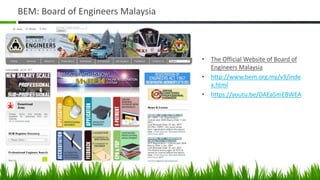
BEM: Board of Engineers Malaysia
• The Official Website of Board of
Engineers Malaysia
• http://www.bem.org.my/v3/inde
x.html
• https://youtu.be/DAEa5mEBWEA
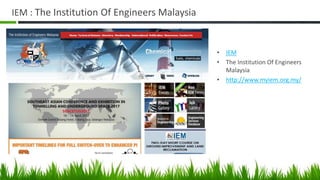
IEM : The Institution Of Engineers Malaysia
• IEM
• The Institution Of Engineers
Malaysia
• http://www.myiem.org.my/
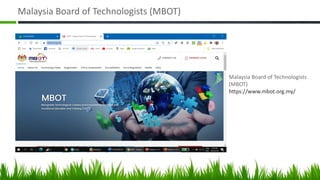
Malaysia Board of Technologists (MBOT)
Malaysia Board of Technologists
(MBOT)
https://www.mbot.org.my/
BOARD OF ENGINEERS MALAYSIA
• The Board of Engineers Malaysia (BEM) is a statutory body
constituted under the Registration of Engineers Act 1967
with perpetual succession and a common seal, which may
sue and be sued. It was formed in 23rd August 1972. BEM
primary role is to facilitate the registration of Engineers,
Engineering Technologists, Inspectors of Works, Sole
Proprietorships, Partnerships and Bodies Corporate providing
professional engineering services and; to regulate the
professional conduct and practice of registered person in
order to safeguard the safety and interest of the public.
• BEM falls within the ambit of responsibility of the Minister of
Works. Vested with wide powers, the Minister may suspend
the operation of the Registration of Engineers Act 1967 (REA)
in any part of Malaysia by notification in the gazette. The
appointment of the Board Members and the Registrar is
made by the Minister.
• The Registration of Engineers Act 1967 and the Registration
of Engineers Regulations 1990 have been amended in 2015
with date of operation on 31st July 2015. The amended REA
will be known as "Registration of Engineers Act 1967
(Revised 2015)' whilst the accompanying Regulations will be
known as "Registration of Engineers Regulatons 1990
(Revised 2015)".
• These latest amendments are a direct result of Government
policies on trade for services. As Malaysia developed towards
a service industry the issue of “liberalisation” of the services
came to the forefront in the Free Trade Agreements (FTA)
which the country signed. These latest amendments directly
address liberalisation issues in order for the country to meet
its international obligations.
• The need to regulate the Engineering Team; Engineers,
Engineering Technologists and Engineering Technicians has
also led the BEM to amend the REA to incorporate two new
categories: Engineering Technologists and Inspector of Works
(also known as Engineering Technicians).
•
http://www.bem.org.my/web/guest/history
BOARD OF ENGINEERS MALAYSIA
• BEM consists of 17 Board Members comprising of :
• President
• 14 Professional Engineers from various sectors :
– 5 from public sector.
– 5 from private practice.
– 2 from local authority or statutory authority.
– 2 from private sector (full time employment).
• 1 representative of the Board of Architects Malaysia.
• 1 representative of the Board of Quantity Surveyors Malaysia.
• Board Members are Professional Engineers, Architect and Quantity Surveyor of high
standing and vast experience as in the opinion of the Ministry of Works and are able to
render services and contribute towards that end. The appointment are by the Ministry of
Works under Section 3 of the Registration of Engineers Act 1967. The Secretary and the
Registrar who are Professional Engineers shall be ex-officio members.
The functions of BEM
• The functions of BEM according to Section 4 of the
Registration of Engineers Act 1967 (Revised 2015) are:
1.0 Maintain the Register
• The Board shall keep and maintain a Register which shall be
in five Parts:
Part A - which shall contain the names, addresses and other
particulars of Professional Engineers;
Part B - which shall contain the names, addresses and other
particulars of Graduate Engineers;
Part C - deleted.
Part D - which shall contain the names, addresses and other
particulars of Engineering consultancy practices;
Part E - which shall contain the names, addresses and other
particulars of Accredited Checkers;
Part E - which shall contain the names, addresses and other
particulars of Professional Engineers with Practising
Certificate;
Part F - which shall contain the names, addresses and other
particulars of Engineering Technologist; and
Part H - which shall contain the names, addresses and other
particulars of Inspectors of Works.
2.0 Process Applications for Registration
• BEM through its Examination and Qualification Committee
conducts Professional Assessment Examination (PAE) to
assess the quality of experience gained by the Graduate
Engineers and their competency. Every application for
registration, be it as Graduate Engineers, Engineering
Technologists, Inspectorid of Works, Professional Engineers,
Professional Engineers with Practising Certificate and,
Engineering Consultancy Practices is scrutinized thoroughly
by the Application Committee to ensure compliance with the
Act and with the policy of BEM. Application to register as
Accredited Checkers will be assessed by Accredited Checkers
Committee.
• BEM also applies restrictions on practices of bodies
corporate with the aim that engineering consulting services
provided by these bodies corporate would be done
professionally for the benefit of the client/public.
The functions of BEM
3.0 Assessment of Academic Qualifications - Engineering Degree Programme by EAC
• BEM through the Engineering Accreditation Council (EAC)* conducts accreditation of engineering degree
programmes offered by institutions of higher learning within Malaysia. Accreditation is done through the
evaluation panel (from academic and industry/practice) whose members are appointed by EAC. The
accreditation panel shall visit the institution to evaluate the curriculum, facilities and the quality management
system and have dialogue with the management, academic and support staff, students and industry
stakeholders.
• The period of full accreditation shall be five years after which it has to be revalidated.
• Where there are minor shortcomings in meeting the accreditation requirement, the programme may be given
accreditation for a period of less than five years during which the faculty must take necessary corrective
measures.
• Prior to conduct of a new engineering programme institution of higher learning shall obtain approval from
the relevant authorities. The authority normally will require supporting document from the EAC.
• BEM through the EAC, in general, uses as a guide the list accredited degree programmes leading to
Professional/Chartered Engineer by accreditation organisations of the country where the degree is issued.
• * The Engineering Accreditation Council is the body on accreditation, representing the Board of Engineers
Malaysia, the Institution of Engineers Malaysia, Malaysian Qualification Agency and Jabatan Perkhidmatan
Awam Malaysia (JPA).
The functions of BEM
4.0 Assessment of Academic Qualifications - Engineering Technology
and Engineering Technician Programmes by ETAC
• BEM traditionally registers graduates and professional engineers
under the Registration of Engineers (Amendment) Act 2007. The
pre-requisite for registration as a graduate engineer is any
qualification in engineering recognised by the Board. Since July
2015, BEM has begun registering engineering technologists who
are also important stakeholders within the engineering workforce.
This is in compliance with the latest Amendments to the
Registration of Engineers Act 1967 (Revised 2015). The BEM
therefore has a duty to ensure that the quality of engineering
technology education/programme of its registered technologists
attains the minimum standard comparable to global practice.
Hence the necessity to accredit engineering technology
programmes conducted in IHLs.
• The Engineering Technology Accreditation Council (ETAC) is a
delegated body by BEM first established in 2011 as the only BEM-
recognised accrediting body for engineering technology bachelor
degree, engineering diploma and engineering technology diploma
programmes offered in Malaysia. ETAC is made up of
representatives from the Board of Engineers Malaysia (BEM), the
Malaysian Qualification Agency (MQA), the Public Services
Department (Jabatan Perkhidmatan Awam Malaysia (JPA)) and
other relevant learned societies.
• The ETAC has been strengthened with respect to its administrative
arm within the set up of the Engineering Accreditation
Department. The Department presently operates at the Kelana
Jaya office. The set up includes a director, and four (4) associate
directors. The Department is also supported by its committees
that oversee the development of the Manual, the outcome-based
culture change at institutions of higher learning, quality assurance
and international affairs.
• The ETAC has been instrumental in ensuring Malaysia’s ETAC
accredited engineering technology bachelors' degree, engineering
diploma and engineering technology diploma programmes are
substantially equivalent to the engineering qualifications of the
signatories of the Sydney Accord and Dublin Accord. Click
download to view or save.
The functions of BEM
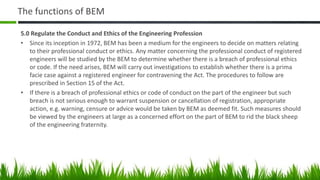
5.0 Regulate the Conduct and Ethics of the Engineering Profession
• Since its inception in 1972, BEM has been a medium for the engineers to decide on matters relating
to their professional conduct or ethics. Any matter concerning the professional conduct of registered
engineers will be studied by the BEM to determine whether there is a breach of professional ethics
or code. If the need arises, BEM will carry out investigations to establish whether there is a prima
facie case against a registered engineer for contravening the Act. The procedures to follow are
prescribed in Section 15 of the Act.
• If there is a breach of professional ethics or code of conduct on the part of the engineer but such
breach is not serious enough to warrant suspension or cancellation of registration, appropriate
action, e.g. warning, censure or advice would be taken by BEM as deemed fit. Such measures should
be viewed by the engineers at large as a concerned effort on the part of BEM to rid the black sheep
of the engineering fraternity.
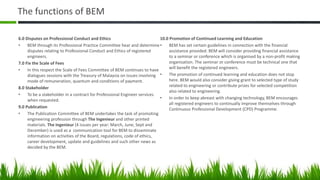
The functions of BEM
6.0 Disputes on Professional Conduct and Ethics
• BEM through its Professional Practice Committee hear and determine
disputes relating to Professional Conduct and Ethics of registered
engineers.
7.0 Fix the Scale of Fees
• In this respect the Scale of Fees Committee of BEM continues to have
dialogues sessions with the Treasury of Malaysia on issues involving
mode of remuneration, quantum and conditions of payment.
8.0 Stakeholder
• To be a stakeholder in a contract for Professional Engineer services
when requested.
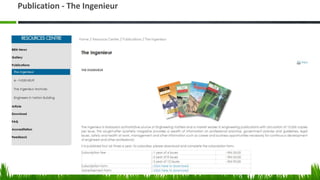
9.0 Publication
• The Publication Committee of BEM undertakes the task of promoting
engineering profession through The Ingenieur and other printed
materials. The Ingenieur (4 issues per year: March, June, Sept and
December) is used as a communication tool for BEM to disseminate
information on activities of the Board, regulations, code of ethics,
career development, update and guidelines and such other news as
decided by the BEM.
10.0 Promotion of Continued Learning and Education
• BEM has set certain guidelines in connection with the financial
assistance provided. BEM will consider providing financial assistance
to a seminar or conference which is organised by a non-profit making
organisation. The seminar or conference must be technical one that
will benefit the registered engineers.
• The promotion of continued learning and education does not stop
here. BEM would also consider giving grant to selected type of study
related to engineering or contribute prizes for selected competition
also related to engineering.
• In order to keep abreast with changing technology, BEM encourages
all registered engineers to continually improve themselves through
Continuous Professional Development (CPD) Programme.
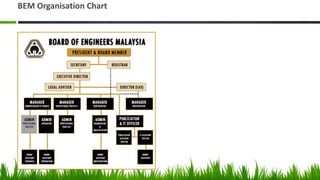
BEM Organisation Chart
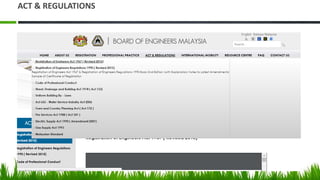
ACT & REGULATIONS
Publication - The Ingenieur
The Institution of Engineers, Malaysia (IEM)
• The Institution of Engineers, Malaysia (IEM) was established in 1959 and its primary
function is to promote and advance the science and profession of engineering in any or all
of its disciplines and to facilitate the exchange of information and ideas related to
engineering.
• The governing body of the IEM is the Council, headed by the President. The affairs of the
Council are carried out by the Executive Committee comprising the President, Deputy
President, seven Vice Presidents, Honorary Secretary, Honorary Treasurer and five members
elected from the Council. Operations are supported by a full time Secretariat.
• Membership of the Institution is currently about 30,000 and the growth rate is about 10%
per annum making it one of the largest professional organization in the country. In order to
support the needs of members, the IEM has 8 Standing Committees to attend to the
different administrative functions of the Institution. To support the multidisciplinary needs
of engineering practice, there are 16 Technical Divisions and 4 Special Interest Groups to
look after and to organize activities for the different disciplines. There is also a Young
Engineer Section and Women Engineers Section that caters exclusively to the younger
members and women engineers respectively.
https://www.myiem.org.my/content/introduction-261.aspx
The Institution of Engineers, Malaysia (IEM)
• Vision
• The Institution of Engineers, Malaysia aims to be
the premier professional Organisation pivotal
achieving Vision 2020.
• Mission
• IEM shall
• promote sound professional engineering practice in
support of the socio-economic development
objectives of the nation.
• service the needs and interests of its members and
the public and uphold the social standing image of
the engineering profession.
• contribute towards nation building and shall strive
to enhance society's consciousness of science an
technology.
•
Functions
• IEM is a society established to promote and advance
the Science and Profession of Engineering in any or
all its disciplines and to facilitate the exchange of
information and ideas related to Engineering.
• Objectives of The Institution
• The objectives of the Institution as set out in the
Constitution shall include the following:
• to hold meetings, exhibitions and visits, and such
other activities as The Institution may deem
incidental or conducive to the promotion or
attainment of the profession of engineering.
• to raise the character and status and advance the
interests of the profession of engineering and those
engaged therein;
• to promote honourable practice. and professional
etiquette among members of The Institution;
• to communicate to members information on all
matters affecting the profession of engineering and
to print, publish, issue and circulate such
publications as may seem conducive to any of the
objectives of the Institution; and
• to do such other things as the Institution may think
incidental or conducive to the attainment of the
objectives of The Institution
https://www.myiem.org.my/content/introduction-261.aspx
Introduction to IEM
• Types of Membership within IEM
 Student Member – open to all engineering students.
 Graduate Member – open to all practicing engineers “registered with BEM”.
 Corporate / Fellow Member – upgrading for experience engineers leading to
Professional Engineer status.
 Associate Member – non-degree engineering practitioner; diploma or certificate
holders.
 Incorporated Member – Professional Engineers from international Engineering
Institution recognized by IEM.
 Honorary Member – distinguish person who contributed to engineering
profession.
Introduction to IEM
❑ Primary BENEFITS as IEM Student Member
– Networking with practicing engineers.
– Technical Talks, Courses and Technical Visits.
– Mentorship program (with Senior Engineer esp. for Final Year project).
– Potential Industrial Training Program (ITP) attachments.
– Potential future job employment.
❑Primary BENEFITS as IEM Member
• Networking amongst engineers.
• Technical Talks, Courses and Technical Visits.
• Provider of Professional Development Program (PDP) for
Graduate Members
• Route to become a Professional Engineer (PE).
• Provider of Continuing Professional Development (CPD)
Program for MIEM/PE
MBOT : https://www.mbot.org.my/
• What is MBOT?
• Malaysia Board of Technologists (MBOT) is a professional
body that gives Professional Recognition to Technologists
and Technicians in related technology and technical fields.
Based on Act 768, MBOT expands its function vertically and
horizontally whereby MBOT looks at technology-based
profession that cuts across discipline based from conceptual
design to a realized technology and covers from Technicians
(with SKM/Diploma Level) up to Technologists (Bachelor’s
Degree level and above). As a whole, these professionals
(Technologists and Technicians) have integrated roles from
concept to reality.
• Function MBOT
• Based on Act 768, MBOT expands its function vertically and
horizontally whereby MBOT looks at technology based
profession that cuts across discipline based from conceptual
design to a realized technology and covers from Technicians
(with SKM/Diploma Level) up to Technologists (Bachelor
Degree level and above). As a whole, these professionals
(Technologists and Technicians) have integrated roles from
concept to reality.
• Section 5 (Act 768) stipulates MBOT to perform the following
functions:
I. To recognize and register Technologists and Technicians as
Professionals based on technology and technical fields;
II. To provide facilities for the promotion of education and
training and to hold or cause to be held, professional
development programmes for registered persons to further
enhance their knowledge relating to their professions;
III. To conduct assessments or to cause assessments to be
conducted by an institution approved by the Board for the
purpose of admission to the profession;
IV. To determine and regulate the conduct and ethics of the
technologists and technician profession; and
V. Generally, to carry out all such acts and do all such things as
may appear to the Board necessary to carry out the
provisions of this Act.
What is MBOT’s Recognized Technology Fields?
• https://www.mbot.org.my/technology-fields/what-is-mbot%E2%80%99s-recognized-technology-
fields/
ASEAN Chartered Professional Engineer Coordinating Committee (ACPECC)
• ACPECC has the authority to confer and withdraw the title of
ASEAN Chartered Professional Engineer (ACPE). ACPECC is
established as an overseeing body at regional level to :-
• facilitate the development and maintenance of authoritative
and reliable Registers of ASEAN Chartered Professional
Engineers (ACPER)
• promote the acceptance of ACPEs in each participating
ASEAN Member Country as possessing general technical and
professional competence that is substantially equivalent to
that of professional engineers registered or licensed in the
Country of Origin
• develop, monitor, maintain and promote mutually
acceptable standards and criteria for facilitating practice by
ACPEs throughout the participating ASEAN Member Country
• gain a greater understanding of existing barriers to such
practice and to develop and promote strategies to help
governments and licensing authorities reduce those barriers
and manage their processes in an effective and non-
discriminatory manner
• encourage relevant governments and licensing authorities to
adopt and implement streamlined procedures for granting
rights to practice to ASEAN Chartered Professional Engineers
(ACPEs)
• Identify and encourage the implementation of best practice
for the preparation and assessment of engineers intending to
practice at the professional level
• Continue mutual monitoring and information exchange
• The Committee is led by a Chairman (ASEAN Country)
appointed by rotation for 2 years and supported by a
Permanent Secretariat which is currently Indonesia.
• To facilitate mobility of engineering services professional, a
register on Asean Chartered Professional Engineer is
introduced.
The International Engineering Alliance (IEA)
• The International Engineering Alliance (IEA) is a global not-for-profit organisation, which comprises
members from APEC economies and the world, covers seven international agreements. These
international agreements govern the recognition of engineering educational qualifications and
professional competence.
• Through the Educational Accords and Competence Agreements members of the International
Engineering Alliance establish and enforce internationally bench-marked standards for engineering
education and expected competence for engineering practice
• Malaysia is currently signatory of APEC Engineers Agreement, International Professional Engineers
Agreement (IntPE) and Washington Accord.

2.1 Engineering Societies (OCT 2020)

  • 1.
    Chapter 2 • Professionalismand Codes of Ethics – Engineering Societies (Malaysia and International) – Registration of Engineers with Board of Engineers (BEM) – Route to be Professional Engineer – Guideline for Code of Professional conduct – Sharing Experience - Invited Speakers Compile by Bulan Abdullah (OCT 2020)
  • 2.
    Engineering societies inMalaysia (1) • Board of Engineers Malaysia (BEM) – Regulatory body for engineering practices in Malaysia set-up under the Registration of Engineers Act, 1967. All engineering practitioner MUST register with BEM within 6-months of practice. • The Institution of Engineers Malaysia (IEM) – A learned institution for practicing engineers in Malaysia; networking, technical learning and socializing group. • Malaysia Board of Technologists (MBOT) – Malaysia Board of Technologists (MBOT) is a professional body that gives Professional Recognition to Technologists and Technicians in related technology and technical fields.
  • 3.
    Engineering societies inMalaysia (2) • Malaysian Society for Engineering and Technology (MySET) – MySET aims to provide a powerful platform for its members to network and enhance their professionalism and ethical conduct, while nurturing them into leading professionals and captains of the industry. • Society of Engineering Education Malaysia (SEEM) – Contribute for the development of education in engineering education field, science and technology including teaching and learning, counseling, research, service and public relations. • Association of Consulting Engineers Malaysia (ACEM) – Promoting the advancement of the profession of consulting engineering by associating together for consultation and cooperation those engineers whose work is of a purely consultative character, and of providing facilities for Governments, Public Bodies, Associations representing industry and trade, and others.
  • 4.
    International Engineering societies •American Society of Mechanical Engineers (ASME) • International Society of Automation • International Society for Optical Engineering • Institute of Electrical and Electronics Engineers (IEEE) • International Council on Systems Engineering • Society of Automotive Engineers • International Society of Pharmaceutical Engineering • Society of Professional Engineers UK • And a lot more…
  • 5.
    BEM: Board ofEngineers Malaysia • The Official Website of Board of Engineers Malaysia • http://www.bem.org.my/v3/inde x.html • https://youtu.be/DAEa5mEBWEA
  • 6.
    IEM : TheInstitution Of Engineers Malaysia • IEM • The Institution Of Engineers Malaysia • http://www.myiem.org.my/
  • 7.
    Malaysia Board ofTechnologists (MBOT) Malaysia Board of Technologists (MBOT) https://www.mbot.org.my/
  • 8.
    BOARD OF ENGINEERSMALAYSIA • The Board of Engineers Malaysia (BEM) is a statutory body constituted under the Registration of Engineers Act 1967 with perpetual succession and a common seal, which may sue and be sued. It was formed in 23rd August 1972. BEM primary role is to facilitate the registration of Engineers, Engineering Technologists, Inspectors of Works, Sole Proprietorships, Partnerships and Bodies Corporate providing professional engineering services and; to regulate the professional conduct and practice of registered person in order to safeguard the safety and interest of the public. • BEM falls within the ambit of responsibility of the Minister of Works. Vested with wide powers, the Minister may suspend the operation of the Registration of Engineers Act 1967 (REA) in any part of Malaysia by notification in the gazette. The appointment of the Board Members and the Registrar is made by the Minister. • The Registration of Engineers Act 1967 and the Registration of Engineers Regulations 1990 have been amended in 2015 with date of operation on 31st July 2015. The amended REA will be known as "Registration of Engineers Act 1967 (Revised 2015)' whilst the accompanying Regulations will be known as "Registration of Engineers Regulatons 1990 (Revised 2015)". • These latest amendments are a direct result of Government policies on trade for services. As Malaysia developed towards a service industry the issue of “liberalisation” of the services came to the forefront in the Free Trade Agreements (FTA) which the country signed. These latest amendments directly address liberalisation issues in order for the country to meet its international obligations. • The need to regulate the Engineering Team; Engineers, Engineering Technologists and Engineering Technicians has also led the BEM to amend the REA to incorporate two new categories: Engineering Technologists and Inspector of Works (also known as Engineering Technicians). • http://www.bem.org.my/web/guest/history
  • 9.
    BOARD OF ENGINEERSMALAYSIA • BEM consists of 17 Board Members comprising of : • President • 14 Professional Engineers from various sectors : – 5 from public sector. – 5 from private practice. – 2 from local authority or statutory authority. – 2 from private sector (full time employment). • 1 representative of the Board of Architects Malaysia. • 1 representative of the Board of Quantity Surveyors Malaysia. • Board Members are Professional Engineers, Architect and Quantity Surveyor of high standing and vast experience as in the opinion of the Ministry of Works and are able to render services and contribute towards that end. The appointment are by the Ministry of Works under Section 3 of the Registration of Engineers Act 1967. The Secretary and the Registrar who are Professional Engineers shall be ex-officio members.
  • 10.
    The functions ofBEM • The functions of BEM according to Section 4 of the Registration of Engineers Act 1967 (Revised 2015) are: 1.0 Maintain the Register • The Board shall keep and maintain a Register which shall be in five Parts: Part A - which shall contain the names, addresses and other particulars of Professional Engineers; Part B - which shall contain the names, addresses and other particulars of Graduate Engineers; Part C - deleted. Part D - which shall contain the names, addresses and other particulars of Engineering consultancy practices; Part E - which shall contain the names, addresses and other particulars of Accredited Checkers; Part E - which shall contain the names, addresses and other particulars of Professional Engineers with Practising Certificate; Part F - which shall contain the names, addresses and other particulars of Engineering Technologist; and Part H - which shall contain the names, addresses and other particulars of Inspectors of Works. 2.0 Process Applications for Registration • BEM through its Examination and Qualification Committee conducts Professional Assessment Examination (PAE) to assess the quality of experience gained by the Graduate Engineers and their competency. Every application for registration, be it as Graduate Engineers, Engineering Technologists, Inspectorid of Works, Professional Engineers, Professional Engineers with Practising Certificate and, Engineering Consultancy Practices is scrutinized thoroughly by the Application Committee to ensure compliance with the Act and with the policy of BEM. Application to register as Accredited Checkers will be assessed by Accredited Checkers Committee. • BEM also applies restrictions on practices of bodies corporate with the aim that engineering consulting services provided by these bodies corporate would be done professionally for the benefit of the client/public.
  • 11.
    The functions ofBEM 3.0 Assessment of Academic Qualifications - Engineering Degree Programme by EAC • BEM through the Engineering Accreditation Council (EAC)* conducts accreditation of engineering degree programmes offered by institutions of higher learning within Malaysia. Accreditation is done through the evaluation panel (from academic and industry/practice) whose members are appointed by EAC. The accreditation panel shall visit the institution to evaluate the curriculum, facilities and the quality management system and have dialogue with the management, academic and support staff, students and industry stakeholders. • The period of full accreditation shall be five years after which it has to be revalidated. • Where there are minor shortcomings in meeting the accreditation requirement, the programme may be given accreditation for a period of less than five years during which the faculty must take necessary corrective measures. • Prior to conduct of a new engineering programme institution of higher learning shall obtain approval from the relevant authorities. The authority normally will require supporting document from the EAC. • BEM through the EAC, in general, uses as a guide the list accredited degree programmes leading to Professional/Chartered Engineer by accreditation organisations of the country where the degree is issued. • * The Engineering Accreditation Council is the body on accreditation, representing the Board of Engineers Malaysia, the Institution of Engineers Malaysia, Malaysian Qualification Agency and Jabatan Perkhidmatan Awam Malaysia (JPA).
  • 12.
    The functions ofBEM 4.0 Assessment of Academic Qualifications - Engineering Technology and Engineering Technician Programmes by ETAC • BEM traditionally registers graduates and professional engineers under the Registration of Engineers (Amendment) Act 2007. The pre-requisite for registration as a graduate engineer is any qualification in engineering recognised by the Board. Since July 2015, BEM has begun registering engineering technologists who are also important stakeholders within the engineering workforce. This is in compliance with the latest Amendments to the Registration of Engineers Act 1967 (Revised 2015). The BEM therefore has a duty to ensure that the quality of engineering technology education/programme of its registered technologists attains the minimum standard comparable to global practice. Hence the necessity to accredit engineering technology programmes conducted in IHLs. • The Engineering Technology Accreditation Council (ETAC) is a delegated body by BEM first established in 2011 as the only BEM- recognised accrediting body for engineering technology bachelor degree, engineering diploma and engineering technology diploma programmes offered in Malaysia. ETAC is made up of representatives from the Board of Engineers Malaysia (BEM), the Malaysian Qualification Agency (MQA), the Public Services Department (Jabatan Perkhidmatan Awam Malaysia (JPA)) and other relevant learned societies. • The ETAC has been strengthened with respect to its administrative arm within the set up of the Engineering Accreditation Department. The Department presently operates at the Kelana Jaya office. The set up includes a director, and four (4) associate directors. The Department is also supported by its committees that oversee the development of the Manual, the outcome-based culture change at institutions of higher learning, quality assurance and international affairs. • The ETAC has been instrumental in ensuring Malaysia’s ETAC accredited engineering technology bachelors' degree, engineering diploma and engineering technology diploma programmes are substantially equivalent to the engineering qualifications of the signatories of the Sydney Accord and Dublin Accord. Click download to view or save.
  • 13.
    The functions ofBEM 5.0 Regulate the Conduct and Ethics of the Engineering Profession • Since its inception in 1972, BEM has been a medium for the engineers to decide on matters relating to their professional conduct or ethics. Any matter concerning the professional conduct of registered engineers will be studied by the BEM to determine whether there is a breach of professional ethics or code. If the need arises, BEM will carry out investigations to establish whether there is a prima facie case against a registered engineer for contravening the Act. The procedures to follow are prescribed in Section 15 of the Act. • If there is a breach of professional ethics or code of conduct on the part of the engineer but such breach is not serious enough to warrant suspension or cancellation of registration, appropriate action, e.g. warning, censure or advice would be taken by BEM as deemed fit. Such measures should be viewed by the engineers at large as a concerned effort on the part of BEM to rid the black sheep of the engineering fraternity.
  • 14.
    The functions ofBEM 6.0 Disputes on Professional Conduct and Ethics • BEM through its Professional Practice Committee hear and determine disputes relating to Professional Conduct and Ethics of registered engineers. 7.0 Fix the Scale of Fees • In this respect the Scale of Fees Committee of BEM continues to have dialogues sessions with the Treasury of Malaysia on issues involving mode of remuneration, quantum and conditions of payment. 8.0 Stakeholder • To be a stakeholder in a contract for Professional Engineer services when requested. 9.0 Publication • The Publication Committee of BEM undertakes the task of promoting engineering profession through The Ingenieur and other printed materials. The Ingenieur (4 issues per year: March, June, Sept and December) is used as a communication tool for BEM to disseminate information on activities of the Board, regulations, code of ethics, career development, update and guidelines and such other news as decided by the BEM. 10.0 Promotion of Continued Learning and Education • BEM has set certain guidelines in connection with the financial assistance provided. BEM will consider providing financial assistance to a seminar or conference which is organised by a non-profit making organisation. The seminar or conference must be technical one that will benefit the registered engineers. • The promotion of continued learning and education does not stop here. BEM would also consider giving grant to selected type of study related to engineering or contribute prizes for selected competition also related to engineering. • In order to keep abreast with changing technology, BEM encourages all registered engineers to continually improve themselves through Continuous Professional Development (CPD) Programme.
  • 15.
  • 16.
  • 17.
  • 18.
    The Institution ofEngineers, Malaysia (IEM) • The Institution of Engineers, Malaysia (IEM) was established in 1959 and its primary function is to promote and advance the science and profession of engineering in any or all of its disciplines and to facilitate the exchange of information and ideas related to engineering. • The governing body of the IEM is the Council, headed by the President. The affairs of the Council are carried out by the Executive Committee comprising the President, Deputy President, seven Vice Presidents, Honorary Secretary, Honorary Treasurer and five members elected from the Council. Operations are supported by a full time Secretariat. • Membership of the Institution is currently about 30,000 and the growth rate is about 10% per annum making it one of the largest professional organization in the country. In order to support the needs of members, the IEM has 8 Standing Committees to attend to the different administrative functions of the Institution. To support the multidisciplinary needs of engineering practice, there are 16 Technical Divisions and 4 Special Interest Groups to look after and to organize activities for the different disciplines. There is also a Young Engineer Section and Women Engineers Section that caters exclusively to the younger members and women engineers respectively. https://www.myiem.org.my/content/introduction-261.aspx
  • 19.
    The Institution ofEngineers, Malaysia (IEM) • Vision • The Institution of Engineers, Malaysia aims to be the premier professional Organisation pivotal achieving Vision 2020. • Mission • IEM shall • promote sound professional engineering practice in support of the socio-economic development objectives of the nation. • service the needs and interests of its members and the public and uphold the social standing image of the engineering profession. • contribute towards nation building and shall strive to enhance society's consciousness of science an technology. • Functions • IEM is a society established to promote and advance the Science and Profession of Engineering in any or all its disciplines and to facilitate the exchange of information and ideas related to Engineering. • Objectives of The Institution • The objectives of the Institution as set out in the Constitution shall include the following: • to hold meetings, exhibitions and visits, and such other activities as The Institution may deem incidental or conducive to the promotion or attainment of the profession of engineering. • to raise the character and status and advance the interests of the profession of engineering and those engaged therein; • to promote honourable practice. and professional etiquette among members of The Institution; • to communicate to members information on all matters affecting the profession of engineering and to print, publish, issue and circulate such publications as may seem conducive to any of the objectives of the Institution; and • to do such other things as the Institution may think incidental or conducive to the attainment of the objectives of The Institution https://www.myiem.org.my/content/introduction-261.aspx
  • 20.
    Introduction to IEM •Types of Membership within IEM  Student Member – open to all engineering students.  Graduate Member – open to all practicing engineers “registered with BEM”.  Corporate / Fellow Member – upgrading for experience engineers leading to Professional Engineer status.  Associate Member – non-degree engineering practitioner; diploma or certificate holders.  Incorporated Member – Professional Engineers from international Engineering Institution recognized by IEM.  Honorary Member – distinguish person who contributed to engineering profession.
  • 21.
    Introduction to IEM ❑Primary BENEFITS as IEM Student Member – Networking with practicing engineers. – Technical Talks, Courses and Technical Visits. – Mentorship program (with Senior Engineer esp. for Final Year project). – Potential Industrial Training Program (ITP) attachments. – Potential future job employment. ❑Primary BENEFITS as IEM Member • Networking amongst engineers. • Technical Talks, Courses and Technical Visits. • Provider of Professional Development Program (PDP) for Graduate Members • Route to become a Professional Engineer (PE). • Provider of Continuing Professional Development (CPD) Program for MIEM/PE
  • 22.
    MBOT : https://www.mbot.org.my/ •What is MBOT? • Malaysia Board of Technologists (MBOT) is a professional body that gives Professional Recognition to Technologists and Technicians in related technology and technical fields. Based on Act 768, MBOT expands its function vertically and horizontally whereby MBOT looks at technology-based profession that cuts across discipline based from conceptual design to a realized technology and covers from Technicians (with SKM/Diploma Level) up to Technologists (Bachelor’s Degree level and above). As a whole, these professionals (Technologists and Technicians) have integrated roles from concept to reality. • Function MBOT • Based on Act 768, MBOT expands its function vertically and horizontally whereby MBOT looks at technology based profession that cuts across discipline based from conceptual design to a realized technology and covers from Technicians (with SKM/Diploma Level) up to Technologists (Bachelor Degree level and above). As a whole, these professionals (Technologists and Technicians) have integrated roles from concept to reality. • Section 5 (Act 768) stipulates MBOT to perform the following functions: I. To recognize and register Technologists and Technicians as Professionals based on technology and technical fields; II. To provide facilities for the promotion of education and training and to hold or cause to be held, professional development programmes for registered persons to further enhance their knowledge relating to their professions; III. To conduct assessments or to cause assessments to be conducted by an institution approved by the Board for the purpose of admission to the profession; IV. To determine and regulate the conduct and ethics of the technologists and technician profession; and V. Generally, to carry out all such acts and do all such things as may appear to the Board necessary to carry out the provisions of this Act.
  • 23.
    What is MBOT’sRecognized Technology Fields? • https://www.mbot.org.my/technology-fields/what-is-mbot%E2%80%99s-recognized-technology- fields/
  • 24.
    ASEAN Chartered ProfessionalEngineer Coordinating Committee (ACPECC) • ACPECC has the authority to confer and withdraw the title of ASEAN Chartered Professional Engineer (ACPE). ACPECC is established as an overseeing body at regional level to :- • facilitate the development and maintenance of authoritative and reliable Registers of ASEAN Chartered Professional Engineers (ACPER) • promote the acceptance of ACPEs in each participating ASEAN Member Country as possessing general technical and professional competence that is substantially equivalent to that of professional engineers registered or licensed in the Country of Origin • develop, monitor, maintain and promote mutually acceptable standards and criteria for facilitating practice by ACPEs throughout the participating ASEAN Member Country • gain a greater understanding of existing barriers to such practice and to develop and promote strategies to help governments and licensing authorities reduce those barriers and manage their processes in an effective and non- discriminatory manner • encourage relevant governments and licensing authorities to adopt and implement streamlined procedures for granting rights to practice to ASEAN Chartered Professional Engineers (ACPEs) • Identify and encourage the implementation of best practice for the preparation and assessment of engineers intending to practice at the professional level • Continue mutual monitoring and information exchange • The Committee is led by a Chairman (ASEAN Country) appointed by rotation for 2 years and supported by a Permanent Secretariat which is currently Indonesia. • To facilitate mobility of engineering services professional, a register on Asean Chartered Professional Engineer is introduced.
  • 25.
    The International EngineeringAlliance (IEA) • The International Engineering Alliance (IEA) is a global not-for-profit organisation, which comprises members from APEC economies and the world, covers seven international agreements. These international agreements govern the recognition of engineering educational qualifications and professional competence. • Through the Educational Accords and Competence Agreements members of the International Engineering Alliance establish and enforce internationally bench-marked standards for engineering education and expected competence for engineering practice • Malaysia is currently signatory of APEC Engineers Agreement, International Professional Engineers Agreement (IntPE) and Washington Accord.