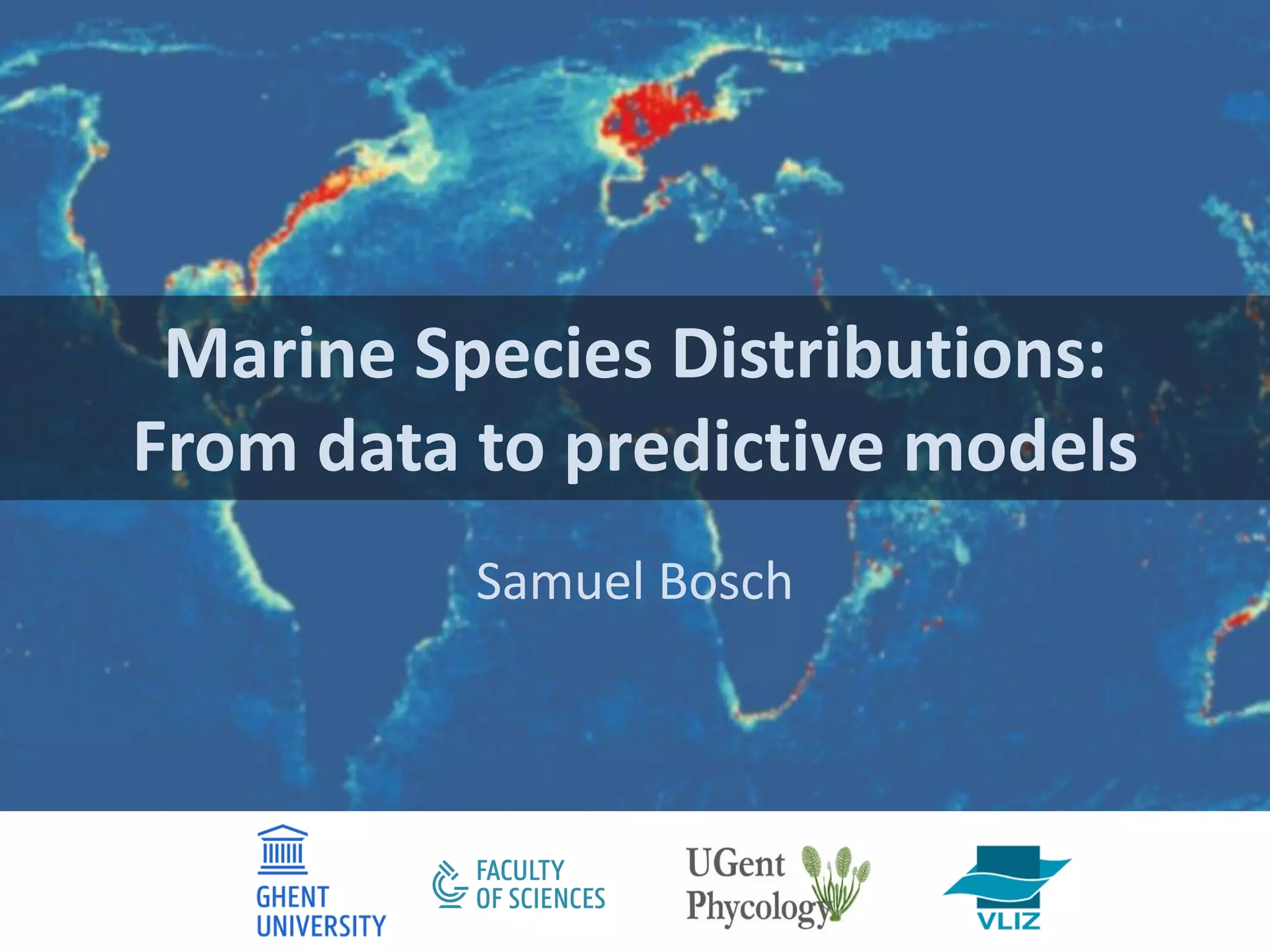
Marine Species Distributions:
From data to predictive models
Samuel Bosch
Topics
• Introduction
• Invasive seaweeds
• Marine species distribution modelling
• Some future perspectives
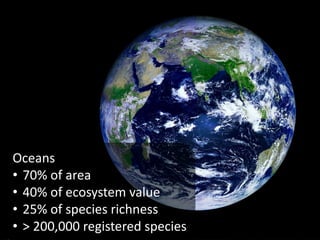
Oceans
• 70% of area
• 40% of ecosystem value
• 25% of species richness
• > 200,000 registered species
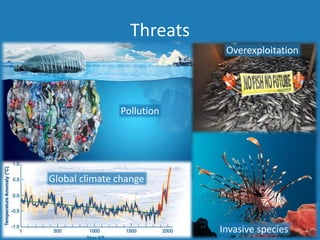
Threats
Pollution
Overexploitation
Invasive species
Global climate change
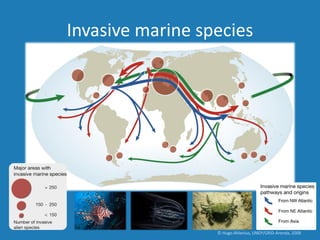
© Hugo Ahlenius, UNEP/GRID-Arenda, 2008
Invasive marine species
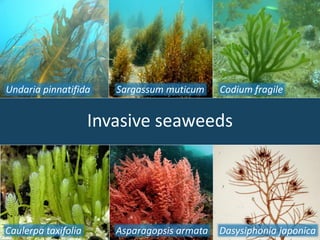
Invasive seaweeds
Undaria pinnatifida Sargassum muticum Codium fragile
Caulerpa taxifolia Asparagopsis armata Dasysiphonia japonica
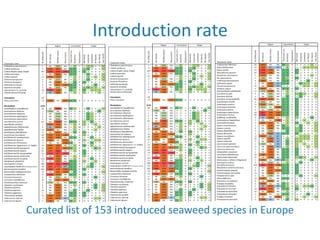
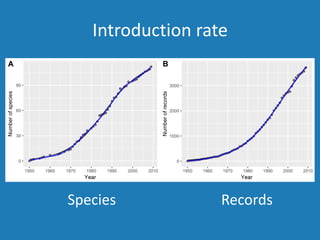
Introduction rate
Curated list of 153 introduced seaweed species in Europe
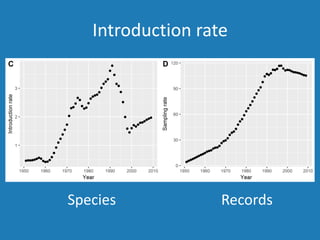
Introduction rate
Species Records
Introduction rate
Species Records
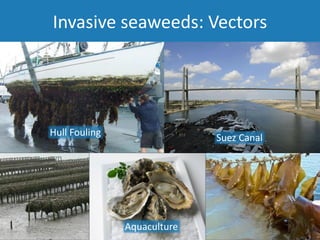
Invasive seaweeds: Vectors
Hull Fouling
Aquaculture
Suez Canal
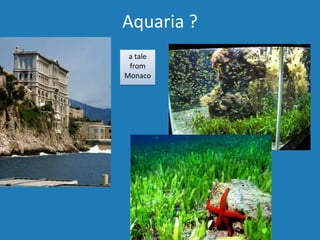
a tale
from
Monaco
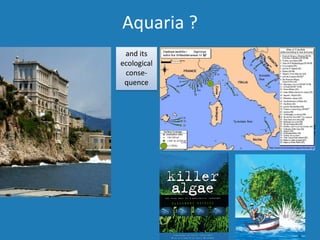
Aquaria ?
and its
ecological
conse-
quence
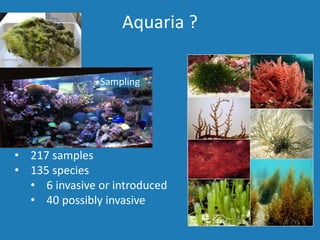
Aquaria ?
Aquaria ?
Sampling
• 217 samples
• 135 species
• 6 invasive or introduced
• 40 possibly invasive
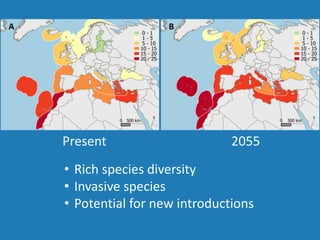
Present 2055
• Rich species diversity
• Invasive species
• Potential for new introductions
More …
• Chapter 5
Bosch, S., De Clerck, O. and Frédéric Mineur, F.
Spatio-temporal patterns of introduced seaweeds in
European waters, a critical review.
• Chapter 6
Vranken, S., Bosch, S., Peña, V., Leliaert, F., Mineur,
F. and De Clerck, O. A risk assessment of aquarium
trade introductions of seaweed in European waters.
Marine species distribution modelling
Image credit: Université de Lausanne
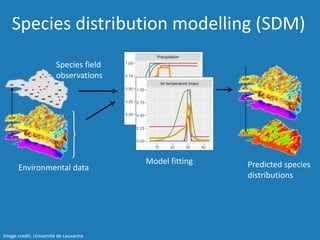
Species distribution modelling (SDM)
Species field
observations
Environmental data
Model fitting Predicted species
distributions
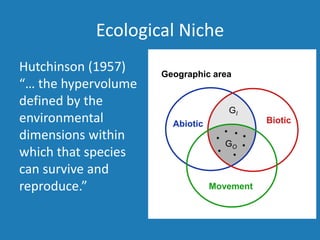
Ecological Niche
Hutchinson (1957)
“… the hypervolume
defined by the
environmental
dimensions within
which that species
can survive and
reproduce.”
Abiotic
Movement
Biotic
GO
GI
Geographic area
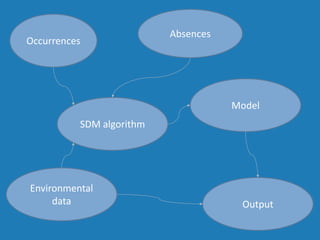
Environmental
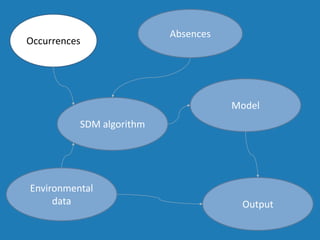
data
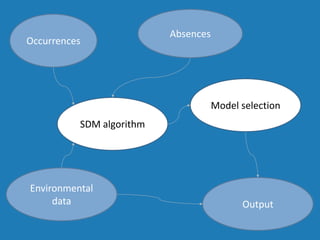
Occurrences
SDM algorithm
Model
Absences
Output
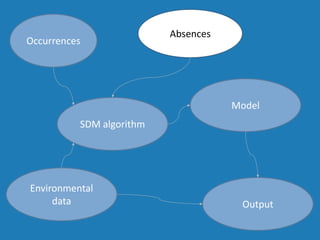
Environmental
data
Occurrences
SDM algorithm
Model
Absences
Output
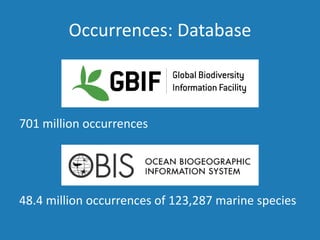
Occurrences: Database
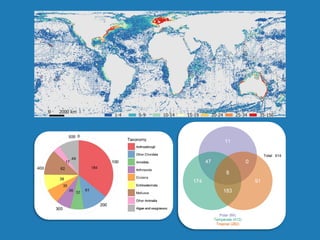
701 million occurrences
48.4 million occurrences of 123,287 marine species
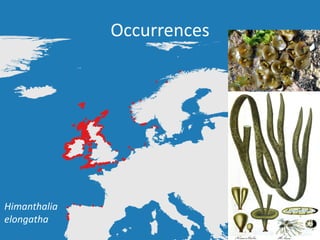
Occurrences
But:
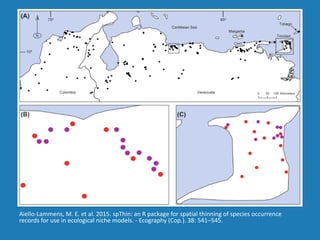
• Spatially uneven sampling and reporting
Occurrences
Himanthalia
elongatha
Aiello-Lammens, M. E. et al. 2015. spThin: an R package for spatial thinning of species occurrence
records for use in ecological niche models. - Ecography (Cop.). 38: 541–545.
Occurrences
But:
• Spatially uneven sampling and reporting
• Errors
– Taxonomic
• Misidentifications
• [cryptic] species complexes
– Geographic
• Typo’s, 0,0, generated coordinates, ….
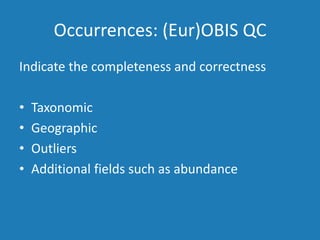
Occurrences: (Eur)OBIS QC
Indicate the completeness and correctness
• Taxonomic
• Geographic
• Outliers
• Additional fields such as abundance
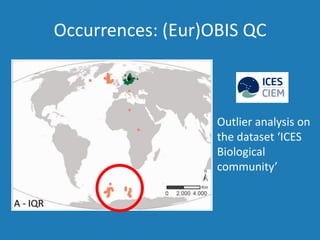
Occurrences: (Eur)OBIS QC
Outlier analysis on
the dataset ‘ICES
Biological
community’
Environmental
data
Occurrences
SDM algorithm
Model
Absences
Output
Absences
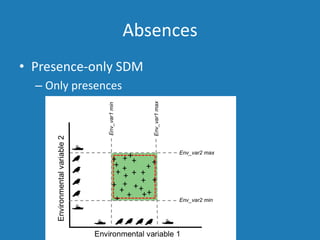
• Presence-only SDM
– Only presences
Absences
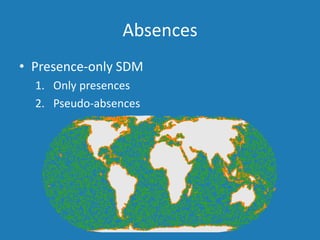
• Presence-only SDM
1. Only presences
2. Pseudo-absences
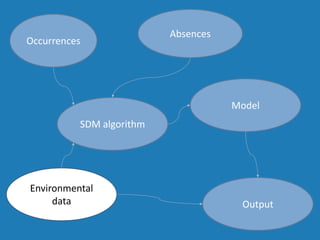
Environmental
data
Occurrences
SDM algorithm
Model
Absences
Output
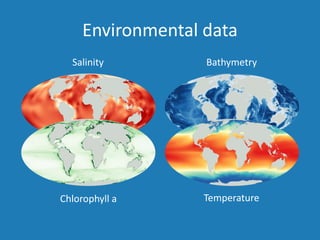
Environmental data
Salinity Bathymetry
TemperatureChlorophyll a
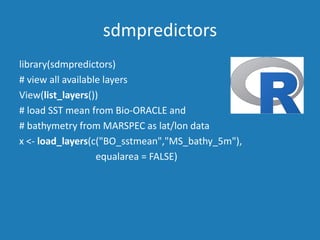
sdmpredictors
library(sdmpredictors)
# view all available layers
View(list_layers())
# load SST mean from Bio-ORACLE and
# bathymetry from MARSPEC as lat/lon data
x <- load_layers(c("BO_sstmean","MS_bathy_5m"),
equalarea = FALSE)
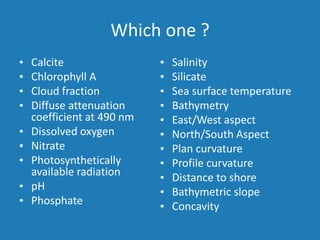
Which one ?
• Calcite
• Chlorophyll A
• Cloud fraction
• Diffuse attenuation
coefficient at 490 nm
• Dissolved oxygen
• Nitrate
• Photosynthetically
available radiation
• pH
• Phosphate
• Salinity
• Silicate
• Sea surface temperature
• Bathymetry
• East/West aspect
• North/South Aspect
• Plan curvature
• Profile curvature
• Distance to shore
• Bathymetric slope
• Concavity
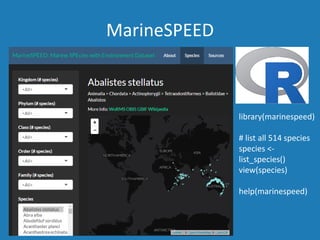
library(marinespeed)
# list all 514 species
species <-
list_species()
view(species)
help(marinespeed)
MarineSPEED
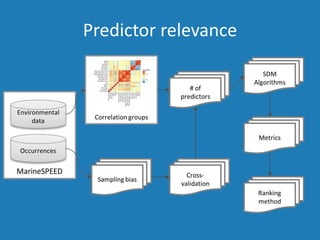
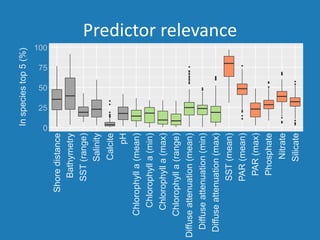
Predictor relevance
Predictor relevance
0
25
50
75
100
Shoredistance
Bathymetry
SST(range)
Salinity
Calcite
pH
Chlorophylla(mean)
Chlorophylla(min)
Chlorophylla(max)
Chlorophylla(range)
Diffuseattenuation(mean)
Diffuseattenuation(min)
Diffuseattenuation(max)
SST(mean)
PAR(mean)
PAR(max)
Phosphate
Nitrate
Silicate
Inspeciestop5(%)
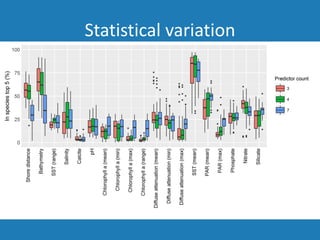
Statistical variation
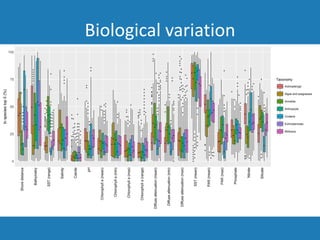
Biological variation
Environmental
data
Occurrences
SDM algorithm
Model selection
Absences
Output
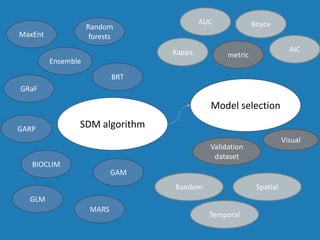
SDM algorithm
Model selection
metric
Validation
dataset
Random Spatial
AUC Boyce
Kappa AIC
MaxEnt
Random
forests
GRaF
GLM
GAM
GARP
Visual
BIOCLIM
Ensemble
BRT
MARS
Temporal
Environmental
data
Occurrences
SDM algorithm
Model
Absences
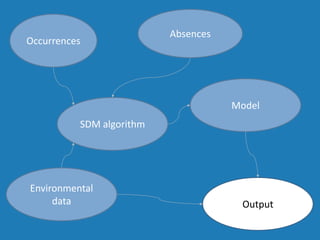
Output
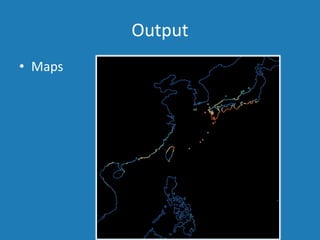
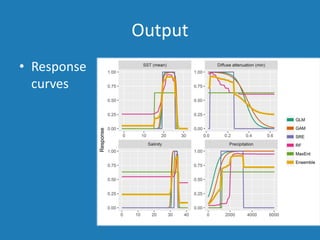
Output
• Maps
Output
• Response
curves
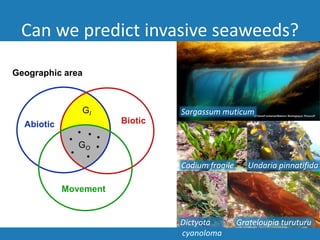
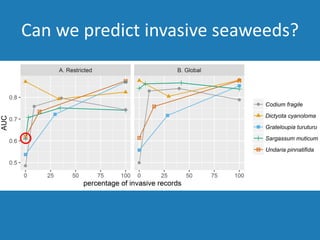
Can we predict invasive seaweeds?
Abiotic
Movement
Biotic
GO
GI
Geographic area
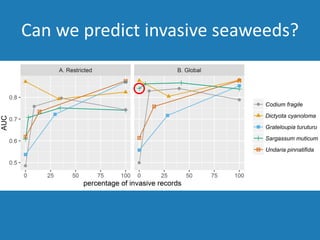
Sargassum muticum
Codium fragile
Dictyota
cyanoloma
Grateloupia turuturu
Undaria pinnatifida
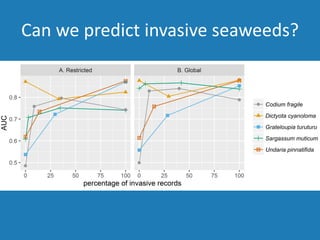
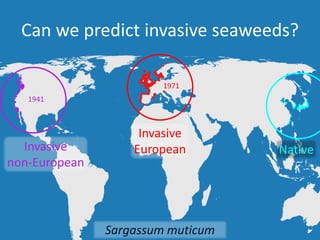
Can we predict invasive seaweeds?
Native
Invasive
EuropeanInvasive
non-European
1971
1941
Sargassum muticum
Can we predict invasive seaweeds?
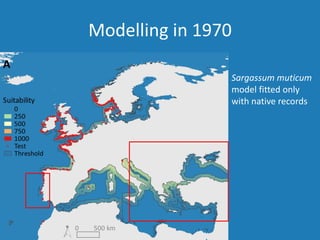
Modelling in 1970
Sargassum muticum
model fitted only
with native records
Can we predict invasive seaweeds?
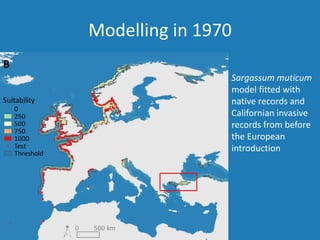
Modelling in 1970
Sargassum muticum
model fitted with
native records and
Californian invasive
records from before
the European
introduction
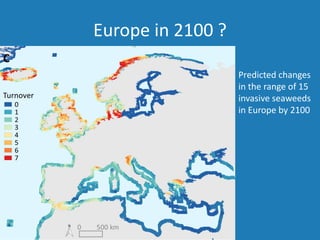
Europe in 2100 ?
Predicted changes
in the range of 15
invasive seaweeds
in Europe by 2100
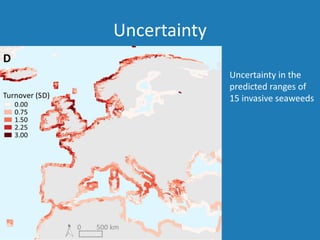
Uncertainty
Uncertainty in the
predicted ranges of
15 invasive seaweeds
More …
• Chapter 2
Vandepitte, L. et al. 2015. Fishing for data and sorting the catch:
assessing the data quality, completeness and fitness for use of data in
marine biogeographic databases. - Database
• Chapter 3
Bosch, S., Tyberghein, L., De Clerck, O. sdmpredictors: an R package for
species distribution modelling predictor datasets
• Chapter 4
Bosch, S., Tyberghein, L., Deneudt, K., Hernandez, F., De Clerck, O. In
search of relevant predictors for marine species distribution modelling
using the MarineSPEED benchmark dataset
• Chapter 7
Bosch, S., Gomez Giron, E., Martínez, B., De Clerck, O. Modelling the past,
present and future distribution of invasive seaweeds in Europe
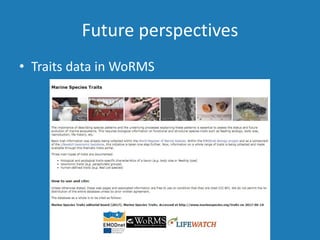
Future perspectives
Future perspectives
• Traits data in WoRMS
Future perspectives
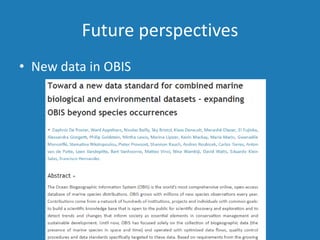
• New data in OBIS
Future perspectives
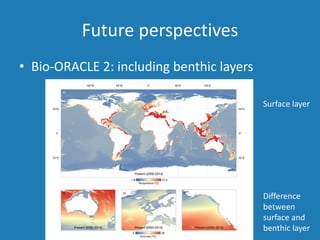
• Bio-ORACLE 2: including benthic layers
Surface layer
Difference
between
surface and
benthic layer
Future perspectives
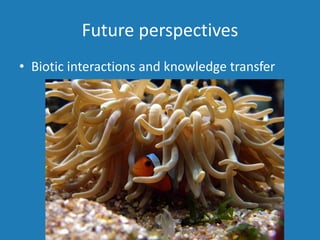
• Biotic interactions and knowledge transfer
Future perspectives
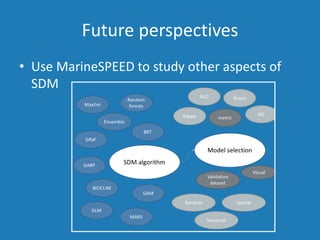
• Use MarineSPEED to study other aspects of
SDM
Acknowledgement
The Great Wave off Kanagawa
“All models are wrong,
but some are useful”
– George Box

Marine Species Distributions: From Data to Predictive Models