

EVIDENCIAS A FAVOR DE LA
LECHE MATERNA
Edwin Villacorta Vigo
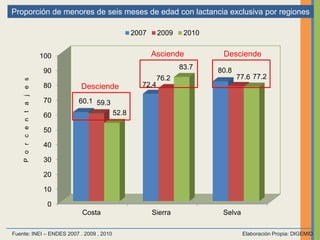
Proporción de menores de seis meses de edad con lactancia exclusiva por regiones
Fuente: INEI – ENDES 2007 . 2009 , 2010 Elaboración Propia: DIGEMID
0
10
20
30
40
50
60
70
80
90
100
Costa Sierra Selva
60.1
72.4
80.8
59.3
76.2 77.6
52.8
83.7
77.2
2007 2009 2010
Porcentajes
Desciende
Asciende Desciende
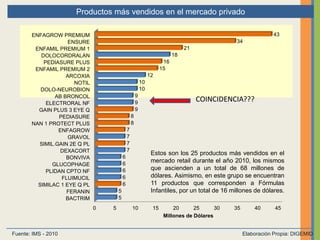
Productos más vendidos en el mercado privado
Fuente: IMS - 2010 Elaboración Propia: DIGEMID
0 5 10 15 20 25 30 35 40 45
BACTRIM
FERANIN
SIMILAC 1 EYE Q PL
FLUIMUCIL
PLIDAN CPTO NF
GLUCOPHAGE
BONVIVA
DEXACORT
SIMIL.GAIN 2E Q PL
GRAVOL
ENFAGROW
NAN 1 PROTECT PLUS
PEDIASURE
GAIN PLUS 3 EYE Q
ELECTRORAL NF
AB BRONCOL
DOLO-NEUROBION
NOTIL
ARCOXIA
ENFAMIL PREMIUM 2
PEDIASURE PLUS
DOLOCORDRALAN
ENFAMIL PREMIUM 1
ENSURE
ENFAGROW PREMIUM
5
5
6
6
6
6
6
7
7
7
7
8
8
9
9
9
10
10
12
15
16
18
21
34
43
Millones de Dólares
Estos son los 25 productos más vendidos en el
mercado retail durante el año 2010, los mismos
que ascienden a un total de 68 millones de
dólares. Asimismo, en este grupo se encuentran
11 productos que corresponden a Fórmulas
Infantiles, por un total de 16 millones de dólares.
COINCIDENCIA???
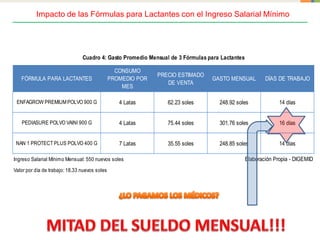
Impacto de las Fórmulas para Lactantes con el Ingreso Salarial Mínimo
FÓRMULA PARA LACTANTES
CONSUMO
PROMEDIO POR
MES
PRECIO ESTIMADO
DE VENTA
GASTO MENSUAL DÍAS DE TRABAJO
ENFAGROW PREMIUMPOLVO 900 G 4 Latas 62.23 soles 248.92 soles 14 días
PEDIASURE POLVO VAINI 900 G 4 Latas 75.44 soles 301.76 soles 16 días
NAN 1 PROTECT PLUS POLVO 400 G 7 Latas 35.55 soles 248.85 soles 14 días
Ingreso Salarial Mínimo Mensual: 550 nuevos soles Elaboración Propia - DIGEMID
Valor por día de trabajo: 18.33 nuevos soles
Cuadro 4: Gasto Promedio Mensual de 3 Fórmulas para Lactantes
POR QUE ES MEJOR
LA LECHE MATERNA…?
Álbum de fotos moderno
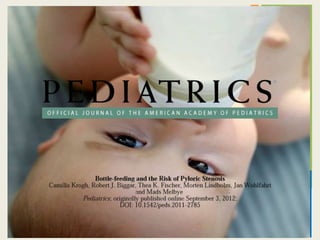
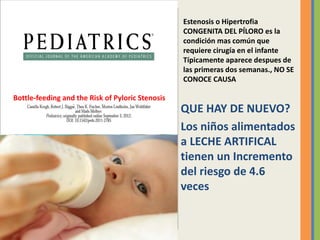
Bottle-feeding and the Risk of Pyloric Stenosis
QUE HAY DE NUEVO?
Los niños alimentados
a LECHE ARTIFICAL
tienen un Incremento
del riesgo de 4.6
veces
Estenosis o Hipertrofia
CONGENITA DEL PÍLORO es la
condición mas común que
requiere cirugía en el infante
Típicamente aparece despues de
las primeras dos semanas., NO SE
CONOCE CAUSA
Bottle-feeding and the Risk of Pyloric Stenosis
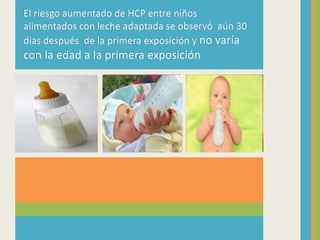
El riesgo aumentado de HCP entre niños
alimentados con leche adaptada se observó aún 30
dias después de la primera exposición y no varía
con la edad a la primera exposición
El riesgo aumentado de HCP entre niños
alimentados con leche adaptada se observó aún 30
dias después de la primera exposición y no varía
con la edad a la primera exposición
CMAJ. 1989 February 15; 140(4): 401–404. PMCID: PMC1268663
Infantile hypertrophic pyloric stenosis: a study of
feeding practices and other possible causes.
B F Habbick, C Khanna
We found that bottle-feeding was 2.9 times
more prevalent among the infants with
IHPS than among the control subjects. We
speculate that the recently observed
decrease in the incidence of IHPS is due to
the decline in bottle-feeding.
An international peer-reviewed journal for health professionals and researchers covering conception to adolescence
The epidemiology of infantile hypertrophic
pyloric stenosis in Sweden 1987–96
G Hedbäcka, K Abrahamssona, B Husbergb, T Granholmb, A Odénc
Abstract
AIMS To find out whether the incidence of infantile hypertrophic pyloric
stenosis (IHPS) has changed over the past decade, and if so, to investigate
possible contributory factors.
RESULTS There was a substantial decline from 2.7/1000 to 0.85/1000 over the
time period. The incidence in the south was almost three times greater than in
the north.
CONCLUSION The declining incidence and geographical difference suggest that
environmental factors are of importance in this disorder.
Arch Dis Child 2001;85:379-381 doi:10.1136/adc.85.5.379
Journal of
Tropical Pediatrics
J Trop Pediatr (2009) 55 (2): 132-134. doi: 10.1093/tropej/fmn094
Does Exclusive Breastfeeding Confer Protection
Against Infantile Hypertrophic Pyloric Stenosis?
A 30-year Experience in Benin City, Nigeria
David Osarumwese Osifo and Iyekoretin Evbuomwan
The incidence of infantile hypertrophic pyloric stenosis has steadily decreased in
developing countries, and this study was designed to confirm this and establish
any protection conferred by exclusive breastfeeding. Following the introduction
of exclusive breastfeeding in late 1980s and early 1990s in Nigeria, a steady drop
in incidence was noticed, with only five cases seen in the last decade and just
one case seen in the past 5 years. All were babies who had artificial feeds, with
none recorded among babies exclusively breastfed. This decrease in the
incidence of infantile hypertrophic pyloric stenosis may have been due to
exclusive breastfeeding.
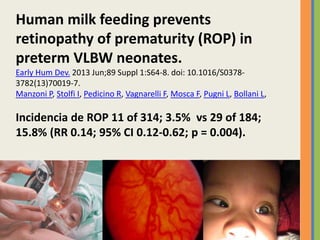
Human milk feeding prevents
retinopathy of prematurity (ROP) in
preterm VLBW neonates.
Early Hum Dev. 2013 Jun;89 Suppl 1:S64-8. doi: 10.1016/S0378-
3782(13)70019-7.
Manzoni P, Stolfi I, Pedicino R, Vagnarelli F, Mosca F, Pugni L, Bollani L,
Incidencia de ROP 11 of 314; 3.5% vs 29 of 184;
15.8% (RR 0.14; 95% CI 0.12-0.62; p = 0.004).
Coppa GV, Zampini L, Galeazzi T, Gabrielli O.
Prebiotics in human milk: a review.
Dig Liver Dis. 2006;38(suppl 2):S291–S294
LA COLONIZACION MICROBIANA SE INICIA AL NACER
LM: bifidobacterias y lactobacilos
L.ARTIFICIAL Flora mixta con escasas bifidobacterias.
LA LECHE MATERNA tiene un “efecto bifidogénico"
debido a la baja concentración de proteónas y fosfatos, a la
presencia de lactoferrina, lactosa, nucleótidos y
oligosacaridos
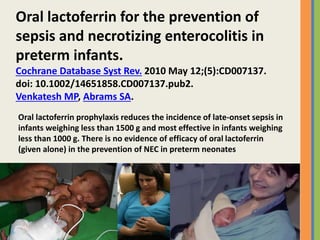
Oral lactoferrin for the prevention of
sepsis and necrotizing enterocolitis in
preterm infants.
Cochrane Database Syst Rev. 2010 May 12;(5):CD007137.
doi: 10.1002/14651858.CD007137.pub2.
Venkatesh MP, Abrams SA.
Oral lactoferrin prophylaxis reduces the incidence of late-onset sepsis in
infants weighing less than 1500 g and most effective in infants weighing
less than 1000 g. There is no evidence of efficacy of oral lactoferrin
(given alone) in the prevention of NEC in preterm neonates
DHA – ARA - LCPUFA
Long-chain polyunsaturated fatty acids (LCPUFA) notably
docosahexaenoeic acid (DHA) and arachidonic acid (ARA) are
important for the optimum growth and development of the
infant
DHA and ARA levels in breast-milk are thought to be
influenced both by direct nutritional intake, and by the
genetic variation of the FA desaturase enzymes.
Breast milk DHA levels in Sri Lankan mothers vary
significantly in three locations that have different access to
dietary fish.
Ceylon Med J. 2013 Jun;58(2):51-5. doi: 10.4038/cmj.v58i2.5679.
Lee PS, Wickramasinghe VP y col
Brazil its rate has increased from around
15% in the 1970’s to 50% in 2011 [3], reaching 77% in
some private clinics [4].
This trend is reflected in many
parts of the world. In China, the most populous country
in the world, CS rates are approaching 50% [5].
Recent data have revealed that the gut microbiota can be
considered to be an environmental factor that modulates
obesity and other metabolic diseases [17].
Other mechanism could also be hypothesized. CS has
also been associated with alteration of newborn hormonal
milieu, characterized by, for example, lower concentrations
of plasma leptin and ghrelin in human newborns and other
orexigenic peptides in animal models, which are related to
post partum appetite control and have been reported to be
associated with an increased risk for later obesity [23,30,36].
In 2004/2005, at reassessment of the two birth cohorts
studied, the obesity rate was 13.0% in RP, whereas in SL
it was 2.1%. The CS rate was 54.5% in RP and 30.8% in
SL. The prevalence of obesity in RP was significantly
higher in children delivered by CS compared with those
born by vaginal delivery (15.7% vs 9.8%, P = 0.022).
In SL, despite obesity not being significantly associated with
type of delivery (p = 0.091), the obesity rate in children
born by CS was more than twofold higher than among
those born by vaginal delivery (3.5% and 1.4% respectively).
Protection is provided by components including
regulatory cytokines and growth factors. In addition,
breast milk contains several other factors such as
lysozyme, lactoferrin, and oligosaccharides, which assist
in preventing infections and supporting the growth of
beneficial bacteria
breast milk is also a continuous source of microbes,
their growth factors, and components that regulate
host-microbe
interactions. These factors emphasize the key position
of breastfeeding
in conferring protection during a critical period in life,
when breast milk is the sole source of nutrition for the
infant and
when the neonate’s own immune defenses, including
the integrity
of the gut barrier, are immature
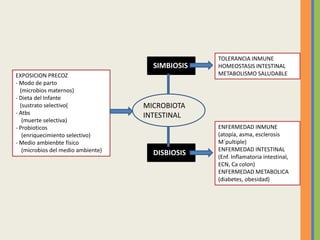
EXPOSICION PRECOZ
- Modo de parto
(microbios maternos)
- Dieta del Infante
(sustrato selectivo(
- Atbs
(muerte selectiva)
- Probioticos
(enriquecimiento selectivo)
- Medio ambienbte físico
(microbios del medio ambiente)
MICROBIOTA
INTESTINAL
DISBIOSIS
TOLERANCIA INMUNE
HOMEOSTASIS INTESTINAL
METABOLISMO SALUDABLE
ENFERMEDAD INMUNE
(atopía, asma, esclerosis
M´pultiple)
ENFERMEDAD INTESTINAL
(Enf. Inflamatoria intestinal,
ECN, Ca colon)
ENFERMEDAD METABOLICA
(diabetes, obesidad)
SIMBIOSIS
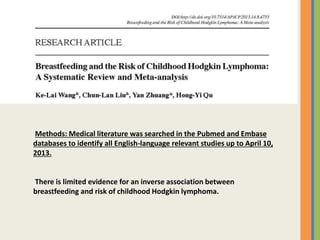
Methods: Medical literature was searched in the Pubmed and Embase
databases to identify all English-language relevant studies up to April 10,
2013.
There is limited evidence for an inverse association between
breastfeeding and risk of childhood Hodgkin lymphoma.
The anticancer mechanism of breastfeeding remained unclear, which may
be a direct effect of human milk on malignances or an indirect effect of
reducing early childhood infections (Section on Breastfeeding, 2012). A
complex biological liquid containing numerous immunoactive agents might
play an important role in the anticancer activity of human breast milk.
High levels of human soluble TNF-related apoptosis-inducing ligand were
found in human colostrum and breast milk, which is an immunoactive
substance that plays a key role in controlling apoptosis and cell
proliferation in various organs and tissues (Davanzo et al., 2013). Human
alpha-lactalbumin made lethal to tumor cells, which is a substance with
anticancer activity in human milk, has been reported (Mossberg et al.,
2010).
The benefits of breastfeeding for children are
well-known. Indeed, breastfeeding affects
cancer, obesity, diabetes mellitus, and
cardiovascular disease, in addition to reducing
episodes of diarrhea, decreasing the
incidence of infections (enteric, otitis media,
and respiratory infections) and eczema (Oddy
et al., 2003; Paramasivam et al., 2006; Das,
2007; Ip et al., 2007; Hosea Blewett et al.,
2008; Monterrosa et al., 2008; Rosenbauer et
al., 2008; Ladomenou et al., 2010).
Increased bone mineral density is associated with
breastfeeding history in premenopausal Spanish
women
Maria Luz Canal-Macias, Raul Roncero-Martin, Jose Maria Moran, Jesus
Maria Lavado-Garcia, Maria del Carmen Costa-Fernandez, Juan Diego
Pedrera-Zamorano
Arch Med Sci 2013; 9, 4: 703–708
Four hundred and thirty-three premenopausal healthy
women, 295 with a mean of 7.82 ±6.68 months of exclusive breastfeeding
and 138 control women, were studied. This study adds to the growing
evidence that breastfeeding has no deleterious effects and may confer an
additional advantage for BMD in premenopausal women.
Breastfeeding may protect against
persistent stuttering.
J Commun Disord. 2013 Jun 24. pii: S0021-9924(13)00034-8. doi:
10.1016/j.jcomdis.2013.06.001. [Epub ahead of print]
Mahurin-Smith J, Ambrose NG.
El perfil de ácidos grasos de la leche humana con su
POTENCIAL PARA AFECTAR LA EXPRESIÓN GENÉTICA Y LA
COMPOSICIÓN DEL TEJIDO NEURAL PODRÍA EXPLICAR ESTA
ASOCIACIÓN
Lactancia materna y protección de la
obesidad infantil
La Lactancia materna protege contra la obesidad
infantil(Canadá)*
Un estudio sistemático y metaanálisis deestudios
epidemiológicos (cohortes,casos-
controles,estudiostransversales)
* KramerMS. J Pediatr1981; 98: 883 –7
** ArenzS et al. InternJ Obes2004; 28: 1247 –56
ENTONCES
¿Que prefieres,
Al IMITADOR?
O AL ORIGINAL?
IMITADOR
ORIGINAL
IMITADOR
ORIGINAL
IMITADOR
YO PREFIERO EL ORIGINALYO PREFIERO EL ORIGINAL
Porque mamá trabaja y nos
alimenta con leche materna!
Porque mamá trabaja y nos
alimenta con leche materna!
Lactancia 2014

Lactancia 2014

  • 1.
    EVIDENCIAS A FAVORDE LA LECHE MATERNA Edwin Villacorta Vigo
  • 2.
    Proporción de menoresde seis meses de edad con lactancia exclusiva por regiones Fuente: INEI – ENDES 2007 . 2009 , 2010 Elaboración Propia: DIGEMID 0 10 20 30 40 50 60 70 80 90 100 Costa Sierra Selva 60.1 72.4 80.8 59.3 76.2 77.6 52.8 83.7 77.2 2007 2009 2010 Porcentajes Desciende Asciende Desciende
  • 3.
    Productos más vendidosen el mercado privado Fuente: IMS - 2010 Elaboración Propia: DIGEMID 0 5 10 15 20 25 30 35 40 45 BACTRIM FERANIN SIMILAC 1 EYE Q PL FLUIMUCIL PLIDAN CPTO NF GLUCOPHAGE BONVIVA DEXACORT SIMIL.GAIN 2E Q PL GRAVOL ENFAGROW NAN 1 PROTECT PLUS PEDIASURE GAIN PLUS 3 EYE Q ELECTRORAL NF AB BRONCOL DOLO-NEUROBION NOTIL ARCOXIA ENFAMIL PREMIUM 2 PEDIASURE PLUS DOLOCORDRALAN ENFAMIL PREMIUM 1 ENSURE ENFAGROW PREMIUM 5 5 6 6 6 6 6 7 7 7 7 8 8 9 9 9 10 10 12 15 16 18 21 34 43 Millones de Dólares Estos son los 25 productos más vendidos en el mercado retail durante el año 2010, los mismos que ascienden a un total de 68 millones de dólares. Asimismo, en este grupo se encuentran 11 productos que corresponden a Fórmulas Infantiles, por un total de 16 millones de dólares. COINCIDENCIA???
  • 4.
    Impacto de lasFórmulas para Lactantes con el Ingreso Salarial Mínimo FÓRMULA PARA LACTANTES CONSUMO PROMEDIO POR MES PRECIO ESTIMADO DE VENTA GASTO MENSUAL DÍAS DE TRABAJO ENFAGROW PREMIUMPOLVO 900 G 4 Latas 62.23 soles 248.92 soles 14 días PEDIASURE POLVO VAINI 900 G 4 Latas 75.44 soles 301.76 soles 16 días NAN 1 PROTECT PLUS POLVO 400 G 7 Latas 35.55 soles 248.85 soles 14 días Ingreso Salarial Mínimo Mensual: 550 nuevos soles Elaboración Propia - DIGEMID Valor por día de trabajo: 18.33 nuevos soles Cuadro 4: Gasto Promedio Mensual de 3 Fórmulas para Lactantes
  • 5.
    POR QUE ESMEJOR LA LECHE MATERNA…?
  • 6.
  • 7.
    Bottle-feeding and theRisk of Pyloric Stenosis
  • 8.
    QUE HAY DENUEVO? Los niños alimentados a LECHE ARTIFICAL tienen un Incremento del riesgo de 4.6 veces Estenosis o Hipertrofia CONGENITA DEL PÍLORO es la condición mas común que requiere cirugía en el infante Típicamente aparece despues de las primeras dos semanas., NO SE CONOCE CAUSA Bottle-feeding and the Risk of Pyloric Stenosis
  • 9.
    El riesgo aumentadode HCP entre niños alimentados con leche adaptada se observó aún 30 dias después de la primera exposición y no varía con la edad a la primera exposición El riesgo aumentado de HCP entre niños alimentados con leche adaptada se observó aún 30 dias después de la primera exposición y no varía con la edad a la primera exposición
  • 10.
    CMAJ. 1989 February15; 140(4): 401–404. PMCID: PMC1268663 Infantile hypertrophic pyloric stenosis: a study of feeding practices and other possible causes. B F Habbick, C Khanna We found that bottle-feeding was 2.9 times more prevalent among the infants with IHPS than among the control subjects. We speculate that the recently observed decrease in the incidence of IHPS is due to the decline in bottle-feeding.
  • 11.
    An international peer-reviewedjournal for health professionals and researchers covering conception to adolescence The epidemiology of infantile hypertrophic pyloric stenosis in Sweden 1987–96 G Hedbäcka, K Abrahamssona, B Husbergb, T Granholmb, A Odénc Abstract AIMS To find out whether the incidence of infantile hypertrophic pyloric stenosis (IHPS) has changed over the past decade, and if so, to investigate possible contributory factors. RESULTS There was a substantial decline from 2.7/1000 to 0.85/1000 over the time period. The incidence in the south was almost three times greater than in the north. CONCLUSION The declining incidence and geographical difference suggest that environmental factors are of importance in this disorder. Arch Dis Child 2001;85:379-381 doi:10.1136/adc.85.5.379
  • 12.
    Journal of Tropical Pediatrics JTrop Pediatr (2009) 55 (2): 132-134. doi: 10.1093/tropej/fmn094 Does Exclusive Breastfeeding Confer Protection Against Infantile Hypertrophic Pyloric Stenosis? A 30-year Experience in Benin City, Nigeria David Osarumwese Osifo and Iyekoretin Evbuomwan The incidence of infantile hypertrophic pyloric stenosis has steadily decreased in developing countries, and this study was designed to confirm this and establish any protection conferred by exclusive breastfeeding. Following the introduction of exclusive breastfeeding in late 1980s and early 1990s in Nigeria, a steady drop in incidence was noticed, with only five cases seen in the last decade and just one case seen in the past 5 years. All were babies who had artificial feeds, with none recorded among babies exclusively breastfed. This decrease in the incidence of infantile hypertrophic pyloric stenosis may have been due to exclusive breastfeeding.
  • 13.
    Human milk feedingprevents retinopathy of prematurity (ROP) in preterm VLBW neonates. Early Hum Dev. 2013 Jun;89 Suppl 1:S64-8. doi: 10.1016/S0378- 3782(13)70019-7. Manzoni P, Stolfi I, Pedicino R, Vagnarelli F, Mosca F, Pugni L, Bollani L, Incidencia de ROP 11 of 314; 3.5% vs 29 of 184; 15.8% (RR 0.14; 95% CI 0.12-0.62; p = 0.004).
  • 15.
    Coppa GV, ZampiniL, Galeazzi T, Gabrielli O. Prebiotics in human milk: a review. Dig Liver Dis. 2006;38(suppl 2):S291–S294 LA COLONIZACION MICROBIANA SE INICIA AL NACER LM: bifidobacterias y lactobacilos L.ARTIFICIAL Flora mixta con escasas bifidobacterias. LA LECHE MATERNA tiene un “efecto bifidogénico" debido a la baja concentración de proteónas y fosfatos, a la presencia de lactoferrina, lactosa, nucleótidos y oligosacaridos
  • 16.
    Oral lactoferrin forthe prevention of sepsis and necrotizing enterocolitis in preterm infants. Cochrane Database Syst Rev. 2010 May 12;(5):CD007137. doi: 10.1002/14651858.CD007137.pub2. Venkatesh MP, Abrams SA. Oral lactoferrin prophylaxis reduces the incidence of late-onset sepsis in infants weighing less than 1500 g and most effective in infants weighing less than 1000 g. There is no evidence of efficacy of oral lactoferrin (given alone) in the prevention of NEC in preterm neonates
  • 18.
    DHA – ARA- LCPUFA Long-chain polyunsaturated fatty acids (LCPUFA) notably docosahexaenoeic acid (DHA) and arachidonic acid (ARA) are important for the optimum growth and development of the infant DHA and ARA levels in breast-milk are thought to be influenced both by direct nutritional intake, and by the genetic variation of the FA desaturase enzymes.
  • 19.
    Breast milk DHAlevels in Sri Lankan mothers vary significantly in three locations that have different access to dietary fish. Ceylon Med J. 2013 Jun;58(2):51-5. doi: 10.4038/cmj.v58i2.5679. Lee PS, Wickramasinghe VP y col
  • 21.
    Brazil its ratehas increased from around 15% in the 1970’s to 50% in 2011 [3], reaching 77% in some private clinics [4]. This trend is reflected in many parts of the world. In China, the most populous country in the world, CS rates are approaching 50% [5].
  • 22.
    Recent data haverevealed that the gut microbiota can be considered to be an environmental factor that modulates obesity and other metabolic diseases [17]. Other mechanism could also be hypothesized. CS has also been associated with alteration of newborn hormonal milieu, characterized by, for example, lower concentrations of plasma leptin and ghrelin in human newborns and other orexigenic peptides in animal models, which are related to post partum appetite control and have been reported to be associated with an increased risk for later obesity [23,30,36].
  • 23.
    In 2004/2005, atreassessment of the two birth cohorts studied, the obesity rate was 13.0% in RP, whereas in SL it was 2.1%. The CS rate was 54.5% in RP and 30.8% in SL. The prevalence of obesity in RP was significantly higher in children delivered by CS compared with those born by vaginal delivery (15.7% vs 9.8%, P = 0.022).
  • 24.
    In SL, despiteobesity not being significantly associated with type of delivery (p = 0.091), the obesity rate in children born by CS was more than twofold higher than among those born by vaginal delivery (3.5% and 1.4% respectively).
  • 25.
    Protection is providedby components including regulatory cytokines and growth factors. In addition, breast milk contains several other factors such as lysozyme, lactoferrin, and oligosaccharides, which assist in preventing infections and supporting the growth of beneficial bacteria
  • 26.
    breast milk isalso a continuous source of microbes, their growth factors, and components that regulate host-microbe interactions. These factors emphasize the key position of breastfeeding in conferring protection during a critical period in life, when breast milk is the sole source of nutrition for the infant and when the neonate’s own immune defenses, including the integrity of the gut barrier, are immature
  • 28.
    EXPOSICION PRECOZ - Modode parto (microbios maternos) - Dieta del Infante (sustrato selectivo( - Atbs (muerte selectiva) - Probioticos (enriquecimiento selectivo) - Medio ambienbte físico (microbios del medio ambiente) MICROBIOTA INTESTINAL DISBIOSIS TOLERANCIA INMUNE HOMEOSTASIS INTESTINAL METABOLISMO SALUDABLE ENFERMEDAD INMUNE (atopía, asma, esclerosis M´pultiple) ENFERMEDAD INTESTINAL (Enf. Inflamatoria intestinal, ECN, Ca colon) ENFERMEDAD METABOLICA (diabetes, obesidad) SIMBIOSIS
  • 29.
    Methods: Medical literaturewas searched in the Pubmed and Embase databases to identify all English-language relevant studies up to April 10, 2013. There is limited evidence for an inverse association between breastfeeding and risk of childhood Hodgkin lymphoma.
  • 30.
    The anticancer mechanismof breastfeeding remained unclear, which may be a direct effect of human milk on malignances or an indirect effect of reducing early childhood infections (Section on Breastfeeding, 2012). A complex biological liquid containing numerous immunoactive agents might play an important role in the anticancer activity of human breast milk. High levels of human soluble TNF-related apoptosis-inducing ligand were found in human colostrum and breast milk, which is an immunoactive substance that plays a key role in controlling apoptosis and cell proliferation in various organs and tissues (Davanzo et al., 2013). Human alpha-lactalbumin made lethal to tumor cells, which is a substance with anticancer activity in human milk, has been reported (Mossberg et al., 2010).
  • 31.
    The benefits ofbreastfeeding for children are well-known. Indeed, breastfeeding affects cancer, obesity, diabetes mellitus, and cardiovascular disease, in addition to reducing episodes of diarrhea, decreasing the incidence of infections (enteric, otitis media, and respiratory infections) and eczema (Oddy et al., 2003; Paramasivam et al., 2006; Das, 2007; Ip et al., 2007; Hosea Blewett et al., 2008; Monterrosa et al., 2008; Rosenbauer et al., 2008; Ladomenou et al., 2010).
  • 32.
    Increased bone mineraldensity is associated with breastfeeding history in premenopausal Spanish women Maria Luz Canal-Macias, Raul Roncero-Martin, Jose Maria Moran, Jesus Maria Lavado-Garcia, Maria del Carmen Costa-Fernandez, Juan Diego Pedrera-Zamorano Arch Med Sci 2013; 9, 4: 703–708 Four hundred and thirty-three premenopausal healthy women, 295 with a mean of 7.82 ±6.68 months of exclusive breastfeeding and 138 control women, were studied. This study adds to the growing evidence that breastfeeding has no deleterious effects and may confer an additional advantage for BMD in premenopausal women.
  • 33.
    Breastfeeding may protectagainst persistent stuttering. J Commun Disord. 2013 Jun 24. pii: S0021-9924(13)00034-8. doi: 10.1016/j.jcomdis.2013.06.001. [Epub ahead of print] Mahurin-Smith J, Ambrose NG. El perfil de ácidos grasos de la leche humana con su POTENCIAL PARA AFECTAR LA EXPRESIÓN GENÉTICA Y LA COMPOSICIÓN DEL TEJIDO NEURAL PODRÍA EXPLICAR ESTA ASOCIACIÓN
  • 34.
    Lactancia materna yprotección de la obesidad infantil La Lactancia materna protege contra la obesidad infantil(Canadá)* Un estudio sistemático y metaanálisis deestudios epidemiológicos (cohortes,casos- controles,estudiostransversales) * KramerMS. J Pediatr1981; 98: 883 –7 ** ArenzS et al. InternJ Obes2004; 28: 1247 –56
  • 35.
  • 36.
  • 37.
  • 38.
  • 39.
  • 40.
  • 41.
  • 42.
    YO PREFIERO ELORIGINALYO PREFIERO EL ORIGINAL
  • 44.
    Porque mamá trabajay nos alimenta con leche materna! Porque mamá trabaja y nos alimenta con leche materna!

Editor's Notes

  • #21 Cesarean section (CS) is increasing markedly worldwide. In the United States, the CS rate has increased by 48% since 1996, reaching a level of 31.8% in 2007 [1]. In Brazil, CS has been associated with high socioeconomic status (SES) [2] and its rate has increased from around 15% in the 1970’s to 50% in 2011 [3], reaching 77% in some private clinics [4]. This trend is reflected in many parts of the world. In China, the most populous country in the world, CS rates are approaching 50% [5]. Overweight and obesity rates are also increasing across the world.
  • #22 The development of obesity is a complex process involving genetic susceptibility and environmental factors, both of which remain only partially understood. In such instances, the gut microbiota is being increasingly recognized as an important factor connecting genes, environment, and the immune system [12-14].
  • #33 Many factors influence bone mineral density (BMD). One important determinant of BMD is calcium dynamics. Marked changes in calcium metabolism are reported during lactation, and abundant calcium is lost from the mother as a result of the amount of breast milk produced, diet and the duration of lactation- BMD declines (DENSIDAD OSEA MINERAL) 5–10% during lactation