CHAPTER 1
Union-Management Relationships in Perspective
Outline
Phases in the Labor Relations Process
The labor relations process includes the following three phases:
Recognition of the legitimate rights and responsibilities of
union and management representatives
Negotiation of the labor agreement, including appropriate
strategies, tactics, and impasse-resolution techniques
Administration of the negotiated labor agreement—applying and
enforcing the terms of the agreement on a daily basis
Characteristics of the labor relations process
The negotiation and administration of work rules vary
considerably across public- and private- sector organizations
Are cumulative with each phase depending on the previous
phase
Are subject to qualitative variations
Elements in the Labor Relations Process (Exhibit 1.1 indicates
these elements)
Focal point of labor relations: work rules (examples of rules are
given in Exhibit 1.2)
Pertain to compensation as well as employees' and employers'
job rights and obligations (e.g., "justice and dignity," clauses
and rules requiring employees to work overtime)
Vary according to their applicability to many occupations and
the extent to which they are specific
Reflect the dynamic nature of labor relations as work rule
existence and/or consent charges over time (The Acquired
Immune Deficiency Syndrome or AIDS, no smoking, and
electronic monitoring of employee performance, for example)
Key participants in the labor relations process
Management officials and consultants
Union officials
Employees who have dual loyalties to both the union and the
company
The government—National Labor Relations Board (NLRB),
laws
Third party neutrals: mediators and arbitrators
Three basic assumptions underlying U.S. labor relations
The adoption and support of a free enterprise (capitalist)
economic system in the United States creates an inherent
conflict of interest between employers (owners) and employees.
Both employees and employers seek to advance their own self-
interests
Employees in a free and democratic society have a right to
independently pursue their employment interests using lawful
means
Collective bargaining provides a process for meaningful
employee participation through independently chosen
representatives in the determination of work rules
Basic characteristics of the private-sector U.S. labor relations
system (Exhibit 1.3):
A bilateral process (union and management) governed by a
framework of labor laws
A highly decentralized and localized bargaining structure
Recognition of key legal principles of majority rule and
exclusive bargaining representation
Permits use of economic pressure (e.g., strike, lockout,
picketing, and boycott)
Encourages use of final and binding arbitration
Significant employer opposition to employee efforts to organize
and bargain collectively
Constraints or influences affecting participants' negotiation and
administration of work rules
State of the economy: national, international, and firm-specific
indicators. Impact of discouraged workers who have given up
looking for a job
Labor market (skills, wage levels, supply and demand)
Product or service market (where the company either sells its
products/services or purchases key elements for creating its
products/services)
Financial market
Technology (equipment, pace and scheduling of work,
characteristics of the work environment, tasks to be performed,
and information exchange)
International forces—employee reservists in Iraq, free-trade,
NAFTA, globalization
Public opinion (influential individuals/organizations within the
community and/or attitudes/traditions held by community
residents), negative union image, union support for social
causes
Union membership (Exhibit 1.4)
Steady decline in total membership
Lower union density (union as a proportion of total labor force)
Causes:
Structural changes in the labor force
Employment shift from manufacturing to service industries
Demographic shifts: female, older, diverse, part-time workforce
Organizational practices to avoid unionization
Economic and political climate: Employment laws reduce
demand for union
CHAPTER 2
The History of Labor–Management Relations
Outline
Historical perspective
Two interrelated dimensions:
Relationships between labor and management organizations
Organizational characteristics of labor organizations.
Criteria for comparing the effectiveness of a labor organization:
A labor organization’s structural and financial stability
Its ability to work within the established political and economic
system, particularly the wage system
The degree to which the broader social environment, such as
laws, media, and public opinion, is supportive or opposed to a
labor organization’s goals and tactics
The ability of union leaders to identify and satisfy members’
goals and interests
1869 to World War I
Brief overview of unions in the U.S. before 1869
Guilds, joint associations of employers and craftspeople, local
markets, small firms
Factory system in 1850s, improved transportation, larger
markets, larger Firms
Article I, Section 8 of U.S. Constitution grants Congress the
right to pass laws regulating interstate commerce which
includes labor laws
Common law doctrine still in use today is the employment-at-
will doctrine
The common law criminal conspiracy doctrine used by
employers against unions was ended by the Commonwealth v.
Hunt decision
The courts continued to apply the civil conspiracy doctrine.
A labor Injunction is a court order restricting certain activities
in a labor dispute
Many employers required their employees to sign yellow-dog
contracts, which stipulated that employees may not join or
organize a union
Application of antitrust legislation to labor unions
Sherman Antitrust Act (1890) – restricts power of corporations
to engage in anti-competitive practices
Loewe v. Lawlor case (Danbury Hatters) – union-organized
boycott of Loewe and company was declared illegal
Clayton Antitrust Act (1914) specifically allowed the existence
of labor unions
Interpretations of Clayton by Supreme Court watered-down its
effectiveness as it became easier for employers to get labor
injunctions
The Knights of Labor (KOL)
Goals included long-range economic and social reforms, which
were greatly influenced by personal philosophy of Powderly
Pyramid-style organizational structure with centralized
authority resting at the top
Strategies included political actions, education, encouragement
of cooperatives, and active avoidance of strikes
The KOL failed because of faulty assumptions about:
The halting and reversibility of technological advancements
The extent shared interests of employers and employees and
among different types of employees
The lack of protective legislation for unions
The lack of leadership identification with members' interests
The eight-hour workday movement and the Haymarket Riot
(1886)
Samuel Gompers strongly advocated the eight-hour work day
Violent aftermath (police and citizens killed) resulted in a
backlash against organized labor which included the KOL
The emergence of the American Federation of Labor (AFL)
Formed under Gompers’ leadership from national unions
expelled from the KOL
Is not one big union; instead member unions join Federation for
its services and retain their separate identities
Goals included an emphasis on short-range material benefits
(economic betterment), enhancement of the existing capitalist
industrial system, and avoidance of long-term philosophical
(social reform) commitments
Strategies and tactics of the AFL:
The use of striking as a viable collective bargaining tactic
Increased involvement in the political arena
To enhance the public status and reputation of organized labor
and the collective bargaining process
Organization of the AFL
Exclusive union jurisdiction for each craft or trade
Decentralized authority through voluntary association
The Homestead Incident (1892)
Violent confrontation over wages at the Carnegie Steel Works
Although it represented a victory for management, the strike
strengthened the AFL by demonstrating to employees the
organization's concern for helping its members
The Pullman Strike (1894)
Protest over unilateral wage cuts while prices for rent and food
in the company-owned town remained the same
The American Railway Union (independent from the AFL)
faded out of existence owing to negative public opinion; the use
of federal troops and injunctions; Pullman management
resistance, and lack of support by the AFL
The Industrial Workers of the World (IWW)
Organized in 1905 with the objective of overthrowing the
existing capitalistic system by any means possible
Failed because of a lack of permanent membership and financial
base, inability to appeal to members' interests, being identified
with sabotage and violence, and alienation of the news media
and government officials
Red Scare gives reason to pass criminal syndicalism laws and
Sedition laws, such as the Espionage Act of 1917 and the
Sedition Act of 1918
World War I to World War II
Union organizing after World War I: Problems and prospects
Post-war economic conditions led to unsuccessful strikes that
weakened unions
Union membership declined in the 1920s due to aggressive
counteractions by employers and organized labor’s inability to
overcome anti-union sentiment among potential union members
Recognition strikes lead to passage of the Railway Labor Act
Counteractions by employers
Open shop movement (American Plan)
Blacklisting
Industrial spies
Mohawk Valley Formula
Employer paternalism
Employee representation plan (ERP) or company union
Use of scrip payments
Labor’s inability to overcome anti-union sentiment due to:
Good economic conditions in “Roaring” 1920s
Corruption and racketeering in unions (sweetheart contracts)
Infiltration by political radicals and communists
Rise of the Congress of Industrial Organization (CIO) and
industrial unionism
AFL did not want to enroll semi-skilled employees. CIO broke
away from the AFL to organize employees in mass production
industries (steel, auto, electrical, etc.).
CIO membership grew quickly owing to strong leadership,
realistic goals (similar to AFL), effective use of the sit-down
strike, passage of favorable legislation (the Wagner Act), and
positive changes in employee attitudes towards union
World War II to the Present
Developments in organized labor since World War II
New collective bargaining issues Unions directed efforts toward
job security in the face of technological advances, new types of
benefits, and wages tied to fluctuations of economic cycles,
such as cost-of –living adjustments
Organization of women, minorities, and professionals in the
public and private sector service industries
Merger of the AFL-CIO in 1955
Formation of the Change to Win Federation
Voluntary departure of seven large national unions from the
AFL-CIO
Dispute over the allocation of resources for organizing
activities and grass-roots direct political action
Recent movements to reunite the labor movement
Aspects of organized labor unchanged since World War II
Exclusive representation
Collective bargaining agreements
Government policies of non-intervention in labor relations
Unions involvement in politics
Difficulty in achieving consensus among unions and among
union members
Continued pursuit of short-range economic and job security
goals instead of long-range reform
CHAPTER 3
Legal Influences
Outline
Origin of Labor Relations Law
Under the preemption doctrine, federal law takes precedence
over state law or local ordinances.
The judicial branch of government functions to determine a
law’s constitutionality.
Administrative agencies within the Executive Branch:
National Labor Relations Board (NLRB).
Management Reporting and Disclosure (Landrum-Griffin) Act.
Federal Mediation and Conciliation Service (FMCS).
U.S. Department of Labor (USDOL).
National Mediation Board (NMB).
National Railroad Adjustment Board (NRAB).
State and local administrative agencies.
The Norris-La Guardia Act (Federal Anti-Injunction Act) of
1932
Restricted role of federal courts, particularly in issuing
injunctions and temporary restraining orders (TRO) and
protected right to peaceful picketing and publicity.
Declared yellow-dog contracts to be unenforceable in federal
courts.
Encouraged courts to balance legitimate rights of employers and
employees.
Expressed congressional support for the process of collective
bargaining.
Deficiencies of Norris-LaGuardia Act:
No independent administrative agency charged or established to
enforce the Act’s provisions.
No specific employer unfair labor practices (ULPs) were
identified and prohibited.
The National Industrial Recovery Act (NIRA) of 1933
Designed to stabilize economic activity.
Allowed businesses to form associations to draw up codes of
fair competition.
Standardization of marketing, pricing, financial, and other
practices.
National Labor Board (NLB) established to determine violations
under Section 7 and help settle disputes.
Section 7 required codes to guarantee employees’ right to
unionize.
Deficiencies of the NIRA:
Not effective in protecting employee’s rights to organize and
bargain collectively because employers were not required to
bargain with unions and the NLB lacked effective enforcement
of its orders.
Ruled unconstitutional in 1935 by Supreme Court.
The National Labor Relations (Wagner) Act of 1935
Passed one month after NIRA declared unconstitutional.
Established new labor policies.
Encouraged collective bargaining and prevented employer
interference.
NLRB authorized to investigate and decide unfair labor
practices (ULPs).
Avoided labor unrest by legal protection for employees’ rights.
Section 7 listed rights of employees (see Exhibit 3.1, page 95).
Section 8 listed ULPs under the NLRA such as:
Discharging or refusing to hire union supporters,
Threatening pro-union workers with poor job assignments or
termination,
Using company spies to learn who was organizing a union,
Blacklisting pro-union employees,
Creating “company unions,”
Bargaining in bad faith (discussed in Chapter 6),
Requiring applicants to sign yellow-dog contracts.
The Supreme Court Challenge
Declared the National Labor Relations (Wagner) Act
constitutional by Supreme Court in 1937.
Recognized important impact of labor relations on interstate
commerce.
Endorsed Congress’ rights to regulate labor relations.
Supreme Court approval and economic conditions lead to huge
union membership growth.
Employer Criticisms of the Wagner Act
Labor relations favored unions too much.
Public concern over union strikes, boycotts, refusal of unions to
negotiate in good faith, and pressure on job applicants to
become union members.
Closed-shop union security clause.
Changes under the Labor-Management Relations (Taft Harley)
Act
Congress amended NLRA with the Taft-Hartley Act (LMRA) in
1947.
LMRA addressed deficiencies of the NLRA.
Focused on rights of individual employees and employers.
Protected anti-union individuals from retaliation.
Gave owners and managers bigger voice in opposing the
unionization of employees.
Deficiencies of the Labor-Management Relations (Taft Harley)
Act:
Did not universally expand free-speech rights.
Required union officers to sign anti-communism affidavits.
Called a “slave labor act.”
Unfair Labor Practices by Unions
A section of unfair union labor practices added to the LMRA
including:
Threatening workers who refuse to join or support a labor
union,
Paying people to support or vote for a union,
Pressuring an employer to discriminate against hiring an anti-
union applicant,
Bargaining in bad faith,
Jurisdictional strikes,
Strikes against employers who are not involved in the labor
dispute,
Political strikes—striking in support of a political cause or
candidate.
The Closed Shop vs the Union Shop
Union shop security clause.
Agency shop clause.
Open shop, right to work laws.
Employer Opposition to Unionization
Restriction of employers’ right to speak against unionization.
Infringement of employers’ free-speech rights ruled
unconstitutional.
Language of court’s decision included in Section 8 of the
LMRA.
Right to File a Lawsuit. LMRA permitted parties to a collective
bargaining agreement to sue in court for breach of contract.
Managers and Unionization. LMRA clarified that managers did
not have a legal right to unionize.
Extended to cover the U.S. Postal service in 1970 and health
care institutions in 1974.
Labor Management Reporting and Disclosure (Landrum-Griffin)
Act (LMDRA)
Congress passed LMDRA in 1959 to deal with abuses of power
and corruption within unions and to guarantee union members
certain rights within unions:
Secret ballot elections.
Approval by members of changes in union dues and fees and
local constitution.
Filing of annual reports with the USDOL.
Legal rights in officer elections regardless of position in union.
Right to run for office, nominate others for office, make
speeches for candidates, and own a copy of collective
bargaining agreement.
Section 303, granting neutral, secondary employees sue for
recovery of illegal strike/boycott/picket damages.
National Labor Relations Board (NLRB)
NLRB is an independent federal administrative agency, primary
interpreter and administrator of the NLRA.
ULP decisions of NLRB could be appealed.
Board composition:
Five-member panel with members serving staggered five year
terms.
Members nominated by the President, confirmed by Senate.
Responsibilities and duties of the board:
Prevent employer and union unfair labor practices (ULPs).
Determine representation desires and hold certification
elections.
Enforcement of LMRA through NLRB
Board serves as judicial and policy-making role.
General Counsel’s office investigates (prima facie evidence)
and prosecutes unfair labor practices; represents Board in
federal court, and works with Regional offices to conduct and
supervise union representation elections.
Procedure followed in cases involving ULP charges, see Exhibit
3.3.
Contact with the NLRB occurs at the regional or resident office
level.
Decisions of the Board are subject to review by court of appeals
and then Supreme Court; Courts have agreed with most of
Board's decisions.
Employer and Employee Coverage under the LMRA, as
Amended
Act covers private-sector employees of all employers whose
operations have the potential to vitally affect interstate
commerce unless specifically excluded (See pages 104-107 for
excluded parties).
NLRB can refuse to assert jurisdiction in de minimus cases.
Exhibit 3.2 lists NLRB jurisdictional standards. NLRB can defer
also to individual states.
Concerted and protect employee activity
To be protected, the concerted activity must be for a protected
purpose described in Sec. 7 of the LMRA and engaged in using
lawful means.
Key point: NLRB decides on a case-by-case basis if an act is
concerted and is protected.
Opportunity for grievance resolution by employer does not have
to precede concerted action.
Interboro doctrine: individuals can act alone if issue concerns
term or condition of collective bargaining agreement.
NLRB unfair labor practice (ULP) procedure (see Exhibit 3.3)
Charging party is party bringing ULP complaint to NLBR.
Respondent is party accused of committing ULP.
General Counsel and regional office staff investigate merit of
ULP charge.
Charge is dismissed, voluntarily settled, or formally heard
before an Administrative Law Judge (ALJ) for decision.
The ALJ’s report and recommendations go to Board for review.
ULP categories: routine ULP case (no new or novel issues) and
lead ULP (raises new or novel issues).
Unfair labor practice remedies
Sec 10 (c), LMRA grants Board broad authority to fashion an
appropriate remedy for ULP violation: issue cease and desist
orders, require posting of written notices, require affirmative
action. Punitive damages are excluded.
Board cannot require agreement or make policy for employers.
Board ULP decision can be appealed to federal appeals courts;
appeals court decisions can be appealed to the Supreme Court
(petition for certiorari).
Decisions must be enforced if:
Decision follows congressional intent in the language of the
LMRA.
Decision is supported by substantial evidence contained in the
case record.
Assessment of the LMRA, as Amended and NLRB
Administration
Academics believe that current labor policy favors the powerful
and labor laws discourage unionism, labor contracts allow
employers to take back gains by the unions, and replacement
workers render strikes ineffective.
Concerns about partisan influences due to Presidential
appointments.
The LMRA, unchanged since 1959, is out of sync with
substantial changes in the labor relations environment and
concerns over weakening of Board interpretations vs focusing
on changing economy and political climates.
Pro labor tilt to the Board under Obama.
Labor unions desired reforms:
Better communication with employees during organizing
campaigns.
Stronger penalties for ULPs by employers against union
supporters.
Elimination of strikers’ replacement.
Employers seek changes:
Employers’ right to create work teams.
Ability to create forums for improving productivity.
Beck rights.
NLRB critics among government officials
Length of time required to complete ULP
case decisions.
Efforts made under Obama administration to reduce time that
elapses between filing of a valid petition and the representation
vote.
Other suggested changes include: strengthening remedies for
ULPs, efficient administrative rule-making, reducing shifts in
Board policies, union authorization cards use, and insuring that
first contract negotiations result in a labor agreement.
Transportation-Related Labor Relations Law (Railway and
Airlines)
The Railway Labor Act (1926) was the first comprehensive
labor relations law (covers railroads and airlines) passed to
promote collective bargaining and to avoid interruptions of
transportation services.
Coverage was extended to airlines in 1936.
Relies mainly on collective bargaining, but uses mandatory
mediation by National Mediation Board (NMB) for major
disputes and turns to the National Railroad Adjustment Board
(NRAB) to resolve minor disputes (grievances), and uses final
and binding arbitration when necessary.
RLA successful in avoiding strikes, 97% of disputes. Only two
airline strikes between 2008 and 2012, only two presidential-
appointed emergency boards established to deal with railroad
issues. Last railroad strike in 1994.
The National Railroad Adjustment Board (NRAB) is a
bipartisan group of 17 union and 17 management
representatives. Established to assist with minor disputes under
the RLA.
Differences between the RLA and the LMRA:
RLA covers railway and airline industries, LMRA covers most
other private-sector employers in interstate commerce.
NMB ballots are mailed, NLRB uses secret ballot.
RLA requires show of support from the majority of all
employees; NLRB requires only support from majority of
employees actually voting. RLA and LM RA use same
certification since 2010.
Higher percentages of employees in the railway and airline
industry are represented by RLA compared to private-sector
employees covered under the LMRA.
A union cannot strike and an employer cannot lock out until
NMB procedures exhausted; under LMRA, parties are allowed
to engage in “self-help” actions.
RLA: arbitration of minor disputes is mandatory; LMRA:
arbitration procedures are negotiated by parties.
LMRA limits certain union activities including
“featherbedding”; The RLA does not contain the same
limitations.
The LMRA allows prohibition of “union shops”; RLA does not.
Assessment of the RLA
Success of the RLA has been and is affected by industry
conditions, a complicated labor relations process; Any measure
of the RLA’s effectiveness must be made with reference to its
objectives.
Mediation remains most important method of intervention under
the RLA, and its greatest success has been resolving minor
issues once large issues have been resolved.
Deregulation legislation in Railroads and Airlines
Airline Deregulation Act of 1978, Motor Carrier Act of 1980,
and Staggers Rail Act of 1980.
Increased efforts to avoid strikes, including interventions by
Congress.
Results of deregulation are generally greater activity in the
industry and structural change (consolidation and merger), and a
decline in services offered, as well as increased time for
contract negotiations and increased frequency of nonstrike work
actions.
Promising Developments Regarding the RLA
Greater union management cooperation.
Reduction of emergency board procedures.
Progress on work-rule issues.
Positive influence of new management and union leadership.
Formation of the National Railway Labor Conference.
RLA appears to have accomplished goal of facilitation
cooperative labor relations.
Additional laws that affect labor relations
The Employee Retirement Income Security Act (ERISA)
establishes minimum standards for plan participation, vesting
rights, benefit accrual and funding, fiduciary responsibilities of
plan administrators, and guaranteed payments of benefits
accrued under a defined benefit plan through a federally
chartered corporation called the Pension Benefit Guaranty
Corporation (PBGC), should the plan be terminated. The PBGC
is funded from insurance premiums paid by employers whose
plans are covered, investment revenues, and the remaining
assets of pension plans, which are terminated and taken over by
the PBGC.
Americans with Disabilities Act of 1990 (ADA): prohibits
employment discrimination against disabled; requires employers
to make "reasonable accommodation," except when there is an
"undue hardship."
Bankruptcy Act (1984): subjects contract proposal and union
negotiations to court review prior to rejection of union contract.
Worker Adjustment and Retraining Act of 1988 (WARN):
requires notification of employees, union, and government
officials 60 days prior to plant closing or mass layoff.
Racketeering Influenced and Corrupt Organizations Act of 1970
(RICO): prohibits anyone involved in racketeering from being
involved in any interstate commerce enterprise.
Employment Discrimination Laws and Executive Orders
Civil Rights Act of 1991 which amended the Civil Rights Act of
1964; prohibits discrimination on basis of race, color, religion,
sex, or national origin.
Age Discrimination in Employment Act of 1967: prohibits the
discrimination against those over the age of 40.
Equal Pay Act of 1963; equal pay for men and women.
Lilly Ledbetter Fair Pay act of 2009 (FPA); states that each
incident of pay discrimination starts anew the time limit for
filing a valid claim.
Executive Orders 11246 and 11375: require affirmative action
plans of government contractors and subcontractors for minority
employees.
Vocational Rehabilitation Act of 1973: requires affirmative
action of federal government contract holders toward qualified
physically and mentally handicapped individuals.
Other related labor relations laws:
Uniform Services Employment and Reemployment Rights Act.
(USERRA) of 1994; Vietnam Era Veterans Readjustment
Assistance Act.
Social Security Act of 1935.
Fair Labor Standards Act of 1938.
Occupational Safety and Health Act of 1970.
Family and Medical Leave Act of 1993.
© 2017 Cengage Learning®. May not be scanned, copied or
duplicated, or
posted to a publicly accessible website, in whole or in part. 1–1
Chapter 1Chapter 1
© 2017 Cengage Learning®. May not be scanned, copied or
duplicated, or
posted to a publicly accessible website, in whole or in part. 1–2
Phases in the Labor Relations ProcessPhases in the Labor
Relations Process
1.1. Recognition of rights and responsibilitiesRecognition of
rights and responsibilities
protections and constraints on union and
management representativesmanagement representatives
2.2. Negotiation of the labor agreementNegotiation of the labor
agreement
techniquesStrategies, tactics, and dispute resolution techniques
3.3. Administration of the negotiated labor Administration of
the negotiated labor
agreementagreement
s the agreement.Management
administers the agreement.
monitors management’s compliance with the
terms of the agreement.terms of the agreement.
© 2017 Cengage Learning®. May not be scanned, copied or
duplicated, or
posted to a publicly accessible website, in whole or in part. 1–3
Exhibit 1.1 Elements in the Labor Relations Process
© 2017 Cengage Learning®. May not be scanned, copied or
duplicated, or
posted to a publicly accessible website, in whole or in part. 1–4
Focal Point of Labor Relations: Work Focal Point of Labor
Relations: Work
RulesRules• Work Rule CategoriesWork Rule Categories
t premiumsWages,
overtime payments, vacations, shift premiums
specifying employees’ and employers’ job rights
and obligationsand obligations
otion No
strike/no lockout, performance standards, promotion
qualifications, job specifications, layoff
provisionsqualifications, job specifications, layoff provisions
• Characteristics of Work RulesCharacteristics of Work Rules
or unique
© 2017 Cengage Learning®. May not be scanned, copied or
duplicated, or
posted to a publicly accessible website, in whole or in part. 1–5
Exhibit 1.2 Examples of Work Rules
© 2017 Cengage Learning®. May not be scanned, copied or
duplicated, or
posted to a publicly accessible website, in whole or in part. 1–6
Participants in the Labor Relations Participants in the Labor
Relations
ProcessProcess• Management OfficialsManagement Officials
-level managersCorporate,
divisional, plant-level managers
expertsManagement consultants, “union avoidance” experts
• Union OfficialsUnion Officials
fficers and representativesElected officers and
representatives
• EmployeesEmployees
organize and vote to ratify negotiated
agreementsagreements
© 2017 Cengage Learning®. May not be scanned, copied or
duplicated, or
posted to a publicly accessible website, in whole or in part. 1–7
Participants…(cont’d)Participants…(cont’d)
• The GovernmentThe Government
legislative, and judicial branches
-Actions
(laws and regulations) can change labor-
management relationships.management relationships.
and local levels of government
• Third-Party NeutralsThird-Party Neutrals
activities.
Consider disputed issues and make decisions binding on
both labor and management.both labor and management.
© 2017 Cengage Learning®. May not be scanned, copied or
duplicated, or
posted to a publicly accessible website, in whole or in part. 1–8
Three Basic Assumptions Underlying Three Basic Assumptions
Underlying
U.S. Labor RelationsU.S. Labor Relations
1.1. The free enterprise (capitalist) economic The free
enterprise (capitalist) economic
system creates an inherent conflict of interest system creates an
inherent conflict of interest
between employers (owners) and employees.between employers
(owners) and employees.
2.2. Employees have a right to pursue their Employees have a
right to pursue their
employment interests using lawful means.employment interests
using lawful means.
3.3. Collective bargaining provides for employee Collective
bargaining provides for employee
participation through their chosen participation through their
chosen
representatives in determination of work rules.representatives in
determination of work rules.
© 2017 Cengage Learning®. May not be scanned, copied or
duplicated, or
posted to a publicly accessible website, in whole or in part. 1–9
Exhibit 1.3 Basic Characteristics of the U.S. Private-Sector
Labor Relations System
© 2017 Cengage Learning®. May not be scanned, copied or
duplicated, or
posted to a publicly accessible website, in whole or in part. 1–
10
Constraints or Infuences on Work Constraints or Infuences on
Work
RulesRules• State of the EconomyState of the Economy
unemployment, and Inflation, interest
rates, unemployment, and
productivity affect job security.productivity affect job security.
• Labor MarketLabor Market
wage levels in the relevant labor market
for labor and shifts in labor market sectors
• Product MarketProduct Market
of disruption to product supply to
customers from the potential for labor strikescustomers from the
potential for labor strikes
materials and products
© 2017 Cengage Learning®. May not be scanned, copied or
duplicated, or
posted to a publicly accessible website, in whole or in part. 1–
11
Constraints or Infuences…(cont’d)Constraints or
Infuences…(cont’d)
• Financial MarketFinancial Market
cost of funds for investment
xchange rates that affect plant location choiceExchange
rates that affect plant location choice
ESOPs
facilitiesCapital investments in nonunion and offshore facilities
• TechnologyTechnology
changing or eliminating skills required
work
tasks
© 2017 Cengage Learning®. May not be scanned, copied or
duplicated, or
posted to a publicly accessible website, in whole or in part. 1–
12
Constraints or Infuences…(cont’d)Constraints or
Infuences…(cont’d)
• International ForcesInternational Forces
American Free Trade Agreement (NAFTA)
investments
and the global economy (24/7)
newly industrializing countries
• Public OpinionPublic Opinion
individuals and organizations
traditions of the community
© 2017 Cengage Learning®. May not be scanned, copied or
duplicated, or
posted to a publicly accessible website, in whole or in part. 1–
13
How Unions Enhance Public OpinionHow Unions Enhance
Public Opinion
• Monitoring and reacting to negative comments Monitoring and
reacting to negative comments
made in the media.made in the media.
• Getting organized labor’s positive message out Getting
organized labor’s positive message out
to the community.to the community.
• Forming alliances with various groups in the Forming
alliances with various groups in the
community.community.
© 2017 Cengage Learning®. May not be scanned, copied or
duplicated, or
posted to a publicly accessible website, in whole or in part. 1–
14
Union Membership Is DecliningUnion Membership Is Declining
• Structural Changes in the Labor ForceStructural Changes in
the Labor Force
-based jobsShift from
manufacturing to knowledge-based jobs
Growth in professional, technical, and service workers
orkforce demographics (more females and Shifts in
workforce demographics (more females and
younger workers)younger workers)
growth primarily in smaller firms
-time and contingent Increases in
the use of part-time and contingent
workersworkers
1–15
Exhibit 1.4 Union Membership Trends, 1975–2014 (in
thousands)
© 2017 Cengage Learning®. May not be scanned, copied or
duplicated, or
posted to a publicly accessible website, in whole or in part.
© 2017 Cengage Learning®. May not be scanned, copied or
duplicated, or
posted to a publicly accessible website, in whole or in part. 1–
16
Union Membership Is Declining Union Membership Is
Declining
(cont’d)(cont’d)• Organizational PracticesOrganizational
Practices
-avoidance practices by firmsUnion-avoidance practices
by firms
resources practices
• Employment LawEmployment Law
use of laws to forestall organizing
unions appear unnecessary
• Union Organizing EffortsUnion Organizing Efforts
e sufficiency of resources devoted
Questions about the sufficiency of resources devoted
to organizing by unionsto organizing by unions
© 2017 Cengage Learning®. May not be scanned, copied or
duplicated, or
posted to a publicly accessible website, in whole or in part. 1–
17
Key TermsKey Terms
• Labor relations processLabor relations process
• Interest disputesInterest disputes
• Rights disputesRights disputes
• Work rulesWork rules
• ManagersManagers
• Management consultantsManagement consultants
• Union representativesUnion representatives
• EmployeesEmployees
• Dual loyaltyDual loyalty
• GovernmentGovernment
• Third-party neutralsThird-party neutrals
• MediatorsMediators
• ArbitratorArbitrator
• EconomyEconomy
• Discouraged workersDiscouraged workers
• Labor marketLabor market
• Product or service marketProduct or service market
• Financial marketFinancial market
• TechnologyTechnology
• International forcesInternational forces
• Public opinionPublic opinion
• Worker centersWorker centers
• Union densityUnion density
• Employment-at-willEmployment-at-will
PowerPoint PresentationPhases in the Labor Relations
ProcessExhibit 1.1 Elements in the Labor Relations
ProcessFocal Point of Labor Relations: Work RulesExhibit 1.2
Examples of Work RulesParticipants in the Labor Relations
ProcessParticipants…(cont’d)Three Basic Assumptions
Underlying U.S. Labor RelationsExhibit 1.3 Basic
Characteristics of the U.S. Private-Sector Labor Relations
SystemConstraints or Influences on Work RulesConstraints or
Influences…(cont’d)Slide 12How Unions Enhance Public
OpinionUnion Membership Is DecliningExhibit 1.4 Union
Membership Trends, 1975–2014 (in thousands)Union
Membership Is Declining (cont’d)Key Terms
© 2017 Cengage Learning®. May not be scanned, copied or
duplicated, or
posted to a publicly accessible website, in whole or in part. 3–1
Chapter 3Chapter 3
© 2017 Cengage Learning®. May not be scanned, copied or
duplicated, or
posted to a publicly accessible website, in whole or in part. 3–2
Origin of Labor Relations LawOrigin of Labor Relations Law
preemption doctrine, federal law takes
precedence over state law or local ordinancesprecedence over
state law or local ordinances
vernment functions to The judicial
branch of government functions to
determine a law’s constitutionalitydetermine a law’s
constitutionality
© 2017 Cengage Learning®. May not be scanned, copied or
duplicated, or
posted to a publicly accessible website, in whole or in part. 3–3
Origin of Labor Relations Law (cont’d)Origin of Labor
Relations Law (cont’d)
• Major Federal Labor Relations LawsMajor Federal Labor
Relations Laws
-La Guardia ActNorris-La Guardia Act
Labor Relations) Act
-Hartley (Labor-Management Relations) ActTaft-Hartley
(Labor-Management Relations) Act
-Griffin (Labor Management Reporting and
Landrum-Griffin (Labor Management Reporting and
Disclosure) ActDisclosure) Act
© 2017 Cengage Learning®. May not be scanned, copied or
duplicated, or
posted to a publicly accessible website, in whole or in part. 3–4
Origin of Labor Relations Law (cont’d)Origin of Labor
Relations Law (cont’d)
• Labor Relations Administrative AgenciesLabor Relations
Administrative Agencies
Relations Board (NLRB)
Mediation and Conciliation Service (FMCS)
(USDOL)
(NMB)
Railroad Adjustment Board (NRAB)
administrative agenciesState and local
administrative agencies
© 2017 Cengage Learning®. May not be scanned, copied or
duplicated, or
posted to a publicly accessible website, in whole or in part. 3–5
The Norris-La Guardia Act of 1932The Norris-La Guardia Act
of 1932
• Protection of Workers’ Basic RightsProtection of Workers’
Basic Rights
Limited the power of federal courts to issue injunctions for
employees’ lawful non-violent concerted acts as anti-trust
violations.violations.
-dog contracts unenforceable.Declared
yellow-dog contracts unenforceable.
disputes.Encouraged more impartiality by courts in labor
disputes.
bargainingExpressed congressional support for collective
bargaining
• ShortcomingsShortcomings
regulatory agency designated to enforce the act.
unfair labor practices for employers.
© 2017 Cengage Learning®. May not be scanned, copied or
duplicated, or
posted to a publicly accessible website, in whole or in part. 3–6
The National Industrial Recovery Act The National Industrial
Recovery Act
of 1933of 1933
• Designed to stabilize economic activityDesigned to stabilize
economic activity
w up Allowed
businesses to form associations to draw up
codes standardizing:codes standardizing:
in protecting employees’ rights to
organize and bargain effectively.organize and bargain
effectively.
unconstitutional by the Supreme Court in 1935.
© 2017 Cengage Learning®. May not be scanned, copied or
duplicated, or
posted to a publicly accessible website, in whole or in part. 3–7
The National Labor Relations Act of The National Labor
Relations Act of
19351935• Also called the Wagner ActAlso called the Wagner
Act
labor peace and stability.Set
national labor policy for labor peace and stability.
use of collective bargaining.
employees’ rights to organization and
representation.representation.
the National Labor Relations Board
(NLRB) to administer and enforce the act.(NLRB) to administer
and enforce the act.
or practices of employers.Defined the
unfair labor practices of employers.
© 2017 Cengage Learning®. May not be scanned, copied or
duplicated, or
posted to a publicly accessible website, in whole or in part. 3–8
Exhibit 3.1 Rights of Employees
© 2017 Cengage Learning®. May not be scanned, copied or
duplicated, or
posted to a publicly accessible website, in whole or in part. 3–9
Labor Management Relations Act of Labor Management
Relations Act of
19471947• Also called the Taft-Hartley ActAlso called the Taft-
Hartley Act
policy.Amended the NLRA to balance labor relations policy.
unfair labor practices were added to the act.
ty options for states to allow:Set up union
security options for states to allow:
(mandatory union membership)
choice) (union membership by employee choice)
representation) (employees pay only for representation)
Allowed unions to be sued by employers for damages
resulting from illegal acts.resulting from illegal acts.
© 2017 Cengage Learning®. May not be scanned, copied or
duplicated, or
posted to a publicly accessible website, in whole or in part. 3–
10
Labor-Management Reporting and Labor-Management
Reporting and
Disclosure Act of 1959Disclosure Act of 1959
• Also called the Landrum-Griffin ActAlso called the Landrum-
Griffin Act
protect union member rights and ensure
union democracy.union democracy.
-ballot elections of union officers.Required
secret-ballot elections of union officers.
Required union membership approval in setting dues and
levying assessments.levying assessments.
reporting requirements.Set federal
financial reporting requirements.
Allowed neutral, secondary employers injured by unlawful
union activities to sue unions for economic damages.union
activities to sue unions for economic damages.
© 2017 Cengage Learning®. May not be scanned, copied or
duplicated, or
posted to a publicly accessible website, in whole or in part. 3–
11
National Labor Relations Board (NLRB)National Labor
Relations Board (NLRB)
• Functions of the NLRBFunctions of the NLRB
administer the LMRA
review.Actions and decisions are subject to federal court
review.
give deference to NLRB policies.Courts are to
give deference to NLRB policies.
prevent employer and union unfair labor practices.
sire for representation.To
determine employees’ desire for representation.
© 2017 Cengage Learning®. May not be scanned, copied or
duplicated, or
posted to a publicly accessible website, in whole or in part. 3–
12
Composition of the NLRBComposition of the NLRB
• Five-Member PanelFive-Member Panel
Senate.Appointed by the president; confirmed by the Senate.
-year terms.Members serve
staggered five-year terms.
handle day-to-day affairs.Regional offices
handle day-to-day affairs.
• General CounselGeneral Counsel
and prosecutes unfair labor practice
charges.charges.
al court when it seeks a
Represents the Board in federal court when it seeks a
court order to enforce its decisions or whenever its court order
to enforce its decisions or whenever its
decisions are appealed.decisions are appealed.
© 2017 Cengage Learning®. May not be scanned, copied or
duplicated, or
posted to a publicly accessible website, in whole or in part. 3–
13
Persons Covered under the LMRAPersons Covered under the
LMRA
• Sources and Reasons for CoverageSources and Reasons for
Coverage
e commerce clause places most private-sector The
commerce clause places most private-sector
employers and employees under the act.employers and
employees under the act.
NLRB may refuse to assert jurisdiction in cases
where it believes the effect on interstate commerce is where it
believes the effect on interstate commerce is
minor (minor (de minimusde minimus).).
standards for firms set thresholds for
coverage of employers.coverage of employers.
© 2017 Cengage Learning®. May not be scanned, copied or
duplicated, or
posted to a publicly accessible website, in whole or in part. 3–
14
Persons Covered under the LMRA Persons Covered under the
LMRA
(cont’d)(cont’d)• Groups Excluded from Jurisdiction of the
Act:Groups Excluded from Jurisdiction of the Act:
covered by the Railway Labor Act
employees
employed by parent or spouse
-sector employeesPublic-sector employees
s
© 2017 Cengage Learning®. May not be scanned, copied or
duplicated, or
posted to a publicly accessible website, in whole or in part. 3–
15
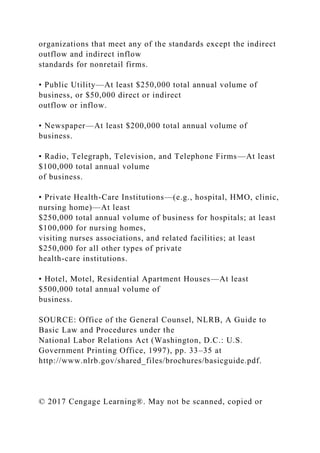
Exhibit 3.2 NLRB Jurisdictional Standards Determining
Employer Coverage
under the LMRA
• Nonretail Business—Direct or indirect sales through others of
goods to consumers in other
states (called outflow), of at least $50,000 a year; or direct or
indirect purchases through others
of goods from suppliers in other States (called inflow), of at
least $50,000 a year.
• Retail Business—At least $500,000 total annual volume of
business.
• Office Building—Total annual revenue of $100,000, of which
$25,000 or more is derived from
organizations that meet any of the standards except the indirect
outflow and indirect inflow
standards for nonretail firms.
• Public Utility—At least $250,000 total annual volume of
business, or $50,000 direct or indirect
outflow or inflow.
• Newspaper—At least $200,000 total annual volume of
business.
• Radio, Telegraph, Television, and Telephone Firms—At least
$100,000 total annual volume
of business.
• Private Health-Care Institutions—(e.g., hospital, HMO, clinic,
nursing home)—At least
$250,000 total annual volume of business for hospitals; at least
$100,000 for nursing homes,
visiting nurses associations, and related facilities; at least
$250,000 for all other types of private
health-care institutions.
• Hotel, Motel, Residential Apartment Houses—At least
$500,000 total annual volume of
business.
SOURCE: Office of the General Counsel, NLRB, A Guide to
Basic Law and Procedures under the
National Labor Relations Act (Washington, D.C.: U.S.
Government Printing Office, 1997), pp. 33–35 at
http://www.nlrb.gov/shared_files/brochures/basicguide.pdf.
© 2017 Cengage Learning®. May not be scanned, copied or
duplicated, or
posted to a publicly accessible website, in whole or in part. 3–
16
Exhibit 3.2 NLRB Jurisdictional Standards Determining
Employer Coverage
under the LMRA (cont’d)
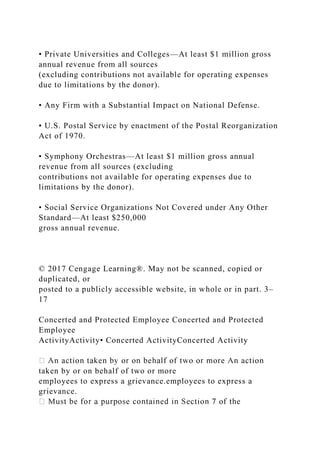
SOURCE: Office of the General Counsel, NLRB, A Guide to
Basic Law and Procedures under the
National Labor Relations Act (Washington, D.C.: U.S.
Government Printing Office, 1997), pp. 33–35 at
http://www.nlrb.gov/shared_files/brochures/basicguide.pdf.
• Transportation Enterprises, Links, and Channels of interstate
Commerce (e.g., Interstate
bus, truck)—At least $50,000 total annual Income from
furnishing Interstate passenger and
freight transportation services or performing services valued at
$50,000 or more for businesses
which meet any of the jurisdictional standards except the
indirect outflow and inflow standards
established for nonretail firms. [Note: Airline and Railroad
operations are covered under the
Railway Labor Act (RLA), not the LMRA, and thus are not
subject to NLRB jurisdiction].
• Transit Systems—At least $250,000 total annual volume of
business.
• Taxicab Companies—At least $500,000 total annual volume of
business.
• Associations—The annual business of each association
member is totaled to determine
whether any of the standards apply.
• Private Universities and Colleges—At least $1 million gross
annual revenue from all sources
(excluding contributions not available for operating expenses
due to limitations by the donor).
• Any Firm with a Substantial Impact on National Defense.
• U.S. Postal Service by enactment of the Postal Reorganization
Act of 1970.
• Symphony Orchestras—At least $1 million gross annual
revenue from all sources (excluding
contributions not available for operating expenses due to
limitations by the donor).
• Social Service Organizations Not Covered under Any Other
Standard—At least $250,000
gross annual revenue.
© 2017 Cengage Learning®. May not be scanned, copied or
duplicated, or
posted to a publicly accessible website, in whole or in part. 3–
17
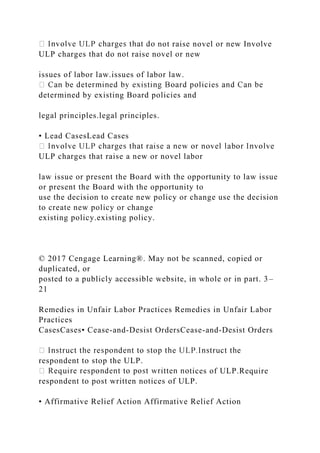
Concerted and Protected Employee Concerted and Protected
Employee
ActivityActivity• Concerted ActivityConcerted Activity
taken by or on behalf of two or more
employees to express a grievance.employees to express a
grievance.
LMRA.Must be for a purpose contained in Section 7 of the
LMRA.
be engaged in using lawful means; NLRB decides
lawfulness on case-by-case basis.lawfulness on case-by-case
basis.
• TheThe Interboro Interboro Doctrine Doctrine
employee working alone may be considered to be
engaged in concerted activity if seeking to enforce the engaged
in concerted activity if seeking to enforce the
terms of a collective bargaining agreement.terms of a collective
bargaining agreement.
© 2017 Cengage Learning®. May not be scanned, copied or
duplicated, or
posted to a publicly accessible website, in whole or in part. 3–
18
NLRB Unfair Labor Practices (ULPs)NLRB Unfair Labor
Practices (ULPs)
• Charging PartyCharging Party
party (union, employer, or individual) filing the
UPL chargeUPL charge
General Counsel
• RespondentRespondent
accused of committing the violation
• MeritMerit
finding that a charge does involve a violationA finding that
a charge does involve a violation
• Administrative Law Judge (ALJ) Administrative Law Judge
(ALJ)
who presides over the formal ULP hearing
© 2017 Cengage Learning®. May not be scanned, copied or
duplicated, or posted to a publicly accessible website, in
whole or in part. 3–19
Exhibit 3.3 Unfair
Labor
Practice
Procedure
SOURCE: National Labor Relations Board.
© 2017 Cengage Learning®. May not be scanned, copied or
duplicated, or
posted to a publicly accessible website, in whole or in part. 3–
20
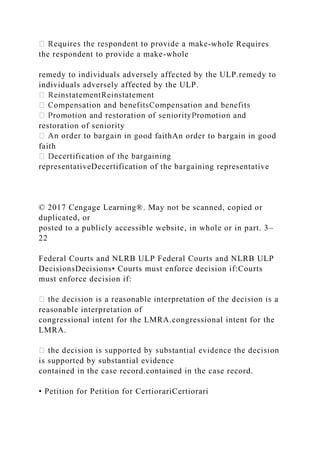
Types of Unfair Labor Practice CasesTypes of Unfair Labor
Practice Cases
• Routine CasesRoutine Cases
not raise novel or new Involve
ULP charges that do not raise novel or new
issues of labor law.issues of labor law.
determined by existing Board policies and
legal principles.legal principles.
• Lead CasesLead Cases
ULP charges that raise a new or novel labor
law issue or present the Board with the opportunity to law issue
or present the Board with the opportunity to
use the decision to create new policy or change use the decision
to create new policy or change
existing policy.existing policy.
© 2017 Cengage Learning®. May not be scanned, copied or
duplicated, or
posted to a publicly accessible website, in whole or in part. 3–
21
Remedies in Unfair Labor Practices Remedies in Unfair Labor
Practices
CasesCases• Cease-and-Desist OrdersCease-and-Desist Orders
respondent to stop the ULP.
tices of ULP.Require
respondent to post written notices of ULP.
• Affirmative Relief Action Affirmative Relief Action
-whole Requires
the respondent to provide a make-whole
remedy to individuals adversely affected by the ULP.remedy to
individuals adversely affected by the ULP.
restoration of seniority
ood faithAn order to bargain in good
faith
representativeDecertification of the bargaining representative
© 2017 Cengage Learning®. May not be scanned, copied or
duplicated, or
posted to a publicly accessible website, in whole or in part. 3–
22
Federal Courts and NLRB ULP Federal Courts and NLRB ULP
DecisionsDecisions• Courts must enforce decision if:Courts
must enforce decision if:
reasonable interpretation of
congressional intent for the LMRA.congressional intent for the
LMRA.
is supported by substantial evidence
contained in the case record.contained in the case record.
• Petition for Petition for CertiorariCertiorari
of appeals’ decision appealed to the Supreme
Court when lower court decisions conflict with each Court when
lower court decisions conflict with each
other.other.
© 2017 Cengage Learning®. May not be scanned, copied or
duplicated, or
posted to a publicly accessible website, in whole or in part. 3–
23
Assessment of the LMRA and the Assessment of the LMRA and
the
NLRBNLRB• Current Labor PolicyCurrent Labor Policy
the powerful (employers) over the powerless
(employees).(employees).
-dragging.Discourages
unionism through foot-dragging.
cient statutory remedies.Offers weak,
insufficient statutory remedies.
outdated and mismatched to the current
labor relations environment.labor relations environment.
., BeckBeck rights) protecting
individuals have rights) protecting individuals have
usurped the role of collective bargaining as the usurped the role
of collective bargaining as the
employees’ voice.employees’ voice.
© 2017 Cengage Learning®. May not be scanned, copied or
duplicated, or
posted to a publicly accessible website, in whole or in part. 3–
24
Unions’ View of the LMRAUnions’ View of the LMRA
• LMRA Reforms that Unions Want Now:LMRA Reforms that
Unions Want Now:
es by organizers.Greater access to
employees by organizers.
Stronger penalties for employers’ ULPs against union
supporters.supporters.
he
use of permanent striker
replacements during economic strikes.replacements during
economic strikes.
of the Section 8 prohibition of
employer domination and interference with union employer
domination and interference with union
organizations.organizations.
© 2017 Cengage Learning®. May not be scanned, copied or
duplicated, or
posted to a publicly accessible website, in whole or in part. 3–
25
Common Concerns about the NLRBCommon Concerns about the
NLRB
• Excessive slowness of case processingExcessive slowness of
case processing
procedures
decisions on leading cases
mber turnover and vacanciesBoard member turnover
and vacancies
© 2017 Cengage Learning®. May not be scanned, copied or
duplicated, or
posted to a publicly accessible website, in whole or in part. 3–
26
Transportation-Related Labor Transportation-Related Labor
Relations Laws (Railway and Airlines)Relations Laws (Railway
and Airlines)
• Railway Labor Act of 1926Railway Labor Act of 1926
comprehensive collective bargaining law
railway employees; amended
Originally covered only railway employees; amended
in 1936 to include airlines.in 1936 to include airlines.
disputes are subject to mandatory
mediation through the National Mediation Board mediation
through the National Mediation Board
(NMB).(NMB).
Railroad Adjustment Board (NRAB)
membersComprised of 18 union and 18 management members
Resolves minor disputes related to terms of the labor
agreement (which never expires)agreement (which never
expires)
© 2017 Cengage Learning®. May not be scanned, copied or
duplicated, or
posted to a publicly accessible website, in whole or in part. 3–
27
Deregulation LegislationDeregulation Legislation
• Airline Deregulation Act of 1978Airline Deregulation Act of
1978
government regulation of fares and routes.
rapid rise and fall in number of
nonunion carriers.nonunion carriers.
major airlines.
downs and terrorist attacks further Economic
slowdowns and terrorist attacks further
exacerbated poor industry conditions.exacerbated poor industry
conditions.
• Staggers Rail Act of 1980Staggers Rail Act of 1980
and service
levels.Increased flexibility in setting rates and service levels.
declined but nonstrike actions have
increased.increased.
© 2017 Cengage Learning®. May not be scanned, copied or
duplicated, or
posted to a publicly accessible website, in whole or in part. 3–
28
Additional Laws That Afect Labor Additional Laws That Afect
Labor
RelationsRelations• Employee Retirement Income Security Act
of Employee Retirement Income Security Act of
1974 (ERISA)1974 (ERISA)
Establishes minimum standards for the operation of
voluntarily established private-sector pension and voluntarily
established private-sector pension and
health benefit plans.health benefit plans.
• The Americans with Disabilities Act of 1990The Americans
with Disabilities Act of 1990
“reasonable accommodation” of workers’
disabilities in all areas of the employment process.disabilities in
all areas of the employment process.
• The Bankruptcy Act of 1984The Bankruptcy Act of 1984
union and employer cooperation to avoid
bankruptcy filings and the alteration of contracts.bankruptcy
filings and the alteration of contracts.
© 2017 Cengage Learning®. May not be scanned, copied or
duplicated, or
posted to a publicly accessible website, in whole or in part. 3–
29
Other Laws…(cont’d)Other Laws…(cont’d)
• The Worker Adjustment and Retraining The Worker
Adjustment and Retraining
Notification (WARN) Act of 1988Notification (WARN) Act of
1988
employers to notify employees and
communities of major workforce reductions.communities of
major workforce reductions.
• Racketeer Influenced and Corrupt Organizations Racketeer
Influenced and Corrupt Organizations
(RICCO) Act of 1970(RICCO) Act of 1970
racketeering in an interstate commerce
organization.organization.
criminal penalties and allows for triple
recovery of damages.recovery of damages.
© 2017 Cengage Learning®. May not be scanned, copied or
duplicated, or
posted to a publicly accessible website, in whole or in part. 3–
30
Employment Discrimination Laws and Employment
Discrimination Laws and
Executive OrdersExecutive Orders
• Civil Rights Act of 1991Civil Rights Act of 1991
discrimination on the basis of race, color,
religion, sex, or national origin.religion, sex, or national origin.
• Age Discrimination in Employment Act of 1967Age
Discrimination in Employment Act of 1967
discrimination against persons over 40
years of age.years of age.
• Executive Orders 11246 and 11375Executive Orders 11246
and 11375
government and
Prohibit discrimination in the federal government and
by government contractors.by government contractors.
© 2017 Cengage Learning®. May not be scanned, copied or
duplicated, or
posted to a publicly accessible website, in whole or in part. 3–
31
Other Related Labor Relations LawsOther Related Labor
Relations Laws
• Vocational Rehabilitation Act of 1973Vocational
Rehabilitation Act of 1973
Section 503 requires affirmative action by government
contractors and federally funded educational contractors and
federally funded educational
organizations in the employment of qualified disabled
persons.persons.
• Uniformed Services Employment and Uniformed Services
Employment and
Reemployment (USSERA) Act of 1994Reemployment
(USSERA) Act of 1994
the returning job rights of individuals called
to military service.to military service.
© 2017 Cengage Learning®. May not be scanned, copied or
duplicated, or
posted to a publicly accessible website, in whole or in part. 3–
32
Other Related Labor Relations Laws Other Related Labor
Relations Laws
(cont’d)(cont’d)• Social Security Act of 1935Social Security
Act of 1935
protection against loss of income resulting
from unemployment, old age, disability, and death.from
unemployment, old age, disability, and death.
protection for survivors of workers.
• Fair Labor Standards Act of 1938Fair Labor Standards Act of
1938
wage and overtime pay rates.
its child labor.Prohibits child labor.
• Employee Retirement and Income Security Act Employee
Retirement and Income Security Act
of 1974of 1974
guarantees employee retirements.
© 2017 Cengage Learning®. May not be scanned, copied or
duplicated, or
posted to a publicly accessible website, in whole or in part. 3–
33
Other Related Labor Relations Laws Other Related Labor
Relations Laws
(cont’d)(cont’d)• Occupational Safety and Health Act of
1970Occupational Safety and Health Act of 1970
regulate work place safety and the
handling of hazardous materials.handling of hazardous
materials.
• Family and Medical Leave Act of 1993Family and Medical
Leave Act of 1993
Requires employers to provide unpaid leave for family
and medical purposes.and medical purposes.
© 2017 Cengage Learning®. May not be scanned, copied or
duplicated, or
posted to a publicly accessible website, in whole or in part. 3–
34
Key TermsKey Terms
• Preemption doctrinePreemption doctrine
• National Labor Relations Board (NLRB)National Labor
Relations Board (NLRB)
• Labor Management Reporting and Disclosure Labor
Management Reporting and Disclosure
(Landrum-Griffin) Act(Landrum-Griffin) Act
• Federal Mediation and Conciliation Service Federal Mediation
and Conciliation Service
(FMCS)(FMCS)
• U.S. Department of Labor (USDOL)U.S. Department of Labor
(USDOL)
• National Railroad Adjustment Board (NRAB)National
Railroad Adjustment Board (NRAB)
• National Mediation Board (NMB)National Mediation Board
(NMB)
• Norris–La Guardia ActNorris–La Guardia Act
• Closed shop union security clauseClosed shop union security
clause
• National Labor Relations Act (NLRA)National Labor
Relations Act (NLRA)
• Labor Management Relations Act (LMRA)Labor Management
Relations Act (LMRA)
• Union shop union security clauseUnion shop union security
clause
• Agency shop union security clauseAgency shop union security
clause
• Right-to-work lawRight-to-work law
• The BoardThe Board
• Union saltsUnion salts
• Weingarten RightsWeingarten Rights
• NLRB jurisdictionNLRB jurisdiction
• Postal Reorganization Act of 1970Postal Reorganization Act
of 1970
• Concerted and protected activityConcerted and protected
activity
• InterboroInterboro doctrine doctrine
• Charging PartyCharging Party
• RespondentRespondent
• MeritMerit
• Administrative Law Judge (ALJ)Administrative Law Judge
(ALJ)
• Routine ULP caseRoutine ULP case
• Lead ULP caseLead ULP case
• Cease-and-desist orderCease-and-desist order
• Post written noticesPost written notices
• Affirmative actionAffirmative action
• Forum shoppingForum shopping
• Petition for Petition for certioraricertiorari
• Railway Labor Act (RLA) of 1926Railway Labor Act (RLA)
of 1926
• Major dispute under the RLAMajor dispute under the RLA
• Minor dispute under the RLAMinor dispute under the RLA
• Employee Retirement Income Security Act Employee
Retirement Income Security Act
(ERISA)(ERISA)
• Pension Benefit Guaranty Corporation (PBGC)Pension Benefit
Guaranty Corporation (PBGC)
• Americans with Disabilities Act (ADA)Americans with
Disabilities Act (ADA)
© 2017 Cengage Learning®. May not be scanned, copied or
duplicated, or
posted to a publicly accessible website, in whole or in part. 3–
35
Key Terms (cont’d)Key Terms (cont’d)
• Bankruptcy Act of 1984Bankruptcy Act of 1984
• Worker Adjustment and Retraining Worker Adjustment and
Retraining
Notification Act (WARN)Notification Act (WARN)
• Racketeer Influenced and Corrupt Racketeer Influenced and
Corrupt
Organizations Act (RICO)Organizations Act (RICO)
• Civil Rights Act of 1964Civil Rights Act of 1964
• Civil Rights Act of 1991Civil Rights Act of 1991
• Age Discrimination in Employment Act of Age Discrimination
in Employment Act of
19671967
• Equal Pay Act of 1963Equal Pay Act of 1963
• Lilly Ledbetter Fair Pay Act of 2009 (FPA)Lilly Ledbetter
Fair Pay Act of 2009 (FPA)
• Executive Order 11246Executive Order 11246
• Executive Order 11375 Executive Order 11375
• Vocational Rehabilitation Act of 1973Vocational
Rehabilitation Act of 1973
• Uniformed Services Employment and Uniformed Services
Employment and
Reemployment Rights Act (USERRA) of Reemployment Rights
Act (USERRA) of
19941994
• Social Security Act of 1935Social Security Act of 1935
• Fair Labor Standards Act of 1938Fair Labor Standards Act of
1938
• Occupational Safety and Health Act of 1970Occupational
Safety and Health Act of 1970
• Family and Medical Leave Act of 1993Family and Medical
Leave Act of 1993
PowerPoint PresentationOrigin of Labor Relations LawOrigin of
Labor Relations Law (cont’d)Slide 4The Norris-La Guardia Act
of 1932The National Industrial Recovery Act of 1933The
National Labor Relations Act of 1935Exhibit 3.1 Rights of
EmployeesLabor Management Relations Act of 1947Labor-
Management Reporting and Disclosure Act of 1959National
Labor Relations Board (NLRB)Composition of the
NLRBPersons Covered under the LMRAPersons Covered under
the LMRA (cont’d)Exhibit 3.2 NLRB Jurisdictional Standards
Determining Employer Coverage under the LMRAExhibit 3.2
NLRB Jurisdictional Standards Determining Employer Coverage
under the LMRA (cont’d)Concerted and Protected Employee
ActivityNLRB Unfair Labor Practices (ULPs)Exhibit 3.3 Unfair
Labor Practice ProcedureTypes of Unfair Labor Practice
CasesRemedies in Unfair Labor Practices CasesFederal Courts
and NLRB ULP DecisionsAssessment of the LMRA and the
NLRBUnions’ View of the LMRACommon Concerns about the
NLRBTransportation-Related Labor Relations Laws (Railway
and Airlines)Deregulation LegislationAdditional Laws That
Affect Labor RelationsOther Laws…(cont’d)Employment
Discrimination Laws and Executive OrdersOther Related Labor
Relations LawsOther Related Labor Relations Laws
(cont’d)Slide 33Key TermsKey Terms (cont’d)
© 2017 Cengage Learning®. May not be scanned, copied or
duplicated, or
posted to a publicly accessible website, in whole or in part. 2–1
Chapter 2Chapter 2
Historical PerspectiveHistorical Perspective
• Two interrelated dimensions:Two interrelated dimensions:
between labor and management
organizationsorganizations
organizationsOrganizational characteristics of labor
organizations
© 2017 Cengage Learning®. May not be scanned, copied or
duplicated, or
posted to a publicly accessible website, in whole or in part. 2–2
Criteria for Comparing the Criteria for Comparing the
Efectiveness of a Labor OrganizationEfectiveness of a Labor
Organization
• The union’s structural and financial stabilityThe union’s
structural and financial stability
• The ability to work within the political and The ability to
work within the political and
economic systemeconomic system
• The presence of mass media and legislationThe presence of
mass media and legislation
• The ability of union leaders to identify and satisfy The ability
of union leaders to identify and satisfy
members’ goals and interestsmembers’ goals and interests
© 2017 Cengage Learning®. May not be scanned, copied or
duplicated, or
posted to a publicly accessible website, in whole or in part. 2–3
© 2017 Cengage Learning®. May not be scanned, copied or
duplicated, or
posted to a publicly accessible website, in whole or in part. 2–4
1869 to World War I1869 to World War I
• The Industrial Revolution (1850s)The Industrial Revolution
(1850s)
expanded due to:
-production technologiesNew mass-production
technologies—factory systems—factory systems
and rail transportation systems
n employers to
Increased competition created pressures on employers to
minimize labor costs through lower wages.minimize labor costs
through lower wages.
-skilled
workers.Demand was principally for low or semi-skilled
workers.
Employers unconcerned about working conditions or
benefits.benefits.
available to protect workers.
© 2017 Cengage Learning®. May not be scanned, copied or
duplicated, or
posted to a publicly accessible website, in whole or in part. 2–5
Legal Interpretations Involving Labor-Legal Interpretations
Involving Labor-
Management Relationships (1806-Management Relationships
(1806-
1931)1931)
• Basis for the Legal SystemBasis for the Legal System
employers’ tangible property rights
employers’ intangible rights to do
business and make a profitbusiness and make a profit
• Criminal Conspiracy DoctrineCriminal Conspiracy Doctrine
Common law interpretation held that it was illegal for
workers to join together to pressure employers for workers to
join together to pressure employers for
better wages or working conditions.better wages or working
conditions.
case upheld criminal conspiracy.
© 2017 Cengage Learning®. May not be scanned, copied or
duplicated, or
posted to a publicly accessible website, in whole or in part. 2–6
Legal Interpretations…(1806-1931) Legal
Interpretations…(1806-1931)
(cont’d)(cont’d)
• Civil Conspiracy DoctrineCivil Conspiracy Doctrine
justification was that employees who acted in
concert (unlawful means) could inflict harm on other concert
(unlawful means) could inflict harm on other
parties even if the employees’ cause was just (lawful parties
even if the employees’ cause was just (lawful
ends).ends).
the use of (1842) ended the use of
criminal conspiracy but left in place civil conspiracy.criminal
conspiracy but left in place civil conspiracy.
continued to use jury trials and injunctions to
prevent concerted acts and the organization of prevent
concerted acts and the organization of
workers.workers.
© 2017 Cengage Learning®. May not be scanned, copied or
duplicated, or
posted to a publicly accessible website, in whole or in part. 2–7
Legal Interpretations…(1806-1931) Legal
Interpretations…(1806-1931)
(cont’d)(cont’d)
• Breach of Contract and the Use of the Labor Breach of
Contract and the Use of the Labor
InjunctionInjunction
labor disputes constituted
interference in contracts between employers and interference in
contracts between employers and
employees.employees.
Employment contracts requiring an employee to refrain from
all union activities or be subject to dismissal.all union activities
or be subject to dismissal.
issued labor injunctions to stop the concerted
activities of employees.activities of employees.
use today is employment-
Common law doctrine still in use today is employment-
at-willat-will
© 2017 Cengage Learning®. May not be scanned, copied or
duplicated, or
posted to a publicly accessible website, in whole or in part. 2–8
Legal Interpretations…(1806-1931) Legal
Interpretations…(1806-1931)
(cont’d)(cont’d)
• Application of Antitrust Legislation to UnionsApplication of
Antitrust Legislation to Unions
restraint of trade by
Originally intended to prevent the restraint of trade by
regulating business monopolies.regulating business monopolies.
Lawlor) case) case
labor organization’s use of the
Supreme Court ruled that the labor organization’s use of the
boycott was an illegal restraint of trade.boycott was an illegal
restraint of trade.
union members held liable for damages.
Clayton Act (1914)——labor no longer labor no longer
considered a commodity and injunctions were limited to
prevent injury to property.prevent injury to property.
© 2017 Cengage Learning®. May not be scanned, copied or
duplicated, or
posted to a publicly accessible website, in whole or in part. 2–9
1869 to World War I (cont’d)1869 to World War I (cont’d)
• The Knights of Labor (KOL), 1869-1917The Knights of Labor
(KOL), 1869-1917
secret society (to protect members
from discharge for union activities)from discharge for union
activities)
a national base of membershipFirst union
with a national base of membership
Union” philosophy
employees and employers
sions from employersFirst union to
win concessions from employers
and economic reforms
-production’s adverse impact on
workersReducing mass-production’s adverse impact on workers
Fostering the moral betterment of workers and
societyFostering the moral betterment of workers and society
© 2017 Cengage Learning®. May not be scanned, copied or
duplicated, or
posted to a publicly accessible website, in whole or in part. 2–
10
1869 to World War I (cont’d)1869 to World War I (cont’d)
• Strategies of the Knights of Labor (KOL)Strategies of the
Knights of Labor (KOL)
workers
ement of
producer and consumer
cooperatives (employee-owned establishments)cooperatives
(employee-owned establishments)
voluntary arbitration and avoidance of strikes
to obtain its goalsto obtain its goals
preference for education of workers over economic
pressure tactics (job actions—strikes and boycotts)pressure
tactics (job actions—strikes and boycotts)
© 2017 Cengage Learning®. May not be scanned, copied or
duplicated, or
posted to a publicly accessible website, in whole or in part. 2–
11
1869 to World War I (cont’d)1869 to World War I (cont’d)
• Reasons for the KOL’s Failure and DemiseReasons for the
KOL’s Failure and Demise
Assumption that technological advancement could be
stopped and possibly reversedstopped and possibly reversed
Overestimation of the shared interests of employees
and employersand employers
Overestimation of interests shared in common by all
workersworkers
legal protection from employers discharging
workers for engaging in union activitiesworkers for engaging in
union activities
Inability of KOL leadership to identify with rank and
file membership goalsfile membership goals
© 2017 Cengage Learning®. May not be scanned, copied or
duplicated, or
posted to a publicly accessible website, in whole or in part. 2–
12
1869 to World War I (cont’d)1869 to World War I (cont’d)
• The 8-Hour Workday Movement and the The 8-Hour Workday
Movement and the
Haymarket Riot (1886)Haymarket Riot (1886)
-hour day to Movement’s
purpose for reducing 10-hour day to
8-hour day was to increase overall employment.8-hour day was
to increase overall employment.
ven policemen were killed by a bomb explosion at Seven
policemen were killed by a bomb explosion at
a mass meeting of movement supporters in Chicago.a mass
meeting of movement supporters in Chicago.
killed
Rioting ensued in which several striking workers were killed
and hundreds were wounded.and hundreds were wounded.
hanged.Eight alleged riot leaders were “tried” and four were
hanged.
violence turned public opinion against the KOL The
violence turned public opinion against the KOL
and labor movement.and labor movement.
© 2017 Cengage Learning®. May not be scanned, copied or
duplicated, or
posted to a publicly accessible website, in whole or in part. 2–
13
1869 to World War I (cont’d)1869 to World War I (cont’d)
• The American Federation of Labor (AFL), 1886The American
Federation of Labor (AFL), 1886
by skilled craft unions expelled from the KOL
of unions that each independently
represented a unique skilled craft or occupationrepresented a
unique skilled craft or occupation
l and local
unionsDecentralized authority to national and local unions
jurisdictionexclusive jurisdiction
use of economic pressure tactics
Favored the pursuit of equitable treatment and economic
betterment for workers (betterment for workers (business
unionismbusiness unionism))
m within the
Utilized a “pure and simple” approach to unionism within the
capitalist system; did not adopt a social reform agendacapitalist
system; did not adopt a social reform agenda
disputesFocused on collective bargaining to settle labor disputes
© 2017 Cengage Learning®. May not be scanned, copied or
duplicated, or
posted to a publicly accessible website, in whole or in part. 2–
14
1869 to World War I (cont’d)1869 to World War I (cont’d)
• Strategies and Tactics of the AFLStrategies and Tactics of the
AFL
strikes and other economic pressures to
attain union goalsattain union goals
Active
involvement in the political arena without
forming a political partyforming a political party
Improving the image of organized labor and collective
bargainingbargaining
© 2017 Cengage Learning®. May not be scanned, copied or
duplicated, or
posted to a publicly accessible website, in whole or in part. 2–
15
1869 to World War I (cont’d)1869 to World War I (cont’d)
• The Homestead Incident (July 6, 1892)The Homestead
Incident (July 6, 1892)
of employees at the Carnegie Steel
Works in Homestead, Pennsylvania.Works in Homestead,
Pennsylvania.
Pinkerton detectives and unionized workers clashed violently
until National Guard troops secured the town.until National
Guard troops secured the town.
Management maintained the lockout, breaking the strike after
five months.five months.
-union efforts of
The company’s success bolstered the anti-union efforts of
other employers.other employers.
press faulted the company for provoking the incident.
cause.Unions gained status and public sympathy for their cause.
© 2017 Cengage Learning®. May not be scanned, copied or
duplicated, or
posted to a publicly accessible website, in whole or in part. 2–
16
1869 to World War I (cont’d)1869 to World War I (cont’d)
• The Pullman Strike (1894)The Pullman Strike (1894)
(ARU)
e on the Pullman
Struck the national railroads to put pressure on the Pullman
company to reach an agreement with the union.company to
reach an agreement with the union.
injunction
Placed federal mail on the trains and obtained an injunction
prohibiting the union from interfering with the
trains.prohibiting the union from interfering with the trains.
federal troops protect trains and strikebreakers.
strike failed and Eugene Debs, president of the
ARU, was sent to jail for violating the injunction.ARU, was
sent to jail for violating the injunction.
© 2017 Cengage Learning®. May not be scanned, copied or
duplicated, or
posted to a publicly accessible website, in whole or in part. 2–
17
1869 to World War I (cont’d)1869 to World War I (cont’d)
• The Industrial Workers of the World (IWW)The Industrial
Workers of the World (IWW)
goal was to overthrow the capitalist system by
any means necessary.any means necessary.
to remove any societal aspect or group that
supported capitalism.supported capitalism.
that the AFL had sold out to capitalism.
establish an effective organization.
permanent membership and financial base
members’ interests
sabotage and violence
officialsAlienation of the news media and government officials
© 2017 Cengage Learning®. May not be scanned, copied or
duplicated, or
posted to a publicly accessible website, in whole or in part. 2–
18
World War I to World War IIWorld War I to World War II
• Union Organizing after WWI: Problems and Union Organizing
after WWI: Problems and
ProspectsProspects
labor’s power during wartime:
guarantee uninterrupted war production, government
contracts enforced union standards.contracts enforced union
standards.
supply.Congress restricted immigration to reduce the labor
supply.
-war problems for unions:Post-war problems for unions:
strike in the steel industry
employer opposition to unions
© 2017 Cengage Learning®. May not be scanned, copied or
duplicated, or
posted to a publicly accessible website, in whole or in part. 2–
19
World War I to World War II (cont’d)World War I to World
War II (cont’d)
• Counteractions by EmployersCounteractions by Employers
(American Plan)
d not have to be or become members of a
Employees did not have to be or become members of a
union to get or keep a job.union to get or keep a job.
Formula for an open shop.
– An agreement requiring that an individual must be a An
agreement requiring that an individual must be a
member of the union before being hired by the
employer.member of the union before being hired by the
employer.
spies to ferret out union supporters for
blacklistingHiring spies to ferret out union supporters for
blacklisting
plan)Establishing company unions (employee representation
plan)
© 2017 Cengage Learning®. May not be scanned, copied or
duplicated, or
posted to a publicly accessible website, in whole or in part. 2–
20
World War I to World War II (cont’d)World War I to World
War II (cont’d)
• Factors Contributing to Labor’s Inability to Factors
Contributing to Labor’s Inability to
Overcome Antiunion SentimentOvercome Antiunion Sentiment
Employees’ reluctance to join unions and forfeit their
paycheckspaychecks
image as corrupt organizations controlled by
socialists, radicals, and communists socialists, radicals, and
communists
sThe V
technique used to dominate union meetings
negotiated sweetheart contractssweetheart contracts
to line their own pocketsto line their own pockets
© 2017 Cengage Learning®. May not be scanned, copied or
duplicated, or
posted to a publicly accessible website, in whole or in part. 2–
21
World War I to World War II (cont’d)World War I to World
War II (cont’d)
• Rise of the Congress of Industrial Organizations Rise of the
Congress of Industrial Organizations
(CIO) and Industrial Unionism(CIO) and Industrial Unionism
Production workers were becoming an increasingly
larger percentage of the labor force.larger percentage of the
labor force.
Most AFL unions resisted inclusion of production Most AFL
unions resisted inclusion of production
workers in their unions and the AFL.workers in their unions and
the AFL.
unions expelled for dual unionism (in support of
industrial unions) form the CIO under the leadership industrial
unions) form the CIO under the leadership
of John L. Lewis.of John L. Lewis.
© 2017 Cengage Learning®. May not be scanned, copied or
duplicated, or
posted to a publicly accessible website, in whole or in part. 2–
22
World War I to World War II (cont’d)World War I to World
War II (cont’d)
• Factors Accounting for the CIO’s Success as a Factors
Accounting for the CIO’s Success as a
Labor OrganizationLabor Organization
-down strikesEffective use of sit-down
strikes
of the National Labor Relations Act (1935)
anges in employee attitudes toward independent Changes
in employee attitudes toward independent
unionsunions
© 2017 Cengage Learning®. May not be scanned, copied or
duplicated, or
posted to a publicly accessible website, in whole or in part. 2–
23
World War II to the PresentWorld War II to the Present
• During WWIIDuring WWII
strikes during the war.
imposition of wage and controls (“Little Steel
Formula”) limited wage increases but prices Formula”) limited
wage increases but prices
increased.increased.
strikes resulted in strong negative public
sentiment toward unions.sentiment toward unions.
Unions’ postwar economic demands (full employment
and wage increases) were strongly reinforced with and wage
increases) were strongly reinforced with
numerous strikes.numerous strikes.
© 2017 Cengage Learning®. May not be scanned, copied or
duplicated, or
posted to a publicly accessible website, in whole or in part. 2–
24
World War II to the Present (cont’d)World War II to the Present
(cont’d)
• Developments in Organized Labor Since WWIIDevelopments
in Organized Labor Since WWII
-bargaining issuesIncreased
concern over collective-bargaining issues
– Health-care cost shifting (higher deductibles, co-payments
Health-care cost shifting (higher deductibles, co-payments
and increased premiums)and increased premiums)
from inflation
bargaining demands of managementWage
concession bargaining demands of management
– Two-tier pay plans for current and new employeesTwo-tier
pay plans for current and new employees
– Lump sum performance paymentsLump sum performance
payments
© 2017 Cengage Learning®. May not be scanned, copied or
duplicated, or
posted to a publicly accessible website, in whole or in part. 2–
25
World War II to the Present (cont’d)World War II to the Present
(cont’d)
• Developments in Organized Labor Since WWIIDevelopments
in Organized Labor Since WWII
-collar and public-
Organizing drives aimed at white-collar and public-
sector employeessector employees
workersIncreased attention to large groups of government
workers
-time presidents of both unionsDeath of long-
time presidents of both unions
raidingRecognition of the ineffectiveness of union raiding
common goals to influence the political
environmentenvironment
© 2017 Cengage Learning®. May not be scanned, copied or
duplicated, or
posted to a publicly accessible website, in whole or in part. 2–
26
World War II to the Present (cont’d)World War II to the Present
(cont’d)
• Formation of the Change to Win FederationFormation of the
Change to Win Federation
-CIO to form a Several
national unions left the AFL-CIO to form a
new federation called the Change to Win federation.new
federation called the Change to Win federation.
Dispute over extent of resources to be devoted to organizing
new union members.new union members.
CTW still shares same basic principles and philosophies as
unions affiliated with the AFL-CIO.unions affiliated with the
AFL-CIO.
CTW will spend less time and money on political parties and
more on grassroots organizing.more on grassroots organizing.
© 2017 Cengage Learning®. May not be scanned, copied or
duplicated, or
posted to a publicly accessible website, in whole or in part. 2–
27
World War II to the Present (cont’d)World War II to the Present
(cont’d)
• Aspects of Organized Labor Unchanged Aspects of Organized
Labor Unchanged
Since WWIISince WWII
iple of exclusive representationThe principle of
exclusive representation
bargaining
grievance procedures and arbitration
-intervention by the governmentNon-intervention by the
government
involvement in the political process
Difficulty in maintaining consensus among member
unionsunions
-term economic and job security goalsPursuit
of short-term economic and job security goals
© 2017 Cengage Learning®. May not be scanned, copied or
duplicated, or
posted to a publicly accessible website, in whole or in part. 2–
28
U.S Labor History Time LineU.S Labor History Time Line
1750 1900
Agrarian
to
Industrial
Economy
Labor
Injunctions
Haymarket
Square Riot
Pullman
Strike
Local
Craft
Unions
Commonwealth
v. Hunt
1800 1850
Knights
of Labor
American
Federation
of Labor
(AFL)
Erdman
Act
Industrial
Workers
of the
World
(IWW)
United
Hatter’s
Union
Triangle Waist
Company fire
Department
of Labor
Homestead
Strike
1925
Railway
Labor
Act
Norris-
LaGuardia
Act
National Labor
Relations Act
Council of
Industrial
Organizations
(CIO)
Labor
Management
Relations Act
19501940
© 2017 Cengage Learning®. May not be scanned, copied or
duplicated, or
posted to a publicly accessible website, in whole or in part. 2–
29
U.S Labor History Time Line (cont’d)U.S Labor History Time
Line (cont’d)
1950 1960
Executive
Order 1088
Employee Retirement
Income Security
Act (ERISA)
AFL
and
CIO
merger
Equal Pay
Act
Industrial-based
to Service-based
Economy
Occupational
Safety and Health
Act (OSHA)
Global
Competition
Civil Service
Reform Act
1980
Labor
Management
Reporting and
Disclosure Act
Civil
Rights
Act
1970 1975
© 2017 Cengage Learning®. May not be scanned, copied or
duplicated, or
posted to a publicly accessible website, in whole or in part. 2–
30
Key TermsKey Terms
• U.S. ConstitutionU.S. Constitution
• Common lawCommon law
• Employment-at-will (EAW) Employment-at-will (EAW)
doctrinedoctrine
• Criminal conspiracy doctrineCriminal conspiracy doctrine
• Commonwealth v. Hunt Commonwealth v. Hunt (1842)(1842)
• Civil conspiracy doctrineCivil conspiracy doctrine
• Labor injunctionLabor injunction
• Yellow-dog contractYellow-dog contract
• Sherman Antitrust ActSherman Antitrust Act
• Loewe v. LawlorLoewe v. Lawlor
• Danbury HattersDanbury Hatters
• Clayton Antitrust ActClayton Antitrust Act
• Knights of Labor (KOL) Knights of Labor (KOL)
• Terence PowderlyTerence Powderly
• One Big UnionOne Big Union
• Haymarket RiotHaymarket Riot
• American Federation of Labor American Federation of Labor
(AFL)(AFL)
• Mohawk Valley FormulaMohawk Valley Formula
• PaternalismPaternalism
• Employee representation planEmployee representation plan
• Company unionCompany union
• ScripScrip
• Sweetheart contractSweetheart contract
• V techniqueV technique
• Congress of Industrial Congress of Industrial
Organizations (CIO)Organizations (CIO)
• John L. LewisJohn L. Lewis
• Sit-down strikeSit-down strike
• National Labor Relations Act National Labor Relations Act
(NLRA) of 1935(NLRA) of 1935
• Byrnes Act of 1936Byrnes Act of 1936
• Concession bargainingConcession bargaining
• AFL-CIOAFL-CIO
• Change to Win federationChange to Win federation
• Samuel GompersSamuel Gompers
• Pure and simple unionismPure and simple unionism
• Exclusive union jurisdictionExclusive union jurisdiction
• Decentralized authorityDecentralized authority
• Homestead IncidentHomestead Incident
• Pullman StrikePullman Strike
• SocialismSocialism
• Industrial Workers of the Industrial Workers of the
World (IWW)World (IWW)
• William ‘‘Big Bill’’ HaywoodWilliam ‘‘Big Bill’’ Haywood
• Communist societyCommunist society
• Red ScareRed Scare
• Criminal syndicalism lawsCriminal syndicalism laws
• Sedition lawsSedition laws
• Recognition strikesRecognition strikes
• Open-shop movementOpen-shop movement
• American PlanAmerican Plan
• Industrial spiesIndustrial spies
• BlacklistedBlacklisted
PowerPoint PresentationHistorical PerspectiveCriteria for
Comparing the Effectiveness of a Labor Organization1869 to
World War ILegal Interpretations Involving Labor-Management
Relationships (1806-1931)Legal Interpretations…(1806-1931)
(cont’d)Slide 7Slide 81869 to World War I (cont’d)Slide
10Slide 11Slide 12Slide 13Slide 14Slide 15Slide 16Slide
17World War I to World War IIWorld War I to World War II
(cont’d)Slide 20Slide 21Slide 22World War II to the
PresentWorld War II to the Present (cont’d)Slide 25Slide
26Slide 27U.S Labor History Time LineU.S Labor History Time
Line (cont’d)Key Terms

CHAPTER 1Union-Management Relationships in Perspective Outline.docx

  • 1.
    CHAPTER 1 Union-Management Relationshipsin Perspective Outline Phases in the Labor Relations Process The labor relations process includes the following three phases: Recognition of the legitimate rights and responsibilities of union and management representatives Negotiation of the labor agreement, including appropriate strategies, tactics, and impasse-resolution techniques Administration of the negotiated labor agreement—applying and enforcing the terms of the agreement on a daily basis Characteristics of the labor relations process The negotiation and administration of work rules vary considerably across public- and private- sector organizations Are cumulative with each phase depending on the previous phase Are subject to qualitative variations Elements in the Labor Relations Process (Exhibit 1.1 indicates these elements) Focal point of labor relations: work rules (examples of rules are given in Exhibit 1.2) Pertain to compensation as well as employees' and employers' job rights and obligations (e.g., "justice and dignity," clauses and rules requiring employees to work overtime) Vary according to their applicability to many occupations and the extent to which they are specific Reflect the dynamic nature of labor relations as work rule existence and/or consent charges over time (The Acquired Immune Deficiency Syndrome or AIDS, no smoking, and electronic monitoring of employee performance, for example) Key participants in the labor relations process Management officials and consultants Union officials Employees who have dual loyalties to both the union and the
  • 2.
    company The government—National LaborRelations Board (NLRB), laws Third party neutrals: mediators and arbitrators Three basic assumptions underlying U.S. labor relations The adoption and support of a free enterprise (capitalist) economic system in the United States creates an inherent conflict of interest between employers (owners) and employees. Both employees and employers seek to advance their own self- interests Employees in a free and democratic society have a right to independently pursue their employment interests using lawful means Collective bargaining provides a process for meaningful employee participation through independently chosen representatives in the determination of work rules Basic characteristics of the private-sector U.S. labor relations system (Exhibit 1.3): A bilateral process (union and management) governed by a framework of labor laws A highly decentralized and localized bargaining structure Recognition of key legal principles of majority rule and exclusive bargaining representation Permits use of economic pressure (e.g., strike, lockout, picketing, and boycott) Encourages use of final and binding arbitration Significant employer opposition to employee efforts to organize and bargain collectively Constraints or influences affecting participants' negotiation and administration of work rules State of the economy: national, international, and firm-specific indicators. Impact of discouraged workers who have given up looking for a job Labor market (skills, wage levels, supply and demand) Product or service market (where the company either sells its products/services or purchases key elements for creating its
  • 3.
    products/services) Financial market Technology (equipment,pace and scheduling of work, characteristics of the work environment, tasks to be performed, and information exchange) International forces—employee reservists in Iraq, free-trade, NAFTA, globalization Public opinion (influential individuals/organizations within the community and/or attitudes/traditions held by community residents), negative union image, union support for social causes Union membership (Exhibit 1.4) Steady decline in total membership Lower union density (union as a proportion of total labor force) Causes: Structural changes in the labor force Employment shift from manufacturing to service industries Demographic shifts: female, older, diverse, part-time workforce Organizational practices to avoid unionization Economic and political climate: Employment laws reduce demand for union CHAPTER 2 The History of Labor–Management Relations Outline Historical perspective Two interrelated dimensions: Relationships between labor and management organizations Organizational characteristics of labor organizations. Criteria for comparing the effectiveness of a labor organization: A labor organization’s structural and financial stability Its ability to work within the established political and economic system, particularly the wage system The degree to which the broader social environment, such as laws, media, and public opinion, is supportive or opposed to a labor organization’s goals and tactics
  • 4.
    The ability ofunion leaders to identify and satisfy members’ goals and interests 1869 to World War I Brief overview of unions in the U.S. before 1869 Guilds, joint associations of employers and craftspeople, local markets, small firms Factory system in 1850s, improved transportation, larger markets, larger Firms Article I, Section 8 of U.S. Constitution grants Congress the right to pass laws regulating interstate commerce which includes labor laws Common law doctrine still in use today is the employment-at- will doctrine The common law criminal conspiracy doctrine used by employers against unions was ended by the Commonwealth v. Hunt decision The courts continued to apply the civil conspiracy doctrine. A labor Injunction is a court order restricting certain activities in a labor dispute Many employers required their employees to sign yellow-dog contracts, which stipulated that employees may not join or organize a union Application of antitrust legislation to labor unions Sherman Antitrust Act (1890) – restricts power of corporations to engage in anti-competitive practices Loewe v. Lawlor case (Danbury Hatters) – union-organized boycott of Loewe and company was declared illegal Clayton Antitrust Act (1914) specifically allowed the existence of labor unions Interpretations of Clayton by Supreme Court watered-down its effectiveness as it became easier for employers to get labor injunctions The Knights of Labor (KOL) Goals included long-range economic and social reforms, which were greatly influenced by personal philosophy of Powderly
  • 5.
    Pyramid-style organizational structurewith centralized authority resting at the top Strategies included political actions, education, encouragement of cooperatives, and active avoidance of strikes The KOL failed because of faulty assumptions about: The halting and reversibility of technological advancements The extent shared interests of employers and employees and among different types of employees The lack of protective legislation for unions The lack of leadership identification with members' interests The eight-hour workday movement and the Haymarket Riot (1886) Samuel Gompers strongly advocated the eight-hour work day Violent aftermath (police and citizens killed) resulted in a backlash against organized labor which included the KOL The emergence of the American Federation of Labor (AFL) Formed under Gompers’ leadership from national unions expelled from the KOL Is not one big union; instead member unions join Federation for its services and retain their separate identities Goals included an emphasis on short-range material benefits (economic betterment), enhancement of the existing capitalist industrial system, and avoidance of long-term philosophical (social reform) commitments Strategies and tactics of the AFL: The use of striking as a viable collective bargaining tactic Increased involvement in the political arena To enhance the public status and reputation of organized labor and the collective bargaining process Organization of the AFL Exclusive union jurisdiction for each craft or trade Decentralized authority through voluntary association The Homestead Incident (1892) Violent confrontation over wages at the Carnegie Steel Works Although it represented a victory for management, the strike strengthened the AFL by demonstrating to employees the
  • 6.
    organization's concern forhelping its members The Pullman Strike (1894) Protest over unilateral wage cuts while prices for rent and food in the company-owned town remained the same The American Railway Union (independent from the AFL) faded out of existence owing to negative public opinion; the use of federal troops and injunctions; Pullman management resistance, and lack of support by the AFL The Industrial Workers of the World (IWW) Organized in 1905 with the objective of overthrowing the existing capitalistic system by any means possible Failed because of a lack of permanent membership and financial base, inability to appeal to members' interests, being identified with sabotage and violence, and alienation of the news media and government officials Red Scare gives reason to pass criminal syndicalism laws and Sedition laws, such as the Espionage Act of 1917 and the Sedition Act of 1918 World War I to World War II Union organizing after World War I: Problems and prospects Post-war economic conditions led to unsuccessful strikes that weakened unions Union membership declined in the 1920s due to aggressive counteractions by employers and organized labor’s inability to overcome anti-union sentiment among potential union members Recognition strikes lead to passage of the Railway Labor Act Counteractions by employers Open shop movement (American Plan) Blacklisting Industrial spies Mohawk Valley Formula Employer paternalism Employee representation plan (ERP) or company union Use of scrip payments Labor’s inability to overcome anti-union sentiment due to:
  • 7.
    Good economic conditionsin “Roaring” 1920s Corruption and racketeering in unions (sweetheart contracts) Infiltration by political radicals and communists Rise of the Congress of Industrial Organization (CIO) and industrial unionism AFL did not want to enroll semi-skilled employees. CIO broke away from the AFL to organize employees in mass production industries (steel, auto, electrical, etc.). CIO membership grew quickly owing to strong leadership, realistic goals (similar to AFL), effective use of the sit-down strike, passage of favorable legislation (the Wagner Act), and positive changes in employee attitudes towards union World War II to the Present Developments in organized labor since World War II New collective bargaining issues Unions directed efforts toward job security in the face of technological advances, new types of benefits, and wages tied to fluctuations of economic cycles, such as cost-of –living adjustments Organization of women, minorities, and professionals in the public and private sector service industries Merger of the AFL-CIO in 1955 Formation of the Change to Win Federation Voluntary departure of seven large national unions from the AFL-CIO Dispute over the allocation of resources for organizing activities and grass-roots direct political action Recent movements to reunite the labor movement Aspects of organized labor unchanged since World War II Exclusive representation Collective bargaining agreements Government policies of non-intervention in labor relations Unions involvement in politics Difficulty in achieving consensus among unions and among union members Continued pursuit of short-range economic and job security
  • 8.
    goals instead oflong-range reform CHAPTER 3 Legal Influences Outline Origin of Labor Relations Law Under the preemption doctrine, federal law takes precedence over state law or local ordinances. The judicial branch of government functions to determine a law’s constitutionality. Administrative agencies within the Executive Branch: National Labor Relations Board (NLRB). Management Reporting and Disclosure (Landrum-Griffin) Act. Federal Mediation and Conciliation Service (FMCS). U.S. Department of Labor (USDOL). National Mediation Board (NMB). National Railroad Adjustment Board (NRAB). State and local administrative agencies. The Norris-La Guardia Act (Federal Anti-Injunction Act) of 1932 Restricted role of federal courts, particularly in issuing injunctions and temporary restraining orders (TRO) and protected right to peaceful picketing and publicity. Declared yellow-dog contracts to be unenforceable in federal courts. Encouraged courts to balance legitimate rights of employers and employees. Expressed congressional support for the process of collective bargaining. Deficiencies of Norris-LaGuardia Act: No independent administrative agency charged or established to enforce the Act’s provisions. No specific employer unfair labor practices (ULPs) were
  • 9.
    identified and prohibited. TheNational Industrial Recovery Act (NIRA) of 1933 Designed to stabilize economic activity. Allowed businesses to form associations to draw up codes of fair competition. Standardization of marketing, pricing, financial, and other practices. National Labor Board (NLB) established to determine violations under Section 7 and help settle disputes. Section 7 required codes to guarantee employees’ right to unionize. Deficiencies of the NIRA: Not effective in protecting employee’s rights to organize and bargain collectively because employers were not required to bargain with unions and the NLB lacked effective enforcement of its orders. Ruled unconstitutional in 1935 by Supreme Court. The National Labor Relations (Wagner) Act of 1935 Passed one month after NIRA declared unconstitutional. Established new labor policies. Encouraged collective bargaining and prevented employer interference. NLRB authorized to investigate and decide unfair labor practices (ULPs). Avoided labor unrest by legal protection for employees’ rights. Section 7 listed rights of employees (see Exhibit 3.1, page 95). Section 8 listed ULPs under the NLRA such as: Discharging or refusing to hire union supporters, Threatening pro-union workers with poor job assignments or termination, Using company spies to learn who was organizing a union, Blacklisting pro-union employees, Creating “company unions,” Bargaining in bad faith (discussed in Chapter 6),
  • 10.
    Requiring applicants tosign yellow-dog contracts. The Supreme Court Challenge Declared the National Labor Relations (Wagner) Act constitutional by Supreme Court in 1937. Recognized important impact of labor relations on interstate commerce. Endorsed Congress’ rights to regulate labor relations. Supreme Court approval and economic conditions lead to huge union membership growth. Employer Criticisms of the Wagner Act Labor relations favored unions too much. Public concern over union strikes, boycotts, refusal of unions to negotiate in good faith, and pressure on job applicants to become union members. Closed-shop union security clause. Changes under the Labor-Management Relations (Taft Harley) Act Congress amended NLRA with the Taft-Hartley Act (LMRA) in 1947. LMRA addressed deficiencies of the NLRA. Focused on rights of individual employees and employers. Protected anti-union individuals from retaliation. Gave owners and managers bigger voice in opposing the unionization of employees. Deficiencies of the Labor-Management Relations (Taft Harley) Act: Did not universally expand free-speech rights. Required union officers to sign anti-communism affidavits. Called a “slave labor act.” Unfair Labor Practices by Unions A section of unfair union labor practices added to the LMRA including: Threatening workers who refuse to join or support a labor union, Paying people to support or vote for a union,
  • 11.
    Pressuring an employerto discriminate against hiring an anti- union applicant, Bargaining in bad faith, Jurisdictional strikes, Strikes against employers who are not involved in the labor dispute, Political strikes—striking in support of a political cause or candidate. The Closed Shop vs the Union Shop Union shop security clause. Agency shop clause. Open shop, right to work laws. Employer Opposition to Unionization Restriction of employers’ right to speak against unionization. Infringement of employers’ free-speech rights ruled unconstitutional. Language of court’s decision included in Section 8 of the LMRA. Right to File a Lawsuit. LMRA permitted parties to a collective bargaining agreement to sue in court for breach of contract. Managers and Unionization. LMRA clarified that managers did not have a legal right to unionize. Extended to cover the U.S. Postal service in 1970 and health care institutions in 1974. Labor Management Reporting and Disclosure (Landrum-Griffin) Act (LMDRA) Congress passed LMDRA in 1959 to deal with abuses of power and corruption within unions and to guarantee union members certain rights within unions: Secret ballot elections. Approval by members of changes in union dues and fees and local constitution. Filing of annual reports with the USDOL. Legal rights in officer elections regardless of position in union.
  • 12.
    Right to runfor office, nominate others for office, make speeches for candidates, and own a copy of collective bargaining agreement. Section 303, granting neutral, secondary employees sue for recovery of illegal strike/boycott/picket damages. National Labor Relations Board (NLRB) NLRB is an independent federal administrative agency, primary interpreter and administrator of the NLRA. ULP decisions of NLRB could be appealed. Board composition: Five-member panel with members serving staggered five year terms. Members nominated by the President, confirmed by Senate. Responsibilities and duties of the board: Prevent employer and union unfair labor practices (ULPs). Determine representation desires and hold certification elections. Enforcement of LMRA through NLRB Board serves as judicial and policy-making role. General Counsel’s office investigates (prima facie evidence) and prosecutes unfair labor practices; represents Board in federal court, and works with Regional offices to conduct and supervise union representation elections. Procedure followed in cases involving ULP charges, see Exhibit 3.3. Contact with the NLRB occurs at the regional or resident office level. Decisions of the Board are subject to review by court of appeals and then Supreme Court; Courts have agreed with most of Board's decisions. Employer and Employee Coverage under the LMRA, as Amended Act covers private-sector employees of all employers whose operations have the potential to vitally affect interstate commerce unless specifically excluded (See pages 104-107 for
  • 13.
    excluded parties). NLRB canrefuse to assert jurisdiction in de minimus cases. Exhibit 3.2 lists NLRB jurisdictional standards. NLRB can defer also to individual states. Concerted and protect employee activity To be protected, the concerted activity must be for a protected purpose described in Sec. 7 of the LMRA and engaged in using lawful means. Key point: NLRB decides on a case-by-case basis if an act is concerted and is protected. Opportunity for grievance resolution by employer does not have to precede concerted action. Interboro doctrine: individuals can act alone if issue concerns term or condition of collective bargaining agreement. NLRB unfair labor practice (ULP) procedure (see Exhibit 3.3) Charging party is party bringing ULP complaint to NLBR. Respondent is party accused of committing ULP. General Counsel and regional office staff investigate merit of ULP charge. Charge is dismissed, voluntarily settled, or formally heard before an Administrative Law Judge (ALJ) for decision. The ALJ’s report and recommendations go to Board for review. ULP categories: routine ULP case (no new or novel issues) and lead ULP (raises new or novel issues). Unfair labor practice remedies Sec 10 (c), LMRA grants Board broad authority to fashion an appropriate remedy for ULP violation: issue cease and desist orders, require posting of written notices, require affirmative action. Punitive damages are excluded. Board cannot require agreement or make policy for employers. Board ULP decision can be appealed to federal appeals courts; appeals court decisions can be appealed to the Supreme Court (petition for certiorari). Decisions must be enforced if: Decision follows congressional intent in the language of the LMRA.
  • 14.
    Decision is supportedby substantial evidence contained in the case record. Assessment of the LMRA, as Amended and NLRB Administration Academics believe that current labor policy favors the powerful and labor laws discourage unionism, labor contracts allow employers to take back gains by the unions, and replacement workers render strikes ineffective. Concerns about partisan influences due to Presidential appointments. The LMRA, unchanged since 1959, is out of sync with substantial changes in the labor relations environment and concerns over weakening of Board interpretations vs focusing on changing economy and political climates. Pro labor tilt to the Board under Obama. Labor unions desired reforms: Better communication with employees during organizing campaigns. Stronger penalties for ULPs by employers against union supporters. Elimination of strikers’ replacement. Employers seek changes: Employers’ right to create work teams. Ability to create forums for improving productivity. Beck rights. NLRB critics among government officials Length of time required to complete ULP case decisions. Efforts made under Obama administration to reduce time that elapses between filing of a valid petition and the representation vote. Other suggested changes include: strengthening remedies for ULPs, efficient administrative rule-making, reducing shifts in Board policies, union authorization cards use, and insuring that first contract negotiations result in a labor agreement.
  • 15.
    Transportation-Related Labor RelationsLaw (Railway and Airlines) The Railway Labor Act (1926) was the first comprehensive labor relations law (covers railroads and airlines) passed to promote collective bargaining and to avoid interruptions of transportation services. Coverage was extended to airlines in 1936. Relies mainly on collective bargaining, but uses mandatory mediation by National Mediation Board (NMB) for major disputes and turns to the National Railroad Adjustment Board (NRAB) to resolve minor disputes (grievances), and uses final and binding arbitration when necessary. RLA successful in avoiding strikes, 97% of disputes. Only two airline strikes between 2008 and 2012, only two presidential- appointed emergency boards established to deal with railroad issues. Last railroad strike in 1994. The National Railroad Adjustment Board (NRAB) is a bipartisan group of 17 union and 17 management representatives. Established to assist with minor disputes under the RLA. Differences between the RLA and the LMRA: RLA covers railway and airline industries, LMRA covers most other private-sector employers in interstate commerce. NMB ballots are mailed, NLRB uses secret ballot. RLA requires show of support from the majority of all employees; NLRB requires only support from majority of employees actually voting. RLA and LM RA use same certification since 2010. Higher percentages of employees in the railway and airline industry are represented by RLA compared to private-sector employees covered under the LMRA. A union cannot strike and an employer cannot lock out until NMB procedures exhausted; under LMRA, parties are allowed to engage in “self-help” actions. RLA: arbitration of minor disputes is mandatory; LMRA: arbitration procedures are negotiated by parties.
  • 16.
    LMRA limits certainunion activities including “featherbedding”; The RLA does not contain the same limitations. The LMRA allows prohibition of “union shops”; RLA does not. Assessment of the RLA Success of the RLA has been and is affected by industry conditions, a complicated labor relations process; Any measure of the RLA’s effectiveness must be made with reference to its objectives. Mediation remains most important method of intervention under the RLA, and its greatest success has been resolving minor issues once large issues have been resolved. Deregulation legislation in Railroads and Airlines Airline Deregulation Act of 1978, Motor Carrier Act of 1980, and Staggers Rail Act of 1980. Increased efforts to avoid strikes, including interventions by Congress. Results of deregulation are generally greater activity in the industry and structural change (consolidation and merger), and a decline in services offered, as well as increased time for contract negotiations and increased frequency of nonstrike work actions. Promising Developments Regarding the RLA Greater union management cooperation. Reduction of emergency board procedures. Progress on work-rule issues. Positive influence of new management and union leadership. Formation of the National Railway Labor Conference. RLA appears to have accomplished goal of facilitation cooperative labor relations. Additional laws that affect labor relations The Employee Retirement Income Security Act (ERISA) establishes minimum standards for plan participation, vesting rights, benefit accrual and funding, fiduciary responsibilities of plan administrators, and guaranteed payments of benefits accrued under a defined benefit plan through a federally
  • 17.
    chartered corporation calledthe Pension Benefit Guaranty Corporation (PBGC), should the plan be terminated. The PBGC is funded from insurance premiums paid by employers whose plans are covered, investment revenues, and the remaining assets of pension plans, which are terminated and taken over by the PBGC. Americans with Disabilities Act of 1990 (ADA): prohibits employment discrimination against disabled; requires employers to make "reasonable accommodation," except when there is an "undue hardship." Bankruptcy Act (1984): subjects contract proposal and union negotiations to court review prior to rejection of union contract. Worker Adjustment and Retraining Act of 1988 (WARN): requires notification of employees, union, and government officials 60 days prior to plant closing or mass layoff. Racketeering Influenced and Corrupt Organizations Act of 1970 (RICO): prohibits anyone involved in racketeering from being involved in any interstate commerce enterprise. Employment Discrimination Laws and Executive Orders Civil Rights Act of 1991 which amended the Civil Rights Act of 1964; prohibits discrimination on basis of race, color, religion, sex, or national origin. Age Discrimination in Employment Act of 1967: prohibits the discrimination against those over the age of 40. Equal Pay Act of 1963; equal pay for men and women. Lilly Ledbetter Fair Pay act of 2009 (FPA); states that each incident of pay discrimination starts anew the time limit for filing a valid claim. Executive Orders 11246 and 11375: require affirmative action plans of government contractors and subcontractors for minority employees. Vocational Rehabilitation Act of 1973: requires affirmative action of federal government contract holders toward qualified physically and mentally handicapped individuals. Other related labor relations laws: Uniform Services Employment and Reemployment Rights Act.
  • 18.
    (USERRA) of 1994;Vietnam Era Veterans Readjustment Assistance Act. Social Security Act of 1935. Fair Labor Standards Act of 1938. Occupational Safety and Health Act of 1970. Family and Medical Leave Act of 1993. © 2017 Cengage Learning®. May not be scanned, copied or duplicated, or posted to a publicly accessible website, in whole or in part. 1–1 Chapter 1Chapter 1 © 2017 Cengage Learning®. May not be scanned, copied or duplicated, or posted to a publicly accessible website, in whole or in part. 1–2 Phases in the Labor Relations ProcessPhases in the Labor Relations Process 1.1. Recognition of rights and responsibilitiesRecognition of rights and responsibilities protections and constraints on union and management representativesmanagement representatives 2.2. Negotiation of the labor agreementNegotiation of the labor agreement techniquesStrategies, tactics, and dispute resolution techniques
  • 19.
    3.3. Administration ofthe negotiated labor Administration of the negotiated labor agreementagreement s the agreement.Management administers the agreement. monitors management’s compliance with the terms of the agreement.terms of the agreement. © 2017 Cengage Learning®. May not be scanned, copied or duplicated, or posted to a publicly accessible website, in whole or in part. 1–3 Exhibit 1.1 Elements in the Labor Relations Process © 2017 Cengage Learning®. May not be scanned, copied or duplicated, or posted to a publicly accessible website, in whole or in part. 1–4 Focal Point of Labor Relations: Work Focal Point of Labor Relations: Work RulesRules• Work Rule CategoriesWork Rule Categories t premiumsWages, overtime payments, vacations, shift premiums specifying employees’ and employers’ job rights and obligationsand obligations
  • 20.
    otion No strike/no lockout,performance standards, promotion qualifications, job specifications, layoff provisionsqualifications, job specifications, layoff provisions • Characteristics of Work RulesCharacteristics of Work Rules or unique © 2017 Cengage Learning®. May not be scanned, copied or duplicated, or posted to a publicly accessible website, in whole or in part. 1–5 Exhibit 1.2 Examples of Work Rules © 2017 Cengage Learning®. May not be scanned, copied or duplicated, or posted to a publicly accessible website, in whole or in part. 1–6 Participants in the Labor Relations Participants in the Labor Relations ProcessProcess• Management OfficialsManagement Officials -level managersCorporate, divisional, plant-level managers expertsManagement consultants, “union avoidance” experts • Union OfficialsUnion Officials fficers and representativesElected officers and
  • 21.
    representatives • EmployeesEmployees organize andvote to ratify negotiated agreementsagreements © 2017 Cengage Learning®. May not be scanned, copied or duplicated, or posted to a publicly accessible website, in whole or in part. 1–7 Participants…(cont’d)Participants…(cont’d) • The GovernmentThe Government legislative, and judicial branches -Actions (laws and regulations) can change labor- management relationships.management relationships. and local levels of government • Third-Party NeutralsThird-Party Neutrals activities. Consider disputed issues and make decisions binding on
  • 22.
    both labor andmanagement.both labor and management. © 2017 Cengage Learning®. May not be scanned, copied or duplicated, or posted to a publicly accessible website, in whole or in part. 1–8 Three Basic Assumptions Underlying Three Basic Assumptions Underlying U.S. Labor RelationsU.S. Labor Relations 1.1. The free enterprise (capitalist) economic The free enterprise (capitalist) economic system creates an inherent conflict of interest system creates an inherent conflict of interest between employers (owners) and employees.between employers (owners) and employees. 2.2. Employees have a right to pursue their Employees have a right to pursue their employment interests using lawful means.employment interests using lawful means. 3.3. Collective bargaining provides for employee Collective bargaining provides for employee participation through their chosen participation through their chosen representatives in determination of work rules.representatives in determination of work rules. © 2017 Cengage Learning®. May not be scanned, copied or duplicated, or
  • 23.
    posted to apublicly accessible website, in whole or in part. 1–9 Exhibit 1.3 Basic Characteristics of the U.S. Private-Sector Labor Relations System © 2017 Cengage Learning®. May not be scanned, copied or duplicated, or posted to a publicly accessible website, in whole or in part. 1– 10 Constraints or Infuences on Work Constraints or Infuences on Work RulesRules• State of the EconomyState of the Economy unemployment, and Inflation, interest rates, unemployment, and productivity affect job security.productivity affect job security. • Labor MarketLabor Market wage levels in the relevant labor market for labor and shifts in labor market sectors • Product MarketProduct Market of disruption to product supply to customers from the potential for labor strikescustomers from the potential for labor strikes materials and products
  • 24.
    © 2017 CengageLearning®. May not be scanned, copied or duplicated, or posted to a publicly accessible website, in whole or in part. 1– 11 Constraints or Infuences…(cont’d)Constraints or Infuences…(cont’d) • Financial MarketFinancial Market cost of funds for investment xchange rates that affect plant location choiceExchange rates that affect plant location choice ESOPs facilitiesCapital investments in nonunion and offshore facilities • TechnologyTechnology changing or eliminating skills required work tasks © 2017 Cengage Learning®. May not be scanned, copied or duplicated, or posted to a publicly accessible website, in whole or in part. 1– 12 Constraints or Infuences…(cont’d)Constraints or Infuences…(cont’d)
  • 25.
    • International ForcesInternationalForces American Free Trade Agreement (NAFTA) investments and the global economy (24/7) newly industrializing countries • Public OpinionPublic Opinion individuals and organizations traditions of the community © 2017 Cengage Learning®. May not be scanned, copied or duplicated, or posted to a publicly accessible website, in whole or in part. 1– 13 How Unions Enhance Public OpinionHow Unions Enhance Public Opinion • Monitoring and reacting to negative comments Monitoring and reacting to negative comments made in the media.made in the media. • Getting organized labor’s positive message out Getting organized labor’s positive message out to the community.to the community.
  • 26.
    • Forming allianceswith various groups in the Forming alliances with various groups in the community.community. © 2017 Cengage Learning®. May not be scanned, copied or duplicated, or posted to a publicly accessible website, in whole or in part. 1– 14 Union Membership Is DecliningUnion Membership Is Declining • Structural Changes in the Labor ForceStructural Changes in the Labor Force -based jobsShift from manufacturing to knowledge-based jobs Growth in professional, technical, and service workers orkforce demographics (more females and Shifts in workforce demographics (more females and younger workers)younger workers) growth primarily in smaller firms -time and contingent Increases in the use of part-time and contingent workersworkers
  • 27.
    1–15 Exhibit 1.4 UnionMembership Trends, 1975–2014 (in thousands) © 2017 Cengage Learning®. May not be scanned, copied or duplicated, or posted to a publicly accessible website, in whole or in part. © 2017 Cengage Learning®. May not be scanned, copied or duplicated, or posted to a publicly accessible website, in whole or in part. 1– 16 Union Membership Is Declining Union Membership Is Declining (cont’d)(cont’d)• Organizational PracticesOrganizational Practices -avoidance practices by firmsUnion-avoidance practices by firms resources practices • Employment LawEmployment Law use of laws to forestall organizing unions appear unnecessary • Union Organizing EffortsUnion Organizing Efforts
  • 28.
    e sufficiency ofresources devoted Questions about the sufficiency of resources devoted to organizing by unionsto organizing by unions © 2017 Cengage Learning®. May not be scanned, copied or duplicated, or posted to a publicly accessible website, in whole or in part. 1– 17 Key TermsKey Terms • Labor relations processLabor relations process • Interest disputesInterest disputes • Rights disputesRights disputes • Work rulesWork rules • ManagersManagers • Management consultantsManagement consultants • Union representativesUnion representatives • EmployeesEmployees • Dual loyaltyDual loyalty • GovernmentGovernment • Third-party neutralsThird-party neutrals • MediatorsMediators • ArbitratorArbitrator • EconomyEconomy • Discouraged workersDiscouraged workers • Labor marketLabor market • Product or service marketProduct or service market • Financial marketFinancial market • TechnologyTechnology • International forcesInternational forces • Public opinionPublic opinion • Worker centersWorker centers
  • 29.
    • Union densityUniondensity • Employment-at-willEmployment-at-will PowerPoint PresentationPhases in the Labor Relations ProcessExhibit 1.1 Elements in the Labor Relations ProcessFocal Point of Labor Relations: Work RulesExhibit 1.2 Examples of Work RulesParticipants in the Labor Relations ProcessParticipants…(cont’d)Three Basic Assumptions Underlying U.S. Labor RelationsExhibit 1.3 Basic Characteristics of the U.S. Private-Sector Labor Relations SystemConstraints or Influences on Work RulesConstraints or Influences…(cont’d)Slide 12How Unions Enhance Public OpinionUnion Membership Is DecliningExhibit 1.4 Union Membership Trends, 1975–2014 (in thousands)Union Membership Is Declining (cont’d)Key Terms © 2017 Cengage Learning®. May not be scanned, copied or duplicated, or posted to a publicly accessible website, in whole or in part. 3–1 Chapter 3Chapter 3 © 2017 Cengage Learning®. May not be scanned, copied or duplicated, or posted to a publicly accessible website, in whole or in part. 3–2 Origin of Labor Relations LawOrigin of Labor Relations Law preemption doctrine, federal law takes precedence over state law or local ordinancesprecedence over state law or local ordinances
  • 30.
    vernment functions toThe judicial branch of government functions to determine a law’s constitutionalitydetermine a law’s constitutionality © 2017 Cengage Learning®. May not be scanned, copied or duplicated, or posted to a publicly accessible website, in whole or in part. 3–3 Origin of Labor Relations Law (cont’d)Origin of Labor Relations Law (cont’d) • Major Federal Labor Relations LawsMajor Federal Labor Relations Laws -La Guardia ActNorris-La Guardia Act Labor Relations) Act -Hartley (Labor-Management Relations) ActTaft-Hartley (Labor-Management Relations) Act -Griffin (Labor Management Reporting and Landrum-Griffin (Labor Management Reporting and Disclosure) ActDisclosure) Act © 2017 Cengage Learning®. May not be scanned, copied or duplicated, or posted to a publicly accessible website, in whole or in part. 3–4
  • 31.
    Origin of LaborRelations Law (cont’d)Origin of Labor Relations Law (cont’d) • Labor Relations Administrative AgenciesLabor Relations Administrative Agencies Relations Board (NLRB) Mediation and Conciliation Service (FMCS) (USDOL) (NMB) Railroad Adjustment Board (NRAB) administrative agenciesState and local administrative agencies © 2017 Cengage Learning®. May not be scanned, copied or duplicated, or posted to a publicly accessible website, in whole or in part. 3–5 The Norris-La Guardia Act of 1932The Norris-La Guardia Act of 1932 • Protection of Workers’ Basic RightsProtection of Workers’ Basic Rights
  • 32.
    Limited the powerof federal courts to issue injunctions for employees’ lawful non-violent concerted acts as anti-trust employees’ lawful non-violent concerted acts as anti-trust violations.violations. -dog contracts unenforceable.Declared yellow-dog contracts unenforceable. disputes.Encouraged more impartiality by courts in labor disputes. bargainingExpressed congressional support for collective bargaining • ShortcomingsShortcomings regulatory agency designated to enforce the act. unfair labor practices for employers. © 2017 Cengage Learning®. May not be scanned, copied or duplicated, or posted to a publicly accessible website, in whole or in part. 3–6 The National Industrial Recovery Act The National Industrial Recovery Act of 1933of 1933 • Designed to stabilize economic activityDesigned to stabilize economic activity w up Allowed businesses to form associations to draw up
  • 33.
    codes standardizing:codes standardizing: inprotecting employees’ rights to organize and bargain effectively.organize and bargain effectively. unconstitutional by the Supreme Court in 1935. © 2017 Cengage Learning®. May not be scanned, copied or duplicated, or posted to a publicly accessible website, in whole or in part. 3–7 The National Labor Relations Act of The National Labor Relations Act of 19351935• Also called the Wagner ActAlso called the Wagner Act labor peace and stability.Set national labor policy for labor peace and stability. use of collective bargaining. employees’ rights to organization and representation.representation.
  • 34.
    the National LaborRelations Board (NLRB) to administer and enforce the act.(NLRB) to administer and enforce the act. or practices of employers.Defined the unfair labor practices of employers. © 2017 Cengage Learning®. May not be scanned, copied or duplicated, or posted to a publicly accessible website, in whole or in part. 3–8 Exhibit 3.1 Rights of Employees © 2017 Cengage Learning®. May not be scanned, copied or duplicated, or posted to a publicly accessible website, in whole or in part. 3–9 Labor Management Relations Act of Labor Management Relations Act of 19471947• Also called the Taft-Hartley ActAlso called the Taft- Hartley Act policy.Amended the NLRA to balance labor relations policy. unfair labor practices were added to the act. ty options for states to allow:Set up union security options for states to allow: (mandatory union membership)
  • 35.
    choice) (union membershipby employee choice) representation) (employees pay only for representation) Allowed unions to be sued by employers for damages resulting from illegal acts.resulting from illegal acts. © 2017 Cengage Learning®. May not be scanned, copied or duplicated, or posted to a publicly accessible website, in whole or in part. 3– 10 Labor-Management Reporting and Labor-Management Reporting and Disclosure Act of 1959Disclosure Act of 1959 • Also called the Landrum-Griffin ActAlso called the Landrum- Griffin Act protect union member rights and ensure union democracy.union democracy. -ballot elections of union officers.Required secret-ballot elections of union officers. Required union membership approval in setting dues and levying assessments.levying assessments. reporting requirements.Set federal
  • 36.
    financial reporting requirements. Allowedneutral, secondary employers injured by unlawful union activities to sue unions for economic damages.union activities to sue unions for economic damages. © 2017 Cengage Learning®. May not be scanned, copied or duplicated, or posted to a publicly accessible website, in whole or in part. 3– 11 National Labor Relations Board (NLRB)National Labor Relations Board (NLRB) • Functions of the NLRBFunctions of the NLRB administer the LMRA review.Actions and decisions are subject to federal court review. give deference to NLRB policies.Courts are to give deference to NLRB policies. prevent employer and union unfair labor practices. sire for representation.To determine employees’ desire for representation.
  • 37.
    © 2017 CengageLearning®. May not be scanned, copied or duplicated, or posted to a publicly accessible website, in whole or in part. 3– 12 Composition of the NLRBComposition of the NLRB • Five-Member PanelFive-Member Panel Senate.Appointed by the president; confirmed by the Senate. -year terms.Members serve staggered five-year terms. handle day-to-day affairs.Regional offices handle day-to-day affairs. • General CounselGeneral Counsel and prosecutes unfair labor practice charges.charges. al court when it seeks a Represents the Board in federal court when it seeks a court order to enforce its decisions or whenever its court order to enforce its decisions or whenever its decisions are appealed.decisions are appealed. © 2017 Cengage Learning®. May not be scanned, copied or duplicated, or posted to a publicly accessible website, in whole or in part. 3– 13 Persons Covered under the LMRAPersons Covered under the
  • 38.
    LMRA • Sources andReasons for CoverageSources and Reasons for Coverage e commerce clause places most private-sector The commerce clause places most private-sector employers and employees under the act.employers and employees under the act. NLRB may refuse to assert jurisdiction in cases where it believes the effect on interstate commerce is where it believes the effect on interstate commerce is minor (minor (de minimusde minimus).). standards for firms set thresholds for coverage of employers.coverage of employers. © 2017 Cengage Learning®. May not be scanned, copied or duplicated, or posted to a publicly accessible website, in whole or in part. 3– 14 Persons Covered under the LMRA Persons Covered under the LMRA (cont’d)(cont’d)• Groups Excluded from Jurisdiction of the Act:Groups Excluded from Jurisdiction of the Act: covered by the Railway Labor Act
  • 39.
    employees employed by parentor spouse -sector employeesPublic-sector employees s © 2017 Cengage Learning®. May not be scanned, copied or duplicated, or posted to a publicly accessible website, in whole or in part. 3– 15 Exhibit 3.2 NLRB Jurisdictional Standards Determining Employer Coverage under the LMRA • Nonretail Business—Direct or indirect sales through others of goods to consumers in other states (called outflow), of at least $50,000 a year; or direct or indirect purchases through others of goods from suppliers in other States (called inflow), of at least $50,000 a year. • Retail Business—At least $500,000 total annual volume of business. • Office Building—Total annual revenue of $100,000, of which $25,000 or more is derived from
  • 40.
    organizations that meetany of the standards except the indirect outflow and indirect inflow standards for nonretail firms. • Public Utility—At least $250,000 total annual volume of business, or $50,000 direct or indirect outflow or inflow. • Newspaper—At least $200,000 total annual volume of business. • Radio, Telegraph, Television, and Telephone Firms—At least $100,000 total annual volume of business. • Private Health-Care Institutions—(e.g., hospital, HMO, clinic, nursing home)—At least $250,000 total annual volume of business for hospitals; at least $100,000 for nursing homes, visiting nurses associations, and related facilities; at least $250,000 for all other types of private health-care institutions. • Hotel, Motel, Residential Apartment Houses—At least $500,000 total annual volume of business. SOURCE: Office of the General Counsel, NLRB, A Guide to Basic Law and Procedures under the National Labor Relations Act (Washington, D.C.: U.S. Government Printing Office, 1997), pp. 33–35 at http://www.nlrb.gov/shared_files/brochures/basicguide.pdf. © 2017 Cengage Learning®. May not be scanned, copied or
  • 41.
    duplicated, or posted toa publicly accessible website, in whole or in part. 3– 16 Exhibit 3.2 NLRB Jurisdictional Standards Determining Employer Coverage under the LMRA (cont’d) SOURCE: Office of the General Counsel, NLRB, A Guide to Basic Law and Procedures under the National Labor Relations Act (Washington, D.C.: U.S. Government Printing Office, 1997), pp. 33–35 at http://www.nlrb.gov/shared_files/brochures/basicguide.pdf. • Transportation Enterprises, Links, and Channels of interstate Commerce (e.g., Interstate bus, truck)—At least $50,000 total annual Income from furnishing Interstate passenger and freight transportation services or performing services valued at $50,000 or more for businesses which meet any of the jurisdictional standards except the indirect outflow and inflow standards established for nonretail firms. [Note: Airline and Railroad operations are covered under the Railway Labor Act (RLA), not the LMRA, and thus are not subject to NLRB jurisdiction]. • Transit Systems—At least $250,000 total annual volume of business. • Taxicab Companies—At least $500,000 total annual volume of business. • Associations—The annual business of each association member is totaled to determine whether any of the standards apply.
  • 42.
    • Private Universitiesand Colleges—At least $1 million gross annual revenue from all sources (excluding contributions not available for operating expenses due to limitations by the donor). • Any Firm with a Substantial Impact on National Defense. • U.S. Postal Service by enactment of the Postal Reorganization Act of 1970. • Symphony Orchestras—At least $1 million gross annual revenue from all sources (excluding contributions not available for operating expenses due to limitations by the donor). • Social Service Organizations Not Covered under Any Other Standard—At least $250,000 gross annual revenue. © 2017 Cengage Learning®. May not be scanned, copied or duplicated, or posted to a publicly accessible website, in whole or in part. 3– 17 Concerted and Protected Employee Concerted and Protected Employee ActivityActivity• Concerted ActivityConcerted Activity taken by or on behalf of two or more employees to express a grievance.employees to express a grievance.
  • 43.
    LMRA.Must be fora purpose contained in Section 7 of the LMRA. be engaged in using lawful means; NLRB decides lawfulness on case-by-case basis.lawfulness on case-by-case basis. • TheThe Interboro Interboro Doctrine Doctrine employee working alone may be considered to be engaged in concerted activity if seeking to enforce the engaged in concerted activity if seeking to enforce the terms of a collective bargaining agreement.terms of a collective bargaining agreement. © 2017 Cengage Learning®. May not be scanned, copied or duplicated, or posted to a publicly accessible website, in whole or in part. 3– 18 NLRB Unfair Labor Practices (ULPs)NLRB Unfair Labor Practices (ULPs) • Charging PartyCharging Party party (union, employer, or individual) filing the UPL chargeUPL charge General Counsel • RespondentRespondent
  • 44.
    accused of committingthe violation • MeritMerit finding that a charge does involve a violationA finding that a charge does involve a violation • Administrative Law Judge (ALJ) Administrative Law Judge (ALJ) who presides over the formal ULP hearing © 2017 Cengage Learning®. May not be scanned, copied or duplicated, or posted to a publicly accessible website, in whole or in part. 3–19 Exhibit 3.3 Unfair Labor Practice Procedure SOURCE: National Labor Relations Board. © 2017 Cengage Learning®. May not be scanned, copied or duplicated, or posted to a publicly accessible website, in whole or in part. 3– 20 Types of Unfair Labor Practice CasesTypes of Unfair Labor Practice Cases • Routine CasesRoutine Cases
  • 45.
    not raise novelor new Involve ULP charges that do not raise novel or new issues of labor law.issues of labor law. determined by existing Board policies and legal principles.legal principles. • Lead CasesLead Cases ULP charges that raise a new or novel labor law issue or present the Board with the opportunity to law issue or present the Board with the opportunity to use the decision to create new policy or change use the decision to create new policy or change existing policy.existing policy. © 2017 Cengage Learning®. May not be scanned, copied or duplicated, or posted to a publicly accessible website, in whole or in part. 3– 21 Remedies in Unfair Labor Practices Remedies in Unfair Labor Practices CasesCases• Cease-and-Desist OrdersCease-and-Desist Orders respondent to stop the ULP. tices of ULP.Require respondent to post written notices of ULP. • Affirmative Relief Action Affirmative Relief Action
  • 46.
    -whole Requires the respondentto provide a make-whole remedy to individuals adversely affected by the ULP.remedy to individuals adversely affected by the ULP. restoration of seniority ood faithAn order to bargain in good faith representativeDecertification of the bargaining representative © 2017 Cengage Learning®. May not be scanned, copied or duplicated, or posted to a publicly accessible website, in whole or in part. 3– 22 Federal Courts and NLRB ULP Federal Courts and NLRB ULP DecisionsDecisions• Courts must enforce decision if:Courts must enforce decision if: reasonable interpretation of congressional intent for the LMRA.congressional intent for the LMRA. is supported by substantial evidence contained in the case record.contained in the case record. • Petition for Petition for CertiorariCertiorari
  • 47.
    of appeals’ decisionappealed to the Supreme Court when lower court decisions conflict with each Court when lower court decisions conflict with each other.other. © 2017 Cengage Learning®. May not be scanned, copied or duplicated, or posted to a publicly accessible website, in whole or in part. 3– 23 Assessment of the LMRA and the Assessment of the LMRA and the NLRBNLRB• Current Labor PolicyCurrent Labor Policy the powerful (employers) over the powerless (employees).(employees). -dragging.Discourages unionism through foot-dragging. cient statutory remedies.Offers weak, insufficient statutory remedies. outdated and mismatched to the current labor relations environment.labor relations environment. ., BeckBeck rights) protecting individuals have rights) protecting individuals have usurped the role of collective bargaining as the usurped the role of collective bargaining as the employees’ voice.employees’ voice.
  • 48.
    © 2017 CengageLearning®. May not be scanned, copied or duplicated, or posted to a publicly accessible website, in whole or in part. 3– 24 Unions’ View of the LMRAUnions’ View of the LMRA • LMRA Reforms that Unions Want Now:LMRA Reforms that Unions Want Now: es by organizers.Greater access to employees by organizers. Stronger penalties for employers’ ULPs against union supporters.supporters. he use of permanent striker replacements during economic strikes.replacements during economic strikes. of the Section 8 prohibition of employer domination and interference with union employer domination and interference with union organizations.organizations. © 2017 Cengage Learning®. May not be scanned, copied or duplicated, or posted to a publicly accessible website, in whole or in part. 3–
  • 49.
    25 Common Concerns aboutthe NLRBCommon Concerns about the NLRB • Excessive slowness of case processingExcessive slowness of case processing procedures decisions on leading cases mber turnover and vacanciesBoard member turnover and vacancies © 2017 Cengage Learning®. May not be scanned, copied or duplicated, or posted to a publicly accessible website, in whole or in part. 3– 26 Transportation-Related Labor Transportation-Related Labor Relations Laws (Railway and Airlines)Relations Laws (Railway and Airlines) • Railway Labor Act of 1926Railway Labor Act of 1926 comprehensive collective bargaining law railway employees; amended Originally covered only railway employees; amended in 1936 to include airlines.in 1936 to include airlines. disputes are subject to mandatory mediation through the National Mediation Board mediation
  • 50.
    through the NationalMediation Board (NMB).(NMB). Railroad Adjustment Board (NRAB) membersComprised of 18 union and 18 management members Resolves minor disputes related to terms of the labor agreement (which never expires)agreement (which never expires) © 2017 Cengage Learning®. May not be scanned, copied or duplicated, or posted to a publicly accessible website, in whole or in part. 3– 27 Deregulation LegislationDeregulation Legislation • Airline Deregulation Act of 1978Airline Deregulation Act of 1978 government regulation of fares and routes. rapid rise and fall in number of nonunion carriers.nonunion carriers. major airlines. downs and terrorist attacks further Economic slowdowns and terrorist attacks further exacerbated poor industry conditions.exacerbated poor industry
  • 51.
    conditions. • Staggers RailAct of 1980Staggers Rail Act of 1980 and service levels.Increased flexibility in setting rates and service levels. declined but nonstrike actions have increased.increased. © 2017 Cengage Learning®. May not be scanned, copied or duplicated, or posted to a publicly accessible website, in whole or in part. 3– 28 Additional Laws That Afect Labor Additional Laws That Afect Labor RelationsRelations• Employee Retirement Income Security Act of Employee Retirement Income Security Act of 1974 (ERISA)1974 (ERISA) Establishes minimum standards for the operation of voluntarily established private-sector pension and voluntarily established private-sector pension and health benefit plans.health benefit plans. • The Americans with Disabilities Act of 1990The Americans with Disabilities Act of 1990 “reasonable accommodation” of workers’ disabilities in all areas of the employment process.disabilities in
  • 52.
    all areas ofthe employment process. • The Bankruptcy Act of 1984The Bankruptcy Act of 1984 union and employer cooperation to avoid bankruptcy filings and the alteration of contracts.bankruptcy filings and the alteration of contracts. © 2017 Cengage Learning®. May not be scanned, copied or duplicated, or posted to a publicly accessible website, in whole or in part. 3– 29 Other Laws…(cont’d)Other Laws…(cont’d) • The Worker Adjustment and Retraining The Worker Adjustment and Retraining Notification (WARN) Act of 1988Notification (WARN) Act of 1988 employers to notify employees and communities of major workforce reductions.communities of major workforce reductions. • Racketeer Influenced and Corrupt Organizations Racketeer Influenced and Corrupt Organizations (RICCO) Act of 1970(RICCO) Act of 1970 racketeering in an interstate commerce organization.organization.
  • 53.
    criminal penalties andallows for triple recovery of damages.recovery of damages. © 2017 Cengage Learning®. May not be scanned, copied or duplicated, or posted to a publicly accessible website, in whole or in part. 3– 30 Employment Discrimination Laws and Employment Discrimination Laws and Executive OrdersExecutive Orders • Civil Rights Act of 1991Civil Rights Act of 1991 discrimination on the basis of race, color, religion, sex, or national origin.religion, sex, or national origin. • Age Discrimination in Employment Act of 1967Age Discrimination in Employment Act of 1967 discrimination against persons over 40 years of age.years of age. • Executive Orders 11246 and 11375Executive Orders 11246 and 11375 government and Prohibit discrimination in the federal government and by government contractors.by government contractors.
  • 54.
    © 2017 CengageLearning®. May not be scanned, copied or duplicated, or posted to a publicly accessible website, in whole or in part. 3– 31 Other Related Labor Relations LawsOther Related Labor Relations Laws • Vocational Rehabilitation Act of 1973Vocational Rehabilitation Act of 1973 Section 503 requires affirmative action by government contractors and federally funded educational contractors and federally funded educational organizations in the employment of qualified disabled organizations in the employment of qualified disabled persons.persons. • Uniformed Services Employment and Uniformed Services Employment and Reemployment (USSERA) Act of 1994Reemployment (USSERA) Act of 1994 the returning job rights of individuals called to military service.to military service. © 2017 Cengage Learning®. May not be scanned, copied or duplicated, or posted to a publicly accessible website, in whole or in part. 3– 32
  • 55.
    Other Related LaborRelations Laws Other Related Labor Relations Laws (cont’d)(cont’d)• Social Security Act of 1935Social Security Act of 1935 protection against loss of income resulting from unemployment, old age, disability, and death.from unemployment, old age, disability, and death. protection for survivors of workers. • Fair Labor Standards Act of 1938Fair Labor Standards Act of 1938 wage and overtime pay rates. its child labor.Prohibits child labor. • Employee Retirement and Income Security Act Employee Retirement and Income Security Act of 1974of 1974 guarantees employee retirements. © 2017 Cengage Learning®. May not be scanned, copied or duplicated, or posted to a publicly accessible website, in whole or in part. 3– 33 Other Related Labor Relations Laws Other Related Labor Relations Laws (cont’d)(cont’d)• Occupational Safety and Health Act of 1970Occupational Safety and Health Act of 1970
  • 56.
    regulate work placesafety and the handling of hazardous materials.handling of hazardous materials. • Family and Medical Leave Act of 1993Family and Medical Leave Act of 1993 Requires employers to provide unpaid leave for family and medical purposes.and medical purposes. © 2017 Cengage Learning®. May not be scanned, copied or duplicated, or posted to a publicly accessible website, in whole or in part. 3– 34 Key TermsKey Terms • Preemption doctrinePreemption doctrine • National Labor Relations Board (NLRB)National Labor Relations Board (NLRB) • Labor Management Reporting and Disclosure Labor Management Reporting and Disclosure (Landrum-Griffin) Act(Landrum-Griffin) Act • Federal Mediation and Conciliation Service Federal Mediation and Conciliation Service (FMCS)(FMCS) • U.S. Department of Labor (USDOL)U.S. Department of Labor (USDOL)
  • 57.
    • National RailroadAdjustment Board (NRAB)National Railroad Adjustment Board (NRAB) • National Mediation Board (NMB)National Mediation Board (NMB) • Norris–La Guardia ActNorris–La Guardia Act • Closed shop union security clauseClosed shop union security clause • National Labor Relations Act (NLRA)National Labor Relations Act (NLRA) • Labor Management Relations Act (LMRA)Labor Management Relations Act (LMRA) • Union shop union security clauseUnion shop union security clause • Agency shop union security clauseAgency shop union security clause • Right-to-work lawRight-to-work law • The BoardThe Board • Union saltsUnion salts • Weingarten RightsWeingarten Rights • NLRB jurisdictionNLRB jurisdiction • Postal Reorganization Act of 1970Postal Reorganization Act of 1970
  • 58.
    • Concerted andprotected activityConcerted and protected activity • InterboroInterboro doctrine doctrine • Charging PartyCharging Party • RespondentRespondent • MeritMerit • Administrative Law Judge (ALJ)Administrative Law Judge (ALJ) • Routine ULP caseRoutine ULP case • Lead ULP caseLead ULP case • Cease-and-desist orderCease-and-desist order • Post written noticesPost written notices • Affirmative actionAffirmative action • Forum shoppingForum shopping • Petition for Petition for certioraricertiorari • Railway Labor Act (RLA) of 1926Railway Labor Act (RLA) of 1926 • Major dispute under the RLAMajor dispute under the RLA • Minor dispute under the RLAMinor dispute under the RLA • Employee Retirement Income Security Act Employee Retirement Income Security Act (ERISA)(ERISA) • Pension Benefit Guaranty Corporation (PBGC)Pension Benefit Guaranty Corporation (PBGC) • Americans with Disabilities Act (ADA)Americans with Disabilities Act (ADA) © 2017 Cengage Learning®. May not be scanned, copied or duplicated, or posted to a publicly accessible website, in whole or in part. 3– 35
  • 59.
    Key Terms (cont’d)KeyTerms (cont’d) • Bankruptcy Act of 1984Bankruptcy Act of 1984 • Worker Adjustment and Retraining Worker Adjustment and Retraining Notification Act (WARN)Notification Act (WARN) • Racketeer Influenced and Corrupt Racketeer Influenced and Corrupt Organizations Act (RICO)Organizations Act (RICO) • Civil Rights Act of 1964Civil Rights Act of 1964 • Civil Rights Act of 1991Civil Rights Act of 1991 • Age Discrimination in Employment Act of Age Discrimination in Employment Act of 19671967 • Equal Pay Act of 1963Equal Pay Act of 1963 • Lilly Ledbetter Fair Pay Act of 2009 (FPA)Lilly Ledbetter Fair Pay Act of 2009 (FPA) • Executive Order 11246Executive Order 11246 • Executive Order 11375 Executive Order 11375 • Vocational Rehabilitation Act of 1973Vocational Rehabilitation Act of 1973 • Uniformed Services Employment and Uniformed Services Employment and Reemployment Rights Act (USERRA) of Reemployment Rights Act (USERRA) of 19941994 • Social Security Act of 1935Social Security Act of 1935
  • 60.
    • Fair LaborStandards Act of 1938Fair Labor Standards Act of 1938 • Occupational Safety and Health Act of 1970Occupational Safety and Health Act of 1970 • Family and Medical Leave Act of 1993Family and Medical Leave Act of 1993 PowerPoint PresentationOrigin of Labor Relations LawOrigin of Labor Relations Law (cont’d)Slide 4The Norris-La Guardia Act of 1932The National Industrial Recovery Act of 1933The National Labor Relations Act of 1935Exhibit 3.1 Rights of EmployeesLabor Management Relations Act of 1947Labor- Management Reporting and Disclosure Act of 1959National Labor Relations Board (NLRB)Composition of the NLRBPersons Covered under the LMRAPersons Covered under the LMRA (cont’d)Exhibit 3.2 NLRB Jurisdictional Standards Determining Employer Coverage under the LMRAExhibit 3.2 NLRB Jurisdictional Standards Determining Employer Coverage under the LMRA (cont’d)Concerted and Protected Employee ActivityNLRB Unfair Labor Practices (ULPs)Exhibit 3.3 Unfair Labor Practice ProcedureTypes of Unfair Labor Practice CasesRemedies in Unfair Labor Practices CasesFederal Courts and NLRB ULP DecisionsAssessment of the LMRA and the NLRBUnions’ View of the LMRACommon Concerns about the NLRBTransportation-Related Labor Relations Laws (Railway and Airlines)Deregulation LegislationAdditional Laws That Affect Labor RelationsOther Laws…(cont’d)Employment Discrimination Laws and Executive OrdersOther Related Labor Relations LawsOther Related Labor Relations Laws (cont’d)Slide 33Key TermsKey Terms (cont’d) © 2017 Cengage Learning®. May not be scanned, copied or duplicated, or posted to a publicly accessible website, in whole or in part. 2–1
  • 61.
    Chapter 2Chapter 2 HistoricalPerspectiveHistorical Perspective • Two interrelated dimensions:Two interrelated dimensions: between labor and management organizationsorganizations organizationsOrganizational characteristics of labor organizations © 2017 Cengage Learning®. May not be scanned, copied or duplicated, or posted to a publicly accessible website, in whole or in part. 2–2 Criteria for Comparing the Criteria for Comparing the Efectiveness of a Labor OrganizationEfectiveness of a Labor Organization • The union’s structural and financial stabilityThe union’s structural and financial stability • The ability to work within the political and The ability to work within the political and economic systemeconomic system • The presence of mass media and legislationThe presence of mass media and legislation • The ability of union leaders to identify and satisfy The ability of union leaders to identify and satisfy members’ goals and interestsmembers’ goals and interests
  • 62.
    © 2017 CengageLearning®. May not be scanned, copied or duplicated, or posted to a publicly accessible website, in whole or in part. 2–3 © 2017 Cengage Learning®. May not be scanned, copied or duplicated, or posted to a publicly accessible website, in whole or in part. 2–4 1869 to World War I1869 to World War I • The Industrial Revolution (1850s)The Industrial Revolution (1850s) expanded due to: -production technologiesNew mass-production technologies—factory systems—factory systems and rail transportation systems n employers to Increased competition created pressures on employers to minimize labor costs through lower wages.minimize labor costs through lower wages. -skilled workers.Demand was principally for low or semi-skilled workers. Employers unconcerned about working conditions or
  • 63.
    benefits.benefits. available to protectworkers. © 2017 Cengage Learning®. May not be scanned, copied or duplicated, or posted to a publicly accessible website, in whole or in part. 2–5 Legal Interpretations Involving Labor-Legal Interpretations Involving Labor- Management Relationships (1806-Management Relationships (1806- 1931)1931) • Basis for the Legal SystemBasis for the Legal System employers’ tangible property rights employers’ intangible rights to do business and make a profitbusiness and make a profit • Criminal Conspiracy DoctrineCriminal Conspiracy Doctrine Common law interpretation held that it was illegal for workers to join together to pressure employers for workers to join together to pressure employers for better wages or working conditions.better wages or working conditions. case upheld criminal conspiracy.
  • 64.
    © 2017 CengageLearning®. May not be scanned, copied or duplicated, or posted to a publicly accessible website, in whole or in part. 2–6 Legal Interpretations…(1806-1931) Legal Interpretations…(1806-1931) (cont’d)(cont’d) • Civil Conspiracy DoctrineCivil Conspiracy Doctrine justification was that employees who acted in concert (unlawful means) could inflict harm on other concert (unlawful means) could inflict harm on other parties even if the employees’ cause was just (lawful parties even if the employees’ cause was just (lawful ends).ends). the use of (1842) ended the use of criminal conspiracy but left in place civil conspiracy.criminal conspiracy but left in place civil conspiracy. continued to use jury trials and injunctions to prevent concerted acts and the organization of prevent concerted acts and the organization of workers.workers. © 2017 Cengage Learning®. May not be scanned, copied or duplicated, or posted to a publicly accessible website, in whole or in part. 2–7
  • 65.
    Legal Interpretations…(1806-1931) Legal Interpretations…(1806-1931) (cont’d)(cont’d) •Breach of Contract and the Use of the Labor Breach of Contract and the Use of the Labor InjunctionInjunction labor disputes constituted interference in contracts between employers and interference in contracts between employers and employees.employees. Employment contracts requiring an employee to refrain from all union activities or be subject to dismissal.all union activities or be subject to dismissal. issued labor injunctions to stop the concerted activities of employees.activities of employees. use today is employment- Common law doctrine still in use today is employment- at-willat-will © 2017 Cengage Learning®. May not be scanned, copied or duplicated, or posted to a publicly accessible website, in whole or in part. 2–8
  • 66.
    Legal Interpretations…(1806-1931) Legal Interpretations…(1806-1931) (cont’d)(cont’d) •Application of Antitrust Legislation to UnionsApplication of Antitrust Legislation to Unions restraint of trade by Originally intended to prevent the restraint of trade by regulating business monopolies.regulating business monopolies. Lawlor) case) case labor organization’s use of the Supreme Court ruled that the labor organization’s use of the boycott was an illegal restraint of trade.boycott was an illegal restraint of trade. union members held liable for damages. Clayton Act (1914)——labor no longer labor no longer considered a commodity and injunctions were limited to considered a commodity and injunctions were limited to prevent injury to property.prevent injury to property. © 2017 Cengage Learning®. May not be scanned, copied or duplicated, or posted to a publicly accessible website, in whole or in part. 2–9 1869 to World War I (cont’d)1869 to World War I (cont’d)
  • 67.
    • The Knightsof Labor (KOL), 1869-1917The Knights of Labor (KOL), 1869-1917 secret society (to protect members from discharge for union activities)from discharge for union activities) a national base of membershipFirst union with a national base of membership Union” philosophy employees and employers sions from employersFirst union to win concessions from employers and economic reforms -production’s adverse impact on workersReducing mass-production’s adverse impact on workers Fostering the moral betterment of workers and societyFostering the moral betterment of workers and society © 2017 Cengage Learning®. May not be scanned, copied or duplicated, or posted to a publicly accessible website, in whole or in part. 2– 10 1869 to World War I (cont’d)1869 to World War I (cont’d) • Strategies of the Knights of Labor (KOL)Strategies of the
  • 68.
    Knights of Labor(KOL) workers ement of producer and consumer cooperatives (employee-owned establishments)cooperatives (employee-owned establishments) voluntary arbitration and avoidance of strikes to obtain its goalsto obtain its goals preference for education of workers over economic pressure tactics (job actions—strikes and boycotts)pressure tactics (job actions—strikes and boycotts) © 2017 Cengage Learning®. May not be scanned, copied or duplicated, or posted to a publicly accessible website, in whole or in part. 2– 11 1869 to World War I (cont’d)1869 to World War I (cont’d) • Reasons for the KOL’s Failure and DemiseReasons for the KOL’s Failure and Demise Assumption that technological advancement could be Assumption that technological advancement could be stopped and possibly reversedstopped and possibly reversed Overestimation of the shared interests of employees
  • 69.
    and employersand employers Overestimationof interests shared in common by all workersworkers legal protection from employers discharging workers for engaging in union activitiesworkers for engaging in union activities Inability of KOL leadership to identify with rank and file membership goalsfile membership goals © 2017 Cengage Learning®. May not be scanned, copied or duplicated, or posted to a publicly accessible website, in whole or in part. 2– 12 1869 to World War I (cont’d)1869 to World War I (cont’d) • The 8-Hour Workday Movement and the The 8-Hour Workday Movement and the Haymarket Riot (1886)Haymarket Riot (1886) -hour day to Movement’s purpose for reducing 10-hour day to 8-hour day was to increase overall employment.8-hour day was to increase overall employment. ven policemen were killed by a bomb explosion at Seven policemen were killed by a bomb explosion at a mass meeting of movement supporters in Chicago.a mass
  • 70.
    meeting of movementsupporters in Chicago. killed Rioting ensued in which several striking workers were killed and hundreds were wounded.and hundreds were wounded. hanged.Eight alleged riot leaders were “tried” and four were hanged. violence turned public opinion against the KOL The violence turned public opinion against the KOL and labor movement.and labor movement. © 2017 Cengage Learning®. May not be scanned, copied or duplicated, or posted to a publicly accessible website, in whole or in part. 2– 13 1869 to World War I (cont’d)1869 to World War I (cont’d) • The American Federation of Labor (AFL), 1886The American Federation of Labor (AFL), 1886 by skilled craft unions expelled from the KOL of unions that each independently represented a unique skilled craft or occupationrepresented a unique skilled craft or occupation l and local unionsDecentralized authority to national and local unions jurisdictionexclusive jurisdiction
  • 71.
    use of economicpressure tactics Favored the pursuit of equitable treatment and economic betterment for workers (betterment for workers (business unionismbusiness unionism)) m within the Utilized a “pure and simple” approach to unionism within the capitalist system; did not adopt a social reform agendacapitalist system; did not adopt a social reform agenda disputesFocused on collective bargaining to settle labor disputes © 2017 Cengage Learning®. May not be scanned, copied or duplicated, or posted to a publicly accessible website, in whole or in part. 2– 14 1869 to World War I (cont’d)1869 to World War I (cont’d) • Strategies and Tactics of the AFLStrategies and Tactics of the AFL strikes and other economic pressures to attain union goalsattain union goals Active involvement in the political arena without forming a political partyforming a political party Improving the image of organized labor and collective
  • 72.
    bargainingbargaining © 2017 CengageLearning®. May not be scanned, copied or duplicated, or posted to a publicly accessible website, in whole or in part. 2– 15 1869 to World War I (cont’d)1869 to World War I (cont’d) • The Homestead Incident (July 6, 1892)The Homestead Incident (July 6, 1892) of employees at the Carnegie Steel Works in Homestead, Pennsylvania.Works in Homestead, Pennsylvania. Pinkerton detectives and unionized workers clashed violently until National Guard troops secured the town.until National Guard troops secured the town. Management maintained the lockout, breaking the strike after five months.five months. -union efforts of The company’s success bolstered the anti-union efforts of other employers.other employers. press faulted the company for provoking the incident. cause.Unions gained status and public sympathy for their cause.
  • 73.
    © 2017 CengageLearning®. May not be scanned, copied or duplicated, or posted to a publicly accessible website, in whole or in part. 2– 16 1869 to World War I (cont’d)1869 to World War I (cont’d) • The Pullman Strike (1894)The Pullman Strike (1894) (ARU) e on the Pullman Struck the national railroads to put pressure on the Pullman company to reach an agreement with the union.company to reach an agreement with the union. injunction Placed federal mail on the trains and obtained an injunction prohibiting the union from interfering with the trains.prohibiting the union from interfering with the trains. federal troops protect trains and strikebreakers. strike failed and Eugene Debs, president of the ARU, was sent to jail for violating the injunction.ARU, was sent to jail for violating the injunction. © 2017 Cengage Learning®. May not be scanned, copied or duplicated, or
  • 74.
    posted to apublicly accessible website, in whole or in part. 2– 17 1869 to World War I (cont’d)1869 to World War I (cont’d) • The Industrial Workers of the World (IWW)The Industrial Workers of the World (IWW) goal was to overthrow the capitalist system by any means necessary.any means necessary. to remove any societal aspect or group that supported capitalism.supported capitalism. that the AFL had sold out to capitalism. establish an effective organization. permanent membership and financial base members’ interests sabotage and violence officialsAlienation of the news media and government officials © 2017 Cengage Learning®. May not be scanned, copied or duplicated, or
  • 75.
    posted to apublicly accessible website, in whole or in part. 2– 18 World War I to World War IIWorld War I to World War II • Union Organizing after WWI: Problems and Union Organizing after WWI: Problems and ProspectsProspects labor’s power during wartime: guarantee uninterrupted war production, government contracts enforced union standards.contracts enforced union standards. supply.Congress restricted immigration to reduce the labor supply. -war problems for unions:Post-war problems for unions: strike in the steel industry employer opposition to unions © 2017 Cengage Learning®. May not be scanned, copied or duplicated, or posted to a publicly accessible website, in whole or in part. 2–
  • 76.
    19 World War Ito World War II (cont’d)World War I to World War II (cont’d) • Counteractions by EmployersCounteractions by Employers (American Plan) d not have to be or become members of a Employees did not have to be or become members of a union to get or keep a job.union to get or keep a job. Formula for an open shop. – An agreement requiring that an individual must be a An agreement requiring that an individual must be a member of the union before being hired by the employer.member of the union before being hired by the employer. spies to ferret out union supporters for blacklistingHiring spies to ferret out union supporters for blacklisting plan)Establishing company unions (employee representation plan) © 2017 Cengage Learning®. May not be scanned, copied or duplicated, or posted to a publicly accessible website, in whole or in part. 2–
  • 77.
    20 World War Ito World War II (cont’d)World War I to World War II (cont’d) • Factors Contributing to Labor’s Inability to Factors Contributing to Labor’s Inability to Overcome Antiunion SentimentOvercome Antiunion Sentiment Employees’ reluctance to join unions and forfeit their paycheckspaychecks image as corrupt organizations controlled by socialists, radicals, and communists socialists, radicals, and communists sThe V technique used to dominate union meetings negotiated sweetheart contractssweetheart contracts to line their own pocketsto line their own pockets © 2017 Cengage Learning®. May not be scanned, copied or duplicated, or posted to a publicly accessible website, in whole or in part. 2– 21 World War I to World War II (cont’d)World War I to World War II (cont’d) • Rise of the Congress of Industrial Organizations Rise of the Congress of Industrial Organizations
  • 78.
    (CIO) and IndustrialUnionism(CIO) and Industrial Unionism Production workers were becoming an increasingly larger percentage of the labor force.larger percentage of the labor force. Most AFL unions resisted inclusion of production Most AFL unions resisted inclusion of production workers in their unions and the AFL.workers in their unions and the AFL. unions expelled for dual unionism (in support of industrial unions) form the CIO under the leadership industrial unions) form the CIO under the leadership of John L. Lewis.of John L. Lewis. © 2017 Cengage Learning®. May not be scanned, copied or duplicated, or posted to a publicly accessible website, in whole or in part. 2– 22 World War I to World War II (cont’d)World War I to World War II (cont’d) • Factors Accounting for the CIO’s Success as a Factors Accounting for the CIO’s Success as a Labor OrganizationLabor Organization -down strikesEffective use of sit-down
  • 79.
    strikes of the NationalLabor Relations Act (1935) anges in employee attitudes toward independent Changes in employee attitudes toward independent unionsunions © 2017 Cengage Learning®. May not be scanned, copied or duplicated, or posted to a publicly accessible website, in whole or in part. 2– 23 World War II to the PresentWorld War II to the Present • During WWIIDuring WWII strikes during the war. imposition of wage and controls (“Little Steel Formula”) limited wage increases but prices Formula”) limited wage increases but prices increased.increased. strikes resulted in strong negative public sentiment toward unions.sentiment toward unions. Unions’ postwar economic demands (full employment and wage increases) were strongly reinforced with and wage increases) were strongly reinforced with
  • 80.
    numerous strikes.numerous strikes. ©2017 Cengage Learning®. May not be scanned, copied or duplicated, or posted to a publicly accessible website, in whole or in part. 2– 24 World War II to the Present (cont’d)World War II to the Present (cont’d) • Developments in Organized Labor Since WWIIDevelopments in Organized Labor Since WWII -bargaining issuesIncreased concern over collective-bargaining issues – Health-care cost shifting (higher deductibles, co-payments Health-care cost shifting (higher deductibles, co-payments and increased premiums)and increased premiums) from inflation bargaining demands of managementWage concession bargaining demands of management – Two-tier pay plans for current and new employeesTwo-tier pay plans for current and new employees – Lump sum performance paymentsLump sum performance payments
  • 81.
    © 2017 CengageLearning®. May not be scanned, copied or duplicated, or posted to a publicly accessible website, in whole or in part. 2– 25 World War II to the Present (cont’d)World War II to the Present (cont’d) • Developments in Organized Labor Since WWIIDevelopments in Organized Labor Since WWII -collar and public- Organizing drives aimed at white-collar and public- sector employeessector employees workersIncreased attention to large groups of government workers -time presidents of both unionsDeath of long- time presidents of both unions raidingRecognition of the ineffectiveness of union raiding common goals to influence the political environmentenvironment © 2017 Cengage Learning®. May not be scanned, copied or duplicated, or posted to a publicly accessible website, in whole or in part. 2– 26
  • 82.
    World War IIto the Present (cont’d)World War II to the Present (cont’d) • Formation of the Change to Win FederationFormation of the Change to Win Federation -CIO to form a Several national unions left the AFL-CIO to form a new federation called the Change to Win federation.new federation called the Change to Win federation. Dispute over extent of resources to be devoted to organizing new union members.new union members. CTW still shares same basic principles and philosophies as unions affiliated with the AFL-CIO.unions affiliated with the AFL-CIO. CTW will spend less time and money on political parties and more on grassroots organizing.more on grassroots organizing. © 2017 Cengage Learning®. May not be scanned, copied or duplicated, or posted to a publicly accessible website, in whole or in part. 2– 27 World War II to the Present (cont’d)World War II to the Present (cont’d) • Aspects of Organized Labor Unchanged Aspects of Organized Labor Unchanged Since WWIISince WWII
  • 83.
    iple of exclusiverepresentationThe principle of exclusive representation bargaining grievance procedures and arbitration -intervention by the governmentNon-intervention by the government involvement in the political process Difficulty in maintaining consensus among member unionsunions -term economic and job security goalsPursuit of short-term economic and job security goals © 2017 Cengage Learning®. May not be scanned, copied or duplicated, or posted to a publicly accessible website, in whole or in part. 2– 28 U.S Labor History Time LineU.S Labor History Time Line 1750 1900 Agrarian to
  • 84.
    Industrial Economy Labor Injunctions Haymarket Square Riot Pullman Strike Local Craft Unions Commonwealth v. Hunt 18001850 Knights of Labor American Federation of Labor (AFL) Erdman Act Industrial Workers
  • 85.
    of the World (IWW) United Hatter’s Union Triangle Waist Companyfire Department of Labor Homestead Strike 1925 Railway Labor Act Norris- LaGuardia Act National Labor Relations Act Council of Industrial Organizations
  • 86.
    (CIO) Labor Management Relations Act 19501940 © 2017Cengage Learning®. May not be scanned, copied or duplicated, or posted to a publicly accessible website, in whole or in part. 2– 29 U.S Labor History Time Line (cont’d)U.S Labor History Time Line (cont’d) 1950 1960 Executive Order 1088 Employee Retirement Income Security Act (ERISA) AFL and CIO merger Equal Pay Act
  • 87.
    Industrial-based to Service-based Economy Occupational Safety andHealth Act (OSHA) Global Competition Civil Service Reform Act 1980 Labor Management Reporting and Disclosure Act Civil Rights Act 1970 1975 © 2017 Cengage Learning®. May not be scanned, copied or duplicated, or
  • 88.
    posted to apublicly accessible website, in whole or in part. 2– 30 Key TermsKey Terms • U.S. ConstitutionU.S. Constitution • Common lawCommon law • Employment-at-will (EAW) Employment-at-will (EAW) doctrinedoctrine • Criminal conspiracy doctrineCriminal conspiracy doctrine • Commonwealth v. Hunt Commonwealth v. Hunt (1842)(1842) • Civil conspiracy doctrineCivil conspiracy doctrine • Labor injunctionLabor injunction • Yellow-dog contractYellow-dog contract • Sherman Antitrust ActSherman Antitrust Act • Loewe v. LawlorLoewe v. Lawlor • Danbury HattersDanbury Hatters • Clayton Antitrust ActClayton Antitrust Act • Knights of Labor (KOL) Knights of Labor (KOL) • Terence PowderlyTerence Powderly • One Big UnionOne Big Union • Haymarket RiotHaymarket Riot • American Federation of Labor American Federation of Labor (AFL)(AFL) • Mohawk Valley FormulaMohawk Valley Formula • PaternalismPaternalism • Employee representation planEmployee representation plan • Company unionCompany union • ScripScrip • Sweetheart contractSweetheart contract
  • 89.
    • V techniqueVtechnique • Congress of Industrial Congress of Industrial Organizations (CIO)Organizations (CIO) • John L. LewisJohn L. Lewis • Sit-down strikeSit-down strike • National Labor Relations Act National Labor Relations Act (NLRA) of 1935(NLRA) of 1935 • Byrnes Act of 1936Byrnes Act of 1936 • Concession bargainingConcession bargaining • AFL-CIOAFL-CIO • Change to Win federationChange to Win federation • Samuel GompersSamuel Gompers • Pure and simple unionismPure and simple unionism • Exclusive union jurisdictionExclusive union jurisdiction • Decentralized authorityDecentralized authority • Homestead IncidentHomestead Incident • Pullman StrikePullman Strike • SocialismSocialism • Industrial Workers of the Industrial Workers of the World (IWW)World (IWW) • William ‘‘Big Bill’’ HaywoodWilliam ‘‘Big Bill’’ Haywood • Communist societyCommunist society • Red ScareRed Scare • Criminal syndicalism lawsCriminal syndicalism laws • Sedition lawsSedition laws
  • 90.
    • Recognition strikesRecognitionstrikes • Open-shop movementOpen-shop movement • American PlanAmerican Plan • Industrial spiesIndustrial spies • BlacklistedBlacklisted PowerPoint PresentationHistorical PerspectiveCriteria for Comparing the Effectiveness of a Labor Organization1869 to World War ILegal Interpretations Involving Labor-Management Relationships (1806-1931)Legal Interpretations…(1806-1931) (cont’d)Slide 7Slide 81869 to World War I (cont’d)Slide 10Slide 11Slide 12Slide 13Slide 14Slide 15Slide 16Slide 17World War I to World War IIWorld War I to World War II (cont’d)Slide 20Slide 21Slide 22World War II to the PresentWorld War II to the Present (cont’d)Slide 25Slide 26Slide 27U.S Labor History Time LineU.S Labor History Time Line (cont’d)Key Terms