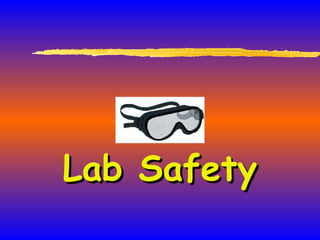
Lab SafetyLab Safety
General Safety RulesGeneral Safety Rules
1. Listen to or read instructions
carefully before attempting to do
anything.
2. Wear safety goggles to protect
your eyes from chemicals,
heated materials, or things that
might be able to shatter.
3. Notify your teacher if any spills or
accidents occur.
General Safety RulesGeneral Safety Rules
4. After handling chemicals, always
wash your hands with soap and
water.
5. During lab work, keep your hands
away from your face.
6. Tie back long hair.
General Safety RulesGeneral Safety Rules
7. Roll up loose sleeves.
8. Know the location of the fire
extinguisher, fire blanket, eyewash
station, and first aid kit.
9. Keep your work area uncluttered. Take
to the lab station only what is
necessary.
General Safety RulesGeneral Safety Rules
10. It is suggested that you wear
glasses rather than contact lenses.
11. Never put anything into your mouth
during a lab experiment.
12. Clean up your lab area at the
conclusion of the laboratory period.
13. Never “horse around” or play
practical jokes in the laboratory.
Glassware SafetyGlassware Safety
1. Chipped or cracked glassware should
not be used. Show it to the teacher.
2. Broken glassware should not be
disposed of in a classroom trashcan.
There is a special glass disposal
container for it.
3. When pouring liquids into glassware,
make sure the container you are
pouring into is resting on a table at
least a hands breadth from the edge.
Glassware SafetyGlassware Safety
4. Pour down a glass stirring rod to
prevent liquids from splattering.
5. If a piece of glassware gets broken,
do not try to clean it up by yourself.
Notify the teacher.
6. When inserting glass tubing into a
rubber stopper, apply glycerin to the
glass and use a twisting motion.
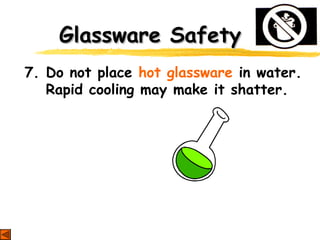
Glassware SafetyGlassware Safety
7. Do not place hot glassware in water.
Rapid cooling may make it shatter.
Chemical SafetyChemical Safety
1. Wear protective goggles and a lab
apron whenever heating or pouring
hazardous chemicals.
2. Never mix chemicals together unless
you are told to do so (and then only in
the manner specified).
3. Never taste any chemicals (you should
never taste anything in the lab).
Chemical SafetyChemical Safety
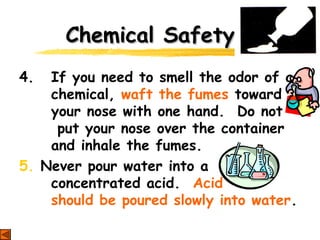
4. If you need to smell the odor of a
chemical, waft the fumes toward
your nose with one hand. Do not
put your nose over the container
and inhale the fumes.
5. Never pour water into a
concentrated acid. Acid
should be poured slowly into water.
Chemical SafetyChemical Safety
6. Follow the instructions of your
teacher when disposing of all
chemicals.
7. Wash your hands after handling
hazardous chemicals.
Electrical SafetyElectrical Safety
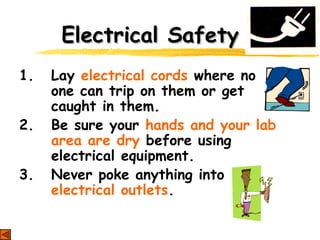
1. Lay electrical cords where no
one can trip on them or get
caught in them.
2. Be sure your hands and your lab
area are dry before using
electrical equipment.
3. Never poke anything into
electrical outlets.
Electrical SafetyElectrical Safety
4. Unplug cords by pulling the plug
and not the cord.
5. Unplug all electrical equipment at
the end of the lab period.
Heating SafetyHeating Safety
1. Let burners and hotplates cool
down before touching them. Test
to see if they are cool enough by
bringing the back of your hand
close to them.
2. Use tongs and/or protective gloves
to handle hot objects.
3. Never reach across an open flame
or burner.
Heating SafetyHeating Safety
4. The only type of glassware that may
safely be heated is either Kimax or
Pyrex.
5. Always point the top ends of test tubes
that are being heated away from people.
6. When heating a test tube, move it
around slowly over the flame to
distribute the heat evenly.
Heating SafetyHeating Safety
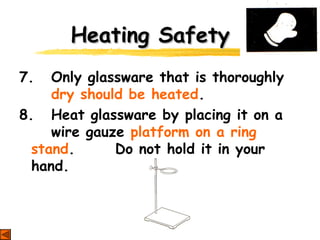
7. Only glassware that is thoroughly
dry should be heated.
8. Heat glassware by placing it on a
wire gauze platform on a ring
stand. Do not hold it in your
hand.
Heating SafetyHeating Safety
9. When lighting a burner, wait until the
striker is in place before you turn on
the gas.
10. The amount of air can be adjusted by
the air supply valve below the tube of
the burner. This regulates the flame
temperature and color.
11. Never leave a burner or hotplate
unattended.
First AidFirst Aid
Injury: Burns
What To Do: Immediately flush with
cold water until burning
sensation is lessened.
First AidFirst Aid
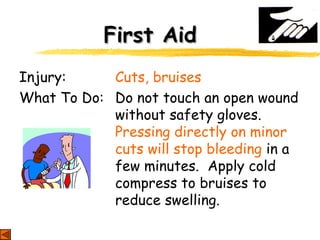
Injury: Cuts, bruises
What To Do: Do not touch an open wound
without safety gloves.
Pressing directly on minor
cuts will stop bleeding in a
few minutes. Apply cold
compress to bruises to
reduce swelling.
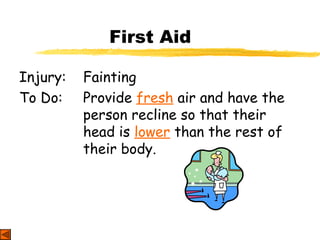
First Aid
Injury: Fainting
To Do: Provide fresh air and have the
person recline so that their
head is lower than the rest of
their body.
First AidFirst Aid
Injury: Eyes
What To Do: Flush eyes immediately
with plenty of water for
several minutes. If a
foreign object is lodged in
the eye, do not allow the
eye to be rubbed.
First AidFirst Aid
Injury: Poisoning
What To Do: Find out what substance
was responsible for the
poisoning and alert the
teacher immediately.
First AidFirst Aid
Injury: Spills on the skin
What To Do: Flush with large
quantities of water. For
acid spills, apply baking
soda solution. For base
spills, apply vinegar or
boric acid.
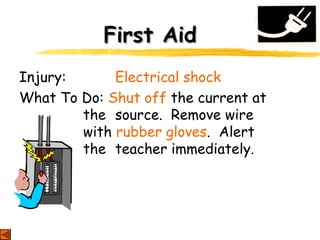
First AidFirst Aid
Injury: Electrical shock
What To Do: Shut off the current at
the source. Remove wire
with rubber gloves. Alert
the teacher immediately.
Video
http://www.youtube.com/watch?v=s6lOQ5_Vlok

Lab safety[1]

  • 1.
  • 2.
    General Safety RulesGeneralSafety Rules 1. Listen to or read instructions carefully before attempting to do anything. 2. Wear safety goggles to protect your eyes from chemicals, heated materials, or things that might be able to shatter. 3. Notify your teacher if any spills or accidents occur.
  • 3.
    General Safety RulesGeneralSafety Rules 4. After handling chemicals, always wash your hands with soap and water. 5. During lab work, keep your hands away from your face. 6. Tie back long hair.
  • 4.
    General Safety RulesGeneralSafety Rules 7. Roll up loose sleeves. 8. Know the location of the fire extinguisher, fire blanket, eyewash station, and first aid kit. 9. Keep your work area uncluttered. Take to the lab station only what is necessary.
  • 5.
    General Safety RulesGeneralSafety Rules 10. It is suggested that you wear glasses rather than contact lenses. 11. Never put anything into your mouth during a lab experiment. 12. Clean up your lab area at the conclusion of the laboratory period. 13. Never “horse around” or play practical jokes in the laboratory.
  • 6.
    Glassware SafetyGlassware Safety 1.Chipped or cracked glassware should not be used. Show it to the teacher. 2. Broken glassware should not be disposed of in a classroom trashcan. There is a special glass disposal container for it. 3. When pouring liquids into glassware, make sure the container you are pouring into is resting on a table at least a hands breadth from the edge.
  • 7.
    Glassware SafetyGlassware Safety 4.Pour down a glass stirring rod to prevent liquids from splattering. 5. If a piece of glassware gets broken, do not try to clean it up by yourself. Notify the teacher. 6. When inserting glass tubing into a rubber stopper, apply glycerin to the glass and use a twisting motion.
  • 8.
    Glassware SafetyGlassware Safety 7.Do not place hot glassware in water. Rapid cooling may make it shatter.
  • 9.
    Chemical SafetyChemical Safety 1.Wear protective goggles and a lab apron whenever heating or pouring hazardous chemicals. 2. Never mix chemicals together unless you are told to do so (and then only in the manner specified). 3. Never taste any chemicals (you should never taste anything in the lab).
  • 10.
    Chemical SafetyChemical Safety 4.If you need to smell the odor of a chemical, waft the fumes toward your nose with one hand. Do not put your nose over the container and inhale the fumes. 5. Never pour water into a concentrated acid. Acid should be poured slowly into water.
  • 11.
    Chemical SafetyChemical Safety 6.Follow the instructions of your teacher when disposing of all chemicals. 7. Wash your hands after handling hazardous chemicals.
  • 12.
    Electrical SafetyElectrical Safety 1.Lay electrical cords where no one can trip on them or get caught in them. 2. Be sure your hands and your lab area are dry before using electrical equipment. 3. Never poke anything into electrical outlets.
  • 13.
    Electrical SafetyElectrical Safety 4.Unplug cords by pulling the plug and not the cord. 5. Unplug all electrical equipment at the end of the lab period.
  • 14.
    Heating SafetyHeating Safety 1.Let burners and hotplates cool down before touching them. Test to see if they are cool enough by bringing the back of your hand close to them. 2. Use tongs and/or protective gloves to handle hot objects. 3. Never reach across an open flame or burner.
  • 15.
    Heating SafetyHeating Safety 4.The only type of glassware that may safely be heated is either Kimax or Pyrex. 5. Always point the top ends of test tubes that are being heated away from people. 6. When heating a test tube, move it around slowly over the flame to distribute the heat evenly.
  • 16.
    Heating SafetyHeating Safety 7.Only glassware that is thoroughly dry should be heated. 8. Heat glassware by placing it on a wire gauze platform on a ring stand. Do not hold it in your hand.
  • 17.
    Heating SafetyHeating Safety 9.When lighting a burner, wait until the striker is in place before you turn on the gas. 10. The amount of air can be adjusted by the air supply valve below the tube of the burner. This regulates the flame temperature and color. 11. Never leave a burner or hotplate unattended.
  • 18.
    First AidFirst Aid Injury:Burns What To Do: Immediately flush with cold water until burning sensation is lessened.
  • 19.
    First AidFirst Aid Injury:Cuts, bruises What To Do: Do not touch an open wound without safety gloves. Pressing directly on minor cuts will stop bleeding in a few minutes. Apply cold compress to bruises to reduce swelling.
  • 20.
    First Aid Injury: Fainting ToDo: Provide fresh air and have the person recline so that their head is lower than the rest of their body.
  • 21.
    First AidFirst Aid Injury:Eyes What To Do: Flush eyes immediately with plenty of water for several minutes. If a foreign object is lodged in the eye, do not allow the eye to be rubbed.
  • 22.
    First AidFirst Aid Injury:Poisoning What To Do: Find out what substance was responsible for the poisoning and alert the teacher immediately.
  • 23.
    First AidFirst Aid Injury:Spills on the skin What To Do: Flush with large quantities of water. For acid spills, apply baking soda solution. For base spills, apply vinegar or boric acid.
  • 24.
    First AidFirst Aid Injury:Electrical shock What To Do: Shut off the current at the source. Remove wire with rubber gloves. Alert the teacher immediately.
  • 25.