© ERI Solutions Inc. All Rights Reserved.
Laboratory Safety
© ERI Solutions Inc. All Rights Reserved.
Lab Safety Requirements -
AWARENESS
• Know the safety rules and SOPs that apply to
the work being done
• Know where to find and how to use laboratory
safety equipment
• Know location of SDS for all chemicals used
• Know what personal protective equipment is
available and use the right PPE for each job
• Be alert to unsafe conditions and how to
correct them.
© ERI Solutions Inc. All Rights Reserved.
Hygiene
• Wear eye protection at all times
• Use protective equipment as needed – gloves available
• No food or drink in the lab, storage rooms or lab fridge.
• Never use lab glassware or equipment for food or drinks
• No smoking
• Handle chemical waste properly – find out where it goes
• Avoid exposure to vapors, gases and aerosols – use snorkel
• Use fume hood when necessary – Draeger testing
• Wash hands after handling chemicals
© ERI Solutions Inc. All Rights Reserved.
Standard Operating Procedures (SOP)
• SOPs should be developed and used for each
laboratory analytical method and routine
laboratory task.
• An SOP manual, specific to the plant lab,
should be available in the plant laboratory.
• The SOP manual should be updated whenever
laboratory methods change or new methods
are added.
© ERI Solutions Inc. All Rights Reserved.
Housekeeping
• Clean work areas
– After each test
• Spilled chemicals
– Clean up immediately
– Dispose of properly
• Ask questions!
© ERI Solutions Inc. All Rights Reserved.
Glassware
• Prevent damage to
glassware
– Careful handling
– Storage procedures
• Glass tubing or flask
sidearm - MicroDist
– Exercise extreme care
inserting into rubber
gaskets or stoppers
• Damaged glassware
– Discard in sharps
container
– Discard if cracked or
chipped
© ERI Solutions Inc. All Rights Reserved.
Sharps
• Approved sharps container
– Must be available for
disposal of all sharps
– Prevent accidental
exposure
• Sharps generally include
– All damaged glassware
– All needles
© ERI Solutions Inc. All Rights Reserved.
Flammability Hazards
Before lighting a flame, remove all flammable
substances from the immediate area
Notify all occupants of laboratory in advance
of using an open flame
Use an open flame only when necessary
Do not use an open flame or ovens to
heat a flammable liquid
Store flammable materials properly
Flammable
Materials
SeeFirePreventionPlan
© ERI Solutions Inc. All Rights Reserved.
Fume Hoods
When transferring hazardous laboratory chemicals from one
container to another
When using equipment during an operation which may
produce splashing, sprays, fires, or a minor explosion
During operations which require heating or evaporating a solvent
When making acid or caustic solutions
During procedures that produce toxic, offensive, or flammable vapor
If a fume hood is not available in the laboratory, these types of laboratory
procedures and chemical operations will not be conducted in the
laboratory
Fume Hoods will
be used:
© ERI Solutions Inc. All Rights Reserved.
Fume Hood – Frequency & Type of Monitoring
• Quarterly
– Each fume hood
o Measure velocity of the air flow
o At the face of the hood
o Using an anemometer or a
velometer
© ERI Solutions Inc. All Rights Reserved.
Storage of Chemicals
Chemicals stored with compatible chemicals
The amount of chemicals held in inventory
shall be the minimum amount necessary
to maintain consistent operation of the lab
and plant chemical systems.
Maintain all chemical markings, placards, and labels, so
that proper use and security is maintained. Store with
labels outward facing.
Storage
© ERI Solutions Inc. All Rights Reserved.
• All liquids ( except pH buffers and
metal standards)
– Stored in liquid chemical storage area
– Stored in approved chemical storage
cabinet
• Acids and bases
– Separated on different shelves or in
different cabinets
• Organics (alcohols, ketones, etc.)
– Separated from acids and bases
– Stored in a flammable cabinet
• All dry chemicals
– Stored in dry chemical storage area
• Concentrated chemicals
– Returned to proper storage area when
not in use
• Prepared working reagents
– When properly labeled may be left on
counters
Storage of Chemicals
© ERI Solutions Inc. All Rights Reserved.
Chemical Disposal
• All chemicals will be disposed of in an environmentally
responsible manner
– All laboratory chemicals that have become outdated, or
are no longer used, will be stored in a secured area and
properly disposed of according to environmental
procedures
– All used samples, prepared working reagents will be
disposed of per the lab’s SOP
– Final disposal will be by environmental policy
© ERI Solutions Inc. All Rights Reserved.
Personal Protective
Equipment and Laboratory
Safety Equipment
© ERI Solutions Inc. All Rights Reserved.
Eye Protection
• Safety glasses with side shields must worn in lab
• Goggles or face shields will be worn when there is
danger of splashing chemicals or flying particles
• All visitors must wear safety glasses in the lab and
areas where chemicals are handled and stored.
© ERI Solutions Inc. All Rights Reserved.
Protective Apparel
• If the possibility of chemical contamination exists,
personal protective apparel shall be worn.
• Lab coats may be worn for protection of clothing
against dirt and minor chemical splashes or spills
encountered in the lab, but are not required.
• The choice of protective apparel depends on the degree
of protection required.
• Plastic or rubber aprons or full acid suits will be worn
with other PPE for protection from corrosive or
irritating liquids.
• All protective apparel will be inspected for
discoloration, punctures and tears before use.
© ERI Solutions Inc. All Rights Reserved.
Hand Protection
• Proper protective gloves will be worn with other
protective apparel whenever the potential for
contact with corrosive or toxic materials exists.
– Latex or latex-free nitrile gloves are appropriate for most
lab applications, but heavier rubber gloves are required
for working on plant chemical feed systems and for
industrial chemical exposures.
– Insulated gloves will be worn when exposed to thermal
hazards.
© ERI Solutions Inc. All Rights Reserved.
Eyewash Fountains
• Eyewash fountains will be provided in the immediate
area where laboratory chemicals are handled.
• An eyewash fountain should provide a soft stream or
spray of aerated water for at least 15 minutes.
• Eyewash fountains will be tested at least weekly to
ensure that the eyewash is operable and to remove
debris from the system.
• Portable eyewash fountains shall be inspected after
each use for quantity of water and availability.
© ERI Solutions Inc. All Rights Reserved.
Lab Employee Safety
Meetings and Training
© ERI Solutions Inc. All Rights Reserved.
Safety Meetings and Training
Each new lab employee will be trained by an experienced employee in
the areas of laboratory and chemical safety.
Employees will be provided training to ensure they are
aware of hazards and chemicals present in their work area.
All lab employees should attend regular safety meetings with lab
staff or with other plant work groups.
Such training will be provided at the time
of initial assignment and prior to being
exposed to any new exposure situations.
Safety training
© ERI Solutions Inc. All Rights Reserved.
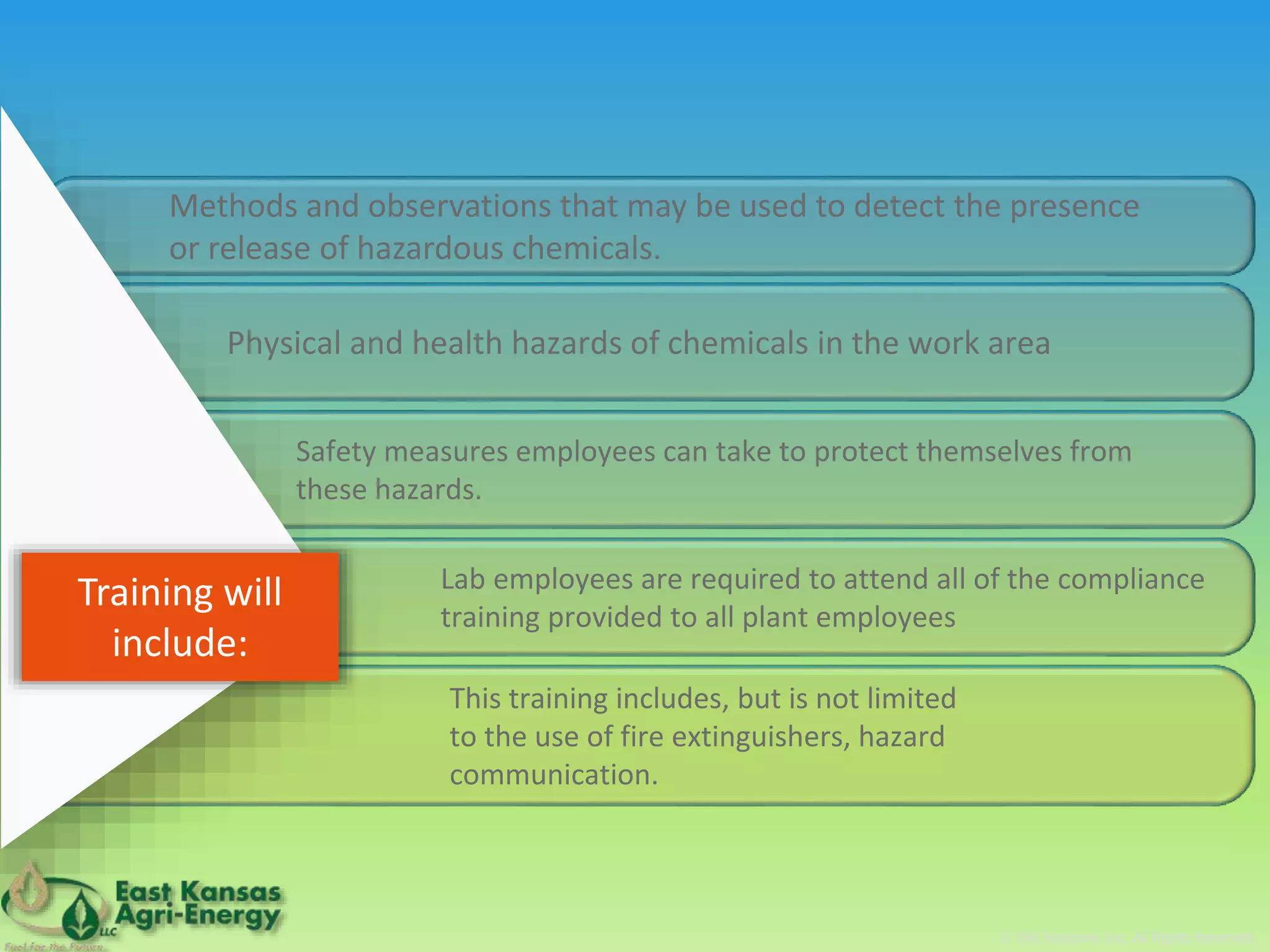
Safety measures employees can take to protect themselves from
these hazards.
Lab employees are required to attend all of the compliance
training provided to all plant employees
Physical and health hazards of chemicals in the work area
This training includes, but is not limited
to the use of fire extinguishers, hazard
communication.
Methods and observations that may be used to detect the presence
or release of hazardous chemicals.
Training will
include:
© ERI Solutions Inc. All Rights Reserved.
Questions?
© ERI Solutions Inc. All Rights Reserved.
Questions?

Lab safety ppt revised

  • 1.
    © ERI SolutionsInc. All Rights Reserved. Laboratory Safety
  • 2.
    © ERI SolutionsInc. All Rights Reserved.
  • 3.
    © ERI SolutionsInc. All Rights Reserved. Lab Safety Requirements - AWARENESS • Know the safety rules and SOPs that apply to the work being done • Know where to find and how to use laboratory safety equipment • Know location of SDS for all chemicals used • Know what personal protective equipment is available and use the right PPE for each job • Be alert to unsafe conditions and how to correct them.
  • 4.
    © ERI SolutionsInc. All Rights Reserved. Hygiene • Wear eye protection at all times • Use protective equipment as needed – gloves available • No food or drink in the lab, storage rooms or lab fridge. • Never use lab glassware or equipment for food or drinks • No smoking • Handle chemical waste properly – find out where it goes • Avoid exposure to vapors, gases and aerosols – use snorkel • Use fume hood when necessary – Draeger testing • Wash hands after handling chemicals
  • 5.
    © ERI SolutionsInc. All Rights Reserved. Standard Operating Procedures (SOP) • SOPs should be developed and used for each laboratory analytical method and routine laboratory task. • An SOP manual, specific to the plant lab, should be available in the plant laboratory. • The SOP manual should be updated whenever laboratory methods change or new methods are added.
  • 6.
    © ERI SolutionsInc. All Rights Reserved. Housekeeping • Clean work areas – After each test • Spilled chemicals – Clean up immediately – Dispose of properly • Ask questions!
  • 7.
    © ERI SolutionsInc. All Rights Reserved. Glassware • Prevent damage to glassware – Careful handling – Storage procedures • Glass tubing or flask sidearm - MicroDist – Exercise extreme care inserting into rubber gaskets or stoppers • Damaged glassware – Discard in sharps container – Discard if cracked or chipped
  • 8.
    © ERI SolutionsInc. All Rights Reserved. Sharps • Approved sharps container – Must be available for disposal of all sharps – Prevent accidental exposure • Sharps generally include – All damaged glassware – All needles
  • 9.
    © ERI SolutionsInc. All Rights Reserved. Flammability Hazards Before lighting a flame, remove all flammable substances from the immediate area Notify all occupants of laboratory in advance of using an open flame Use an open flame only when necessary Do not use an open flame or ovens to heat a flammable liquid Store flammable materials properly Flammable Materials SeeFirePreventionPlan
  • 10.
    © ERI SolutionsInc. All Rights Reserved. Fume Hoods When transferring hazardous laboratory chemicals from one container to another When using equipment during an operation which may produce splashing, sprays, fires, or a minor explosion During operations which require heating or evaporating a solvent When making acid or caustic solutions During procedures that produce toxic, offensive, or flammable vapor If a fume hood is not available in the laboratory, these types of laboratory procedures and chemical operations will not be conducted in the laboratory Fume Hoods will be used:
  • 11.
    © ERI SolutionsInc. All Rights Reserved. Fume Hood – Frequency & Type of Monitoring • Quarterly – Each fume hood o Measure velocity of the air flow o At the face of the hood o Using an anemometer or a velometer
  • 12.
    © ERI SolutionsInc. All Rights Reserved. Storage of Chemicals Chemicals stored with compatible chemicals The amount of chemicals held in inventory shall be the minimum amount necessary to maintain consistent operation of the lab and plant chemical systems. Maintain all chemical markings, placards, and labels, so that proper use and security is maintained. Store with labels outward facing. Storage
  • 13.
    © ERI SolutionsInc. All Rights Reserved. • All liquids ( except pH buffers and metal standards) – Stored in liquid chemical storage area – Stored in approved chemical storage cabinet • Acids and bases – Separated on different shelves or in different cabinets • Organics (alcohols, ketones, etc.) – Separated from acids and bases – Stored in a flammable cabinet • All dry chemicals – Stored in dry chemical storage area • Concentrated chemicals – Returned to proper storage area when not in use • Prepared working reagents – When properly labeled may be left on counters Storage of Chemicals
  • 14.
    © ERI SolutionsInc. All Rights Reserved. Chemical Disposal • All chemicals will be disposed of in an environmentally responsible manner – All laboratory chemicals that have become outdated, or are no longer used, will be stored in a secured area and properly disposed of according to environmental procedures – All used samples, prepared working reagents will be disposed of per the lab’s SOP – Final disposal will be by environmental policy
  • 15.
    © ERI SolutionsInc. All Rights Reserved. Personal Protective Equipment and Laboratory Safety Equipment
  • 16.
    © ERI SolutionsInc. All Rights Reserved. Eye Protection • Safety glasses with side shields must worn in lab • Goggles or face shields will be worn when there is danger of splashing chemicals or flying particles • All visitors must wear safety glasses in the lab and areas where chemicals are handled and stored.
  • 17.
    © ERI SolutionsInc. All Rights Reserved. Protective Apparel • If the possibility of chemical contamination exists, personal protective apparel shall be worn. • Lab coats may be worn for protection of clothing against dirt and minor chemical splashes or spills encountered in the lab, but are not required. • The choice of protective apparel depends on the degree of protection required. • Plastic or rubber aprons or full acid suits will be worn with other PPE for protection from corrosive or irritating liquids. • All protective apparel will be inspected for discoloration, punctures and tears before use.
  • 18.
    © ERI SolutionsInc. All Rights Reserved. Hand Protection • Proper protective gloves will be worn with other protective apparel whenever the potential for contact with corrosive or toxic materials exists. – Latex or latex-free nitrile gloves are appropriate for most lab applications, but heavier rubber gloves are required for working on plant chemical feed systems and for industrial chemical exposures. – Insulated gloves will be worn when exposed to thermal hazards.
  • 19.
    © ERI SolutionsInc. All Rights Reserved. Eyewash Fountains • Eyewash fountains will be provided in the immediate area where laboratory chemicals are handled. • An eyewash fountain should provide a soft stream or spray of aerated water for at least 15 minutes. • Eyewash fountains will be tested at least weekly to ensure that the eyewash is operable and to remove debris from the system. • Portable eyewash fountains shall be inspected after each use for quantity of water and availability.
  • 20.
    © ERI SolutionsInc. All Rights Reserved. Lab Employee Safety Meetings and Training
  • 21.
    © ERI SolutionsInc. All Rights Reserved. Safety Meetings and Training Each new lab employee will be trained by an experienced employee in the areas of laboratory and chemical safety. Employees will be provided training to ensure they are aware of hazards and chemicals present in their work area. All lab employees should attend regular safety meetings with lab staff or with other plant work groups. Such training will be provided at the time of initial assignment and prior to being exposed to any new exposure situations. Safety training
  • 22.
    © ERI SolutionsInc. All Rights Reserved. Safety measures employees can take to protect themselves from these hazards. Lab employees are required to attend all of the compliance training provided to all plant employees Physical and health hazards of chemicals in the work area This training includes, but is not limited to the use of fire extinguishers, hazard communication. Methods and observations that may be used to detect the presence or release of hazardous chemicals. Training will include:
  • 23.
    © ERI SolutionsInc. All Rights Reserved. Questions?
  • 24.
    © ERI SolutionsInc. All Rights Reserved. Questions?

Editor's Notes

  • #4 All employees are able to access the SDS by going to the “Z” drive-Community-Safety Files-MSDS/SDS and then proceed to the Lab chemicals and find what you need.
  • #9 An approved sharps container must be available in the lab area for disposal of all sharps. Disposal of sharps in the container prevents accidental exposure to custodial workers. Also, the container can be disposed of in a landfill. In the lab, sharps generally include all needles and all damaged or broken glassware. These should all be discarded in the sharps container. With regard to needles, never recap a needle under any circumstances.
  • #10 All flammable materials must be stored according to housekeeping procedures in the fire prevention plan. An open flame should only be used when necessary and, before lighting an open flame, all flammable substances must be removed from the immediate area. All occupants of the laboratory must be notified in advance of using an open flame. An open flame or oven should never be used to heat flammable liquids.
  • #11 Fume hoods will be used during procedures that produce toxic, offensive, or flammable vapors; during operations which require heating or evaporating a solvent; when transferring hazardous laboratory chemicals from one container to another; when using equipment during an operation which may produce splashing, sprays, fires, or a minor explosion; and when making acid or caustic solutions. If a fume hood is not available in the laboratory, these types of laboratory procedures and chemical operations will not be conducted in the laboratory.
  • #12 Fume hoods require daily, quarterly and yearly monitoring. Each fume hood will be fitted with an anemometer or other air velocity measuring device to enable the user to determine that the hood is operating properly. Each day or when operated the air velocity must be measured by an anemometer and recorded. Every quarter, each fume hood will have the velocity of the air flow at the face of the hood measured by using an anemometer or a velometer. The face velocity measurements will be taken in a grid pattern to determine the uniformity of air delivery to the hood face. A sets of measurements should be made with the hood sash fully opened and with the hood sash in one or more partially closed positions. The face velocity measurements will be recorded by laboratory personnel and maintained at the hood location.
  • #13 Some chemicals present a greater hazard when combined with other chemicals; therefore, chemicals must be stored only with compatible chemicals and in accordance with the list titled “Incompatible Chemicals In Storage & Reactions” (found in the written program). Care should be taken to maintain all chemical markings, placards, and labels, so proper use and security is maintained.
  • #14 Laboratory chemicals will be stored in a safe manner with the labels facing outward and following approved methods. All liquids, with the exception of pH buffers and metal standards, will be stored in the liquid chemical storage area or an approved chemical storage cabinet. Acids and bases will be separated on different shelves or in different cabinets. Organics (alcohols, ketones, etc.) will be separated from acids and bases and will be stored in a flammable cabinet. All dry chemicals will be stored in the dry chemical storage area. Concentrated chemicals must be returned to the proper storage area when not in use. Prepared working reagents may be left on counters as long as they are properly labeled.
  • #15 If laboratory employees use hazardous chemicals, the employer must develop and implement a written chemical hygiene plan to protect them. If the plant’s laboratory is, because of the nature of the work performed, exempt from the requirements of OSHA Regulation 29 CFR 1910.1450, (Occupational Exposure to Hazardous Chemicals in Laboratories), it is not necessary to meet the requirements of a plan. However, for good safety practice, employers should establish the same safe work practices and laboratory procedures for the laboratory as are required under the OSHA rule. "Laboratory use" means performing chemical procedures using small quantities of hazardous chemicals on a laboratory scale and not as part of a production process in an environment where protective laboratory practices and equipment are in common use.