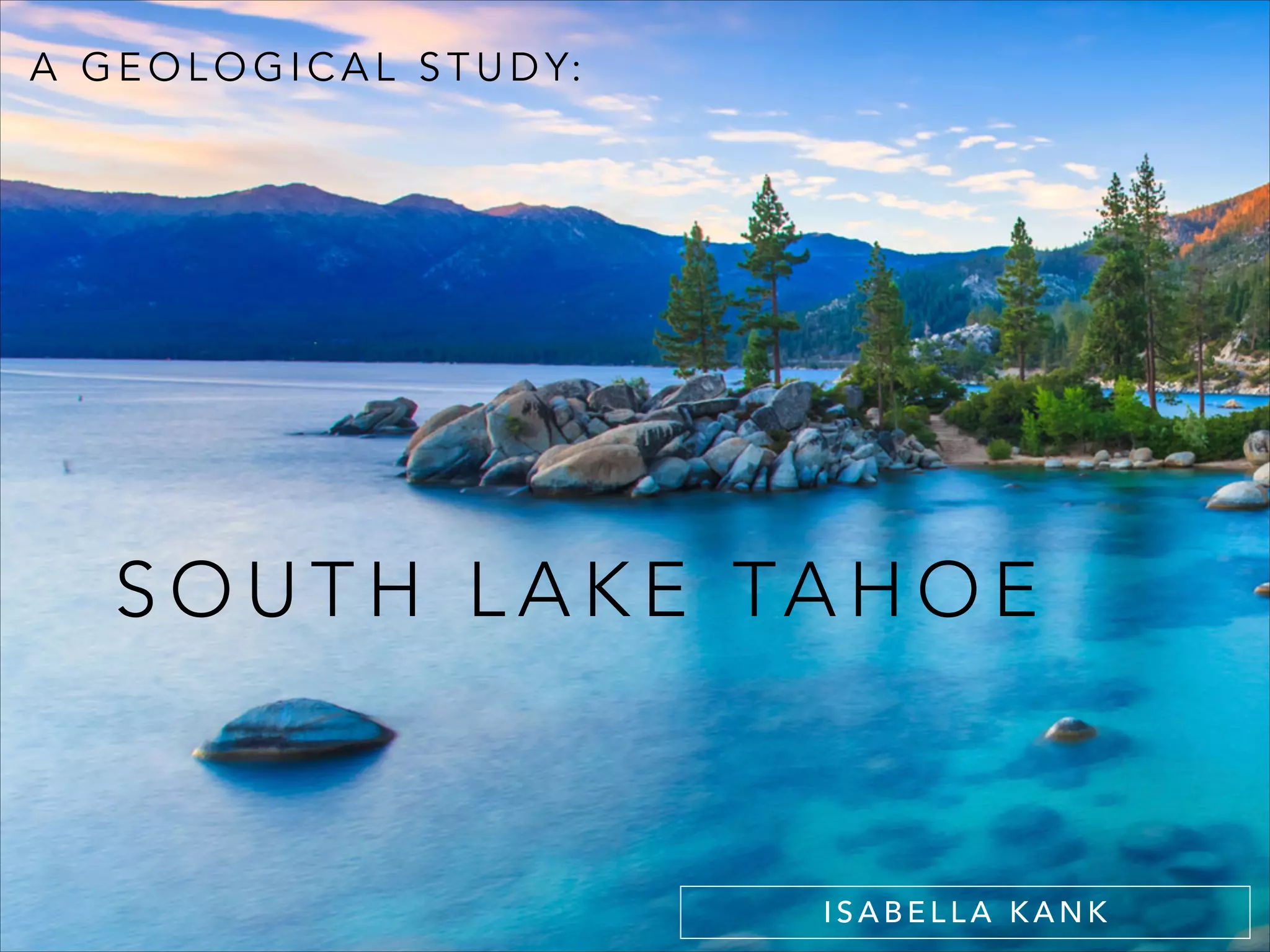
S O U T H L A K E TA H O E
A G E O L O G I C A L S T U D Y:
I S A B E L L A K A N K
I N T R O D U C T I O N
The purpose of this Slideshow is to provide you with some insight and
geologic history into the background of South Lake Tahoe and the
surrounding areas. The research provided in this essay was found
while out in the Lake Tahoe National Forest, Emerald Bay State Park,
and Truckee. I examined the evolutionary changes of Cave Rock,
Emerald Bay, and the Truckee River. I also found an two igneous-
granite rocks and a very interesting rock that I attempted to identify. I
also came across some wildlife within the Tahoe Basin that we will
identify and discuss how they have evolved over the years.
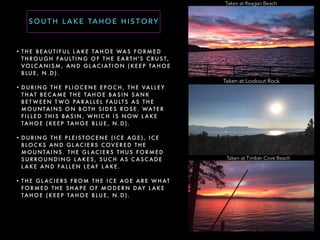
• T H E B E AU T I F U L L A K E TA H O E WA S F O R M E D
T H RO U G H FAU LT I N G O F T H E E A R T H ' S C RU S T,
VO LC A N I S M , A N D G L AC I AT I O N ( K E E P TA H O E
B LU E , N . D ) .
• D U R I N G T H E P L I O C E N E E P O C H , T H E VA L L E Y
T H AT B E C A M E T H E TA H O E BA S I N S A N K
B E T W E E N T WO PA R A L L E L FAU LT S A S T H E
M O U N TA I N S O N B OT H S I D E S RO S E . WAT E R
F I L L E D T H I S BA S I N , W H I C H I S N OW L A K E
TA H O E ( K E E P TA H O E B LU E , N . D ) .
• D U R I N G T H E P L E I S TO C E N E ( I C E AG E ) , I C E
B LO C KS A N D G L AC I E R S C OV E R E D T H E
M O U N TA I N S . T H E G L AC I E R S T H U S F O R M E D
S U R RO U N D I N G L A K E S , S U C H A S C A S C A D E
L A K E A N D FA L L E N L E A F L A K E .
• T H E G L AC I E R S F RO M T H E I C E AG E A R E W H AT
F O R M E D T H E S H A P E O F M O D E R N DAY L A K E
TA H O E ( K E E P TA H O E B LU E , N . D ) .
S O U T H L A K E TA H O E H I S T O RY
Taken at Reagan Beach
Taken at Lookout Rock
Taken at Timber Cove Beach
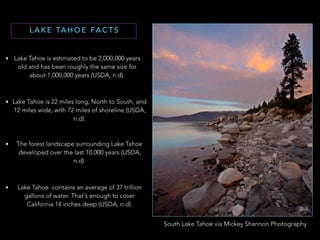
L A K E TA H O E FA C T S
South Lake Tahoe via Mickey Shannon Photography
• Lake Tahoe is estimated to be 2,000,000 years
old and has been roughly the same size for
about 1,000,000 years (USDA, n.d).
• Lake Tahoe is 22 miles long, North to South, and
12 miles wide, with 72 miles of shoreline (USDA,
n.d).
• The forest landscape surrounding Lake Tahoe
developed over the last 10,000 years (USDA,
n.d).
• Lake Tahoe contains an average of 37 trillion
gallons of water. That's enough to cover
California 14 inches deep (USDA, n.d).
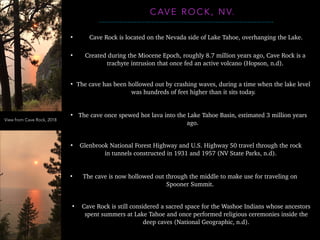
View from Cave Rock, 2018
C AV E R O C K , N V.
• Cave Rock is located on the Nevada side of Lake Tahoe, overhanging the Lake.
• Created during the Miocene Epoch, roughly 8.7 million years ago, Cave Rock is a
trachyte intrusion that once fed an active volcano (Hopson, n.d).
• The cave has been hollowed out by crashing waves, during a time when the lake level
was hundreds of feet higher than it sits today.
• The cave once spewed hot lava into the Lake Tahoe Basin, estimated 3 million years
ago.
• The cave is now hollowed out through the middle to make use for traveling on
Spooner Summit.
• Glenbrook National Forest Highway and U.S. Highway 50 travel through the rock
in tunnels constructed in 1931 and 1957 (NV State Parks, n.d).
• Cave Rock is still considered a sacred space for the Washoe Indians whose ancestors
spent summers at Lake Tahoe and once performed religious ceremonies inside the
deep caves (National Geographic, n.d).
C AV E R O C K : T H E N & N O W
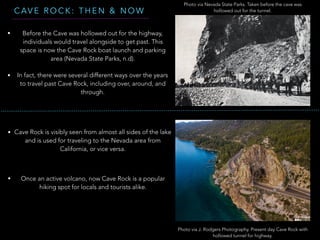
Photo via Nevada State Parks. Taken before the cave was
hollowed out for the tunnel.
Photo via J. Rodgers Photography. Present day Cave Rock with
hollowed tunnel for highway.
• Before the Cave was hollowed out for the highway,
individuals would travel alongside to get past. This
space is now the Cave Rock boat launch and parking
area (Nevada State Parks, n.d).
• In fact, there were several different ways over the years
to travel past Cave Rock, including over, around, and
through.
• Cave Rock is visibly seen from almost all sides of the lake
and is used for traveling to the Nevada area from
California, or vice versa.
• Once an active volcano, now Cave Rock is a popular
hiking spot for locals and tourists alike.
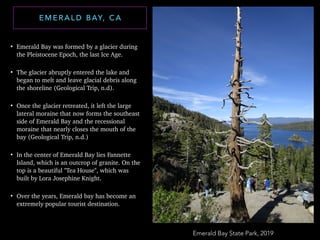
• Emerald Bay was formed by a glacier during
the Pleistocene Epoch, the last Ice Age.
• The glacier abruptly entered the lake and
began to melt and leave glacial debris along
the shoreline (Geological Trip, n.d).
• Once the glacier retreated, it left the large
lateral moraine that now forms the southeast
side of Emerald Bay and the recessional
moraine that nearly closes the mouth of the
bay (Geological Trip, n.d.)
• In the center of Emerald Bay lies Fannette
Island, which is an outcrop of granite. On the
top is a beautiful "Tea House", which was
built by Lora Josephine Knight.
• Over the years, Emerald bay has become an
extremely popular tourist destination.
E M E R A L D B AY, C A
Emerald Bay State Park, 2019
R A C C O O N ( P R O C Y O N L O T O R )
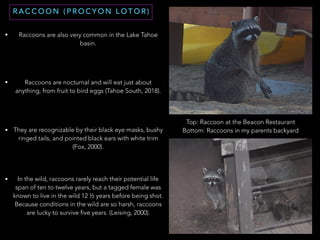
Top: Raccoon at the Beacon Restaurant
Bottom: Raccoons in my parents backyard
• Raccoons are also very common in the Lake Tahoe
basin.
• Raccoons are nocturnal and will eat just about
anything, from fruit to bird eggs (Tahoe South, 2018).
• They are recognizable by their black eye masks, bushy
ringed tails, and pointed black ears with white trim
(Fox, 2000).
• In the wild, raccoons rarely reach their potential life
span of ten to twelve years, but a tagged female was
known to live in the wild 12 ½ years before being shot.
Because conditions in the wild are so harsh, raccoons
are lucky to survive five years. (Leising, 2000).
H O W D I D R A C C O O N S E V O LV E ?
• During the Cretaceous period, about 135 million years ago (mya), the earliest known placental mammals
were insectivores (Leising, 2000).
Photo via Kirsten Leising
• A placental mammal, Procyon lotor, the common North American raccoon, is a member of the family
Procyonidae under the order of Carnivora (Leising, 2000).
• The raccoon’s ancestry
has been successfully
traced back to the genera
Phlaocyon and Cynodictis
from the Lower Miocene
or Oligocene (37 mya)
periods (Leising, 2000)
• By the early Pleistocene
period, 2.5 mya, the
genus Procyon was well
represented throughout
North America, where it
ranged from the Atlantic
to the Pacific oceans
across the present
United States (Leising,
2000).
B L A C K B E A R
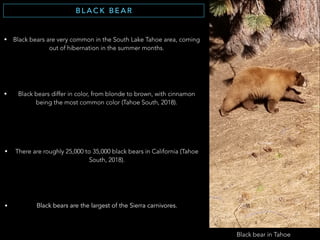
• Black bears are very common in the South Lake Tahoe area, coming
out of hibernation in the summer months.
• Black bears differ in color, from blonde to brown, with cinnamon
being the most common color (Tahoe South, 2018).
• There are roughly 25,000 to 35,000 black bears in California (Tahoe
South, 2018).
• Black bears are the largest of the Sierra carnivores.
Black bear in Tahoe
H O W D I D B L A C K
B E A R S E V O LV E ?
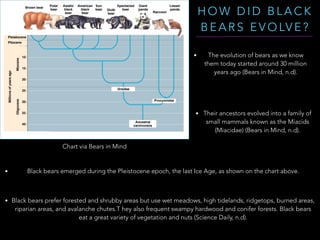
• The evolution of bears as we know
them today started around 30 million
years ago (Bears in Mind, n.d).
• Their ancestors evolved into a family of
small mammals known as the Miacids
(Miacidae) (Bears in Mind, n.d).
• Black bears emerged during the Pleistocene epoch, the last Ice Age, as shown on the chart above.
• Black bears prefer forested and shrubby areas but use wet meadows, high tidelands, ridgetops, burned areas,
riparian areas, and avalanche chutes.T hey also frequent swampy hardwood and conifer forests. Black bears
eat a great variety of vegetation and nuts (Science Daily, n.d).
Chart via Bears in Mind
I G N E O U S - G R A N I T E
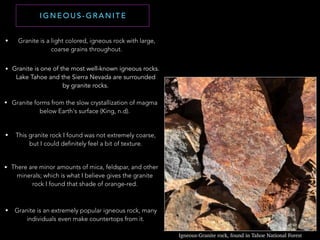
Igneous-Granite rock, found in Tahoe National Forest
• Granite is a light colored, igneous rock with large,
coarse grains throughout.
• Granite is one of the most well-known igneous rocks.
Lake Tahoe and the Sierra Nevada are surrounded
by granite rocks.
• Granite forms from the slow crystallization of magma
below Earth's surface (King, n.d).
• This granite rock I found was not extremely coarse,
but I could definitely feel a bit of texture.
• There are minor amounts of mica, feldspar, and other
minerals; which is what I believe gives the granite
rock I found that shade of orange-red.
• Granite is an extremely popular igneous rock, many
individuals even make countertops from it.
H E A R T- S H A P E D
I G N E O U S - G R A N I T E
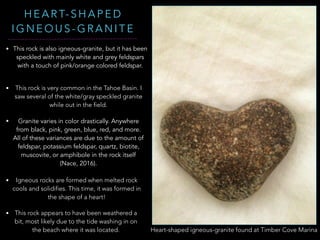
Heart-shaped igneous-granite found at Timber Cove Marina
• This rock is also igneous-granite, but it has been
speckled with mainly white and grey feldspars
with a touch of pink/orange colored feldspar.
• This rock is very common in the Tahoe Basin. I
saw several of the white/gray speckled granite
while out in the field.
• Granite varies in color drastically. Anywhere
from black, pink, green, blue, red, and more.
All of these variances are due to the amount of
feldspar, potassium feldspar, quartz, biotite,
muscovite, or amphibole in the rock itself
(Nace, 2016).
• Igneous rocks are formed when melted rock
cools and solidifies. This time, it was formed in
the shape of a heart!
• This rock appears to have been weathered a
bit, most likely due to the tide washing in on
the beach where it was located.
R E D C O N G L O M E R AT E -
S E D I M E N TA RY
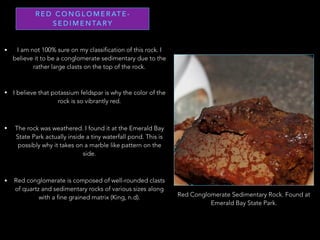
• I am not 100% sure on my classification of this rock. I
believe it to be a conglomerate sedimentary due to the
rather large clasts on the top of the rock.
• I believe that potassium feldspar is why the color of the
rock is so vibrantly red.
• The rock was weathered. I found it at the Emerald Bay
State Park actually inside a tiny waterfall pond. This is
possibly why it takes on a marble like pattern on the
side.
Red Conglomerate Sedimentary Rock. Found at
Emerald Bay State Park.
• Red conglomerate is composed of well-rounded clasts
of quartz and sedimentary rocks of various sizes along
with a fine grained matrix (King, n.d).
L AW O F S U P E R - P O S I T I O N
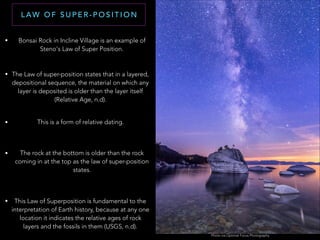
• Bonsai Rock in Incline Village is an example of
Steno's Law of Super Position.
Photo via Optimal Focus Photography
• The Law of super-position states that in a layered,
depositional sequence, the material on which any
layer is deposited is older than the layer itself
(Relative Age, n.d).
• This is a form of relative dating.
• The rock at the bottom is older than the rock
coming in at the top as the law of super-position
states.
• This Law of Superposition is fundamental to the
interpretation of Earth history, because at any one
location it indicates the relative ages of rock
layers and the fossils in them (USGS, n.d).
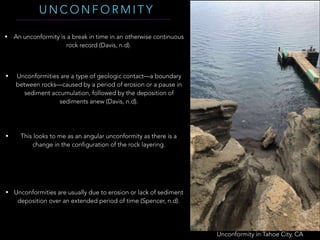
Unconformity in Tahoe City, CA
U N C O N F O R M I T Y
• An unconformity is a break in time in an otherwise continuous
rock record (Davis, n.d).
• Unconformities are a type of geologic contact—a boundary
between rocks—caused by a period of erosion or a pause in
sediment accumulation, followed by the deposition of
sediments anew (Davis, n.d).
• This looks to me as an angular unconformity as there is a
change in the configuration of the rock layering.
• Unconformities are usually due to erosion or lack of sediment
deposition over an extended period of time (Spencer, n.d).
R E F E R E N C E S
Keep Tahoe Blue. (n.d). Fun Facts & History. Retrieved June 06, 2019, from https://www.keeptahoeblue.org/
abouttahoe/historyfacts
National Geographic. (n.d). Cave Rock - Sierra Nevada Geotourism. Retrieved June 06, 2019 from https://
www.sierranevadageotourism.org/content/cave-rock/sied297f2dc0d30d2ca8
Hopson, F. (2012, August 6). Travels in Geology: Lake Tahoe Jewel of the Sierra Nevada. Retrieved June 06, 2019,
from https://www.earthmagazine.org/article/travels-geology-lake-tahoe-jewel-sierra-nevada
Tahoe South. (n.d). Emerald Bay | Emerald Bay Lake Tahoe. Retrieved June 11, 2019, from https://
tahoesouth.com/emerald-bay/
Geologic Trip. (n.d). Geologic Trip. Lake Tahoe Area Emerald bay. Retrieved June 11, 2019, from http://
www.geologictrips.com/sn/snpeb.htm
Konigsmark, T. (n.d). Geologic Trips, Sierra Nevada. Retrieved June 12, 2019, from http://
www.geologictrips.com/sn/snttlt.pdf
King, H. (n.d). Granite: Igneous Rock. Retrieved June 12, 2019, from https://geology.com/rocks/granite.shtml
R E F E R E N C E S - PA G E T W O
Howard, G. (n.d.). Ice, Fire, and Granite. Retrieved June 12, 2019, from http://tahoequarterly.com/
winter-2015-2016/ice-fire-and-granite
Nace, T. (2016, June 5). Why Granite Colors Range From White To Black. Retrieved June 12, 2019, from
https://www.forbes.com/sites/trevornace/2016/06/05/granite-colors-white-black-countertops/#b5583507b982
King, H. (n.d). Conglomerate: Sedimentary Rocks. Retrieved June 12, 2019, from https://geology.com/rocks/
conglomerate.shtml
Coates, G. (n.d). History of the Truckee Area. Retrieved June 13, 2019, from https://www.truckeehistory.org/
history-of-the-truckee-area.html
Bears in Mind. (n.d). The evolution of bear species. Retrieved June 13, 2019, from https://
www.bearsinmind.org/Page/The-evolution-of-bear-species
Tahoe South. (2018, June 11). Mammals of the Lake Tahoe Basin. Retrieved June 13, 2019, from https://
tahoesouth.com/explore/attractions-blog/articles/tahoe-mammals/
Leising, K. (2000). The Biogeography of the Raccoon (Procyon lotor). Retrieved June 13, 2019, from http://
online.sfsu.edu/bholzman/courses/Fall00Projects/raccoon.html
R E F E R E N C E S - PA G E T H R E E
Relative Age. (n.d). Determining Relative Age From The Rock Record. Retrieved June 13, 2019, from http://
academic.brooklyn.cuny.edu/geology/leveson/core/topics/time/froshlec8.html
USGS. (n.d). Fossils, Rocks, and Time: Rocks and Layers. Retrieved June 13, 2019, from https://pubs.usgs.gov/
gip/fossils/rocks-layers.html
Spencer, C. (n.d). Unconformities in Geology: Definition and Types. Retrieved June 13, 2019, from https://
study.com/academy/lesson/unconformities-in-geology-definition-types-quiz.html
Davis, J. (n.d). Glad You Asked: What is an Unconformity? Retrieved June 13, 2019, from https://
geology.utah.gov/map-pub/survey-notes/glad-you-asked/unconformity/

Geologic Study: South Lake Tahoe

  • 1.
    S O UT H L A K E TA H O E A G E O L O G I C A L S T U D Y: I S A B E L L A K A N K
  • 2.
    I N TR O D U C T I O N The purpose of this Slideshow is to provide you with some insight and geologic history into the background of South Lake Tahoe and the surrounding areas. The research provided in this essay was found while out in the Lake Tahoe National Forest, Emerald Bay State Park, and Truckee. I examined the evolutionary changes of Cave Rock, Emerald Bay, and the Truckee River. I also found an two igneous- granite rocks and a very interesting rock that I attempted to identify. I also came across some wildlife within the Tahoe Basin that we will identify and discuss how they have evolved over the years.
  • 3.
    • T HE B E AU T I F U L L A K E TA H O E WA S F O R M E D T H RO U G H FAU LT I N G O F T H E E A R T H ' S C RU S T, VO LC A N I S M , A N D G L AC I AT I O N ( K E E P TA H O E B LU E , N . D ) . • D U R I N G T H E P L I O C E N E E P O C H , T H E VA L L E Y T H AT B E C A M E T H E TA H O E BA S I N S A N K B E T W E E N T WO PA R A L L E L FAU LT S A S T H E M O U N TA I N S O N B OT H S I D E S RO S E . WAT E R F I L L E D T H I S BA S I N , W H I C H I S N OW L A K E TA H O E ( K E E P TA H O E B LU E , N . D ) . • D U R I N G T H E P L E I S TO C E N E ( I C E AG E ) , I C E B LO C KS A N D G L AC I E R S C OV E R E D T H E M O U N TA I N S . T H E G L AC I E R S T H U S F O R M E D S U R RO U N D I N G L A K E S , S U C H A S C A S C A D E L A K E A N D FA L L E N L E A F L A K E . • T H E G L AC I E R S F RO M T H E I C E AG E A R E W H AT F O R M E D T H E S H A P E O F M O D E R N DAY L A K E TA H O E ( K E E P TA H O E B LU E , N . D ) . S O U T H L A K E TA H O E H I S T O RY Taken at Reagan Beach Taken at Lookout Rock Taken at Timber Cove Beach
  • 4.
    L A KE TA H O E FA C T S South Lake Tahoe via Mickey Shannon Photography • Lake Tahoe is estimated to be 2,000,000 years old and has been roughly the same size for about 1,000,000 years (USDA, n.d). • Lake Tahoe is 22 miles long, North to South, and 12 miles wide, with 72 miles of shoreline (USDA, n.d). • The forest landscape surrounding Lake Tahoe developed over the last 10,000 years (USDA, n.d). • Lake Tahoe contains an average of 37 trillion gallons of water. That's enough to cover California 14 inches deep (USDA, n.d).
  • 5.
    View from CaveRock, 2018 C AV E R O C K , N V. • Cave Rock is located on the Nevada side of Lake Tahoe, overhanging the Lake. • Created during the Miocene Epoch, roughly 8.7 million years ago, Cave Rock is a trachyte intrusion that once fed an active volcano (Hopson, n.d). • The cave has been hollowed out by crashing waves, during a time when the lake level was hundreds of feet higher than it sits today. • The cave once spewed hot lava into the Lake Tahoe Basin, estimated 3 million years ago. • The cave is now hollowed out through the middle to make use for traveling on Spooner Summit. • Glenbrook National Forest Highway and U.S. Highway 50 travel through the rock in tunnels constructed in 1931 and 1957 (NV State Parks, n.d). • Cave Rock is still considered a sacred space for the Washoe Indians whose ancestors spent summers at Lake Tahoe and once performed religious ceremonies inside the deep caves (National Geographic, n.d).
  • 6.
    C AV ER O C K : T H E N & N O W Photo via Nevada State Parks. Taken before the cave was hollowed out for the tunnel. Photo via J. Rodgers Photography. Present day Cave Rock with hollowed tunnel for highway. • Before the Cave was hollowed out for the highway, individuals would travel alongside to get past. This space is now the Cave Rock boat launch and parking area (Nevada State Parks, n.d). • In fact, there were several different ways over the years to travel past Cave Rock, including over, around, and through. • Cave Rock is visibly seen from almost all sides of the lake and is used for traveling to the Nevada area from California, or vice versa. • Once an active volcano, now Cave Rock is a popular hiking spot for locals and tourists alike.
  • 7.
    • Emerald Baywas formed by a glacier during the Pleistocene Epoch, the last Ice Age. • The glacier abruptly entered the lake and began to melt and leave glacial debris along the shoreline (Geological Trip, n.d). • Once the glacier retreated, it left the large lateral moraine that now forms the southeast side of Emerald Bay and the recessional moraine that nearly closes the mouth of the bay (Geological Trip, n.d.) • In the center of Emerald Bay lies Fannette Island, which is an outcrop of granite. On the top is a beautiful "Tea House", which was built by Lora Josephine Knight. • Over the years, Emerald bay has become an extremely popular tourist destination. E M E R A L D B AY, C A Emerald Bay State Park, 2019
  • 8.
    R A CC O O N ( P R O C Y O N L O T O R ) Top: Raccoon at the Beacon Restaurant Bottom: Raccoons in my parents backyard • Raccoons are also very common in the Lake Tahoe basin. • Raccoons are nocturnal and will eat just about anything, from fruit to bird eggs (Tahoe South, 2018). • They are recognizable by their black eye masks, bushy ringed tails, and pointed black ears with white trim (Fox, 2000). • In the wild, raccoons rarely reach their potential life span of ten to twelve years, but a tagged female was known to live in the wild 12 ½ years before being shot. Because conditions in the wild are so harsh, raccoons are lucky to survive five years. (Leising, 2000).
  • 9.
    H O WD I D R A C C O O N S E V O LV E ? • During the Cretaceous period, about 135 million years ago (mya), the earliest known placental mammals were insectivores (Leising, 2000). Photo via Kirsten Leising • A placental mammal, Procyon lotor, the common North American raccoon, is a member of the family Procyonidae under the order of Carnivora (Leising, 2000). • The raccoon’s ancestry has been successfully traced back to the genera Phlaocyon and Cynodictis from the Lower Miocene or Oligocene (37 mya) periods (Leising, 2000) • By the early Pleistocene period, 2.5 mya, the genus Procyon was well represented throughout North America, where it ranged from the Atlantic to the Pacific oceans across the present United States (Leising, 2000).
  • 10.
    B L AC K B E A R • Black bears are very common in the South Lake Tahoe area, coming out of hibernation in the summer months. • Black bears differ in color, from blonde to brown, with cinnamon being the most common color (Tahoe South, 2018). • There are roughly 25,000 to 35,000 black bears in California (Tahoe South, 2018). • Black bears are the largest of the Sierra carnivores. Black bear in Tahoe
  • 11.
    H O WD I D B L A C K B E A R S E V O LV E ? • The evolution of bears as we know them today started around 30 million years ago (Bears in Mind, n.d). • Their ancestors evolved into a family of small mammals known as the Miacids (Miacidae) (Bears in Mind, n.d). • Black bears emerged during the Pleistocene epoch, the last Ice Age, as shown on the chart above. • Black bears prefer forested and shrubby areas but use wet meadows, high tidelands, ridgetops, burned areas, riparian areas, and avalanche chutes.T hey also frequent swampy hardwood and conifer forests. Black bears eat a great variety of vegetation and nuts (Science Daily, n.d). Chart via Bears in Mind
  • 12.
    I G NE O U S - G R A N I T E Igneous-Granite rock, found in Tahoe National Forest • Granite is a light colored, igneous rock with large, coarse grains throughout. • Granite is one of the most well-known igneous rocks. Lake Tahoe and the Sierra Nevada are surrounded by granite rocks. • Granite forms from the slow crystallization of magma below Earth's surface (King, n.d). • This granite rock I found was not extremely coarse, but I could definitely feel a bit of texture. • There are minor amounts of mica, feldspar, and other minerals; which is what I believe gives the granite rock I found that shade of orange-red. • Granite is an extremely popular igneous rock, many individuals even make countertops from it.
  • 13.
    H E AR T- S H A P E D I G N E O U S - G R A N I T E Heart-shaped igneous-granite found at Timber Cove Marina • This rock is also igneous-granite, but it has been speckled with mainly white and grey feldspars with a touch of pink/orange colored feldspar. • This rock is very common in the Tahoe Basin. I saw several of the white/gray speckled granite while out in the field. • Granite varies in color drastically. Anywhere from black, pink, green, blue, red, and more. All of these variances are due to the amount of feldspar, potassium feldspar, quartz, biotite, muscovite, or amphibole in the rock itself (Nace, 2016). • Igneous rocks are formed when melted rock cools and solidifies. This time, it was formed in the shape of a heart! • This rock appears to have been weathered a bit, most likely due to the tide washing in on the beach where it was located.
  • 14.
    R E DC O N G L O M E R AT E - S E D I M E N TA RY • I am not 100% sure on my classification of this rock. I believe it to be a conglomerate sedimentary due to the rather large clasts on the top of the rock. • I believe that potassium feldspar is why the color of the rock is so vibrantly red. • The rock was weathered. I found it at the Emerald Bay State Park actually inside a tiny waterfall pond. This is possibly why it takes on a marble like pattern on the side. Red Conglomerate Sedimentary Rock. Found at Emerald Bay State Park. • Red conglomerate is composed of well-rounded clasts of quartz and sedimentary rocks of various sizes along with a fine grained matrix (King, n.d).
  • 15.
    L AW OF S U P E R - P O S I T I O N • Bonsai Rock in Incline Village is an example of Steno's Law of Super Position. Photo via Optimal Focus Photography • The Law of super-position states that in a layered, depositional sequence, the material on which any layer is deposited is older than the layer itself (Relative Age, n.d). • This is a form of relative dating. • The rock at the bottom is older than the rock coming in at the top as the law of super-position states. • This Law of Superposition is fundamental to the interpretation of Earth history, because at any one location it indicates the relative ages of rock layers and the fossils in them (USGS, n.d).
  • 16.
    Unconformity in TahoeCity, CA U N C O N F O R M I T Y • An unconformity is a break in time in an otherwise continuous rock record (Davis, n.d). • Unconformities are a type of geologic contact—a boundary between rocks—caused by a period of erosion or a pause in sediment accumulation, followed by the deposition of sediments anew (Davis, n.d). • This looks to me as an angular unconformity as there is a change in the configuration of the rock layering. • Unconformities are usually due to erosion or lack of sediment deposition over an extended period of time (Spencer, n.d).
  • 17.
    R E FE R E N C E S Keep Tahoe Blue. (n.d). Fun Facts & History. Retrieved June 06, 2019, from https://www.keeptahoeblue.org/ abouttahoe/historyfacts National Geographic. (n.d). Cave Rock - Sierra Nevada Geotourism. Retrieved June 06, 2019 from https:// www.sierranevadageotourism.org/content/cave-rock/sied297f2dc0d30d2ca8 Hopson, F. (2012, August 6). Travels in Geology: Lake Tahoe Jewel of the Sierra Nevada. Retrieved June 06, 2019, from https://www.earthmagazine.org/article/travels-geology-lake-tahoe-jewel-sierra-nevada Tahoe South. (n.d). Emerald Bay | Emerald Bay Lake Tahoe. Retrieved June 11, 2019, from https:// tahoesouth.com/emerald-bay/ Geologic Trip. (n.d). Geologic Trip. Lake Tahoe Area Emerald bay. Retrieved June 11, 2019, from http:// www.geologictrips.com/sn/snpeb.htm Konigsmark, T. (n.d). Geologic Trips, Sierra Nevada. Retrieved June 12, 2019, from http:// www.geologictrips.com/sn/snttlt.pdf King, H. (n.d). Granite: Igneous Rock. Retrieved June 12, 2019, from https://geology.com/rocks/granite.shtml
  • 18.
    R E FE R E N C E S - PA G E T W O Howard, G. (n.d.). Ice, Fire, and Granite. Retrieved June 12, 2019, from http://tahoequarterly.com/ winter-2015-2016/ice-fire-and-granite Nace, T. (2016, June 5). Why Granite Colors Range From White To Black. Retrieved June 12, 2019, from https://www.forbes.com/sites/trevornace/2016/06/05/granite-colors-white-black-countertops/#b5583507b982 King, H. (n.d). Conglomerate: Sedimentary Rocks. Retrieved June 12, 2019, from https://geology.com/rocks/ conglomerate.shtml Coates, G. (n.d). History of the Truckee Area. Retrieved June 13, 2019, from https://www.truckeehistory.org/ history-of-the-truckee-area.html Bears in Mind. (n.d). The evolution of bear species. Retrieved June 13, 2019, from https:// www.bearsinmind.org/Page/The-evolution-of-bear-species Tahoe South. (2018, June 11). Mammals of the Lake Tahoe Basin. Retrieved June 13, 2019, from https:// tahoesouth.com/explore/attractions-blog/articles/tahoe-mammals/ Leising, K. (2000). The Biogeography of the Raccoon (Procyon lotor). Retrieved June 13, 2019, from http:// online.sfsu.edu/bholzman/courses/Fall00Projects/raccoon.html
  • 19.
    R E FE R E N C E S - PA G E T H R E E Relative Age. (n.d). Determining Relative Age From The Rock Record. Retrieved June 13, 2019, from http:// academic.brooklyn.cuny.edu/geology/leveson/core/topics/time/froshlec8.html USGS. (n.d). Fossils, Rocks, and Time: Rocks and Layers. Retrieved June 13, 2019, from https://pubs.usgs.gov/ gip/fossils/rocks-layers.html Spencer, C. (n.d). Unconformities in Geology: Definition and Types. Retrieved June 13, 2019, from https:// study.com/academy/lesson/unconformities-in-geology-definition-types-quiz.html Davis, J. (n.d). Glad You Asked: What is an Unconformity? Retrieved June 13, 2019, from https:// geology.utah.gov/map-pub/survey-notes/glad-you-asked/unconformity/