Political Economy of Parcel Tax
in California School Districts
Soomi Lee, Ph.D.
Assistant Professor
University of La Verne
April 30, 2015
Lincoln Institute
Cambridge, MA
Parcel tax
• Define parcel tax
• Regressivity
• Parcel taxes to supplement school funding
in California
• Study political economy of parcel tax
adoption
History
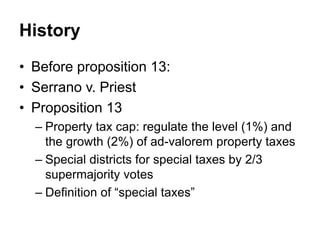
• Before proposition 13:
• Serrano v. Priest
• Proposition 13
– Property tax cap: regulate the level (1%) and
the growth (2%) of ad-valorem property taxes
– Special districts for special taxes by 2/3
supermajority votes
– Definition of “special taxes”
California Tax Foundation, 2014
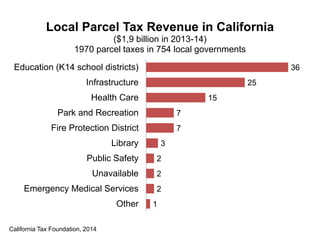
36
25
15
7
7
3
2
2
2
1
Education (K14 school districts)
Infrastructure
Health Care
Park and Recreation
Fire Protection District
Library
Public Safety
Unavailable
Emergency Medical Services
Other
Local Parcel Tax Revenue in California
($1,9 billion in 2013-14)
1970 parcel taxes in 754 local governments
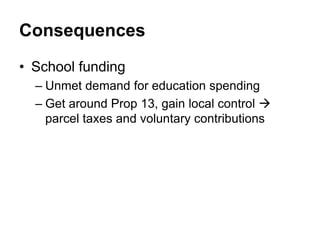
Consequences
• School funding
– Unmet demand for education spending
– Get around Prop 13, gain local control 
parcel taxes and voluntary contributions
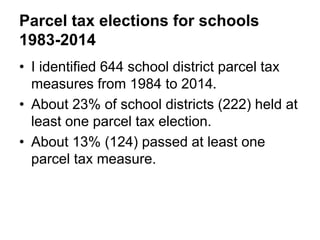
Parcel tax elections for schools
1983-2014
• I identified 644 school district parcel tax
measures from 1984 to 2014.
• About 23% of school districts (222) held at
least one parcel tax election.
• About 13% (124) passed at least one
parcel tax measure.
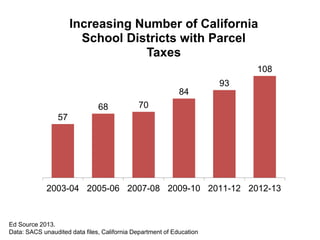
57
68 70
84
93
108
2003-04 2005-06 2007-08 2009-10 2011-12 2012-13
Increasing Number of California
School Districts with Parcel
Taxes
Ed Source 2013.
Data: SACS unaudited data files, California Department of Education
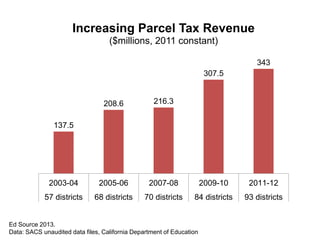
137.5
208.6 216.3
307.5
343
2003-04 2005-06 2007-08 2009-10 2011-12
57 districts 68 districts 70 districts 84 districts 93 districts
Increasing Parcel Tax Revenue
($millions, 2011 constant)
Ed Source 2013.
Data: SACS unaudited data files, California Department of Education
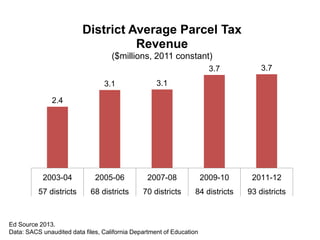
2.4
3.1 3.1
3.7 3.7
2003-04 2005-06 2007-08 2009-10 2011-12
57 districts 68 districts 70 districts 84 districts 93 districts
District Average Parcel Tax
Revenue
($millions, 2011 constant)
Ed Source 2013.
Data: SACS unaudited data files, California Department of Education
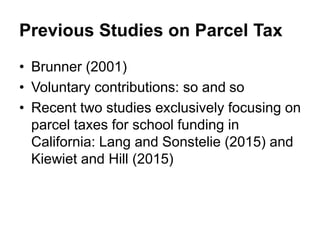
Previous Studies on Parcel Tax
• Brunner (2001)
• Voluntary contributions: so and so
• Recent two studies exclusively focusing on
parcel taxes for school funding in
California: Lang and Sonstelie (2015) and
Kiewiet and Hill (2015)
Lang and Sonstelie (2015)
• Marginal cost of schooling
Kiewiet and Hill (2015)
• Political ideology
• Electoral strategy of school boards
Gap in the literature
• Political economic perspective
• Income distribution
• Methodology
Main contribution in one
sentence
Model
Empirical Strategy
• Matching method
• Parcel tax measures v. school construction
bond measures
Data
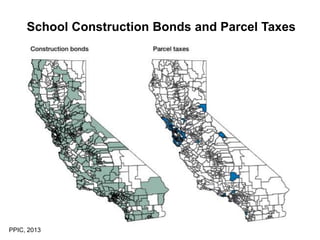
School Construction Bonds and Parcel Taxes
PPIC, 2013

Lincoln Institute 2015

  • 1.
    Political Economy ofParcel Tax in California School Districts Soomi Lee, Ph.D. Assistant Professor University of La Verne April 30, 2015 Lincoln Institute Cambridge, MA
  • 2.
    Parcel tax • Defineparcel tax • Regressivity • Parcel taxes to supplement school funding in California • Study political economy of parcel tax adoption
  • 3.
    History • Before proposition13: • Serrano v. Priest • Proposition 13 – Property tax cap: regulate the level (1%) and the growth (2%) of ad-valorem property taxes – Special districts for special taxes by 2/3 supermajority votes – Definition of “special taxes”
  • 4.
    California Tax Foundation,2014 36 25 15 7 7 3 2 2 2 1 Education (K14 school districts) Infrastructure Health Care Park and Recreation Fire Protection District Library Public Safety Unavailable Emergency Medical Services Other Local Parcel Tax Revenue in California ($1,9 billion in 2013-14) 1970 parcel taxes in 754 local governments
  • 5.
    Consequences • School funding –Unmet demand for education spending – Get around Prop 13, gain local control  parcel taxes and voluntary contributions
  • 6.
    Parcel tax electionsfor schools 1983-2014 • I identified 644 school district parcel tax measures from 1984 to 2014. • About 23% of school districts (222) held at least one parcel tax election. • About 13% (124) passed at least one parcel tax measure.
  • 7.
    57 68 70 84 93 108 2003-04 2005-062007-08 2009-10 2011-12 2012-13 Increasing Number of California School Districts with Parcel Taxes Ed Source 2013. Data: SACS unaudited data files, California Department of Education
  • 8.
    137.5 208.6 216.3 307.5 343 2003-04 2005-062007-08 2009-10 2011-12 57 districts 68 districts 70 districts 84 districts 93 districts Increasing Parcel Tax Revenue ($millions, 2011 constant) Ed Source 2013. Data: SACS unaudited data files, California Department of Education
  • 9.
    2.4 3.1 3.1 3.7 3.7 2003-042005-06 2007-08 2009-10 2011-12 57 districts 68 districts 70 districts 84 districts 93 districts District Average Parcel Tax Revenue ($millions, 2011 constant) Ed Source 2013. Data: SACS unaudited data files, California Department of Education
  • 10.
    Previous Studies onParcel Tax • Brunner (2001) • Voluntary contributions: so and so • Recent two studies exclusively focusing on parcel taxes for school funding in California: Lang and Sonstelie (2015) and Kiewiet and Hill (2015)
  • 11.
    Lang and Sonstelie(2015) • Marginal cost of schooling
  • 12.
    Kiewiet and Hill(2015) • Political ideology • Electoral strategy of school boards
  • 13.
    Gap in theliterature • Political economic perspective • Income distribution • Methodology
  • 14.
  • 15.
  • 16.
    Empirical Strategy • Matchingmethod • Parcel tax measures v. school construction bond measures
  • 17.
  • 18.
    School Construction Bondsand Parcel Taxes PPIC, 2013

Editor's Notes

  • #3 Are you familiar with parcel tax? Property tax imposed on per parcel Differ from traditional ad-valorem tax on assessed value of properties Requires historical background to understand parcel tax for school funding in California To that end, we need to learn a little but about proposition13 in 1978 and California Supreme Court decision on Serrano v. Priest in 1971.
  • #4 Before prop 13, the property tax rate throughout California averaged about less than 3% of market value. There were no limits on increases for the tax rate or on individual ad valorem charges. Some properties were reassessed 50% to 100% in just one year and their owners’ property tax bills increased accordingly.