POVERTY IS POLITICAL
Christine Saulnier, PhD
Nova Scotia Director, Canadian Centre for Policy Alternatives
Working Together to End Poverty Conference
Truro, NS
October 18, 2016
#endpovertyNS
CONSIDERATIONS OF POLICY SOLUTIONS
How do they fit into broader goals/values?
What problems are to be solved? Who will it
help/who will benefit?
How would they be implemented?
2
KEY MESSAGE
We need to ensure all Canadians:
 have access to the essentials,
can live in dignity and participate in society regardless of
job status, and,
all have sufficient income so none live in poverty.
We need to transform our welfare state based on
principles of equity and equality, and reinvest in
social justice
3
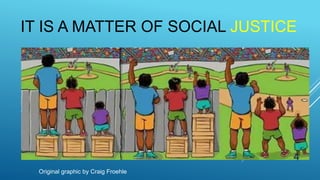
IT IS A MATTER OF SOCIAL JUSTICE
Original graphic by Craig Froehle
4
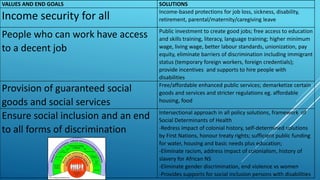
VALUES AND END GOALS SOLUTIONS
Income security for all Income-based protections for job loss, sickness, disability,
retirement, parental/maternity/caregiving leave
People who can work have access
to a decent job
Public investment to create good jobs; free access to education
and skills training, literacy, language training; higher minimum
wage, living wage, better labour standards, unionization, pay
equity, eliminate barriers of discrimination including immigrant
status (temporary foreign workers, foreign credentials);
provide incentives and supports to hire people with
disabilities
Provision of guaranteed social
goods and social services
Free/affordable enhanced public services; demarketize certain
goods and services and stricter regulations eg. affordable
housing, food
Ensure social inclusion and an end
to all forms of discrimination
Intersectional approach in all policy solutions, framework of
Social Determinants of Health
-Redress impact of colonial history, self-determined solutions
by First Nations, honour treaty rights; sufficient public funding
for water, housing and basic needs plus education;
-Eliminate racism, address impact of colonialism, history of
slavery for African NS
-Eliminate gender discrimination, end violence vs women
-Provides supports for social inclusion persons with disabilities
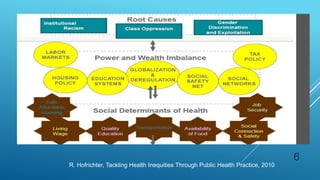
R. Hofrichter, Tackling Health Inequities Through Public Health Practice, 2010
6
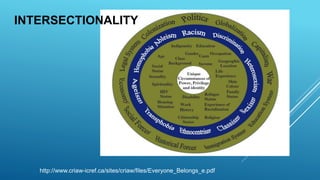
INTERSECTIONALITY
http://www.criaw-icref.ca/sites/criaw/files/Everyone_Belongs_e.pdf
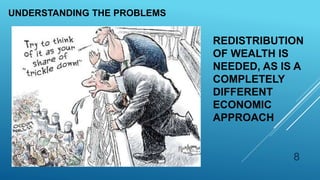
REDISTRIBUTION
OF WEALTH IS
NEEDED, AS IS A
COMPLETELY
DIFFERENT
ECONOMIC
APPROACH
UNDERSTANDING THE PROBLEMS
8
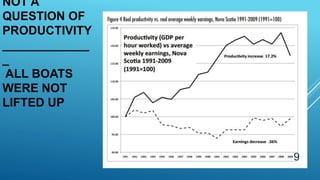
NOT A
QUESTION OF
PRODUCTIVITY
_____________
_
ALL BOATS
WERE NOT
LIFTED UP
9
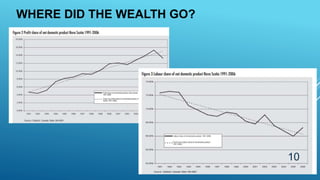
WHERE DID THE WEALTH GO?
10
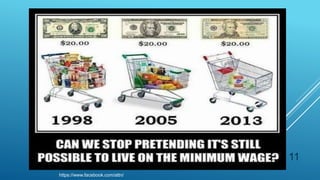
https://www.facebook.com/attn/
11
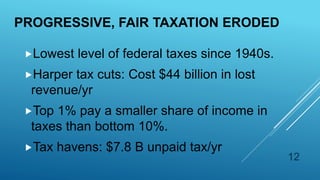
PROGRESSIVE, FAIR TAXATION ERODED
Lowest level of federal taxes since 1940s.
Harper tax cuts: Cost $44 billion in lost
revenue/yr
Top 1% pay a smaller share of income in
taxes than bottom 10%.
Tax havens: $7.8 B unpaid tax/yr
12
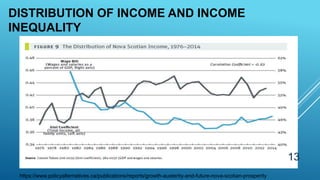
DISTRIBUTION OF INCOME AND INCOME
INEQUALITY
13
https://www.policyalternatives.ca/publications/reports/growth-austerity-and-future-nova-scotian-prosperity
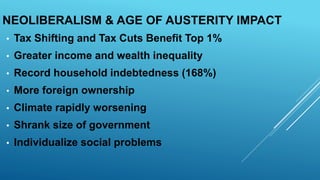
NEOLIBERALISM & AGE OF AUSTERITY IMPACT
• Tax Shifting and Tax Cuts Benefit Top 1%
• Greater income and wealth inequality
• Record household indebtedness (168%)
• More foreign ownership
• Climate rapidly worsening
• Shrank size of government
• Individualize social problems
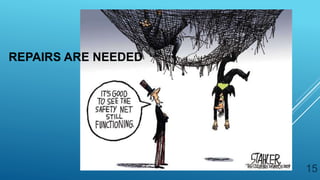
REPAIRS ARE NEEDED
15
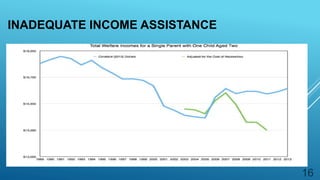
INADEQUATE INCOME ASSISTANCE
16
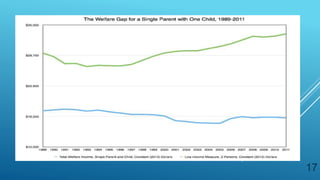
WELFARE GAP
17
SOCIAL EXCLUSION & STIGMA
 “we have a standard of what’s acceptable for people
who live with poverty, and we have a standard that’s
deemed acceptable for all of the rest of us.”
"Unless it affects their lives in some manner, it is just,
“People living off the system”. People don’t want to
live off the system! They want to be contributing
members of society and there’s that horrible, huge
stigma that is forever around”.
From Cornerstone Compromised, CCPA-NS 18
ACCESS TO HEALTH CARE
The bottom 33% of Canadian income earners are:
• 50% less likely to see a specialist when needed
• 40% more likely to wait five days or more for an appointment with a
physician.
• Three times less likely to fill a prescription due to cost
Medicare covers only 70% of total health care costs
Dental plans are available to only 26% of low-income workers.
Only 39% of those without plans visit a dentist on an annual
basis.
(Mikkonen and Raphael, 2010) 19
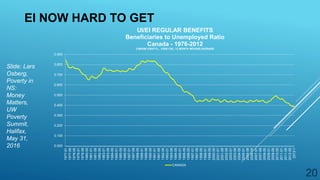
EI NOW HARD TO GET
0.000
0.100
0.200
0.300
0.400
0.500
0.600
0.700
0.800
0.900
1977-01
1977-09
1978-05
1979-01
1979-09
1980-05
1981-01
1981-09
1982-05
1983-01
1983-09
1984-05
1985-01
1985-09
1986-05
1987-01
1987-09
1988-05
1989-01
1989-09
1990-05
1991-01
1991-09
1992-05
1993-01
1993-09
1994-05
1995-01
1995-09
1996-05
1997-01
1997-09
1998-05
1999-01
1999-09
2000-05
2001-01
2001-09
2002-05
2003-01
2003-09
2004-05
2005-01
2005-09
2006-05
2007-01
2007-09
2008-05
2009-01
2009-09
2010-05
2011-01
2011-09
2012-05
2013-1
UI/EI REGULAR BENEFITS
Beneficiaries to Unemployed Ratio
Canada - 1976-2012
CANSIM V384773, , V2091135,; 12 MONTH MOVING AVERAGE
CANADA
Slide: Lars
Osberg,
Poverty in
NS:
Money
Matters,
UW
Poverty
Summit,
Halifax,
May 31,
2016
20
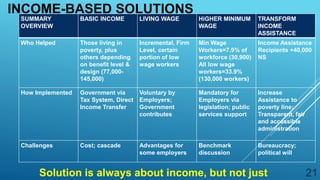
INCOME-BASED SOLUTIONS
SUMMARY
OVERVIEW
BASIC INCOME LIVING WAGE HiGHER MINIMUM
WAGE
TRANSFORM
INCOME
ASSISTANCE
Who Helped Those living in
poverty, plus
others depending
on benefit level &
design (77,000-
145,000)
Incremental, Firm
Level, certain
portion of low
wage workers
Min Wage
Workers=7.9% of
workforce (30,900)
All low wage
workers=33.9%
(130,000 workers)
Income Assistance
Recipients +40,000
NS
How Implemented Government via
Tax System, Direct
Income Transfer
Voluntary by
Employers;
Government
contributes
Mandatory for
Employers via
legislation; public
services support
Increase
Assistance to
poverty line;
Transparent, fair
and accessible
administration
Challenges Cost; cascade Advantages for
some employers
Benchmark
discussion
Bureaucracy;
political will
Solution is always about income, but not just 21
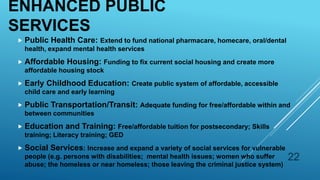
ENHANCED PUBLIC
SERVICES
 Public Health Care: Extend to fund national pharmacare, homecare, oral/dental
health, expand mental health services
 Affordable Housing: Funding to fix current social housing and create more
affordable housing stock
 Early Childhood Education: Create public system of affordable, accessible
child care and early learning
 Public Transportation/Transit: Adequate funding for free/affordable within and
between communities
 Education and Training: Free/affordable tuition for postsecondary; Skills
training; Literacy training; GED
 Social Services: Increase and expand a variety of social services for vulnerable
people (e.g. persons with disabilities; mental health issues; women who suffer
abuse; the homeless or near homeless; those leaving the criminal justice system)
22
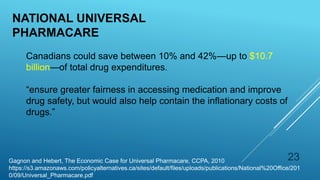
NATIONAL UNIVERSAL
PHARMACARE
Gagnon and Hebert, The Economic Case for Universal Pharmacare, CCPA, 2010
https://s3.amazonaws.com/policyalternatives.ca/sites/default/files/uploads/publications/National%20Office/201
0/09/Universal_Pharmacare.pdf
Canadians could save between 10% and 42%—up to $10.7
billion—of total drug expenditures.
“ensure greater fairness in accessing medication and improve
drug safety, but would also help contain the inflationary costs of
drugs.”
23
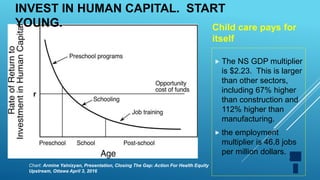
INVEST IN HUMAN CAPITAL. START
YOUNG.
24
Chart: Armine Yalnizyan, Presentation, Closing The Gap: Action For Health Equity
Upstream, Ottawa April 3, 2016
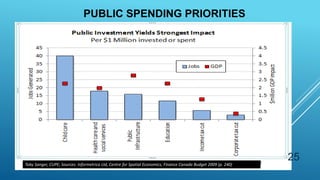
Child care pays for
itself
 The NS GDP multiplier
is $2.23. This is larger
than other sectors,
including 67% higher
than construction and
112% higher than
manufacturing.
 the employment
multiplier is 46.8 jobs
per million dollars.
PUBLIC SPENDING PRIORITIES
Toby Sanger, CUPE; Sources: Informetrica Ltd, Centre for Spatial Economics, Finance Canada Budget 2009 (p. 240)
25
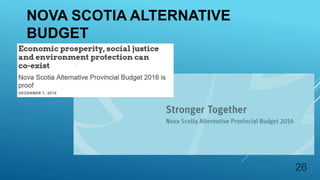
NOVA SCOTIA ALTERNATIVE
BUDGET
26
27
CHANGE STRATEGY
What is your starting point? What’s nonnegotiable?
Who’s on your side and with what exactly? Who are
you willing to partner with? What are the potential
risks? Benefits?
What are you advocating for: Short-term, Medium,
Long-term? Consider windows of opportunity, which
level(s) of government, but also cascading/sequence
effects 28
Thank you.
https://www.policyalternatives.ca/offices/nova-scotia
www.twitter.com/ccpans
www.facebook.com/ccpans
Christine@policyalternatives.ca
29
FURTHER READING
 Better is Always Possible: A Federal Plan to a Federal Plan to Tackle Poverty
and Inequality by Seth Klein and Armine Yalnizyan (2016)
https://www.policyalternatives.ca/sites/default/files/uploads/publications/Natio
nal%20Office/2016/02/Better_Is_Always%20Possible.pdf
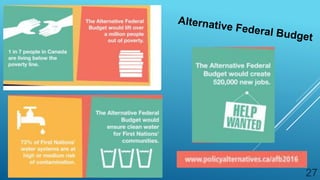
 Federal Alternative Budget:
 https://www.policyalternatives.ca/projects/alternative-federal-budget
 NS Alternative Budget:
 https://www.policyalternatives.ca/projects/nova-scotia-alternative-budget
 Living Wage for Halifax report by Mary Dan Johnson and Christine Saulnier:
https://www.policyalternatives.ca/publications/reports/working-living-not-living-
work 30

Poverty is Political

  • 1.
    POVERTY IS POLITICAL ChristineSaulnier, PhD Nova Scotia Director, Canadian Centre for Policy Alternatives Working Together to End Poverty Conference Truro, NS October 18, 2016 #endpovertyNS
  • 2.
    CONSIDERATIONS OF POLICYSOLUTIONS How do they fit into broader goals/values? What problems are to be solved? Who will it help/who will benefit? How would they be implemented? 2
  • 3.
    KEY MESSAGE We needto ensure all Canadians:  have access to the essentials, can live in dignity and participate in society regardless of job status, and, all have sufficient income so none live in poverty. We need to transform our welfare state based on principles of equity and equality, and reinvest in social justice 3
  • 4.
    IT IS AMATTER OF SOCIAL JUSTICE Original graphic by Craig Froehle 4
  • 5.
    VALUES AND ENDGOALS SOLUTIONS Income security for all Income-based protections for job loss, sickness, disability, retirement, parental/maternity/caregiving leave People who can work have access to a decent job Public investment to create good jobs; free access to education and skills training, literacy, language training; higher minimum wage, living wage, better labour standards, unionization, pay equity, eliminate barriers of discrimination including immigrant status (temporary foreign workers, foreign credentials); provide incentives and supports to hire people with disabilities Provision of guaranteed social goods and social services Free/affordable enhanced public services; demarketize certain goods and services and stricter regulations eg. affordable housing, food Ensure social inclusion and an end to all forms of discrimination Intersectional approach in all policy solutions, framework of Social Determinants of Health -Redress impact of colonial history, self-determined solutions by First Nations, honour treaty rights; sufficient public funding for water, housing and basic needs plus education; -Eliminate racism, address impact of colonialism, history of slavery for African NS -Eliminate gender discrimination, end violence vs women -Provides supports for social inclusion persons with disabilities
  • 6.
    R. Hofrichter, TacklingHealth Inequities Through Public Health Practice, 2010 6
  • 7.
  • 8.
    REDISTRIBUTION OF WEALTH IS NEEDED,AS IS A COMPLETELY DIFFERENT ECONOMIC APPROACH UNDERSTANDING THE PROBLEMS 8
  • 9.
  • 10.
    WHERE DID THEWEALTH GO? 10
  • 11.
  • 12.
    PROGRESSIVE, FAIR TAXATIONERODED Lowest level of federal taxes since 1940s. Harper tax cuts: Cost $44 billion in lost revenue/yr Top 1% pay a smaller share of income in taxes than bottom 10%. Tax havens: $7.8 B unpaid tax/yr 12
  • 13.
    DISTRIBUTION OF INCOMEAND INCOME INEQUALITY 13 https://www.policyalternatives.ca/publications/reports/growth-austerity-and-future-nova-scotian-prosperity
  • 14.
    NEOLIBERALISM & AGEOF AUSTERITY IMPACT • Tax Shifting and Tax Cuts Benefit Top 1% • Greater income and wealth inequality • Record household indebtedness (168%) • More foreign ownership • Climate rapidly worsening • Shrank size of government • Individualize social problems
  • 15.
  • 16.
  • 17.
  • 18.
    SOCIAL EXCLUSION &STIGMA  “we have a standard of what’s acceptable for people who live with poverty, and we have a standard that’s deemed acceptable for all of the rest of us.” "Unless it affects their lives in some manner, it is just, “People living off the system”. People don’t want to live off the system! They want to be contributing members of society and there’s that horrible, huge stigma that is forever around”. From Cornerstone Compromised, CCPA-NS 18
  • 19.
    ACCESS TO HEALTHCARE The bottom 33% of Canadian income earners are: • 50% less likely to see a specialist when needed • 40% more likely to wait five days or more for an appointment with a physician. • Three times less likely to fill a prescription due to cost Medicare covers only 70% of total health care costs Dental plans are available to only 26% of low-income workers. Only 39% of those without plans visit a dentist on an annual basis. (Mikkonen and Raphael, 2010) 19
  • 20.
    EI NOW HARDTO GET 0.000 0.100 0.200 0.300 0.400 0.500 0.600 0.700 0.800 0.900 1977-01 1977-09 1978-05 1979-01 1979-09 1980-05 1981-01 1981-09 1982-05 1983-01 1983-09 1984-05 1985-01 1985-09 1986-05 1987-01 1987-09 1988-05 1989-01 1989-09 1990-05 1991-01 1991-09 1992-05 1993-01 1993-09 1994-05 1995-01 1995-09 1996-05 1997-01 1997-09 1998-05 1999-01 1999-09 2000-05 2001-01 2001-09 2002-05 2003-01 2003-09 2004-05 2005-01 2005-09 2006-05 2007-01 2007-09 2008-05 2009-01 2009-09 2010-05 2011-01 2011-09 2012-05 2013-1 UI/EI REGULAR BENEFITS Beneficiaries to Unemployed Ratio Canada - 1976-2012 CANSIM V384773, , V2091135,; 12 MONTH MOVING AVERAGE CANADA Slide: Lars Osberg, Poverty in NS: Money Matters, UW Poverty Summit, Halifax, May 31, 2016 20
  • 21.
    INCOME-BASED SOLUTIONS SUMMARY OVERVIEW BASIC INCOMELIVING WAGE HiGHER MINIMUM WAGE TRANSFORM INCOME ASSISTANCE Who Helped Those living in poverty, plus others depending on benefit level & design (77,000- 145,000) Incremental, Firm Level, certain portion of low wage workers Min Wage Workers=7.9% of workforce (30,900) All low wage workers=33.9% (130,000 workers) Income Assistance Recipients +40,000 NS How Implemented Government via Tax System, Direct Income Transfer Voluntary by Employers; Government contributes Mandatory for Employers via legislation; public services support Increase Assistance to poverty line; Transparent, fair and accessible administration Challenges Cost; cascade Advantages for some employers Benchmark discussion Bureaucracy; political will Solution is always about income, but not just 21
  • 22.
    ENHANCED PUBLIC SERVICES  PublicHealth Care: Extend to fund national pharmacare, homecare, oral/dental health, expand mental health services  Affordable Housing: Funding to fix current social housing and create more affordable housing stock  Early Childhood Education: Create public system of affordable, accessible child care and early learning  Public Transportation/Transit: Adequate funding for free/affordable within and between communities  Education and Training: Free/affordable tuition for postsecondary; Skills training; Literacy training; GED  Social Services: Increase and expand a variety of social services for vulnerable people (e.g. persons with disabilities; mental health issues; women who suffer abuse; the homeless or near homeless; those leaving the criminal justice system) 22
  • 23.
    NATIONAL UNIVERSAL PHARMACARE Gagnon andHebert, The Economic Case for Universal Pharmacare, CCPA, 2010 https://s3.amazonaws.com/policyalternatives.ca/sites/default/files/uploads/publications/National%20Office/201 0/09/Universal_Pharmacare.pdf Canadians could save between 10% and 42%—up to $10.7 billion—of total drug expenditures. “ensure greater fairness in accessing medication and improve drug safety, but would also help contain the inflationary costs of drugs.” 23
  • 24.
    INVEST IN HUMANCAPITAL. START YOUNG. 24 Chart: Armine Yalnizyan, Presentation, Closing The Gap: Action For Health Equity Upstream, Ottawa April 3, 2016 Child care pays for itself  The NS GDP multiplier is $2.23. This is larger than other sectors, including 67% higher than construction and 112% higher than manufacturing.  the employment multiplier is 46.8 jobs per million dollars.
  • 25.
    PUBLIC SPENDING PRIORITIES TobySanger, CUPE; Sources: Informetrica Ltd, Centre for Spatial Economics, Finance Canada Budget 2009 (p. 240) 25
  • 26.
  • 27.
  • 28.
    CHANGE STRATEGY What isyour starting point? What’s nonnegotiable? Who’s on your side and with what exactly? Who are you willing to partner with? What are the potential risks? Benefits? What are you advocating for: Short-term, Medium, Long-term? Consider windows of opportunity, which level(s) of government, but also cascading/sequence effects 28
  • 29.
  • 30.
    FURTHER READING  Betteris Always Possible: A Federal Plan to a Federal Plan to Tackle Poverty and Inequality by Seth Klein and Armine Yalnizyan (2016) https://www.policyalternatives.ca/sites/default/files/uploads/publications/Natio nal%20Office/2016/02/Better_Is_Always%20Possible.pdf  Federal Alternative Budget:  https://www.policyalternatives.ca/projects/alternative-federal-budget  NS Alternative Budget:  https://www.policyalternatives.ca/projects/nova-scotia-alternative-budget  Living Wage for Halifax report by Mary Dan Johnson and Christine Saulnier: https://www.policyalternatives.ca/publications/reports/working-living-not-living- work 30