BIG PICTURE
LA1 – Understanding the
Ownership Models of Media
Institutions
KEYWORDS
Independent – Funding – Co-
Production – Private Capital –
Agencies and Public Funding –
Job Roles
LEARNING OBJECTIVES
Understand the key features of independent
media production companies
SUCCESS CRITERIA
• Table of information on Warp Films as an
example of a UK Independent
• Definition notes on key roles in media
production
Take your seat. Bag under your desk.
Have your equipment and planner out.
Unit 1 – Media Products and Audiences
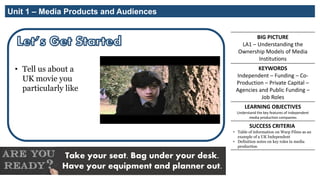
• Tell us about a
UK movie you
particularly like
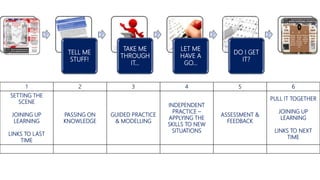
TELL ME
STUFF!
TAKE ME
THROUGH
IT…
LET ME
HAVE A
GO…
DO I GET
IT?
1 2 3 4 5 6
SETTING THE
SCENE
JOINING UP
LEARNING
LINKS TO LAST
TIME
PASSING ON
KNOWLEDGE
GUIDED PRACTICE
& MODELLING
INDEPENDENT
PRACTICE –
APPLYING THE
SKILLS TO NEW
SITUATIONS
ASSESSMENT &
FEEDBACK
PULL IT TOGETHER
JOINING UP
LEARNING
LINKS TO NEXT
TIME
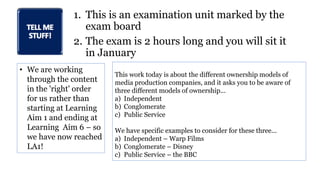
1. This is an examination unit marked by the
exam board
2. The exam is 2 hours long and you will sit it
in January
• We are working
through the content
in the 'right' order
for us rather than
starting at Learning
Aim 1 and ending at
Learning Aim 6 – so
we have now reached
LA1!
This work today is about the different ownership models of
media production companies, and it asks you to be aware of
three different models of ownership...
a) Independent
b) Conglomerate
c) Public Service
We have specific examples to consider for these three...
a) Independent – Warp Films
b) Conglomerate – Disney
c) Public Service – the BBC
Understanding Independent
Media Production
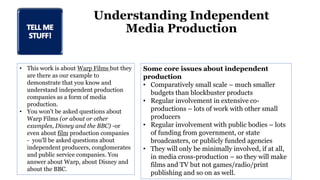
• This work is about Warp Films but they
are there as our example to
demonstrate that you know and
understand independent production
companies as a form of media
production.
• You won't be asked questions about
Warp Films (or about or other
examples, Disney and the BBC) -or
even about film production companies
- you'll be asked questions about
independent producers, conglomerates
and public service companies. You
answer about Warp, about Disney and
about the BBC.
Some core issues about independent
production
• Comparatively small scale – much smaller
budgets than blockbuster products
• Regular involvement in extensive co-
productions – lots of work with other small
producers
• Regular involvement with public bodies – lots
of funding from government, or state
broadcasters, or publicly funded agencies
• They will only be minimally involved, if at all,
in media cross-production – so they will make
films and TV but not games/radio/print
publishing and so on as well.
SO why are Warp Films a good illustrative example
of an independent media company?
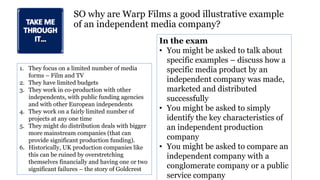
1. They focus on a limited number of media
forms – Film and TV
2. They have limited budgets
3. They work in co-production with other
independents, with public funding agencies
and with other European independents
4. They work on a fairly limited number of
projects at any one time
5. They might do distribution deals with bigger
more mainstream companies (that can
provide significant production funding).
6. Historically, UK production companies like
this can be ruined by overstretching
themselves financially and having one or two
significant failures – the story of Goldcrest
In the exam
• You might be asked to talk about
specific examples – discuss how a
specific media product by an
independent company was made,
marketed and distributed
successfully
• You might be asked to simply
identify the key characteristics of
an independent production
company
• You might be asked to compare an
independent company with a
conglomerate company or a public
service company
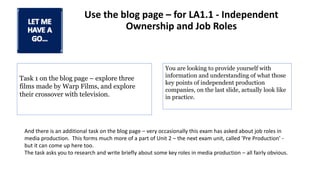
Use the blog page – for LA1.1 - Independent
Ownership and Job Roles
Task 1 on the blog page – explore three
films made by Warp Films, and explore
their crossover with television.
You are looking to provide yourself with
information and understanding of what those
key points of independent production
companies, on the last slide, actually look like
in practice.
And there is an additional task on the blog page – very occasionally this exam has asked about job roles in
media production. This forms much more of a part of Unit 2 – the next exam unit, called 'Pre Production' -
but it can come up here too.
The task asks you to research and write briefly about some key roles in media production – all fairly obvious.
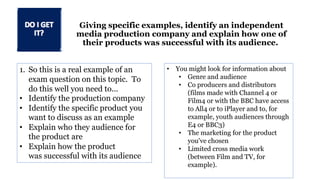
Giving specific examples, identify an independent
media production company and explain how one of
their products was successful with its audience.
1. So this is a real example of an
exam question on this topic. To
do this well you need to...
• Identify the production company
• Identify the specific product you
want to discuss as an example
• Explain who they audience for
the product are
• Explain how the product
was successful with its audience
• You might look for information about
• Genre and audience
• Co producers and distributors
(films made with Channel 4 or
Film4 or with the BBC have access
to All4 or to iPlayer and to, for
example, youth audiences through
E4 or BBC3)
• The marketing for the product
you've chosen
• Limited cross media work
(between Film and TV, for
example).
BIG
PICTURE
MY
LEARNING
How did this
lesson fit into
your other
lessons?
What is my
top take- away
from the
lesson?
Have you contributed to the lesson? Will you be able to improve
next lesson? Do you know what you need to go away and do?
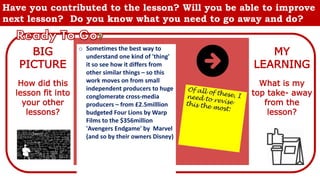
o Sometimes the best way to
understand one kind of 'thing'
it so see how it differs from
other similar things – so this
work moves on from small
independent producers to huge
conglomerate cross-media
producers – from £2.5milllion
budgeted Four Lions by Warp
Films to the $356million
'Avengers Endgame' by Marvel
(and so by their owners Disney)

LA 1.1 independent producers

  • 1.
    BIG PICTURE LA1 –Understanding the Ownership Models of Media Institutions KEYWORDS Independent – Funding – Co- Production – Private Capital – Agencies and Public Funding – Job Roles LEARNING OBJECTIVES Understand the key features of independent media production companies SUCCESS CRITERIA • Table of information on Warp Films as an example of a UK Independent • Definition notes on key roles in media production Take your seat. Bag under your desk. Have your equipment and planner out. Unit 1 – Media Products and Audiences • Tell us about a UK movie you particularly like
  • 2.
    TELL ME STUFF! TAKE ME THROUGH IT… LETME HAVE A GO… DO I GET IT? 1 2 3 4 5 6 SETTING THE SCENE JOINING UP LEARNING LINKS TO LAST TIME PASSING ON KNOWLEDGE GUIDED PRACTICE & MODELLING INDEPENDENT PRACTICE – APPLYING THE SKILLS TO NEW SITUATIONS ASSESSMENT & FEEDBACK PULL IT TOGETHER JOINING UP LEARNING LINKS TO NEXT TIME
  • 3.
    1. This isan examination unit marked by the exam board 2. The exam is 2 hours long and you will sit it in January • We are working through the content in the 'right' order for us rather than starting at Learning Aim 1 and ending at Learning Aim 6 – so we have now reached LA1! This work today is about the different ownership models of media production companies, and it asks you to be aware of three different models of ownership... a) Independent b) Conglomerate c) Public Service We have specific examples to consider for these three... a) Independent – Warp Films b) Conglomerate – Disney c) Public Service – the BBC
  • 4.
    Understanding Independent Media Production •This work is about Warp Films but they are there as our example to demonstrate that you know and understand independent production companies as a form of media production. • You won't be asked questions about Warp Films (or about or other examples, Disney and the BBC) -or even about film production companies - you'll be asked questions about independent producers, conglomerates and public service companies. You answer about Warp, about Disney and about the BBC. Some core issues about independent production • Comparatively small scale – much smaller budgets than blockbuster products • Regular involvement in extensive co- productions – lots of work with other small producers • Regular involvement with public bodies – lots of funding from government, or state broadcasters, or publicly funded agencies • They will only be minimally involved, if at all, in media cross-production – so they will make films and TV but not games/radio/print publishing and so on as well.
  • 5.
    SO why areWarp Films a good illustrative example of an independent media company? 1. They focus on a limited number of media forms – Film and TV 2. They have limited budgets 3. They work in co-production with other independents, with public funding agencies and with other European independents 4. They work on a fairly limited number of projects at any one time 5. They might do distribution deals with bigger more mainstream companies (that can provide significant production funding). 6. Historically, UK production companies like this can be ruined by overstretching themselves financially and having one or two significant failures – the story of Goldcrest In the exam • You might be asked to talk about specific examples – discuss how a specific media product by an independent company was made, marketed and distributed successfully • You might be asked to simply identify the key characteristics of an independent production company • You might be asked to compare an independent company with a conglomerate company or a public service company
  • 6.
    Use the blogpage – for LA1.1 - Independent Ownership and Job Roles Task 1 on the blog page – explore three films made by Warp Films, and explore their crossover with television. You are looking to provide yourself with information and understanding of what those key points of independent production companies, on the last slide, actually look like in practice. And there is an additional task on the blog page – very occasionally this exam has asked about job roles in media production. This forms much more of a part of Unit 2 – the next exam unit, called 'Pre Production' - but it can come up here too. The task asks you to research and write briefly about some key roles in media production – all fairly obvious.
  • 7.
    Giving specific examples,identify an independent media production company and explain how one of their products was successful with its audience. 1. So this is a real example of an exam question on this topic. To do this well you need to... • Identify the production company • Identify the specific product you want to discuss as an example • Explain who they audience for the product are • Explain how the product was successful with its audience • You might look for information about • Genre and audience • Co producers and distributors (films made with Channel 4 or Film4 or with the BBC have access to All4 or to iPlayer and to, for example, youth audiences through E4 or BBC3) • The marketing for the product you've chosen • Limited cross media work (between Film and TV, for example).
  • 8.
    BIG PICTURE MY LEARNING How did this lessonfit into your other lessons? What is my top take- away from the lesson? Have you contributed to the lesson? Will you be able to improve next lesson? Do you know what you need to go away and do? o Sometimes the best way to understand one kind of 'thing' it so see how it differs from other similar things – so this work moves on from small independent producers to huge conglomerate cross-media producers – from £2.5milllion budgeted Four Lions by Warp Films to the $356million 'Avengers Endgame' by Marvel (and so by their owners Disney)

Editor's Notes

  • #2 9:05 – 9:15 / 10:20 – 10:30
  • #9 9:05 – 9:15