INTRODUCTION
Question:
How would you define an intrusion?
CUIT420:
CYBER SECURITY
MS CHIMHENO
rchimheno@cut.ac.zw
Office: E-12
L5A – INTRUSION DETECTION SYSTEMS (IDS)
LEARNING OUTCOMES
At the end of this lecture students should be able to:
 Explain IDS
 Describe the ways to detect an intrusion
 Describe the types of Intrusion Detection Systems
INTRUSION DETECTION SYSTEMS (IDS)
 An intrusion detection system is used to monitor and protect
networks or systems for malicious activities.
 To alert security personnel about intrusions, intrusion detection
systems are highly useful.
 IDSes are used to monitor network traffic.
 An IDS is also referred to as a "packet-sniffer," which intercepts
packets traveling along various communication mediums and
protocols, usually TCP/IP.
INTRUSION DETECTION SYSTEMS (IDS)
What IDS does -
 An IDS checks for suspicious activities.
 It notifies the administrator about intrusions immediately.
 It gathers and analyzes information from within a computer or a
network, to identify the possible violations of security policy,
including unauthorized access, as well as misuse.
 It analyses packets after they are captured.
 It evaluates a suspected intrusion once it has taken place and signals
an alarm
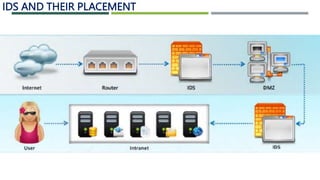
IDS AND THEIR PLACEMENT
PURPOSE OF IDS
 The main purposes of IDSes are that they not only prevent
intrusions but also alert the administrator immediately when the
attack is still going on.
 The administrator could identify methods and techniques being
used by the intruder and also the source of attack.
HOW IDS WORKS
HOW IDS WORKS
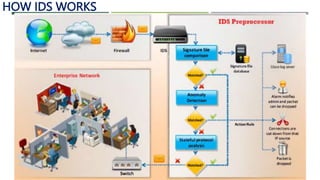
An IDS works in the following way:
o IDSes have sensors to detect signatures and some advanced IDSes
have behavioral activity detection to determine malicious behavior.
Even if signatures don't match this activity detection system can
alert administrators about possible attacks.
o If the signature matches, then it moves to the next step or the
connections are cut down from that IP source, the packet is
dropped, and the alarm notifies the admin and the packet can be
dropped.
HOW IDS WORKS
An IDS works in the following way:
o Once the signature is matched, then sensors pass on anomaly
detection, whether the received packet or request matches or not.
o If the packet passes the anomaly stage, then stateful protocol
analysis is done.
o After that through switch the packets are passed on to the
network.
o If anything mismatches again, the connections are cut down from
that IP source, the packet is dropped, and the alarm notifies the
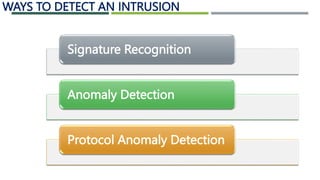
WAYS TO DETECT AN INTRUSION
Signature Recognition
Anomaly Detection
Protocol Anomaly Detection
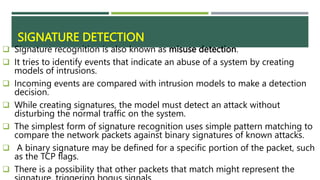
SIGNATURE DETECTION
 Signature recognition is also known as misuse detection.
 It tries to identify events that indicate an abuse of a system by creating
models of intrusions.
 Incoming events are compared with intrusion models to make a detection
decision.
 While creating signatures, the model must detect an attack without
disturbing the normal traffic on the system.
 The simplest form of signature recognition uses simple pattern matching to
compare the network packets against binary signatures of known attacks.
 A binary signature may be defined for a specific portion of the packet, such
as the TCP flags.
 There is a possibility that other packets that match might represent the
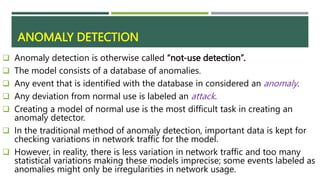
ANOMALY DETECTION
 Anomaly detection is otherwise called “not-use detection”.
 The model consists of a database of anomalies.
 Any event that is identified with the database in considered an anomaly.
 Any deviation from normal use is labeled an attack.
 Creating a model of normal use is the most difficult task in creating an
anomaly detector.
 In the traditional method of anomaly detection, important data is kept for
checking variations in network traffic for the model.
 However, in reality, there is less variation in network traffic and too many
statistical variations making these models imprecise; some events labeled as
anomalies might only be irregularities in network usage.
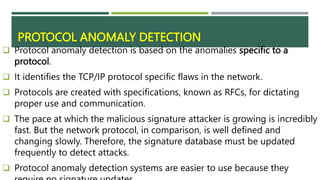
PROTOCOL ANOMALY DETECTION
 Protocol anomaly detection is based on the anomalies specific to a
protocol.
 It identifies the TCP/IP protocol specific flaws in the network.
 Protocols are created with specifications, known as RFCs, for dictating
proper use and communication.
 The pace at which the malicious signature attacker is growing is incredibly
fast. But the network protocol, in comparison, is well defined and
changing slowly. Therefore, the signature database must be updated
frequently to detect attacks.
 Protocol anomaly detection systems are easier to use because they
TYPES OF IDS
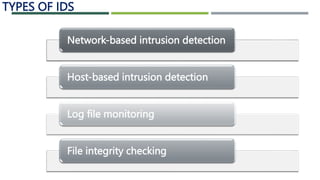
TYPES OF IDS
Network-based intrusion detection
Host-based intrusion detection
Log file monitoring
File integrity checking
NETWORK-BASED INTRUSION DETECTION
 The NIDS checks every packet entering the network for the presence of
anomalies and incorrect data.
 NIDS captures and inspects all traffic, regardless of whether it is
permitted.
 Based on the content, at either the IP or application-level, an alert is
generated.
 Network-based intrusion detection systems tend to be more distributed
than host-based IDSes. The NIDS is basically designed to identify the
anomalies at the router- and host-level.
 The mechanisms typically consist of a black box that is placed on the
network in the promiscuous mode, listening for patterns indicative of an
HOST-BASED INTRUSION DETECTION
 In the host-based system, the IDS analyzes each system's
behavior.
 The HIDS can be installed on any system ranging from a
desktop PC to a server.
 The HIDS is more versatile than the NIDS
 Host-based systems are also effective at detecting unauthorized
file modification.
 HIDS is also more platform-centric, with more focus on the
Windows OS, but there are other HIDSes for UNIX platforms.
LOG FILE MONITORING
 Log File Monitor (LFM) monitors log files created by network
services.
 The LFT IDS searches through the logs and identifies malicious
events.
 These systems look for patterns in the log files that suggest an
intrusion.
 A typical example would be parsers for HTTP server log files that
look for intruders who try well-known security holes, such as the
"phf" attack.
FILE INTEGRITY CHECKING
 These mechanisms check for Trojan horses, or files that have
otherwise been modified, indicating an intruder has already
been there, for example, Tripwire.
SYSTEM INTEGRITY VERIFIERS (SIV)
 A System Integrity Verifier (SIV) monitors system files to
determine whether an intruder has changed the files.
 Although they have limited functionality, integrity monitors can
add an additional layer of protection to other forms of intrusion
detection.
INDICATIONS OF SYSTEM INTRUSIONS
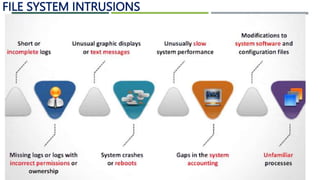
FILE SYSTEM INTRUSIONS
NETWORK INTRUSIONS
 Sudden increase in bandwidth consumption is an indication of
intrusion.
 Repeated probes of the available services on your machines.
 Connection requests from IPs other than those in the network range
are an indication that an unauthenticated user (intruder) is
attempting to connect to the network.
 You can identify repeated attempts to log in from remote machines.
 Arbitrary log data in log files indicates attempts of denial-of-service
attacks, bandwidth consumption, and distributed denial-of-service
CONCLUSION
 Describe the ways to detect an intrusion.

L5A - Intrusion Detection Systems.pptx

  • 1.
  • 2.
    CUIT420: CYBER SECURITY MS CHIMHENO rchimheno@cut.ac.zw Office:E-12 L5A – INTRUSION DETECTION SYSTEMS (IDS)
  • 3.
    LEARNING OUTCOMES At theend of this lecture students should be able to:  Explain IDS  Describe the ways to detect an intrusion  Describe the types of Intrusion Detection Systems
  • 4.
    INTRUSION DETECTION SYSTEMS(IDS)  An intrusion detection system is used to monitor and protect networks or systems for malicious activities.  To alert security personnel about intrusions, intrusion detection systems are highly useful.  IDSes are used to monitor network traffic.  An IDS is also referred to as a "packet-sniffer," which intercepts packets traveling along various communication mediums and protocols, usually TCP/IP.
  • 5.
    INTRUSION DETECTION SYSTEMS(IDS) What IDS does -  An IDS checks for suspicious activities.  It notifies the administrator about intrusions immediately.  It gathers and analyzes information from within a computer or a network, to identify the possible violations of security policy, including unauthorized access, as well as misuse.  It analyses packets after they are captured.  It evaluates a suspected intrusion once it has taken place and signals an alarm
  • 6.
    IDS AND THEIRPLACEMENT
  • 7.
    PURPOSE OF IDS The main purposes of IDSes are that they not only prevent intrusions but also alert the administrator immediately when the attack is still going on.  The administrator could identify methods and techniques being used by the intruder and also the source of attack.
  • 8.
  • 9.
    HOW IDS WORKS AnIDS works in the following way: o IDSes have sensors to detect signatures and some advanced IDSes have behavioral activity detection to determine malicious behavior. Even if signatures don't match this activity detection system can alert administrators about possible attacks. o If the signature matches, then it moves to the next step or the connections are cut down from that IP source, the packet is dropped, and the alarm notifies the admin and the packet can be dropped.
  • 10.
    HOW IDS WORKS AnIDS works in the following way: o Once the signature is matched, then sensors pass on anomaly detection, whether the received packet or request matches or not. o If the packet passes the anomaly stage, then stateful protocol analysis is done. o After that through switch the packets are passed on to the network. o If anything mismatches again, the connections are cut down from that IP source, the packet is dropped, and the alarm notifies the
  • 11.
    WAYS TO DETECTAN INTRUSION
  • 12.
    WAYS TO DETECTAN INTRUSION Signature Recognition Anomaly Detection Protocol Anomaly Detection
  • 13.
    SIGNATURE DETECTION  Signaturerecognition is also known as misuse detection.  It tries to identify events that indicate an abuse of a system by creating models of intrusions.  Incoming events are compared with intrusion models to make a detection decision.  While creating signatures, the model must detect an attack without disturbing the normal traffic on the system.  The simplest form of signature recognition uses simple pattern matching to compare the network packets against binary signatures of known attacks.  A binary signature may be defined for a specific portion of the packet, such as the TCP flags.  There is a possibility that other packets that match might represent the
  • 14.
    ANOMALY DETECTION  Anomalydetection is otherwise called “not-use detection”.  The model consists of a database of anomalies.  Any event that is identified with the database in considered an anomaly.  Any deviation from normal use is labeled an attack.  Creating a model of normal use is the most difficult task in creating an anomaly detector.  In the traditional method of anomaly detection, important data is kept for checking variations in network traffic for the model.  However, in reality, there is less variation in network traffic and too many statistical variations making these models imprecise; some events labeled as anomalies might only be irregularities in network usage.
  • 15.
    PROTOCOL ANOMALY DETECTION Protocol anomaly detection is based on the anomalies specific to a protocol.  It identifies the TCP/IP protocol specific flaws in the network.  Protocols are created with specifications, known as RFCs, for dictating proper use and communication.  The pace at which the malicious signature attacker is growing is incredibly fast. But the network protocol, in comparison, is well defined and changing slowly. Therefore, the signature database must be updated frequently to detect attacks.  Protocol anomaly detection systems are easier to use because they
  • 16.
  • 17.
    TYPES OF IDS Network-basedintrusion detection Host-based intrusion detection Log file monitoring File integrity checking
  • 18.
    NETWORK-BASED INTRUSION DETECTION The NIDS checks every packet entering the network for the presence of anomalies and incorrect data.  NIDS captures and inspects all traffic, regardless of whether it is permitted.  Based on the content, at either the IP or application-level, an alert is generated.  Network-based intrusion detection systems tend to be more distributed than host-based IDSes. The NIDS is basically designed to identify the anomalies at the router- and host-level.  The mechanisms typically consist of a black box that is placed on the network in the promiscuous mode, listening for patterns indicative of an
  • 19.
    HOST-BASED INTRUSION DETECTION In the host-based system, the IDS analyzes each system's behavior.  The HIDS can be installed on any system ranging from a desktop PC to a server.  The HIDS is more versatile than the NIDS  Host-based systems are also effective at detecting unauthorized file modification.  HIDS is also more platform-centric, with more focus on the Windows OS, but there are other HIDSes for UNIX platforms.
  • 20.
    LOG FILE MONITORING Log File Monitor (LFM) monitors log files created by network services.  The LFT IDS searches through the logs and identifies malicious events.  These systems look for patterns in the log files that suggest an intrusion.  A typical example would be parsers for HTTP server log files that look for intruders who try well-known security holes, such as the "phf" attack.
  • 21.
    FILE INTEGRITY CHECKING These mechanisms check for Trojan horses, or files that have otherwise been modified, indicating an intruder has already been there, for example, Tripwire.
  • 22.
    SYSTEM INTEGRITY VERIFIERS(SIV)  A System Integrity Verifier (SIV) monitors system files to determine whether an intruder has changed the files.  Although they have limited functionality, integrity monitors can add an additional layer of protection to other forms of intrusion detection.
  • 23.
  • 24.
  • 25.
    NETWORK INTRUSIONS  Suddenincrease in bandwidth consumption is an indication of intrusion.  Repeated probes of the available services on your machines.  Connection requests from IPs other than those in the network range are an indication that an unauthenticated user (intruder) is attempting to connect to the network.  You can identify repeated attempts to log in from remote machines.  Arbitrary log data in log files indicates attempts of denial-of-service attacks, bandwidth consumption, and distributed denial-of-service
  • 26.
    CONCLUSION  Describe theways to detect an intrusion.

Editor's Notes

  • #9 IDSes have sensors to detect signatures and some advanced IDSes have behavioral activity detection to determine malicious behavior. Even if signatures don't match this activity detection system can alert administrators about possible attacks. If the signature matches, then it moves to the next step or the connections are cut down from that IP source, the packet is dropped, and the alarm notifies the admin and the packet can be dropped. Once the signature is matched, then sensors pass on anomaly detection, whether the received packet or request matches or not. If the packet passes the anomaly stage, then stateful protocol analysis is done. After that through switch the packets are passed on to the network. If anything mismatches again, the connections are cut down from that IP source, the packet is dropped, and the alarm notifies the admin and packet can be dropped.
  • #20 One example of a host-based system is a program that operates on a system and receives application or operating system audit logs. These programs are highly effective for detecting insider abuses. If one of these users attempts unauthorized activity, host based systems usually detect and collect the most pertinent information promptly.
  • #23 For example, a basic integrity monitor uses system files, or registry keys, to track changes by an intruder.