

Recall
• What are files handling used for?
• How do we write in to a file?
• What are the different modes of opening a
file?
• What is fgetc() ?
Introduction to C++
Week 4- day 1
C++
• Super Set of C
C++ was originally developed to be the next version of C, not a new
language.
• Backward compactable with C
Most of the C functions can run in C++
• Same compiler preprocessor
Must have a function names “main” to determine where the program starts
Where they born
Bell Labs
C Vs C++
Similarities
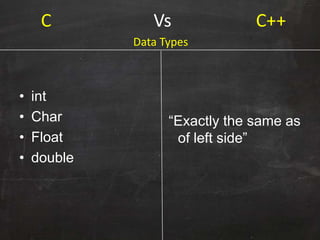
C Vs C++
• int
• Char
• Float
• double
“Exactly the same as
of left side”
Data Types
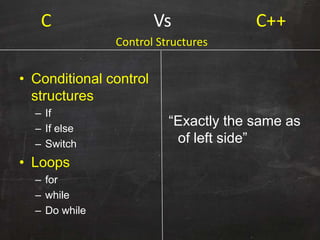
C Vs C++
• Conditional control
structures
– If
– If else
– Switch
• Loops
– for
– while
– Do while
“Exactly the same as
of left side”
Control Structures
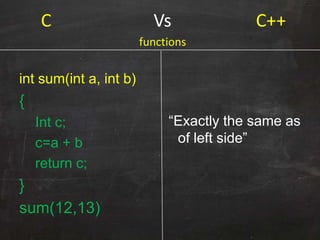
C Vs C++
int sum(int a, int b)
{
Int c;
c=a + b
return c;
}
sum(12,13)
“Exactly the same as
of left side”
functions
C Vs C++
Int a[10];
Int b[] = {1000, 2, 3,
50}; “Exactly the same as
of left side”
Arrays
C Vs C++
Differences
C Vs C++
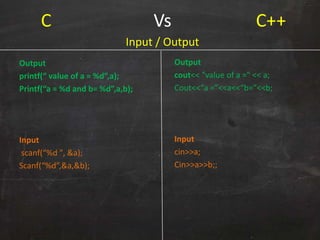
Output
printf(“ value of a = %d”,a);
Printf(“a = %d and b= %d”,a,b);
Input
scanf(“%d ", &a);
Scanf(“%d”,&a,&b);
Output
cout<< “value of a =" << a;
Cout<<“a =”<<a<<“b=”<<b;
Input
cin>>a;
Cin>>a>>b;;
Input / Output
C Vs C++
char str[10];
str = "Hello!"; //ERROR
char str1[11] = "Call
home!";
char str2[] = "Send
money!";
char str3[] = {'O', 'K',
'0'};
strcat(str1, str2);
string str;
str = "Hello";
string str1("Call
home!");
string str2 = "Send
money!";
string str3("OK");
str = str1 + str2;
str = otherString;
Strings
C Vs C++
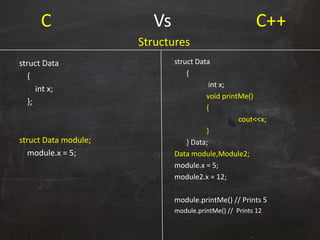
struct Data
{
int x;
};
struct Data module;
​module.x = 5;
struct Data
{
int x;
void printMe()
{
cout<<x;
}
} Data;
Data module,Module2;
module.x = 5;
module2.x = 12;
module.printMe() // Prints 5
module.printMe() // Prints 12
Structures
What’s New in C++ ?
• OOP concepts
• Operator overloading
What’s New in C++ ?
OOP Concept
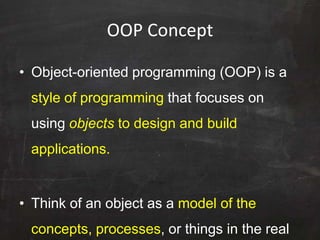
• Object-oriented programming (OOP) is a
style of programming that focuses on
using objects to design and build
applications.
• Think of an object as a model of the
concepts, processes, or things in the real
Objects in real World
Real World
Objects
Objects in real world
• Object will have an identity/name
 Eg: reynolds, Cello for pen. Nokia,apple for
mobile
• Object will have different properties which
describes them best
 Eg:Color,size,width
• Object can perform different actions
 Eg: writing,erasing etc for pen. Calling,
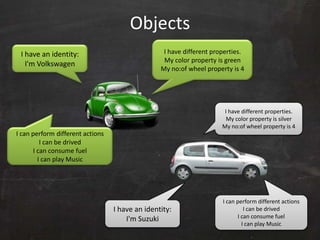
Objects
I have an identity:
I'm Volkswagen
I have different properties.
My color property is green
My no:of wheel property is 4
I can perform different actions
I can be drived
I can consume fuel
I can play Music
I have an identity:
I'm Suzuki
I have different properties.
My color property is silver
My no:of wheel property is 4
I can perform different actions
I can be drived
I can consume fuel
I can play Music
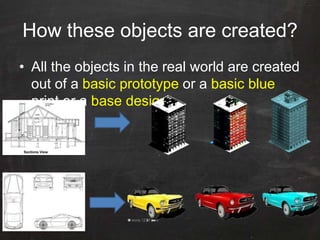
How these objects are created?
• All the objects in the real world are created
out of a basic prototype or a basic blue
print or a base design
Objects in software World
Objects in the software world
• Same like in the real world we can create
objects in computer programming world
–Which will have a name as identity
–Properties to define its behaviour
–Actions what it can perform
How these objects are
created
• We need to create a base design which
defines the properties and functionalities
that the object should have.
• In programming terms we call this base
design as Class
• Simply by having a class we can create
any number of objects of that type
Definition
• Class : is the base design of
objects
• Object : is the instance of a class
• No memory is allocated when a class is
created.
• Memory is allocated only when an object is
created.
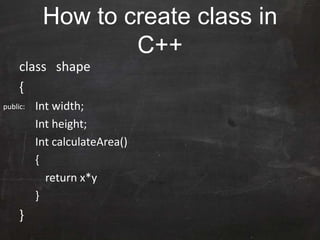
How to create class in
C++
class shape
{
Int width;
Int height;
Int calculateArea()
{
return x*y
}
}
public:
How to create class in
C++
class shape
{
Int width;
Int height;
Int calculateArea()
{
return x*y
}
}
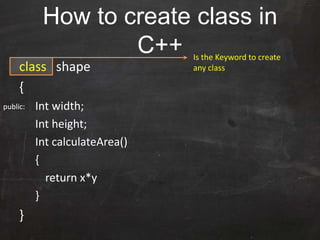
Is the Keyword to create
any class
public:
How to create class in
C++
class shape
{
Int width;
Int height;
Int calculateArea()
{
return x*y
}
}
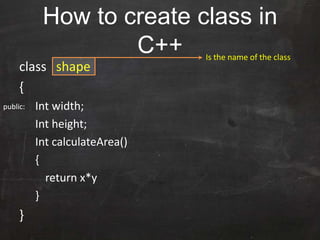
Is the name of the class
public:
How to create class in
C++
class shape
{
Int width;
Int height;
Int calculateArea()
{
return x*y
}
}
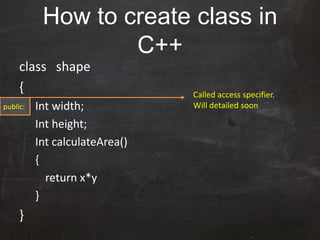
Called access specifier.
Will detailed soonpublic:
How to create class in
C++
class shape
{
Int width;
Int height;
Int calculateArea()
{
return x*y
}
}
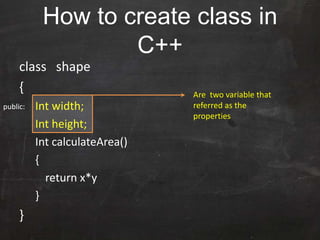
Are two variable that
referred as the
properties
public:
How to create class in
C++
class shape
{
Int width;
Int height;
Int calculateArea()
{
return x*y
}
}
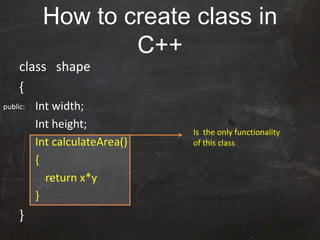
Is the only functionality
of this class
public:
How to create objects in
C++
shape rectangle,square;
rectangle.width=20;
recangle.height=35;
square.height=10;
square.width=10;
rArea=rectangle.calculateArea();
sArea=square.calculateArea();
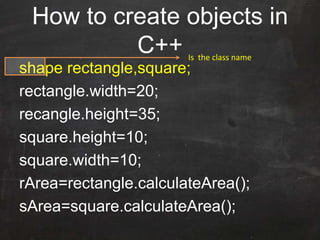
Is the class name
How to create objects in
C++
shape rectangle,square;
rectangle.width=20;
recangle.height=35;
square.height=10;
square.width=10;
rArea=rectangle.calculateArea();
sArea=square.calculateArea();
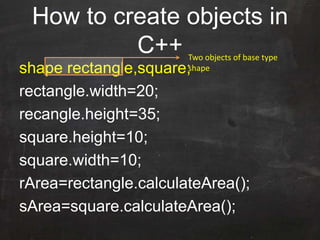
Two objects of base type
shape
How to create objects in
C++
shape rectangle,square;
rectangle.width=20;
recangle.height=35;
square.height=10;
square.width=10;
rArea=rectangle.calculateArea();
sArea=square.calculateArea();
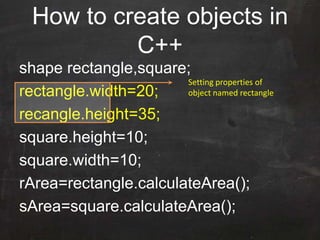
Setting properties of
object named rectangle
How to create objects in
C++
shape rectangle,square;
rectangle.width=20;
recangle.height=35;
square.height=10;
square.width=10;
rArea=rectangle.calculateArea();
sArea=square.calculateArea();
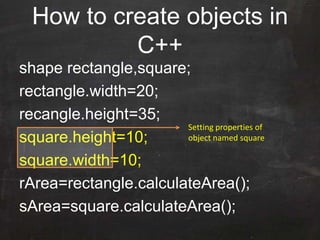
Setting properties of
object named square
How to create objects in
C++
shape rectangle,square;
rectangle.width=20;
recangle.height=35;
square.height=10;
square.width=10;
rArea=rectangle.calculateArea();
sArea=square.calculateArea();
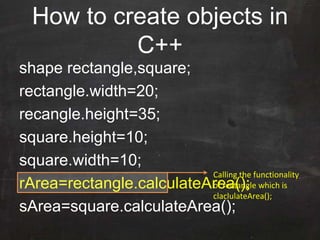
Calling the functionality
of rectangle which is
claclulateArea();
How to create objects in
C++
shape rectangle,square;
rectangle.width=20;
recangle.height=35;
square.height=10;
square.width=10;
rArea=rectangle.calculateArea();
sArea=square.calculateArea();
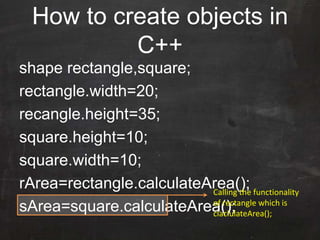
Calling the functionality
of rectangle which is
claclulateArea();
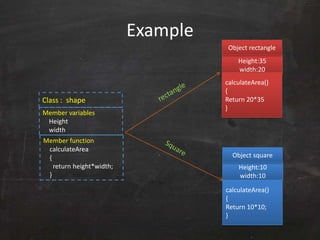
Example
Class : shape
Height:35
width:20
Object rectangle
calculateArea()
{
Return 20*35
}
Height:10
width:10
Object square
calculateArea()
{
Return 10*10;
}
Member variables
Height
width
Member function
calculateArea
{
return height*width;
}
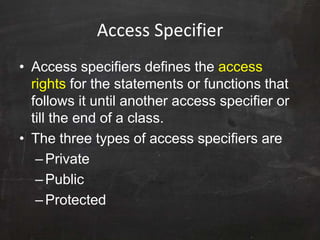
Access Specifier
• Access specifiers defines the access
rights for the statements or functions that
follows it until another access specifier or
till the end of a class.
• The three types of access specifiers are
–Private
–Public
–Protected
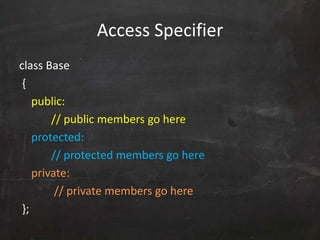
Access Specifier
class Base
{
public:
// public members go here
protected:
// protected members go here
private:
// private members go here
};
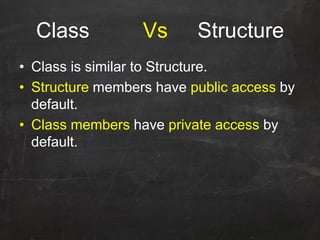
Class Vs Structure
• Class is similar to Structure.
• Structure members have public access by
default.
• Class members have private access by
default.
Self Check !!
Self Check
• Which of the following term is used for a
function defined inside a class?
–Member Variable
–Member function
–Class function
–Classic function
Self Check
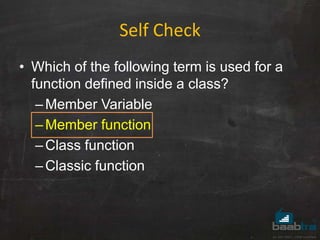
• Which of the following term is used for a
function defined inside a class?
–Member Variable
–Member function
–Class function
–Classic function
Self Check
• cout is a/an __________ .
–Operator
–Function
–Object
–macro
Self Check
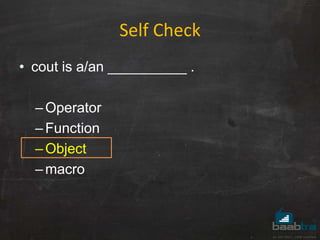
• cout is a/an __________ .
–Operator
–Function
–Object
–macro
Self Check
• Which of the following is correct about
class and structure?
– class can have member functions while
structure cannot.
– class data members are public by default
while that of structure are private.
– Pointer to structure or classes cannot be
declared.
– class data members are private by default
while that of structure are public by default.
Self Check
• Which of the following is correct about
class and structure?
– class can have member functions while
structure cannot.
– class data members are public by default
while that of structure are private.
– Pointer to structure or classes cannot be
declared.
– class data members are private by default
while that of structure are public by default.
Self Check
• Which of the following operator is
overloaded for object cout?
•>>
•<<
•+
•=
Self Check
• Which of the following operator is
overloaded for object cout?
•>>
•<<
•+
•=
Self Check
• Which of the following access
specifier is used as a default in a
class definition?
•protected
•public
•private
•friend
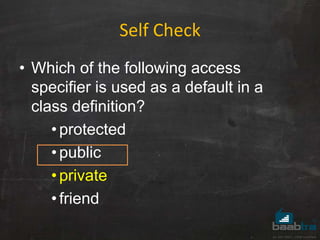
Self Check
• Which of the following access
specifier is used as a default in a
class definition?
•protected
•public
•private
•friend
End of Day

Introduction to c ++ part -1

  • 1.
    Recall • What arefiles handling used for? • How do we write in to a file? • What are the different modes of opening a file? • What is fgetc() ?
  • 2.
  • 3.
    C++ • Super Setof C C++ was originally developed to be the next version of C, not a new language. • Backward compactable with C Most of the C functions can run in C++ • Same compiler preprocessor Must have a function names “main” to determine where the program starts
  • 4.
  • 5.
  • 6.
    C Vs C++ •int • Char • Float • double “Exactly the same as of left side” Data Types
  • 7.
    C Vs C++ •Conditional control structures – If – If else – Switch • Loops – for – while – Do while “Exactly the same as of left side” Control Structures
  • 8.
    C Vs C++ intsum(int a, int b) { Int c; c=a + b return c; } sum(12,13) “Exactly the same as of left side” functions
  • 9.
    C Vs C++ Inta[10]; Int b[] = {1000, 2, 3, 50}; “Exactly the same as of left side” Arrays
  • 10.
  • 11.
    C Vs C++ Output printf(“value of a = %d”,a); Printf(“a = %d and b= %d”,a,b); Input scanf(“%d ", &a); Scanf(“%d”,&a,&b); Output cout<< “value of a =" << a; Cout<<“a =”<<a<<“b=”<<b; Input cin>>a; Cin>>a>>b;; Input / Output
  • 12.
    C Vs C++ charstr[10]; str = "Hello!"; //ERROR char str1[11] = "Call home!"; char str2[] = "Send money!"; char str3[] = {'O', 'K', '0'}; strcat(str1, str2); string str; str = "Hello"; string str1("Call home!"); string str2 = "Send money!"; string str3("OK"); str = str1 + str2; str = otherString; Strings
  • 13.
    C Vs C++ structData { int x; }; struct Data module; ​module.x = 5; struct Data { int x; void printMe() { cout<<x; } } Data; Data module,Module2; module.x = 5; module2.x = 12; module.printMe() // Prints 5 module.printMe() // Prints 12 Structures
  • 14.
  • 15.
    • OOP concepts •Operator overloading What’s New in C++ ?
  • 16.
    OOP Concept • Object-orientedprogramming (OOP) is a style of programming that focuses on using objects to design and build applications. • Think of an object as a model of the concepts, processes, or things in the real
  • 17.
  • 18.
  • 19.
    Objects in realworld • Object will have an identity/name  Eg: reynolds, Cello for pen. Nokia,apple for mobile • Object will have different properties which describes them best  Eg:Color,size,width • Object can perform different actions  Eg: writing,erasing etc for pen. Calling,
  • 20.
    Objects I have anidentity: I'm Volkswagen I have different properties. My color property is green My no:of wheel property is 4 I can perform different actions I can be drived I can consume fuel I can play Music I have an identity: I'm Suzuki I have different properties. My color property is silver My no:of wheel property is 4 I can perform different actions I can be drived I can consume fuel I can play Music
  • 21.
    How these objectsare created? • All the objects in the real world are created out of a basic prototype or a basic blue print or a base design
  • 22.
  • 23.
    Objects in thesoftware world • Same like in the real world we can create objects in computer programming world –Which will have a name as identity –Properties to define its behaviour –Actions what it can perform
  • 24.
    How these objectsare created • We need to create a base design which defines the properties and functionalities that the object should have. • In programming terms we call this base design as Class • Simply by having a class we can create any number of objects of that type
  • 25.
    Definition • Class :is the base design of objects • Object : is the instance of a class • No memory is allocated when a class is created. • Memory is allocated only when an object is created.
  • 26.
    How to createclass in C++ class shape { Int width; Int height; Int calculateArea() { return x*y } } public:
  • 27.
    How to createclass in C++ class shape { Int width; Int height; Int calculateArea() { return x*y } } Is the Keyword to create any class public:
  • 28.
    How to createclass in C++ class shape { Int width; Int height; Int calculateArea() { return x*y } } Is the name of the class public:
  • 29.
    How to createclass in C++ class shape { Int width; Int height; Int calculateArea() { return x*y } } Called access specifier. Will detailed soonpublic:
  • 30.
    How to createclass in C++ class shape { Int width; Int height; Int calculateArea() { return x*y } } Are two variable that referred as the properties public:
  • 31.
    How to createclass in C++ class shape { Int width; Int height; Int calculateArea() { return x*y } } Is the only functionality of this class public:
  • 32.
    How to createobjects in C++ shape rectangle,square; rectangle.width=20; recangle.height=35; square.height=10; square.width=10; rArea=rectangle.calculateArea(); sArea=square.calculateArea(); Is the class name
  • 33.
    How to createobjects in C++ shape rectangle,square; rectangle.width=20; recangle.height=35; square.height=10; square.width=10; rArea=rectangle.calculateArea(); sArea=square.calculateArea(); Two objects of base type shape
  • 34.
    How to createobjects in C++ shape rectangle,square; rectangle.width=20; recangle.height=35; square.height=10; square.width=10; rArea=rectangle.calculateArea(); sArea=square.calculateArea(); Setting properties of object named rectangle
  • 35.
    How to createobjects in C++ shape rectangle,square; rectangle.width=20; recangle.height=35; square.height=10; square.width=10; rArea=rectangle.calculateArea(); sArea=square.calculateArea(); Setting properties of object named square
  • 36.
    How to createobjects in C++ shape rectangle,square; rectangle.width=20; recangle.height=35; square.height=10; square.width=10; rArea=rectangle.calculateArea(); sArea=square.calculateArea(); Calling the functionality of rectangle which is claclulateArea();
  • 37.
    How to createobjects in C++ shape rectangle,square; rectangle.width=20; recangle.height=35; square.height=10; square.width=10; rArea=rectangle.calculateArea(); sArea=square.calculateArea(); Calling the functionality of rectangle which is claclulateArea();
  • 38.
    Example Class : shape Height:35 width:20 Objectrectangle calculateArea() { Return 20*35 } Height:10 width:10 Object square calculateArea() { Return 10*10; } Member variables Height width Member function calculateArea { return height*width; }
  • 39.
    Access Specifier • Accessspecifiers defines the access rights for the statements or functions that follows it until another access specifier or till the end of a class. • The three types of access specifiers are –Private –Public –Protected
  • 40.
    Access Specifier class Base { public: //public members go here protected: // protected members go here private: // private members go here };
  • 41.
    Class Vs Structure •Class is similar to Structure. • Structure members have public access by default. • Class members have private access by default.
  • 42.
  • 43.
    Self Check • Whichof the following term is used for a function defined inside a class? –Member Variable –Member function –Class function –Classic function
  • 44.
    Self Check • Whichof the following term is used for a function defined inside a class? –Member Variable –Member function –Class function –Classic function
  • 45.
    Self Check • coutis a/an __________ . –Operator –Function –Object –macro
  • 46.
    Self Check • coutis a/an __________ . –Operator –Function –Object –macro
  • 47.
    Self Check • Whichof the following is correct about class and structure? – class can have member functions while structure cannot. – class data members are public by default while that of structure are private. – Pointer to structure or classes cannot be declared. – class data members are private by default while that of structure are public by default.
  • 48.
    Self Check • Whichof the following is correct about class and structure? – class can have member functions while structure cannot. – class data members are public by default while that of structure are private. – Pointer to structure or classes cannot be declared. – class data members are private by default while that of structure are public by default.
  • 49.
    Self Check • Whichof the following operator is overloaded for object cout? •>> •<< •+ •=
  • 50.
    Self Check • Whichof the following operator is overloaded for object cout? •>> •<< •+ •=
  • 51.
    Self Check • Whichof the following access specifier is used as a default in a class definition? •protected •public •private •friend
  • 52.
    Self Check • Whichof the following access specifier is used as a default in a class definition? •protected •public •private •friend
  • 53.