Zhiqiang Ren
Boston University
Research Outline
 Goal: Software Development with Verification
 Specification: What is correct anyway?
 Verification: Will the program behave correctly?
 Our Work: Put them together in one language.
What is ATS (statically)?
 http://www.ats-lang.org
 Statically typed programming language that unifies
implementation, formal specification, and proof.
 ML like syntax
 Dependent Types
 Linear Types
 Compiled to C, JavaScript, Erlang
What is ATS (dynamically)?
 As efficient as C/C++ (see The Computer Language
Benchmarks Game for concrete evidence).
 Supports a variety of programming paradigm
(Functional, Imperative, Concurrent, and Modular
programming).
 Feature-Rich practical PL: closure, pattern match,
unboxed data representation, polymorphism
(overloading, template).
 Optional Runtime and GC.
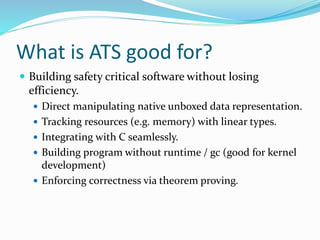
What is ATS good for?
 Building safety critical software without losing
efficiency.
 Direct manipulating native unboxed data representation.
 Tracking resources (e.g. memory) with linear types.
 Integrating with C seamlessly.
 Building program without runtime / gc (good for kernel
development)
 Enforcing correctness via theorem proving.
What has been built using ATS?
 ATS itself, and ATS website (JavaScript)
 Scientific Computing
 Linux Device Driver
 Kernel
 Terrier: OS in development for Panda and Beagle Boards.
 Model Checker for ATS (under construction)
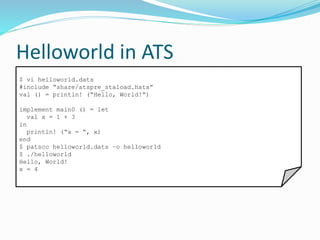
Helloworld in ATS
$ vi helloworld.dats
#include “share/atspre_staload.hats”
val () = println! (“Hello, World!”)
implement main0 () = let
val x = 1 + 3
in
println! (“x = “, x)
end
$ patscc helloworld.dats –o helloworld
$ ./helloworld
Hello, World!
x = 4
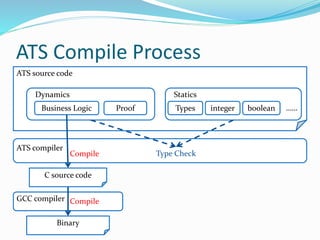
ATS Compile Process
ATS source code
Dynamics
Business Logic Proof
Statics
Types integer boolean ……
ATS compiler
Type Check
C source code
Binary
Compile
GCC compiler Compile
Dependent Types (Singleton Type)
#include “share/atspre_staload.hats”
val x = 2 / (1 – 1) // type error
fun mydiv {x,y:int} (a: int x, b: int y): [z:int] int z =
if b != 0 then a / b
else $raise div_by_0_exception
val y = mydiv (2, 1 – 1) // no type error
fun foo {x,y:int} (a:int x, b: int y): int (3 * (x + y)) = let
val v1 = 3 * a
val v2 = 3 * b
in
(v1 + v2)
end
1: int 1
/: {x,y: int | y != 0}
(int x, int y): [z:int] int z
Blue: type indices in the statics
Red: Entities in the dynamics
some types
Dependent Types (array)
// arrayref (a, n) is a type.
// It depends on two indices: type of element, length of array
fun{a:t@ype} array_make_elt{n:int}
(asz: size_t n, elt: a): arrayref (a, n)
fun{a:t@ype} arrayref_get_at {n:int}{i:nat | i < n}
(A: arrayref (a, n), pos: size_t i): a
overload [] with arrayref_get_at
fun{a:t@ype} arrayref_set_at {n:int}{i:nat | i < n}
(A: arrayref (a, n), pos: size_t i, x: a): void
overload [] with arrayref_set_at
typedef Int = [x:int] int x
val arr: arrayref (Int, 3) = arrayref_make_elt<Int> (i2sz(3), 0)
val v = arr[2]
val () = arr[i2sz(v)] := 99
val () = assertloc (v < 3)
val () = assertloc (v >= 0)
prfun fun pure_assert {b:bool}
(bool b): [b == true] void
prval () = pure_assert (v < 3)
prval () = pure_assert (v >= 0)
Specification:
What should a function do?
• SUM (x) = 0 + 1 + 2 + … + x
• relation: y = SUM (x)
y = SUM (x) = 0 if x = 0
y= SUM (x) = x + y1 if SUM (x - 1) = y1
fun sum (x: int): int =
if x = 0 then 0
else x + sum (x – 1)
)(.int:)0.(int: xSUMyyoutputyxinputxx 
No Connection
between two worlds!
Implementation
Specification: Encoding via types
dataprop SUM (int, int) =
| SUMbas (0, 0) of ()
| {x,y1:int} SUMind (x+1, y1+x+1) of SUM (x, y1)
fun sum {x:int | x >= 0} (a: int x):
[y:int] (SUM (x, y) | int y) =
if a = 0 then (SUMbase () | 0)
else let
val (pf1 | s) = sum(a - 1)
prval pf = SUMind (pf1)
in
(pf | s + a)
end
Verification: Theorem Proving
dataprop SUM (int, int) =
| SUMbas (0, 0) of ()
| {x,y1:int} SUMind (x+1, y1+x+1) of SUM (x, y1)
fun sum_mul{x: int | x >= 0} (a: int x):
[s: int] (MUL (x, x+1, s) | int (s/2)) = let
val sum = a * (a + 1)
prval pf = mul_make ()
in
(pf | sum / 2)
end
extern prfun mul2sum {x,s:int | x >= 0}
(pf: MUL (x, x+1,s)): SUM (x, s / 2)
fun sum {x:int | x >= 0} (a: int x):
[y:int] (SUM (x, y) | int y) = let
val (pf_mul | sum) = sum_mul(a)
prval pf_sum = mul2sum (pf_mul)
in
(pf_sum | sum)
end
Linear Type (Intuition)
 Program Entities of linear types can be consumed once
and exactly once.
Creation of
Linear Object
Passing on
Linear Object
Destruction of
Linear Object
Linear Type (viewtype)
 Resource Management: lock, memory, interrupt, …
absviewt@ype lock
extern fun lock_acquire (): lock
extern fun lock_release (l: lock >> _): void
fun foo (): void = let
val l = lock_acquire ()
// ... process
val () = lock_release (l) // must release only once
in
end
Linear Type (View)
fun{a:vt0p} ptr_alloc ()
:<> [l:addr | l > 0]
(
a? @ l, mfree_gc_v (l) | ptr l
)
fun ptr_free {a:t@ype}{l:addr}
(
pfgc: mfree_gc_v (l)
, pfat: a @ l
| p: ptr l
):<> void
a? @ l
mfree_gc_v (l)
ptr l
view
(linear
proof)
Concrete
Code
Can Deference
Can NOT Deference
Program Verification
Prove that the implementation
meets the specification
Theorem Proving
Model Checking
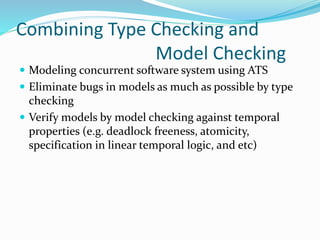
Combining Type Checking and
Model Checking
 Modeling concurrent software system using ATS
 Eliminate bugs in models as much as possible by type
checking
 Verify models by model checking against temporal
properties (e.g. deadlock freeness, atomicity,
specification in linear temporal logic, and etc)
Q & A
 Thank You.
 Questions?

ATS Programming

  • 1.
  • 2.
    Research Outline  Goal:Software Development with Verification  Specification: What is correct anyway?  Verification: Will the program behave correctly?  Our Work: Put them together in one language.
  • 3.
    What is ATS(statically)?  http://www.ats-lang.org  Statically typed programming language that unifies implementation, formal specification, and proof.  ML like syntax  Dependent Types  Linear Types  Compiled to C, JavaScript, Erlang
  • 4.
    What is ATS(dynamically)?  As efficient as C/C++ (see The Computer Language Benchmarks Game for concrete evidence).  Supports a variety of programming paradigm (Functional, Imperative, Concurrent, and Modular programming).  Feature-Rich practical PL: closure, pattern match, unboxed data representation, polymorphism (overloading, template).  Optional Runtime and GC.
  • 5.
    What is ATSgood for?  Building safety critical software without losing efficiency.  Direct manipulating native unboxed data representation.  Tracking resources (e.g. memory) with linear types.  Integrating with C seamlessly.  Building program without runtime / gc (good for kernel development)  Enforcing correctness via theorem proving.
  • 6.
    What has beenbuilt using ATS?  ATS itself, and ATS website (JavaScript)  Scientific Computing  Linux Device Driver  Kernel  Terrier: OS in development for Panda and Beagle Boards.  Model Checker for ATS (under construction)
  • 7.
    Helloworld in ATS $vi helloworld.dats #include “share/atspre_staload.hats” val () = println! (“Hello, World!”) implement main0 () = let val x = 1 + 3 in println! (“x = “, x) end $ patscc helloworld.dats –o helloworld $ ./helloworld Hello, World! x = 4
  • 8.
    ATS Compile Process ATSsource code Dynamics Business Logic Proof Statics Types integer boolean …… ATS compiler Type Check C source code Binary Compile GCC compiler Compile
  • 9.
    Dependent Types (SingletonType) #include “share/atspre_staload.hats” val x = 2 / (1 – 1) // type error fun mydiv {x,y:int} (a: int x, b: int y): [z:int] int z = if b != 0 then a / b else $raise div_by_0_exception val y = mydiv (2, 1 – 1) // no type error fun foo {x,y:int} (a:int x, b: int y): int (3 * (x + y)) = let val v1 = 3 * a val v2 = 3 * b in (v1 + v2) end 1: int 1 /: {x,y: int | y != 0} (int x, int y): [z:int] int z Blue: type indices in the statics Red: Entities in the dynamics some types
  • 10.
    Dependent Types (array) //arrayref (a, n) is a type. // It depends on two indices: type of element, length of array fun{a:t@ype} array_make_elt{n:int} (asz: size_t n, elt: a): arrayref (a, n) fun{a:t@ype} arrayref_get_at {n:int}{i:nat | i < n} (A: arrayref (a, n), pos: size_t i): a overload [] with arrayref_get_at fun{a:t@ype} arrayref_set_at {n:int}{i:nat | i < n} (A: arrayref (a, n), pos: size_t i, x: a): void overload [] with arrayref_set_at typedef Int = [x:int] int x val arr: arrayref (Int, 3) = arrayref_make_elt<Int> (i2sz(3), 0) val v = arr[2] val () = arr[i2sz(v)] := 99 val () = assertloc (v < 3) val () = assertloc (v >= 0) prfun fun pure_assert {b:bool} (bool b): [b == true] void prval () = pure_assert (v < 3) prval () = pure_assert (v >= 0)
  • 11.
    Specification: What should afunction do? • SUM (x) = 0 + 1 + 2 + … + x • relation: y = SUM (x) y = SUM (x) = 0 if x = 0 y= SUM (x) = x + y1 if SUM (x - 1) = y1 fun sum (x: int): int = if x = 0 then 0 else x + sum (x – 1) )(.int:)0.(int: xSUMyyoutputyxinputxx  No Connection between two worlds! Implementation
  • 12.
    Specification: Encoding viatypes dataprop SUM (int, int) = | SUMbas (0, 0) of () | {x,y1:int} SUMind (x+1, y1+x+1) of SUM (x, y1) fun sum {x:int | x >= 0} (a: int x): [y:int] (SUM (x, y) | int y) = if a = 0 then (SUMbase () | 0) else let val (pf1 | s) = sum(a - 1) prval pf = SUMind (pf1) in (pf | s + a) end
  • 13.
    Verification: Theorem Proving datapropSUM (int, int) = | SUMbas (0, 0) of () | {x,y1:int} SUMind (x+1, y1+x+1) of SUM (x, y1) fun sum_mul{x: int | x >= 0} (a: int x): [s: int] (MUL (x, x+1, s) | int (s/2)) = let val sum = a * (a + 1) prval pf = mul_make () in (pf | sum / 2) end extern prfun mul2sum {x,s:int | x >= 0} (pf: MUL (x, x+1,s)): SUM (x, s / 2) fun sum {x:int | x >= 0} (a: int x): [y:int] (SUM (x, y) | int y) = let val (pf_mul | sum) = sum_mul(a) prval pf_sum = mul2sum (pf_mul) in (pf_sum | sum) end
  • 14.
    Linear Type (Intuition) Program Entities of linear types can be consumed once and exactly once. Creation of Linear Object Passing on Linear Object Destruction of Linear Object
  • 15.
    Linear Type (viewtype) Resource Management: lock, memory, interrupt, … absviewt@ype lock extern fun lock_acquire (): lock extern fun lock_release (l: lock >> _): void fun foo (): void = let val l = lock_acquire () // ... process val () = lock_release (l) // must release only once in end
  • 16.
    Linear Type (View) fun{a:vt0p}ptr_alloc () :<> [l:addr | l > 0] ( a? @ l, mfree_gc_v (l) | ptr l ) fun ptr_free {a:t@ype}{l:addr} ( pfgc: mfree_gc_v (l) , pfat: a @ l | p: ptr l ):<> void a? @ l mfree_gc_v (l) ptr l view (linear proof) Concrete Code Can Deference Can NOT Deference
  • 17.
    Program Verification Prove thatthe implementation meets the specification Theorem Proving Model Checking
  • 18.
    Combining Type Checkingand Model Checking  Modeling concurrent software system using ATS  Eliminate bugs in models as much as possible by type checking  Verify models by model checking against temporal properties (e.g. deadlock freeness, atomicity, specification in linear temporal logic, and etc)
  • 19.
    Q & A Thank You.  Questions?

Editor's Notes

  • #5 boehm garbage collector performance