Physics L1
About Science “ rules of the game” The study of nature’s rules Star patterns Weather patterns A way of thinking A collection of knowledge
 
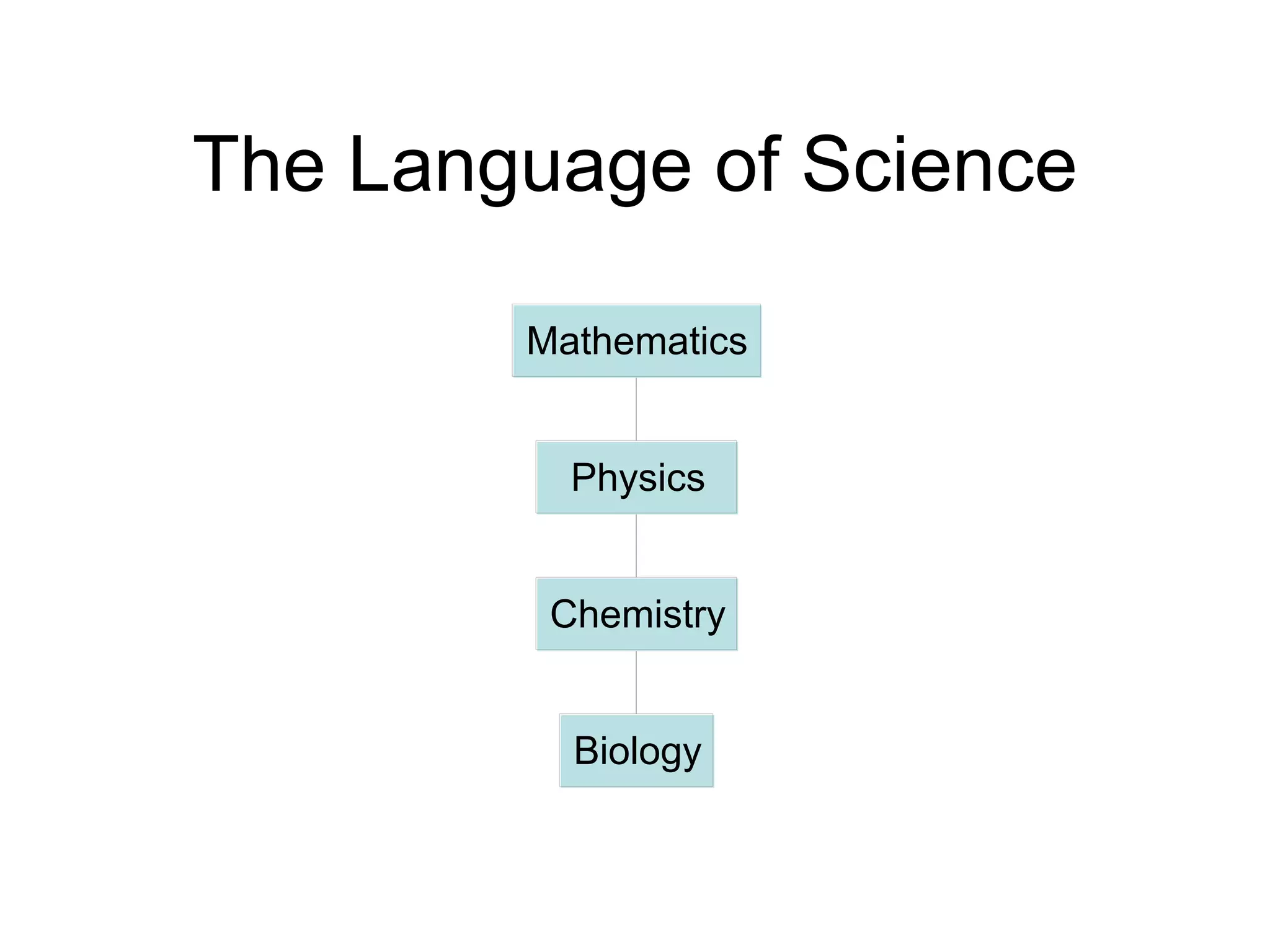
The Language of Science
The Scientific Method Recognize problem Make hypothesis Predict consequences Perform experiments Find rule Hypothesis Educated guess Principle / Law Hypotheses tested by experiments and not contradicted
Aristotle’s hypothesis Regarding the free fall of an object An object twice as heavy falls twice as fast
Galileo’s experiment In the absence of air resistance, all objects fall in the same time  Tower of Pisa, Italy
Theory Not hypothesis Synthesis of a large body of information Includes many verified hypotheses Undergoes change Atomic theory Cell theory
Tests of Hypotheses Scientific hypothesis can be proven right and  wrong “ The alignment of planets determines the best time for making decisions” “ Intelligent life exists on other planets” “ Most people stop for red lights” “ No material object can travel faster than light”
Over to you Which hypothesis is scientific? “ Atoms are the smallest particles of matter”; “ Our universe is surrounded by another universe, which cannot be detected”; “ Albert Einstein was the greatest physicist of the twentieth century”
Science and Technology Science Answers theoretical questions A way of knowing Technology Putting science facts to practical use Interferes with life and nature A way of doing
 
End L1

L1

  • 1.
  • 2.
    About Science “rules of the game” The study of nature’s rules Star patterns Weather patterns A way of thinking A collection of knowledge
  • 3.
  • 4.
  • 5.
    The Scientific MethodRecognize problem Make hypothesis Predict consequences Perform experiments Find rule Hypothesis Educated guess Principle / Law Hypotheses tested by experiments and not contradicted
  • 6.
    Aristotle’s hypothesis Regardingthe free fall of an object An object twice as heavy falls twice as fast
  • 7.
    Galileo’s experiment Inthe absence of air resistance, all objects fall in the same time Tower of Pisa, Italy
  • 8.
    Theory Not hypothesisSynthesis of a large body of information Includes many verified hypotheses Undergoes change Atomic theory Cell theory
  • 9.
    Tests of HypothesesScientific hypothesis can be proven right and wrong “ The alignment of planets determines the best time for making decisions” “ Intelligent life exists on other planets” “ Most people stop for red lights” “ No material object can travel faster than light”
  • 10.
    Over to youWhich hypothesis is scientific? “ Atoms are the smallest particles of matter”; “ Our universe is surrounded by another universe, which cannot be detected”; “ Albert Einstein was the greatest physicist of the twentieth century”
  • 11.
    Science and TechnologyScience Answers theoretical questions A way of knowing Technology Putting science facts to practical use Interferes with life and nature A way of doing
  • 12.
  • 13.