IOSR Journal of Mechanical and Civil Engineering (IOSR-JMCE)
e-ISSN: 2278-1684,p-ISSN: 2320-334X, Volume 9, Issue 2 (Sep. - Oct. 2013), PP 97-101
www.iosrjournals.org
www.iosrjournals.org 97 | Page
Comparative Analysis of a 15 Story Flat Plate Building with and
Without Shear Wall and Diagonal Bracing Under Wind and
Seismic Loads
Rajib Kumar Biswas1
, Md.Meraj Uddin2
, Md.Arman Chowdhury3
,
Md.Al-Imran Khan4
1
( Graduate student, Department of Civil Engineering, Ahsanullah University of Science and Technology)
2
( Graduate student, Department of Civil Engineering, Ahsanullah University of Science and Technology)
3
( Graduate student, Department of Civil Engineering, Ahsanullah University of Science and Technology)
4
( Graduate student, Department of Civil Engineering, Ahsanullah University of Science and Technology)
Abstract : A flat plate is a reinforced concrete slab supported directly by concrete columns without the use of
beams, column flares or drop panels. Flat plate system has been adopted in many buildings constructed recently
taking advantage of the reduced floor height to meet the economical and architectural demands. However, In
Multistoried structures the flat plate floor system has week resistance to lateral loads like wind and earthquake
hence this paper is concerned to increase lateral stiffness of flat plate structure and to minimize the
displacement of the structure under lateral loading. This paper is also concerned about column axial load and
to review our structure with special features like shear walls & diagonal bracing. In present work, a 15 storied
flat plate garments building have been modeled using software package “STAAD Pro” for earthquake zone II
in Bangladesh .This model is considered in most vulnerable situation where we took wind speed as 260 kmph
and Earthquake load has been taken as per Bangladesh National Building Code(BNBC)
Keywords: Shear wall, Diagonal bracing, Lateral stiffness, Flat plate
I. INTRODUCTION
From the beginning flat plate attracts the eye of architectures for its beautiful view and of engineers for its
reduced floor height. But its demands get down because of its weakness to lateral forces. Because it does not
allow any beam at its edge so necessarily due to deflection control slab thickness needs to be increased. So,
question may arise why not to be concerned by gravity load. Gravity load although does not concern us but there
is a provision for increasing the column section to a great extent or provide great thickness of bearing wall.
After that, it still cannot be ruled out that gravity load has a great relation with seismic forces. So threat
continues to exert on flat plate. To minimize that, like in many research, in this paper it will be clarified that
lateral stiffness is the key. To analyze that in this paper structural software STAAD Pro will be used. Lateral
drift and displacement will also be a matter of discussion in this study as these have an important relationship
with structures lateral stiffness. After the work has given its‟ what, why and how results will be depicted to
provide final observation and thus will give a good decision making conditions.
II. OBJECTIVE OF THE STUDY
We execute this research to improve the condition of flat plate structure .In the present scenario flat
plate is considered as a risky structure. So we focus on a multi bay flat plate building
 To analyze the structural behaviors of flat plate using X bracing, shear wall in structural analysis software
„STAAD Pro‟.
 Study on X-bracing system and shear wall by providing them to flat building to increase lateral stiffness.
 To analyze the structures with different case studies.
III. DETAILS OF THE PRESENT STUDY
General
Whenever we talk about a structure we always think about the loads it carries and its resistivity against
it. For that, we have to know about that structures force, moment, stress and displacement. As we will try to
increase lateral stiffness of a 15-storied flat plate garment building so in this segment of our work we will show
our data about axial force and displacement which is obtained by STAAD Pro software analysis.
Comparative Analysis Of A 15 Story Flat Plate Building With And Without Shear Wall And Diagonal
www.iosrjournals.org 98 | Page
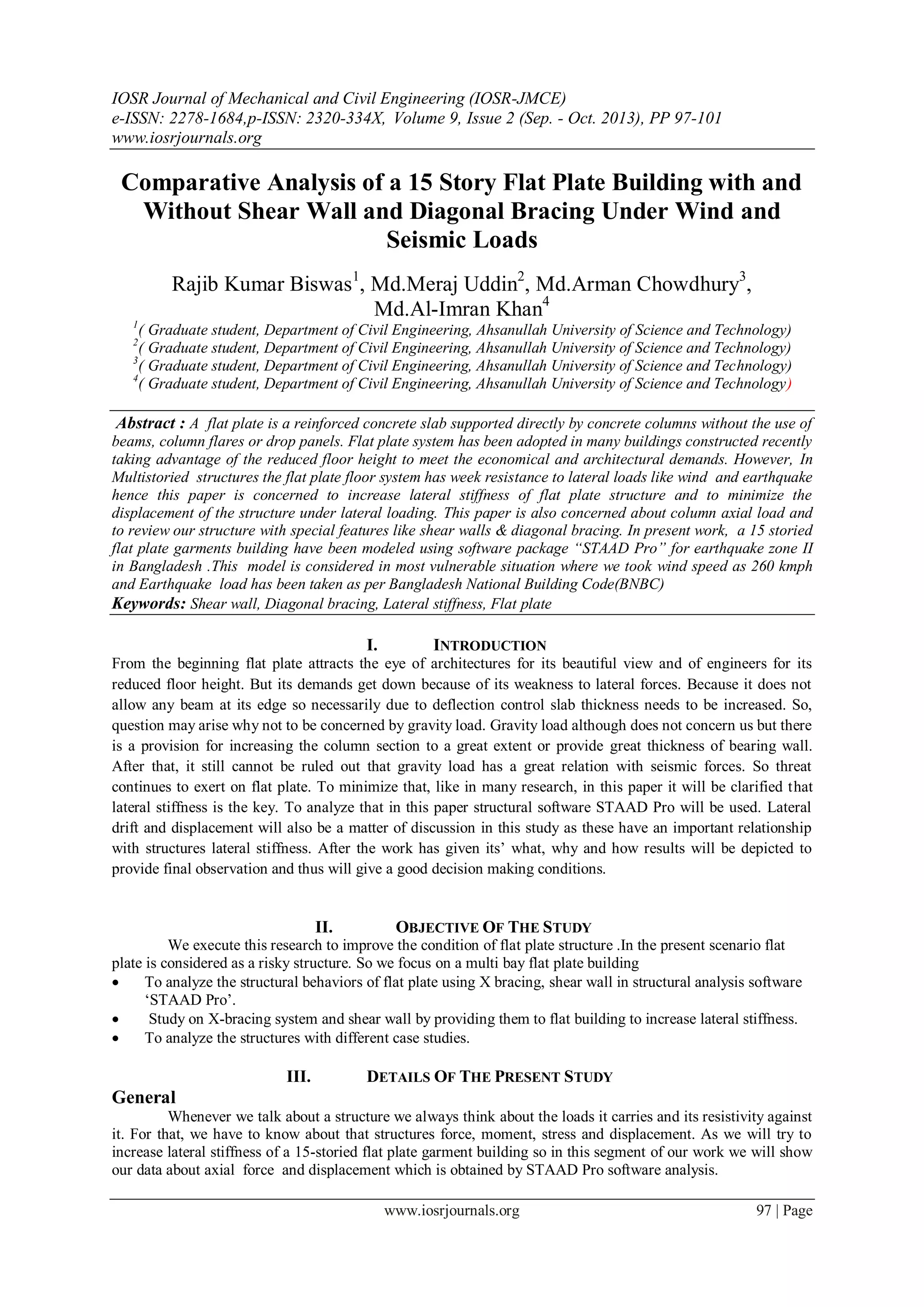
Figure 01: Conceptual Frame View (Grid Division).
Details of the Models
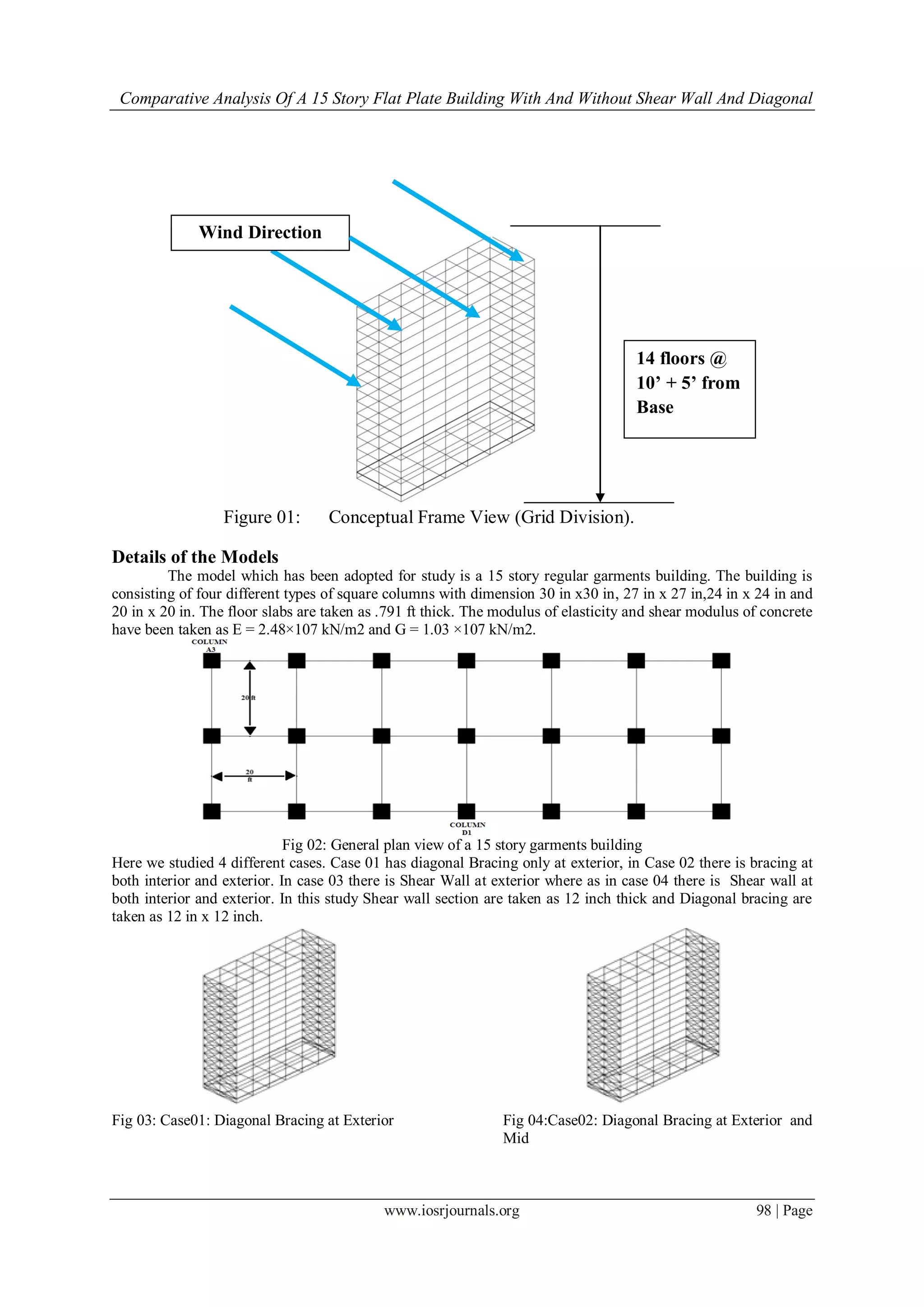
The model which has been adopted for study is a 15 story regular garments building. The building is
consisting of four different types of square columns with dimension 30 in x30 in, 27 in x 27 in,24 in x 24 in and
20 in x 20 in. The floor slabs are taken as .791 ft thick. The modulus of elasticity and shear modulus of concrete
have been taken as E = 2.48×10⁷ kN/m2 and G = 1.03 ×10⁷ kN/m2.
Fig 02: General plan view of a 15 story garments building
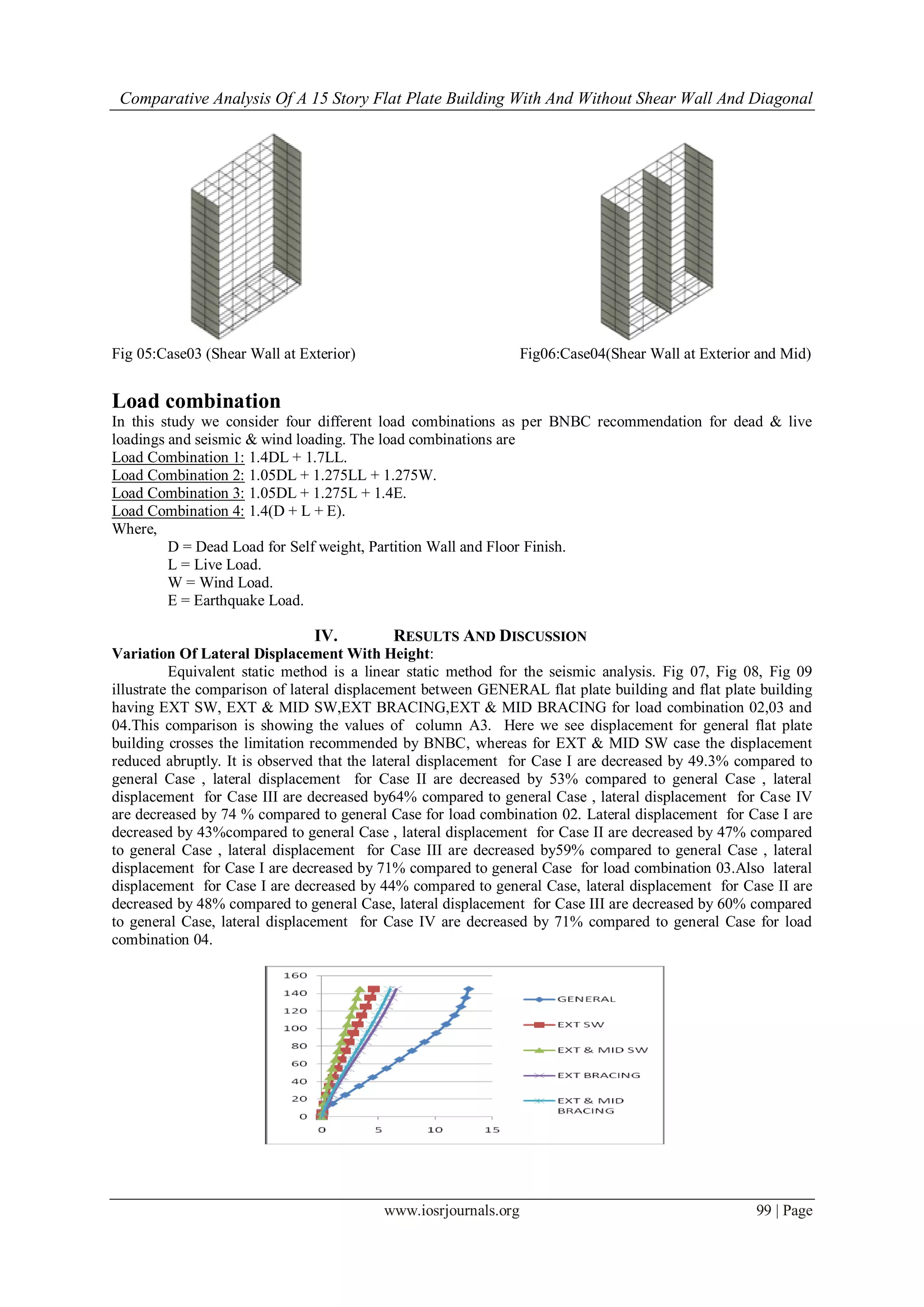
Here we studied 4 different cases. Case 01 has diagonal Bracing only at exterior, in Case 02 there is bracing at
both interior and exterior. In case 03 there is Shear Wall at exterior where as in case 04 there is Shear wall at
both interior and exterior. In this study Shear wall section are taken as 12 inch thick and Diagonal bracing are
taken as 12 in x 12 inch.
Fig 03: Case01: Diagonal Bracing at Exterior Fig 04:Case02: Diagonal Bracing at Exterior and
Mid
Wind Direction
14 floors @
10’ + 5’ from
Base
Comparative Analysis Of A 15 Story Flat Plate Building With And Without Shear Wall And Diagonal
www.iosrjournals.org 99 | Page
Fig 05:Case03 (Shear Wall at Exterior) Fig06:Case04(Shear Wall at Exterior and Mid)
Load combination
In this study we consider four different load combinations as per BNBC recommendation for dead & live
loadings and seismic & wind loading. The load combinations are
Load Combination 1: 1.4DL + 1.7LL.
Load Combination 2: 1.05DL + 1.275LL + 1.275W.
Load Combination 3: 1.05DL + 1.275L + 1.4E.
Load Combination 4: 1.4(D + L + E).
Where,
D = Dead Load for Self weight, Partition Wall and Floor Finish.
L = Live Load.
W = Wind Load.
E = Earthquake Load.
IV. RESULTS AND DISCUSSION
Variation Of Lateral Displacement With Height:
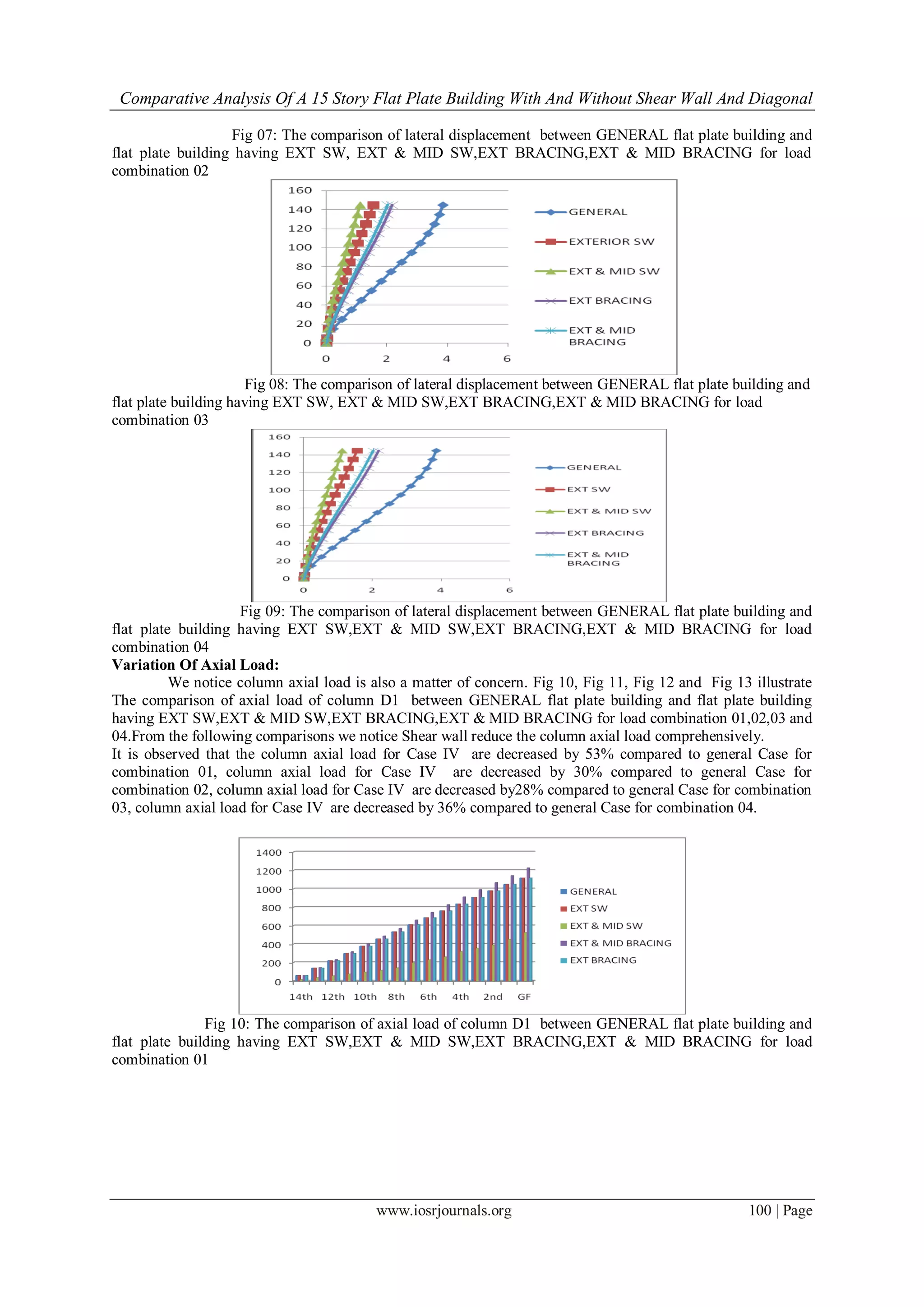
Equivalent static method is a linear static method for the seismic analysis. Fig 07, Fig 08, Fig 09
illustrate the comparison of lateral displacement between GENERAL flat plate building and flat plate building
having EXT SW, EXT & MID SW,EXT BRACING,EXT & MID BRACING for load combination 02,03 and
04.This comparison is showing the values of column A3. Here we see displacement for general flat plate
building crosses the limitation recommended by BNBC, whereas for EXT & MID SW case the displacement
reduced abruptly. It is observed that the lateral displacement for Case I are decreased by 49.3% compared to
general Case , lateral displacement for Case II are decreased by 53% compared to general Case , lateral
displacement for Case III are decreased by64% compared to general Case , lateral displacement for Case IV
are decreased by 74 % compared to general Case for load combination 02. Lateral displacement for Case I are
decreased by 43%compared to general Case , lateral displacement for Case II are decreased by 47% compared
to general Case , lateral displacement for Case III are decreased by59% compared to general Case , lateral
displacement for Case I are decreased by 71% compared to general Case for load combination 03.Also lateral
displacement for Case I are decreased by 44% compared to general Case, lateral displacement for Case II are
decreased by 48% compared to general Case, lateral displacement for Case III are decreased by 60% compared
to general Case, lateral displacement for Case IV are decreased by 71% compared to general Case for load
combination 04.
Comparative Analysis Of A 15 Story Flat Plate Building With And Without Shear Wall And Diagonal
www.iosrjournals.org 100 | Page
Fig 07: The comparison of lateral displacement between GENERAL flat plate building and
flat plate building having EXT SW, EXT & MID SW,EXT BRACING,EXT & MID BRACING for load
combination 02
Fig 08: The comparison of lateral displacement between GENERAL flat plate building and
flat plate building having EXT SW, EXT & MID SW,EXT BRACING,EXT & MID BRACING for load
combination 03
Fig 09: The comparison of lateral displacement between GENERAL flat plate building and
flat plate building having EXT SW,EXT & MID SW,EXT BRACING,EXT & MID BRACING for load
combination 04
Variation Of Axial Load:
We notice column axial load is also a matter of concern. Fig 10, Fig 11, Fig 12 and Fig 13 illustrate
The comparison of axial load of column D1 between GENERAL flat plate building and flat plate building
having EXT SW,EXT & MID SW,EXT BRACING,EXT & MID BRACING for load combination 01,02,03 and
04.From the following comparisons we notice Shear wall reduce the column axial load comprehensively.
It is observed that the column axial load for Case IV are decreased by 53% compared to general Case for
combination 01, column axial load for Case IV are decreased by 30% compared to general Case for
combination 02, column axial load for Case IV are decreased by28% compared to general Case for combination
03, column axial load for Case IV are decreased by 36% compared to general Case for combination 04.
Fig 10: The comparison of axial load of column D1 between GENERAL flat plate building and
flat plate building having EXT SW,EXT & MID SW,EXT BRACING,EXT & MID BRACING for load
combination 01
Comparative Analysis Of A 15 Story Flat Plate Building With And Without Shear Wall And Diagonal
www.iosrjournals.org 101 | Page
Fig 11: The comparison of axial load of column D1 between GENERAL flat plate building and flat plate
building having EXT SW,EXT & MID SW,EXT BRACING,EXT & MID BRACING for load combination 02
Fig 12: The comparison of axial load of column D1 between GENERAL flat plate building and flat
plate building having EXT SW,EXT & MID SW,EXT BRACING,EXT & MID BRACING for load
combination 03
Fig 13: The comparison of axial load of column D1 between GENERAL flat plate building and flat plate
building having EXT SW,EXT & MID SW,EXT BRACING,EXT & MID BRACING for load combination 04
V. CONCLUSION
Flat plate is good in perspective of gravity load. But it experienced that flat plate building can‟t stand
strongly against wind, seismic or other lateral forces. As a result, more than any other structural component, the
lateral force-resisting structure has significant impact on space planning. So it is essential for a structure to have
lateral resistance. To do the initial schematic design in right way it is important to recognize that it is critical to
consider lateral forces from the very start and to integrate lateral force –resisting structure. From the experience
of our study we will recommend Shear wall to implement in flat plate structure.
REFERENCES
[1] H.S.Kim, D.G.Lee , Efficient Analysis of Flat Plate Structures subjected to Lateral Loads , Science Direct, Engineering Structures
Journal, Vol.27, Issue.2, January 2005, pp 251-263.
[2] Husam Omar, Glenn Morris; Analysis of laterally loaded flat-plate structures, Canadian Journal of structural engineering, Vol.18,
No.1, 1991, pp.109-117.
[3] L.G. Jaeger, A.A. Mufti, J.C. Mamet, The structural analysis of tall buildings having irregularly positioned shear walls, Journal of
Building Science, Vol.8, pp.11-22. Pergamum Press 1973
[4] Fayazuddin Ahmed Syed, B. Dean Kumar, Y. Chandrasekhar, B.L.P. Swami, Comparative Analysis of Flat Plate Multistoried
Frames With and Without Shear Walls under Wind Loads, International Journal of Engineering and Advanced Technology (IJEAT)
ISSN: 2249 – 8958, Volume-2, Issue-1, October 2012
[5] IS: 875(Part 3)-1987, “Code of Practise for Design Loads (Other than earthquakes) for Buildings and Structures”, Part 3 Wind
Loads, Second Revision, Bureau of Indian Standards, New Delhi, 1989.
[6] Mehmet Emin Kara and Sinan Altin, Strengthening of RC non ductile frames with RC Infills : An Experimental Study, Science
Direct, Cement and Composite journal, Vol.34, Issue.7, August 2008, pp 612-621.

Comparative Analysis of a 15 Story Flat Plate Building with and Without Shear Wall and Diagonal Bracing Under Wind and Seismic Loads

  • 1.
    IOSR Journal ofMechanical and Civil Engineering (IOSR-JMCE) e-ISSN: 2278-1684,p-ISSN: 2320-334X, Volume 9, Issue 2 (Sep. - Oct. 2013), PP 97-101 www.iosrjournals.org www.iosrjournals.org 97 | Page Comparative Analysis of a 15 Story Flat Plate Building with and Without Shear Wall and Diagonal Bracing Under Wind and Seismic Loads Rajib Kumar Biswas1 , Md.Meraj Uddin2 , Md.Arman Chowdhury3 , Md.Al-Imran Khan4 1 ( Graduate student, Department of Civil Engineering, Ahsanullah University of Science and Technology) 2 ( Graduate student, Department of Civil Engineering, Ahsanullah University of Science and Technology) 3 ( Graduate student, Department of Civil Engineering, Ahsanullah University of Science and Technology) 4 ( Graduate student, Department of Civil Engineering, Ahsanullah University of Science and Technology) Abstract : A flat plate is a reinforced concrete slab supported directly by concrete columns without the use of beams, column flares or drop panels. Flat plate system has been adopted in many buildings constructed recently taking advantage of the reduced floor height to meet the economical and architectural demands. However, In Multistoried structures the flat plate floor system has week resistance to lateral loads like wind and earthquake hence this paper is concerned to increase lateral stiffness of flat plate structure and to minimize the displacement of the structure under lateral loading. This paper is also concerned about column axial load and to review our structure with special features like shear walls & diagonal bracing. In present work, a 15 storied flat plate garments building have been modeled using software package “STAAD Pro” for earthquake zone II in Bangladesh .This model is considered in most vulnerable situation where we took wind speed as 260 kmph and Earthquake load has been taken as per Bangladesh National Building Code(BNBC) Keywords: Shear wall, Diagonal bracing, Lateral stiffness, Flat plate I. INTRODUCTION From the beginning flat plate attracts the eye of architectures for its beautiful view and of engineers for its reduced floor height. But its demands get down because of its weakness to lateral forces. Because it does not allow any beam at its edge so necessarily due to deflection control slab thickness needs to be increased. So, question may arise why not to be concerned by gravity load. Gravity load although does not concern us but there is a provision for increasing the column section to a great extent or provide great thickness of bearing wall. After that, it still cannot be ruled out that gravity load has a great relation with seismic forces. So threat continues to exert on flat plate. To minimize that, like in many research, in this paper it will be clarified that lateral stiffness is the key. To analyze that in this paper structural software STAAD Pro will be used. Lateral drift and displacement will also be a matter of discussion in this study as these have an important relationship with structures lateral stiffness. After the work has given its‟ what, why and how results will be depicted to provide final observation and thus will give a good decision making conditions. II. OBJECTIVE OF THE STUDY We execute this research to improve the condition of flat plate structure .In the present scenario flat plate is considered as a risky structure. So we focus on a multi bay flat plate building  To analyze the structural behaviors of flat plate using X bracing, shear wall in structural analysis software „STAAD Pro‟.  Study on X-bracing system and shear wall by providing them to flat building to increase lateral stiffness.  To analyze the structures with different case studies. III. DETAILS OF THE PRESENT STUDY General Whenever we talk about a structure we always think about the loads it carries and its resistivity against it. For that, we have to know about that structures force, moment, stress and displacement. As we will try to increase lateral stiffness of a 15-storied flat plate garment building so in this segment of our work we will show our data about axial force and displacement which is obtained by STAAD Pro software analysis.
  • 2.
    Comparative Analysis OfA 15 Story Flat Plate Building With And Without Shear Wall And Diagonal www.iosrjournals.org 98 | Page Figure 01: Conceptual Frame View (Grid Division). Details of the Models The model which has been adopted for study is a 15 story regular garments building. The building is consisting of four different types of square columns with dimension 30 in x30 in, 27 in x 27 in,24 in x 24 in and 20 in x 20 in. The floor slabs are taken as .791 ft thick. The modulus of elasticity and shear modulus of concrete have been taken as E = 2.48×10⁷ kN/m2 and G = 1.03 ×10⁷ kN/m2. Fig 02: General plan view of a 15 story garments building Here we studied 4 different cases. Case 01 has diagonal Bracing only at exterior, in Case 02 there is bracing at both interior and exterior. In case 03 there is Shear Wall at exterior where as in case 04 there is Shear wall at both interior and exterior. In this study Shear wall section are taken as 12 inch thick and Diagonal bracing are taken as 12 in x 12 inch. Fig 03: Case01: Diagonal Bracing at Exterior Fig 04:Case02: Diagonal Bracing at Exterior and Mid Wind Direction 14 floors @ 10’ + 5’ from Base
  • 3.
    Comparative Analysis OfA 15 Story Flat Plate Building With And Without Shear Wall And Diagonal www.iosrjournals.org 99 | Page Fig 05:Case03 (Shear Wall at Exterior) Fig06:Case04(Shear Wall at Exterior and Mid) Load combination In this study we consider four different load combinations as per BNBC recommendation for dead & live loadings and seismic & wind loading. The load combinations are Load Combination 1: 1.4DL + 1.7LL. Load Combination 2: 1.05DL + 1.275LL + 1.275W. Load Combination 3: 1.05DL + 1.275L + 1.4E. Load Combination 4: 1.4(D + L + E). Where, D = Dead Load for Self weight, Partition Wall and Floor Finish. L = Live Load. W = Wind Load. E = Earthquake Load. IV. RESULTS AND DISCUSSION Variation Of Lateral Displacement With Height: Equivalent static method is a linear static method for the seismic analysis. Fig 07, Fig 08, Fig 09 illustrate the comparison of lateral displacement between GENERAL flat plate building and flat plate building having EXT SW, EXT & MID SW,EXT BRACING,EXT & MID BRACING for load combination 02,03 and 04.This comparison is showing the values of column A3. Here we see displacement for general flat plate building crosses the limitation recommended by BNBC, whereas for EXT & MID SW case the displacement reduced abruptly. It is observed that the lateral displacement for Case I are decreased by 49.3% compared to general Case , lateral displacement for Case II are decreased by 53% compared to general Case , lateral displacement for Case III are decreased by64% compared to general Case , lateral displacement for Case IV are decreased by 74 % compared to general Case for load combination 02. Lateral displacement for Case I are decreased by 43%compared to general Case , lateral displacement for Case II are decreased by 47% compared to general Case , lateral displacement for Case III are decreased by59% compared to general Case , lateral displacement for Case I are decreased by 71% compared to general Case for load combination 03.Also lateral displacement for Case I are decreased by 44% compared to general Case, lateral displacement for Case II are decreased by 48% compared to general Case, lateral displacement for Case III are decreased by 60% compared to general Case, lateral displacement for Case IV are decreased by 71% compared to general Case for load combination 04.
  • 4.
    Comparative Analysis OfA 15 Story Flat Plate Building With And Without Shear Wall And Diagonal www.iosrjournals.org 100 | Page Fig 07: The comparison of lateral displacement between GENERAL flat plate building and flat plate building having EXT SW, EXT & MID SW,EXT BRACING,EXT & MID BRACING for load combination 02 Fig 08: The comparison of lateral displacement between GENERAL flat plate building and flat plate building having EXT SW, EXT & MID SW,EXT BRACING,EXT & MID BRACING for load combination 03 Fig 09: The comparison of lateral displacement between GENERAL flat plate building and flat plate building having EXT SW,EXT & MID SW,EXT BRACING,EXT & MID BRACING for load combination 04 Variation Of Axial Load: We notice column axial load is also a matter of concern. Fig 10, Fig 11, Fig 12 and Fig 13 illustrate The comparison of axial load of column D1 between GENERAL flat plate building and flat plate building having EXT SW,EXT & MID SW,EXT BRACING,EXT & MID BRACING for load combination 01,02,03 and 04.From the following comparisons we notice Shear wall reduce the column axial load comprehensively. It is observed that the column axial load for Case IV are decreased by 53% compared to general Case for combination 01, column axial load for Case IV are decreased by 30% compared to general Case for combination 02, column axial load for Case IV are decreased by28% compared to general Case for combination 03, column axial load for Case IV are decreased by 36% compared to general Case for combination 04. Fig 10: The comparison of axial load of column D1 between GENERAL flat plate building and flat plate building having EXT SW,EXT & MID SW,EXT BRACING,EXT & MID BRACING for load combination 01
  • 5.
    Comparative Analysis OfA 15 Story Flat Plate Building With And Without Shear Wall And Diagonal www.iosrjournals.org 101 | Page Fig 11: The comparison of axial load of column D1 between GENERAL flat plate building and flat plate building having EXT SW,EXT & MID SW,EXT BRACING,EXT & MID BRACING for load combination 02 Fig 12: The comparison of axial load of column D1 between GENERAL flat plate building and flat plate building having EXT SW,EXT & MID SW,EXT BRACING,EXT & MID BRACING for load combination 03 Fig 13: The comparison of axial load of column D1 between GENERAL flat plate building and flat plate building having EXT SW,EXT & MID SW,EXT BRACING,EXT & MID BRACING for load combination 04 V. CONCLUSION Flat plate is good in perspective of gravity load. But it experienced that flat plate building can‟t stand strongly against wind, seismic or other lateral forces. As a result, more than any other structural component, the lateral force-resisting structure has significant impact on space planning. So it is essential for a structure to have lateral resistance. To do the initial schematic design in right way it is important to recognize that it is critical to consider lateral forces from the very start and to integrate lateral force –resisting structure. From the experience of our study we will recommend Shear wall to implement in flat plate structure. REFERENCES [1] H.S.Kim, D.G.Lee , Efficient Analysis of Flat Plate Structures subjected to Lateral Loads , Science Direct, Engineering Structures Journal, Vol.27, Issue.2, January 2005, pp 251-263. [2] Husam Omar, Glenn Morris; Analysis of laterally loaded flat-plate structures, Canadian Journal of structural engineering, Vol.18, No.1, 1991, pp.109-117. [3] L.G. Jaeger, A.A. Mufti, J.C. Mamet, The structural analysis of tall buildings having irregularly positioned shear walls, Journal of Building Science, Vol.8, pp.11-22. Pergamum Press 1973 [4] Fayazuddin Ahmed Syed, B. Dean Kumar, Y. Chandrasekhar, B.L.P. Swami, Comparative Analysis of Flat Plate Multistoried Frames With and Without Shear Walls under Wind Loads, International Journal of Engineering and Advanced Technology (IJEAT) ISSN: 2249 – 8958, Volume-2, Issue-1, October 2012 [5] IS: 875(Part 3)-1987, “Code of Practise for Design Loads (Other than earthquakes) for Buildings and Structures”, Part 3 Wind Loads, Second Revision, Bureau of Indian Standards, New Delhi, 1989. [6] Mehmet Emin Kara and Sinan Altin, Strengthening of RC non ductile frames with RC Infills : An Experimental Study, Science Direct, Cement and Composite journal, Vol.34, Issue.7, August 2008, pp 612-621.