International Journal of Engineering Research and Development
e-ISSN: 2278-067X, p-ISSN: 2278-800X, www.ijerd.com
Volume 6, Issue 5 (March 2013), PP. 68-73

        Methodology for energy management in industries
                          Rini Mary Cherian1, Dr. Haris Naduthodi2
                    1M Tech Student,Government Engineering College,Thrissur Kerala,India
                          2Government Engineering College,Thrissur Kerala,India


    Abstract:- Energy is defined as the ability or capacity to do work. Energy can be found in number of
    different forms. It can be chemical energy, electrical energy, heat (thermal energy), light (radiant
    energy), mechanical energy, and nuclear energy. There has been an enormous increase in the demand
    for energy since the middle of the last century as a result of industrial development and population
    growth. Total commercial energy consumption has been growing tremendously since the last decade.
    The five most energy intensive industrial sub sectors including iron and steel, petroleum refining,
    cement production, pulp and paper and chemicals account for approximately 45 percent of all
    industrial energy consumption in the region. Sadly enough, large amounts of energy consumed by
    industry are used inefficiently because of lack of awareness about proper energy management and
    weak energy policies and measures, among others. Hence, finding ways to increase energy efficiency
    in the industrial sector is important. In this paper, energy conservation is viewed from management as
    well as technical aspects. Management aspect deals with studying and identifying the barriers that
    affect company’s ability to become energy efficient. This can be identified by conducting a survey.
    Technical aspect deals with studying and identifying the various opportunities for saving energy in an
    industry. Approximate energy savings, investment and payback period were estimated with the data
    collected from a plant of a petroleum refining organization.

    Keywords:- energy, energy management, energy conservation

                                         I.        INTRODUCTION
          Energy is defined as the ability or the capacity to do work. We use energy to do work and make all
movements. When we eat, our bodies transform the food into energy to do work. When we run or walk or do
some work, we ‘burn’ energy in our bodies. There are many sources of energy that help to run the various
machines in industries .With the advent of the Industrial Revolution, the use of energy in the form of fossil fuels
began growing as more and more industries were set up. There has been an enormous increase in the demand for
energy since the middle of the last century as a result of industrial development and population growth. Total
commercial energy consumption has been growing tremendously since the last decade. Per capita commercial
energy consumption in low-income countries have more than doubled. About 15% of the world's population
living in the wealthy industrialized nations consume over half the energy used in the world. In some respects,
the global energy system has evolved in a cleaner direction in the last 25 years. The share of world primary
energy derived from natural gas – the cleanest fossil fuel – has increased by more than 25%. So has the use and
generation of renewable energy sources. Still, the overall efficiency of energy production remains extremely
low: on average, more than 90% of energy consumed is lost or wasted in the process of conversion Conserving
energy has become the need of the day be it in the transport, household, or industrial sectors. Energy
conservation means reduction of energy consumption without losing production quality and quantity. This can
be achieved by efficient and judicious use of energy.
          Industries must closely manage their operations in order to be successful. But they often overlook
managing the use their energy resources as a key way to reduce operating costs. Establishing an energy
management program requires commitment from all levels of the organization so that energy usage patterns in
every department can be carefully reviewed and adjusted. Basic techniques must be applied to activities such as
administration, finance, or production in order to make the enterprise successful. Energy management is the
application of these techniques to the use of energy resources. Making the most effective use of energy through
efficient application and reduction of waste will keep energy consumption and costs at a controlled minimum.
The benefits of energy management will vary with individual circumstances. There is a potential savings in
every plant, even in well-run plants, for which a systematic planning and procedures are required. Managing
energy to reduce operating cost, minimize environmental impact and increase profitability has traditionally been
a hard sell to executives and difficult task for those assigned. In most cases, since energy is not viewed as a core
component of business activity a haphazard approach is followed. When energy is in short supply or energy
prices rise, energy management becomes a major focus. After the crisis period passes, normal operations resume
                                                        68
Methodology for energy management in industries
and energy is relegated to a secondary role. Effective management of energy requires an organizational structure
that elevates the importance of energy within the business and delineates the people, resources and planning to
achieve the desired results. While most experts argue that energy management is a technical problem that must
be addressed with technological solutions, the framers of the energy management standard formulated a
management solution that incorporates both management and technical solutions to the problem. Whatever the
technology identified by an organization to address their energy needs, it still must be implemented by people,
and to optimize the outcome, people have to be managed.
          In this paper effectiveness of energy policy and capital investment in energy efficiency technologies in
the industrial sector in India was identified. Indian energy policies relating to industrial energy efficiency over
the past 25 years were briefly reviewed, and a comparison study of these energy efficiency policies and
strategies in India and China had been carried out. The accounts of 26 industrial enterprises which applied and
used a loan of the Asian Development Bank were audited for data collection. Field-visits to seven industrial
entrepreneurs were undertaken in a case study. Methodologies used in this study include documentation, cross-
country reviews on energy policies, questionnaire design and distribution in the industrial sector, and on-site
auditing of energy efficiency technologies. It was concluded that current energy policies and strategies in India
need further improvement to promote energy efficiency investment and energy efficiency technology
development in the industrial sector.[1] The paper presented the preliminary findings from a research study
which explored the drivers and barriers for energy efficiency improvements in South African crude oil
refineries. These influences were important in understanding the discrepancy between theoretical potential
savings and actual implementation of energy saving measures. Preliminary findings in the paper were in
agreement with recent literature in the field of drivers and barriers for energy efficiency improvement. However
disparate views were found pertaining to availability of capital, the impact of economic climate on energy
efficiency investments and technical skill required for energy efficiency measures [2]. The paper reviewed the
economics literature on energy efficiency in India, as a guide for further research in this area. The empirical
literature has focused on four questions: How does energy efficiency in India compare with energy efficiency in
other countries? What would be the energy savings (and cost savings) from adopting certain energy-efficient
technologies? Why are these technologies being—or not being— adopted? What policies should be
implemented to encourage their adoption?[3]. With the background of high energy saving potential and its
benefits, bridging the gap between demand and supply, reducing environmental emissions through energy
saving, and to effectively overcome the barrier, in October 2001, the Government of India had enacted the
Energy Conservation Act - 2001. The Act provides the much-needed legal framework and institutional
arrangement for embarking on an energy efficiency drive. This Act of Parliament received the assent of the
President on the 29th September, 2001. India has a huge scope for energy saving. Various studies undertaken
suggest substantial energy saving potential in industrial, commercial and domestic sectors. Efficient use of
energy provides the least cost and environmentally friendly option for capacity creation in the shortest time
frame. Energy efficiency also assumes further importance, as "one unit of energy saved at consumer end, avoids
3 units of fresh capacity addition". Thus the scope of the project is to identify potential energy saving areas.
Also it’s clear that companies are faced with a range of financial, cultural, technical and external barriers that
affect their ability to adopt energy efficiency measures. Thus by conducting a survey, such barriers can be
identified.

  II.        BARRIERS THAT INFLUENCE COMPANIES ABILITY TO BECOME MORE
                               ENERGY EFFICIENT
          Some companies improve their energy efficiency and but some others don’t. Companies are faced with
a range of financial, cultural, technical and external barriers that affect their ability to adopt energy efficiency
measures. Thus the question is what are they and how can we overcome the barriers.
     According to a study by United Nations Environment Program (UNEP), they identified four categories of
barriers to energy efficiency as:
     1) Management
     2) Knowledge/information
     3) Financing
     4) Policy

1) Lack of Management Awareness
         The lack of awareness of energy efficiency by top management of companies is an important barrier
because without management commitment it is an uphill battle to improve energy efficiency. This appears to be
the root cause of other barriers, such as the priority for production, lack of investment capital, and limited
policies, systems and reporting processes to manage energy consumption, and hierarchical management
structures.

                                                        69
Methodology for energy management in industries

2) Limited Knowledge and Information
         A second barrier is about knowledge and information. It covers limited information and (technical)
knowledge at company level and facilitating organizations, but also a limited access to and availability of
knowledge and information. Company information on energy and resources is crucial because only then the
improvements after implementation of options can be measured, and management is more likely to continue
with resource and energy efficiency if quantitative data on savings are available. Limited internal knowledge
and expertise was also a common problem. A minimum technical knowledge of energy, production processes
and equipment is required to be able to identify, investigate and implement options to improve resource and
energy efficiency.

3) Lack of Financing
          There are financial limitations of implementing energy efficiency options. Sometimes the issue was
that money was available, but not readily available. Another barrier was the lack of money to invest in options.
Lack of financing can also be a perceived barrier that stops companies from taking action. Often there is a gap
between what management would like to do and how much they are willing to spend. At the start of the project
management
of several companies indicated an interest in technically sophisticated options. But when push came to shove,
management would not approve the options citing high investment costs and long payback periods. It is
therefore important to also focus on options that require little investment but have good return on investment,
even if these are not the most glamorous options

4) Lack of Policies and Legislation and Enforcement
          While companies hold the key to reducing their energy consumption, government policy certainly has a
big influence. Limited policies, poor enforcement and conflicting economic and environmental policies were
identified as the fourth group of barriers. Lack of effective policies is a key issue, but the situation is different
between countries. A second problem is weak enforcement of environmental policies and legislation.[4]

                 III.       ENERGY SAVING SCHEMES - TECHNICAL ASPECT
         Energy conservation refers to efforts made to reduce energy consumption. Energy conservation can be
achieved through increased efficient energy use, in conjunction with decreased energy consumption and/or
reduced consumption from conventional energy sources. Energy conservation can result in increased financial
capital, environmental quality, national security, personal security, and human comfort. Individuals and
organizations that are direct consumers of energy choose to conserve energy to reduce energy costs and promote
economic security. Industrial and commercial users can increase energy use efficiency to maximize profit. Some
methods to improve energy efficiency in industry has been identified as :

    1)   Use of variable frequency drives
    2)   Use of energy efficient motors
    3)   Improving system power factor using capacitors/capacitor banks
    4)   Use of energy efficient lighting system

Variable frequency drive:
           Adding a variable frequency drive (VFD) to a motor-driven system can offer potential energy savings
in a system in which the loads vary with time. VFDs belong to a group of equipment called adjustable speed
drives or variable speed drives. (Variable speed drives can be electrical or mechanical, whereas VFDs are
electrical.) The operating speed of a motor connected to a VFD is varied by changing the frequency of the motor
supply voltage. This allows continuous process speed control. Motor-driven systems are often designed to
handle peak loads that have a safety factor. This often leads to energy inefficiency in systems that operate for
extended periods at reduced load. The ability to adjust motor speed enables closer matching of motor output to
load and often results in energy savings

Use of energy efficient motors:
          Electric motors are intrinsically very efficient. Their efficiencies vary from 85% to 95% for motors of
sizes ranging from 10 HP to 500 HP. It is still possible to improve the efficiency of these motors by 1 to 4% by
using more efficient motors. However, in the energy efficiency game, there are a number of other things also
one should focus; more than just improving the efficiency of motors alone. In industry, most commonly used
motors are 3 phase squirrel cage induction type. Use of synchronous motors and DC motors for heavy duty and
precision drives etc. are also common. With the introduction of variable frequency drives for speed and torque

                                                         70
Methodology for energy management in industries
control, the 3-phase induction motors are finding increasingly acceptable for applications where DC drives were
earlier used. The classic challenge for energy users is to determine whether it is appropriate to spend more
money now in order to save money in the long term. However, just because something saves money in the long
term does not necessarily mean that it saves an amount sufficient to justify the required additional investment. In
many applications it is worthwhile replacing motors even when considerable working life remains. Motors can
run without problems for 20 years or more with good protection and routine maintenance. However, if they are
running inefficiently, it is worthwhile replacing them as running costs are much more than first costs. Motors
can be considered as consumable items and not capital items, considering the current energy prices.

Improving system power factor:
           Power factor is defined as the ratio of real power to apparent power. This definition is often
mathematically represented as kW/kVA, where the numerator is the active (real) power and the denominator is
the (active+ reactive) or apparent power. Reactive power is neither produced nor consumed. But, in reality we
measure reactive power losses, introduce so many equipments for reactive power compensation to reduce
electricity consumption and cost. The reactive power required by loads such as induction furnace, arc lamps,
inductive loads increase the amount of apparent power in the distribution system and this increase in reactive
power and apparent power results in a lower power factor. Power factor can be improved by adding consumers
of reactive power in the system like Capacitors or Synchronous Motors. Power factor improvement in plant will
generally compensate for the losses and reduce current loadings on supply equipment, i.e.; cables, switchgear,
transformers, generating plant, etc. That means power factor corrections – whenever there is scope for
correction- will reduce electricity consumption in the plant and in turn the electricity cost. Power factor
improvement will lead to reduction in electricity consumption, when it is done at the equipment level or at the
Control Center level.

Energy efficient lighting system:
          Most often inefficient use of electrical lighting in home and factories causes wastage and losses. By
taking appropriate measures energy can be used efficiently in lighting. Lighting is an essential requirement for
any facility and it touches the day-to-day lives of people in more ways than one. It accounts for 15% of the total
energy consumed in a developing country as against about 7%–10% in developed countries. Energy efficiency
has often been viewed as a ‘resource option’, just like coal, oil, or natural gas. For a developing country such as
India, it provides additional economic value by preserving the resource base and reducing pollution. Today,
energy efficiency assumes even greater importance because it is the most cost effective and reliable means of
mitigating global climate change. Recognition of such potential has led to high expectations regarding control of
future carbon dioxide emissions through more frequent energy-efficiency improvements as compared to those in
the past. Thus, with new product development taking place at a much faster pace, the lighting sector as a whole
has immense potential to pursue energy efficiency options. Often in industrial plants, the use of efficient lighting
is not considered important, as energy consumption for lighting purposes generally forms only a small
component of the total energy consumed. There has been continuous development in lighting technologies over
the past 60 years to produce the best lighting products and controls for creating higher lighting quality with
reduced energy consumption. However, the speed at which these technological developments have taken place
has not been complemented by a corresponding pace in generating awareness about them and their availability
to the end-users. Also, the emergence of new secondary players has generated a lot of competition in the
lighting market. These market barriers should be addressed through aggressive customer-oriented awareness
programmes and demonstration projects.

          IV.        CASE STUDY AT A PETROLEUM REFINING ORGANIZATION.
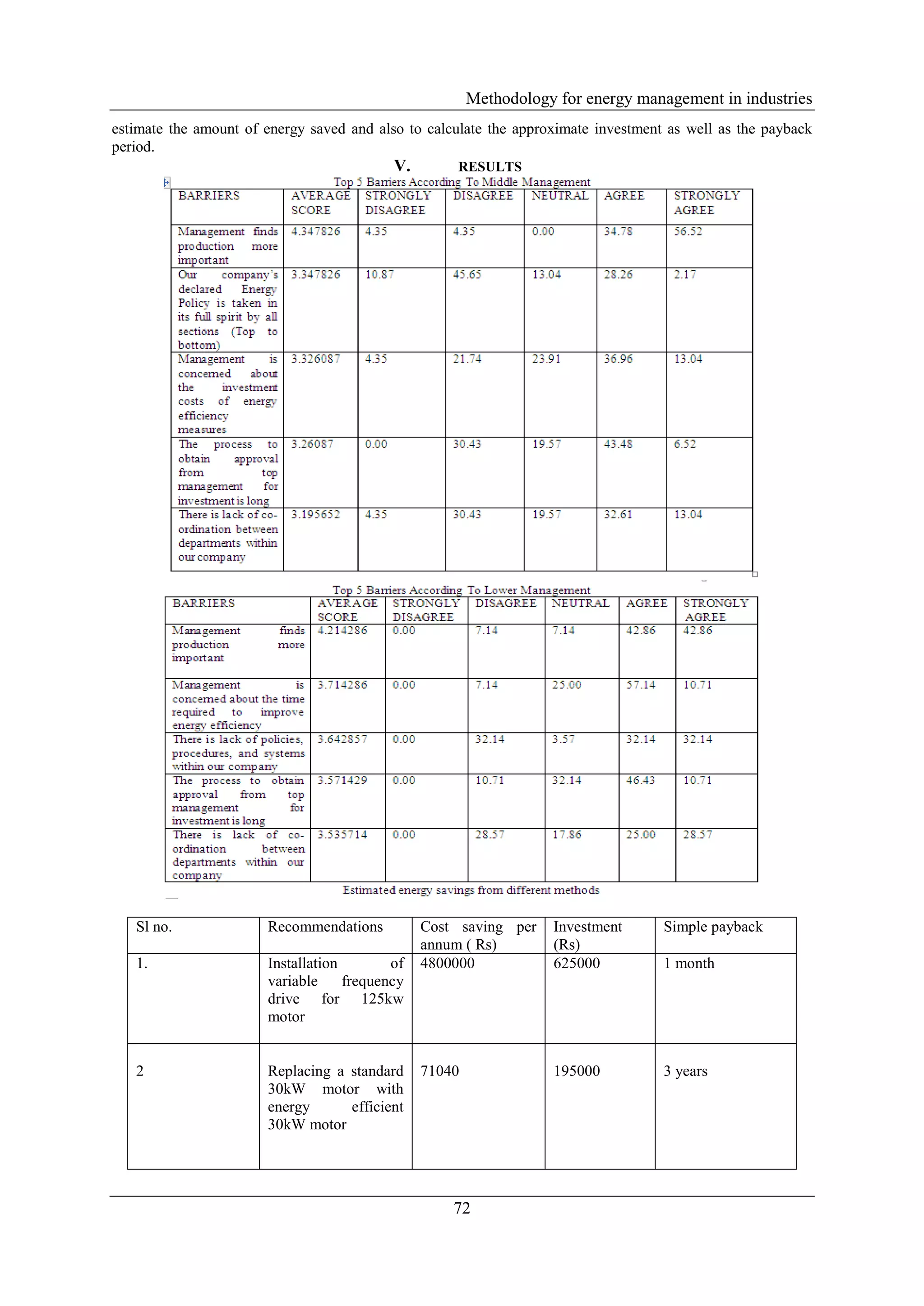
         Questionnaire was prepared with 25 questions and five options each. It was distributed and received
feedback from 74 employees. Of the 74 employees, 46 were from middle management and 28 from lower
management. Middle management consisted of officers who were chief managers, senior managers, managers
and deputy managers. Lower management included supervisors, technicians and operators. Spreads of scores
were from 1 to 5. Survey was analyzed using a spreadsheet/statistical software called SPSS. SPSS is a computer
program used for survey authoring and deployment (IBM SPSS Data Collection), data mining (IBM SPSS
Modeler), text analytics, statistical analysis, and collaboration and deployment (batch and automated scoring
services). Statistical test used was Mann Whitney U test. The Mann Whitney U test is used to compare
differences between two independent groups when the dependent variable is either ordinal or interval but not
normally distributed. Sometimes distributions of variables do not show a normal distribution, or the samples
taken are so small that one cannot tell if they are part of a normal distribution or not.
In order to study the technical aspect, field measurements of various electrical parameters like Voltage, current,
Power factor and Power of certain motors installed in the plant were taken. This data was used as the base to

                                                        71
Methodology for energy management in industries
estimate the amount of energy saved and also to calculate the approximate investment as well as the payback
period.
                                           V.       RESULTS


   Sl no.              Recommendations          Cost saving per    Investment       Simple payback
                                                annum ( Rs)        (Rs)
   1.                  Installation        of   4800000            625000           1 month
                       variable     frequency
                       drive for 125kw
                       motor


   2                   Replacing a standard     71040              195000           3 years
                       30kW motor with
                       energy      efficient
                       30kW motor


                                                    72
Methodology for energy management in industries
   3.                    Use       of    energy     137970             96768             8 months
                         efficient      lighting
                         system       –       T5
                         tubelights


   4                     Use       of    energy     209714.4           254268            14 months
                         efficient      lighting
                         system       –    LED
                         tubelights

   5                     Improving      system      11700              75000             6 years
                         power factor using
                         capacitors/capacitor
                         banks

                                         VI.         CONCLUSION
          In this paper the concept of energy conservation was viewed from a management as well as technical
aspect. The barriers that affect company’s ability to become energy efficient were studied in general. On the
basis of this study, the barriers that affect company’s ability to become energy efficient were identified at
petroleum refining organization using a survey. Survey analysis was done at middle management and lower
management level. One limitation to this survey was that number of respondents in both categories were
different. Technical aspect of the thesis work dealt with studying various energy potential areas in an industry.
Thus various energy potential areas at a unit of a petroleum refining organization was identified and
approximate energy savings, investment and the payback period were calculated. Considerable energy savings
were estimated. Thus if remaining areas are also considered, then the organization could achieve considerable
energy savings.

                                                   REFERENCES
  [1].  Ming Yang, ‘ Energy efficiency policy impact in India: case study of investment in industrial energy
        efficiency’, Energy Policy 34 (2006), pp 3104-3114
  [2]. C Bergh and Dr B Cohen, ‘Energy efficiency in the South African oil refining industry’, 2011
        Proceedings of the 8th Conference on the Industrial amd Commercial Use of Energy, pp 46-52
  [3]. Soma Bhattacharya and Maureen L. Cropper, ‘Options for Energy Efficiency in India and Barriers to
        Their Adoption’, April 2010, RFF DP 10-20
  [4]. Amulya K.N.Reddy, ‘ Barriers to improvements in energy efficiency’, Energy policy December 1991,
        pp 953-.
  [5]. Aimee McKane, Lynn Price, Stephane de la Rue du Can, ‘Policies for Promoting Industrial Energy
        Efficiency in Developing Countries and Transition Economies’, United Nations Industrial
        Development Organization,Vienna, 2008
  [6]. Division of Technology, Industry and Economics, ‘Barriers To Energy Efficiency In Industry In Asia’,
        United Nations Environment Programme, June 2006
  [7]. Gilbert A. McCoy, Todd Litman, John G. Douglass, ‘Energy-Efficient Electric Motor Selection
        Handbook, Revision 3, January 1993
  [8].   ‘Narendra B Soni, ‘The Transition To Led Illumination: A Case Study On Energy Conservation’
        Journal of Theoretical and Applied Information Technology, pp 1083-1087
  [9]. Ernst Worrell, John A. Laitner, Michael Ruth and Hodayah Finman, ‘Productivity benefits of industrial
        energy efficiency measures’ Energy, 28, 11, pp 1081-1098, 9/1/2003
  [10]. An American National Standard IEEE Recommended Practice for Energy Conservation and Cost
        Effective Planning in Industrial Facilities, IEEE standards board ANSI/IEEE(Std 739-1984)
  [11]. Sara Westman, Sophie Punte, ‘Improving Energy Efficiency In Industry In Asia’, A Policy Review As
        Part Of The Energy Efficiency Guide For Industry In Asia, United Nations Environment Programme
        Division Of Technology, Industry And Economics March 2006


                                                        73

Welcome to International Journal of Engineering Research and Development (IJERD)

  • 1.
    International Journal ofEngineering Research and Development e-ISSN: 2278-067X, p-ISSN: 2278-800X, www.ijerd.com Volume 6, Issue 5 (March 2013), PP. 68-73 Methodology for energy management in industries Rini Mary Cherian1, Dr. Haris Naduthodi2 1M Tech Student,Government Engineering College,Thrissur Kerala,India 2Government Engineering College,Thrissur Kerala,India Abstract:- Energy is defined as the ability or capacity to do work. Energy can be found in number of different forms. It can be chemical energy, electrical energy, heat (thermal energy), light (radiant energy), mechanical energy, and nuclear energy. There has been an enormous increase in the demand for energy since the middle of the last century as a result of industrial development and population growth. Total commercial energy consumption has been growing tremendously since the last decade. The five most energy intensive industrial sub sectors including iron and steel, petroleum refining, cement production, pulp and paper and chemicals account for approximately 45 percent of all industrial energy consumption in the region. Sadly enough, large amounts of energy consumed by industry are used inefficiently because of lack of awareness about proper energy management and weak energy policies and measures, among others. Hence, finding ways to increase energy efficiency in the industrial sector is important. In this paper, energy conservation is viewed from management as well as technical aspects. Management aspect deals with studying and identifying the barriers that affect company’s ability to become energy efficient. This can be identified by conducting a survey. Technical aspect deals with studying and identifying the various opportunities for saving energy in an industry. Approximate energy savings, investment and payback period were estimated with the data collected from a plant of a petroleum refining organization. Keywords:- energy, energy management, energy conservation I. INTRODUCTION Energy is defined as the ability or the capacity to do work. We use energy to do work and make all movements. When we eat, our bodies transform the food into energy to do work. When we run or walk or do some work, we ‘burn’ energy in our bodies. There are many sources of energy that help to run the various machines in industries .With the advent of the Industrial Revolution, the use of energy in the form of fossil fuels began growing as more and more industries were set up. There has been an enormous increase in the demand for energy since the middle of the last century as a result of industrial development and population growth. Total commercial energy consumption has been growing tremendously since the last decade. Per capita commercial energy consumption in low-income countries have more than doubled. About 15% of the world's population living in the wealthy industrialized nations consume over half the energy used in the world. In some respects, the global energy system has evolved in a cleaner direction in the last 25 years. The share of world primary energy derived from natural gas – the cleanest fossil fuel – has increased by more than 25%. So has the use and generation of renewable energy sources. Still, the overall efficiency of energy production remains extremely low: on average, more than 90% of energy consumed is lost or wasted in the process of conversion Conserving energy has become the need of the day be it in the transport, household, or industrial sectors. Energy conservation means reduction of energy consumption without losing production quality and quantity. This can be achieved by efficient and judicious use of energy. Industries must closely manage their operations in order to be successful. But they often overlook managing the use their energy resources as a key way to reduce operating costs. Establishing an energy management program requires commitment from all levels of the organization so that energy usage patterns in every department can be carefully reviewed and adjusted. Basic techniques must be applied to activities such as administration, finance, or production in order to make the enterprise successful. Energy management is the application of these techniques to the use of energy resources. Making the most effective use of energy through efficient application and reduction of waste will keep energy consumption and costs at a controlled minimum. The benefits of energy management will vary with individual circumstances. There is a potential savings in every plant, even in well-run plants, for which a systematic planning and procedures are required. Managing energy to reduce operating cost, minimize environmental impact and increase profitability has traditionally been a hard sell to executives and difficult task for those assigned. In most cases, since energy is not viewed as a core component of business activity a haphazard approach is followed. When energy is in short supply or energy prices rise, energy management becomes a major focus. After the crisis period passes, normal operations resume 68
  • 2.
    Methodology for energymanagement in industries and energy is relegated to a secondary role. Effective management of energy requires an organizational structure that elevates the importance of energy within the business and delineates the people, resources and planning to achieve the desired results. While most experts argue that energy management is a technical problem that must be addressed with technological solutions, the framers of the energy management standard formulated a management solution that incorporates both management and technical solutions to the problem. Whatever the technology identified by an organization to address their energy needs, it still must be implemented by people, and to optimize the outcome, people have to be managed. In this paper effectiveness of energy policy and capital investment in energy efficiency technologies in the industrial sector in India was identified. Indian energy policies relating to industrial energy efficiency over the past 25 years were briefly reviewed, and a comparison study of these energy efficiency policies and strategies in India and China had been carried out. The accounts of 26 industrial enterprises which applied and used a loan of the Asian Development Bank were audited for data collection. Field-visits to seven industrial entrepreneurs were undertaken in a case study. Methodologies used in this study include documentation, cross- country reviews on energy policies, questionnaire design and distribution in the industrial sector, and on-site auditing of energy efficiency technologies. It was concluded that current energy policies and strategies in India need further improvement to promote energy efficiency investment and energy efficiency technology development in the industrial sector.[1] The paper presented the preliminary findings from a research study which explored the drivers and barriers for energy efficiency improvements in South African crude oil refineries. These influences were important in understanding the discrepancy between theoretical potential savings and actual implementation of energy saving measures. Preliminary findings in the paper were in agreement with recent literature in the field of drivers and barriers for energy efficiency improvement. However disparate views were found pertaining to availability of capital, the impact of economic climate on energy efficiency investments and technical skill required for energy efficiency measures [2]. The paper reviewed the economics literature on energy efficiency in India, as a guide for further research in this area. The empirical literature has focused on four questions: How does energy efficiency in India compare with energy efficiency in other countries? What would be the energy savings (and cost savings) from adopting certain energy-efficient technologies? Why are these technologies being—or not being— adopted? What policies should be implemented to encourage their adoption?[3]. With the background of high energy saving potential and its benefits, bridging the gap between demand and supply, reducing environmental emissions through energy saving, and to effectively overcome the barrier, in October 2001, the Government of India had enacted the Energy Conservation Act - 2001. The Act provides the much-needed legal framework and institutional arrangement for embarking on an energy efficiency drive. This Act of Parliament received the assent of the President on the 29th September, 2001. India has a huge scope for energy saving. Various studies undertaken suggest substantial energy saving potential in industrial, commercial and domestic sectors. Efficient use of energy provides the least cost and environmentally friendly option for capacity creation in the shortest time frame. Energy efficiency also assumes further importance, as "one unit of energy saved at consumer end, avoids 3 units of fresh capacity addition". Thus the scope of the project is to identify potential energy saving areas. Also it’s clear that companies are faced with a range of financial, cultural, technical and external barriers that affect their ability to adopt energy efficiency measures. Thus by conducting a survey, such barriers can be identified. II. BARRIERS THAT INFLUENCE COMPANIES ABILITY TO BECOME MORE ENERGY EFFICIENT Some companies improve their energy efficiency and but some others don’t. Companies are faced with a range of financial, cultural, technical and external barriers that affect their ability to adopt energy efficiency measures. Thus the question is what are they and how can we overcome the barriers. According to a study by United Nations Environment Program (UNEP), they identified four categories of barriers to energy efficiency as: 1) Management 2) Knowledge/information 3) Financing 4) Policy 1) Lack of Management Awareness The lack of awareness of energy efficiency by top management of companies is an important barrier because without management commitment it is an uphill battle to improve energy efficiency. This appears to be the root cause of other barriers, such as the priority for production, lack of investment capital, and limited policies, systems and reporting processes to manage energy consumption, and hierarchical management structures. 69
  • 3.
    Methodology for energymanagement in industries 2) Limited Knowledge and Information A second barrier is about knowledge and information. It covers limited information and (technical) knowledge at company level and facilitating organizations, but also a limited access to and availability of knowledge and information. Company information on energy and resources is crucial because only then the improvements after implementation of options can be measured, and management is more likely to continue with resource and energy efficiency if quantitative data on savings are available. Limited internal knowledge and expertise was also a common problem. A minimum technical knowledge of energy, production processes and equipment is required to be able to identify, investigate and implement options to improve resource and energy efficiency. 3) Lack of Financing There are financial limitations of implementing energy efficiency options. Sometimes the issue was that money was available, but not readily available. Another barrier was the lack of money to invest in options. Lack of financing can also be a perceived barrier that stops companies from taking action. Often there is a gap between what management would like to do and how much they are willing to spend. At the start of the project management of several companies indicated an interest in technically sophisticated options. But when push came to shove, management would not approve the options citing high investment costs and long payback periods. It is therefore important to also focus on options that require little investment but have good return on investment, even if these are not the most glamorous options 4) Lack of Policies and Legislation and Enforcement While companies hold the key to reducing their energy consumption, government policy certainly has a big influence. Limited policies, poor enforcement and conflicting economic and environmental policies were identified as the fourth group of barriers. Lack of effective policies is a key issue, but the situation is different between countries. A second problem is weak enforcement of environmental policies and legislation.[4] III. ENERGY SAVING SCHEMES - TECHNICAL ASPECT Energy conservation refers to efforts made to reduce energy consumption. Energy conservation can be achieved through increased efficient energy use, in conjunction with decreased energy consumption and/or reduced consumption from conventional energy sources. Energy conservation can result in increased financial capital, environmental quality, national security, personal security, and human comfort. Individuals and organizations that are direct consumers of energy choose to conserve energy to reduce energy costs and promote economic security. Industrial and commercial users can increase energy use efficiency to maximize profit. Some methods to improve energy efficiency in industry has been identified as : 1) Use of variable frequency drives 2) Use of energy efficient motors 3) Improving system power factor using capacitors/capacitor banks 4) Use of energy efficient lighting system Variable frequency drive: Adding a variable frequency drive (VFD) to a motor-driven system can offer potential energy savings in a system in which the loads vary with time. VFDs belong to a group of equipment called adjustable speed drives or variable speed drives. (Variable speed drives can be electrical or mechanical, whereas VFDs are electrical.) The operating speed of a motor connected to a VFD is varied by changing the frequency of the motor supply voltage. This allows continuous process speed control. Motor-driven systems are often designed to handle peak loads that have a safety factor. This often leads to energy inefficiency in systems that operate for extended periods at reduced load. The ability to adjust motor speed enables closer matching of motor output to load and often results in energy savings Use of energy efficient motors: Electric motors are intrinsically very efficient. Their efficiencies vary from 85% to 95% for motors of sizes ranging from 10 HP to 500 HP. It is still possible to improve the efficiency of these motors by 1 to 4% by using more efficient motors. However, in the energy efficiency game, there are a number of other things also one should focus; more than just improving the efficiency of motors alone. In industry, most commonly used motors are 3 phase squirrel cage induction type. Use of synchronous motors and DC motors for heavy duty and precision drives etc. are also common. With the introduction of variable frequency drives for speed and torque 70
  • 4.
    Methodology for energymanagement in industries control, the 3-phase induction motors are finding increasingly acceptable for applications where DC drives were earlier used. The classic challenge for energy users is to determine whether it is appropriate to spend more money now in order to save money in the long term. However, just because something saves money in the long term does not necessarily mean that it saves an amount sufficient to justify the required additional investment. In many applications it is worthwhile replacing motors even when considerable working life remains. Motors can run without problems for 20 years or more with good protection and routine maintenance. However, if they are running inefficiently, it is worthwhile replacing them as running costs are much more than first costs. Motors can be considered as consumable items and not capital items, considering the current energy prices. Improving system power factor: Power factor is defined as the ratio of real power to apparent power. This definition is often mathematically represented as kW/kVA, where the numerator is the active (real) power and the denominator is the (active+ reactive) or apparent power. Reactive power is neither produced nor consumed. But, in reality we measure reactive power losses, introduce so many equipments for reactive power compensation to reduce electricity consumption and cost. The reactive power required by loads such as induction furnace, arc lamps, inductive loads increase the amount of apparent power in the distribution system and this increase in reactive power and apparent power results in a lower power factor. Power factor can be improved by adding consumers of reactive power in the system like Capacitors or Synchronous Motors. Power factor improvement in plant will generally compensate for the losses and reduce current loadings on supply equipment, i.e.; cables, switchgear, transformers, generating plant, etc. That means power factor corrections – whenever there is scope for correction- will reduce electricity consumption in the plant and in turn the electricity cost. Power factor improvement will lead to reduction in electricity consumption, when it is done at the equipment level or at the Control Center level. Energy efficient lighting system: Most often inefficient use of electrical lighting in home and factories causes wastage and losses. By taking appropriate measures energy can be used efficiently in lighting. Lighting is an essential requirement for any facility and it touches the day-to-day lives of people in more ways than one. It accounts for 15% of the total energy consumed in a developing country as against about 7%–10% in developed countries. Energy efficiency has often been viewed as a ‘resource option’, just like coal, oil, or natural gas. For a developing country such as India, it provides additional economic value by preserving the resource base and reducing pollution. Today, energy efficiency assumes even greater importance because it is the most cost effective and reliable means of mitigating global climate change. Recognition of such potential has led to high expectations regarding control of future carbon dioxide emissions through more frequent energy-efficiency improvements as compared to those in the past. Thus, with new product development taking place at a much faster pace, the lighting sector as a whole has immense potential to pursue energy efficiency options. Often in industrial plants, the use of efficient lighting is not considered important, as energy consumption for lighting purposes generally forms only a small component of the total energy consumed. There has been continuous development in lighting technologies over the past 60 years to produce the best lighting products and controls for creating higher lighting quality with reduced energy consumption. However, the speed at which these technological developments have taken place has not been complemented by a corresponding pace in generating awareness about them and their availability to the end-users. Also, the emergence of new secondary players has generated a lot of competition in the lighting market. These market barriers should be addressed through aggressive customer-oriented awareness programmes and demonstration projects. IV. CASE STUDY AT A PETROLEUM REFINING ORGANIZATION. Questionnaire was prepared with 25 questions and five options each. It was distributed and received feedback from 74 employees. Of the 74 employees, 46 were from middle management and 28 from lower management. Middle management consisted of officers who were chief managers, senior managers, managers and deputy managers. Lower management included supervisors, technicians and operators. Spreads of scores were from 1 to 5. Survey was analyzed using a spreadsheet/statistical software called SPSS. SPSS is a computer program used for survey authoring and deployment (IBM SPSS Data Collection), data mining (IBM SPSS Modeler), text analytics, statistical analysis, and collaboration and deployment (batch and automated scoring services). Statistical test used was Mann Whitney U test. The Mann Whitney U test is used to compare differences between two independent groups when the dependent variable is either ordinal or interval but not normally distributed. Sometimes distributions of variables do not show a normal distribution, or the samples taken are so small that one cannot tell if they are part of a normal distribution or not. In order to study the technical aspect, field measurements of various electrical parameters like Voltage, current, Power factor and Power of certain motors installed in the plant were taken. This data was used as the base to 71
  • 5.
    Methodology for energymanagement in industries estimate the amount of energy saved and also to calculate the approximate investment as well as the payback period. V. RESULTS Sl no. Recommendations Cost saving per Investment Simple payback annum ( Rs) (Rs) 1. Installation of 4800000 625000 1 month variable frequency drive for 125kw motor 2 Replacing a standard 71040 195000 3 years 30kW motor with energy efficient 30kW motor 72
  • 6.
    Methodology for energymanagement in industries 3. Use of energy 137970 96768 8 months efficient lighting system – T5 tubelights 4 Use of energy 209714.4 254268 14 months efficient lighting system – LED tubelights 5 Improving system 11700 75000 6 years power factor using capacitors/capacitor banks VI. CONCLUSION In this paper the concept of energy conservation was viewed from a management as well as technical aspect. The barriers that affect company’s ability to become energy efficient were studied in general. On the basis of this study, the barriers that affect company’s ability to become energy efficient were identified at petroleum refining organization using a survey. Survey analysis was done at middle management and lower management level. One limitation to this survey was that number of respondents in both categories were different. Technical aspect of the thesis work dealt with studying various energy potential areas in an industry. Thus various energy potential areas at a unit of a petroleum refining organization was identified and approximate energy savings, investment and the payback period were calculated. Considerable energy savings were estimated. Thus if remaining areas are also considered, then the organization could achieve considerable energy savings. REFERENCES [1]. Ming Yang, ‘ Energy efficiency policy impact in India: case study of investment in industrial energy efficiency’, Energy Policy 34 (2006), pp 3104-3114 [2]. C Bergh and Dr B Cohen, ‘Energy efficiency in the South African oil refining industry’, 2011 Proceedings of the 8th Conference on the Industrial amd Commercial Use of Energy, pp 46-52 [3]. Soma Bhattacharya and Maureen L. Cropper, ‘Options for Energy Efficiency in India and Barriers to Their Adoption’, April 2010, RFF DP 10-20 [4]. Amulya K.N.Reddy, ‘ Barriers to improvements in energy efficiency’, Energy policy December 1991, pp 953-. [5]. Aimee McKane, Lynn Price, Stephane de la Rue du Can, ‘Policies for Promoting Industrial Energy Efficiency in Developing Countries and Transition Economies’, United Nations Industrial Development Organization,Vienna, 2008 [6]. Division of Technology, Industry and Economics, ‘Barriers To Energy Efficiency In Industry In Asia’, United Nations Environment Programme, June 2006 [7]. Gilbert A. McCoy, Todd Litman, John G. Douglass, ‘Energy-Efficient Electric Motor Selection Handbook, Revision 3, January 1993 [8]. ‘Narendra B Soni, ‘The Transition To Led Illumination: A Case Study On Energy Conservation’ Journal of Theoretical and Applied Information Technology, pp 1083-1087 [9]. Ernst Worrell, John A. Laitner, Michael Ruth and Hodayah Finman, ‘Productivity benefits of industrial energy efficiency measures’ Energy, 28, 11, pp 1081-1098, 9/1/2003 [10]. An American National Standard IEEE Recommended Practice for Energy Conservation and Cost Effective Planning in Industrial Facilities, IEEE standards board ANSI/IEEE(Std 739-1984) [11]. Sara Westman, Sophie Punte, ‘Improving Energy Efficiency In Industry In Asia’, A Policy Review As Part Of The Energy Efficiency Guide For Industry In Asia, United Nations Environment Programme Division Of Technology, Industry And Economics March 2006 73