


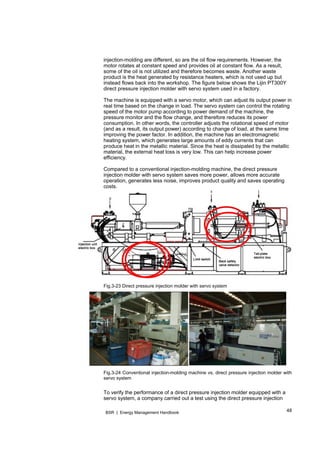
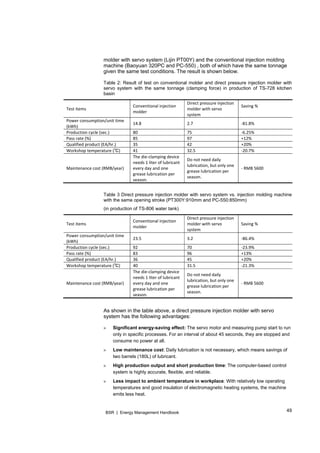
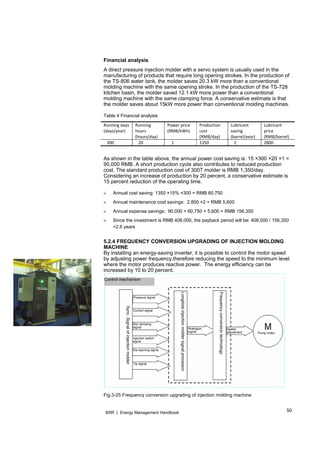
Energy Management Handbook
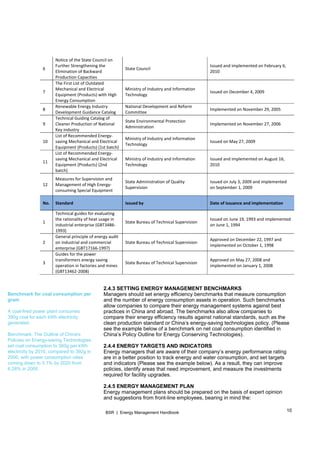
April 2012
www.bsr.org
2BSR | Energy Management Handbook
About The Handbook
China has an ambitious goal of cutting energy consumption per GDP by 20
percent of 2005 levels by 2015. To reach this goal, the government created the
Comprehensive Scheme on Energy Saving and Emission Reduction in August
2011. The scheme is directed at large enterprises in key industries such as
power generation and construction materials. Small and medium-sized
enterprises, however, account for half of China’s total annual energy
consumption and are about 30 to 60 percent less energy-efficient than larger
companies. Improving energy management of SME scan significantly help China
achieve its energy conservation and emissions reduction goals.
This energy management handbook was created by BSR, a leader in
sustainability management, after a series of studies on manufacturing SMEs. The
studies examined the challenges faced by these companies, and explored cost-
effective energy-saving methods. This booklet teaches SMEs how to establish
energy management systems, explains the concepts and procedures of an
energy audit, and introduces methods of energy efficiency diagnostics as well as
energy efficiency technologies and best practices. We also make practical and
easy to operate recommendations to SMEs from both management and technical
perspectives.
The handbook was written by Fengyuan Wang of BSR Hong Kong and Andy
Chen of BSR Guangzhou. The authors would like to thank Starbucks Coffee
Company and its China-based suppliers for their contribution in the research, and
the British Foreign & Commonwealth Office for its funding support.
DISCLAIMER
BSR publishes occasional papers as a contribution to the understanding of the
role of business in society and the trends related to corporate social responsibility
and responsible business practices. BSR maintains a policy of not acting as a
representative of its membership, nor does it endorse specific policies or
standards. The views expressed in this publication are those of its authors and
do not reflect those of BSR members.
ABOUT BSR
BSR works with its global network of nearly 300 member companies to build a
just and sustainable world. From its offices in Asia, Europe, and North and South
America, BSR develops sustainable business strategies and solutions through
consulting, research, and cross-sector collaboration. Visit www.bsr.org for more
information about BSR’s more than 20 years of leadership in sustainability.
3BSR | Energy Management Handbook
Contents
4 Energy Management System
Overview
Establishing a Management System
15 Energy Audit
Overview
Key Factors of an Energy Audit
26 Energy Saving for Large Energy-Consuming Systems
Power Distribution Systems
Lighting Systems
Compressed Air Systems
Air-Conditioning and Ventilation Systems
Injection-Molding Systems
4BSR | Energy Management Handbook
Energy Management System
1. Overview
China's huge population and rapid pace of economic growth make its energy
needs particularly challenging. After two decades of annual growth averaging
eight percent, it is now the world's second largest energy consumer after the
United States, according to the International Energy Agency (IEA). China’s
National Bureau of Statistics reports consumption of coal in China rose 18.6
percent to 3.06 billion tons in 2009, outpacing supply, which rose 18 percent to
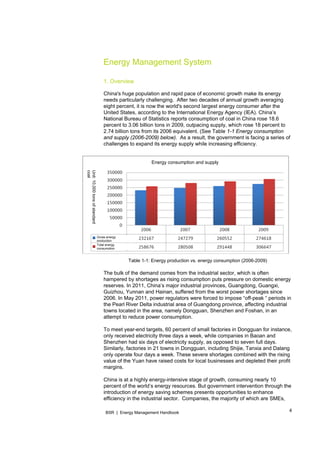
2.74 billion tons from its 2006 equivalent. (See Table 1-1 Energy consumption
and supply (2006-2009) below). As a result, the government is facing a series of
challenges to expand its energy supply while increasing efficiency.
Table 1-1: Energy production vs. energy consumption (2006-2009)
The bulk of the demand comes from the industrial sector, which is often
hampered by shortages as rising consumption puts pressure on domestic energy
reserves. In 2011, China’s major industrial provinces, Guangdong, Guangxi,
Guizhou, Yunnan and Hainan, suffered from the worst power shortages since
2006. In May 2011, power regulators were forced to impose “off-peak “ periods in
the Pearl River Delta industrial area of Guangdong province, affecting industrial
towns located in the area, namely Dongguan, Shenzhen and Foshan, in an
attempt to reduce power consumption.
To meet year-end targets, 60 percent of small factories in Dongguan for instance,
only received electricity three days a week, while companies in Baoan and
Shenzhen had six days of electricity supply, as opposed to seven full days.
Similarly, factories in 21 towns in Dongguan, including Shijie, Tanxia and Dalang
only operate four days a week. These severe shortages combined with the rising
value of the Yuan have raised costs for local businesses and depleted their profit
margins.
China is at a highly energy-intensive stage of growth, consuming nearly 10
percent of the world’s energy resources. But government intervention through the
introduction of energy saving schemes presents opportunities to enhance
efficiency in the industrial sector. Companies, the majority of which are SMEs,
Energy consumption and supply
Unit:10,000tonsofstandard
coal
Gross energy
production
Total energy
consumption
5BSR | Energy Management Handbook
will benefit from implementing such schemes to help them reduce power usage,
increase energy efficiency and reduce costs.
The following chapters explain the benefits of implementing energy management
systems and offers best practice advice to help SMEs use energy more
efficiently.
ENERGY MANAGEMENT SYSTEM STANDARDS: ISO50001 AND GB/T23331-2009
China’s Standard Certification Center (CSC) began research into improving
energy management systems and upgrading national standards in 2002. In 2009,
the government implemented its newly developed research GB/T 23331-2009,
"Requirements for Energy Management Systems." Since then, China has made
regular updates to its systems to match national standards with those of the
International Organization for Standardization (ISO), which published its latest
international energy management standards, the ISO 50001, in June 2011.
Organizations across the world face energy-related challenges, including those
related to energy supply, reliability and climate change matters. The ISO 50001
is a framework that helps companies manage their energy systems and plan
better to save energy and to reduce pollution as well as costs. ISO estimates
these standards can reduce global energy consumption by 60 percent.
The ISO 50001 provides the following benefits:
» Resolves energy efficiency problems
» Improves energy usage of energy-consuming assets
» Estimates environmental impact of greenhouse gases;
» Improves energy management and communication;
» Provides best practices for energy efficiency;
» Prioritizes new energy-saving technology;
» Improves energy efficiency of supply chains; and
» Details greenhouse gas reduction plans
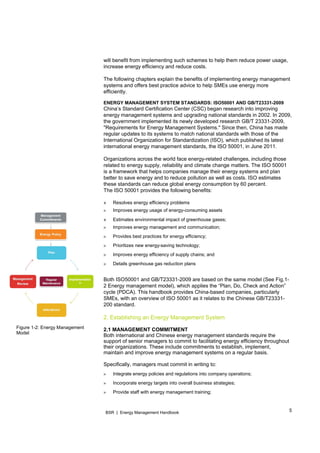
Both ISO50001 and GB/T23331-2009 are based on the same model (See Fig.1-
2 Energy management model), which applies the “Plan, Do, Check and Action”
cycle (PDCA). This handbook provides China-based companies, particularly
SMEs, with an overview of ISO 50001 as it relates to the Chinese GB/T23331-
200 standard.
2. Establishing an Energy Management System
2.1 MANAGEMENT COMMITMENT
Both international and Chinese energy management standards require the
support of senior managers to commit to facilitating energy efficiency throughout
their organizations. These include commitments to establish, implement,
maintain and improve energy management systems on a regular basis.
Specifically, managers must commit in writing to:
» Integrate energy policies and regulations into company operations;
» Incorporate energy targets into overall business strategies;
» Provide staff with energy management training;
Figure 1-2: Energy Management
Model
6BSR | Energy Management Handbook
A good energy manager should
display the following
competences:
» A senior/middle class manager
who can report to the top
management directly;
» Be familiar with main production
processes;
» Have a certain understanding of
production equipment, electrical,
boiler, air-conditioning, lighting,
and auxiliary systems;
» Have a certain degree of financial
knowledge and energy
management; and
» Strong management ability and is
able to implement improvement
plans independently.
» Conduct management reviews of energy management processes; and
» Keep energy-related equipment well maintained.
Energy Saving Commitments
» Establish a system to collect, analyze, and report data related energy consumption,
and ensure correctness and integrity of that data;
» Designate personnel with expertise and technical experience, or above, to be in
charge of energy management, and file this personnel in government agencies in
charge of energy saving;
» Enhance measuring instrument management and equip and use qualified measuring
instruments according to relevant regulations;
» Establish a responsibility system and award organizations and individuals with good
performance in energy-saving activities;
» Make and implement energy-saving plans and technical measures;
» Comply with national energy limitation standards and make corporate standards that
are stricter than national standards;
» Use energy efficiency markings on products according to relevant regulations;
» Conduct energy-saving education and training regularly;
» Never produce, import, or sell any products or equipment (or use equipment) that are
clearly specified as "to be eliminated" by government agencies or those which do not
conform with energy efficiency standards;
» Never provide free energy to employees or implement any "package fee" system for
energy use.
These commitments should be printed and posted in public areas in the factory to
promote energy management.
2.2 ENERGY POLICY (OPTIONAL)
National and international energy management standards encourage companies
to create energy policies specific to their company operations. But
implementation of these policies is up to the discretion of managers and
companies.
Good energy policies:
» Are integrated with the company’s business activities, products and services;
» Reduce energy consumption, increase efficiency and guarantee regular system
maintenance;
» Comply with applicable laws and regulations;
» Provide a framework for making and evaluating energy targets and indicators;
» Offer employees training materials so that they can understand and implement
energy policies; and
» Are readily available to all relevant parties within the organization.
2.3 ENERGY MANAGER
Senior executives must assign an independent specialist to oversee energy
management within the company, with the exception of SMEs, whose directors
7BSR | Energy Management Handbook
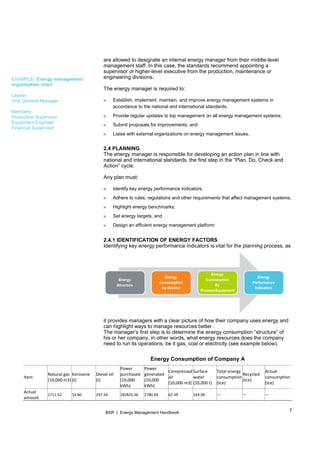
EXAMPLE- Energy management
organization chart
Leader:
Vice General Manager
Members:
Production Supervisor
Equipment Engineer
Financial Supervisor
are allowed to designate an internal energy manager from their middle-level
management staff. In this case, the standards recommend appointing a
supervisor or higher-level executive from the production, maintenance or
engineering divisions.
The energy manager is required to:
» Establish, implement, maintain, and improve energy management systems in
accordance to the national and international standards;
» Provide regular updates to top management on all energy management systems;
» Submit proposals for improvements; and
» Liaise with external organizations on energy management issues.
2.4 PLANNING
The energy manager is responsible for developing an action plan in line with
national and international standards, the first step in the “Plan, Do, Check and
Action” cycle.
Any plan must:
» Identify key energy performance indicators;
» Adhere to rules, regulations and other requirements that affect management systems;
» Highlight energy benchmarks;
» Set energy targets; and
» Design an efficient energy management platform
2.4.1 IDENTIFICATION OF ENERGY FACTORS
Identifying key energy performance indicators is vital for the planning process, as
it provides managers with a clear picture of how their company uses energy and
can highlight ways to manage resources better.
The manager’s first step is to determine the energy consumption “structure” of
his or her company, in other words, what energy resources does the company
need to run its operations, be it gas, coal or electricity (see example below).
Energy Consumption of Company A
Item 
Natural gas 
(10,000 m3) 
Kerosene 
(t) 
Diesel oil 
(t) 
Power 
purchased 
(10,000 
kWh) 
Power 
generated 
(10,000 
kWh) 
Compressed 
air 
(10,000 m3)
Surface 
water 
(10,000 t) 
Total energy 
consumption 
(tce) 
Recycled 
(tce) 
Actual 
consumption
(tce) 
Actual 
amount 
1711.52  14.80  297.54  182825.66  2780.84  62.34  164.06  —  —  — 
8BSR | Energy Management Handbook
Rectifier
Power transformer
Cogeneration
Compress air station
Electrolyzer
Main production
Auxiliary production
Office
Lighting
Other
Transportation
Gas
Kerosene
Diesel
Gasoline
Electricity
229558.98
9734.47
221524.42 214878.69
102067.38
9442.44 3813.2513355.69
9805.2
2840.39
11.94
8690.79
16611.33
416.13
1050.94
2247.88
31.31
62.91
283.10
1.06
2545.614345.15
9966.8403.65525.47
114.39113.08
113.08
31.31
416.13
19142.31
12.48
9575.51
118.1
112811.31
4741.266939.898034.56
292.03
Storage loss
8326.59(3.25)
7045.87(2.72)
Distribution loss
End use loss
Useful energy consumption
164250 kWh
20.2
20.2 373.25 267.27
105.98
149.55
7.48
3.04
106.5
Total:259015.48(100)
0.7
127373.05(49.18)
119845.06
(46.27)
Note:
1、Unit: tce
(% of total energy input)
2、Energy utilization rate is 46.27%
Purchase
Storage
Processing
Conversion
Distribution Final use
1.947GWh
1740.21wm3
285.59T
21.28T
76.85T
Water pump
Conversion 
to standard 
coal 
10832.21  21.78  433.55  224692.74  3417.65  22.44  200.81  239621.18  3640.91  235980.27 
%  4.52  0.01  0.18  93.77  1.43  0.01  0.08  100.00  1.52  98.48 
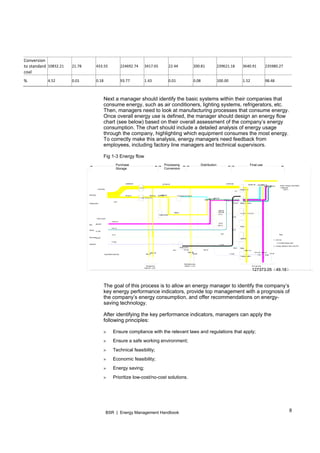
Next a manager should identify the basic systems within their companies that
consume energy, such as air conditioners, lighting systems, refrigerators, etc.
Then, managers need to look at manufacturing processes that consume energy.
Once overall energy use is defined, the manager should design an energy flow
chart (see below) based on their overall assessment of the company’s energy
consumption. The chart should include a detailed analysis of energy usage
through the company, highlighting which equipment consumes the most energy.
To correctly make this analysis, energy managers need feedback from
employees, including factory line managers and technical supervisors.
Fig 1-3 Energy flow
The goal of this process is to allow an energy manager to identify the company’s
key energy performance indicators, provide top management with a prognosis of
the company’s energy consumption, and offer recommendations on energy-
saving technology.
After identifying the key performance indicators, managers can apply the
following principles:
» Ensure compliance with the relevant laws and regulations that apply;
» Ensure a safe working environment;
» Technical feasibility;
» Economic feasibility;
» Energy saving;
» Prioritize low-cost/no-cost solutions.
9BSR | Energy Management Handbook
Table: Energy Performance Indicator
Energy 
consumption  
process 
Energy 
consumption 
asset/equip
ment 
To be 
eliminated by 
law or not 
Status  Energy factor
Technical 
feasibility 
1‐10 
Economical 
feasibility 
1‐10 
Adverse 
impact 
(safety, 
quality, 
environment) 
High, 
Medium, 
Small, No 
Assessment 
result 
A: maintain 
B: control with 
high priority 
C: to be studied
D: no measure 
Related 
division 
Air 
conditioning 
Central air 
conditioner 
No 
No control by 
area, time, 
and climate 
Seasonality   9  9  No  B 
Office 
building
Worksh
op 
Heat/cool 
air demand 
varies in 
different 
area and 
time 
7  8  No  B 
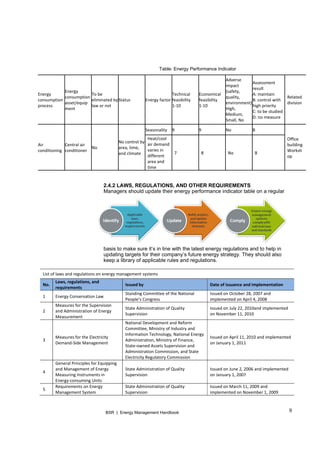
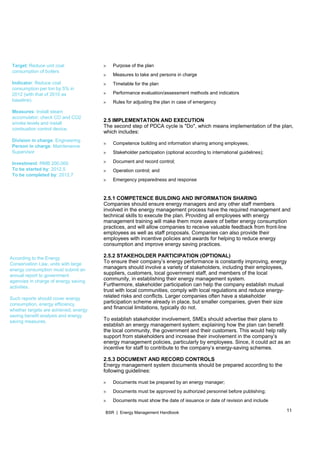
2.4.2 LAWS, REGULATIONS, AND OTHER REQUIREMENTS
Managers should update their energy performance indicator table on a regular
basis to make sure it’s in line with the latest energy regulations and to help in
updating targets for their company’s future energy strategy. They should also
keep a library of applicable rules and regulations.
List of laws and regulations on energy management systems 
No. 
Laws, regulations, and 
requirements 
Issued by  Date of issuance and implementation 
1  Energy Conservation Law 
Standing Committee of the National 
People’s Congress 
Issued on October 28, 2007 and 
implemented on April 4, 2008 
2 
Measures for the Supervision 
and Administration of Energy 
Measurement 
State Administration of Quality 
Supervision 
Issued on July 22, 2010and implemented 
on November 11, 2010 
3 
Measures for the Electricity 
Demand‐Side Management 
National Development and Reform 
Committee, Ministry of Industry and 
Information Technology, National Energy 
Administration, Ministry of Finance, 
State‐owned Assets Supervision and 
Administration Commission, and State 
Electricity Regulatory Commission
Issued on April 11, 2010 and implemented 
on January 1, 2011 
4 
General Principles for Equipping 
and Management of Energy 
Measuring Instruments in 
Energy‐consuming Units 
State Administration of Quality 
Supervision 
Issued on June 2, 2006 and implemented 
on January 1, 2007 
5 
Requirements on Energy 
Management System 
State Administration of Quality 
Supervision 
Issued on March 11, 2009 and 
implemented on November 1, 2009 
10BSR | Energy Management Handbook
Benchmark for coal consumption per
gram
A coal-fired power plant consumes
390g coal for each kWh electricity
generated.
Benchmark: The Outline of China's
Policies on Energy-saving Technologies
set coal consumption to 360g per kWh
electricity by 2010, compared to 392g in
2000, with power consumption rates
coming down to 5.1% by 2020 from
6.28% in 2000.
6 
Notice of the State Council on 
Further Strengthening the 
Elimination of Backward 
Production Capacities 
State Council 
Issued and implemented on February 6, 
2010 
7 
The First List of Outdated 
Mechanical and Electrical 
Equipment (Products) with High 
Energy Consumption 
Ministry of Industry and Information 
Technology 
Issued on December 4, 2009 
8 
Renewable Energy Industry 
Development Guidance Catalog 
National Development and Reform 
Committee 
Implemented on November 29, 2005 
9 
Technical Guiding Catalog of 
Cleaner Production of National 
Key industry 
State Environmental Protection 
Administration 
Implemented on November 27, 2006 
10 
List of Recommended Energy‐
saving Mechanical and Electrical 
Equipment (Products) (1st batch) 
Ministry of Industry and Information 
Technology 
Issued on May 27, 2009 
11 
List of Recommended Energy‐
saving Mechanical and Electrical 
Equipment (Products) (2nd 
batch) 
Ministry of Industry and Information 
Technology 
Issued and implemented on August 16, 
2010 
12 
Measures for Supervision and 
Management of High Energy‐
consuming Special Equipment 
State Administration of Quality 
Supervision 
Issued on July 3, 2009 and implemented 
on September 1, 2009 
No.  Standard  Issued by  Date of issuance and implementation 
1 
Technical guides for evaluating 
the rationality of heat usage in 
industrial enterprise (GBT3486‐
1993) 
State Bureau of Technical Supervision 
Issued on June 19, 1993 and implemented 
on June 1, 1994 
2 
General principle of energy audit 
on industrial and commercial 
enterprise (GBT17166‐1997) 
State Bureau of Technical Supervision 
Approved on December 22, 1997 and 
implemented on October 1, 1998 
3 
Guides for the power 
transformers energy saving 
operation in factories and mines 
(GBT13462‐2008) 
State Bureau of Technical Supervision 
Approved on May 27, 2008 and 
implemented on January 1, 2008 
2.4.3 SETTING ENERGY MANAGEMENT BENCHMARKS
Managers should set energy efficiency benchmarks that measure consumption
and the number of energy consumption assets in operation. Such benchmarks
allow companies to compare their energy management systems against best
practices in China and abroad. The benchmarks also allow companies to
compare their energy efficiency results against national standards, such as the
clean production standard or China’s energy-saving technologies policy. (Please
see the example below of a benchmark on net coal consumption identified in
China’s Policy Outline for Energy Conserving Technologies).
2.4.4 ENERGY TARGETS AND INDICATORS
Energy managers that are aware of their company’s energy performance rating
are in a better position to track energy and water consumption, and set targets
and indicators (Please see the example below). As a result, they can improve
policies, identify areas that need improvement, and measure the investments
required for facility upgrades.
2.4.5 ENERGY MANAGEMENT PLAN
Energy management plans should be prepared on the basis of expert opinion
and suggestions from front-line employees, bearing in mind the:
11BSR | Energy Management Handbook
 
Target: Reduce unit coal
consumption of boilers
Indicator: Reduce coal
consumption per ton by 5% in
2012 (with that of 2010 as
baseline).
Measures: Install steam
accumulator; check CO and CO2
smoke levels and install
combustion control device.
Division in charge: Engineering
Person in charge: Maintenance
Supervisor
Investment: RMB 200,000
To be started by: 2012.5
To be completed by: 2012.7
According to the Energy
Conservation Law, units with large
energy consumption must submit an
annual report to government
agencies in charge of energy saving
activities.
Such reports should cover energy
consumption, energy efficiency,
whether targets are achieved, energy
saving benefit analysis and energy
saving measures.
» Purpose of the plan
» Measures to take and persons in charge
» Timetable for the plan
» Performance evaluation/assessment methods and indicators
» Rules for adjusting the plan in case of emergency
2.5 IMPLEMENTATION AND EXECUTION
The second step of PDCA cycle is "Do", which means implementation of the plan,
which includes:
» Competence building and information sharing among employees;
» Stakeholder participation (optional according to international guidelines);
» Document and record control;
» Operation control; and
» Emergency preparedness and response
2.5.1 COMPETENCE BUILDING AND INFORMATION SHARING
Companies should ensure energy managers and any other staff members
involved in the energy management process have the required management and
technical skills to execute the plan. Providing all employees with energy
management training will make them more aware of better energy consumption
practices, and will allow companies to receive valuable feedback from front-line
employees as well as staff proposals. Companies can also provide their
employees with incentive policies and awards for helping to reduce energy
consumption and improve energy saving practices.
2.5.2 STAKEHOLDER PARTICIPATION (OPTIONAL)
To ensure their company’s energy performance is constantly improving, energy
managers should involve a variety of stakeholders, including their employees,
suppliers, customers, local government staff, and members of the local
community, in establishing their energy management system.
Furthermore, stakeholder participation can help the company establish mutual
trust with local communities, comply with local regulations and reduce energy-
related risks and conflicts. Larger companies often have a stakeholder
participation scheme already in place, but smaller companies, given their size
and financial limitations, typically do not.
To establish stakeholder involvement, SMEs should advertise their plans to
establish an energy management system; explaining how the plan can benefit
the local community, the government and their customers. This would help rally
support from stakeholders and increase their involvement in the company’s
energy management policies, particularly by employees. Since, it could act as an
incentive for staff to contribute to the company’s energy-saving schemes.
2.5.3 DOCUMENT AND RECORD CONTROLS
Energy management system documents should be prepared according to the
following guidelines:
» Documents must be prepared by an energy manager;
» Documents must be approved by authorized personnel before publishing;
» Documents must show the date of issuance or date of revision and include
12BSR | Energy Management Handbook
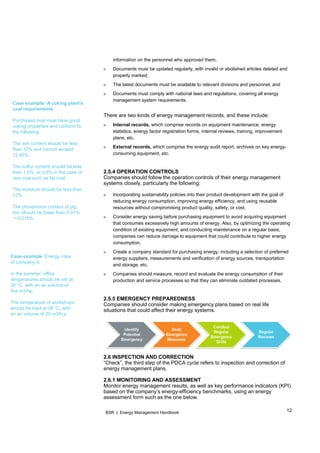
Case example: A coking plant's
coal requirements
Purchased coal must have good
coking properties and conform to
the following:
The ash content should be less
than 10% and cannot exceed
12.45%.
The sulfur content should be less
than 1.5%, or 2.5% in the case of
rare coal such as fat coal.
The moisture should be less than
12%.
The phosphorus content of pig
iron should be lower than 0.01%
~0.015%.
Case example: Energy rules
of company X.
In the summer, office
temperatures should be set at
26 °C, with an air volume of
five m3/hp.
The temperature of workshops
should be kept at 28 °C, with
an air volume of 20 m3/h.p
information on the personnel who approved them;
» Documents must be updated regularly, with invalid or abolished articles deleted and
properly marked;
» The latest documents must be available to relevant divisions and personnel; and
» Documents must comply with national laws and regulations, covering all energy
management system requirements.
There are two kinds of energy management records, and these include:
» Internal records, which comprise records on equipment maintenance, energy
statistics, energy factor registration forms, internal reviews, training, improvement
plans, etc.
» External records, which comprise the energy audit report, archives on key energy-
consuming equipment, etc.
2.5.4 OPERATION CONTROLS
Companies should follow the operation controls of their energy management
systems closely, particularly the following:
» Incorporating sustainability policies into their product development with the goal of
reducing energy consumption, improving energy efficiency, and using reusable
resources without compromising product quality, safety, or cost.
» Consider energy saving before purchasing equipment to avoid acquiring equipment
that consumes excessively high amounts of energy. Also, by optimizing the operating
condition of existing equipment, and conducting maintenance on a regular basis,
companies can reduce damage to equipment that could contribute to higher energy
consumption.
» Create a company standard for purchasing energy, including a selection of preferred
energy suppliers, measurements and verification of energy sources, transportation
and storage, etc.
» Companies should measure, record and evaluate the energy consumption of their
production and service processes so that they can eliminate outdated processes.
2.5.5 EMERGENCY PREPAREDNESS
Companies should consider making emergency plans based on real life
situations that could affect their energy systems.
2.6 INSPECTION AND CORRECTION
“Check”, the third step of the PDCA cycle refers to inspection and correction of
energy management plans.
2.6.1 MONITORING AND ASSESSMENT
Monitor energy management results, as well as key performance indicators (KPI)
based on the company’s energy-efficiency benchmarks, using an energy
assessment form such as the one below.
13BSR | Energy Management Handbook
2.6.2 MAKING AN IMPROVEMENT PLAN
Prepare an improvement plan based on monitoring and assessment results. The
aim is to:
» Correct non-conformities;
» Take preventive measures against non-conformities; and
» Assign a person in charge of following up and ensuring that improvements are
implemented.
EXAMPLE: Non‐conformity report of Company A (Corrective Actions Form) 
Division audited:  
Results 
    
The items above do not conform to ______________ and are ________________ non‐
conformities.  
 Auditor/date:   
Receipt by manager of division audited:                             Date: 
Cause analysis and corrective actions:  
 To be completed on:  
 Manager of division audited:           Auditor:        Approved by:  
Implementation of corrective actions: 
  Manager of division audited:                      Date: 
Effectiveness of corrective actions:  
  Auditor/date:  
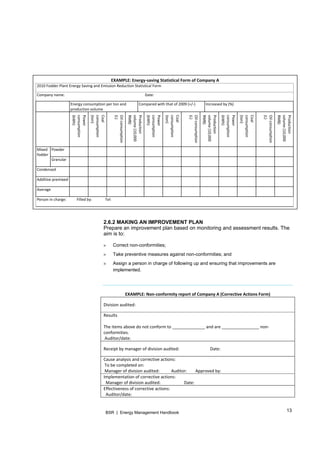
EXAMPLE: Energy‐saving Statistical Form of Company A 
2010 Fodder Plant Energy Saving and Emission Reduction Statistical Form 
Company name:               Date: 
    Energy consumption per ton and 
production volume 
Compared with that of 2009 (+/‐)  Increased by (%) 
   
Power 
consumption 
(kWh) 
Coal 
consumption 
(ton) 
Oil consumption 
(L) 
Production 
volume (10,000 
RMB) 
Power 
consumption 
(kWh) 
Coal 
consumption 
(ton) 
Oil consumption 
(L) 
Production 
volume (10,000 
RMB) 
Power 
consumption 
(kWh) 
Coal 
consumption 
(ton) 
Oil consumption 
(L) 
Production 
volume (10,000 
RMB) 
Mixed  
fodder 
Powder                         
Granular                         
Condensed             
Additive premixed                         
Average                         
Person in charge:           Filled by:              Tel: 
14BSR | Energy Management Handbook
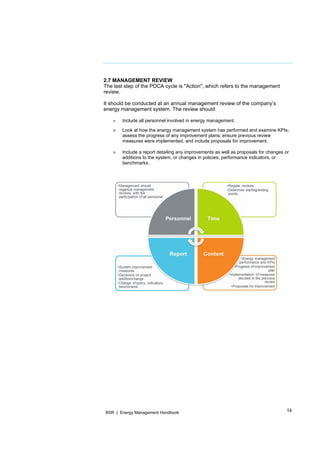
2.7 MANAGEMENT REVIEW
The last step of the PDCA cycle is "Action", which refers to the management
review.
It should be conducted at an annual management review of the company’s
energy management system. The review should:
» Include all personnel involved in energy management.
» Look at how the energy management system has performed and examine KPIs;
assess the progress of any improvement plans; ensure previous review
measures were implemented, and include proposals for improvement.
» Include a report detailing any improvements as well as proposals for changes or
additions to the system, or changes in policies, performance indicators, or
benchmarks.
15BSR | Energy Management Handbook
 
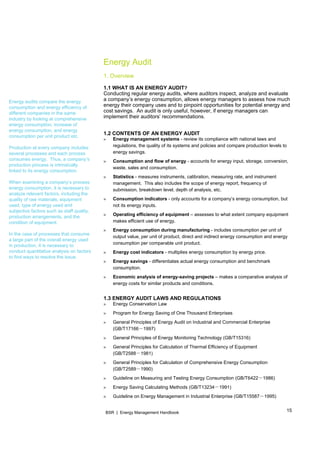
Energy audits compare the energy
consumption and energy efficiency of
different companies in the same
industry by looking at comprehensive
energy consumption, increase of
energy consumption, and energy
consumption per unit product etc.
Production at every company includes
several processes and each process
consumes energy. Thus, a company’s
production process is intrinsically
linked to its energy consumption.
When examining a company’s process
energy consumption, it is necessary to
analyze relevant factors, including the
quality of raw materials, equipment
used, type of energy used and
subjective factors such as staff quality,
production arrangements, and the
condition of equipment.
In the case of processes that consume
a large part of the overall energy used
in production, it is necessary to
conduct quantitative analysis on factors
to find ways to resolve the issue.
Energy Audit
1. Overview
1.1 WHAT IS AN ENERGY AUDIT?
Conducting regular energy audits, where auditors inspect, analyze and evaluate
a company’s energy consumption, allows energy managers to assess how much
energy their company uses and to pinpoint opportunities for potential energy and
cost savings. An audit is only useful, however, if energy managers can
implement their auditors’ recommendations.
1.2 CONTENTS OF AN ENERGY AUDIT
» Energy management systems - review its compliance with national laws and
regulations, the quality of its systems and policies and compare production levels to
energy savings.
» Consumption and flow of energy - accounts for energy input, storage, conversion,
waste, sales and consumption.
» Statistics - measures instruments, calibration, measuring rate, and instrument
management. This also includes the scope of energy report, frequency of
submission, breakdown level, depth of analysis, etc.
» Consumption indicators - only accounts for a company’s energy consumption, but
not its energy inputs.
» Operating efficiency of equipment – assesses to what extent company equipment
makes efficient use of energy.
» Energy consumption during manufacturing - includes consumption per unit of
output value, per unit of product, direct and indirect energy consumption and energy
consumption per comparable unit product.
» Energy cost indicators - multiplies energy consumption by energy price.
» Energy savings - differentiates actual energy consumption and benchmark
consumption.
» Economic analysis of energy-saving projects – makes a comparative analysis of
energy costs for similar products and conditions.
1.3 ENERGY AUDIT LAWS AND REGULATIONS
» Energy Conservation Law
» Program for Energy Saving of One Thousand Enterprises
» General Principles of Energy Audit on Industrial and Commercial Enterprise
-(GB/T17166 1997)
» General Principles of Energy Monitoring Technology (GB/T15316)
» General Principles for Calculation of Thermal Efficiency of Equipment
-(GB/T2588 1981)
» General Principles for Calculation of Comprehensive Energy Consumption
-(GB/T2589 1990)
» -Guideline on Measuring and Testing Energy Consumption (GB/T6422 1986)
» -Energy Saving Calculating Methods (GB/T13234 1991)
» Guideline on Energy Man -agement in Industrial Enterprise (GB/T15587 1995)
16BSR | Energy Management Handbook
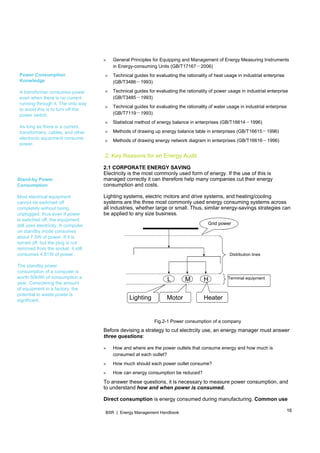
Power Consumption
Knowledge
A transformer consumes power
even when there is no current
running through it. The only way
to avoid this is to turn off the
power switch.
As long as there is a current,
transformers, cables, and other
electronic equipment consume
power.
Stand-by Power
Consumption
Most electrical equipment
cannot be switched off
completely without being
unplugged, thus even if power
is switched off, the equipment
still uses electricity. A computer
on standby mode consumes
about 7.5W of power. If it is
turned off, but the plug is not
removed from the socket, it still
consumes 4.81W of power.
The standby power
consumption of a computer is
worth 50kWh of consumption a
year. Considering the amount
of equipment in a factory, the
potential to waste power is
significant.
» General Principles for Equipping and Management of Energy Measuring Instruments
in Energy- -consuming Units (GB/T17167 2006)
» Technical guides for evaluating the rationality of heat usage in industrial enterprise
-(GB/T3486 1993)
» Technical guides for evaluating the rationality of power usage in industrial enterprise
-(GB/T3485 1993)
» Technical guides for evaluating the rationality of water usage in industrial enterprise
-(GB/T7119 1993)
» -Statistical method of energy balance in enterprises (GB/T16614 1996)
» -Methods of drawing up energy balance table in enterprises (GB/T16615 1996)
» -Methods of drawing energy network diagram in enterprises (GB/T16616 1996)
2. Key Reasons for an Energy Audit
2.1 CORPORATE ENERGY SAVING
Electricity is the most commonly used form of energy. If the use of this is
managed correctly it can therefore help many companies cut their energy
consumption and costs.
Lighting systems, electric motors and drive systems, and heating/cooling
systems are the three most commonly used energy consuming systems across
all industries, whether large or small. Thus, similar energy-savings strategies can
be applied to any size business.
Fig.2-1 Power consumption of a company
Before devising a strategy to cut electrcity use, an energy manager must answer
three questions:
» How and where are the power outlets that consume energy and how much is
consumed at each outlet?
» How much should each power outlet consume?
» How can energy consumption be reduced?
To answer these questions, it is necessary to measure power consumption, and
to understand how and when power is consumed.
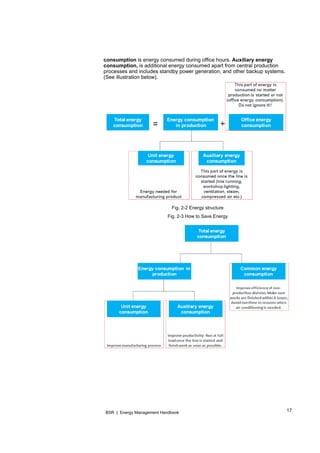
Direct consumption is energy consumed during manufacturing. Common use
L M H
Distribution lines
Grid power
Lighting Motor Heater
Terminal equipment
17BSR | Energy Management Handbook
consumption is energy consumed during office hours. Auxiliary energy
consumption, is additional energy consumed apart from central production
processes and includes standby power generation, and other backup systems.
(See illustration below).
Fig. 2-2 Energy structure
Fig. 2-3 How to Save Energy
18BSR | Energy Management Handbook
List of Energy Measuring Instruments
No.
Name
Model
Precisiondegree
Scopeof
measurement
Manufacturer
Deliverynumber
Managementnumber
Locationofinstallation
(workshop,line,
equipment)andusage
(energy
measurement,self-
inspection,energy
qualityanalysis)
Condition
(qualified/allowedto
use/forbiddentouse)
1 Power meter
DX863-
2K
0.5 - Swiss 67877983
EP-
301A01
High-voltage room,
1F, 301 Substation:
Shenhua No.1 line
Qualified
2 Power meter
DS862-
2
0.5 -
Wuxi
Weida
1685
EP-
301A03
High-voltage room,
1F, 301 Substation:
Shenhua
Qualified
3 Vortex flowmeter DN200 2.5 -
Shanghai
Henghe
9803106 FQ-1100
152 pipe rack,
Meiya Steam
Qualified
4
Electromagnetic
flow meter
MAG-
XE
0.5 - ABB WA-001
103C South Gate,
tap water inlet of the
factory
Allowed to
use
5
Turbine flow
meter
DN200 1 -
Shanghai
Henghe
FQ-
1350A
152 pipe rack,
Meiya Softwater
Qualified
6 …… …… …… …… …… …… …… …… ……
Larger companies usually have an
independent energy measurement
division or designated personnel in
charge of energy measurement,
while smaller companies designate
an energy manager to conduct the
task of measuring energy
consumption.
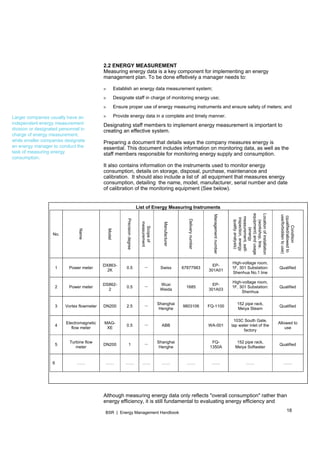
2.2 ENERGY MEASUREMENT
Measuring energy data is a key component for implementing an energy
management plan. To be done effetively a manager needs to:
» Establish an energy data measurement system;
» Designate staff in charge of monitoring energy use;
» Ensure proper use of energy measuring instruments and ensure safety of meters; and
» Provide energy data in a complete and timely manner.
Designating staff members to implement energy measurement is important to
creating an effective system.
Preparing a document that details ways the company measures energy is
essential. This document includes information on monitoring data, as well as the
staff members responsible for monitoring energy supply and consumption.
It also contains information on the instruments used to monitor energy
consumption, details on storage, disposal, purchase, maintenance and
calibration. It should also include a list of all equipment that measures energy
consumption, detailing the name, model, manufacturer, serial number and date
of calibration of the monitoring equipment (See below).
Although measuring energy data only reflects "overall consumption" rather than
energy efficiency, it is still fundamental to evaluating energy efficiency and
19BSR | Energy Management Handbook
energy-saving opportunities.
Companies should measure energy consumption by taking into account:
» Overall energy consumption.
» Energy consumption of power lines and departments
» Energy consumption of office and production equipment.
Alternatively, companies can measure power by:
(1) Measuring average power over a period of time:
» For a system with constant power: Power consumption = actual power X working
hours
» For a system with variable power: Power consumption = average power X working
hours
(2) Deciding where to install an electric power meter depends on whether the:
» Equipment consumes large amounts of power or power consumption fluctuates;
» Systems require modification to make them more energy efficient; and
» Lines/departments that are subject to energy assessment and evaluation.
2.3 ENERGY-CONSUMING EQUIPMENT
Energy managers should identify office and production equipment that consume
the most energy. According to the Principle for Equipping and Managing the
Measuring Instrument of Energy Units (GB17167-2006), these pieces of
equipment often consume power that is above the limit specified in Table 2-1.
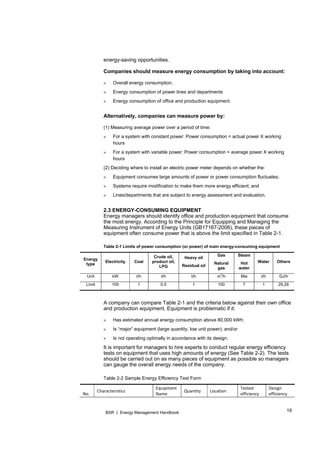
Table 2-1 Limits of power consumption (or power) of main energy-consuming equipment
Energy
type
Electricity Coal
Crude oil,
product oil,
LPG
Heavy oil
Residual oil
Gas
Natural
gas
Steam
Hot
water
Water Others
Unit kW t/h t/h t/h m
3
/h Mw t/h GJ/h
Limit 100 1 0.5 1 100 7 1 29.26
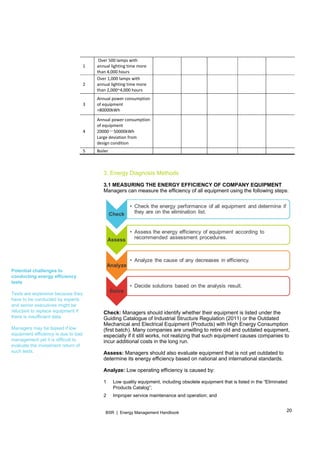
A company can compare Table 2-1 and the criteria below against their own office
and production equipment. Equipment is problematic if it:
» Has estimated annual energy consumption above 80,000 kWh;
» Is “major” equipment (large quantity, low unit power); and/or
» Is not operating optimally in accordance with its design.
It is important for managers to hire experts to conduct regular energy efficiency
tests on equipment that uses high amounts of energy (See Table 2-2). The tests
should be carried out on as many pieces of equipment as possible so managers
can gauge the overall energy needs of the company.
Table 2-2 Sample Energy Efficiency Test Form
  
No. 
Characteristics 
Equipment 
Name 
Quantity  Location 
Tested 
efficiency 
Design 
efficiency 
20BSR | Energy Management Handbook
Potential challenges to
conducting energy efficiency
tests
Tests are expensive because they
have to be conducted by experts
and senior executives might be
reluctant to replace equipment if
there is insufficient data.
Managers may be biased if low
equipment efficiency is due to bad
management yet it is difficult to
evaluate the investment return of
such tests.
1 
 Over 500 lamps with 
annual lighting time more 
than 4,000 hours 
         
2 
Over 1,000 lamps with 
annual lighting time more 
than 2,000~4,000 hours 
         
3 
Annual power consumption 
of equipment  
>80000kWh  
         
4 
Annual power consumption 
of equipment  
20000-50000kWh  
Large deviation from 
design condition 
         
5  Boiler           
3. Energy Diagnosis Methods
3.1 MEASURING THE ENERGY EFFICIENCY OF COMPANY EQUIPMENT
Managers can measure the efficiency of all equipment using the following steps:
Check: Managers should identify whether their equipment is listed under the
Guiding Catalogue of Industrial Structure Regulation (2011) or the Outdated
Mechanical and Electrical Equipment (Products) with High Energy Consumption
(first batch). Many companies are unwilling to retire old and outdated equipment,
especially if it still works, not realizing that such equipment causes companies to
incur additional costs in the long run.
Assess: Managers should also evaluate equipment that is not yet outdated to
determine its energy efficiency based on national and international standards.
Analyze: Low operating efficiency is caused by:
1 Low quality equipment, including obsolete equipment that is listed in the “Eliminated
Products Catalog”;
2 Improper service maintenance and operation; and
21BSR | Energy Management Handbook
Case study of an electronics
factory
At an assembly workshop in an
electronics factory, 80 percent of
total energy consumption goes
towards auxiliary uses. This is
largely because the workshop runs
8-hour shifts even though
productivity is low and there are
insufficient orders.
Suggestions:
Maintain higher productivity levels
with the aim of completing
production in six hours rather than
eight. This will save the company
276 kWh of power (RMB 220)
every day.
The remaining hours can be used
to train operators.
Switch to night shifts as this could
help reduce air-conditioning costs,
since the price of electricity is
significant lower at the night than
in the daytime. (allowing for a
reduction of 80 percent of energy
costs.)
3 Process requirements that render equipment less efficient.
Solve: To correct efficiency problems managers should:
4 Replace obsolete equipment with new energy efficient models;
5 Improve energy management, including the establishment of equipment operation
and maintenance policies; and
6 Integrate energy-saving technologies into the manufacturing process at a system
level.
3.2 ENERGY STRUCTURE EVALUATION
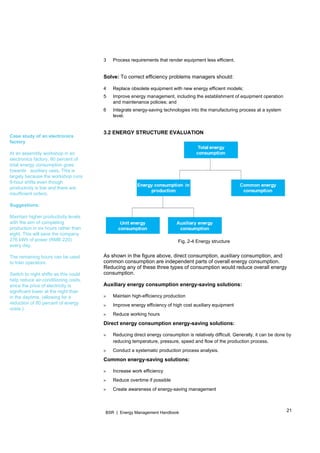
Fig. 2-4 Energy structure
As shown in the figure above, direct consumption, auxiliary consumption, and
common consumption are independent parts of overall energy consumption.
Reducing any of these three types of consumption would reduce overall energy
consumption.
Auxiliary energy consumption energy-saving solutions:
» Maintain high-efficiency production
» Improve energy efficiency of high cost auxiliary equipment
» Reduce working hours
Direct energy consumption energy-saving solutions:
» Reducing direct energy consumption is relatively difficult. Generally, it can be done by
reducing temperature, pressure, speed and flow of the production process.
» Conduct a systematic production process analysis.
Common energy-saving solutions:
» Increase work efficiency
» Reduce overtime if possible
» Create awareness of energy-saving management
22BSR | Energy Management Handbook
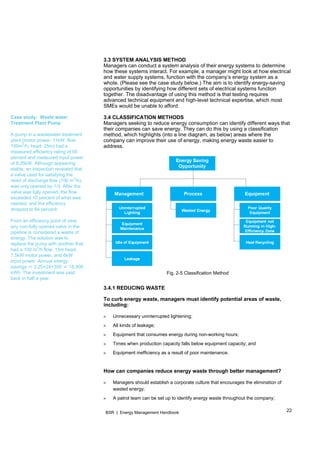
Case study: Waste water
Treatment Plant Pump
A pump in a wastewater treatment
plant (motor power: 11kW, flow:
100m
3
/h, head: 25m) had a
measured efficiency rating of 95
percent and measured input power
of 8.25kW. Although appearing
stable, an inspection revealed that
a valve used for satisfying the
need of discharge flow (100 m
3
/h),
was only opened by 1/3. After the
valve was fully opened, the flow
exceeded 10 percent of what was
needed, and the efficiency
dropped to 64 percent.
From an efficiency point of view,
any non-fully opened valve in the
pipeline is considered a waste of
energy. The solution was to
replace the pump with another that
had a 100 m
3
/h flow, 15m head,
7.5kW motor power, and 6kW
input power. Annual energy
savings = 2.25×24×350 = 18,900
kWh. The investment was paid
back in half a year.
3.3 SYSTEM ANALYSIS METHOD
Managers can conduct a system analysis of their energy systems to determine
how these systems interact. For example, a manager might look at how electrical
and water supply systems, function with the company’s energy system as a
whole. (Please see the case study below.) The aim is to identify energy-saving
opportunities by identifying how different sets of electrical systems function
together. The disadvantage of using this method is that testing requires
advanced technical equipment and high-level technical expertise, which most
SMEs would be unable to afford.
3.4 CLASSIFICATION METHODS
Managers seeking to reduce energy consumption can identify different ways that
their companies can save energy. They can do this by using a classification
method, which highlights (into a line diagram, as below) areas where the
company can improve their use of energy, making energy waste easier to
address.
Fig. 2-5 Classification Method
3.4.1 REDUCING WASTE
To curb energy waste, managers must identify potential areas of waste,
including:
» Unnecessary uninterrupted lightening;
» All kinds of leakage;
» Equipment that consumes energy during non-working hours;
» Times when production capacity falls below equipment capacity; and
» Equipment inefficiency as a result of poor maintenance.
How can companies reduce energy waste through better management?
» Managers should establish a corporate culture that encourages the elimination of
wasted energy;
» A patrol team can be set up to identify energy waste throughout the company;
23BSR | Energy Management Handbook
» Conduct energy-saving training; and
» Implement incentive policies to award employees that conserve energy.
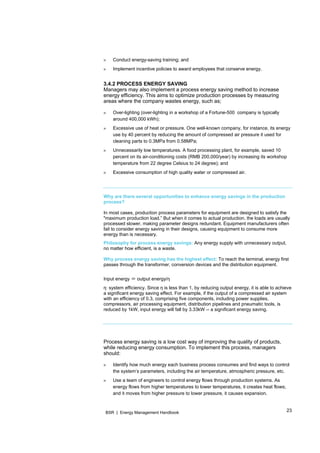
3.4.2 PROCESS ENERGY SAVING
Managers may also implement a process energy saving method to increase
energy efficiency. This aims to optimize production processes by measuring
areas where the company wastes energy, such as;
» Over-lighting (over-lighting in a workshop of a Fortune-500 company is typically
around 400,000 kWh);
» Excessive use of heat or pressure. One well-known company, for instance, its energy
use by 40 percent by reducing the amount of compressed air pressure it used for
cleaning parts to 0.3MPa from 0.58MPa;
» Unnecessarily low temperatures. A food processing plant, for example, saved 10
percent on its air-conditioning costs (RMB 200,000/year) by increasing its workshop
temperature from 22 degree Celsius to 24 degree); and
» Excessive consumption of high quality water or compressed air.
Why are there several opportunities to enhance energy savings in the production
process?
In most cases, production process parameters for equipment are designed to satisfy the
"maximum production load.” But when it comes to actual production, the loads are usually
processed slower, making parameter designs redundant. Equipment manufacturers often
fail to consider energy saving in their designs, causing equipment to consume more
energy than is necessary.
Philosophy for process energy savings: Any energy supply with unnecessary output,
no matter how efficient, is a waste.
Why process energy saving has the highest effect: To reach the terminal, energy first
passes through the transformer, conversion devices and the distribution equipment.
Input energy = output energy/η
η: system efficiency. Since η is less than 1, by reducing output energy, it is able to achieve
a significant energy saving effect. For example, if the output of a compressed air system
with an efficiency of 0.3, comprising five components, including power supplies,
compressors, air processing equipment, distribution pipelines and pneumatic tools, is
reduced by 1kW, input energy will fall by 3.33kW -- a significant energy saving.
Process energy saving is a low cost way of improving the quality of products,
while reducing energy consumption. To implement this process, managers
should:
» Identify how much energy each business process consumes and find ways to control
the system’s parameters, including the air temperature, atmospheric pressure, etc.
» Use a team of engineers to control energy flows through production systems. As
energy flows from higher temperatures to lower temperatures, it creates heat flows;
and it moves from higher pressure to lower pressure, it causes expansion.
24BSR | Energy Management Handbook
3.4.3 MAXIMIZING THE EFFICIENCY OF EQUIPMENT
There are two key issues to consider when trying to save energy:
» Design efficiency reflects maximum efficiency and cannot be achieved in actual
production.
» Energy-saving technology resolves the issue when equipment is "operating in the low
efficiency zone”, but it is not a remedy for poorly maintained equipment. Equipment
maintenance is thus vital and should take place on a regular basis, as per the
requirements of its maintenance manual.
To enhance energy saving on equipment, managers should:
» Inspect the condition of equipment regularly to avoid energy waste caused by poor
maintenance and avoid: (a) the loss of heat transfer in heat exchangers; (b)
blockages in the fuel filters; and (c) overloading of lubrication systems, among other
issues. One company found a filter in a compressed air system was blocked, causing
a 146kW overload of the power generator. The air generated by the compressor,
meanwhile, only amounted to 18m/min.
» Consider whether the design specifications of the company’s equipment causes low
energy efficiency, and if that is the case, whether the company can replace it with one
that is a better fit for its needs.
» As an alternative to replacing equipment, companies can install inverters or other
energy-saving devices. Although doing this saves energy to some extent, it does not
reduce costs or overall energy consumption. The example below demonstrates this
point.
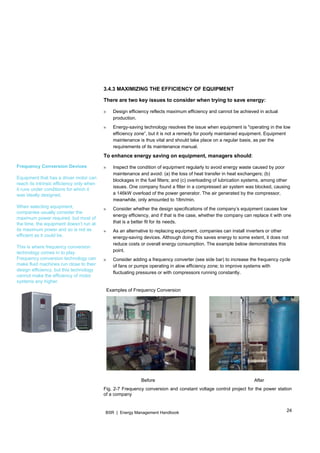
» Consider adding a frequency converter (see side bar) to increase the frequency cycle
of fans or pumps operating in alow efficiency zone; to improve systems with
fluctuating pressures or with compressors running constantly.
Examples of Frequency Conversion
Before After
Fig. 2-7 Frequency conversion and constant voltage control project for the power station
of a company
Frequency Conversion Devices
Equipment that has a driver motor can
reach its intrinsic efficiency only when
it runs under conditions for which it
was ideally designed.
When selecting equipment,
companies usually consider the
maximum power required, but most of
the time, the equipment doesn’t run at
its maximum power and so is not as
efficient as it could be.
This is where frequency conversion
technology comes in to play.
Frequency conversion technology can
make fluid machines run close to their
design efficiency, but this technology
cannot make the efficiency of motor
systems any higher.
25BSR | Energy Management Handbook
A company invested RMB 50,000 in a frequency conversion and constant
voltage control project for its power station. The new system reduced power
consumption by 6500 kWh and saved the company RMB 5,200 a month.
Fig. 2-8 Elevator network controller
By introducing an elevator network control system based on frequency
conversion technology, a company saved 6,000 kWh power per month,
equivalent to monthly savings of RMB 4,800 (based on a price of RMB 0.8/kWh).
26BSR | Energy Management Handbook
Energy Savings for Key Energy-Consuming
Systems
1. Power Distribution Systems
1.1 ENERGY DIAGNOSIS: POWER DISTRIBUTION SYSTEMS
A company’s distribution systems network carries electricity from the
transmission system and delivers it to its equipment and factories. Typically, the
network includes low-voltage (less than 1 kV) distribution wiring and medium-
voltage (less than 50 kV) power lines and transformers, which engineers can
regulate to reduce the voltage of power distribution to the company. Enhancing
equipment and distribution efficiency ensures higher energy savings and reduces
power used during the distribution process.
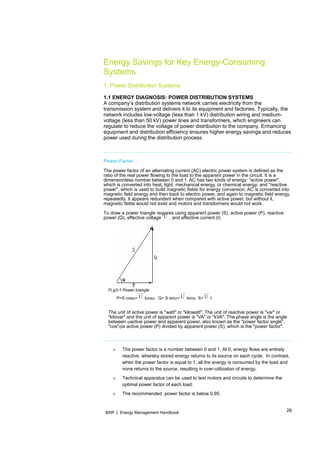
Power Factor
The power factor of an alternating current (AC) electric power system is defined as the
ratio of the real power flowing to the load to the apparent power in the circuit. It is a
dimensionless number between 0 and 1. AC has two kinds of energy: "active power",
which is converted into heat, light, mechanical energy, or chemical energy; and "reactive
power", which is used to build magnetic fields for energy conversion. AC is converted into
magnetic field energy and then back to electric power, and again to magnetic field energy,
repeatedly. It appears redundant when compared with active power, but without it,
magnetic fields would not exist and motors and transformers would not work.
To draw a power triangle requires using apparent power (S), active power (P), reactive
power (Q), effective voltage U , and effective current (I)
Fi.g3-1 Power triangle
P=S·cos= U Icos Q= S·sin= U Isin S= U I
The unit of active power is "watt" or "kilowatt". The unit of reactive power is "var" or
"kilovar" and the unit of apparent power is "VA" or "kVA". The phase angle is the angle
between active power and apparent power, also known as the "power factor angle".
"cos"is active power (P) divided by apparent power (S), which is the "power factor".
» The power factor is a number between 0 and 1. At 0, energy flows are entirely
reactive, whereby stored energy returns to its source on each cycle. In contrast,
when the power factor is equal to 1, all the energy is consumed by the load and
none returns to the source, resulting in over-utilization of energy.
» Technical apparatus can be used to test motors and circuits to determine the
optimal power factor of each load.
» The recommended power factor is below 0.95.
27BSR | Energy Management Handbook
1.2 ENERGY-SAVING MEASURES FOR POWER DISTRIBUTION SYSTEMS
» Select cable sections according to the economic current density. The economic
current density is closely related to the annual operating hours of cables. Considering
the large amount of data and calculation required to determine the economic current
density, a comparison method is commonly adopted by industrial companies.
» An increase of the operating voltage helps to improve power quality and reduce line
loss. By increasing voltage by 10 percent, a subsequent 18 percent decline in line
loss can occur.
» Reducing reactive currents and increasing the power factor of a line is an effective
way of reducing energy waste. At a constant voltage and current, the higher the
power factor, the higher the active power will be. A chemical factory, for instance,
installed a 1,500 kVA transformer. The initial requirements were 1,160 kVA with a
power factor of 0.70. The load percentage of the transformer was 78 percent
(1160/1500=77.3%). To increase the load, but avoid fines charged by the power
agency, the factory needs to add 438kVAr reactive power compensation to the motor
load. This subsequently increased the factor to 0.90 and reduced power to 900 KVA,
which is the vectorial sum of KW and KVAr.
How to select a transformer
Stick to the economic operation principle by selecting transformer capacities according to
the calculated capacity (this principle can be applied to new factories or for expanding
existing factories.)
Adjust or replace transformers according to the actual load rate. The load rate of a stand-
alone transformer should be 70 to 80 percent. In the case of a transformer network, some
loads should be transferred and several transformers should be stopped (this applies to
existing factories.)
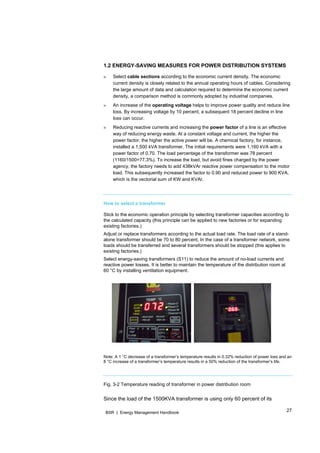
Select energy-saving transformers (S11) to reduce the amount of no-load currents and
reactive power losses. It is better to maintain the temperature of the distribution room at
60 °C by installing ventilation equipment.
   
 
Note: A 1 °C decrease of a transformer’s temperature results in 0.32% reduction of power loss and an
8 °C increase of a transformer’s temperature results in a 50% reduction of the transformer’s life.
Fig. 3-2 Temperature reading of transformer in power distribution room
Since the load of the 1500KVA transformer is using only 60 percent of its
28BSR | Energy Management Handbook
capacity, the factory can add more loads to the transformer in the future.
2. Lighting Systems
2.1 ENERGY DIAGNOSIS: LIGHTING SYSTEMS
Businesses can save money and create a more comfortable environment for
their workers by upgrading lighting systems to higher quality alternatives with the
use of lighting controls, alternative electrical sources and natural light.
Problems frequently found in lighting systems include:
» Uninterrupted lightening: In many cases, office buildings and manufacturing plants
are illuminated overnight and on weekends, and sometimes workers operate outdoor
lighting during the daylight.
» Over-illumination in office buildings due to poor lighting system design;
» Under-illumination due to dusty light bulbs, lamp shades or poor quality lighting
design and selection;
» Insufficient use of natural light; and
» Use of low-efficient light bulbs
Energy efficiency can be achieved by:
» Improving lighting management: Identify the best ways to use illumination, either
through improving the location or the number of hours that illumination is required or
find ways to make better use of natural lighting (See figure 3-3 below);
» Improving energy-saving processes, by determining the best location for lighting in
factories, offices or unoccupied areas; and
» Selecting equipment that offers maximum energy savings. For example, a
company C throughout the year.
2.2 MEASURES FOR ENHANCING ENERGY SAVINGS IN THE LIGHTING
SYSTEMS
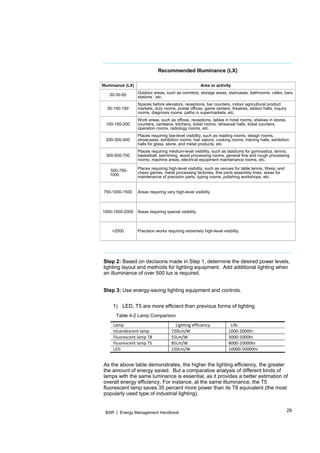
Step 1: Decide on the illuminance, which measures the luminous flux spread
over a given area.
» Corridor and walkways: 80-120 lux
» Work areas used intermittently: 150-200 lux
» Office areas: 200-250 lux
» General inspection areas: 350-450 lux
» Continuously occupied areas used for the inspection of small parts: 500-600 lux
29BSR | Energy Management Handbook
Recommended Illuminance (LX)
Illuminance (LX) Area or activity
20-30-50
Outdoor areas, such as corridors, storage areas, staircases, bathrooms, cafes, bars,
stations , etc.
30-100-150
Spaces before elevators, receptions, bar counters, indoor agricultural product
markets, duty rooms, postal offices, game centers, theatres, station halls, inquiry
rooms, diagnosis rooms, paths in supermarkets, etc.
100-150-200
Work areas, such as offices, receptions, tables in hotel rooms, shelves in stores,
counters, canteens, kitchens, ticket rooms, rehearsal halls, ticket counters,
operation rooms, radiology rooms, etc.
200-300-500
Places requiring low-level visibility, such as reading rooms, design rooms,
showcases, exhibition rooms, hair salons, cooking rooms, training halls, exhibition
halls for glass, stone, and metal products, etc.
300-500-700
Places requiring medium-level visibility, such as stadiums for gymnastics, tennis,
basketball, swimming, wood processing rooms, general fine and rough processing
rooms, machine areas, electrical equipment maintenance rooms, etc.
500-750-
1000
Places requiring high-level visibility, such as venues for table tennis, Weiqi, and
chess games, metal processing factories, fine parts assembly lines, areas for
maintenance of precision parts, typing rooms, polishing workshops, etc.
750-1000-1500 Areas requiring very high-level visibility.
1000-1500-2000 Areas requiring special visibility.
>2000 Precision works requiring extremely high-level visibility.
Step 2: Based on decisions made in Step 1, determine the desired power levels,
lighting layout and methods for lighting equipment. Add additional lighting when
an illuminance of over 500 lux is required.
Step 3: Use energy-saving lighting equipment and controls.
1) LED, T5 are more efficient than previous forms of lighting
Table 4-2 Lamp Comparison
Lamp      Lighting efficiency    Life 
Incandescent lamp  720Lm/W  1000‐2000hr 
Fluorescent lamp T8  55Lm/W  3000‐5000hr 
Fluorescent lamp T5  85Lm/W  8000‐10000hr 
LED  150Lm/W  10000‐50000hr 
As the above table demonstrates, the higher the lighting efficiency, the greater
the amount of energy saved. But a comparative analysis of different kinds of
lamps with the same luminance is essential, as it provides a better estimation of
overall energy efficiency. For instance, at the same illuminance, the T5
fluorescent lamp saves 35 percent more power than its T8 equivalent (the most
popularly used type of industrial lighting).
30BSR | Energy Management Handbook
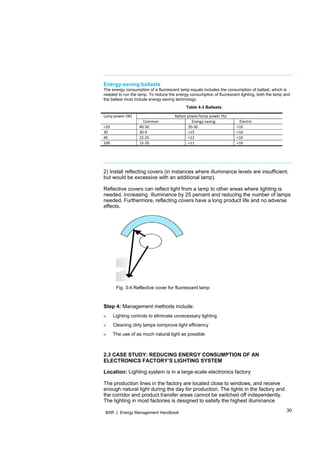
Energy-saving ballasts
The energy consumption of a fluorescent lamp equals includes the consumption of ballast, which is
needed to run the lamp. To reduce the energy consumption of fluorescent lighting, both the lamp and
the ballast must include energy saving technology.
Table 4-3 Ballasts
Lamp power (W)  Ballast power/lamp power (%) 
   Common    Energy‐saving    Electric 
<20  40‐50  20‐30  <10 
30  30‐4  <15  <10 
40  22‐25 <12 <10 
100  15‐20 <11 <10 
2) Install reflecting covers (in instances where illuminance levels are insufficient,
but would be excessive with an additional lamp).
Reflective covers can reflect light from a lamp to other areas where lighting is
needed, increasing illuminance by 25 percent and reducing the number of lamps
needed. Furthermore, reflecting covers have a long product life and no adverse
effects.
Fig. 3-4 Reflective cover for fluorescent lamp
Step 4: Management methods include:
» Lighting controls to eliminate unnecessary lighting
» Cleaning dirty lamps toimprove light efficiency
» The use of as much natural light as possible
2.3 CASE STUDY: REDUCING ENERGY CONSUMPTION OF AN
ELECTRONICS FACTORY’S LIGHTING SYSTEM
Location: Lighting system is in a large-scale electronics factory
The production lines in the factory are located close to windows, and receive
enough natural light during the day for production. The lights in the factory and
the corridor and product transfer areas cannot be switched off independently.
The lighting in most factories is designed to satisfy the highest illuminance
31BSR | Energy Management Handbook
requirement, and thus evenly distributed across the workshop.
Energy-saving measures include:
» Evenly distributed lighting: 900×3x2700
» Total power: (36x2)×2700x102.6kW (T8 lamp)
» Average illuminance of 50 points: 500Lux
» =Annual power consumption: 8352×102.6 856,9000 kWh
» Power bill: RMB 428,400
(Note: Electric ballasts have been installed for energy saving)
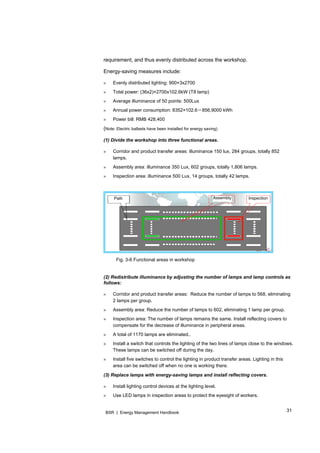
(1) Divide the workshop into three functional areas.
» Corridor and product transfer areas: illuminance 150 lux, 284 groups, totally 852
lamps.
» Assembly area: illuminance 350 Lux, 602 groups, totally 1,806 lamps.
» Inspection area: illuminance 500 Lux, 14 groups, totally 42 lamps.
Fig. 3-6 Functional areas in workshop
(2) Redistribute illuminance by adjusting the number of lamps and lamp controls as
follows:
» Corridor and product transfer areas: Reduce the number of lamps to 568, eliminating
2 lamps per group.
» Assembly area: Reduce the number of lamps to 602, eliminating 1 lamp per group.
» Inspection area: The number of lamps remains the same. Install reflecting covers to
compensate for the decrease of illuminance in peripheral areas.
» A total of 1170 lamps are eliminated..
» Install a switch that controls the lighting of the two lines of lamps close to the windows.
These lamps can be switched off during the day.
» Install five switches to control the lighting in product transfer areas. Lighting in this
area can be switched off when no one is working there.
(3) Replace lamps with energy-saving lamps and install reflecting covers.
» Install lighting control devices at the lighting level.
» Use LED lamps in inspection areas to protect the eyesight of workers.
Path Assembly Inspection
32BSR | Energy Management Handbook
Filter
Connector
Connecting
Hose
Water discharger
Water
Discharger
By-pass pipe
Filter
Wet air tank
Dryer
Water discharger
Oil filter
Oil collector
Oil filter
Dry air tank
By-pass pipe
Compressor
Branch pipe
Pressure/flow
regulator
Condensate
management
system
Auxiliary air tank
Large-flow, intermittent
air-consuming equipments
»
(4) Provide training to operators on energy efficiency management, including:
» Energy saving
» Lamp cleaning
» Natural light
3. Compressed Air Systems
3.1 ENERGY-SAVING DIAGNOSIS: COMPRESSED AIR SYSTEMS
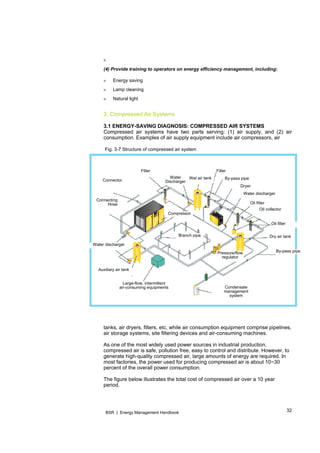
Compressed air systems have two parts serving: (1) air supply, and (2) air
consumption. Examples of air supply equipment include air compressors, air
Fig. 3-7 Structure of compressed air system
tanks, air dryers, filters, etc, while air consumption equipment comprise pipelines,
air storage systems, site filtering devices and air-consuming machines.
As one of the most widely used power sources in industrial production,
compressed air is safe, pollution free, easy to control and distribute. However, to
generate high-quality compressed air, large amounts of energy are required. In
most factories, the power used for producing compressed air is about 10~30
percent of the overall power consumption.
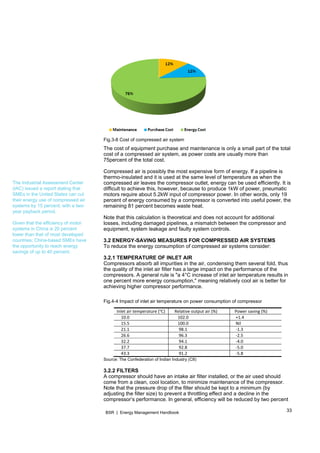
The figure below illustrates the total cost of compressed air over a 10 year
period.
33BSR | Energy Management Handbook
The Industrial Assessment Center
(IAC) issued a report stating that
SMEs in the United States can cut
their energy use of compressed air
systems by 15 percent, with a two-
year payback period.
Given that the efficiency of motor
systems in China is 20 percent
lower than that of most developed
countries; China-based SMEs have
the opportunity to reach energy
savings of up to 40 percent.
Fig.3-8 Cost of compressed air system
The cost of equipment purchase and maintenance is only a small part of the total
cost of a compressed air system, as power costs are usually more than
75percent of the total cost.
Compressed air is possibly the most expensive form of energy. If a pipeline is
thermo-insulated and it is used at the same level of temperature as when the
compressed air leaves the compressor outlet, energy can be used efficiently. It is
difficult to achieve this, however, because to produce 1kW of power, pneumatic
motors require about 5.2kW input of compressor power. In other words, only 19
percent of energy consumed by a compressor is converted into useful power, the
remaining 81 percent becomes waste heat.
Note that this calculation is theoretical and does not account for additional
losses, including damaged pipelines, a mismatch between the compressor and
equipment, system leakage and faulty system controls.
3.2 ENERGY-SAVING MEASURES FOR COMPRESSED AIR SYSTEMS
To reduce the energy consumption of compressed air systems consider:
3.2.1 TEMPERATURE OF INLET AIR
Compressors absorb all impurities in the air, condensing them several fold, thus
the quality of the inlet air filter has a large impact on the performance of the
compressors. A general rule is "a 4°C increase of inlet air temperature results in
one percent more energy consumption," meaning relatively cool air is better for
achieving higher compressor performance.
Fig.4-4 Impact of inlet air temperature on power consumption of compressor
Inlet air temperature ( )     Relative output air (%)    Power saving (%) 
    10.0       102.0    +1.4 
    15.5        100.0     Nil 
    21.1         98.1     ‐1.3 
    26.6         96.3     ‐2.5 
    32.2        94.1    ‐4.0 
    37.7         92.8     ‐5.0 
    43.3         91.2     ‐5.8 
Source: The Confederation of Indian Industry (CII)
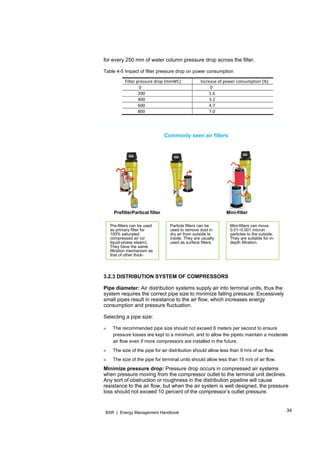
3.2.2 FILTERS
A compressor should have an intake air filter installed, or the air used should
come from a clean, cool location, to minimize maintenance of the compressor.
Note that the pressure drop of the filter should be kept to a minimum (by
adjusting the filter size) to prevent a throttling effect and a decline in the
compressor’s performance. In general, efficiency will be reduced by two percent
34BSR | Energy Management Handbook
Commonly seen air filters
PrefilterPartical filter Mini-filter
Pre-filters can be used
as primary filter for
100% saturated
compressed air (or
liquid-phase steam).
They have the same
filtration mechanism as
that of other thick-
Particle filters can be
used to remove dust in
dry air from outside to
inside. They are usually
used as surface filters.
Mini-filters can move
0.01~0.001 micron
particles to the outside.
They are suitable for in-
depth filtration.
for every 250 mm of water column pressure drop across the filter.
Table 4-5 Impact of filter pressure drop on power consumption
Filter pressure drop (mmWC)       Increase of power consumption (%) 
             0                0 
            200               1.6 
            400             3.2
            600               4.7 
            800               7.0 
3.2.3 DISTRIBUTION SYSTEM OF COMPRESSORS
Pipe diameter: Air distribution systems supply air into terminal units, thus the
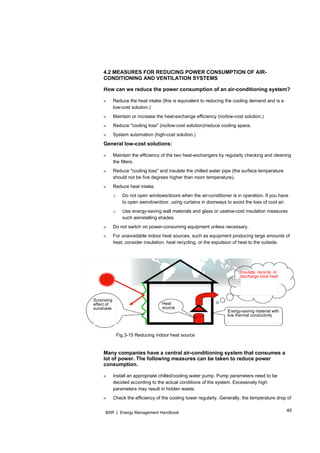
system requires the correct pipe size to minimize falling pressure. Excessively
small pipes result in resistance to the air flow, which increases energy
consumption and pressure fluctuation.
Selecting a pipe size:
» The recommended pipe size should not exceed 6 meters per second to ensure
pressure losses are kept to a minimum, and to allow the pipeto maintain a moderate
air flow even if more compressors are installed in the future.
» The size of the pipe for air distribution should allow less than 9 m/s of air flow.
» The size of the pipe for terminal units should allow less than 15 m/s of air flow.
Minimize pressure drop: Pressure drop occurs in compressed air systems
when pressure moving from the compressor outlet to the terminal unit declines.
Any sort of obstruction or roughness in the distribution pipeline will cause
resistance to the air flow, but when the air system is well designed, the pressure
loss should not exceed 10 percent of the compressor’s outlet pressure.
35BSR | Energy Management Handbook
Air supply
side
Air-consuming side
Operating range of
compressor
Pressure drop of
after cooler,
separator, dryer, and
filt
Pressure drop of pipe
system (non-adjusted
terminal use)
Pressure drop of FRL,
valve, hose, and
connection (adjusted
terminal use)
Case study of a typical pressure gradient
The normal operating pressure for pneumatic tools is 6 bar (g) (1bar(g)=1kg). Any
pressure higher than this will cause a rise in costs.
 Air consumption V = 40 m
3
/min at 7 bar(g) 250kW.
 At 8 bar(g), 7% more power (>15kW) is required.
Increase of cost:
 15 kW x 0.6RMB/kWh x 8000 h/year = 72,000RMB/year
Fig.3-0 typical pressure gradient
Pressure drops can be minimized three ways:
» Select proper equipment. Select air treatment components, such as after coolers,
gas-liquid separators, driers and filters, with the lowest possible pressure drop at
specified maximum operating conditions. Or select terminal units, such as pressure
regulators, lubricators, hoses, and connections with the best performance
characteristics at the lowest pressure differential.
» Correct system maintenance. Monitor the pressure drop of each system component
and conduct regular maintenance following supplier instructions.
» Pipe optimization. Industrial compressed air systems usually experience rapid
fluctuations. Even a well-designed pipeline can experience a sudden decrease in
pressure after the installation of a new terminal unit. To deal with this problem, raise
the compressor discharge pressure, since even a small modification of the air supply
pipeline can help reduce the energy consumption of the entire system.
36BSR | Energy Management Handbook
How to Fix a Faulty Compressed Air System
The pictures above show pipelines for a typical compressed air system. This kind of
configuration usually results in a 0.14~0.2 MPa pressure loss between the air pipe
and the terminal unit. To resolve this issue, reduce the length of the hose and use
metal pipes as much as possible.
Changing the pipeline network layout solves the problem of low terminal pressure
and improves air efficiency, while reducing input pressure.
3.2.4 STORAGE SYSTEMS
Certain intermittent, high-load air applications in factories may cause air system
pressure to experience serious fluctuations. As a result, pressure-sensitive
processes cannot don’t smoothly and product quality is affected. A solution to
this problem is to raise the discharge pressure or capacity of the compressor. But
this could lead to an increase in power consumption (a 0.1 MPa increase of
discharge pressure results in a seven percent increase of the compressor’s
power).
Problems of this kind can be solved by installing an air tank. Since high loads
usually last for a limited period of time, and there is an interval between loads,
this interval can be used to fill the tank, thus satisfying the extra demand for air
without increasing the capacity of the compressor.
37BSR | Energy Management Handbook
Fig. 3-11 Air Leakage Detection
Fig. 3-10 Storage system of compressor
3.2.6 SELECT CONTROL STRATEGY MATCHING WITH SYSTEM LOAD
The purpose of system control is to ensure air supply satisfies air demand.
Therefore, a good control strategy is essential for maintaining a high efficiency
operation of the air system. An air system usually is made of multiple air
compressors. A good strategy is to allow full-load operation of running
compressors and stop those that are not running.
3.2.7 AIR LEAKAGE
In an industrial compressed air system, leakage may result in a 20 to 30 percent
waste of total air production.
Table 4-6 Leakage loss of compressed air
    Hole size  Air consumption at 6 bar(g) 
m
3
/min 
Power loss (kW) 
    1 mm        0.065      0.3 
    2 mm        0.240      1.7 
    4 mm        0.980      6.5 
    6 mm         2.120     12.0 
Note: If the power price is RMB 0.6/kWh and annual running time is 8000hours/year, then the leakage
loss due to a 4mm hole will be RMB 31,200/year.
Air leakage cannot be perceived visually and hence needs to be detected using
the appropriate methods. The best way to detect air leakage is by using an
ultrasonic detector, which can detect the sound of air seepage beyond ordinary
human auditory capabilities. A portable air leakage detector is generally
equipped with a microphone, an amplifier, a filter, an indicator, as well as an
earphone piece. A less complex method of air detection can be conducted by
simply using soapy water, which although a very reliable method, can also be
time-consuming.
Compressed air pipe
network
Pneumatic
equipments
Compressed air pipe
network
Large-load pneumatic
equipments
Flow regulator
38BSR | Energy Management Handbook
A simple way to calculate leakage:
» Switch off pneumatic equipment or do the test when no equipment is in operation
» Run the compressor and check the operating pressure
» Record the time required to complete the cycle of loading and unloading. To
obtain precise data, record the time required to run 8 to 10 cycles, and then
calculate the total loading time (T) and unloading time (t).
» Use the following formula to calculate the leakage rate. "Q" is the actual air supply
(m3/min). Total leakage rate (m3/min.) would be:
)( tTTQ 
Heat recycling Total energy
consumption of
compressor
Heat emitted by
compressor (2%)
Heat in
compressed
air (4%)
Recyclable heat
(94%)
Heat emission
of motor (9%)
Heat recyclable
by oil cooler
(72%)
Heat recyclable
by after cooler
(13%)
3.2.8 HEAT RECYCLING
About 80 to 93 percent of power consumed by an industrial air compressor is
converted to heat. In most cases, 50 to 90 percent of such heat can be recycled
and used in heating air or water. Heat recycling is possible for both air-cooled
and water-cooled compressors. Typical applications of heat recycling is in
auxiliary space heating, process heating, water heating, circulating air heating,
and water preheating for boilers.
Fig. 3-12 Illustration of heat recycling
39BSR | Energy Management Handbook
Application of recycled heat
Recycled heat from cooled air is
suitable for heating spaces. When
air passes through after-heaters
and lubricant coolers, it absorbs
heat from compressed air. This can
be used for heating spaces, drying
or preheating for boilers. A rule of
thumb is that about 5kW energy
can be obtained from a 1m
3
/min
capacity (full load). The heat can be
used to heat air to a temperature
that is 16~22°C higher than the
cool air inlet temperature. The
recycling efficiency is usually 80 to
90 percent.
Efficiency of air-conditioning
system =Cooling capacity/Input
energy =COP
COP is the most important energy
performance indicator for air
conditioners. It has clearly defined
limit values in the national
standards. Check the COP before
you purchase any air conditioner.
4. Air-conditioning and Ventilation Systems
4.1 ENERGY DIAGNOSIS: AIR-CONDITIONING AND VENTILATION
SYSTEMS
An air-conditioner is a device that can "move" the hot air in a room to the external
atmosphere through four phases of heat transfer. Each heat exchange is a
process that consumes energy.
Fig.3-13 Operating principle of central air-conditioning system
Fig.3-14 Operating principle of split-type air conditioner
The power consumption of a central air-conditioning system is the sum of
the power consumption of the compressor, the chilled water pump, the
indoor heat exchanger’s fan, the cooling tower’s fan, and the cool water
pump.
Factors affecting the energy performance of a central air-conditioning system are
the efficiencies of the compressor, the two water pumps, the two fans, and the
heat exchanger. A decrease in efficiency of any of these components will result
in the increased power consumption of the other components.
The power consumption of a split-type air conditioner is the sum of power
consumption of compressor, indoor heat exchanger fan, and outdoor heat
exchanger fan.
The compressor consumes 75 to 80 percent of the power while the two fans
consume 10 percent of the power.
Coolingtower
Cool
water
Hot
water
Heatexchanger
Compressor
IndoorHeatexchanger
Hot air
Cold air
Cold air
Hot air
Outdoorheatexchanger
Indoorheatexchanger
Compressor
Hot air
Cold air
40BSR | Energy Management Handbook
4.2 MEASURES FOR REDUCING POWER CONSUMPTION OF AIR-
CONDITIONING AND VENTILATION SYSTEMS
How can we reduce the power consumption of an air-conditioning system?
» Reduce the heat intake (this is equivalent to reducing the cooling demand and is a
low-cost solution.)
» Maintain or increase the heat-exchange efficiency (no/low-cost solution.)
» Reduce "cooling loss" (no/low-cost solution)/reduce cooling space.
» System automation (high-cost solution.)
General low-cost solutions:
» Maintain the efficiency of the two heat-exchangers by regularly checking and cleaning
the filters.
» Reduce "cooling loss" and insulate the chilled water pipe (the surface temperature
should not be five degrees higher than room temperature).
» Reduce heat intake.
o Do not open windows/doors when the air-conditioner is in operation. If you have
to open awindow/door, using curtains in doorways to avoid the loss of cool air.
o Use energy-saving wall materials and glass or uselow-cost insulation measures
such asinstalling shades.
» Do not switch on power-consuming equipment unless necessary.
» For unavoidable indoor heat sources, such as equipment producing large amounts of
heat, consider insulation, heat recycling, or the expulsion of heat to the outside.
Fig.3-15 Reducing indoor heat source
Many companies have a central air-conditioning system that consumes a
lot of power. The following measures can be taken to reduce power
consumption.
» Install an appropriate chilled/cooling water pump. Pump parameters need to be
decided according to the actual conditions of the system. Excessively high
parameters may result in hidden waste.
» Check the efficiency of the cooling tower regularly. Generally, the temperature drop of
Surprising
effect of
sunshade
Heat
source
Insulate, recycle, or
discharge local heat
Energy-saving material with
low thermal conductivity
41BSR | Energy Management Handbook
"Supply as demanded"
In places where constant
temperature is required, install
air conditioners with appropriate
power that can ensure constant
room temperature even in
adverse weather (e.g. ambient
temperature is 40 ).
In very crowded offices (area
per capita less than 2m2),
select air conditioners
according to the standard
method, and install ceiling fans.
In offices that are not crowded,
select air conditioners that have
a power of about 70% of the
standard power and make sure
the air outlet face seats.
a cooling tower is about 5 degrees, and the outlet temperature is one to two degrees
higher than the ambient temperature (evaporation rate being 1.5 percent).
Maintenance or cleaning work will be necessary if the cooling efficiency is lower than
the above-mentioned values.
» Ensure good insulation of chilled water pipe.
» Check the efficiency of the three heat exchanging devices regularly; keep the surface
of heat exchanger clean; and clean filters regularly.
» Make sure that there is a switch in each independent room, which can be used to turn
off the fan of the heat exchanger.
» A central air-conditioning system is suitable for cooling a relatively large area but not
for achieving a reduced temperature in a small space (such as areas that need to be
maintained at 22 degrees Celsius or lower). For the low-temperature cooling of a
small area, use a cabinet-type air conditioner.
» Set the chilled water outlet temperature at nine degrees Celsius to increase the
chiller's energy performance.
Energy-saving solutions for split-type air conditioners:
» Select frequency conversion air conditioners with a high-energy performance
ratio.Decide the power of the air conditioner according to desired cooling
requirements.
» The setup temperature should not be lower than 26 degrees Celsius. If the air outlet
faces worker areas directly, the setup temperature can be 28 degrees Celsius.
» Turn off air conditioners 30 minutes before the close of the business day (Never let air
conditioners run overnight). Avoid positioning outdoor units in direct sunshine and
ensure uninterrupted airflow. Place a protective covering over the unit if it is not to be
used for a long time.
4.3 CASE STUDY: SAVING ENERGY AT A FOOD PROCESSING PLANT
The preparation workshop at a food processing plant has five outlets for a central
air-conditioning system, one 18kW indoor air conditioner, eight sugar melting
pots with a surface temperature higher than 60 degrees Celsius, and one
vacuum tank with a surface temperature higher than 80 degrees Celsius. There
are many pipes for distribution of hot water and steam. The surface temperature
of these pipes is higher than 50 degrees Celsius. The annual power consumption
of the air-conditioners is 1,360,000 kWh. The temperature of the workshop is
required to be 22 ± 2 degrees Celsius.
42BSR | Energy Management Handbook
Fig.3-16 Layout of preparation workshop
Analysis of high power consumption:
» The only place in the workshop that needs to be cooled down is the material
preparation area.
» Air-conditioning is needed in winter because there are too many heat sources in the
workshop.
» The workshop solely relies on an air-conditioning system without considering the use
of natural air during the cold season. The power bill in January 2008 was more then
RMB 300,000.
Solutions:
» Use partitions to divide the workshop into several areas. Use three of the five outlets
of the central air-conditioning system and close the other two. Move indoor air
conditioners to other places.
Fig.3-17 New layout of workshop
Material tank High-
temperature
vacuum tank
Heat exchanger
for cooling
vacuum pump
Outlet of central
air-conditioning
system
Hot cleaning water
tank
Eight sugar melting
pots
Indoor air
conditioner
43BSR | Energy Management Handbook
» Insulate high-temperature containers to reduce steam consumption and to reduce the
load on the air-conditioning systems.
» Replace the high-temperature vacuum condensing process with a low-temperature
vacuum condenser. This will alsohelp reduce the load onthe air-conditioning system.
» Replace heat provided by steam with the heat generated in the heat pump. Use the
cold air from the heat pump to cool down the material preparation area. This can
further reduce the load on the air-conditioning system.
The total investment for all energy saving measures was RMB 276,000, while
annual power savings were 370,000 kWh.
Fig.3-18 Pictures of the workshop before and after the energy-saving project
Before
After
44BSR | Energy Management Handbook
5. Injection-Molding Systems
5.1 ENERGY-SAVING DIAGNOSIS
Similar to a syringe, an injection-molding machine has a screw or plunger that
can inject plastic fluid into a die cavity. Plastic fluid solidifies in the die cavity and
products are formed. Usually a hydraulic transmission machine, an injection-
molding machine consists of an injection device, a die opening/clamping device,
a hydraulic transmission device, and an electrical control device. Injection and
die opening/clamping devices are key components of an injection-molding
machine. Electrical control devices ensure that the machine operates correctly
according to the process requirements (such as pressure, speed, temperature,
time, and position) and specified procedures.
Tests indicate the amount of power consumed by each component in an
injection-molding machine is:
» Hydraulic system: 75-80 percent
» Heating unit: 10-15 percent
» Cooling system: 5-10 percent
» Control system: 1-5 percent
A hydraulic system consumes more than 75 percent of the machine's overall
power consumption. The hydraulic loss of an injection-molding machine consists
of three parts:
» Overflow loss: Depending on products and processes, the hydraulic power, flow,
and pressure of processes vary. The load of the machine is always changing. Oil
pumps are designed to satisfy the largest flow and the motors run at constant speed.
When the flow needed is less than the largest flow, the excess oil runs back to the oil
tank through an overflow valve. The energy used to provide this part of oil is then
wasted.
» Throttling loss: This refers to the pressure drop of hydraulic oil when it runs through
a throttle valve. Since the throttling area of directional valve is relatively large, most
throttling loss occurs at the directional valve. The high-speed circulation of hydraulic
oil as well as friction with hydraulic parts leads to high oil temperature, noise, and the
reduced life-span of the machine.
» Design surplus loss: In most cases, the design capacity of a motor is much higher
than actual requirements. This also leads to waste of power.
5.2 ENERGY-SAVING MEASURES FOR INJECTION MOLDING MACHINE
An energy-saving upgrade of an injection-molding machine can be conducted
considering the following aspects.
45BSR | Energy Management Handbook
Fig.3-19 Energy-saving opportunities of injection molding machine
5.2.1 INFRARED ENERGY-SAVING HEATER BAND
Fig.3-20 Infrared energy-saving heater band
Features:
» Heating speed: Heats up nanometer material to 1000 degrees within 45 seconds and
maintain 750 degree temperature for a long period of time.
» Heat conversion efficiency: >99.8 percent.
» Life span: Allows for continuous use for more than 50,000 hours.
Heat recycled is used
in material preheating
High-efficiency heating
and barrel heat recycling
Direct pressure injection
molder with a servo system
Frequency converter, power factor
improver, and servo motor
46BSR | Energy Management Handbook
» Insulating/one-way heat transfer performance: Maintains less than 80 degree surface
temperature.
Result: Power savings of 25 to 50 percent; return on investment period is five
months.
Fig.3-21 Before and after upgrading using infrared energy-saving heater band
5.2.2 HEAT RECYCLING
The heat generated by the barrel of the injection-molding machine can be
recycled for preheating materials. This can reduce heat loss and power
consumption of the material preheater without affecting the operation of the
machine. An insulating case is installed to conserve the heat produced by the
heater band, and the hot air in the space between the case and the barrel is
transferred to the material preheater by a fan. The air is then passed through a
filter, which removes the dust in the air, and is transferred back to the space
between the case and the barrel, ultimately forming a heat cycle. Due to an
increase in thermal efficiency and a reduction of heat emission, the workshop will
be cooler with power consumption and dissipation reduced.
47BSR | Energy Management Handbook
High power consumption and heat emissions have long been problems with
conventional injection molding machines. Such problems lead to increased
production costs and power consumption as well as environment impacts. Heat
emission of an injection molding machine is mainly due to the following problems:
(1) Material preheats using resistance wire, which generates heat on both
inner and outer surfaces. The heat on the outer surface escapes into air
and is wasted.
(2) High surface temperature (200 to 300 °C) of the barrel which makes the
workshop very hot. During the summer, the temperature in a workshop can
be more than 40 °C. Factories tend to use air conditioners to cool down
workshops, but this only leads to secondary waste of energy.
Fig.3-22 Heat recycling equipment for an injection-molding machine
A power meter is installed to measure the power consumption of the barrel, the
material hopper, and the injection-molding machine after the installation of a
heat-recycling system. The same is done on other machines without this device.
The data is used to calculate energy consumption and power costs of the
machine before and after the installation of the heat-recycling system, as well as
to estimate operating costs and payback periods.
Table 1 Energy saving and economic effects
Heat recycling equipment 
Power 
factor 
Injection molding machine  Material preheat barrel 
Payback 
period (year) 
Power 
consumption 
(kWh) 
Energy 
saving 
(%) 
Power 
consumption 
(kWh) 
Energy 
saving 
(%) 
Plant A 
Heat recycling equipment 
installed 
0.88  31 
 
1.6 
2.3 
20.7  2.4 
Heat recycling equipment 
not installed 
0.88  30.5  1.69 
Plant B 
Heat recycling equipment 
installed 
0.67  4.93 
4.3 
0.12 
69  4 
Heat recycling equipment 
not installed 
1  5.15  0.38 
Plant C 
Heat recycling equipment 
installed 
0.77  1.13 
16.3 
0.36 
37.9  0.4 
Heat recycling equipment 
not installed 
0.85  1.35  0.58 
As shown in the table above, plants installed with heat-recycling equipment
reduced their power consumption. The decrease in power consumed by the
preheat barrel and the injection-molding machine was 20.7 to 69 percent and 1.6
to 16.3 percent, respectively. The payback period was 0.4 to 4 years. Test
results show the heat-recycling equipment is effective in reducing power
consumption and the costs of the preheat barrel. The test results of the injection
molding machines, however, showed the power consumtpion depended on the
product and therefore only reflected the results achieved at the operating
conditions of the equipment.
5.2.3 DIRECT PRESSURE INJECTION MOLDER WITH SERVO SYSTEM
Conventional injection-molding machines have fixed pressurizing systems, which
rely on motor-driven pumps. The speed and pressure needed in each step of
48BSR | Energy Management Handbook
injection-molding are different, so are the oil flow requirements. However, the
motor rotates at constant speed and provides oil at constant flow. As a result,
some of the oil is not utilized and therefore becomes waste. Another waste
product is the heat generated by resistance heaters, which is not used up but
instead flows back into the workshop. The figure below shows the Lijin PT300Y
direct pressure injection molder with servo system used in a factory.
The machine is equipped with a servo motor, which can adjust its output power in
real time based on the change in load. The servo system can control the rotating
speed of the motor pump according to power demand of the machine, the
pressure monitor and the flow change, and therefore reduces its power
consumption. In other words, the controller adjusts the rotational speed of motor
(and as a result, its output power) according to change of load, at the same time
improving the power factor. In addition, the machine has an electromagnetic
heating system, which generates large amounts of eddy currents that can
produce heat in the metallic material. Since the heat is dissipated by the metallic
material, the external heat loss is very low. This can help increase power
efficiency.
Compared to a conventional injection-molding machine, the direct pressure
injection molder with servo system saves more power, allows more accurate
operation, generates less noise, improves product quality and saves operating
costs.
Fig.3-23 Direct pressure injection molder with servo system
Fig.3-24 Conventional injection-molding machine vs. direct pressure injection molder with
servo system
To verify the performance of a direct pressure injection molder equipped with a
servo system, a company carried out a test using the direct pressure injection
49BSR | Energy Management Handbook
molder with servo system (Lijin PT00Y) and the conventional injection molding
machine (Baoyuan 320PC and PC-550) , both of which have the same tonnage
given the same test conditions. The result is shown below.
Table 2: Result of test on conventional molder and direct pressure injection molder with
servo system with the same tonnage (clamping force) in production of TS-728 kitchen
basin
Test items 
Conventional injection 
molder 
Direct pressure injection 
molder with servo 
system 
Saving % 
 
Power consumption/unit time 
(kWh) 
14.8  2.7  ‐81.8% 
Production cycle (sec.)  80  75  ‐6.25% 
Pass rate (%)  85  97  +12% 
Qualified product (EA/hr.)  35  42  +20% 
Workshop temperature (℃)  41  32.5  ‐20.7% 
Maintenance cost (RMB/year) 
The die‐clamping device 
needs 1 liter of lubricant 
every day and one 
grease lubrication per 
season. 
Do not need daily 
lubrication, but only one 
grease lubrication per 
season. 
‐ RMB 5600 
Table 3 Direct pressure injection molder with servo system vs. injection molding machine
with the same opening stroke (PT300Y:910mm and PC-550:850mm)
(in production of TS-806 water tank)
Test items 
Conventional injection 
molder 
Direct pressure injection 
molder with servo 
system 
Saving % 
Power consumption/unit time 
(kWh) 
23.5  3.2  ‐86.4% 
Production cycle (sec.)  92  70  ‐23.9% 
Pass rate (%)  83 96 +13% 
Qualified product (EA/hr.)  36  45  +20% 
Workshop temperature (℃)  40  31.5  ‐21.3% 
Maintenance cost (RMB/year) 
The die‐clamping device 
needs 1 liter of lubricant 
every day and one 
grease lubrication per 
season. 
Do not need daily 
lubrication, but only one 
grease lubrication per 
season. 
‐ RMB 5600 
As shown in the table above, a direct pressure injection molder with servo
system has the following advantages:
» Significant energy-saving effect: The servo motor and measuring pump start to run
only in specific processes. For an interval of about 45 seconds, they are stopped and
consume no power at all.
» Low maintenance cost: Daily lubrication is not necessary, which means savings of
two barrels (180L) of lubricant.
» High production output and short production time: The computer-based control
system is highly accurate, flexible, and reliable.
» Less impact to ambient temperature in workplace: With relatively low operating
temperatures and good insulation of electromagnetic heating systems, the machine
emits less heat.
50BSR | Energy Management Handbook
Financial analysis
A direct pressure injection molder with a servo system is usually used in the
manufacturing of products that require long opening strokes. In the production of
the TS-806 water tank, the molder saves 20.3 kW more than a conventional
molding machine with the same opening stroke. In the production of the TS-728
kitchen basin, the molder saved 12.1 kW more power than a conventional
molding machine with the same clamping force. A conservative estimate is that
the molder saves about 15kW more power than conventional molding machines.
Table 4 Financial analysis
Running days 
(days/year) 
Running 
hours 
(hours/day) 
Power price 
(RMB/kWh) 
Production 
cost 
(RMB/day) 
Lubricant 
saving 
(barrel/year) 
Lubricant 
price 
(RMB/barrel) 
   300     20      1  1350     2  2800 
As shown in the table above, the annual power cost saving is: 15 ×300 ×20 ×1 =
90,000 RMB. A short production cycle also contributes to reduced production
cost. The standard production cost of 300T molder is RMB 1,350/day.
Considering an increase of production by 20 percent, a conservative estimate is
15 percent reduction of the operating time.
» Annual cost saving: 1350 ×15% ×300 = RMB 60,750
» Annual maintenance cost savings: 2,800 ×2 = RMB 5,600
» Annual expense savings: 90,000 + 60,750 + 5,600 = RMB 156,350
» Since the investment is RMB 408,000, the payback period will be: 408,000 / 156,350
=2.6 years
5.2.4 FREQUENCY CONVERSION UPGRADING OF INJECTION MOLDING
MACHINE
By installing an energy-saving inverter, it is possible to control the motor speed
by adjusting power frequency,therefore reducing the speed to the minimum level
where the motor produces reactive power. The energy efficiency can be
increased by 10 to 20 percent.
Fig.3-25 Frequency conversion upgrading of injection molding machine
Control mechanism
Pressure signal
Current signal
Die clamping
signal
Injection switch
signal
Die opening signal
Tip signal
Sync.Signalofinjectionmolder
Longbidainjectionmoldersignalprocessor
Frequencyconversiontechnology
Analogue
signal
Speed
adjustment Pump motor

Energy management handbook

  • 1.
  • 2.
    2BSR | EnergyManagement Handbook About The Handbook China has an ambitious goal of cutting energy consumption per GDP by 20 percent of 2005 levels by 2015. To reach this goal, the government created the Comprehensive Scheme on Energy Saving and Emission Reduction in August 2011. The scheme is directed at large enterprises in key industries such as power generation and construction materials. Small and medium-sized enterprises, however, account for half of China’s total annual energy consumption and are about 30 to 60 percent less energy-efficient than larger companies. Improving energy management of SME scan significantly help China achieve its energy conservation and emissions reduction goals. This energy management handbook was created by BSR, a leader in sustainability management, after a series of studies on manufacturing SMEs. The studies examined the challenges faced by these companies, and explored cost- effective energy-saving methods. This booklet teaches SMEs how to establish energy management systems, explains the concepts and procedures of an energy audit, and introduces methods of energy efficiency diagnostics as well as energy efficiency technologies and best practices. We also make practical and easy to operate recommendations to SMEs from both management and technical perspectives. The handbook was written by Fengyuan Wang of BSR Hong Kong and Andy Chen of BSR Guangzhou. The authors would like to thank Starbucks Coffee Company and its China-based suppliers for their contribution in the research, and the British Foreign & Commonwealth Office for its funding support. DISCLAIMER BSR publishes occasional papers as a contribution to the understanding of the role of business in society and the trends related to corporate social responsibility and responsible business practices. BSR maintains a policy of not acting as a representative of its membership, nor does it endorse specific policies or standards. The views expressed in this publication are those of its authors and do not reflect those of BSR members. ABOUT BSR BSR works with its global network of nearly 300 member companies to build a just and sustainable world. From its offices in Asia, Europe, and North and South America, BSR develops sustainable business strategies and solutions through consulting, research, and cross-sector collaboration. Visit www.bsr.org for more information about BSR’s more than 20 years of leadership in sustainability.
  • 3.
    3BSR | EnergyManagement Handbook Contents 4 Energy Management System Overview Establishing a Management System 15 Energy Audit Overview Key Factors of an Energy Audit 26 Energy Saving for Large Energy-Consuming Systems Power Distribution Systems Lighting Systems Compressed Air Systems Air-Conditioning and Ventilation Systems Injection-Molding Systems
  • 4.
    4BSR | EnergyManagement Handbook Energy Management System 1. Overview China's huge population and rapid pace of economic growth make its energy needs particularly challenging. After two decades of annual growth averaging eight percent, it is now the world's second largest energy consumer after the United States, according to the International Energy Agency (IEA). China’s National Bureau of Statistics reports consumption of coal in China rose 18.6 percent to 3.06 billion tons in 2009, outpacing supply, which rose 18 percent to 2.74 billion tons from its 2006 equivalent. (See Table 1-1 Energy consumption and supply (2006-2009) below). As a result, the government is facing a series of challenges to expand its energy supply while increasing efficiency. Table 1-1: Energy production vs. energy consumption (2006-2009) The bulk of the demand comes from the industrial sector, which is often hampered by shortages as rising consumption puts pressure on domestic energy reserves. In 2011, China’s major industrial provinces, Guangdong, Guangxi, Guizhou, Yunnan and Hainan, suffered from the worst power shortages since 2006. In May 2011, power regulators were forced to impose “off-peak “ periods in the Pearl River Delta industrial area of Guangdong province, affecting industrial towns located in the area, namely Dongguan, Shenzhen and Foshan, in an attempt to reduce power consumption. To meet year-end targets, 60 percent of small factories in Dongguan for instance, only received electricity three days a week, while companies in Baoan and Shenzhen had six days of electricity supply, as opposed to seven full days. Similarly, factories in 21 towns in Dongguan, including Shijie, Tanxia and Dalang only operate four days a week. These severe shortages combined with the rising value of the Yuan have raised costs for local businesses and depleted their profit margins. China is at a highly energy-intensive stage of growth, consuming nearly 10 percent of the world’s energy resources. But government intervention through the introduction of energy saving schemes presents opportunities to enhance efficiency in the industrial sector. Companies, the majority of which are SMEs, Energy consumption and supply Unit:10,000tonsofstandard coal Gross energy production Total energy consumption
  • 5.
    5BSR | EnergyManagement Handbook will benefit from implementing such schemes to help them reduce power usage, increase energy efficiency and reduce costs. The following chapters explain the benefits of implementing energy management systems and offers best practice advice to help SMEs use energy more efficiently. ENERGY MANAGEMENT SYSTEM STANDARDS: ISO50001 AND GB/T23331-2009 China’s Standard Certification Center (CSC) began research into improving energy management systems and upgrading national standards in 2002. In 2009, the government implemented its newly developed research GB/T 23331-2009, "Requirements for Energy Management Systems." Since then, China has made regular updates to its systems to match national standards with those of the International Organization for Standardization (ISO), which published its latest international energy management standards, the ISO 50001, in June 2011. Organizations across the world face energy-related challenges, including those related to energy supply, reliability and climate change matters. The ISO 50001 is a framework that helps companies manage their energy systems and plan better to save energy and to reduce pollution as well as costs. ISO estimates these standards can reduce global energy consumption by 60 percent. The ISO 50001 provides the following benefits: » Resolves energy efficiency problems » Improves energy usage of energy-consuming assets » Estimates environmental impact of greenhouse gases; » Improves energy management and communication; » Provides best practices for energy efficiency; » Prioritizes new energy-saving technology; » Improves energy efficiency of supply chains; and » Details greenhouse gas reduction plans Both ISO50001 and GB/T23331-2009 are based on the same model (See Fig.1- 2 Energy management model), which applies the “Plan, Do, Check and Action” cycle (PDCA). This handbook provides China-based companies, particularly SMEs, with an overview of ISO 50001 as it relates to the Chinese GB/T23331- 200 standard. 2. Establishing an Energy Management System 2.1 MANAGEMENT COMMITMENT Both international and Chinese energy management standards require the support of senior managers to commit to facilitating energy efficiency throughout their organizations. These include commitments to establish, implement, maintain and improve energy management systems on a regular basis. Specifically, managers must commit in writing to: » Integrate energy policies and regulations into company operations; » Incorporate energy targets into overall business strategies; » Provide staff with energy management training; Figure 1-2: Energy Management Model
  • 6.
    6BSR | EnergyManagement Handbook A good energy manager should display the following competences: » A senior/middle class manager who can report to the top management directly; » Be familiar with main production processes; » Have a certain understanding of production equipment, electrical, boiler, air-conditioning, lighting, and auxiliary systems; » Have a certain degree of financial knowledge and energy management; and » Strong management ability and is able to implement improvement plans independently. » Conduct management reviews of energy management processes; and » Keep energy-related equipment well maintained. Energy Saving Commitments » Establish a system to collect, analyze, and report data related energy consumption, and ensure correctness and integrity of that data; » Designate personnel with expertise and technical experience, or above, to be in charge of energy management, and file this personnel in government agencies in charge of energy saving; » Enhance measuring instrument management and equip and use qualified measuring instruments according to relevant regulations; » Establish a responsibility system and award organizations and individuals with good performance in energy-saving activities; » Make and implement energy-saving plans and technical measures; » Comply with national energy limitation standards and make corporate standards that are stricter than national standards; » Use energy efficiency markings on products according to relevant regulations; » Conduct energy-saving education and training regularly; » Never produce, import, or sell any products or equipment (or use equipment) that are clearly specified as "to be eliminated" by government agencies or those which do not conform with energy efficiency standards; » Never provide free energy to employees or implement any "package fee" system for energy use. These commitments should be printed and posted in public areas in the factory to promote energy management. 2.2 ENERGY POLICY (OPTIONAL) National and international energy management standards encourage companies to create energy policies specific to their company operations. But implementation of these policies is up to the discretion of managers and companies. Good energy policies: » Are integrated with the company’s business activities, products and services; » Reduce energy consumption, increase efficiency and guarantee regular system maintenance; » Comply with applicable laws and regulations; » Provide a framework for making and evaluating energy targets and indicators; » Offer employees training materials so that they can understand and implement energy policies; and » Are readily available to all relevant parties within the organization. 2.3 ENERGY MANAGER Senior executives must assign an independent specialist to oversee energy management within the company, with the exception of SMEs, whose directors
  • 7.
    7BSR | EnergyManagement Handbook EXAMPLE- Energy management organization chart Leader: Vice General Manager Members: Production Supervisor Equipment Engineer Financial Supervisor are allowed to designate an internal energy manager from their middle-level management staff. In this case, the standards recommend appointing a supervisor or higher-level executive from the production, maintenance or engineering divisions. The energy manager is required to: » Establish, implement, maintain, and improve energy management systems in accordance to the national and international standards; » Provide regular updates to top management on all energy management systems; » Submit proposals for improvements; and » Liaise with external organizations on energy management issues. 2.4 PLANNING The energy manager is responsible for developing an action plan in line with national and international standards, the first step in the “Plan, Do, Check and Action” cycle. Any plan must: » Identify key energy performance indicators; » Adhere to rules, regulations and other requirements that affect management systems; » Highlight energy benchmarks; » Set energy targets; and » Design an efficient energy management platform 2.4.1 IDENTIFICATION OF ENERGY FACTORS Identifying key energy performance indicators is vital for the planning process, as it provides managers with a clear picture of how their company uses energy and can highlight ways to manage resources better. The manager’s first step is to determine the energy consumption “structure” of his or her company, in other words, what energy resources does the company need to run its operations, be it gas, coal or electricity (see example below). Energy Consumption of Company A Item  Natural gas  (10,000 m3)  Kerosene  (t)  Diesel oil  (t)  Power  purchased  (10,000  kWh)  Power  generated  (10,000  kWh)  Compressed  air  (10,000 m3) Surface  water  (10,000 t)  Total energy  consumption  (tce)  Recycled  (tce)  Actual  consumption (tce)  Actual  amount  1711.52  14.80  297.54  182825.66  2780.84  62.34  164.06  —  —  — 
  • 8.
    8BSR | EnergyManagement Handbook Rectifier Power transformer Cogeneration Compress air station Electrolyzer Main production Auxiliary production Office Lighting Other Transportation Gas Kerosene Diesel Gasoline Electricity 229558.98 9734.47 221524.42 214878.69 102067.38 9442.44 3813.2513355.69 9805.2 2840.39 11.94 8690.79 16611.33 416.13 1050.94 2247.88 31.31 62.91 283.10 1.06 2545.614345.15 9966.8403.65525.47 114.39113.08 113.08 31.31 416.13 19142.31 12.48 9575.51 118.1 112811.31 4741.266939.898034.56 292.03 Storage loss 8326.59(3.25) 7045.87(2.72) Distribution loss End use loss Useful energy consumption 164250 kWh 20.2 20.2 373.25 267.27 105.98 149.55 7.48 3.04 106.5 Total:259015.48(100) 0.7 127373.05(49.18) 119845.06 (46.27) Note: 1、Unit: tce (% of total energy input) 2、Energy utilization rate is 46.27% Purchase Storage Processing Conversion Distribution Final use 1.947GWh 1740.21wm3 285.59T 21.28T 76.85T Water pump Conversion  to standard  coal  10832.21  21.78  433.55  224692.74  3417.65  22.44  200.81  239621.18  3640.91  235980.27  %  4.52  0.01  0.18  93.77  1.43  0.01  0.08  100.00  1.52  98.48  Next a manager should identify the basic systems within their companies that consume energy, such as air conditioners, lighting systems, refrigerators, etc. Then, managers need to look at manufacturing processes that consume energy. Once overall energy use is defined, the manager should design an energy flow chart (see below) based on their overall assessment of the company’s energy consumption. The chart should include a detailed analysis of energy usage through the company, highlighting which equipment consumes the most energy. To correctly make this analysis, energy managers need feedback from employees, including factory line managers and technical supervisors. Fig 1-3 Energy flow The goal of this process is to allow an energy manager to identify the company’s key energy performance indicators, provide top management with a prognosis of the company’s energy consumption, and offer recommendations on energy- saving technology. After identifying the key performance indicators, managers can apply the following principles: » Ensure compliance with the relevant laws and regulations that apply; » Ensure a safe working environment; » Technical feasibility; » Economic feasibility; » Energy saving; » Prioritize low-cost/no-cost solutions.
  • 9.
    9BSR | EnergyManagement Handbook Table: Energy Performance Indicator Energy  consumption   process  Energy  consumption  asset/equip ment  To be  eliminated by  law or not  Status  Energy factor Technical  feasibility  1‐10  Economical  feasibility  1‐10  Adverse  impact  (safety,  quality,  environment)  High,  Medium,  Small, No  Assessment  result  A: maintain  B: control with  high priority  C: to be studied D: no measure  Related  division  Air  conditioning  Central air  conditioner  No  No control by  area, time,  and climate  Seasonality   9  9  No  B  Office  building Worksh op  Heat/cool  air demand  varies in  different  area and  time  7  8  No  B  2.4.2 LAWS, REGULATIONS, AND OTHER REQUIREMENTS Managers should update their energy performance indicator table on a regular basis to make sure it’s in line with the latest energy regulations and to help in updating targets for their company’s future energy strategy. They should also keep a library of applicable rules and regulations. List of laws and regulations on energy management systems  No.  Laws, regulations, and  requirements  Issued by  Date of issuance and implementation  1  Energy Conservation Law  Standing Committee of the National  People’s Congress  Issued on October 28, 2007 and  implemented on April 4, 2008  2  Measures for the Supervision  and Administration of Energy  Measurement  State Administration of Quality  Supervision  Issued on July 22, 2010and implemented  on November 11, 2010  3  Measures for the Electricity  Demand‐Side Management  National Development and Reform  Committee, Ministry of Industry and  Information Technology, National Energy  Administration, Ministry of Finance,  State‐owned Assets Supervision and  Administration Commission, and State  Electricity Regulatory Commission Issued on April 11, 2010 and implemented  on January 1, 2011  4  General Principles for Equipping  and Management of Energy  Measuring Instruments in  Energy‐consuming Units  State Administration of Quality  Supervision  Issued on June 2, 2006 and implemented  on January 1, 2007  5  Requirements on Energy  Management System  State Administration of Quality  Supervision  Issued on March 11, 2009 and  implemented on November 1, 2009 
  • 10.
    10BSR | EnergyManagement Handbook Benchmark for coal consumption per gram A coal-fired power plant consumes 390g coal for each kWh electricity generated. Benchmark: The Outline of China's Policies on Energy-saving Technologies set coal consumption to 360g per kWh electricity by 2010, compared to 392g in 2000, with power consumption rates coming down to 5.1% by 2020 from 6.28% in 2000. 6  Notice of the State Council on  Further Strengthening the  Elimination of Backward  Production Capacities  State Council  Issued and implemented on February 6,  2010  7  The First List of Outdated  Mechanical and Electrical  Equipment (Products) with High  Energy Consumption  Ministry of Industry and Information  Technology  Issued on December 4, 2009  8  Renewable Energy Industry  Development Guidance Catalog  National Development and Reform  Committee  Implemented on November 29, 2005  9  Technical Guiding Catalog of  Cleaner Production of National  Key industry  State Environmental Protection  Administration  Implemented on November 27, 2006  10  List of Recommended Energy‐ saving Mechanical and Electrical  Equipment (Products) (1st batch)  Ministry of Industry and Information  Technology  Issued on May 27, 2009  11  List of Recommended Energy‐ saving Mechanical and Electrical  Equipment (Products) (2nd  batch)  Ministry of Industry and Information  Technology  Issued and implemented on August 16,  2010  12  Measures for Supervision and  Management of High Energy‐ consuming Special Equipment  State Administration of Quality  Supervision  Issued on July 3, 2009 and implemented  on September 1, 2009  No.  Standard  Issued by  Date of issuance and implementation  1  Technical guides for evaluating  the rationality of heat usage in  industrial enterprise (GBT3486‐ 1993)  State Bureau of Technical Supervision  Issued on June 19, 1993 and implemented  on June 1, 1994  2  General principle of energy audit  on industrial and commercial  enterprise (GBT17166‐1997)  State Bureau of Technical Supervision  Approved on December 22, 1997 and  implemented on October 1, 1998  3  Guides for the power  transformers energy saving  operation in factories and mines  (GBT13462‐2008)  State Bureau of Technical Supervision  Approved on May 27, 2008 and  implemented on January 1, 2008  2.4.3 SETTING ENERGY MANAGEMENT BENCHMARKS Managers should set energy efficiency benchmarks that measure consumption and the number of energy consumption assets in operation. Such benchmarks allow companies to compare their energy management systems against best practices in China and abroad. The benchmarks also allow companies to compare their energy efficiency results against national standards, such as the clean production standard or China’s energy-saving technologies policy. (Please see the example below of a benchmark on net coal consumption identified in China’s Policy Outline for Energy Conserving Technologies). 2.4.4 ENERGY TARGETS AND INDICATORS Energy managers that are aware of their company’s energy performance rating are in a better position to track energy and water consumption, and set targets and indicators (Please see the example below). As a result, they can improve policies, identify areas that need improvement, and measure the investments required for facility upgrades. 2.4.5 ENERGY MANAGEMENT PLAN Energy management plans should be prepared on the basis of expert opinion and suggestions from front-line employees, bearing in mind the:
  • 11.
    11BSR | EnergyManagement Handbook   Target: Reduce unit coal consumption of boilers Indicator: Reduce coal consumption per ton by 5% in 2012 (with that of 2010 as baseline). Measures: Install steam accumulator; check CO and CO2 smoke levels and install combustion control device. Division in charge: Engineering Person in charge: Maintenance Supervisor Investment: RMB 200,000 To be started by: 2012.5 To be completed by: 2012.7 According to the Energy Conservation Law, units with large energy consumption must submit an annual report to government agencies in charge of energy saving activities. Such reports should cover energy consumption, energy efficiency, whether targets are achieved, energy saving benefit analysis and energy saving measures. » Purpose of the plan » Measures to take and persons in charge » Timetable for the plan » Performance evaluation/assessment methods and indicators » Rules for adjusting the plan in case of emergency 2.5 IMPLEMENTATION AND EXECUTION The second step of PDCA cycle is "Do", which means implementation of the plan, which includes: » Competence building and information sharing among employees; » Stakeholder participation (optional according to international guidelines); » Document and record control; » Operation control; and » Emergency preparedness and response 2.5.1 COMPETENCE BUILDING AND INFORMATION SHARING Companies should ensure energy managers and any other staff members involved in the energy management process have the required management and technical skills to execute the plan. Providing all employees with energy management training will make them more aware of better energy consumption practices, and will allow companies to receive valuable feedback from front-line employees as well as staff proposals. Companies can also provide their employees with incentive policies and awards for helping to reduce energy consumption and improve energy saving practices. 2.5.2 STAKEHOLDER PARTICIPATION (OPTIONAL) To ensure their company’s energy performance is constantly improving, energy managers should involve a variety of stakeholders, including their employees, suppliers, customers, local government staff, and members of the local community, in establishing their energy management system. Furthermore, stakeholder participation can help the company establish mutual trust with local communities, comply with local regulations and reduce energy- related risks and conflicts. Larger companies often have a stakeholder participation scheme already in place, but smaller companies, given their size and financial limitations, typically do not. To establish stakeholder involvement, SMEs should advertise their plans to establish an energy management system; explaining how the plan can benefit the local community, the government and their customers. This would help rally support from stakeholders and increase their involvement in the company’s energy management policies, particularly by employees. Since, it could act as an incentive for staff to contribute to the company’s energy-saving schemes. 2.5.3 DOCUMENT AND RECORD CONTROLS Energy management system documents should be prepared according to the following guidelines: » Documents must be prepared by an energy manager; » Documents must be approved by authorized personnel before publishing; » Documents must show the date of issuance or date of revision and include
  • 12.
    12BSR | EnergyManagement Handbook Case example: A coking plant's coal requirements Purchased coal must have good coking properties and conform to the following: The ash content should be less than 10% and cannot exceed 12.45%. The sulfur content should be less than 1.5%, or 2.5% in the case of rare coal such as fat coal. The moisture should be less than 12%. The phosphorus content of pig iron should be lower than 0.01% ~0.015%. Case example: Energy rules of company X. In the summer, office temperatures should be set at 26 °C, with an air volume of five m3/hp. The temperature of workshops should be kept at 28 °C, with an air volume of 20 m3/h.p information on the personnel who approved them; » Documents must be updated regularly, with invalid or abolished articles deleted and properly marked; » The latest documents must be available to relevant divisions and personnel; and » Documents must comply with national laws and regulations, covering all energy management system requirements. There are two kinds of energy management records, and these include: » Internal records, which comprise records on equipment maintenance, energy statistics, energy factor registration forms, internal reviews, training, improvement plans, etc. » External records, which comprise the energy audit report, archives on key energy- consuming equipment, etc. 2.5.4 OPERATION CONTROLS Companies should follow the operation controls of their energy management systems closely, particularly the following: » Incorporating sustainability policies into their product development with the goal of reducing energy consumption, improving energy efficiency, and using reusable resources without compromising product quality, safety, or cost. » Consider energy saving before purchasing equipment to avoid acquiring equipment that consumes excessively high amounts of energy. Also, by optimizing the operating condition of existing equipment, and conducting maintenance on a regular basis, companies can reduce damage to equipment that could contribute to higher energy consumption. » Create a company standard for purchasing energy, including a selection of preferred energy suppliers, measurements and verification of energy sources, transportation and storage, etc. » Companies should measure, record and evaluate the energy consumption of their production and service processes so that they can eliminate outdated processes. 2.5.5 EMERGENCY PREPAREDNESS Companies should consider making emergency plans based on real life situations that could affect their energy systems. 2.6 INSPECTION AND CORRECTION “Check”, the third step of the PDCA cycle refers to inspection and correction of energy management plans. 2.6.1 MONITORING AND ASSESSMENT Monitor energy management results, as well as key performance indicators (KPI) based on the company’s energy-efficiency benchmarks, using an energy assessment form such as the one below.
  • 13.
    13BSR | EnergyManagement Handbook 2.6.2 MAKING AN IMPROVEMENT PLAN Prepare an improvement plan based on monitoring and assessment results. The aim is to: » Correct non-conformities; » Take preventive measures against non-conformities; and » Assign a person in charge of following up and ensuring that improvements are implemented. EXAMPLE: Non‐conformity report of Company A (Corrective Actions Form)  Division audited:   Results       The items above do not conform to ______________ and are ________________ non‐ conformities.    Auditor/date:    Receipt by manager of division audited:                             Date:  Cause analysis and corrective actions:    To be completed on:    Manager of division audited:           Auditor:        Approved by:   Implementation of corrective actions:    Manager of division audited:                      Date:  Effectiveness of corrective actions:     Auditor/date:   EXAMPLE: Energy‐saving Statistical Form of Company A  2010 Fodder Plant Energy Saving and Emission Reduction Statistical Form  Company name:               Date:      Energy consumption per ton and  production volume  Compared with that of 2009 (+/‐)  Increased by (%)      Power  consumption  (kWh)  Coal  consumption  (ton)  Oil consumption  (L)  Production  volume (10,000  RMB)  Power  consumption  (kWh)  Coal  consumption  (ton)  Oil consumption  (L)  Production  volume (10,000  RMB)  Power  consumption  (kWh)  Coal  consumption  (ton)  Oil consumption  (L)  Production  volume (10,000  RMB)  Mixed   fodder  Powder                          Granular                          Condensed              Additive premixed                          Average                          Person in charge:           Filled by:              Tel: 
  • 14.
    14BSR | EnergyManagement Handbook 2.7 MANAGEMENT REVIEW The last step of the PDCA cycle is "Action", which refers to the management review. It should be conducted at an annual management review of the company’s energy management system. The review should: » Include all personnel involved in energy management. » Look at how the energy management system has performed and examine KPIs; assess the progress of any improvement plans; ensure previous review measures were implemented, and include proposals for improvement. » Include a report detailing any improvements as well as proposals for changes or additions to the system, or changes in policies, performance indicators, or benchmarks.
  • 15.
    15BSR | EnergyManagement Handbook   Energy audits compare the energy consumption and energy efficiency of different companies in the same industry by looking at comprehensive energy consumption, increase of energy consumption, and energy consumption per unit product etc. Production at every company includes several processes and each process consumes energy. Thus, a company’s production process is intrinsically linked to its energy consumption. When examining a company’s process energy consumption, it is necessary to analyze relevant factors, including the quality of raw materials, equipment used, type of energy used and subjective factors such as staff quality, production arrangements, and the condition of equipment. In the case of processes that consume a large part of the overall energy used in production, it is necessary to conduct quantitative analysis on factors to find ways to resolve the issue. Energy Audit 1. Overview 1.1 WHAT IS AN ENERGY AUDIT? Conducting regular energy audits, where auditors inspect, analyze and evaluate a company’s energy consumption, allows energy managers to assess how much energy their company uses and to pinpoint opportunities for potential energy and cost savings. An audit is only useful, however, if energy managers can implement their auditors’ recommendations. 1.2 CONTENTS OF AN ENERGY AUDIT » Energy management systems - review its compliance with national laws and regulations, the quality of its systems and policies and compare production levels to energy savings. » Consumption and flow of energy - accounts for energy input, storage, conversion, waste, sales and consumption. » Statistics - measures instruments, calibration, measuring rate, and instrument management. This also includes the scope of energy report, frequency of submission, breakdown level, depth of analysis, etc. » Consumption indicators - only accounts for a company’s energy consumption, but not its energy inputs. » Operating efficiency of equipment – assesses to what extent company equipment makes efficient use of energy. » Energy consumption during manufacturing - includes consumption per unit of output value, per unit of product, direct and indirect energy consumption and energy consumption per comparable unit product. » Energy cost indicators - multiplies energy consumption by energy price. » Energy savings - differentiates actual energy consumption and benchmark consumption. » Economic analysis of energy-saving projects – makes a comparative analysis of energy costs for similar products and conditions. 1.3 ENERGY AUDIT LAWS AND REGULATIONS » Energy Conservation Law » Program for Energy Saving of One Thousand Enterprises » General Principles of Energy Audit on Industrial and Commercial Enterprise -(GB/T17166 1997) » General Principles of Energy Monitoring Technology (GB/T15316) » General Principles for Calculation of Thermal Efficiency of Equipment -(GB/T2588 1981) » General Principles for Calculation of Comprehensive Energy Consumption -(GB/T2589 1990) » -Guideline on Measuring and Testing Energy Consumption (GB/T6422 1986) » -Energy Saving Calculating Methods (GB/T13234 1991) » Guideline on Energy Man -agement in Industrial Enterprise (GB/T15587 1995)
  • 16.
    16BSR | EnergyManagement Handbook Power Consumption Knowledge A transformer consumes power even when there is no current running through it. The only way to avoid this is to turn off the power switch. As long as there is a current, transformers, cables, and other electronic equipment consume power. Stand-by Power Consumption Most electrical equipment cannot be switched off completely without being unplugged, thus even if power is switched off, the equipment still uses electricity. A computer on standby mode consumes about 7.5W of power. If it is turned off, but the plug is not removed from the socket, it still consumes 4.81W of power. The standby power consumption of a computer is worth 50kWh of consumption a year. Considering the amount of equipment in a factory, the potential to waste power is significant. » General Principles for Equipping and Management of Energy Measuring Instruments in Energy- -consuming Units (GB/T17167 2006) » Technical guides for evaluating the rationality of heat usage in industrial enterprise -(GB/T3486 1993) » Technical guides for evaluating the rationality of power usage in industrial enterprise -(GB/T3485 1993) » Technical guides for evaluating the rationality of water usage in industrial enterprise -(GB/T7119 1993) » -Statistical method of energy balance in enterprises (GB/T16614 1996) » -Methods of drawing up energy balance table in enterprises (GB/T16615 1996) » -Methods of drawing energy network diagram in enterprises (GB/T16616 1996) 2. Key Reasons for an Energy Audit 2.1 CORPORATE ENERGY SAVING Electricity is the most commonly used form of energy. If the use of this is managed correctly it can therefore help many companies cut their energy consumption and costs. Lighting systems, electric motors and drive systems, and heating/cooling systems are the three most commonly used energy consuming systems across all industries, whether large or small. Thus, similar energy-savings strategies can be applied to any size business. Fig.2-1 Power consumption of a company Before devising a strategy to cut electrcity use, an energy manager must answer three questions: » How and where are the power outlets that consume energy and how much is consumed at each outlet? » How much should each power outlet consume? » How can energy consumption be reduced? To answer these questions, it is necessary to measure power consumption, and to understand how and when power is consumed. Direct consumption is energy consumed during manufacturing. Common use L M H Distribution lines Grid power Lighting Motor Heater Terminal equipment
  • 17.
    17BSR | EnergyManagement Handbook consumption is energy consumed during office hours. Auxiliary energy consumption, is additional energy consumed apart from central production processes and includes standby power generation, and other backup systems. (See illustration below). Fig. 2-2 Energy structure Fig. 2-3 How to Save Energy
  • 18.
    18BSR | EnergyManagement Handbook List of Energy Measuring Instruments No. Name Model Precisiondegree Scopeof measurement Manufacturer Deliverynumber Managementnumber Locationofinstallation (workshop,line, equipment)andusage (energy measurement,self- inspection,energy qualityanalysis) Condition (qualified/allowedto use/forbiddentouse) 1 Power meter DX863- 2K 0.5 - Swiss 67877983 EP- 301A01 High-voltage room, 1F, 301 Substation: Shenhua No.1 line Qualified 2 Power meter DS862- 2 0.5 - Wuxi Weida 1685 EP- 301A03 High-voltage room, 1F, 301 Substation: Shenhua Qualified 3 Vortex flowmeter DN200 2.5 - Shanghai Henghe 9803106 FQ-1100 152 pipe rack, Meiya Steam Qualified 4 Electromagnetic flow meter MAG- XE 0.5 - ABB WA-001 103C South Gate, tap water inlet of the factory Allowed to use 5 Turbine flow meter DN200 1 - Shanghai Henghe FQ- 1350A 152 pipe rack, Meiya Softwater Qualified 6 …… …… …… …… …… …… …… …… …… Larger companies usually have an independent energy measurement division or designated personnel in charge of energy measurement, while smaller companies designate an energy manager to conduct the task of measuring energy consumption. 2.2 ENERGY MEASUREMENT Measuring energy data is a key component for implementing an energy management plan. To be done effetively a manager needs to: » Establish an energy data measurement system; » Designate staff in charge of monitoring energy use; » Ensure proper use of energy measuring instruments and ensure safety of meters; and » Provide energy data in a complete and timely manner. Designating staff members to implement energy measurement is important to creating an effective system. Preparing a document that details ways the company measures energy is essential. This document includes information on monitoring data, as well as the staff members responsible for monitoring energy supply and consumption. It also contains information on the instruments used to monitor energy consumption, details on storage, disposal, purchase, maintenance and calibration. It should also include a list of all equipment that measures energy consumption, detailing the name, model, manufacturer, serial number and date of calibration of the monitoring equipment (See below). Although measuring energy data only reflects "overall consumption" rather than energy efficiency, it is still fundamental to evaluating energy efficiency and
  • 19.
    19BSR | EnergyManagement Handbook energy-saving opportunities. Companies should measure energy consumption by taking into account: » Overall energy consumption. » Energy consumption of power lines and departments » Energy consumption of office and production equipment. Alternatively, companies can measure power by: (1) Measuring average power over a period of time: » For a system with constant power: Power consumption = actual power X working hours » For a system with variable power: Power consumption = average power X working hours (2) Deciding where to install an electric power meter depends on whether the: » Equipment consumes large amounts of power or power consumption fluctuates; » Systems require modification to make them more energy efficient; and » Lines/departments that are subject to energy assessment and evaluation. 2.3 ENERGY-CONSUMING EQUIPMENT Energy managers should identify office and production equipment that consume the most energy. According to the Principle for Equipping and Managing the Measuring Instrument of Energy Units (GB17167-2006), these pieces of equipment often consume power that is above the limit specified in Table 2-1. Table 2-1 Limits of power consumption (or power) of main energy-consuming equipment Energy type Electricity Coal Crude oil, product oil, LPG Heavy oil Residual oil Gas Natural gas Steam Hot water Water Others Unit kW t/h t/h t/h m 3 /h Mw t/h GJ/h Limit 100 1 0.5 1 100 7 1 29.26 A company can compare Table 2-1 and the criteria below against their own office and production equipment. Equipment is problematic if it: » Has estimated annual energy consumption above 80,000 kWh; » Is “major” equipment (large quantity, low unit power); and/or » Is not operating optimally in accordance with its design. It is important for managers to hire experts to conduct regular energy efficiency tests on equipment that uses high amounts of energy (See Table 2-2). The tests should be carried out on as many pieces of equipment as possible so managers can gauge the overall energy needs of the company. Table 2-2 Sample Energy Efficiency Test Form    No.  Characteristics  Equipment  Name  Quantity  Location  Tested  efficiency  Design  efficiency 
  • 20.
    20BSR | EnergyManagement Handbook Potential challenges to conducting energy efficiency tests Tests are expensive because they have to be conducted by experts and senior executives might be reluctant to replace equipment if there is insufficient data. Managers may be biased if low equipment efficiency is due to bad management yet it is difficult to evaluate the investment return of such tests. 1   Over 500 lamps with  annual lighting time more  than 4,000 hours            2  Over 1,000 lamps with  annual lighting time more  than 2,000~4,000 hours            3  Annual power consumption  of equipment   >80000kWh             4  Annual power consumption  of equipment   20000-50000kWh   Large deviation from  design condition            5  Boiler            3. Energy Diagnosis Methods 3.1 MEASURING THE ENERGY EFFICIENCY OF COMPANY EQUIPMENT Managers can measure the efficiency of all equipment using the following steps: Check: Managers should identify whether their equipment is listed under the Guiding Catalogue of Industrial Structure Regulation (2011) or the Outdated Mechanical and Electrical Equipment (Products) with High Energy Consumption (first batch). Many companies are unwilling to retire old and outdated equipment, especially if it still works, not realizing that such equipment causes companies to incur additional costs in the long run. Assess: Managers should also evaluate equipment that is not yet outdated to determine its energy efficiency based on national and international standards. Analyze: Low operating efficiency is caused by: 1 Low quality equipment, including obsolete equipment that is listed in the “Eliminated Products Catalog”; 2 Improper service maintenance and operation; and
  • 21.
    21BSR | EnergyManagement Handbook Case study of an electronics factory At an assembly workshop in an electronics factory, 80 percent of total energy consumption goes towards auxiliary uses. This is largely because the workshop runs 8-hour shifts even though productivity is low and there are insufficient orders. Suggestions: Maintain higher productivity levels with the aim of completing production in six hours rather than eight. This will save the company 276 kWh of power (RMB 220) every day. The remaining hours can be used to train operators. Switch to night shifts as this could help reduce air-conditioning costs, since the price of electricity is significant lower at the night than in the daytime. (allowing for a reduction of 80 percent of energy costs.) 3 Process requirements that render equipment less efficient. Solve: To correct efficiency problems managers should: 4 Replace obsolete equipment with new energy efficient models; 5 Improve energy management, including the establishment of equipment operation and maintenance policies; and 6 Integrate energy-saving technologies into the manufacturing process at a system level. 3.2 ENERGY STRUCTURE EVALUATION Fig. 2-4 Energy structure As shown in the figure above, direct consumption, auxiliary consumption, and common consumption are independent parts of overall energy consumption. Reducing any of these three types of consumption would reduce overall energy consumption. Auxiliary energy consumption energy-saving solutions: » Maintain high-efficiency production » Improve energy efficiency of high cost auxiliary equipment » Reduce working hours Direct energy consumption energy-saving solutions: » Reducing direct energy consumption is relatively difficult. Generally, it can be done by reducing temperature, pressure, speed and flow of the production process. » Conduct a systematic production process analysis. Common energy-saving solutions: » Increase work efficiency » Reduce overtime if possible » Create awareness of energy-saving management
  • 22.
    22BSR | EnergyManagement Handbook Case study: Waste water Treatment Plant Pump A pump in a wastewater treatment plant (motor power: 11kW, flow: 100m 3 /h, head: 25m) had a measured efficiency rating of 95 percent and measured input power of 8.25kW. Although appearing stable, an inspection revealed that a valve used for satisfying the need of discharge flow (100 m 3 /h), was only opened by 1/3. After the valve was fully opened, the flow exceeded 10 percent of what was needed, and the efficiency dropped to 64 percent. From an efficiency point of view, any non-fully opened valve in the pipeline is considered a waste of energy. The solution was to replace the pump with another that had a 100 m 3 /h flow, 15m head, 7.5kW motor power, and 6kW input power. Annual energy savings = 2.25×24×350 = 18,900 kWh. The investment was paid back in half a year. 3.3 SYSTEM ANALYSIS METHOD Managers can conduct a system analysis of their energy systems to determine how these systems interact. For example, a manager might look at how electrical and water supply systems, function with the company’s energy system as a whole. (Please see the case study below.) The aim is to identify energy-saving opportunities by identifying how different sets of electrical systems function together. The disadvantage of using this method is that testing requires advanced technical equipment and high-level technical expertise, which most SMEs would be unable to afford. 3.4 CLASSIFICATION METHODS Managers seeking to reduce energy consumption can identify different ways that their companies can save energy. They can do this by using a classification method, which highlights (into a line diagram, as below) areas where the company can improve their use of energy, making energy waste easier to address. Fig. 2-5 Classification Method 3.4.1 REDUCING WASTE To curb energy waste, managers must identify potential areas of waste, including: » Unnecessary uninterrupted lightening; » All kinds of leakage; » Equipment that consumes energy during non-working hours; » Times when production capacity falls below equipment capacity; and » Equipment inefficiency as a result of poor maintenance. How can companies reduce energy waste through better management? » Managers should establish a corporate culture that encourages the elimination of wasted energy; » A patrol team can be set up to identify energy waste throughout the company;
  • 23.
    23BSR | EnergyManagement Handbook » Conduct energy-saving training; and » Implement incentive policies to award employees that conserve energy. 3.4.2 PROCESS ENERGY SAVING Managers may also implement a process energy saving method to increase energy efficiency. This aims to optimize production processes by measuring areas where the company wastes energy, such as; » Over-lighting (over-lighting in a workshop of a Fortune-500 company is typically around 400,000 kWh); » Excessive use of heat or pressure. One well-known company, for instance, its energy use by 40 percent by reducing the amount of compressed air pressure it used for cleaning parts to 0.3MPa from 0.58MPa; » Unnecessarily low temperatures. A food processing plant, for example, saved 10 percent on its air-conditioning costs (RMB 200,000/year) by increasing its workshop temperature from 22 degree Celsius to 24 degree); and » Excessive consumption of high quality water or compressed air. Why are there several opportunities to enhance energy savings in the production process? In most cases, production process parameters for equipment are designed to satisfy the "maximum production load.” But when it comes to actual production, the loads are usually processed slower, making parameter designs redundant. Equipment manufacturers often fail to consider energy saving in their designs, causing equipment to consume more energy than is necessary. Philosophy for process energy savings: Any energy supply with unnecessary output, no matter how efficient, is a waste. Why process energy saving has the highest effect: To reach the terminal, energy first passes through the transformer, conversion devices and the distribution equipment. Input energy = output energy/η η: system efficiency. Since η is less than 1, by reducing output energy, it is able to achieve a significant energy saving effect. For example, if the output of a compressed air system with an efficiency of 0.3, comprising five components, including power supplies, compressors, air processing equipment, distribution pipelines and pneumatic tools, is reduced by 1kW, input energy will fall by 3.33kW -- a significant energy saving. Process energy saving is a low cost way of improving the quality of products, while reducing energy consumption. To implement this process, managers should: » Identify how much energy each business process consumes and find ways to control the system’s parameters, including the air temperature, atmospheric pressure, etc. » Use a team of engineers to control energy flows through production systems. As energy flows from higher temperatures to lower temperatures, it creates heat flows; and it moves from higher pressure to lower pressure, it causes expansion.
  • 24.
    24BSR | EnergyManagement Handbook 3.4.3 MAXIMIZING THE EFFICIENCY OF EQUIPMENT There are two key issues to consider when trying to save energy: » Design efficiency reflects maximum efficiency and cannot be achieved in actual production. » Energy-saving technology resolves the issue when equipment is "operating in the low efficiency zone”, but it is not a remedy for poorly maintained equipment. Equipment maintenance is thus vital and should take place on a regular basis, as per the requirements of its maintenance manual. To enhance energy saving on equipment, managers should: » Inspect the condition of equipment regularly to avoid energy waste caused by poor maintenance and avoid: (a) the loss of heat transfer in heat exchangers; (b) blockages in the fuel filters; and (c) overloading of lubrication systems, among other issues. One company found a filter in a compressed air system was blocked, causing a 146kW overload of the power generator. The air generated by the compressor, meanwhile, only amounted to 18m/min. » Consider whether the design specifications of the company’s equipment causes low energy efficiency, and if that is the case, whether the company can replace it with one that is a better fit for its needs. » As an alternative to replacing equipment, companies can install inverters or other energy-saving devices. Although doing this saves energy to some extent, it does not reduce costs or overall energy consumption. The example below demonstrates this point. » Consider adding a frequency converter (see side bar) to increase the frequency cycle of fans or pumps operating in alow efficiency zone; to improve systems with fluctuating pressures or with compressors running constantly. Examples of Frequency Conversion Before After Fig. 2-7 Frequency conversion and constant voltage control project for the power station of a company Frequency Conversion Devices Equipment that has a driver motor can reach its intrinsic efficiency only when it runs under conditions for which it was ideally designed. When selecting equipment, companies usually consider the maximum power required, but most of the time, the equipment doesn’t run at its maximum power and so is not as efficient as it could be. This is where frequency conversion technology comes in to play. Frequency conversion technology can make fluid machines run close to their design efficiency, but this technology cannot make the efficiency of motor systems any higher.
  • 25.
    25BSR | EnergyManagement Handbook A company invested RMB 50,000 in a frequency conversion and constant voltage control project for its power station. The new system reduced power consumption by 6500 kWh and saved the company RMB 5,200 a month. Fig. 2-8 Elevator network controller By introducing an elevator network control system based on frequency conversion technology, a company saved 6,000 kWh power per month, equivalent to monthly savings of RMB 4,800 (based on a price of RMB 0.8/kWh).
  • 26.
    26BSR | EnergyManagement Handbook Energy Savings for Key Energy-Consuming Systems 1. Power Distribution Systems 1.1 ENERGY DIAGNOSIS: POWER DISTRIBUTION SYSTEMS A company’s distribution systems network carries electricity from the transmission system and delivers it to its equipment and factories. Typically, the network includes low-voltage (less than 1 kV) distribution wiring and medium- voltage (less than 50 kV) power lines and transformers, which engineers can regulate to reduce the voltage of power distribution to the company. Enhancing equipment and distribution efficiency ensures higher energy savings and reduces power used during the distribution process. Power Factor The power factor of an alternating current (AC) electric power system is defined as the ratio of the real power flowing to the load to the apparent power in the circuit. It is a dimensionless number between 0 and 1. AC has two kinds of energy: "active power", which is converted into heat, light, mechanical energy, or chemical energy; and "reactive power", which is used to build magnetic fields for energy conversion. AC is converted into magnetic field energy and then back to electric power, and again to magnetic field energy, repeatedly. It appears redundant when compared with active power, but without it, magnetic fields would not exist and motors and transformers would not work. To draw a power triangle requires using apparent power (S), active power (P), reactive power (Q), effective voltage U , and effective current (I) Fi.g3-1 Power triangle P=S·cos= U Icos Q= S·sin= U Isin S= U I The unit of active power is "watt" or "kilowatt". The unit of reactive power is "var" or "kilovar" and the unit of apparent power is "VA" or "kVA". The phase angle is the angle between active power and apparent power, also known as the "power factor angle". "cos"is active power (P) divided by apparent power (S), which is the "power factor". » The power factor is a number between 0 and 1. At 0, energy flows are entirely reactive, whereby stored energy returns to its source on each cycle. In contrast, when the power factor is equal to 1, all the energy is consumed by the load and none returns to the source, resulting in over-utilization of energy. » Technical apparatus can be used to test motors and circuits to determine the optimal power factor of each load. » The recommended power factor is below 0.95.
  • 27.
    27BSR | EnergyManagement Handbook 1.2 ENERGY-SAVING MEASURES FOR POWER DISTRIBUTION SYSTEMS » Select cable sections according to the economic current density. The economic current density is closely related to the annual operating hours of cables. Considering the large amount of data and calculation required to determine the economic current density, a comparison method is commonly adopted by industrial companies. » An increase of the operating voltage helps to improve power quality and reduce line loss. By increasing voltage by 10 percent, a subsequent 18 percent decline in line loss can occur. » Reducing reactive currents and increasing the power factor of a line is an effective way of reducing energy waste. At a constant voltage and current, the higher the power factor, the higher the active power will be. A chemical factory, for instance, installed a 1,500 kVA transformer. The initial requirements were 1,160 kVA with a power factor of 0.70. The load percentage of the transformer was 78 percent (1160/1500=77.3%). To increase the load, but avoid fines charged by the power agency, the factory needs to add 438kVAr reactive power compensation to the motor load. This subsequently increased the factor to 0.90 and reduced power to 900 KVA, which is the vectorial sum of KW and KVAr. How to select a transformer Stick to the economic operation principle by selecting transformer capacities according to the calculated capacity (this principle can be applied to new factories or for expanding existing factories.) Adjust or replace transformers according to the actual load rate. The load rate of a stand- alone transformer should be 70 to 80 percent. In the case of a transformer network, some loads should be transferred and several transformers should be stopped (this applies to existing factories.) Select energy-saving transformers (S11) to reduce the amount of no-load currents and reactive power losses. It is better to maintain the temperature of the distribution room at 60 °C by installing ventilation equipment.       Note: A 1 °C decrease of a transformer’s temperature results in 0.32% reduction of power loss and an 8 °C increase of a transformer’s temperature results in a 50% reduction of the transformer’s life. Fig. 3-2 Temperature reading of transformer in power distribution room Since the load of the 1500KVA transformer is using only 60 percent of its
  • 28.
    28BSR | EnergyManagement Handbook capacity, the factory can add more loads to the transformer in the future. 2. Lighting Systems 2.1 ENERGY DIAGNOSIS: LIGHTING SYSTEMS Businesses can save money and create a more comfortable environment for their workers by upgrading lighting systems to higher quality alternatives with the use of lighting controls, alternative electrical sources and natural light. Problems frequently found in lighting systems include: » Uninterrupted lightening: In many cases, office buildings and manufacturing plants are illuminated overnight and on weekends, and sometimes workers operate outdoor lighting during the daylight. » Over-illumination in office buildings due to poor lighting system design; » Under-illumination due to dusty light bulbs, lamp shades or poor quality lighting design and selection; » Insufficient use of natural light; and » Use of low-efficient light bulbs Energy efficiency can be achieved by: » Improving lighting management: Identify the best ways to use illumination, either through improving the location or the number of hours that illumination is required or find ways to make better use of natural lighting (See figure 3-3 below); » Improving energy-saving processes, by determining the best location for lighting in factories, offices or unoccupied areas; and » Selecting equipment that offers maximum energy savings. For example, a company C throughout the year. 2.2 MEASURES FOR ENHANCING ENERGY SAVINGS IN THE LIGHTING SYSTEMS Step 1: Decide on the illuminance, which measures the luminous flux spread over a given area. » Corridor and walkways: 80-120 lux » Work areas used intermittently: 150-200 lux » Office areas: 200-250 lux » General inspection areas: 350-450 lux » Continuously occupied areas used for the inspection of small parts: 500-600 lux
  • 29.
    29BSR | EnergyManagement Handbook Recommended Illuminance (LX) Illuminance (LX) Area or activity 20-30-50 Outdoor areas, such as corridors, storage areas, staircases, bathrooms, cafes, bars, stations , etc. 30-100-150 Spaces before elevators, receptions, bar counters, indoor agricultural product markets, duty rooms, postal offices, game centers, theatres, station halls, inquiry rooms, diagnosis rooms, paths in supermarkets, etc. 100-150-200 Work areas, such as offices, receptions, tables in hotel rooms, shelves in stores, counters, canteens, kitchens, ticket rooms, rehearsal halls, ticket counters, operation rooms, radiology rooms, etc. 200-300-500 Places requiring low-level visibility, such as reading rooms, design rooms, showcases, exhibition rooms, hair salons, cooking rooms, training halls, exhibition halls for glass, stone, and metal products, etc. 300-500-700 Places requiring medium-level visibility, such as stadiums for gymnastics, tennis, basketball, swimming, wood processing rooms, general fine and rough processing rooms, machine areas, electrical equipment maintenance rooms, etc. 500-750- 1000 Places requiring high-level visibility, such as venues for table tennis, Weiqi, and chess games, metal processing factories, fine parts assembly lines, areas for maintenance of precision parts, typing rooms, polishing workshops, etc. 750-1000-1500 Areas requiring very high-level visibility. 1000-1500-2000 Areas requiring special visibility. >2000 Precision works requiring extremely high-level visibility. Step 2: Based on decisions made in Step 1, determine the desired power levels, lighting layout and methods for lighting equipment. Add additional lighting when an illuminance of over 500 lux is required. Step 3: Use energy-saving lighting equipment and controls. 1) LED, T5 are more efficient than previous forms of lighting Table 4-2 Lamp Comparison Lamp      Lighting efficiency    Life  Incandescent lamp  720Lm/W  1000‐2000hr  Fluorescent lamp T8  55Lm/W  3000‐5000hr  Fluorescent lamp T5  85Lm/W  8000‐10000hr  LED  150Lm/W  10000‐50000hr  As the above table demonstrates, the higher the lighting efficiency, the greater the amount of energy saved. But a comparative analysis of different kinds of lamps with the same luminance is essential, as it provides a better estimation of overall energy efficiency. For instance, at the same illuminance, the T5 fluorescent lamp saves 35 percent more power than its T8 equivalent (the most popularly used type of industrial lighting).
  • 30.
    30BSR | EnergyManagement Handbook Energy-saving ballasts The energy consumption of a fluorescent lamp equals includes the consumption of ballast, which is needed to run the lamp. To reduce the energy consumption of fluorescent lighting, both the lamp and the ballast must include energy saving technology. Table 4-3 Ballasts Lamp power (W)  Ballast power/lamp power (%)     Common    Energy‐saving    Electric  <20  40‐50  20‐30  <10  30  30‐4  <15  <10  40  22‐25 <12 <10  100  15‐20 <11 <10  2) Install reflecting covers (in instances where illuminance levels are insufficient, but would be excessive with an additional lamp). Reflective covers can reflect light from a lamp to other areas where lighting is needed, increasing illuminance by 25 percent and reducing the number of lamps needed. Furthermore, reflecting covers have a long product life and no adverse effects. Fig. 3-4 Reflective cover for fluorescent lamp Step 4: Management methods include: » Lighting controls to eliminate unnecessary lighting » Cleaning dirty lamps toimprove light efficiency » The use of as much natural light as possible 2.3 CASE STUDY: REDUCING ENERGY CONSUMPTION OF AN ELECTRONICS FACTORY’S LIGHTING SYSTEM Location: Lighting system is in a large-scale electronics factory The production lines in the factory are located close to windows, and receive enough natural light during the day for production. The lights in the factory and the corridor and product transfer areas cannot be switched off independently. The lighting in most factories is designed to satisfy the highest illuminance
  • 31.
    31BSR | EnergyManagement Handbook requirement, and thus evenly distributed across the workshop. Energy-saving measures include: » Evenly distributed lighting: 900×3x2700 » Total power: (36x2)×2700x102.6kW (T8 lamp) » Average illuminance of 50 points: 500Lux » =Annual power consumption: 8352×102.6 856,9000 kWh » Power bill: RMB 428,400 (Note: Electric ballasts have been installed for energy saving) (1) Divide the workshop into three functional areas. » Corridor and product transfer areas: illuminance 150 lux, 284 groups, totally 852 lamps. » Assembly area: illuminance 350 Lux, 602 groups, totally 1,806 lamps. » Inspection area: illuminance 500 Lux, 14 groups, totally 42 lamps. Fig. 3-6 Functional areas in workshop (2) Redistribute illuminance by adjusting the number of lamps and lamp controls as follows: » Corridor and product transfer areas: Reduce the number of lamps to 568, eliminating 2 lamps per group. » Assembly area: Reduce the number of lamps to 602, eliminating 1 lamp per group. » Inspection area: The number of lamps remains the same. Install reflecting covers to compensate for the decrease of illuminance in peripheral areas. » A total of 1170 lamps are eliminated.. » Install a switch that controls the lighting of the two lines of lamps close to the windows. These lamps can be switched off during the day. » Install five switches to control the lighting in product transfer areas. Lighting in this area can be switched off when no one is working there. (3) Replace lamps with energy-saving lamps and install reflecting covers. » Install lighting control devices at the lighting level. » Use LED lamps in inspection areas to protect the eyesight of workers. Path Assembly Inspection
  • 32.
    32BSR | EnergyManagement Handbook Filter Connector Connecting Hose Water discharger Water Discharger By-pass pipe Filter Wet air tank Dryer Water discharger Oil filter Oil collector Oil filter Dry air tank By-pass pipe Compressor Branch pipe Pressure/flow regulator Condensate management system Auxiliary air tank Large-flow, intermittent air-consuming equipments » (4) Provide training to operators on energy efficiency management, including: » Energy saving » Lamp cleaning » Natural light 3. Compressed Air Systems 3.1 ENERGY-SAVING DIAGNOSIS: COMPRESSED AIR SYSTEMS Compressed air systems have two parts serving: (1) air supply, and (2) air consumption. Examples of air supply equipment include air compressors, air Fig. 3-7 Structure of compressed air system tanks, air dryers, filters, etc, while air consumption equipment comprise pipelines, air storage systems, site filtering devices and air-consuming machines. As one of the most widely used power sources in industrial production, compressed air is safe, pollution free, easy to control and distribute. However, to generate high-quality compressed air, large amounts of energy are required. In most factories, the power used for producing compressed air is about 10~30 percent of the overall power consumption. The figure below illustrates the total cost of compressed air over a 10 year period.
  • 33.
    33BSR | EnergyManagement Handbook The Industrial Assessment Center (IAC) issued a report stating that SMEs in the United States can cut their energy use of compressed air systems by 15 percent, with a two- year payback period. Given that the efficiency of motor systems in China is 20 percent lower than that of most developed countries; China-based SMEs have the opportunity to reach energy savings of up to 40 percent. Fig.3-8 Cost of compressed air system The cost of equipment purchase and maintenance is only a small part of the total cost of a compressed air system, as power costs are usually more than 75percent of the total cost. Compressed air is possibly the most expensive form of energy. If a pipeline is thermo-insulated and it is used at the same level of temperature as when the compressed air leaves the compressor outlet, energy can be used efficiently. It is difficult to achieve this, however, because to produce 1kW of power, pneumatic motors require about 5.2kW input of compressor power. In other words, only 19 percent of energy consumed by a compressor is converted into useful power, the remaining 81 percent becomes waste heat. Note that this calculation is theoretical and does not account for additional losses, including damaged pipelines, a mismatch between the compressor and equipment, system leakage and faulty system controls. 3.2 ENERGY-SAVING MEASURES FOR COMPRESSED AIR SYSTEMS To reduce the energy consumption of compressed air systems consider: 3.2.1 TEMPERATURE OF INLET AIR Compressors absorb all impurities in the air, condensing them several fold, thus the quality of the inlet air filter has a large impact on the performance of the compressors. A general rule is "a 4°C increase of inlet air temperature results in one percent more energy consumption," meaning relatively cool air is better for achieving higher compressor performance. Fig.4-4 Impact of inlet air temperature on power consumption of compressor Inlet air temperature ( )     Relative output air (%)    Power saving (%)      10.0       102.0    +1.4      15.5        100.0     Nil      21.1         98.1     ‐1.3      26.6         96.3     ‐2.5      32.2        94.1    ‐4.0      37.7         92.8     ‐5.0      43.3         91.2     ‐5.8  Source: The Confederation of Indian Industry (CII) 3.2.2 FILTERS A compressor should have an intake air filter installed, or the air used should come from a clean, cool location, to minimize maintenance of the compressor. Note that the pressure drop of the filter should be kept to a minimum (by adjusting the filter size) to prevent a throttling effect and a decline in the compressor’s performance. In general, efficiency will be reduced by two percent
  • 34.
    34BSR | EnergyManagement Handbook Commonly seen air filters PrefilterPartical filter Mini-filter Pre-filters can be used as primary filter for 100% saturated compressed air (or liquid-phase steam). They have the same filtration mechanism as that of other thick- Particle filters can be used to remove dust in dry air from outside to inside. They are usually used as surface filters. Mini-filters can move 0.01~0.001 micron particles to the outside. They are suitable for in- depth filtration. for every 250 mm of water column pressure drop across the filter. Table 4-5 Impact of filter pressure drop on power consumption Filter pressure drop (mmWC)       Increase of power consumption (%)               0                0              200               1.6              400             3.2             600               4.7              800               7.0  3.2.3 DISTRIBUTION SYSTEM OF COMPRESSORS Pipe diameter: Air distribution systems supply air into terminal units, thus the system requires the correct pipe size to minimize falling pressure. Excessively small pipes result in resistance to the air flow, which increases energy consumption and pressure fluctuation. Selecting a pipe size: » The recommended pipe size should not exceed 6 meters per second to ensure pressure losses are kept to a minimum, and to allow the pipeto maintain a moderate air flow even if more compressors are installed in the future. » The size of the pipe for air distribution should allow less than 9 m/s of air flow. » The size of the pipe for terminal units should allow less than 15 m/s of air flow. Minimize pressure drop: Pressure drop occurs in compressed air systems when pressure moving from the compressor outlet to the terminal unit declines. Any sort of obstruction or roughness in the distribution pipeline will cause resistance to the air flow, but when the air system is well designed, the pressure loss should not exceed 10 percent of the compressor’s outlet pressure.
  • 35.
    35BSR | EnergyManagement Handbook Air supply side Air-consuming side Operating range of compressor Pressure drop of after cooler, separator, dryer, and filt Pressure drop of pipe system (non-adjusted terminal use) Pressure drop of FRL, valve, hose, and connection (adjusted terminal use) Case study of a typical pressure gradient The normal operating pressure for pneumatic tools is 6 bar (g) (1bar(g)=1kg). Any pressure higher than this will cause a rise in costs.  Air consumption V = 40 m 3 /min at 7 bar(g) 250kW.  At 8 bar(g), 7% more power (>15kW) is required. Increase of cost:  15 kW x 0.6RMB/kWh x 8000 h/year = 72,000RMB/year Fig.3-0 typical pressure gradient Pressure drops can be minimized three ways: » Select proper equipment. Select air treatment components, such as after coolers, gas-liquid separators, driers and filters, with the lowest possible pressure drop at specified maximum operating conditions. Or select terminal units, such as pressure regulators, lubricators, hoses, and connections with the best performance characteristics at the lowest pressure differential. » Correct system maintenance. Monitor the pressure drop of each system component and conduct regular maintenance following supplier instructions. » Pipe optimization. Industrial compressed air systems usually experience rapid fluctuations. Even a well-designed pipeline can experience a sudden decrease in pressure after the installation of a new terminal unit. To deal with this problem, raise the compressor discharge pressure, since even a small modification of the air supply pipeline can help reduce the energy consumption of the entire system.
  • 36.
    36BSR | EnergyManagement Handbook How to Fix a Faulty Compressed Air System The pictures above show pipelines for a typical compressed air system. This kind of configuration usually results in a 0.14~0.2 MPa pressure loss between the air pipe and the terminal unit. To resolve this issue, reduce the length of the hose and use metal pipes as much as possible. Changing the pipeline network layout solves the problem of low terminal pressure and improves air efficiency, while reducing input pressure. 3.2.4 STORAGE SYSTEMS Certain intermittent, high-load air applications in factories may cause air system pressure to experience serious fluctuations. As a result, pressure-sensitive processes cannot don’t smoothly and product quality is affected. A solution to this problem is to raise the discharge pressure or capacity of the compressor. But this could lead to an increase in power consumption (a 0.1 MPa increase of discharge pressure results in a seven percent increase of the compressor’s power). Problems of this kind can be solved by installing an air tank. Since high loads usually last for a limited period of time, and there is an interval between loads, this interval can be used to fill the tank, thus satisfying the extra demand for air without increasing the capacity of the compressor.
  • 37.
    37BSR | EnergyManagement Handbook Fig. 3-11 Air Leakage Detection Fig. 3-10 Storage system of compressor 3.2.6 SELECT CONTROL STRATEGY MATCHING WITH SYSTEM LOAD The purpose of system control is to ensure air supply satisfies air demand. Therefore, a good control strategy is essential for maintaining a high efficiency operation of the air system. An air system usually is made of multiple air compressors. A good strategy is to allow full-load operation of running compressors and stop those that are not running. 3.2.7 AIR LEAKAGE In an industrial compressed air system, leakage may result in a 20 to 30 percent waste of total air production. Table 4-6 Leakage loss of compressed air     Hole size  Air consumption at 6 bar(g)  m 3 /min  Power loss (kW)      1 mm        0.065      0.3      2 mm        0.240      1.7      4 mm        0.980      6.5      6 mm         2.120     12.0  Note: If the power price is RMB 0.6/kWh and annual running time is 8000hours/year, then the leakage loss due to a 4mm hole will be RMB 31,200/year. Air leakage cannot be perceived visually and hence needs to be detected using the appropriate methods. The best way to detect air leakage is by using an ultrasonic detector, which can detect the sound of air seepage beyond ordinary human auditory capabilities. A portable air leakage detector is generally equipped with a microphone, an amplifier, a filter, an indicator, as well as an earphone piece. A less complex method of air detection can be conducted by simply using soapy water, which although a very reliable method, can also be time-consuming. Compressed air pipe network Pneumatic equipments Compressed air pipe network Large-load pneumatic equipments Flow regulator
  • 38.
    38BSR | EnergyManagement Handbook A simple way to calculate leakage: » Switch off pneumatic equipment or do the test when no equipment is in operation » Run the compressor and check the operating pressure » Record the time required to complete the cycle of loading and unloading. To obtain precise data, record the time required to run 8 to 10 cycles, and then calculate the total loading time (T) and unloading time (t). » Use the following formula to calculate the leakage rate. "Q" is the actual air supply (m3/min). Total leakage rate (m3/min.) would be: )( tTTQ  Heat recycling Total energy consumption of compressor Heat emitted by compressor (2%) Heat in compressed air (4%) Recyclable heat (94%) Heat emission of motor (9%) Heat recyclable by oil cooler (72%) Heat recyclable by after cooler (13%) 3.2.8 HEAT RECYCLING About 80 to 93 percent of power consumed by an industrial air compressor is converted to heat. In most cases, 50 to 90 percent of such heat can be recycled and used in heating air or water. Heat recycling is possible for both air-cooled and water-cooled compressors. Typical applications of heat recycling is in auxiliary space heating, process heating, water heating, circulating air heating, and water preheating for boilers. Fig. 3-12 Illustration of heat recycling
  • 39.
    39BSR | EnergyManagement Handbook Application of recycled heat Recycled heat from cooled air is suitable for heating spaces. When air passes through after-heaters and lubricant coolers, it absorbs heat from compressed air. This can be used for heating spaces, drying or preheating for boilers. A rule of thumb is that about 5kW energy can be obtained from a 1m 3 /min capacity (full load). The heat can be used to heat air to a temperature that is 16~22°C higher than the cool air inlet temperature. The recycling efficiency is usually 80 to 90 percent. Efficiency of air-conditioning system =Cooling capacity/Input energy =COP COP is the most important energy performance indicator for air conditioners. It has clearly defined limit values in the national standards. Check the COP before you purchase any air conditioner. 4. Air-conditioning and Ventilation Systems 4.1 ENERGY DIAGNOSIS: AIR-CONDITIONING AND VENTILATION SYSTEMS An air-conditioner is a device that can "move" the hot air in a room to the external atmosphere through four phases of heat transfer. Each heat exchange is a process that consumes energy. Fig.3-13 Operating principle of central air-conditioning system Fig.3-14 Operating principle of split-type air conditioner The power consumption of a central air-conditioning system is the sum of the power consumption of the compressor, the chilled water pump, the indoor heat exchanger’s fan, the cooling tower’s fan, and the cool water pump. Factors affecting the energy performance of a central air-conditioning system are the efficiencies of the compressor, the two water pumps, the two fans, and the heat exchanger. A decrease in efficiency of any of these components will result in the increased power consumption of the other components. The power consumption of a split-type air conditioner is the sum of power consumption of compressor, indoor heat exchanger fan, and outdoor heat exchanger fan. The compressor consumes 75 to 80 percent of the power while the two fans consume 10 percent of the power. Coolingtower Cool water Hot water Heatexchanger Compressor IndoorHeatexchanger Hot air Cold air Cold air Hot air Outdoorheatexchanger Indoorheatexchanger Compressor Hot air Cold air
  • 40.
    40BSR | EnergyManagement Handbook 4.2 MEASURES FOR REDUCING POWER CONSUMPTION OF AIR- CONDITIONING AND VENTILATION SYSTEMS How can we reduce the power consumption of an air-conditioning system? » Reduce the heat intake (this is equivalent to reducing the cooling demand and is a low-cost solution.) » Maintain or increase the heat-exchange efficiency (no/low-cost solution.) » Reduce "cooling loss" (no/low-cost solution)/reduce cooling space. » System automation (high-cost solution.) General low-cost solutions: » Maintain the efficiency of the two heat-exchangers by regularly checking and cleaning the filters. » Reduce "cooling loss" and insulate the chilled water pipe (the surface temperature should not be five degrees higher than room temperature). » Reduce heat intake. o Do not open windows/doors when the air-conditioner is in operation. If you have to open awindow/door, using curtains in doorways to avoid the loss of cool air. o Use energy-saving wall materials and glass or uselow-cost insulation measures such asinstalling shades. » Do not switch on power-consuming equipment unless necessary. » For unavoidable indoor heat sources, such as equipment producing large amounts of heat, consider insulation, heat recycling, or the expulsion of heat to the outside. Fig.3-15 Reducing indoor heat source Many companies have a central air-conditioning system that consumes a lot of power. The following measures can be taken to reduce power consumption. » Install an appropriate chilled/cooling water pump. Pump parameters need to be decided according to the actual conditions of the system. Excessively high parameters may result in hidden waste. » Check the efficiency of the cooling tower regularly. Generally, the temperature drop of Surprising effect of sunshade Heat source Insulate, recycle, or discharge local heat Energy-saving material with low thermal conductivity
  • 41.
    41BSR | EnergyManagement Handbook "Supply as demanded" In places where constant temperature is required, install air conditioners with appropriate power that can ensure constant room temperature even in adverse weather (e.g. ambient temperature is 40 ). In very crowded offices (area per capita less than 2m2), select air conditioners according to the standard method, and install ceiling fans. In offices that are not crowded, select air conditioners that have a power of about 70% of the standard power and make sure the air outlet face seats. a cooling tower is about 5 degrees, and the outlet temperature is one to two degrees higher than the ambient temperature (evaporation rate being 1.5 percent). Maintenance or cleaning work will be necessary if the cooling efficiency is lower than the above-mentioned values. » Ensure good insulation of chilled water pipe. » Check the efficiency of the three heat exchanging devices regularly; keep the surface of heat exchanger clean; and clean filters regularly. » Make sure that there is a switch in each independent room, which can be used to turn off the fan of the heat exchanger. » A central air-conditioning system is suitable for cooling a relatively large area but not for achieving a reduced temperature in a small space (such as areas that need to be maintained at 22 degrees Celsius or lower). For the low-temperature cooling of a small area, use a cabinet-type air conditioner. » Set the chilled water outlet temperature at nine degrees Celsius to increase the chiller's energy performance. Energy-saving solutions for split-type air conditioners: » Select frequency conversion air conditioners with a high-energy performance ratio.Decide the power of the air conditioner according to desired cooling requirements. » The setup temperature should not be lower than 26 degrees Celsius. If the air outlet faces worker areas directly, the setup temperature can be 28 degrees Celsius. » Turn off air conditioners 30 minutes before the close of the business day (Never let air conditioners run overnight). Avoid positioning outdoor units in direct sunshine and ensure uninterrupted airflow. Place a protective covering over the unit if it is not to be used for a long time. 4.3 CASE STUDY: SAVING ENERGY AT A FOOD PROCESSING PLANT The preparation workshop at a food processing plant has five outlets for a central air-conditioning system, one 18kW indoor air conditioner, eight sugar melting pots with a surface temperature higher than 60 degrees Celsius, and one vacuum tank with a surface temperature higher than 80 degrees Celsius. There are many pipes for distribution of hot water and steam. The surface temperature of these pipes is higher than 50 degrees Celsius. The annual power consumption of the air-conditioners is 1,360,000 kWh. The temperature of the workshop is required to be 22 ± 2 degrees Celsius.
  • 42.
    42BSR | EnergyManagement Handbook Fig.3-16 Layout of preparation workshop Analysis of high power consumption: » The only place in the workshop that needs to be cooled down is the material preparation area. » Air-conditioning is needed in winter because there are too many heat sources in the workshop. » The workshop solely relies on an air-conditioning system without considering the use of natural air during the cold season. The power bill in January 2008 was more then RMB 300,000. Solutions: » Use partitions to divide the workshop into several areas. Use three of the five outlets of the central air-conditioning system and close the other two. Move indoor air conditioners to other places. Fig.3-17 New layout of workshop Material tank High- temperature vacuum tank Heat exchanger for cooling vacuum pump Outlet of central air-conditioning system Hot cleaning water tank Eight sugar melting pots Indoor air conditioner
  • 43.
    43BSR | EnergyManagement Handbook » Insulate high-temperature containers to reduce steam consumption and to reduce the load on the air-conditioning systems. » Replace the high-temperature vacuum condensing process with a low-temperature vacuum condenser. This will alsohelp reduce the load onthe air-conditioning system. » Replace heat provided by steam with the heat generated in the heat pump. Use the cold air from the heat pump to cool down the material preparation area. This can further reduce the load on the air-conditioning system. The total investment for all energy saving measures was RMB 276,000, while annual power savings were 370,000 kWh. Fig.3-18 Pictures of the workshop before and after the energy-saving project Before After
  • 44.
    44BSR | EnergyManagement Handbook 5. Injection-Molding Systems 5.1 ENERGY-SAVING DIAGNOSIS Similar to a syringe, an injection-molding machine has a screw or plunger that can inject plastic fluid into a die cavity. Plastic fluid solidifies in the die cavity and products are formed. Usually a hydraulic transmission machine, an injection- molding machine consists of an injection device, a die opening/clamping device, a hydraulic transmission device, and an electrical control device. Injection and die opening/clamping devices are key components of an injection-molding machine. Electrical control devices ensure that the machine operates correctly according to the process requirements (such as pressure, speed, temperature, time, and position) and specified procedures. Tests indicate the amount of power consumed by each component in an injection-molding machine is: » Hydraulic system: 75-80 percent » Heating unit: 10-15 percent » Cooling system: 5-10 percent » Control system: 1-5 percent A hydraulic system consumes more than 75 percent of the machine's overall power consumption. The hydraulic loss of an injection-molding machine consists of three parts: » Overflow loss: Depending on products and processes, the hydraulic power, flow, and pressure of processes vary. The load of the machine is always changing. Oil pumps are designed to satisfy the largest flow and the motors run at constant speed. When the flow needed is less than the largest flow, the excess oil runs back to the oil tank through an overflow valve. The energy used to provide this part of oil is then wasted. » Throttling loss: This refers to the pressure drop of hydraulic oil when it runs through a throttle valve. Since the throttling area of directional valve is relatively large, most throttling loss occurs at the directional valve. The high-speed circulation of hydraulic oil as well as friction with hydraulic parts leads to high oil temperature, noise, and the reduced life-span of the machine. » Design surplus loss: In most cases, the design capacity of a motor is much higher than actual requirements. This also leads to waste of power. 5.2 ENERGY-SAVING MEASURES FOR INJECTION MOLDING MACHINE An energy-saving upgrade of an injection-molding machine can be conducted considering the following aspects.
  • 45.
    45BSR | EnergyManagement Handbook Fig.3-19 Energy-saving opportunities of injection molding machine 5.2.1 INFRARED ENERGY-SAVING HEATER BAND Fig.3-20 Infrared energy-saving heater band Features: » Heating speed: Heats up nanometer material to 1000 degrees within 45 seconds and maintain 750 degree temperature for a long period of time. » Heat conversion efficiency: >99.8 percent. » Life span: Allows for continuous use for more than 50,000 hours. Heat recycled is used in material preheating High-efficiency heating and barrel heat recycling Direct pressure injection molder with a servo system Frequency converter, power factor improver, and servo motor
  • 46.
    46BSR | EnergyManagement Handbook » Insulating/one-way heat transfer performance: Maintains less than 80 degree surface temperature. Result: Power savings of 25 to 50 percent; return on investment period is five months. Fig.3-21 Before and after upgrading using infrared energy-saving heater band 5.2.2 HEAT RECYCLING The heat generated by the barrel of the injection-molding machine can be recycled for preheating materials. This can reduce heat loss and power consumption of the material preheater without affecting the operation of the machine. An insulating case is installed to conserve the heat produced by the heater band, and the hot air in the space between the case and the barrel is transferred to the material preheater by a fan. The air is then passed through a filter, which removes the dust in the air, and is transferred back to the space between the case and the barrel, ultimately forming a heat cycle. Due to an increase in thermal efficiency and a reduction of heat emission, the workshop will be cooler with power consumption and dissipation reduced.
  • 47.
    47BSR | EnergyManagement Handbook High power consumption and heat emissions have long been problems with conventional injection molding machines. Such problems lead to increased production costs and power consumption as well as environment impacts. Heat emission of an injection molding machine is mainly due to the following problems: (1) Material preheats using resistance wire, which generates heat on both inner and outer surfaces. The heat on the outer surface escapes into air and is wasted. (2) High surface temperature (200 to 300 °C) of the barrel which makes the workshop very hot. During the summer, the temperature in a workshop can be more than 40 °C. Factories tend to use air conditioners to cool down workshops, but this only leads to secondary waste of energy. Fig.3-22 Heat recycling equipment for an injection-molding machine A power meter is installed to measure the power consumption of the barrel, the material hopper, and the injection-molding machine after the installation of a heat-recycling system. The same is done on other machines without this device. The data is used to calculate energy consumption and power costs of the machine before and after the installation of the heat-recycling system, as well as to estimate operating costs and payback periods. Table 1 Energy saving and economic effects Heat recycling equipment  Power  factor  Injection molding machine  Material preheat barrel  Payback  period (year)  Power  consumption  (kWh)  Energy  saving  (%)  Power  consumption  (kWh)  Energy  saving  (%)  Plant A  Heat recycling equipment  installed  0.88  31    1.6  2.3  20.7  2.4  Heat recycling equipment  not installed  0.88  30.5  1.69  Plant B  Heat recycling equipment  installed  0.67  4.93  4.3  0.12  69  4  Heat recycling equipment  not installed  1  5.15  0.38  Plant C  Heat recycling equipment  installed  0.77  1.13  16.3  0.36  37.9  0.4  Heat recycling equipment  not installed  0.85  1.35  0.58  As shown in the table above, plants installed with heat-recycling equipment reduced their power consumption. The decrease in power consumed by the preheat barrel and the injection-molding machine was 20.7 to 69 percent and 1.6 to 16.3 percent, respectively. The payback period was 0.4 to 4 years. Test results show the heat-recycling equipment is effective in reducing power consumption and the costs of the preheat barrel. The test results of the injection molding machines, however, showed the power consumtpion depended on the product and therefore only reflected the results achieved at the operating conditions of the equipment. 5.2.3 DIRECT PRESSURE INJECTION MOLDER WITH SERVO SYSTEM Conventional injection-molding machines have fixed pressurizing systems, which rely on motor-driven pumps. The speed and pressure needed in each step of
  • 48.
    48BSR | EnergyManagement Handbook injection-molding are different, so are the oil flow requirements. However, the motor rotates at constant speed and provides oil at constant flow. As a result, some of the oil is not utilized and therefore becomes waste. Another waste product is the heat generated by resistance heaters, which is not used up but instead flows back into the workshop. The figure below shows the Lijin PT300Y direct pressure injection molder with servo system used in a factory. The machine is equipped with a servo motor, which can adjust its output power in real time based on the change in load. The servo system can control the rotating speed of the motor pump according to power demand of the machine, the pressure monitor and the flow change, and therefore reduces its power consumption. In other words, the controller adjusts the rotational speed of motor (and as a result, its output power) according to change of load, at the same time improving the power factor. In addition, the machine has an electromagnetic heating system, which generates large amounts of eddy currents that can produce heat in the metallic material. Since the heat is dissipated by the metallic material, the external heat loss is very low. This can help increase power efficiency. Compared to a conventional injection-molding machine, the direct pressure injection molder with servo system saves more power, allows more accurate operation, generates less noise, improves product quality and saves operating costs. Fig.3-23 Direct pressure injection molder with servo system Fig.3-24 Conventional injection-molding machine vs. direct pressure injection molder with servo system To verify the performance of a direct pressure injection molder equipped with a servo system, a company carried out a test using the direct pressure injection
  • 49.
    49BSR | EnergyManagement Handbook molder with servo system (Lijin PT00Y) and the conventional injection molding machine (Baoyuan 320PC and PC-550) , both of which have the same tonnage given the same test conditions. The result is shown below. Table 2: Result of test on conventional molder and direct pressure injection molder with servo system with the same tonnage (clamping force) in production of TS-728 kitchen basin Test items  Conventional injection  molder  Direct pressure injection  molder with servo  system  Saving %    Power consumption/unit time  (kWh)  14.8  2.7  ‐81.8%  Production cycle (sec.)  80  75  ‐6.25%  Pass rate (%)  85  97  +12%  Qualified product (EA/hr.)  35  42  +20%  Workshop temperature (℃)  41  32.5  ‐20.7%  Maintenance cost (RMB/year)  The die‐clamping device  needs 1 liter of lubricant  every day and one  grease lubrication per  season.  Do not need daily  lubrication, but only one  grease lubrication per  season.  ‐ RMB 5600  Table 3 Direct pressure injection molder with servo system vs. injection molding machine with the same opening stroke (PT300Y:910mm and PC-550:850mm) (in production of TS-806 water tank) Test items  Conventional injection  molder  Direct pressure injection  molder with servo  system  Saving %  Power consumption/unit time  (kWh)  23.5  3.2  ‐86.4%  Production cycle (sec.)  92  70  ‐23.9%  Pass rate (%)  83 96 +13%  Qualified product (EA/hr.)  36  45  +20%  Workshop temperature (℃)  40  31.5  ‐21.3%  Maintenance cost (RMB/year)  The die‐clamping device  needs 1 liter of lubricant  every day and one  grease lubrication per  season.  Do not need daily  lubrication, but only one  grease lubrication per  season.  ‐ RMB 5600  As shown in the table above, a direct pressure injection molder with servo system has the following advantages: » Significant energy-saving effect: The servo motor and measuring pump start to run only in specific processes. For an interval of about 45 seconds, they are stopped and consume no power at all. » Low maintenance cost: Daily lubrication is not necessary, which means savings of two barrels (180L) of lubricant. » High production output and short production time: The computer-based control system is highly accurate, flexible, and reliable. » Less impact to ambient temperature in workplace: With relatively low operating temperatures and good insulation of electromagnetic heating systems, the machine emits less heat.
  • 50.
    50BSR | EnergyManagement Handbook Financial analysis A direct pressure injection molder with a servo system is usually used in the manufacturing of products that require long opening strokes. In the production of the TS-806 water tank, the molder saves 20.3 kW more than a conventional molding machine with the same opening stroke. In the production of the TS-728 kitchen basin, the molder saved 12.1 kW more power than a conventional molding machine with the same clamping force. A conservative estimate is that the molder saves about 15kW more power than conventional molding machines. Table 4 Financial analysis Running days  (days/year)  Running  hours  (hours/day)  Power price  (RMB/kWh)  Production  cost  (RMB/day)  Lubricant  saving  (barrel/year)  Lubricant  price  (RMB/barrel)     300     20      1  1350     2  2800  As shown in the table above, the annual power cost saving is: 15 ×300 ×20 ×1 = 90,000 RMB. A short production cycle also contributes to reduced production cost. The standard production cost of 300T molder is RMB 1,350/day. Considering an increase of production by 20 percent, a conservative estimate is 15 percent reduction of the operating time. » Annual cost saving: 1350 ×15% ×300 = RMB 60,750 » Annual maintenance cost savings: 2,800 ×2 = RMB 5,600 » Annual expense savings: 90,000 + 60,750 + 5,600 = RMB 156,350 » Since the investment is RMB 408,000, the payback period will be: 408,000 / 156,350 =2.6 years 5.2.4 FREQUENCY CONVERSION UPGRADING OF INJECTION MOLDING MACHINE By installing an energy-saving inverter, it is possible to control the motor speed by adjusting power frequency,therefore reducing the speed to the minimum level where the motor produces reactive power. The energy efficiency can be increased by 10 to 20 percent. Fig.3-25 Frequency conversion upgrading of injection molding machine Control mechanism Pressure signal Current signal Die clamping signal Injection switch signal Die opening signal Tip signal Sync.Signalofinjectionmolder Longbidainjectionmoldersignalprocessor Frequencyconversiontechnology Analogue signal Speed adjustment Pump motor