Gauss and Gaussian Elimination
for solving system of linear equations
Gaussian Elimination process though simple enough that can be
taught to even a 7th
standard student, hides lots of interesting
properties.
To unravel the Gaussian process, you need
concepts of linear combination, Linear
independence and vector space In Linear Algebra
https://www.youtube.com/watch?v=2j5Ic2V7wq4
Algebra 53 - Elementary Row Operations – YouTube
https://www.youtube.com/watch?v=2GKESu5atVQ
Gaussian Elimination Videos
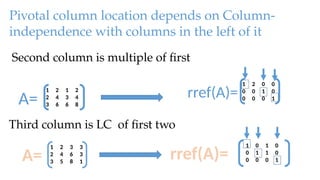
Pivotal column location depends on Column-
independence with columns in the left of it
1 2 1 2
2 4 3 4
3 6 6 8
A=
Second column is multiple of first
Third column is LC of first two
1 2 3 3
2 4 6 3
3 5 8 1
A= rref(A)=
1 0 1 0
0 1 1 0
0 0 0 1
1 2 0 0
0 0 1 0
0 0 0 1
rref(A)=
How to use rref to get basis set for row space and
column space.
Ans:
all nonzero rows of rref(A) form basis set for row space
[a b]=rref(A)
a=reduced matrix
b=array giving index of pivotal columns
Brows=a(1:length(b),:) % Row-space basis set
Bcols=A(:,b) % column-space basis set from columns of A
Note: multiple ways to choose a basis set.
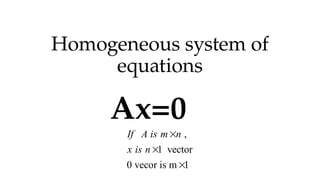
Homogeneous system of
equations
Ax=0
,
1 vector
0 vecor is m 1
If A is m n
x is n



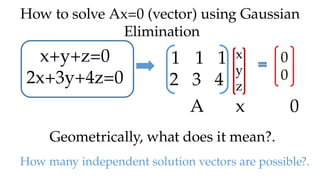
How to solve Ax=0 (vector) using Gaussian
Elimination
Geometrically, what does it mean?.
How many independent solution vectors are possible?.
x+y+z=0
2x+3y+4z=0
1 1 1
2 3 4
x
y
z
0
0
A x 0
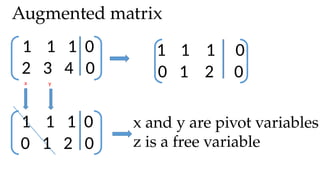
1 1 1 0
2 3 4 0
1 1 1 0
0 1 2 0
1 1 1 0
0 1 2 0
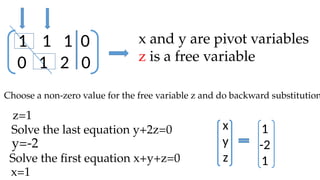
x and y are pivot variables
z is a free variable
Augmented matrix
x y
1 1 1 0
0 1 2 0
x and y are pivot variables
z is a free variable
Choose a non-zero value for the free variable z and do backward substitution
z=1
Solve the last equation y+2z=0
y=-2
Solve the first equation x+y+z=0
x=1
x
y
z
1
-2
1
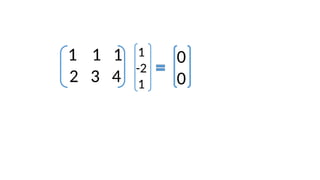
1 1 1
2 3 4
1
-2
1
0
0
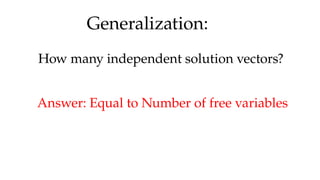
Generalization:
How many independent solution vectors?
Answer: Equal to Number of free variables
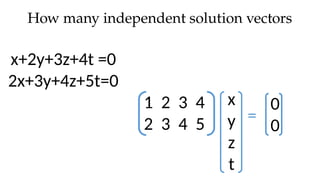
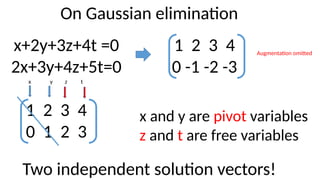
x+2y+3z+4t =0
2x+3y+4z+5t=0
How many independent solution vectors
x
y
z
t
1 2 3 4
2 3 4 5
0
0
=
On Gaussian elimination
x+2y+3z+4t =0
2x+3y+4z+5t=0
1 2 3 4
0 -1 -2 -3
x and y are pivot variables
z and t are free variables
Two independent solution vectors!
1 2 3 4
0 1 2 3
Augmentation omitted
x y z t
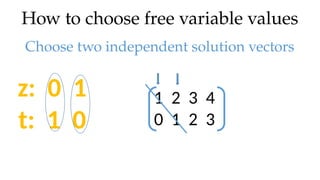
How to choose free variable values
Choose two independent solution vectors
z: 0 1
t: 1 0
1 2 3 4
0 1 2 3
1 2 3 4
0 1 2 3
x
y
z
t
2
-3
0
1
x
y
z
t
1
-2
1
0
z: 0 1
t: 1 0
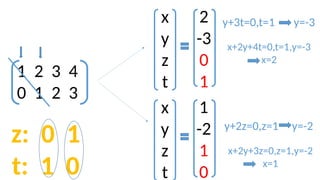
y+3t=0,t=1 y=-3
x+2y+4t=0,t=1,y=-3
x=2
y+2z=0,z=1 y=-2
x+2y+3z=0,z=1,y=-2
x=1
1 2 3 4
2 3 4 5
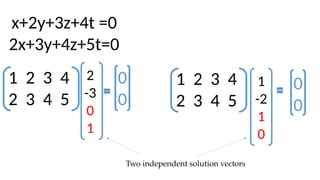
x+2y+3z+4t =0
2x+3y+4z+5t=0
2
-3
0
1
0
0
1 2 3 4
2 3 4 5
1
-2
1
0
0
0
Two independent solution vectors
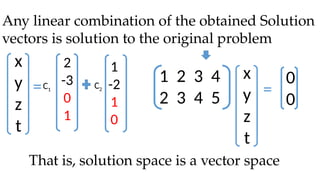
Any linear combination of the obtained Solution
vectors is solution to the original problem
That is, solution space is a vector space
x
y
z
t
1 2 3 4
2 3 4 5
0
0
=
2
-3
0
1
1
-2
1
0
x
y
z
t
=C1 C2
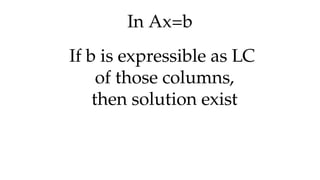
If b is expressible as LC
of those columns,
then solution exist
In Ax=b
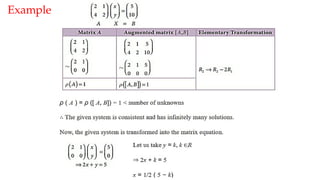
Example
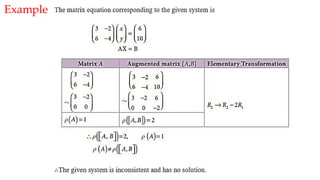
Example
Example
L02_Gaussian Elimination for solving Equations.pptx

L02_Gaussian Elimination for solving Equations.pptx

  • 1.
    Gauss and GaussianElimination for solving system of linear equations
  • 2.
    Gaussian Elimination processthough simple enough that can be taught to even a 7th standard student, hides lots of interesting properties. To unravel the Gaussian process, you need concepts of linear combination, Linear independence and vector space In Linear Algebra
  • 3.
    https://www.youtube.com/watch?v=2j5Ic2V7wq4 Algebra 53 -Elementary Row Operations – YouTube https://www.youtube.com/watch?v=2GKESu5atVQ Gaussian Elimination Videos
  • 9.
    Pivotal column locationdepends on Column- independence with columns in the left of it 1 2 1 2 2 4 3 4 3 6 6 8 A= Second column is multiple of first Third column is LC of first two 1 2 3 3 2 4 6 3 3 5 8 1 A= rref(A)= 1 0 1 0 0 1 1 0 0 0 0 1 1 2 0 0 0 0 1 0 0 0 0 1 rref(A)=
  • 10.
    How to userref to get basis set for row space and column space. Ans: all nonzero rows of rref(A) form basis set for row space [a b]=rref(A) a=reduced matrix b=array giving index of pivotal columns Brows=a(1:length(b),:) % Row-space basis set Bcols=A(:,b) % column-space basis set from columns of A Note: multiple ways to choose a basis set.
  • 11.
    Homogeneous system of equations Ax=0 , 1vector 0 vecor is m 1 If A is m n x is n   
  • 12.
    How to solveAx=0 (vector) using Gaussian Elimination Geometrically, what does it mean?. How many independent solution vectors are possible?. x+y+z=0 2x+3y+4z=0 1 1 1 2 3 4 x y z 0 0 A x 0
  • 13.
    1 1 10 2 3 4 0 1 1 1 0 0 1 2 0 1 1 1 0 0 1 2 0 x and y are pivot variables z is a free variable Augmented matrix x y
  • 14.
    1 1 10 0 1 2 0 x and y are pivot variables z is a free variable Choose a non-zero value for the free variable z and do backward substitution z=1 Solve the last equation y+2z=0 y=-2 Solve the first equation x+y+z=0 x=1 x y z 1 -2 1
  • 15.
    1 1 1 23 4 1 -2 1 0 0
  • 16.
    Generalization: How many independentsolution vectors? Answer: Equal to Number of free variables
  • 17.
    x+2y+3z+4t =0 2x+3y+4z+5t=0 How manyindependent solution vectors x y z t 1 2 3 4 2 3 4 5 0 0 =
  • 18.
    On Gaussian elimination x+2y+3z+4t=0 2x+3y+4z+5t=0 1 2 3 4 0 -1 -2 -3 x and y are pivot variables z and t are free variables Two independent solution vectors! 1 2 3 4 0 1 2 3 Augmentation omitted x y z t
  • 19.
    How to choosefree variable values Choose two independent solution vectors z: 0 1 t: 1 0 1 2 3 4 0 1 2 3
  • 20.
    1 2 34 0 1 2 3 x y z t 2 -3 0 1 x y z t 1 -2 1 0 z: 0 1 t: 1 0 y+3t=0,t=1 y=-3 x+2y+4t=0,t=1,y=-3 x=2 y+2z=0,z=1 y=-2 x+2y+3z=0,z=1,y=-2 x=1
  • 21.
    1 2 34 2 3 4 5 x+2y+3z+4t =0 2x+3y+4z+5t=0 2 -3 0 1 0 0 1 2 3 4 2 3 4 5 1 -2 1 0 0 0 Two independent solution vectors
  • 22.
    Any linear combinationof the obtained Solution vectors is solution to the original problem That is, solution space is a vector space x y z t 1 2 3 4 2 3 4 5 0 0 = 2 -3 0 1 1 -2 1 0 x y z t =C1 C2
  • 23.
    If b isexpressible as LC of those columns, then solution exist In Ax=b
  • 25.
  • 26.
  • 27.