VCS-JNR:
Lessons learned and suggestions
Lucio Pedroni
Baselines and Monitoring:
Experience from Ecuador and Peru
Lucio Pedroni - lpedroni@carbondecisions.com
C A R B O N
D E C I S I O N S
I N T E R N A T I O N A L
South-South Jurisdictional and Nested
REDD+ (JNR) Exchange Workshop
Manaus (Brasil), 13-15 June, 2013®
A consulting firm specialized in the development
of forest carbon assets and forest management.
C A R B O N
D E C I S I O N S
I N T E R N A T I O N A L®
ARR
IFM
REDD+
CDM
CCBS
VCS
JNR
Argentina
Brazil
Colombia
Costa Rica
Ecuador
Ghana
Guatemala
Guyana
Honduras
Indonesia
Madagascar
Mexico
Nicaragua
Peru
Senegal
Tanzania
Indonesia
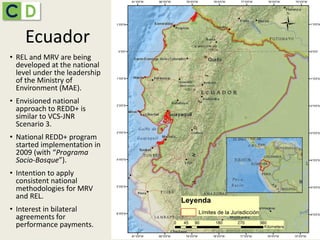
EcuadorEcuador
• REL and MRV are being
developed at the national
level under the leadership
of the Ministry of
Environment (MAE).
• Envisioned national
approach to REDD+ is
similar to VCS-JNR
Scenario 3.
• National REDD+ program
started implementation in
2009 (with “Programa
Socio-Bosque”).
• Intention to apply
consistent national
methodologies for MRV
and REL.
• Interest in bilateral
agreements for
performance payments.
Ecuador
MRV:
• Activity data:
– Three national land cover maps (1990, 2000, 2008): 3
points in time, but 1990 is more than 10 years behind.
– Some areas with clouds and shadows
(“unknown areas” are not categorized as “forest” or
“no-forest” and are excluded form accounting).
– Scope: “deforestation” (REDD+).
– Plan to measure deforestation wall-to-wall every 2nd
year, starting in 2014.
• Carbon stocks:
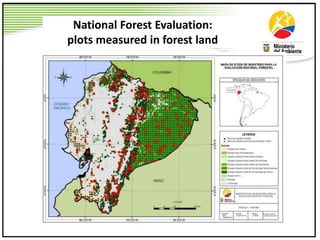
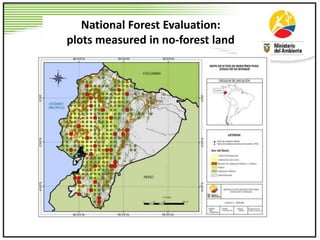
– National inventory almost completed.
National Forest Evaluation:
plots measured in forest land
Paso 4. Creación de un Mapa de Densidades
de Carbono (MDC)
National Forest Evaluation:
plots measured in no-forest land
Ecuador
REL:
• A national methodology based on VCS–JNR (and
VM0015) has been developed and will be submitted
to independent review.
• Scope: only deforestation for the period 2009-2014.
More activities (degradation, enhancement) may be
included in the second period (2015-2020).
• Reference activity data for the period 2009-2014:
– Average area deforested between 2000–2008.
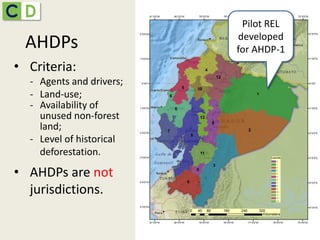
– Calculated separately for 14 AHDPs (“Areas of
Homogeneous Deforestation Processes”).
AHDPs
• Criteria:
- Agents and drivers;
- Land-use;
- Availability of
unused non-forest
land;
- Level of historical
deforestation.
• AHDPs are not
jurisdictions.
Pilot REL
developed
for AHDP-1
REL:
• Projected activity data adjusted according to VCS-JNR
requirements:
– Natural disturbances (> 1,000 ha, return frequency > 10
years).
– Large infrastructure projects (> 1,000 ha)
– Large-scale commercial projects (if > 10% of historical
deforestation projection is not spatially explicit).
• Unplanned deforestation and planned deforestation
(large infrastructure projects) is spatially projected
(30x30 m resolution) using a modeling tool (Dinamica
Ego).
• The national REL is disaggregated at the levels of
Canton, Province and AHD.
Ecuador
REL:
• Emission factors:
– Carbon stock of forests from field measurements (> 600
plots of the National Forest Evaluation).
– Carbon stocks of post-deforestation land uses: default
values from IPCC tables and (very soon) from field
measurements. Calculated as the area-weighted average of
land-uses established on areas deforested between 1990-
2000 (one average value per AHDP).
– Conservative adjustments of the estimated average carbon
stocks to account for uncertainty (according to VCS-JNR
requirements).
– Default carbon stock decrease functions according to VCS-
AFOLU (for carbon pools that are not emitted immediately).
– Default carbon stock increase functions according to
VM0015 (for post-deforestation land uses).
Ecuador
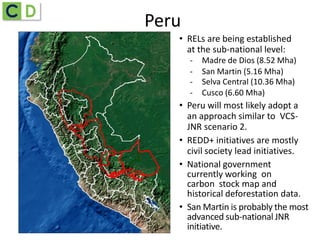
Peru
• RELs are being established
at the sub-national level:
- Madre de Dios (8.52 Mha)
- San Martin (5.16 Mha)
- Selva Central (10.36 Mha)
- Cusco (6.60 Mha)
• Peru will most likely adopt a
an approach similar to VCS-
JNR scenario 2.
• National government
currently working on
carbon stock map and
historical deforestation data.
• REDD+ initiatives are mostly
civil society lead initiatives.
• San Martin is probably the most
advanced sub-national JNR
initiative.
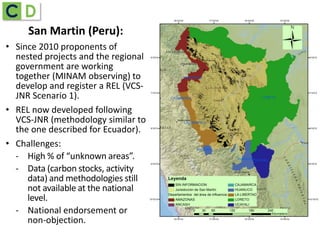
San Martin (Peru):
• Since 2010 proponents of
nested projects and the regional
government are working
together (MINAM observing) to
develop and register a REL (VCS-
JNR Scenario 1).
• REL now developed following
VCS-JNR (methodology similar to
the one described for Ecuador).
• Challenges:
- High % of “unknown areas”.
- Data (carbon stocks, activity
data) and methodologies still
not available at the national
level.
- National endorsement or
non-objection.
Common Challenges
(related to MRV and RELs)
1. Institutional capacities.
2. Slow decision-making at the political level.
3. Choosing a “VCS-JNR Scenario” (1, 2 or 3).
4. Defining and adopting MRV and REL methodologies.
5. Generation of new and/or use of existing information on
carbon stocks and activity data.
6. Complying with many international requirements (IPCC,
UNFCCC, bilateral and multilateral processes and
agreements, VCS-JNR, Safeguards).
7. Demands of the civil society and indigenous organizations.
8. Long-term adoption at the political and institutional levels.
Opportunities
(related to MRV and RELs)
1. Durban´s stepwise approach: start working with
existing data and methodologies, using conservative
approaches (instead of looking for the perfect data
and methodologies and delaying the process).
2. Testing VCS-JNR requirements and adjust the
jurisdictional plans and the VCS-JNR requirements as
needed.
3. Test VCS-JNR requirements in the context of bilateral
and multilateral initiatives in order to align key
international REDD+ players on methodological
approaches and basic rules for JNR.
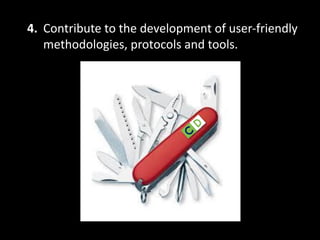
4. Contribute to the development of user-friendly
methodologies, protocols and tools.
CARBON
DECISIONS
INTERNATIONAL
Aligning interests of local people,
governments and investors to protect
and restore tropical forest landscapes
www.carbondecisions.com
Thank you for your attention!
®

L pedroni, ecuador and peru

  • 1.
    VCS-JNR: Lessons learned andsuggestions Lucio Pedroni Baselines and Monitoring: Experience from Ecuador and Peru Lucio Pedroni - lpedroni@carbondecisions.com C A R B O N D E C I S I O N S I N T E R N A T I O N A L South-South Jurisdictional and Nested REDD+ (JNR) Exchange Workshop Manaus (Brasil), 13-15 June, 2013®
  • 2.
    A consulting firmspecialized in the development of forest carbon assets and forest management. C A R B O N D E C I S I O N S I N T E R N A T I O N A L® ARR IFM REDD+ CDM CCBS VCS JNR Argentina Brazil Colombia Costa Rica Ecuador Ghana Guatemala Guyana Honduras Indonesia Madagascar Mexico Nicaragua Peru Senegal Tanzania Indonesia
  • 3.
    EcuadorEcuador • REL andMRV are being developed at the national level under the leadership of the Ministry of Environment (MAE). • Envisioned national approach to REDD+ is similar to VCS-JNR Scenario 3. • National REDD+ program started implementation in 2009 (with “Programa Socio-Bosque”). • Intention to apply consistent national methodologies for MRV and REL. • Interest in bilateral agreements for performance payments.
  • 4.
    Ecuador MRV: • Activity data: –Three national land cover maps (1990, 2000, 2008): 3 points in time, but 1990 is more than 10 years behind. – Some areas with clouds and shadows (“unknown areas” are not categorized as “forest” or “no-forest” and are excluded form accounting). – Scope: “deforestation” (REDD+). – Plan to measure deforestation wall-to-wall every 2nd year, starting in 2014. • Carbon stocks: – National inventory almost completed.
  • 5.
    National Forest Evaluation: plotsmeasured in forest land
  • 6.
    Paso 4. Creaciónde un Mapa de Densidades de Carbono (MDC) National Forest Evaluation: plots measured in no-forest land
  • 7.
    Ecuador REL: • A nationalmethodology based on VCS–JNR (and VM0015) has been developed and will be submitted to independent review. • Scope: only deforestation for the period 2009-2014. More activities (degradation, enhancement) may be included in the second period (2015-2020). • Reference activity data for the period 2009-2014: – Average area deforested between 2000–2008. – Calculated separately for 14 AHDPs (“Areas of Homogeneous Deforestation Processes”).
  • 8.
    AHDPs • Criteria: - Agentsand drivers; - Land-use; - Availability of unused non-forest land; - Level of historical deforestation. • AHDPs are not jurisdictions. Pilot REL developed for AHDP-1
  • 9.
    REL: • Projected activitydata adjusted according to VCS-JNR requirements: – Natural disturbances (> 1,000 ha, return frequency > 10 years). – Large infrastructure projects (> 1,000 ha) – Large-scale commercial projects (if > 10% of historical deforestation projection is not spatially explicit). • Unplanned deforestation and planned deforestation (large infrastructure projects) is spatially projected (30x30 m resolution) using a modeling tool (Dinamica Ego). • The national REL is disaggregated at the levels of Canton, Province and AHD. Ecuador
  • 10.
    REL: • Emission factors: –Carbon stock of forests from field measurements (> 600 plots of the National Forest Evaluation). – Carbon stocks of post-deforestation land uses: default values from IPCC tables and (very soon) from field measurements. Calculated as the area-weighted average of land-uses established on areas deforested between 1990- 2000 (one average value per AHDP). – Conservative adjustments of the estimated average carbon stocks to account for uncertainty (according to VCS-JNR requirements). – Default carbon stock decrease functions according to VCS- AFOLU (for carbon pools that are not emitted immediately). – Default carbon stock increase functions according to VM0015 (for post-deforestation land uses). Ecuador
  • 11.
    Peru • RELs arebeing established at the sub-national level: - Madre de Dios (8.52 Mha) - San Martin (5.16 Mha) - Selva Central (10.36 Mha) - Cusco (6.60 Mha) • Peru will most likely adopt a an approach similar to VCS- JNR scenario 2. • National government currently working on carbon stock map and historical deforestation data. • REDD+ initiatives are mostly civil society lead initiatives. • San Martin is probably the most advanced sub-national JNR initiative.
  • 12.
    San Martin (Peru): •Since 2010 proponents of nested projects and the regional government are working together (MINAM observing) to develop and register a REL (VCS- JNR Scenario 1). • REL now developed following VCS-JNR (methodology similar to the one described for Ecuador). • Challenges: - High % of “unknown areas”. - Data (carbon stocks, activity data) and methodologies still not available at the national level. - National endorsement or non-objection.
  • 13.
    Common Challenges (related toMRV and RELs) 1. Institutional capacities. 2. Slow decision-making at the political level. 3. Choosing a “VCS-JNR Scenario” (1, 2 or 3). 4. Defining and adopting MRV and REL methodologies. 5. Generation of new and/or use of existing information on carbon stocks and activity data. 6. Complying with many international requirements (IPCC, UNFCCC, bilateral and multilateral processes and agreements, VCS-JNR, Safeguards). 7. Demands of the civil society and indigenous organizations. 8. Long-term adoption at the political and institutional levels.
  • 14.
    Opportunities (related to MRVand RELs) 1. Durban´s stepwise approach: start working with existing data and methodologies, using conservative approaches (instead of looking for the perfect data and methodologies and delaying the process). 2. Testing VCS-JNR requirements and adjust the jurisdictional plans and the VCS-JNR requirements as needed. 3. Test VCS-JNR requirements in the context of bilateral and multilateral initiatives in order to align key international REDD+ players on methodological approaches and basic rules for JNR.
  • 15.
    4. Contribute tothe development of user-friendly methodologies, protocols and tools.
  • 16.
    CARBON DECISIONS INTERNATIONAL Aligning interests oflocal people, governments and investors to protect and restore tropical forest landscapes www.carbondecisions.com Thank you for your attention! ®