Zambia’s Forest Reference
Emission Level for the UNFCCC
Presented at the Global Landscape Forum, COP21 on the 5th
November 2015
Deuteronomy Kasaro1
and Abel M. Siampale2
1
Climate Change Secretariat
Ministry of Finance
2
Forestry Department
Ministry of Lands
Presentation Structure
a. REDD+ Requirements
b. Technical Assessment for FREL
c. Scale, Scope and forest definition
d. FREL Components and Construction
e. Construction Approach for FREL
f. Challenges and consideration for Scale and Scope
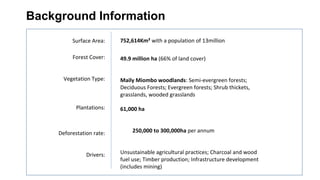
Surface Area:
Forest Cover:
Vegetation Type:
Plantations:
Deforestation rate:
Drivers:
752,614Km² with a population of 13million
49.9 million ha (66% of land cover)
Maily Miombo woodlands: Semi-evergreen forests;
Deciduous Forests; Evergreen forests; Shrub thickets,
grasslands, wooded grasslands
61,000 ha
250,000 to 300,000ha per annum
Unsustainable agricultural practices; Charcoal and wood
fuel use; Timber production; Infrastructure development
(includes mining)
Background Information
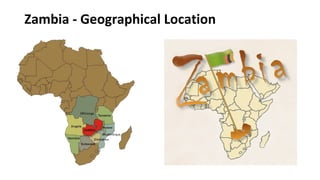
Zambia - Geographical Location
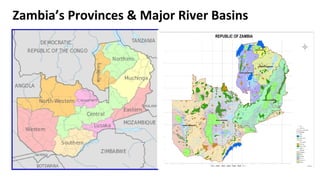
Zambia’s Provinces & Major River Basins
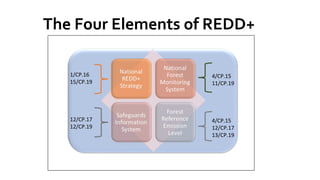
The Four Elements of REDD+
4/CP.15
12/CP.17
13/CP.19
4/CP.15
11/CP.19
1/CP.16
15/CP.19
12/CP.17
12/CP.19
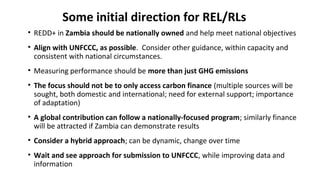
Some initial direction for REL/RLs
• REDD+ in Zambia should be nationally owned and help meet national objectives
• Align with UNFCCC, as possible. Consider other guidance, within capacity and
consistent with national circumstances.
• Measuring performance should be more than just GHG emissions
• The focus should not be to only access carbon finance (multiple sources will be
sought, both domestic and international; need for external support; importance
of adaptation)
• A global contribution can follow a nationally-focused program; similarly finance
will be attracted if Zambia can demonstrate results
• Consider a hybrid approach; can be dynamic, change over time
• Wait and see approach for submission to UNFCCC, while improving data and
information
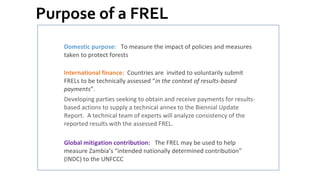
Purpose of a FREL
Domestic purpose: To measure the impact of policies and measures
taken to protect forests
International finance: Countries are invited to voluntarily submit
FRELs to be technically assessed “in the context of results-based
payments”.
Developing parties seeking to obtain and receive payments for results-
based actions to supply a technical annex to the Biennial Update
Report. A technical team of experts will analyze consistency of the
reported results with the assessed FREL.
Global mitigation contribution: The FREL may be used to help
measure Zambia’s “intended nationally determined contribution”
(INDC) to the UNFCCC
Scale, scope and forest definition
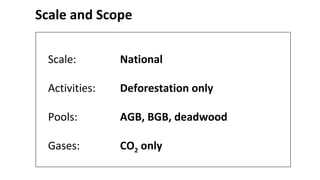
Scale and Scope
Scale: National
Activities: Deforestation only
Pools: AGB, BGB, deadwood
Gases: CO2 only
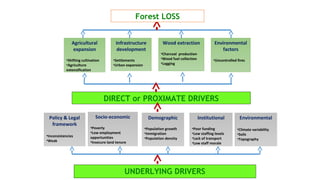
Infrastructure
development
•Settlements
•Urban expansion
Wood extraction
•Charcoal production
•Wood fuel collection
•Logging
Agricultural
expansion
•Shifting cultivation
•Agriculture
extensification
Environmental
factors
•Uncontrolled fires
DIRECT or PROXIMATE DRIVERS
UNDERLYING DRIVERS
Policy & Legal
framework
•Inconsistencies
•Weak
Socio-economic
•Poverty
•Low employment
opportunities
•Insecure land tenure
Demographic
•Population growth
•Immigration
•Population density
Institutional
•Poor funding
•Low staffing levels
•Lack of transport
•Low staff morale
Environmental
•Climate variability
•Soils
•Topography
Forest LOSS
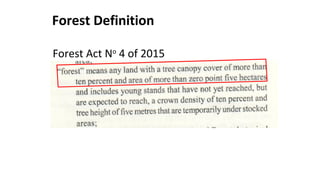
Forest Definition
Forest Act No
4 of 2015
FREL components and construction
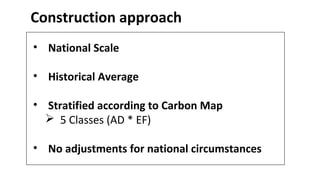
• National Scale
• Historical Average
• Stratified according to Carbon Map
 5 Classes (AD * EF)
• No adjustments for national circumstances
Construction approach
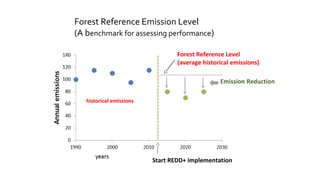
Forest Reference Level
(average historical emissions)
Emission Reduction
historical emissions
Start REDD+ implementation
Forest Reference Emission Level
(A benchmark for assessing performance)
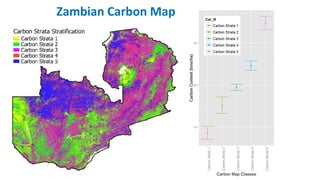
Zambian Carbon Map
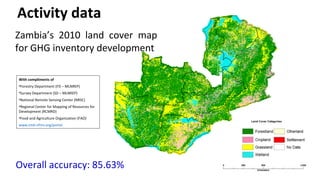
Overall accuracy: 85.63%
Zambia’s 2010 land cover map
for GHG inventory development
Activity data
With compliments of
•Forestry Department (FD – MLNREP)
•Survey Department (SD – MLNREP)
•National Remote Sensing Center (NRSC)
•Regional Center for Mapping of Resources for
Development (RCMRD)
•Food and Agriculture Organization (FAO)
www.zmb-nfms.org/portal
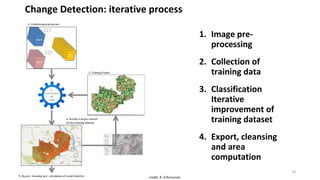
1. Image pre-
processing
2. Collection of
training data
3. Classification
Iterative
improvement of
training dataset
4. Export, cleansing
and area
computation
Change Detection: iterative process
credit: R. d’Annunzio
18
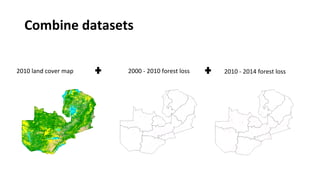
Combine datasets
2010 land cover map 2000 - 2010 forest loss 2010 - 2014 forest loss
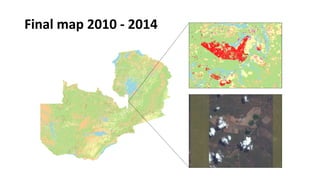
Final map 2010 - 2014
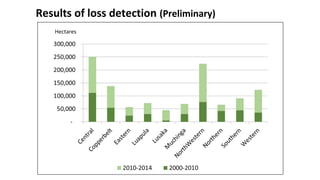
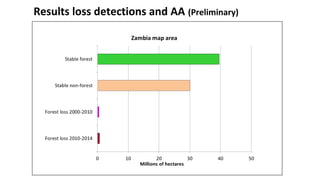
Results of loss detection (Preliminary)
Hectares
Results loss detections and AA (Preliminary)
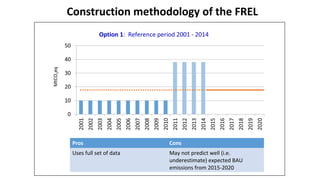
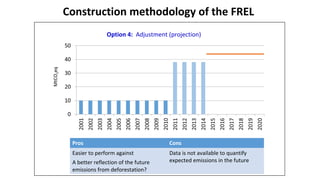
Construction methodology of the FREL
Pros Cons
Uses full set of data May not predict well (i.e.
underestimate) expected BAU
emissions from 2015-2020
Option 1: Reference period 2001 - 2014
MtCO2eq
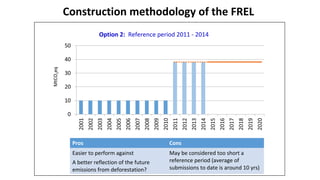
Pros Cons
Easier to perform against
A better reflection of the future
emissions from deforestation?
May be considered too short a
reference period (average of
submissions to date is around 10 yrs)
Option 2: Reference period 2011 - 2014
MtCO2eq
Construction methodology of the FREL
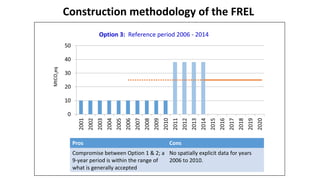
Pros Cons
Compromise between Option 1 & 2; a
9-year period is within the range of
what is generally accepted
No spatially explicit data for years
2006 to 2010.
Option 3: Reference period 2006 - 2014
MtCO2eq
Construction methodology of the FREL
Pros Cons
Easier to perform against
A better reflection of the future
emissions from deforestation?
Data is not available to quantify
expected emissions in the future
MtCO2eq
Option 4: Adjustment (projection)
Construction methodology of the FREL
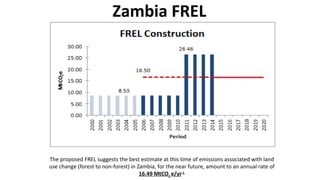
Zambia FREL
The proposed FREL suggests the best estimate at this time of emissions associated with land
use change (forest to non-forest) in Zambia, for the near future, amount to an annual rate of
16.49 MtCO2 e/yr-1
National circumstances
• Energy demand
• New districts
• Infrastructure development
• Mining activities
• Rural to Rural migration
• Policy and Legal Reforms
 Forest Act / Forestry Policy
 Urban and Regional planning Act
Key Challenges to data Needs
• The cost of satellite images (i.e. high res.) to
support a wall to wall approach to cover the
country
• Appropriate technology and methodologies
which are sustainable
• The level of forest loss to be assessed
(deforestation, degradation, fires)
• Varying forest types in the country
Approaches to historical Forest Degradation
• Zambia has not yet addressed this issue
because an appropriate methodology [for dry
forest (Miombo)] has not been identified
Considerations for selecting Scale and Scope
• Capacity to undertake the work and monitor
the change
• The approach for REDD+ Implementation
• Availability of data
• The need to track the changes and
implementation of activities
Way forward
• Proposed future Improvements
 Additional land use assessment – Option 3 (2006)
 Measuring degradation
 Including gain & regrowth
 Additional pools
 Soil Carbon
 Litter
 Including emissions from fire, including non-CO2 gases
(Collaborate with ZEMA)
 National Circumstances
 Monitoring, Assessment, Quantification
Thank you for your attention
www.zmb-nfms.org/portal

Zambia’s forest reference emission level for the unfccc

  • 1.
    Zambia’s Forest Reference EmissionLevel for the UNFCCC Presented at the Global Landscape Forum, COP21 on the 5th November 2015 Deuteronomy Kasaro1 and Abel M. Siampale2 1 Climate Change Secretariat Ministry of Finance 2 Forestry Department Ministry of Lands
  • 2.
    Presentation Structure a. REDD+Requirements b. Technical Assessment for FREL c. Scale, Scope and forest definition d. FREL Components and Construction e. Construction Approach for FREL f. Challenges and consideration for Scale and Scope
  • 3.
    Surface Area: Forest Cover: VegetationType: Plantations: Deforestation rate: Drivers: 752,614Km² with a population of 13million 49.9 million ha (66% of land cover) Maily Miombo woodlands: Semi-evergreen forests; Deciduous Forests; Evergreen forests; Shrub thickets, grasslands, wooded grasslands 61,000 ha 250,000 to 300,000ha per annum Unsustainable agricultural practices; Charcoal and wood fuel use; Timber production; Infrastructure development (includes mining) Background Information
  • 4.
  • 5.
    Zambia’s Provinces &Major River Basins
  • 6.
    The Four Elementsof REDD+ 4/CP.15 12/CP.17 13/CP.19 4/CP.15 11/CP.19 1/CP.16 15/CP.19 12/CP.17 12/CP.19
  • 7.
    Some initial directionfor REL/RLs • REDD+ in Zambia should be nationally owned and help meet national objectives • Align with UNFCCC, as possible. Consider other guidance, within capacity and consistent with national circumstances. • Measuring performance should be more than just GHG emissions • The focus should not be to only access carbon finance (multiple sources will be sought, both domestic and international; need for external support; importance of adaptation) • A global contribution can follow a nationally-focused program; similarly finance will be attracted if Zambia can demonstrate results • Consider a hybrid approach; can be dynamic, change over time • Wait and see approach for submission to UNFCCC, while improving data and information
  • 8.
    Purpose of aFREL Domestic purpose: To measure the impact of policies and measures taken to protect forests International finance: Countries are invited to voluntarily submit FRELs to be technically assessed “in the context of results-based payments”. Developing parties seeking to obtain and receive payments for results- based actions to supply a technical annex to the Biennial Update Report. A technical team of experts will analyze consistency of the reported results with the assessed FREL. Global mitigation contribution: The FREL may be used to help measure Zambia’s “intended nationally determined contribution” (INDC) to the UNFCCC
  • 9.
    Scale, scope andforest definition
  • 10.
    Scale and Scope Scale:National Activities: Deforestation only Pools: AGB, BGB, deadwood Gases: CO2 only
  • 11.
    Infrastructure development •Settlements •Urban expansion Wood extraction •Charcoalproduction •Wood fuel collection •Logging Agricultural expansion •Shifting cultivation •Agriculture extensification Environmental factors •Uncontrolled fires DIRECT or PROXIMATE DRIVERS UNDERLYING DRIVERS Policy & Legal framework •Inconsistencies •Weak Socio-economic •Poverty •Low employment opportunities •Insecure land tenure Demographic •Population growth •Immigration •Population density Institutional •Poor funding •Low staffing levels •Lack of transport •Low staff morale Environmental •Climate variability •Soils •Topography Forest LOSS
  • 12.
  • 13.
    FREL components andconstruction
  • 14.
    • National Scale •Historical Average • Stratified according to Carbon Map  5 Classes (AD * EF) • No adjustments for national circumstances Construction approach
  • 15.
    Forest Reference Level (averagehistorical emissions) Emission Reduction historical emissions Start REDD+ implementation Forest Reference Emission Level (A benchmark for assessing performance)
  • 16.
  • 17.
    Overall accuracy: 85.63% Zambia’s2010 land cover map for GHG inventory development Activity data With compliments of •Forestry Department (FD – MLNREP) •Survey Department (SD – MLNREP) •National Remote Sensing Center (NRSC) •Regional Center for Mapping of Resources for Development (RCMRD) •Food and Agriculture Organization (FAO) www.zmb-nfms.org/portal
  • 18.
    1. Image pre- processing 2.Collection of training data 3. Classification Iterative improvement of training dataset 4. Export, cleansing and area computation Change Detection: iterative process credit: R. d’Annunzio 18
  • 19.
    Combine datasets 2010 landcover map 2000 - 2010 forest loss 2010 - 2014 forest loss
  • 20.
  • 21.
    Results of lossdetection (Preliminary) Hectares
  • 22.
    Results loss detectionsand AA (Preliminary)
  • 23.
    Construction methodology ofthe FREL Pros Cons Uses full set of data May not predict well (i.e. underestimate) expected BAU emissions from 2015-2020 Option 1: Reference period 2001 - 2014 MtCO2eq
  • 24.
    Pros Cons Easier toperform against A better reflection of the future emissions from deforestation? May be considered too short a reference period (average of submissions to date is around 10 yrs) Option 2: Reference period 2011 - 2014 MtCO2eq Construction methodology of the FREL
  • 25.
    Pros Cons Compromise betweenOption 1 & 2; a 9-year period is within the range of what is generally accepted No spatially explicit data for years 2006 to 2010. Option 3: Reference period 2006 - 2014 MtCO2eq Construction methodology of the FREL
  • 26.
    Pros Cons Easier toperform against A better reflection of the future emissions from deforestation? Data is not available to quantify expected emissions in the future MtCO2eq Option 4: Adjustment (projection) Construction methodology of the FREL
  • 27.
    Zambia FREL The proposedFREL suggests the best estimate at this time of emissions associated with land use change (forest to non-forest) in Zambia, for the near future, amount to an annual rate of 16.49 MtCO2 e/yr-1
  • 28.
    National circumstances • Energydemand • New districts • Infrastructure development • Mining activities • Rural to Rural migration • Policy and Legal Reforms  Forest Act / Forestry Policy  Urban and Regional planning Act
  • 29.
    Key Challenges todata Needs • The cost of satellite images (i.e. high res.) to support a wall to wall approach to cover the country • Appropriate technology and methodologies which are sustainable • The level of forest loss to be assessed (deforestation, degradation, fires) • Varying forest types in the country
  • 30.
    Approaches to historicalForest Degradation • Zambia has not yet addressed this issue because an appropriate methodology [for dry forest (Miombo)] has not been identified
  • 31.
    Considerations for selectingScale and Scope • Capacity to undertake the work and monitor the change • The approach for REDD+ Implementation • Availability of data • The need to track the changes and implementation of activities
  • 32.
    Way forward • Proposedfuture Improvements  Additional land use assessment – Option 3 (2006)  Measuring degradation  Including gain & regrowth  Additional pools  Soil Carbon  Litter  Including emissions from fire, including non-CO2 gases (Collaborate with ZEMA)  National Circumstances  Monitoring, Assessment, Quantification
  • 33.
    Thank you foryour attention www.zmb-nfms.org/portal