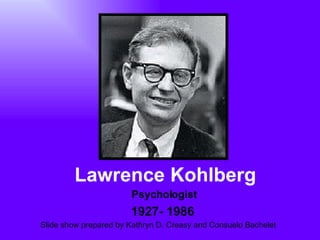
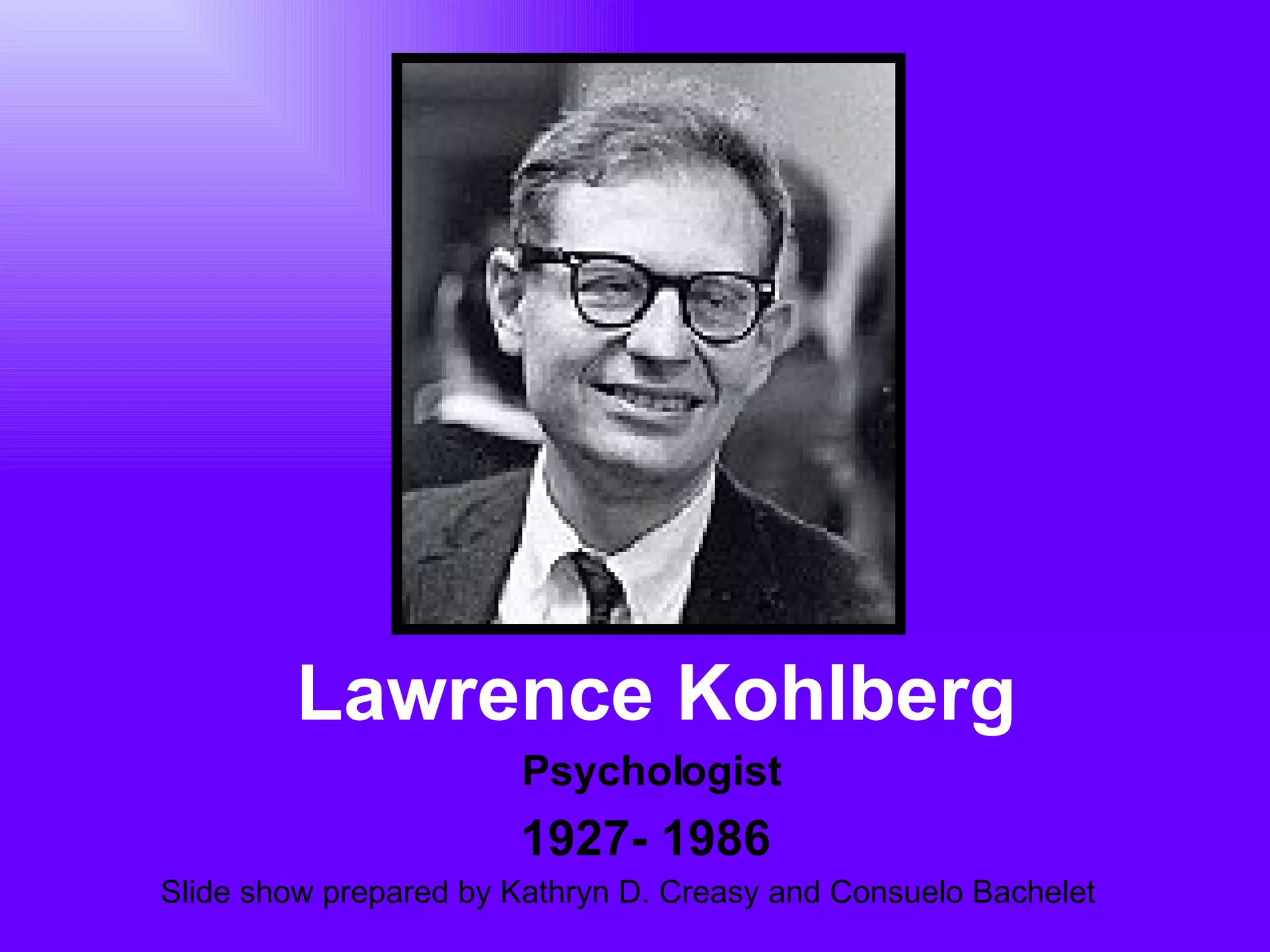
Lawrence Kohlberg 1927- 1986 Psychologist Slide show prepared by Kathryn D. Creasy and Consuelo Bachelet
Biography Born 1927 Grew up in Bronxville, New York. High school at Andover Academy in Massachusetts (private, elite institution) Helped transport refugees  from parts of Europe to Israel. Enrolled at the University of Chicago in 1948. Earned his degree in one year.
Worked in  psychology in Chicago  during his graduate years. Became interested in the work of  Jean Piaget.  Revealed his  stage theory of moral development  for the first time in 1958 . Began his  teaching career  at Harvard in 1968 . He ended his life by drowning at the age of 59
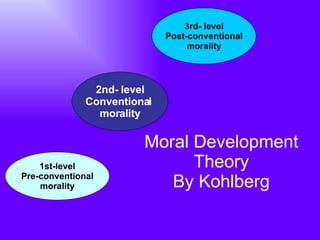
Moral Development Theory By Kohlberg 1st-level Pre-conventional morality 2nd- level Conventional  morality 3rd- level Post-conventional morality
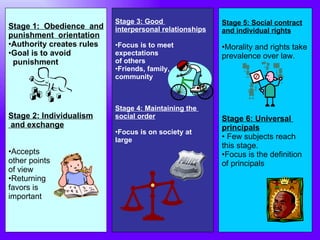
Stage 1:   Obedience  and punishment  orientation Authority creates rules Goal is to avoid  punishment Stage 2: Individualism and exchange Accepts other points of view Returning  favors is important Stage 3: Good  interpersonal relationships Focus is to meet  expectations  of others  Friends, family, community Stage 4: Maintaining the  social order Focus is on society at large Stage 5: Social contract and individual rights Morality and rights take prevalence over law. Stage 6: Universal  principals Few subjects reach  this stage. Focus is the definition of principals
Stages do not unfold as consequence of maturation or socialization.   Stages unfold as individuals think about social experiences. Stages unfold sequentially, but not all subjects reach the highest levels. Key points
Kohlberg’s  Method  Interviewed  children at different stages of age. Presented them with  dilemmas , and asked them give a value judgment and explain.  Then, he asked others for validation. This is called  interrater reliability .
Resources W.C. Crain. (1985).  Theories of Development.  Prentice-Hall  Wenar, C. (1994.)  Developmental Psychopathology:  From Infancy Through  Adolescence (3rd ed.).  McGraw-Hill, Inc

L. Kohlberg (revised)

  • 1.
    Lawrence Kohlberg 1927-1986 Psychologist Slide show prepared by Kathryn D. Creasy and Consuelo Bachelet
  • 2.
    Biography Born 1927Grew up in Bronxville, New York. High school at Andover Academy in Massachusetts (private, elite institution) Helped transport refugees from parts of Europe to Israel. Enrolled at the University of Chicago in 1948. Earned his degree in one year.
  • 3.
    Worked in psychology in Chicago during his graduate years. Became interested in the work of Jean Piaget. Revealed his stage theory of moral development for the first time in 1958 . Began his teaching career at Harvard in 1968 . He ended his life by drowning at the age of 59
  • 4.
    Moral Development TheoryBy Kohlberg 1st-level Pre-conventional morality 2nd- level Conventional morality 3rd- level Post-conventional morality
  • 5.
    Stage 1: Obedience and punishment orientation Authority creates rules Goal is to avoid punishment Stage 2: Individualism and exchange Accepts other points of view Returning favors is important Stage 3: Good interpersonal relationships Focus is to meet expectations of others Friends, family, community Stage 4: Maintaining the social order Focus is on society at large Stage 5: Social contract and individual rights Morality and rights take prevalence over law. Stage 6: Universal principals Few subjects reach this stage. Focus is the definition of principals
  • 6.
    Stages do notunfold as consequence of maturation or socialization. Stages unfold as individuals think about social experiences. Stages unfold sequentially, but not all subjects reach the highest levels. Key points
  • 7.
    Kohlberg’s Method Interviewed children at different stages of age. Presented them with dilemmas , and asked them give a value judgment and explain. Then, he asked others for validation. This is called interrater reliability .
  • 8.
    Resources W.C. Crain.(1985). Theories of Development. Prentice-Hall Wenar, C. (1994.) Developmental Psychopathology: From Infancy Through Adolescence (3rd ed.). McGraw-Hill, Inc