SEMINAR   US–EU Safeguard China update Manufacturer Identification Code–MID New US Customs Regulation  3.Company Investigated by US Customs  By   Vallop   Vitanakorn   Thai Garment Manufacturers Association  November 11, 2005
China Safeguard
 
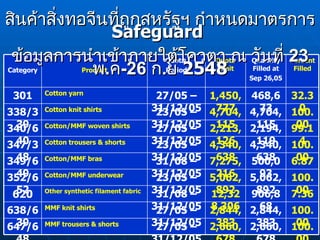
สินค้าสิ่งทอจีนที่ถูกสหรัฐฯ กำหนดมาตรการ  Safeguard  ข้อมูลการนำเข้าภายใต้โควตา ณ วันที่  23   พ . ค - 26   ก . ย  2548 100.00 2,660,678 2,660,678 27/05 – 31/12/05 MMF trousers & shorts 647/648 100.00 2,844,383 2,844,383 27/05 – 31/12/05 MMF knit shirts 638/639 7.36 906,868 12,328,306 31/08 – 31/12/05 Other synthetic filament fabric 620 100.00 5,062,892 5,062,892 23/05 – 31/12/05 Cotton/MMF underwear 352/652 6.87 500,093 7,275,216 31/08 – 31/12/05 Cotton/MMF bras 349/649 100.00 4,340,638 4,340,638 23/05 – 31/12/05 Cotton trousers & shorts 347/348 99.14 2,194,119 2,213,126 27/05 – 31/12/05 Cotton/MMF woven shirts 340/640 100.00 4,704,115 4,704,115 23/05 – 31/12/05 Cotton knit shirts 338/339 32.30 468,673 1,450,777 27/05 – 31/12/05 Cotton yarn 301 Percent Filled Quantity Filled at Sep 26,05 Quota Limit Quota  Period Product Category
Manufacturer Identification  Code –MID New US Customs  Regulation
UPDATE - NEW MANUFACTURER IDENTIFICATION CODE (MID) REQUIREMENTS  FOR TEXTILE AND APPAREL IMPORTS   CBP Delays Enforcement Until November 18 As previously advised, US Customs and Border Protection (CBP) recently published interim amendments to the Customs Regulations relating to the country of origin of textile and apparel products.  These amendments place new obligations on importers of such products that, if not complied with, may result in  rejected entries  and the assessment of  monetary penalties .   In particular, as of October 5, importers must identify the manufacturer whose processes confer country of origin on the article through the Manufacturer Identification Code (MID) required on the entry.  However, CBP has announced a grace period until November 18 for enforcement of this requirement.  During this period, CBP will not reject entries or assess penalties on brokers or importers for submitting incorrect MIDs.  However, for all textile and apparel goods covered under 19 CFR 102.21(b)(5) and entered on or after November 19, CBP will fully enforce the requirements of this new regulation.
The MID should be constructed from the  name and address of the   entity performing the origin-conferring operations .  It is important to note that the operations that confer origin differ depending on the applicable rule of origin for each specific textile or apparel article.  For example, the manufacturer of knit-to-shape apparel is the panel knitter, the manufacturer of bedding is the fabric mill, and the manufacturer of cut and sew garments is the company that wholly assembled the garment or, if multiple manufacturers  are involved (OPA), the manufacturer is the company that performed the most import assembly operations.  However, there are exceptions to these general rules.   Trading companies, agents, sellers other than manufacturers, etc. cannot be used to create the MID for textile or apparel articles.  The MID must be accurately constructed using  the methodology set forth in the new Appendix to Part 102 of the Customs Regulations,  including the use of the correct two-letter International Organization for Standardization (ISO) code for the country of origin.
When a single entry is filed for products of more than one manufacturer, the  products of each manufacturer must be separately identified.   The interim amendments also provide that  importers must be able to demonstrate their use of reasonable care in determining the origin-conferring manufacturer .   If an entry of textile or apparel products fails to include the MID properly constructed from the name and address of the manufacturer, the port director may reject the entry or take other appropriate action (e.g., assessment of a penalty).   It is important to note that the  origin-conferring manufacturer  may not be the same party who actually sells the merchandise to you.  Therefore, you must exercise reasonable care to ensure not only that your MID is constructed properly, but that your customs broker has the correct  "manufacturer"  information. 
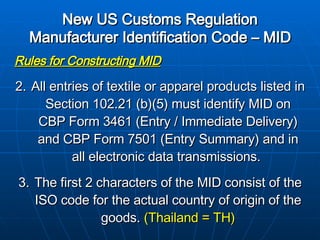
New US Customs Regulation Manufacturer Identification Code – MID   Rules for Constructing MID All entries of textile or apparel products listed in Section 102.21 (b)(5) must identify MID on CBP Form 3461 (Entry / Immediate Delivery) and CBP Form 7501 (Entry Summary) and in all electronic data transmissions.  The first 2 characters of the MID consist of the ISO code for the actual country of origin of the goods.  (Thailand = TH)
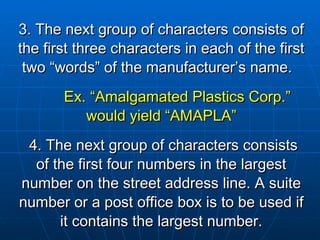
3. The next group of characters consists of the first three characters in each of the first two “words” of the manufacturer’s name.  Ex. “Amalgamated Plastics Corp.” would yield “AMAPLA” 4. The next group of characters consists of the first four numbers in the largest number on the street address line.   A suite number or a post office box is to be used if it contains the largest number.
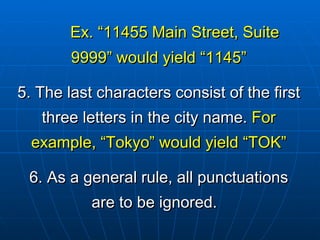
Ex. “11455 Main Street, Suite 9999” would yield “1145” 5.  The last characters consist of the first three letters in the city name.  For example, “Tokyo” would yield “TOK” 6. As a general rule, all punctuations are to be ignored.
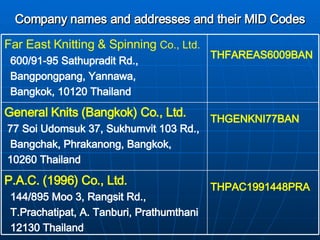
Company names and addresses and their MID Codes THPAC1991448PRA P.A.C. (1996) Co., Ltd.  144/895 Moo 3, Rangsit Rd.,  T.Prachatipat, A. Tanburi, Prathumthani  12130 Thailand THGENKNI77BAN General Knits (Bangkok) Co., Ltd.   77 Soi Udomsuk 37, Sukhumvit 103 Rd.,  Bangchak, Phrakanong, Bangkok,  10260 Thailand THFAREAS6009BAN Far East Knitting & Spinning  Co., Ltd. 600/91-95 Sathupradit Rd.,  Bangpongpang, Yannawa,  Bangkok, 10120 Thailand
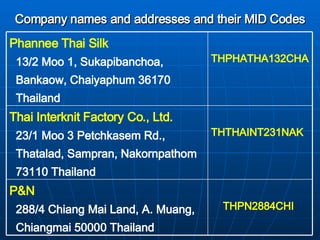
  Company names and addresses and their MID Codes THPN2884CHI P&N   288/4 Chiang Mai Land, A. Muang,  Chiangmai 50000 Thailand THTHAINT231NAK Thai Interknit Factory Co., Ltd.  23/1 Moo 3 Petchkasem Rd.,  Thatalad, Sampran, Nakornpathom  73110 Thailand THPHATHA132CHA Phannee Thai Silk 13/2 Moo 1, Sukapibanchoa,  Bankaow, Chaiyaphum 36170  Thailand
Company Investigated  by  US Customs
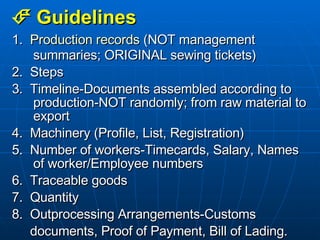
   Guidelines 1.  Production records  (NOT management summaries; ORIGINAL sewing tickets) 2.  Steps 3.  Timeline-Documents assembled according to production-NOT randomly; from raw material to export 4.  Machinery (Profile, List, Registration) 5.  Number of workers-Timecards, Salary, Names of worker/Employee numbers 6.  Traceable goods 7.  Quantity 8.  Outprocessing Arrangements-Customs  documents, Proof of Payment, Bill of Lading.
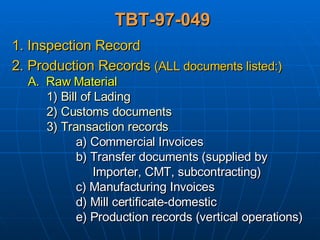
TBT-97-049 1. Inspection Record 2. Production Records  (ALL documents listed:) A.  Raw Material 1) Bill of Lading 2) Customs documents 3) Transaction records a) Commercial Invoices b) Transfer documents (supplied by    Importer, CMT, subcontracting) c) Manufacturing Invoices d) Mill certificate-domestic e) Production records (vertical operations)
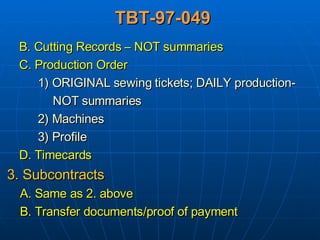
TBT-97-049 B. Cutting Records – NOT summaries C. Production Order 1) ORIGINAL sewing tickets; DAILY production- NOT summaries 2) Machines 3) Profile D. Timecards 3. Subcontracts A. Same as 2. above B. Transfer documents/proof of payment
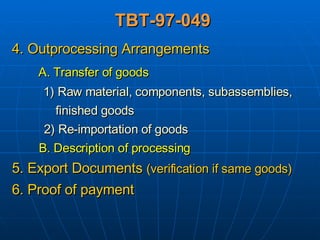
TBT-97-049 4. Outprocessing Arrangements A. Transfer of goods   1) Raw material, components, subassemblies,  finished goods 2) Re-importation of goods B. Description of processing 5. Export Documents  (verification if same goods) 6. Proof of payment
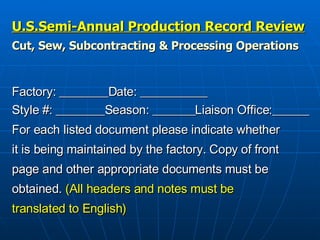
U.S.Semi-Annual Production Record Review Cut, Sew, Subcontracting & Processing Operations Factory: ________Date: ___________ Style #: ________Season: _______Liaison Office:______ For each listed document please indicate whether  it is being maintained by the factory. Copy of front  page and other appropriate documents must be  obtained.  (All headers and notes must be  translated to English)
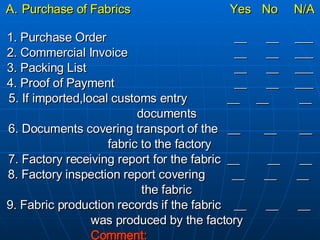
Purchase of Fabrics Yes No N/A 1. Purchase Order  __  __ ___ 2. Commercial Invoice  __  __ ___ 3. Packing List  __  __ ___ 4. Proof of Payment    __  __ ___ 5. If imported,local customs entry  __  __   __ documents 6. Documents covering transport of the  __ __  __ fabric to the factory   7. Factory receiving report for the fabric  __  __  __ 8. Factory inspection report covering __  __  __  the fabric  9. Fabric production records if the fabric  __  __  __  was produced by the factory Comment: _____________
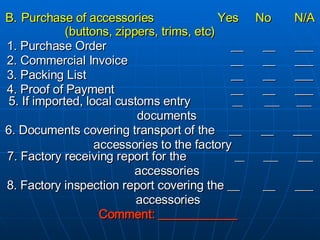
B.   Purchase of accessories    Yes  No  N/A (buttons, zippers, trims, etc) 1. Purchase Order __ __ ___ 2. Commercial Invoice __ __ ___ 3. Packing List   __ __ ___ 4. Proof of Payment   __ __ ___ 5. If imported, local customs entry  __ ___ ___ documents 6. Documents covering transport of the  __ __ ___  accessories to the factory 7. Factory receiving report for the    __  ___  ___ accessories 8. Factory inspection report covering the __ __ ___ accessories Comment: _____________
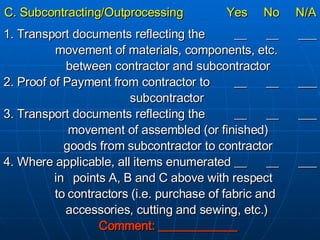
C.   Subcontracting/Outprocessing   Yes  No  N/A 1. Transport documents reflecting the    __   __   ___ movement of materials, components, etc.  between contractor and subcontractor 2. Proof of Payment from contractor to    __   __   ___ subcontractor 3. Transport documents reflecting the    __   __   ___ movement of assembled (or finished) goods from subcontractor to contractor 4. Where applicable, all items enumerated __   __   ___ in  points A, B and C above with respect  to   contractors (i.e. purchase of fabric and  accessories, cutting and sewing, etc.) Comment: _____________
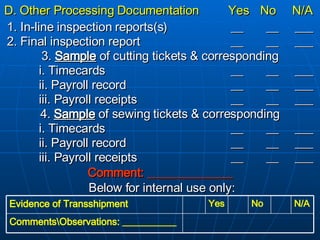
D. Other Processing Documentation Yes No N/A   1. In-line inspection reports(s) __   __ ___ 2. Final inspection report __  __ ___ 3.  Sample  of cutting tickets & corresponding i. Timecards __  __ ___ ii. Payroll record __  __ ___ iii. Payroll receipts __  __ ___ 4.   Sample  of sewing tickets & corresponding i. Timecards __  __ ___ ii. Payroll record __  __ ___ iii. Payroll receipts __  __ ___ Comment:  ______________ Below for internal use only: Comments\Observations: ___________ N/A No Yes Evidence of Transshipment

K.Vallop

  • 1.
    SEMINAR US–EU Safeguard China update Manufacturer Identification Code–MID New US Customs Regulation 3.Company Investigated by US Customs By Vallop Vitanakorn Thai Garment Manufacturers Association November 11, 2005
  • 2.
  • 3.
  • 4.
    สินค้าสิ่งทอจีนที่ถูกสหรัฐฯ กำหนดมาตรการ Safeguard ข้อมูลการนำเข้าภายใต้โควตา ณ วันที่ 23 พ . ค - 26 ก . ย 2548 100.00 2,660,678 2,660,678 27/05 – 31/12/05 MMF trousers & shorts 647/648 100.00 2,844,383 2,844,383 27/05 – 31/12/05 MMF knit shirts 638/639 7.36 906,868 12,328,306 31/08 – 31/12/05 Other synthetic filament fabric 620 100.00 5,062,892 5,062,892 23/05 – 31/12/05 Cotton/MMF underwear 352/652 6.87 500,093 7,275,216 31/08 – 31/12/05 Cotton/MMF bras 349/649 100.00 4,340,638 4,340,638 23/05 – 31/12/05 Cotton trousers & shorts 347/348 99.14 2,194,119 2,213,126 27/05 – 31/12/05 Cotton/MMF woven shirts 340/640 100.00 4,704,115 4,704,115 23/05 – 31/12/05 Cotton knit shirts 338/339 32.30 468,673 1,450,777 27/05 – 31/12/05 Cotton yarn 301 Percent Filled Quantity Filled at Sep 26,05 Quota Limit Quota Period Product Category
  • 5.
    Manufacturer Identification Code –MID New US Customs Regulation
  • 6.
    UPDATE - NEWMANUFACTURER IDENTIFICATION CODE (MID) REQUIREMENTS FOR TEXTILE AND APPAREL IMPORTS CBP Delays Enforcement Until November 18 As previously advised, US Customs and Border Protection (CBP) recently published interim amendments to the Customs Regulations relating to the country of origin of textile and apparel products.  These amendments place new obligations on importers of such products that, if not complied with, may result in rejected entries and the assessment of monetary penalties .   In particular, as of October 5, importers must identify the manufacturer whose processes confer country of origin on the article through the Manufacturer Identification Code (MID) required on the entry.  However, CBP has announced a grace period until November 18 for enforcement of this requirement.  During this period, CBP will not reject entries or assess penalties on brokers or importers for submitting incorrect MIDs.  However, for all textile and apparel goods covered under 19 CFR 102.21(b)(5) and entered on or after November 19, CBP will fully enforce the requirements of this new regulation.
  • 7.
    The MID shouldbe constructed from the name and address of the entity performing the origin-conferring operations . It is important to note that the operations that confer origin differ depending on the applicable rule of origin for each specific textile or apparel article.  For example, the manufacturer of knit-to-shape apparel is the panel knitter, the manufacturer of bedding is the fabric mill, and the manufacturer of cut and sew garments is the company that wholly assembled the garment or, if multiple manufacturers  are involved (OPA), the manufacturer is the company that performed the most import assembly operations.  However, there are exceptions to these general rules. Trading companies, agents, sellers other than manufacturers, etc. cannot be used to create the MID for textile or apparel articles. The MID must be accurately constructed using the methodology set forth in the new Appendix to Part 102 of the Customs Regulations, including the use of the correct two-letter International Organization for Standardization (ISO) code for the country of origin.
  • 8.
    When a singleentry is filed for products of more than one manufacturer, the products of each manufacturer must be separately identified. The interim amendments also provide that importers must be able to demonstrate their use of reasonable care in determining the origin-conferring manufacturer .   If an entry of textile or apparel products fails to include the MID properly constructed from the name and address of the manufacturer, the port director may reject the entry or take other appropriate action (e.g., assessment of a penalty).  It is important to note that the origin-conferring manufacturer may not be the same party who actually sells the merchandise to you. Therefore, you must exercise reasonable care to ensure not only that your MID is constructed properly, but that your customs broker has the correct "manufacturer" information. 
  • 9.
    New US CustomsRegulation Manufacturer Identification Code – MID Rules for Constructing MID All entries of textile or apparel products listed in Section 102.21 (b)(5) must identify MID on CBP Form 3461 (Entry / Immediate Delivery) and CBP Form 7501 (Entry Summary) and in all electronic data transmissions. The first 2 characters of the MID consist of the ISO code for the actual country of origin of the goods. (Thailand = TH)
  • 10.
    3. The nextgroup of characters consists of the first three characters in each of the first two “words” of the manufacturer’s name. Ex. “Amalgamated Plastics Corp.” would yield “AMAPLA” 4. The next group of characters consists of the first four numbers in the largest number on the street address line. A suite number or a post office box is to be used if it contains the largest number.
  • 11.
    Ex. “11455 MainStreet, Suite 9999” would yield “1145” 5. The last characters consist of the first three letters in the city name. For example, “Tokyo” would yield “TOK” 6. As a general rule, all punctuations are to be ignored.
  • 12.
    Company names andaddresses and their MID Codes THPAC1991448PRA P.A.C. (1996) Co., Ltd. 144/895 Moo 3, Rangsit Rd., T.Prachatipat, A. Tanburi, Prathumthani 12130 Thailand THGENKNI77BAN General Knits (Bangkok) Co., Ltd. 77 Soi Udomsuk 37, Sukhumvit 103 Rd., Bangchak, Phrakanong, Bangkok, 10260 Thailand THFAREAS6009BAN Far East Knitting & Spinning Co., Ltd. 600/91-95 Sathupradit Rd., Bangpongpang, Yannawa, Bangkok, 10120 Thailand
  • 13.
    Companynames and addresses and their MID Codes THPN2884CHI P&N 288/4 Chiang Mai Land, A. Muang, Chiangmai 50000 Thailand THTHAINT231NAK Thai Interknit Factory Co., Ltd. 23/1 Moo 3 Petchkasem Rd., Thatalad, Sampran, Nakornpathom 73110 Thailand THPHATHA132CHA Phannee Thai Silk 13/2 Moo 1, Sukapibanchoa, Bankaow, Chaiyaphum 36170 Thailand
  • 14.
    Company Investigated by US Customs
  • 15.
    Guidelines 1. Production records (NOT management summaries; ORIGINAL sewing tickets) 2. Steps 3. Timeline-Documents assembled according to production-NOT randomly; from raw material to export 4. Machinery (Profile, List, Registration) 5. Number of workers-Timecards, Salary, Names of worker/Employee numbers 6. Traceable goods 7. Quantity 8. Outprocessing Arrangements-Customs documents, Proof of Payment, Bill of Lading.
  • 16.
    TBT-97-049 1. InspectionRecord 2. Production Records (ALL documents listed:) A. Raw Material 1) Bill of Lading 2) Customs documents 3) Transaction records a) Commercial Invoices b) Transfer documents (supplied by Importer, CMT, subcontracting) c) Manufacturing Invoices d) Mill certificate-domestic e) Production records (vertical operations)
  • 17.
    TBT-97-049 B. CuttingRecords – NOT summaries C. Production Order 1) ORIGINAL sewing tickets; DAILY production- NOT summaries 2) Machines 3) Profile D. Timecards 3. Subcontracts A. Same as 2. above B. Transfer documents/proof of payment
  • 18.
    TBT-97-049 4. OutprocessingArrangements A. Transfer of goods 1) Raw material, components, subassemblies, finished goods 2) Re-importation of goods B. Description of processing 5. Export Documents (verification if same goods) 6. Proof of payment
  • 19.
    U.S.Semi-Annual Production RecordReview Cut, Sew, Subcontracting & Processing Operations Factory: ________Date: ___________ Style #: ________Season: _______Liaison Office:______ For each listed document please indicate whether it is being maintained by the factory. Copy of front page and other appropriate documents must be obtained. (All headers and notes must be translated to English)
  • 20.
    Purchase of FabricsYes No N/A 1. Purchase Order __ __ ___ 2. Commercial Invoice __ __ ___ 3. Packing List __ __ ___ 4. Proof of Payment __ __ ___ 5. If imported,local customs entry __ __ __ documents 6. Documents covering transport of the __ __ __ fabric to the factory 7. Factory receiving report for the fabric __ __ __ 8. Factory inspection report covering __ __ __ the fabric 9. Fabric production records if the fabric __ __ __ was produced by the factory Comment: _____________
  • 21.
    B. Purchase of accessories Yes No N/A (buttons, zippers, trims, etc) 1. Purchase Order __ __ ___ 2. Commercial Invoice __ __ ___ 3. Packing List __ __ ___ 4. Proof of Payment __ __ ___ 5. If imported, local customs entry __ ___ ___ documents 6. Documents covering transport of the __ __ ___ accessories to the factory 7. Factory receiving report for the __ ___ ___ accessories 8. Factory inspection report covering the __ __ ___ accessories Comment: _____________
  • 22.
    C. Subcontracting/Outprocessing Yes No N/A 1. Transport documents reflecting the __ __ ___ movement of materials, components, etc. between contractor and subcontractor 2. Proof of Payment from contractor to __ __ ___ subcontractor 3. Transport documents reflecting the __ __ ___ movement of assembled (or finished) goods from subcontractor to contractor 4. Where applicable, all items enumerated __ __ ___ in points A, B and C above with respect to contractors (i.e. purchase of fabric and accessories, cutting and sewing, etc.) Comment: _____________
  • 23.
    D. Other ProcessingDocumentation Yes No N/A 1. In-line inspection reports(s) __ __ ___ 2. Final inspection report __ __ ___ 3. Sample of cutting tickets & corresponding i. Timecards __ __ ___ ii. Payroll record __ __ ___ iii. Payroll receipts __ __ ___ 4. Sample of sewing tickets & corresponding i. Timecards __ __ ___ ii. Payroll record __ __ ___ iii. Payroll receipts __ __ ___ Comment: ______________ Below for internal use only: Comments\Observations: ___________ N/A No Yes Evidence of Transshipment