.
.
.
.
.
.
.
.
.
.
.
.
.
.
.
.
.
.
.
.
.
.
.
.
.
.
.
.
.
.
.
.
.
.
.
.
.
.
.
.
Introduction Literature Review Materials and Methods
Hydrography Surveying: Seafloor Mapping
Introduction
Ketut Tomy Suhari, ST., MT.
Department of Geodesy Engineering
Institut Teknologi Nasional Malang
2021 年 9 月 30 日
Ketut Tomy Suhari, ST., MT. Department of Geodesy Engineering, FTSP, ITN
Hydrography Surveying: Seafloor Mapping 1 / 79
.
.
.
.
.
.
.
.
.
.
.
.
.
.
.
.
.
.
.
.
.
.
.
.
.
.
.
.
.
.
.
.
.
.
.
.
.
.
.
.
Introduction Literature Review Materials and Methods
“DI LAUT TERSIMPAN HARAPAN,
DI LAUT TERSIMPAN KEJAYAAN,
JALESVEVA JAYAMAHE”
Ketut Tomy Suhari, ST., MT. Department of Geodesy Engineering, FTSP, ITN
Hydrography Surveying: Seafloor Mapping 2 / 79
.
.
.
.
.
.
.
.
.
.
.
.
.
.
.
.
.
.
.
.
.
.
.
.
.
.
.
.
.
.
.
.
.
.
.
.
.
.
.
.
Introduction Literature Review Materials and Methods
1 Introduction
2 Literature Review
3 Materials and Methods
Ketut Tomy Suhari, ST., MT. Department of Geodesy Engineering, FTSP, ITN
Hydrography Surveying: Seafloor Mapping 3 / 79
.
.
.
.
.
.
.
.
.
.
.
.
.
.
.
.
.
.
.
.
.
.
.
.
.
.
.
.
.
.
.
.
.
.
.
.
.
.
.
.
Introduction Literature Review Materials and Methods
1 Introduction
Definition
Principal Components
Hydrographic Sciences
Benefits
2 Literature Review
3 Materials and Methods
Ketut Tomy Suhari, ST., MT. Department of Geodesy Engineering, FTSP, ITN
Hydrography Surveying: Seafloor Mapping 4 / 79
.
.
.
.
.
.
.
.
.
.
.
.
.
.
.
.
.
.
.
.
.
.
.
.
.
.
.
.
.
.
.
.
.
.
.
.
.
.
.
.
Introduction Literature Review Materials and Methods
1 Introduction
Definition
Principal Components
Hydrographic Sciences
Benefits
2 Literature Review
3 Materials and Methods
Ketut Tomy Suhari, ST., MT. Department of Geodesy Engineering, FTSP, ITN
Hydrography Surveying: Seafloor Mapping 5 / 79
.
.
.
.
.
.
.
.
.
.
.
.
.
.
.
.
.
.
.
.
.
.
.
.
.
.
.
.
.
.
.
.
.
.
.
.
.
.
.
.
Introduction Literature Review Materials and Methods
Definition
• Hydrography means water mapping. That’s quite a broad
definition and in fact has different meanings depending on the
scientific discipline to which it refers. Oceanographers use the
term to describe and map the physical characteristics of water
such as temperature, salinity, and chemical content.
Ketut Tomy Suhari, ST., MT. Department of Geodesy Engineering, FTSP, ITN
Hydrography Surveying: Seafloor Mapping 6 / 79
.
.
.
.
.
.
.
.
.
.
.
.
.
.
.
.
.
.
.
.
.
.
.
.
.
.
.
.
.
.
.
.
.
.
.
.
.
.
.
.
Introduction Literature Review Materials and Methods
Definition
• Hydrography means water mapping. That’s quite a broad
definition and in fact has different meanings depending on the
scientific discipline to which it refers. Oceanographers use the
term to describe and map the physical characteristics of water
such as temperature, salinity, and chemical content.
• Geographers and geologists use hydrography to define the
water surface in the U.S. and the direction and volume of
water flow between water bodies. Hydrography, as used in
nautical charting, is focused on identifying hazards to safe
navigation which includes shallow depths, shipwrecks, rocks,
or other dangerous objects. The International Hydrographic
Organization defines hydrography as follows:
Ketut Tomy Suhari, ST., MT. Department of Geodesy Engineering, FTSP, ITN
Hydrography Surveying: Seafloor Mapping 6 / 79
.
.
.
.
.
.
.
.
.
.
.
.
.
.
.
.
.
.
.
.
.
.
.
.
.
.
.
.
.
.
.
.
.
.
.
.
.
.
.
.
Introduction Literature Review Materials and Methods
Definition
• Hydrography is the branch of applied science which deals with
the measurement and description of the physical features of
oceans, seas, coastal areas, lakes and rivers, as well as with
the prediction of their change over time, for the primary
purpose of safety of navigation and in support of all other
marine activities, including economic development, security
and defense, scientific research, and environmental protection.
Ketut Tomy Suhari, ST., MT. Department of Geodesy Engineering, FTSP, ITN
Hydrography Surveying: Seafloor Mapping 7 / 79
.
.
.
.
.
.
.
.
.
.
.
.
.
.
.
.
.
.
.
.
.
.
.
.
.
.
.
.
.
.
.
.
.
.
.
.
.
.
.
.
Introduction Literature Review Materials and Methods
Definition
• Hydrography is the branch of applied science which deals with
the measurement and description of the physical features of
oceans, seas, coastal areas, lakes and rivers, as well as with
the prediction of their change over time, for the primary
purpose of safety of navigation and in support of all other
marine activities, including economic development, security
and defense, scientific research, and environmental protection.
• The key here is the emphasis on safe navigation and features
related to that endeavor.
Ketut Tomy Suhari, ST., MT. Department of Geodesy Engineering, FTSP, ITN
Hydrography Surveying: Seafloor Mapping 7 / 79
.
.
.
.
.
.
.
.
.
.
.
.
.
.
.
.
.
.
.
.
.
.
.
.
.
.
.
.
.
.
.
.
.
.
.
.
.
.
.
.
Introduction Literature Review Materials and Methods
1 Introduction
Definition
Principal Components
Hydrographic Sciences
Benefits
2 Literature Review
3 Materials and Methods
Ketut Tomy Suhari, ST., MT. Department of Geodesy Engineering, FTSP, ITN
Hydrography Surveying: Seafloor Mapping 8 / 79
.
.
.
.
.
.
.
.
.
.
.
.
.
.
.
.
.
.
.
.
.
.
.
.
.
.
.
.
.
.
.
.
.
.
.
.
.
.
.
.
Introduction Literature Review Materials and Methods
Ketut Tomy Suhari, ST., MT. Department of Geodesy Engineering, FTSP, ITN
Hydrography Surveying: Seafloor Mapping 9 / 79
.
.
.
.
.
.
.
.
.
.
.
.
.
.
.
.
.
.
.
.
.
.
.
.
.
.
.
.
.
.
.
.
.
.
.
.
.
.
.
.
Introduction Literature Review Materials and Methods
Principal Components
The end result of a hydrographic survey is a nautical chart: a map
that shows the seafloor and other features related to navigation.
Thus every hydrographic survey has four major components.
• Positioning. This refers to the location of the survey data
with respect to latitude and longitude.
• Water depth, measured from a vertical reference surface or
datum, such as mean lower low water, to the seafloor.
• Features, sometimes referred to as targets, which may be
hazards to navigation. These include wrecks, shoals, reefs,
and other features.
• Seafloor characteristics. This refers primarily to the bottom
type (for example, mud, sand, bedrock, coral reef). Mariners
want to know seafloor characteristics to determine good
anchorages or the danger in running aground.
Ketut Tomy Suhari, ST., MT. Department of Geodesy Engineering, FTSP, ITN
Hydrography Surveying: Seafloor Mapping 10 / 79
.
.
.
.
.
.
.
.
.
.
.
.
.
.
.
.
.
.
.
.
.
.
.
.
.
.
.
.
.
.
.
.
.
.
.
.
.
.
.
.
Introduction Literature Review Materials and Methods
1 Introduction
Definition
Principal Components
Hydrographic Sciences
Benefits
2 Literature Review
3 Materials and Methods
Ketut Tomy Suhari, ST., MT. Department of Geodesy Engineering, FTSP, ITN
Hydrography Surveying: Seafloor Mapping 11 / 79
.
.
.
.
.
.
.
.
.
.
.
.
.
.
.
.
.
.
.
.
.
.
.
.
.
.
.
.
.
.
.
.
.
.
.
.
.
.
.
.
Introduction Literature Review Materials and Methods
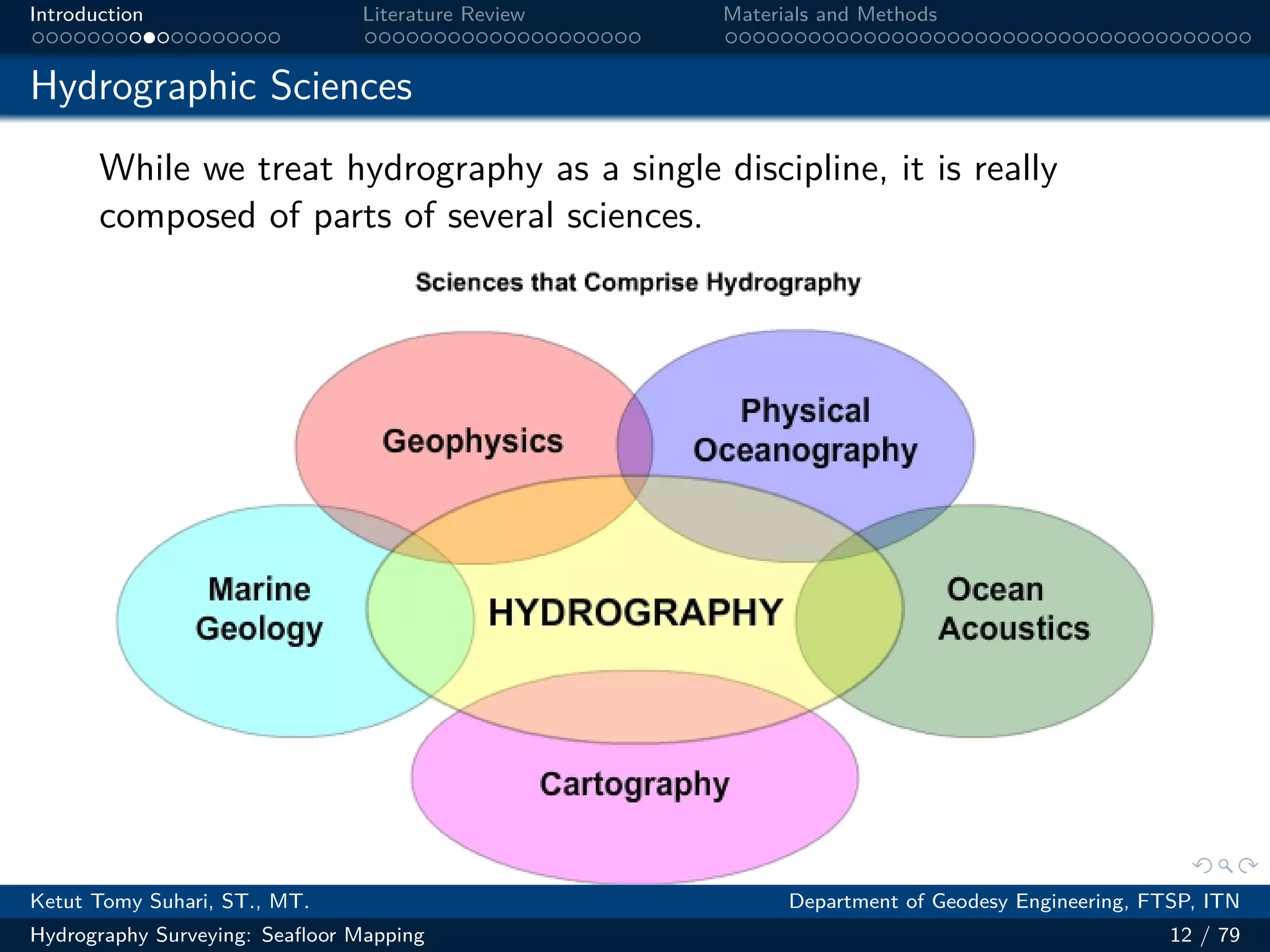
Hydrographic Sciences
While we treat hydrography as a single discipline, it is really
composed of parts of several sciences.
Ketut Tomy Suhari, ST., MT. Department of Geodesy Engineering, FTSP, ITN
Hydrography Surveying: Seafloor Mapping 12 / 79
.
.
.
.
.
.
.
.
.
.
.
.
.
.
.
.
.
.
.
.
.
.
.
.
.
.
.
.
.
.
.
.
.
.
.
.
.
.
.
.
Introduction Literature Review Materials and Methods
Hydrographic Sciences
Hydrographers use physical oceanography to characterize the
properties of the water column, which directly impact ocean
acoustics, and to analyze the tidal characteristics of the survey
area. Most modern surveys use acoustic soundings to determine
the water depth, so a successful survey requires a solid
understanding of acoustics. Marine geology is useful in
characterizing the seafloor. Determination of the geoid and other
vertical reference levels requires geophysical data, primarily gravity.
Gathering the data together and producing a nautical chart
depends on sound cartography.
Thus, hydrography is really a multi-disciplinary science drawing on
many fields to gather and process data.
Ketut Tomy Suhari, ST., MT. Department of Geodesy Engineering, FTSP, ITN
Hydrography Surveying: Seafloor Mapping 13 / 79
.
.
.
.
.
.
.
.
.
.
.
.
.
.
.
.
.
.
.
.
.
.
.
.
.
.
.
.
.
.
.
.
.
.
.
.
.
.
.
.
Introduction Literature Review Materials and Methods
1 Introduction
Definition
Principal Components
Hydrographic Sciences
Benefits
2 Literature Review
3 Materials and Methods
Ketut Tomy Suhari, ST., MT. Department of Geodesy Engineering, FTSP, ITN
Hydrography Surveying: Seafloor Mapping 14 / 79
.
.
.
.
.
.
.
.
.
.
.
.
.
.
.
.
.
.
.
.
.
.
.
.
.
.
.
.
.
.
.
.
.
.
.
.
.
.
.
.
Introduction Literature Review Materials and Methods
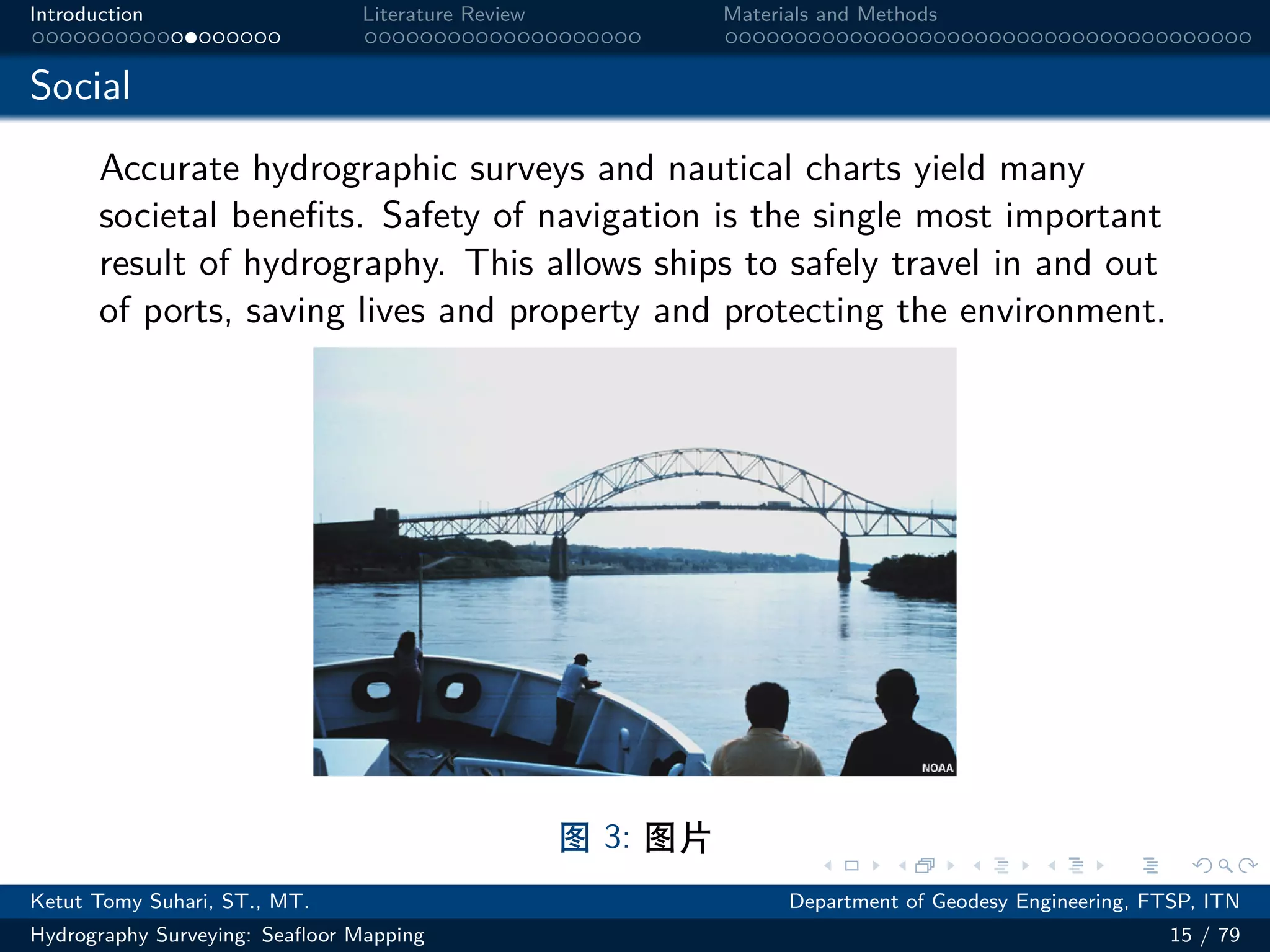
Social
Accurate hydrographic surveys and nautical charts yield many
societal benefits. Safety of navigation is the single most important
result of hydrography. This allows ships to safely travel in and out
of ports, saving lives and property and protecting the environment.
图 3: 图片
Ketut Tomy Suhari, ST., MT. Department of Geodesy Engineering, FTSP, ITN
Hydrography Surveying: Seafloor Mapping 15 / 79
.
.
.
.
.
.
.
.
.
.
.
.
.
.
.
.
.
.
.
.
.
.
.
.
.
.
.
.
.
.
.
.
.
.
.
.
.
.
.
.
Introduction Literature Review Materials and Methods
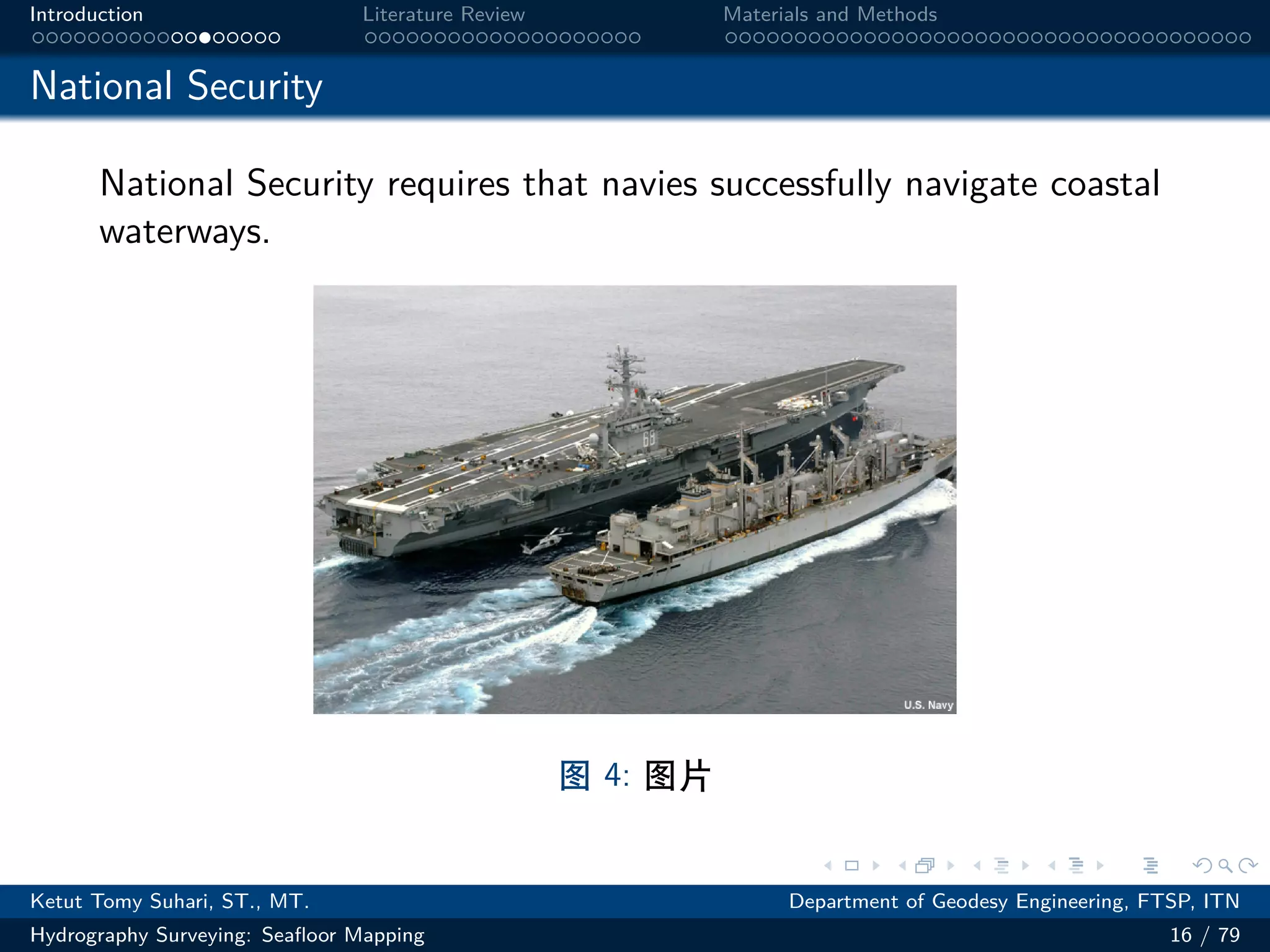
National Security
National Security requires that navies successfully navigate coastal
waterways.
图 4: 图片
Ketut Tomy Suhari, ST., MT. Department of Geodesy Engineering, FTSP, ITN
Hydrography Surveying: Seafloor Mapping 16 / 79
.
.
.
.
.
.
.
.
.
.
.
.
.
.
.
.
.
.
.
.
.
.
.
.
.
.
.
.
.
.
.
.
.
.
.
.
.
.
.
.
Introduction Literature Review Materials and Methods
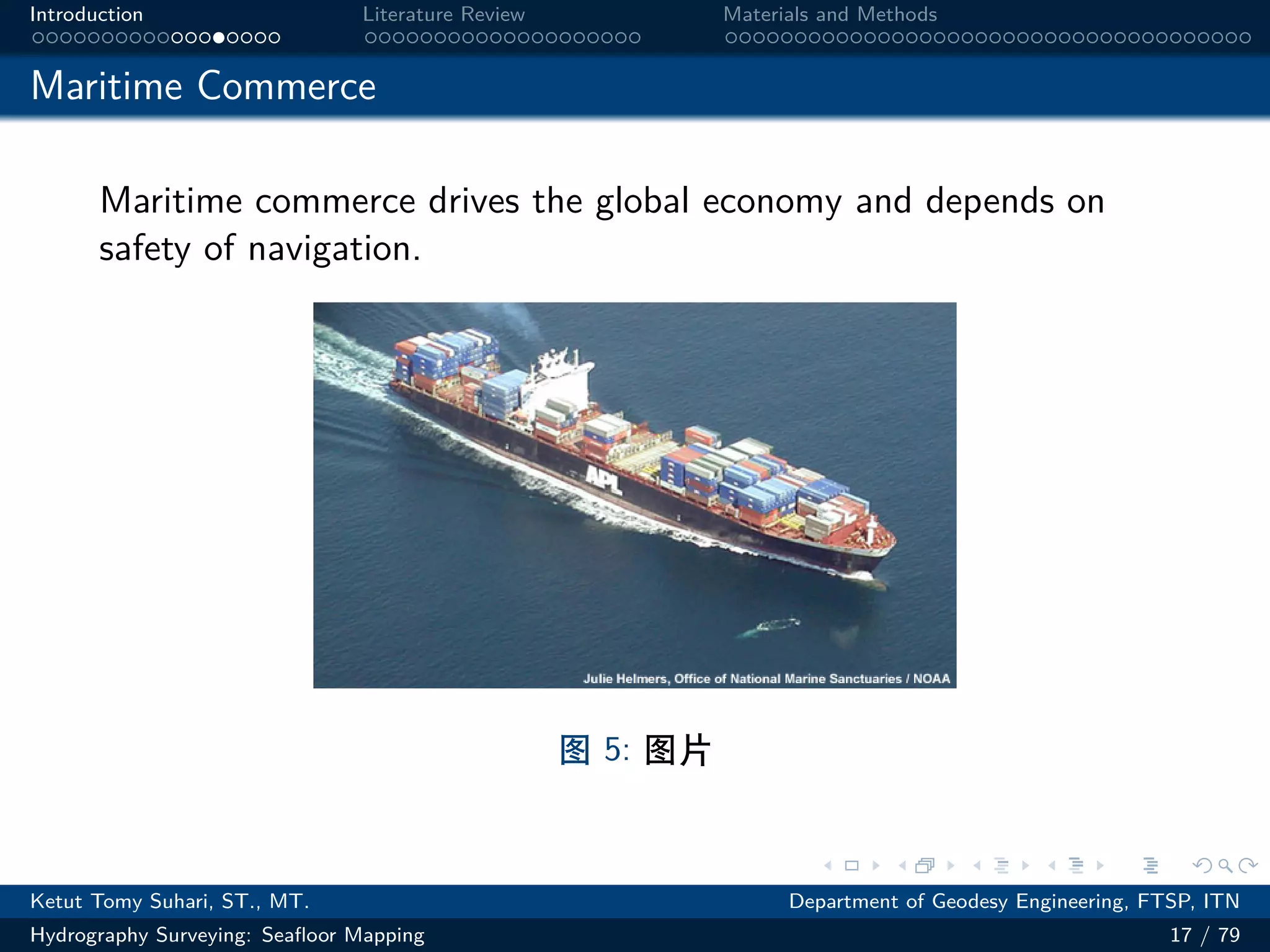
Maritime Commerce
Maritime commerce drives the global economy and depends on
safety of navigation.
图 5: 图片
Ketut Tomy Suhari, ST., MT. Department of Geodesy Engineering, FTSP, ITN
Hydrography Surveying: Seafloor Mapping 17 / 79
.
.
.
.
.
.
.
.
.
.
.
.
.
.
.
.
.
.
.
.
.
.
.
.
.
.
.
.
.
.
.
.
.
.
.
.
.
.
.
.
Introduction Literature Review Materials and Methods
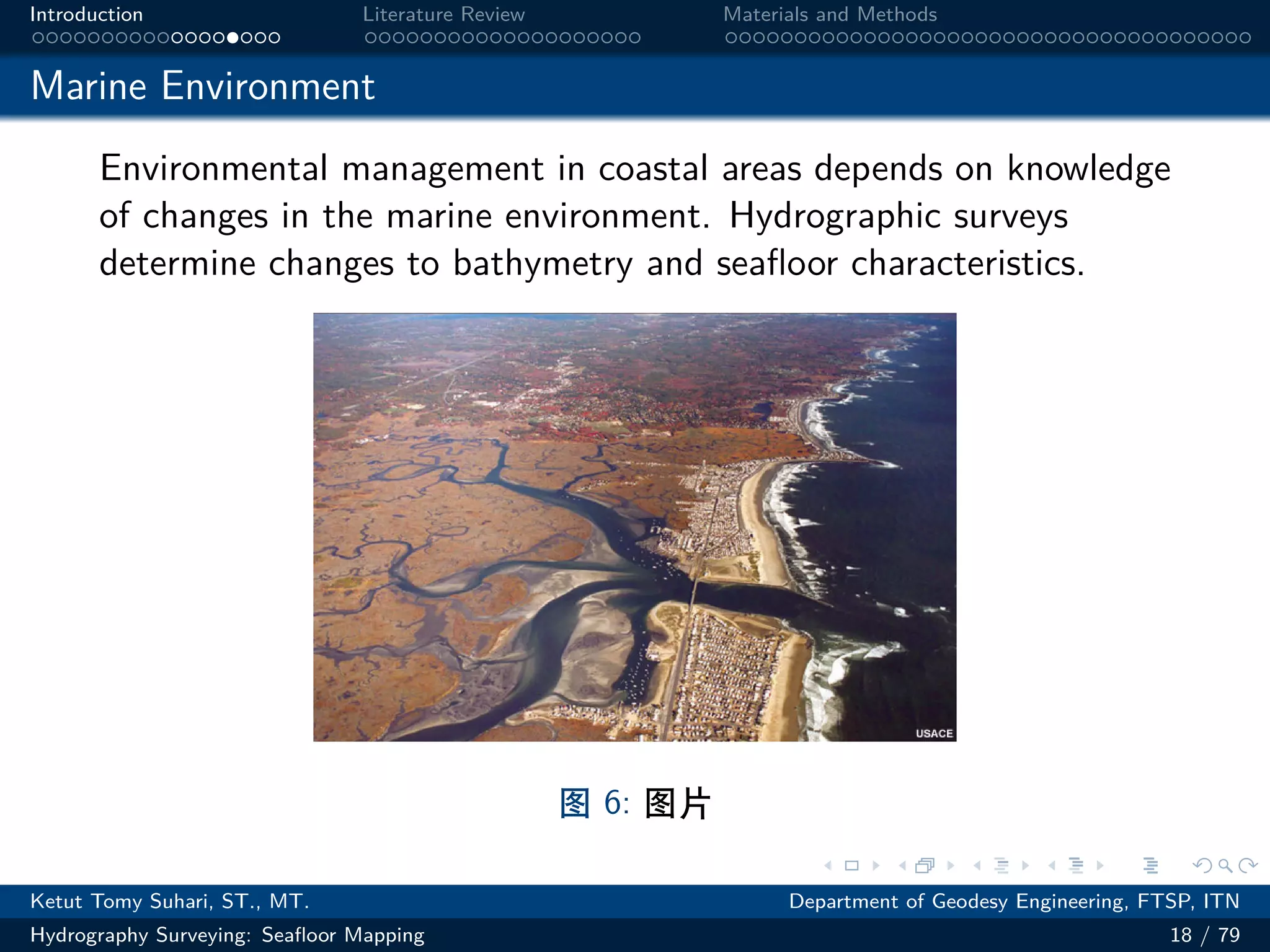
Marine Environment
Environmental management in coastal areas depends on knowledge
of changes in the marine environment. Hydrographic surveys
determine changes to bathymetry and seafloor characteristics.
图 6: 图片
Ketut Tomy Suhari, ST., MT. Department of Geodesy Engineering, FTSP, ITN
Hydrography Surveying: Seafloor Mapping 18 / 79
.
.
.
.
.
.
.
.
.
.
.
.
.
.
.
.
.
.
.
.
.
.
.
.
.
.
.
.
.
.
.
.
.
.
.
.
.
.
.
.
Introduction Literature Review Materials and Methods
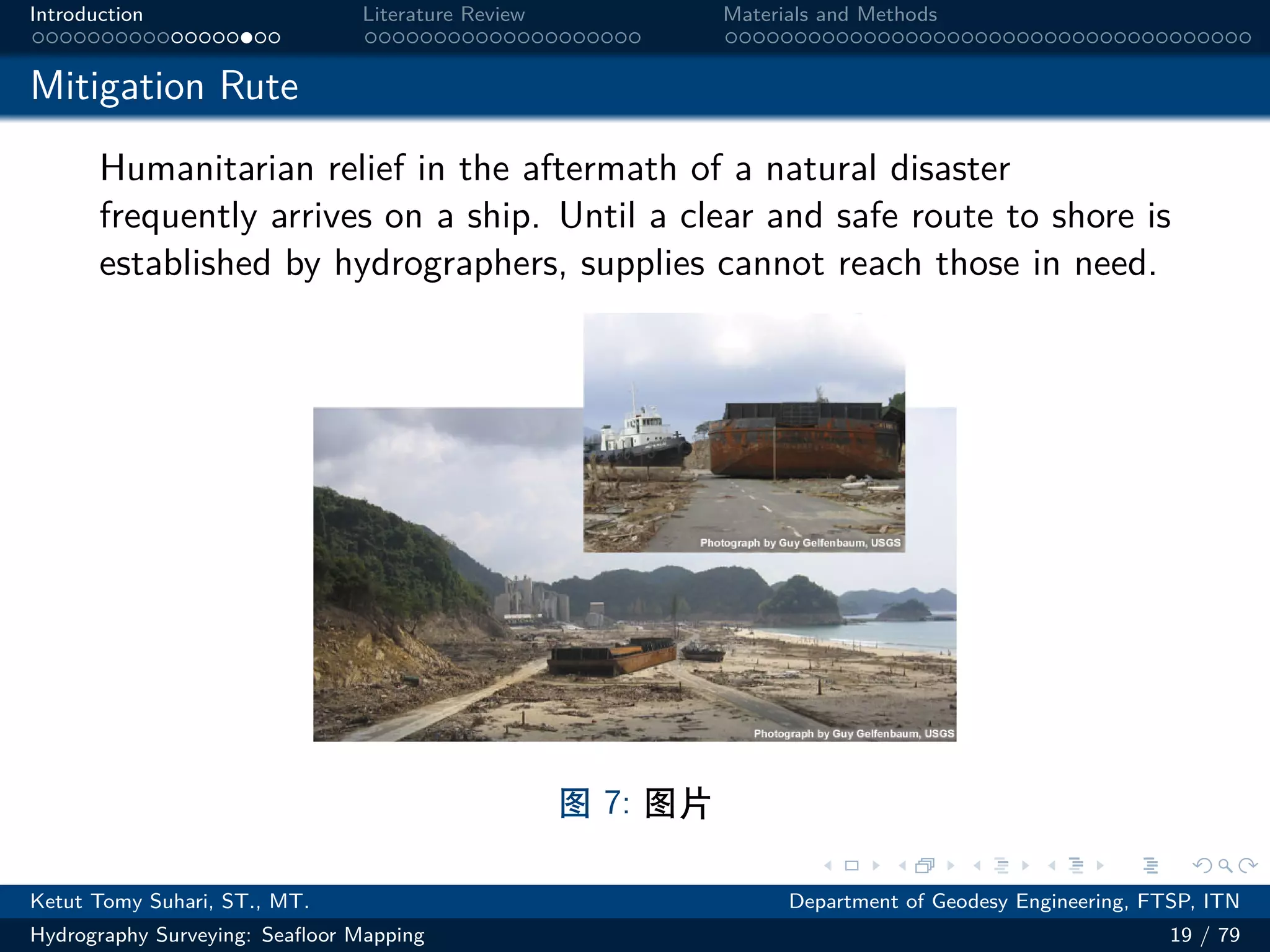
Mitigation Rute
Humanitarian relief in the aftermath of a natural disaster
frequently arrives on a ship. Until a clear and safe route to shore is
established by hydrographers, supplies cannot reach those in need.
图 7: 图片
Ketut Tomy Suhari, ST., MT. Department of Geodesy Engineering, FTSP, ITN
Hydrography Surveying: Seafloor Mapping 19 / 79
.
.
.
.
.
.
.
.
.
.
.
.
.
.
.
.
.
.
.
.
.
.
.
.
.
.
.
.
.
.
.
.
.
.
.
.
.
.
.
.
Introduction Literature Review Materials and Methods
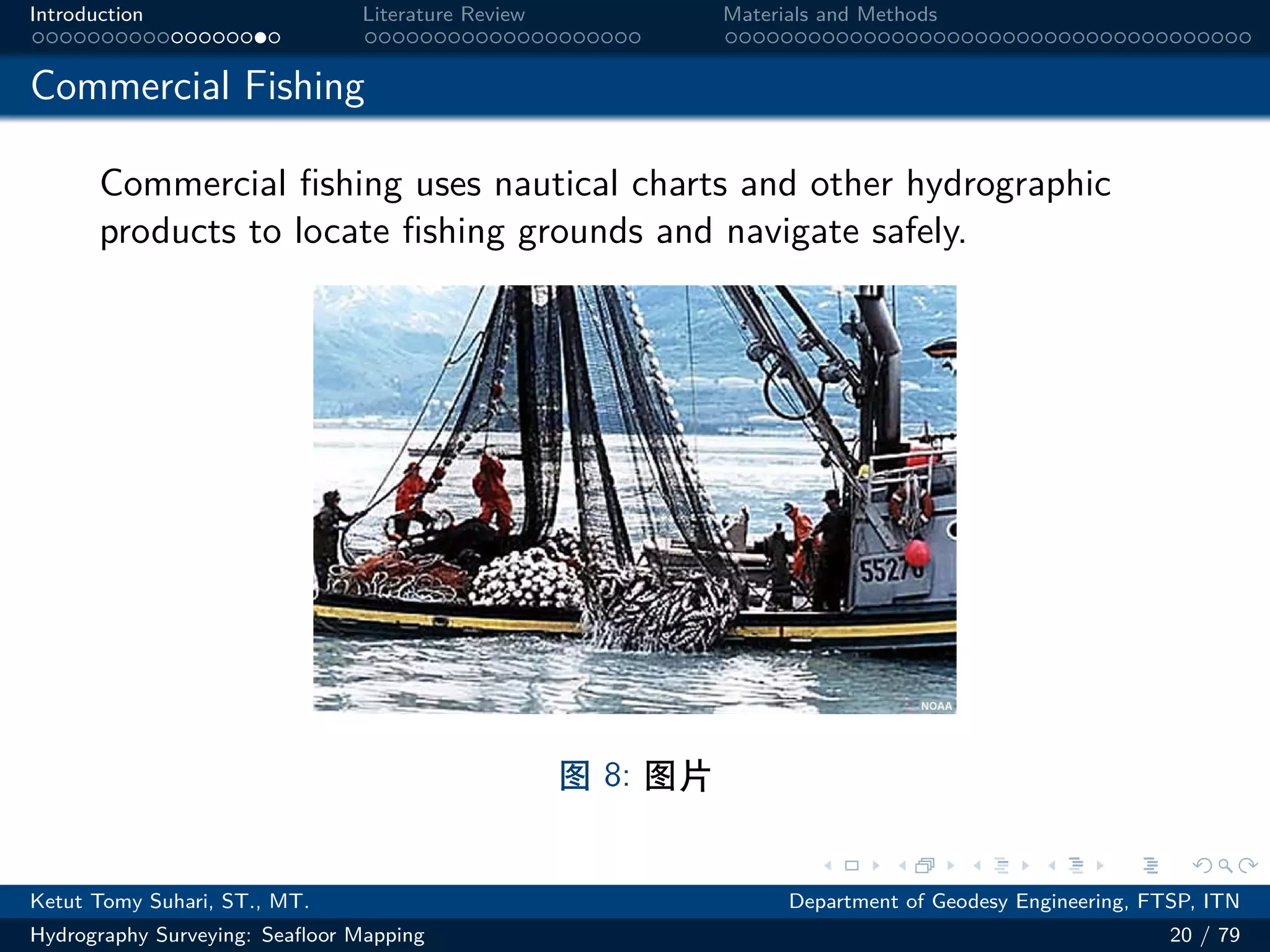
Commercial Fishing
Commercial fishing uses nautical charts and other hydrographic
products to locate fishing grounds and navigate safely.
图 8: 图片
Ketut Tomy Suhari, ST., MT. Department of Geodesy Engineering, FTSP, ITN
Hydrography Surveying: Seafloor Mapping 20 / 79
.
.
.
.
.
.
.
.
.
.
.
.
.
.
.
.
.
.
.
.
.
.
.
.
.
.
.
.
.
.
.
.
.
.
.
.
.
.
.
.
Introduction Literature Review Materials and Methods
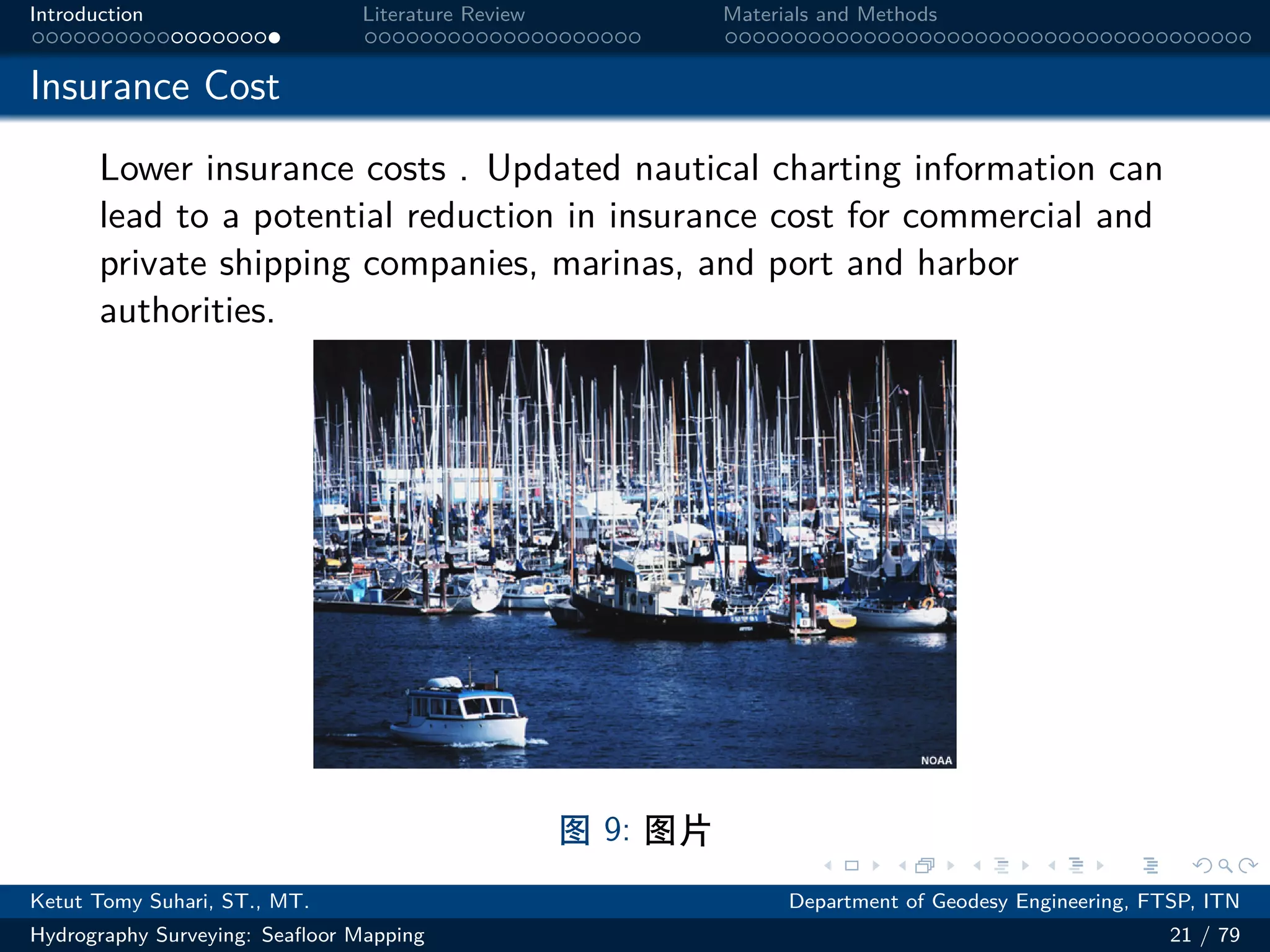
Insurance Cost
Lower insurance costs . Updated nautical charting information can
lead to a potential reduction in insurance cost for commercial and
private shipping companies, marinas, and port and harbor
authorities.
图 9: 图片
Ketut Tomy Suhari, ST., MT. Department of Geodesy Engineering, FTSP, ITN
Hydrography Surveying: Seafloor Mapping 21 / 79
.
.
.
.
.
.
.
.
.
.
.
.
.
.
.
.
.
.
.
.
.
.
.
.
.
.
.
.
.
.
.
.
.
.
.
.
.
.
.
.
Introduction Literature Review Materials and Methods
1 Introduction
2 Literature Review
History of U.S., and Indonesia
3 Materials and Methods
Ketut Tomy Suhari, ST., MT. Department of Geodesy Engineering, FTSP, ITN
Hydrography Surveying: Seafloor Mapping 22 / 79
.
.
.
.
.
.
.
.
.
.
.
.
.
.
.
.
.
.
.
.
.
.
.
.
.
.
.
.
.
.
.
.
.
.
.
.
.
.
.
.
Introduction Literature Review Materials and Methods
1 Introduction
2 Literature Review
History of U.S., and Indonesia
3 Materials and Methods
Ketut Tomy Suhari, ST., MT. Department of Geodesy Engineering, FTSP, ITN
Hydrography Surveying: Seafloor Mapping 23 / 79
.
.
.
.
.
.
.
.
.
.
.
.
.
.
.
.
.
.
.
.
.
.
.
.
.
.
.
.
.
.
.
.
.
.
.
.
.
.
.
.
Introduction Literature Review Materials and Methods
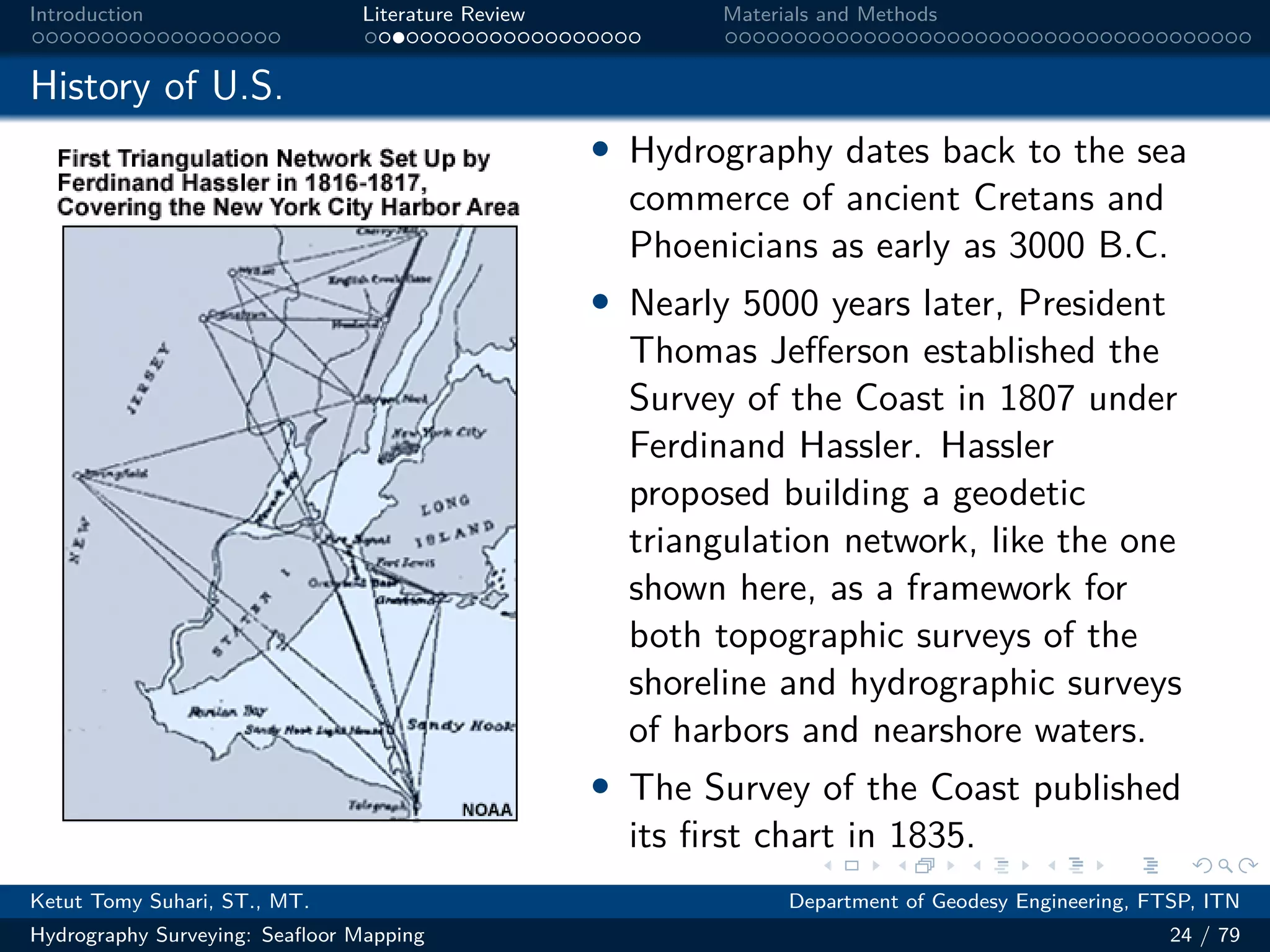
History of U.S.
• Hydrography dates back to the sea
commerce of ancient Cretans and
Phoenicians as early as 3000 B.C.
• Nearly 5000 years later, President
Thomas Jefferson established the
Survey of the Coast in 1807 under
Ferdinand Hassler. Hassler
proposed building a geodetic
triangulation network, like the one
shown here, as a framework for
both topographic surveys of the
shoreline and hydrographic surveys
of harbors and nearshore waters.
• The Survey of the Coast published
its first chart in 1835.
Ketut Tomy Suhari, ST., MT. Department of Geodesy Engineering, FTSP, ITN
Hydrography Surveying: Seafloor Mapping 24 / 79
.
.
.
.
.
.
.
.
.
.
.
.
.
.
.
.
.
.
.
.
.
.
.
.
.
.
.
.
.
.
.
.
.
.
.
.
.
.
.
.
Introduction Literature Review Materials and Methods
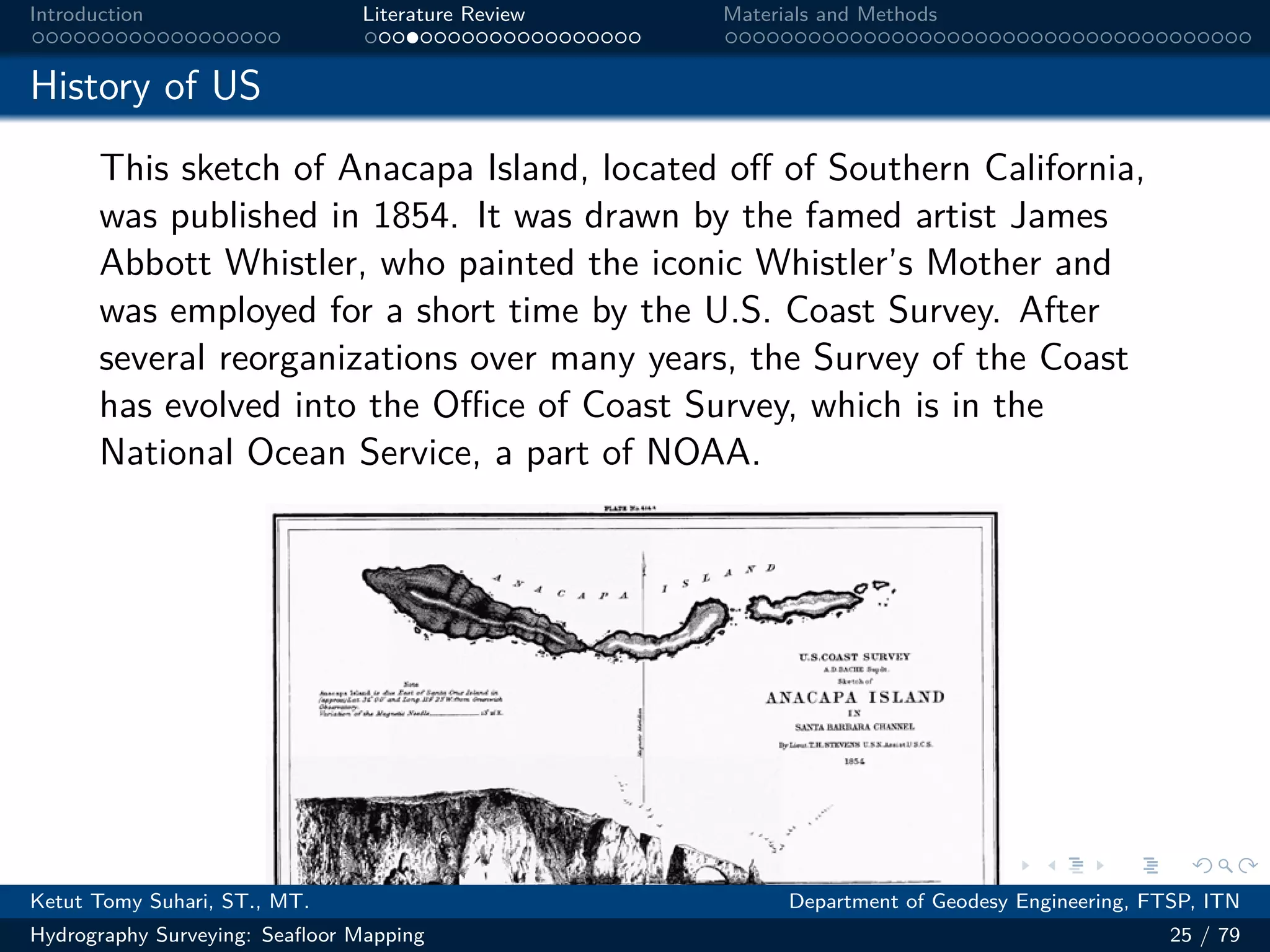
History of US
This sketch of Anacapa Island, located off of Southern California,
was published in 1854. It was drawn by the famed artist James
Abbott Whistler, who painted the iconic Whistler’s Mother and
was employed for a short time by the U.S. Coast Survey. After
several reorganizations over many years, the Survey of the Coast
has evolved into the Office of Coast Survey, which is in the
National Ocean Service, a part of NOAA.
Ketut Tomy Suhari, ST., MT. Department of Geodesy Engineering, FTSP, ITN
Hydrography Surveying: Seafloor Mapping 25 / 79
.
.
.
.
.
.
.
.
.
.
.
.
.
.
.
.
.
.
.
.
.
.
.
.
.
.
.
.
.
.
.
.
.
.
.
.
.
.
.
.
Introduction Literature Review Materials and Methods
History of U.S. Navy Hydrography
The U.S. Navy’s entry into hydrography started in 1830 with
establishment of the Depot of Charts and Instruments under the
command of LT Charles Wilkes. Among Wilkes’accomplishments,
he lead an expedition in 1838 to explore and survey the Southern
Ocean and ”determine the existence of all doubtful islands and
shoals, as to discover, and accurately fix, the position of those
which [lay] in or near the track of our vessels in that quarter.”[J.K.
Paulding, Secretary of the Navy, 1838]
Ketut Tomy Suhari, ST., MT. Department of Geodesy Engineering, FTSP, ITN
Hydrography Surveying: Seafloor Mapping 26 / 79
.
.
.
.
.
.
.
.
.
.
.
.
.
.
.
.
.
.
.
.
.
.
.
.
.
.
.
.
.
.
.
.
.
.
.
.
.
.
.
.
Introduction Literature Review Materials and Methods
History of U.S. Navy Hydrography
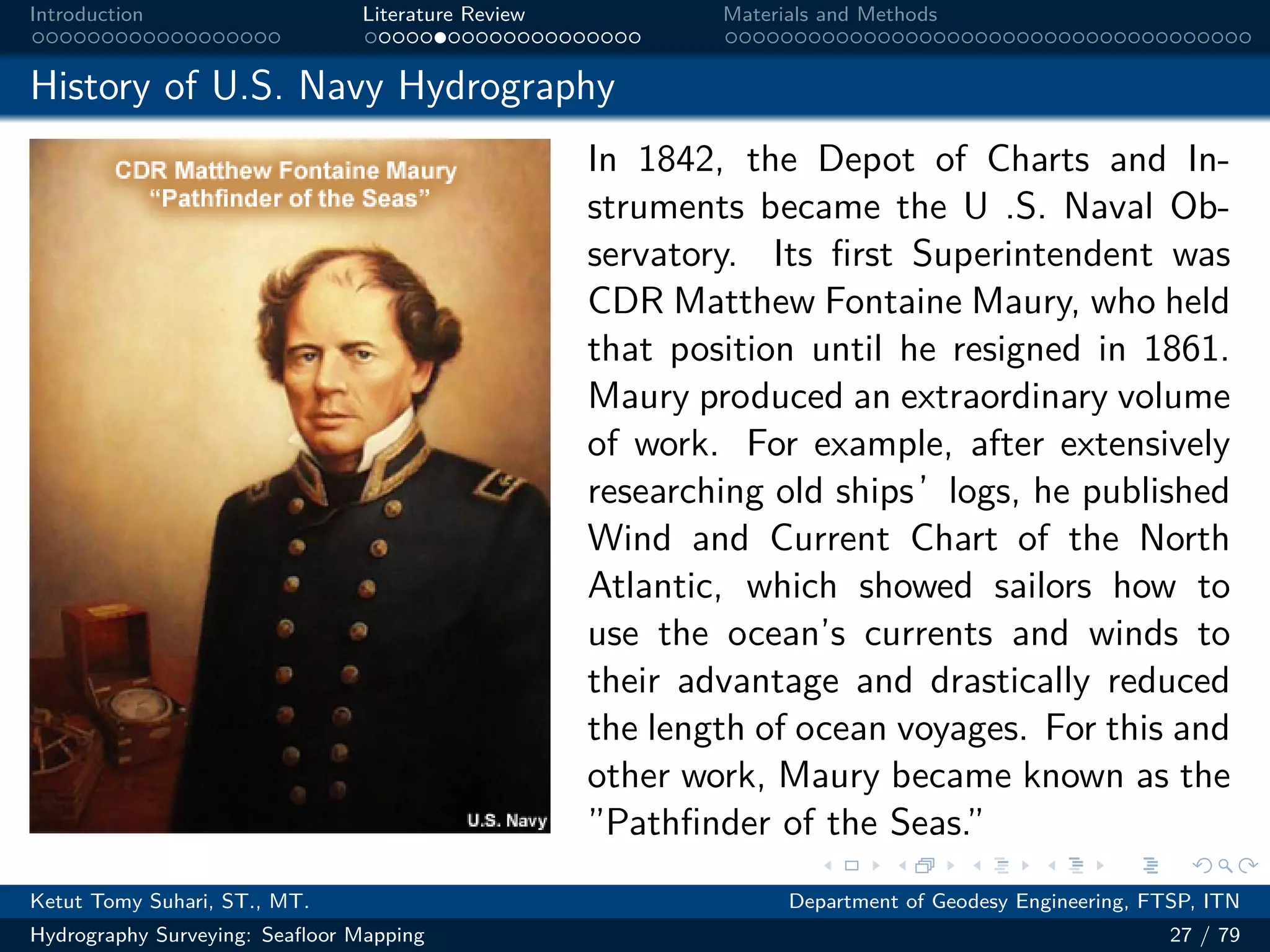
In 1842, the Depot of Charts and In-
struments became the U .S. Naval Ob-
servatory. Its first Superintendent was
CDR Matthew Fontaine Maury, who held
that position until he resigned in 1861.
Maury produced an extraordinary volume
of work. For example, after extensively
researching old ships’logs, he published
Wind and Current Chart of the North
Atlantic, which showed sailors how to
use the ocean’s currents and winds to
their advantage and drastically reduced
the length of ocean voyages. For this and
other work, Maury became known as the
”Pathfinder of the Seas.”
Ketut Tomy Suhari, ST., MT. Department of Geodesy Engineering, FTSP, ITN
Hydrography Surveying: Seafloor Mapping 27 / 79
.
.
.
.
.
.
.
.
.
.
.
.
.
.
.
.
.
.
.
.
.
.
.
.
.
.
.
.
.
.
.
.
.
.
.
.
.
.
.
.
Introduction Literature Review Materials and Methods
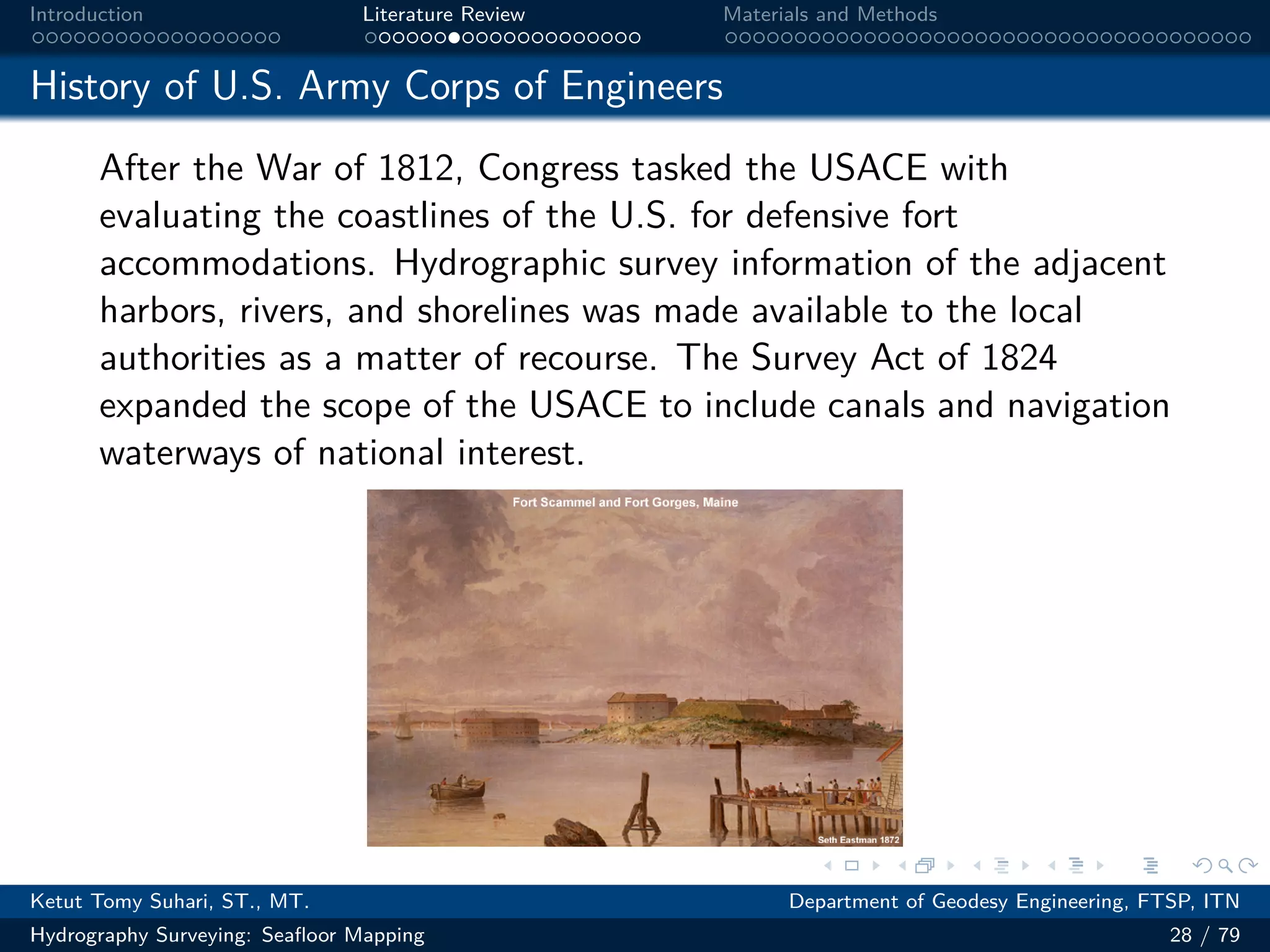
History of U.S. Army Corps of Engineers
After the War of 1812, Congress tasked the USACE with
evaluating the coastlines of the U.S. for defensive fort
accommodations. Hydrographic survey information of the adjacent
harbors, rivers, and shorelines was made available to the local
authorities as a matter of recourse. The Survey Act of 1824
expanded the scope of the USACE to include canals and navigation
waterways of national interest.
图 12: 图片
Ketut Tomy Suhari, ST., MT. Department of Geodesy Engineering, FTSP, ITN
Hydrography Surveying: Seafloor Mapping 28 / 79
.
.
.
.
.
.
.
.
.
.
.
.
.
.
.
.
.
.
.
.
.
.
.
.
.
.
.
.
.
.
.
.
.
.
.
.
.
.
.
.
Introduction Literature Review Materials and Methods
U.S. Hydrographic Agencies
Several agencies within the U.S. contribute to the production of
nautical charts and other hydrographic products, including
• the NOAA National Ocean Service,
• the Naval Oceanographic Office and its Fleet Survey Team,
• the U.S. Army Corps of Engineers (USACE),
• National Geospatial-Intelligence Agency (NGA),
• U.S. Coast Guard (USCG), and
• Private Contractors/Commercial Companies.
Ketut Tomy Suhari, ST., MT. Department of Geodesy Engineering, FTSP, ITN
Hydrography Surveying: Seafloor Mapping 29 / 79
.
.
.
.
.
.
.
.
.
.
.
.
.
.
.
.
.
.
.
.
.
.
.
.
.
.
.
.
.
.
.
.
.
.
.
.
.
.
.
.
Introduction Literature Review Materials and Methods
National Oceanic and Atmospheric Administration (NOAA)
Three main offices within the National Ocean Service of NOAA
work together to produce nautical charts. The Office of Coast
Survey is the national charting authority and is responsible for
producing the suite of nautical charts that covers the U.S. EEZ
(Exclusive Economic Zone) from shore to 200 nautical miles
offshore, including U.S. territories in the Pacific. Charts and other
products are available at their website. NOAA also maintains tide,
current, and other oceanographic data through the Center for
Operational Oceanographic Products and Services (CO-OPS). This
data is available through their website. Finally, the National
Geodetic Survey maintains the National Spatial Reference System
(NSRS), a consistent national coordinate system that specifies
latitude, longitude, height, scale, gravity, and orientation
throughout the nation, as well as how these values change with
time. http://www.nauticalcharts.noaa.gov
Ketut Tomy Suhari, ST., MT. Department of Geodesy Engineering, FTSP, ITN
Hydrography Surveying: Seafloor Mapping 30 / 79
.
.
.
.
.
.
.
.
.
.
.
.
.
.
.
.
.
.
.
.
.
.
.
.
.
.
.
.
.
.
.
.
.
.
.
.
.
.
.
.
Introduction Literature Review Materials and Methods
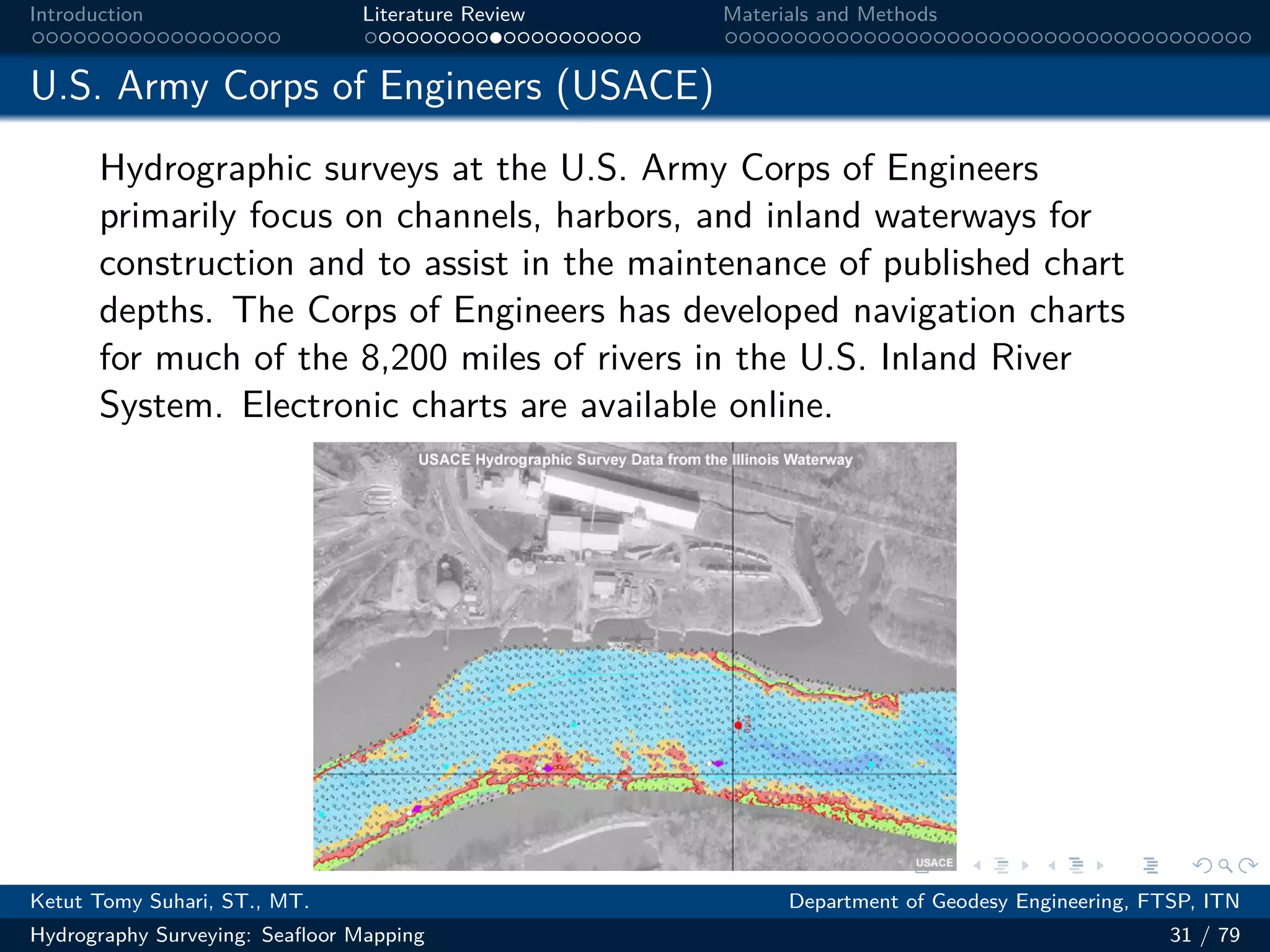
U.S. Army Corps of Engineers (USACE)
Hydrographic surveys at the U.S. Army Corps of Engineers
primarily focus on channels, harbors, and inland waterways for
construction and to assist in the maintenance of published chart
depths. The Corps of Engineers has developed navigation charts
for much of the 8,200 miles of rivers in the U.S. Inland River
System. Electronic charts are available online.
图 13: 图片
Ketut Tomy Suhari, ST., MT. Department of Geodesy Engineering, FTSP, ITN
Hydrography Surveying: Seafloor Mapping 31 / 79
.
.
.
.
.
.
.
.
.
.
.
.
.
.
.
.
.
.
.
.
.
.
.
.
.
.
.
.
.
.
.
.
.
.
.
.
.
.
.
.
Introduction Literature Review Materials and Methods
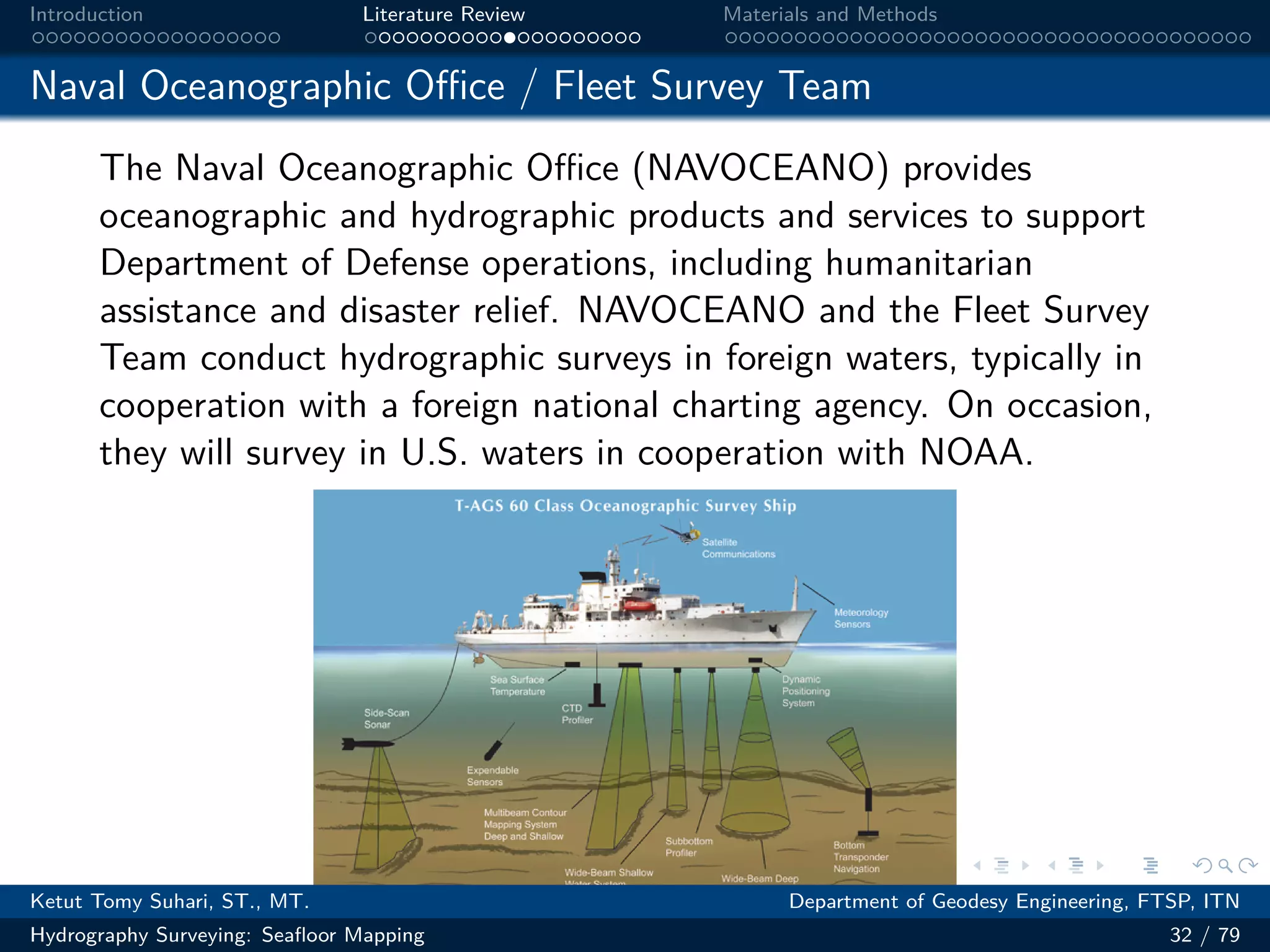
Naval Oceanographic Office / Fleet Survey Team
The Naval Oceanographic Office (NAVOCEANO) provides
oceanographic and hydrographic products and services to support
Department of Defense operations, including humanitarian
assistance and disaster relief. NAVOCEANO and the Fleet Survey
Team conduct hydrographic surveys in foreign waters, typically in
cooperation with a foreign national charting agency. On occasion,
they will survey in U.S. waters in cooperation with NOAA.
Ketut Tomy Suhari, ST., MT. Department of Geodesy Engineering, FTSP, ITN
Hydrography Surveying: Seafloor Mapping 32 / 79
.
.
.
.
.
.
.
.
.
.
.
.
.
.
.
.
.
.
.
.
.
.
.
.
.
.
.
.
.
.
.
.
.
.
.
.
.
.
.
.
Introduction Literature Review Materials and Methods
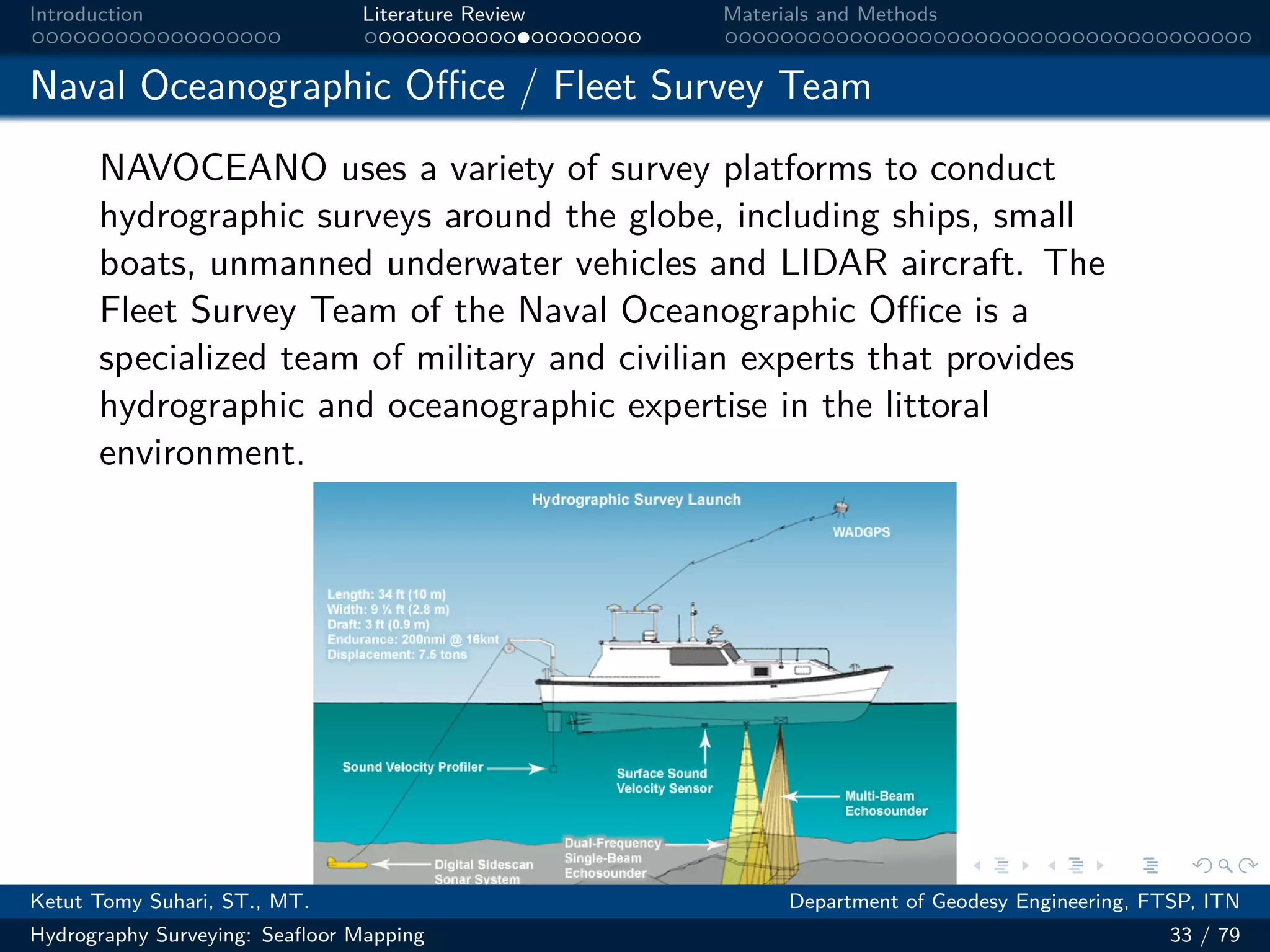
Naval Oceanographic Office / Fleet Survey Team
NAVOCEANO uses a variety of survey platforms to conduct
hydrographic surveys around the globe, including ships, small
boats, unmanned underwater vehicles and LIDAR aircraft. The
Fleet Survey Team of the Naval Oceanographic Office is a
specialized team of military and civilian experts that provides
hydrographic and oceanographic expertise in the littoral
environment.
Ketut Tomy Suhari, ST., MT. Department of Geodesy Engineering, FTSP, ITN
Hydrography Surveying: Seafloor Mapping 33 / 79
.
.
.
.
.
.
.
.
.
.
.
.
.
.
.
.
.
.
.
.
.
.
.
.
.
.
.
.
.
.
.
.
.
.
.
.
.
.
.
.
Introduction Literature Review Materials and Methods
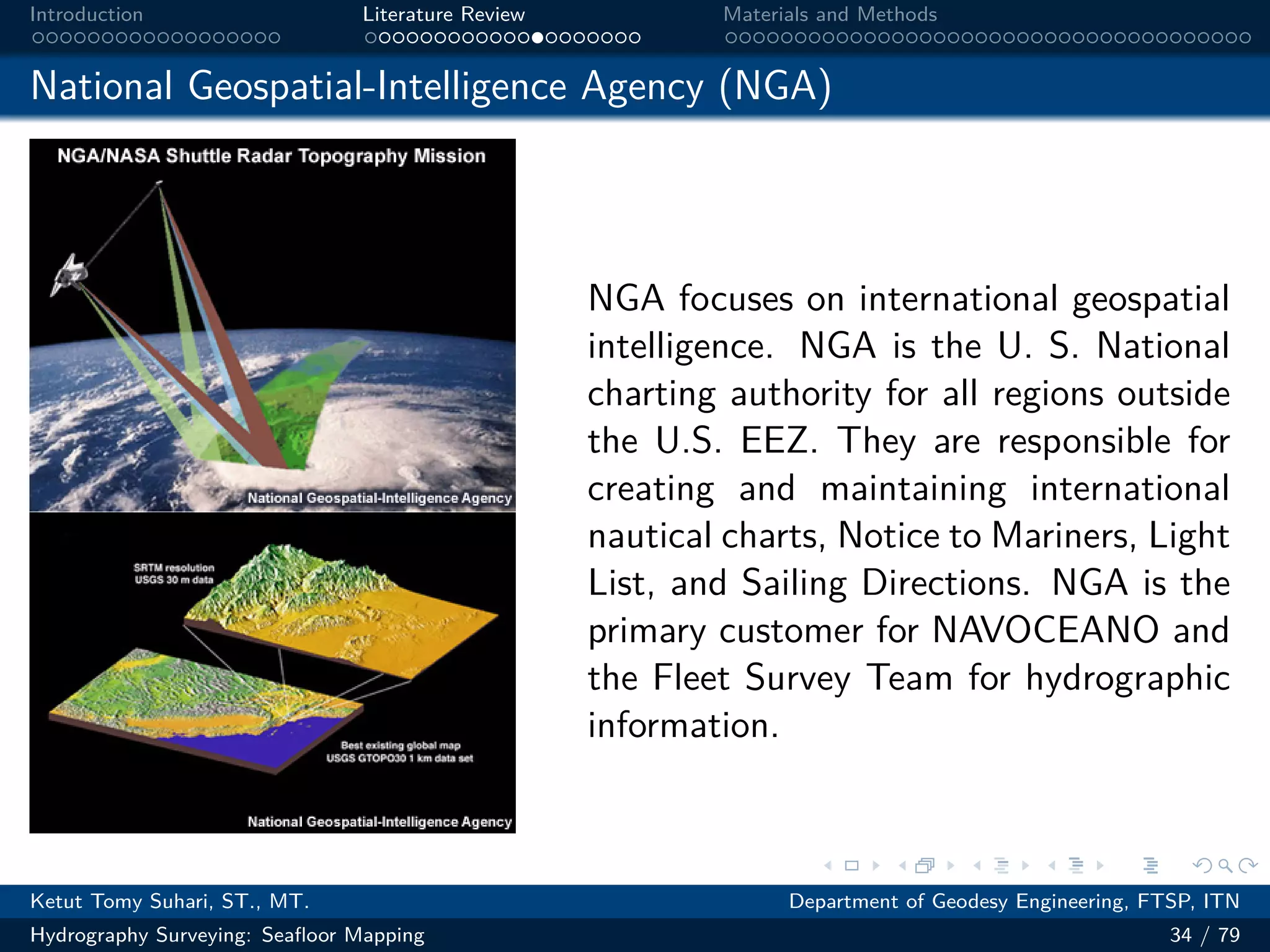
National Geospatial-Intelligence Agency (NGA)
NGA focuses on international geospatial
intelligence. NGA is the U. S. National
charting authority for all regions outside
the U.S. EEZ. They are responsible for
creating and maintaining international
nautical charts, Notice to Mariners, Light
List, and Sailing Directions. NGA is the
primary customer for NAVOCEANO and
the Fleet Survey Team for hydrographic
information.
Ketut Tomy Suhari, ST., MT. Department of Geodesy Engineering, FTSP, ITN
Hydrography Surveying: Seafloor Mapping 34 / 79
.
.
.
.
.
.
.
.
.
.
.
.
.
.
.
.
.
.
.
.
.
.
.
.
.
.
.
.
.
.
.
.
.
.
.
.
.
.
.
.
Introduction Literature Review Materials and Methods
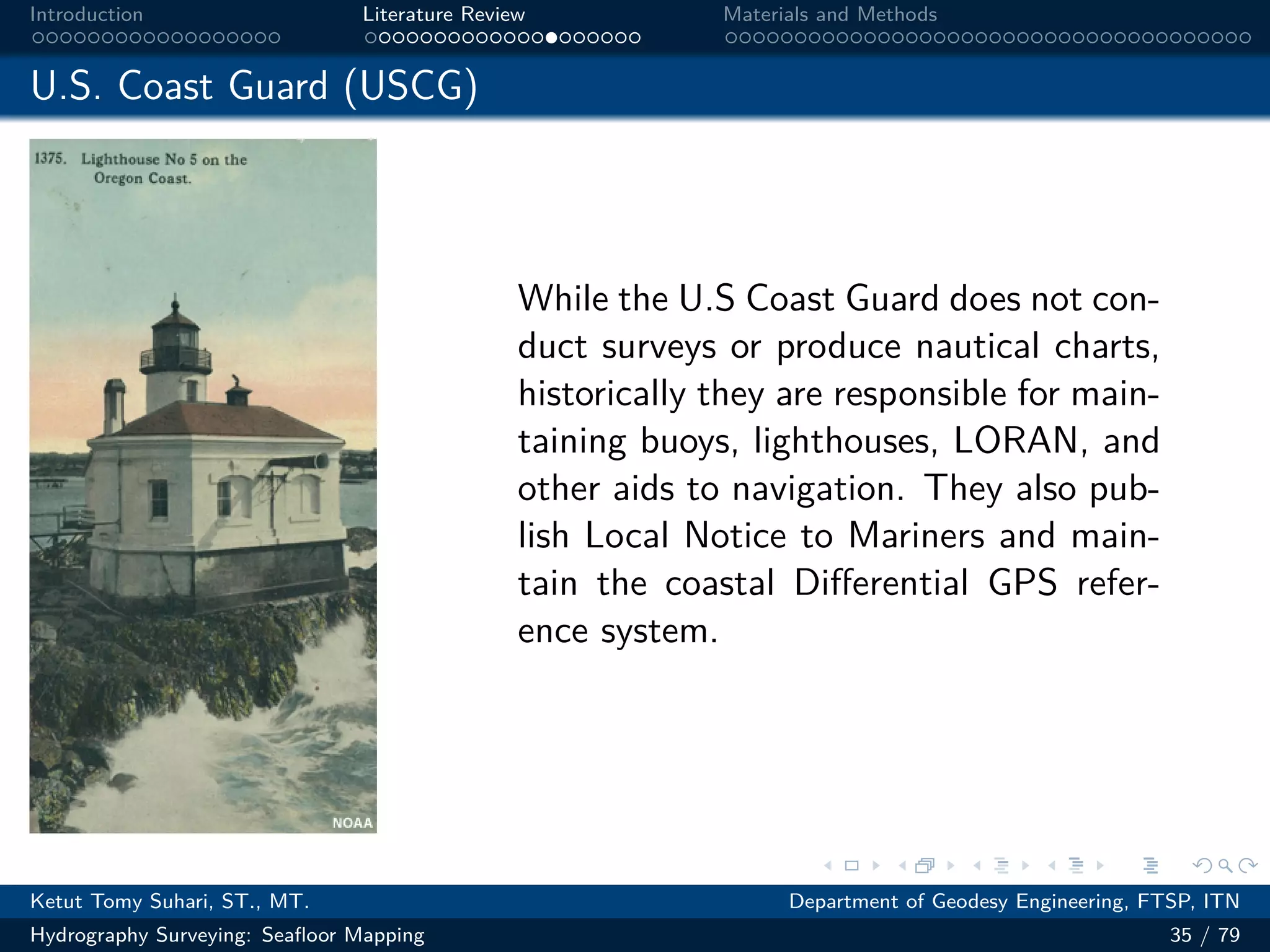
U.S. Coast Guard (USCG)
While the U.S Coast Guard does not con-
duct surveys or produce nautical charts,
historically they are responsible for main-
taining buoys, lighthouses, LORAN, and
other aids to navigation. They also pub-
lish Local Notice to Mariners and main-
tain the coastal Differential GPS refer-
ence system.
Ketut Tomy Suhari, ST., MT. Department of Geodesy Engineering, FTSP, ITN
Hydrography Surveying: Seafloor Mapping 35 / 79
.
.
.
.
.
.
.
.
.
.
.
.
.
.
.
.
.
.
.
.
.
.
.
.
.
.
.
.
.
.
.
.
.
.
.
.
.
.
.
.
Introduction Literature Review Materials and Methods
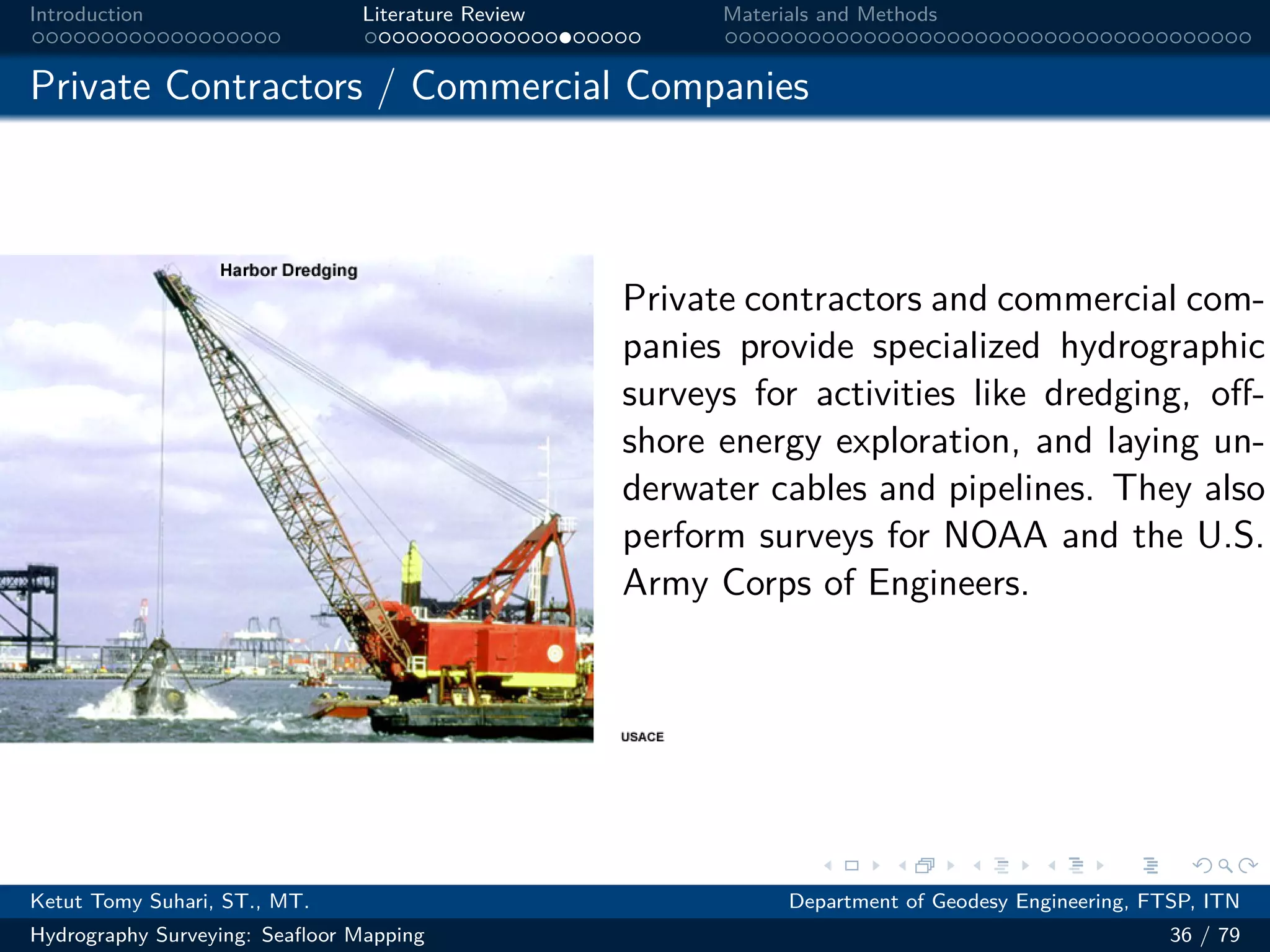
Private Contractors / Commercial Companies
Private contractors and commercial com-
panies provide specialized hydrographic
surveys for activities like dredging, off-
shore energy exploration, and laying un-
derwater cables and pipelines. They also
perform surveys for NOAA and the U.S.
Army Corps of Engineers.
Ketut Tomy Suhari, ST., MT. Department of Geodesy Engineering, FTSP, ITN
Hydrography Surveying: Seafloor Mapping 36 / 79
.
.
.
.
.
.
.
.
.
.
.
.
.
.
.
.
.
.
.
.
.
.
.
.
.
.
.
.
.
.
.
.
.
.
.
.
.
.
.
.
Introduction Literature Review Materials and Methods
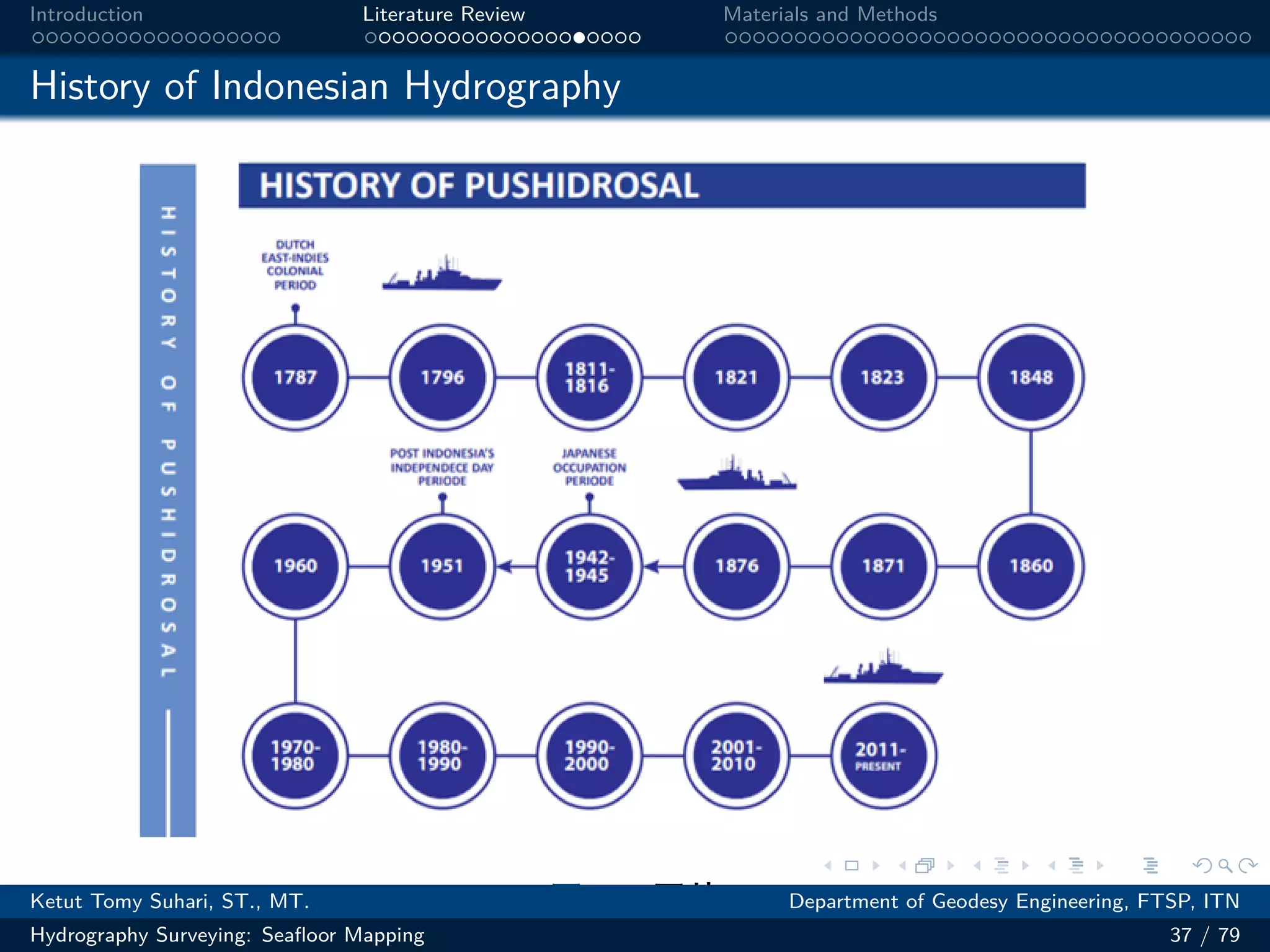
History of Indonesian Hydrography
图 16: 图片
Ketut Tomy Suhari, ST., MT. Department of Geodesy Engineering, FTSP, ITN
Hydrography Surveying: Seafloor Mapping 37 / 79
.
.
.
.
.
.
.
.
.
.
.
.
.
.
.
.
.
.
.
.
.
.
.
.
.
.
.
.
.
.
.
.
.
.
.
.
.
.
.
.
Introduction Literature Review Materials and Methods
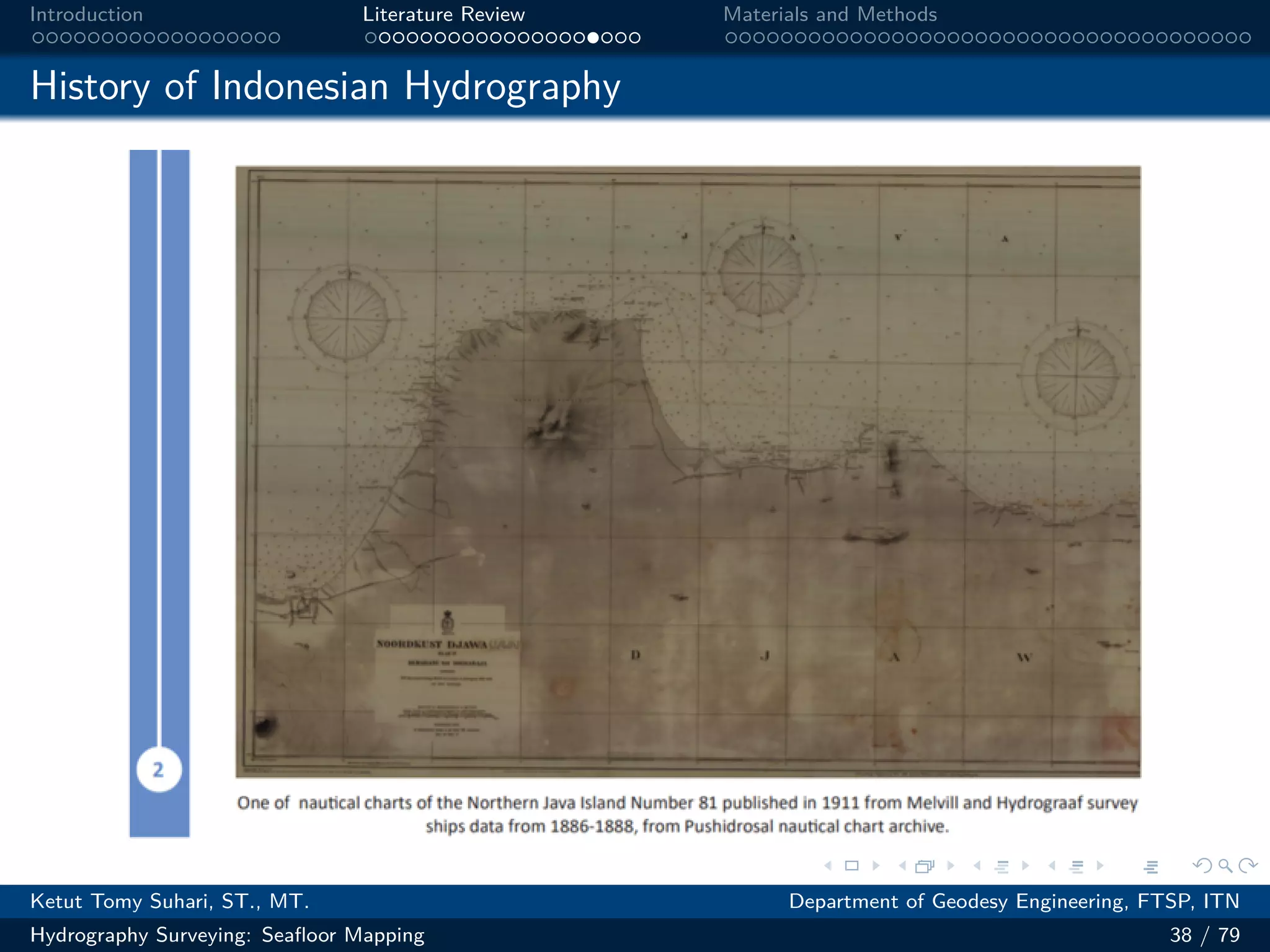
History of Indonesian Hydrography
图 17: 图片
Ketut Tomy Suhari, ST., MT. Department of Geodesy Engineering, FTSP, ITN
Hydrography Surveying: Seafloor Mapping 38 / 79
.
.
.
.
.
.
.
.
.
.
.
.
.
.
.
.
.
.
.
.
.
.
.
.
.
.
.
.
.
.
.
.
.
.
.
.
.
.
.
.
Introduction Literature Review Materials and Methods
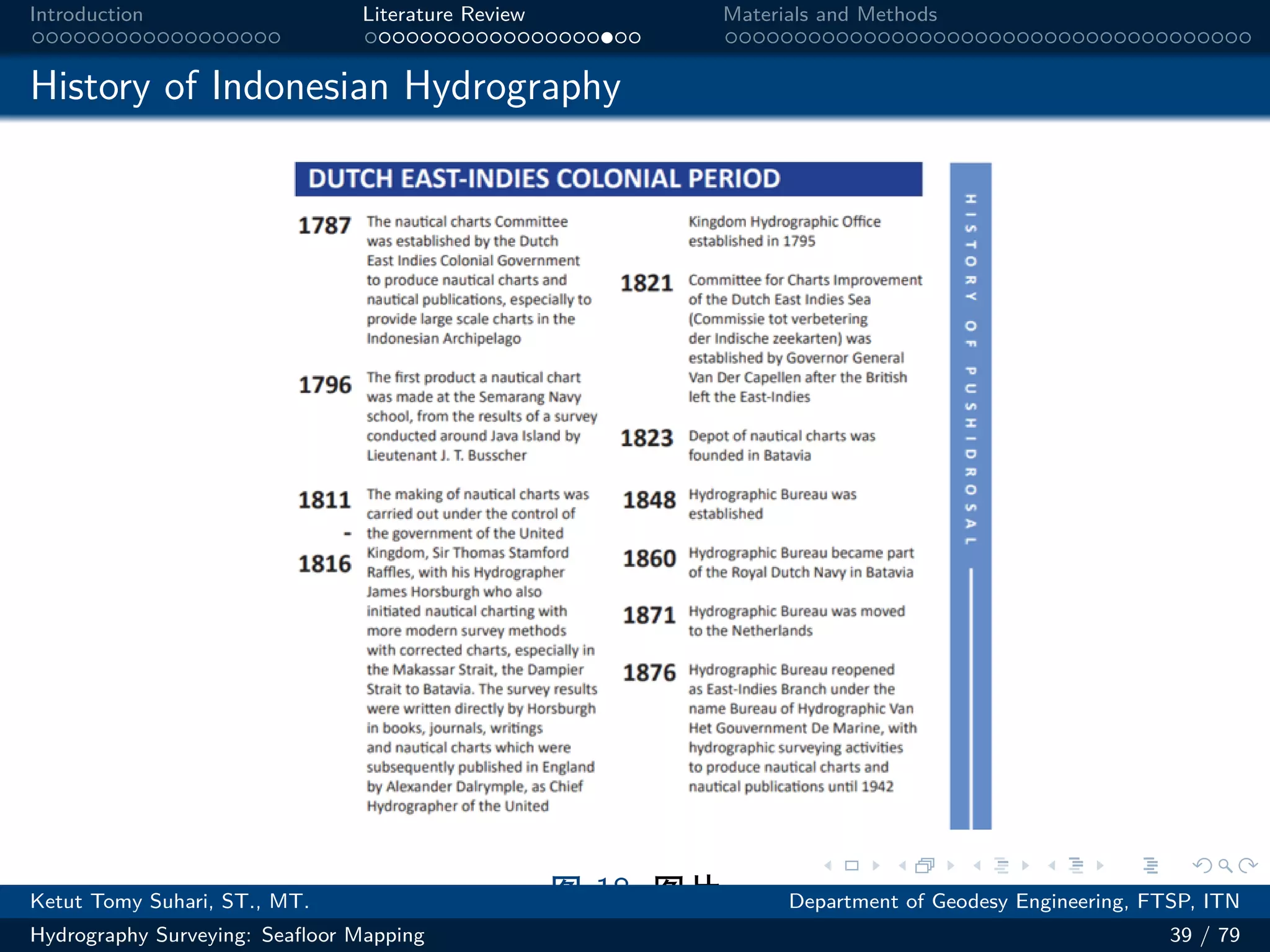
History of Indonesian Hydrography
图 18: 图片
Ketut Tomy Suhari, ST., MT. Department of Geodesy Engineering, FTSP, ITN
Hydrography Surveying: Seafloor Mapping 39 / 79
.
.
.
.
.
.
.
.
.
.
.
.
.
.
.
.
.
.
.
.
.
.
.
.
.
.
.
.
.
.
.
.
.
.
.
.
.
.
.
.
Introduction Literature Review Materials and Methods
History of Indonesian Hydrography
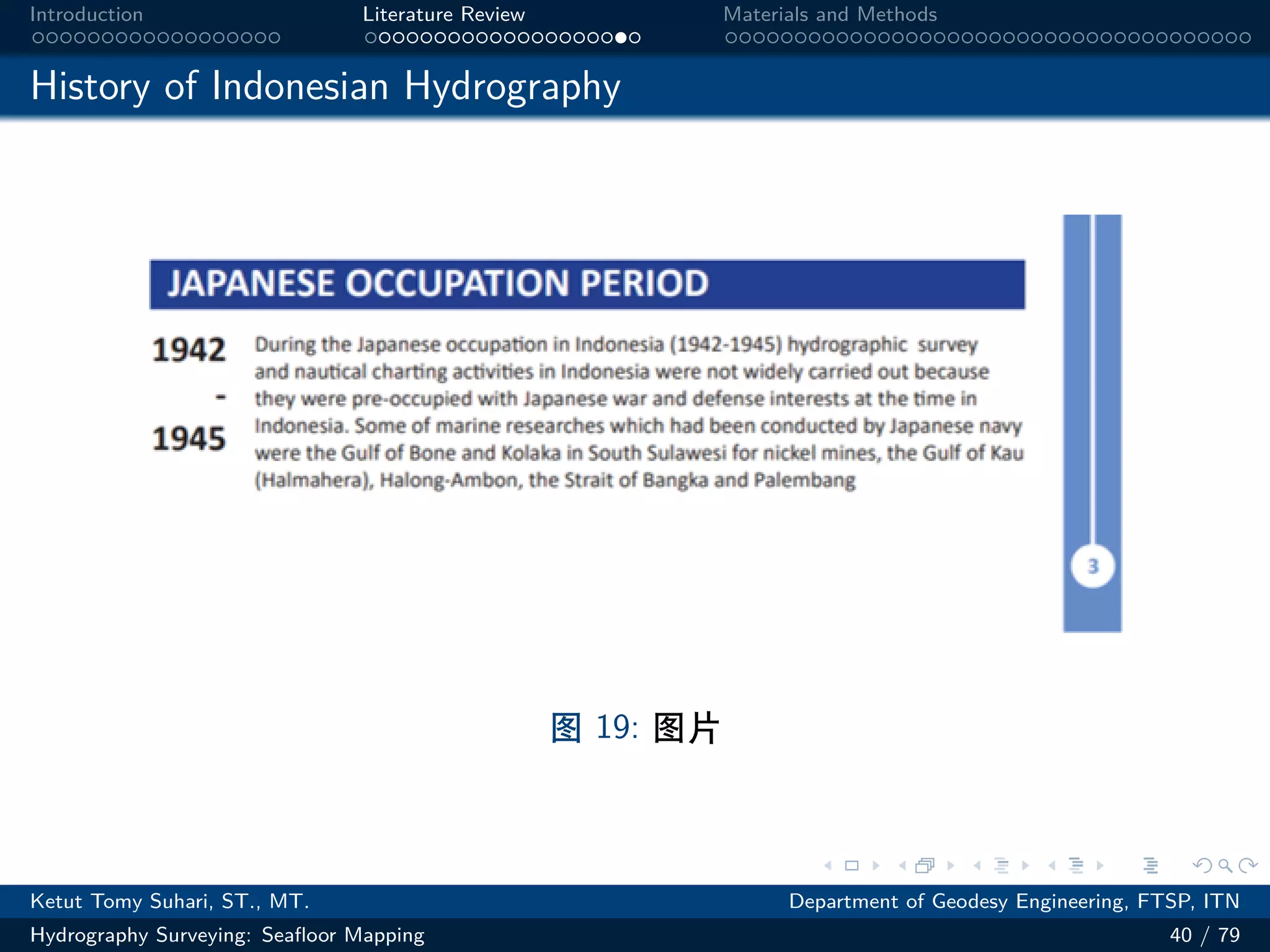
图 19: 图片
Ketut Tomy Suhari, ST., MT. Department of Geodesy Engineering, FTSP, ITN
Hydrography Surveying: Seafloor Mapping 40 / 79
.
.
.
.
.
.
.
.
.
.
.
.
.
.
.
.
.
.
.
.
.
.
.
.
.
.
.
.
.
.
.
.
.
.
.
.
.
.
.
.
Introduction Literature Review Materials and Methods
History of Indonesian Hydrography
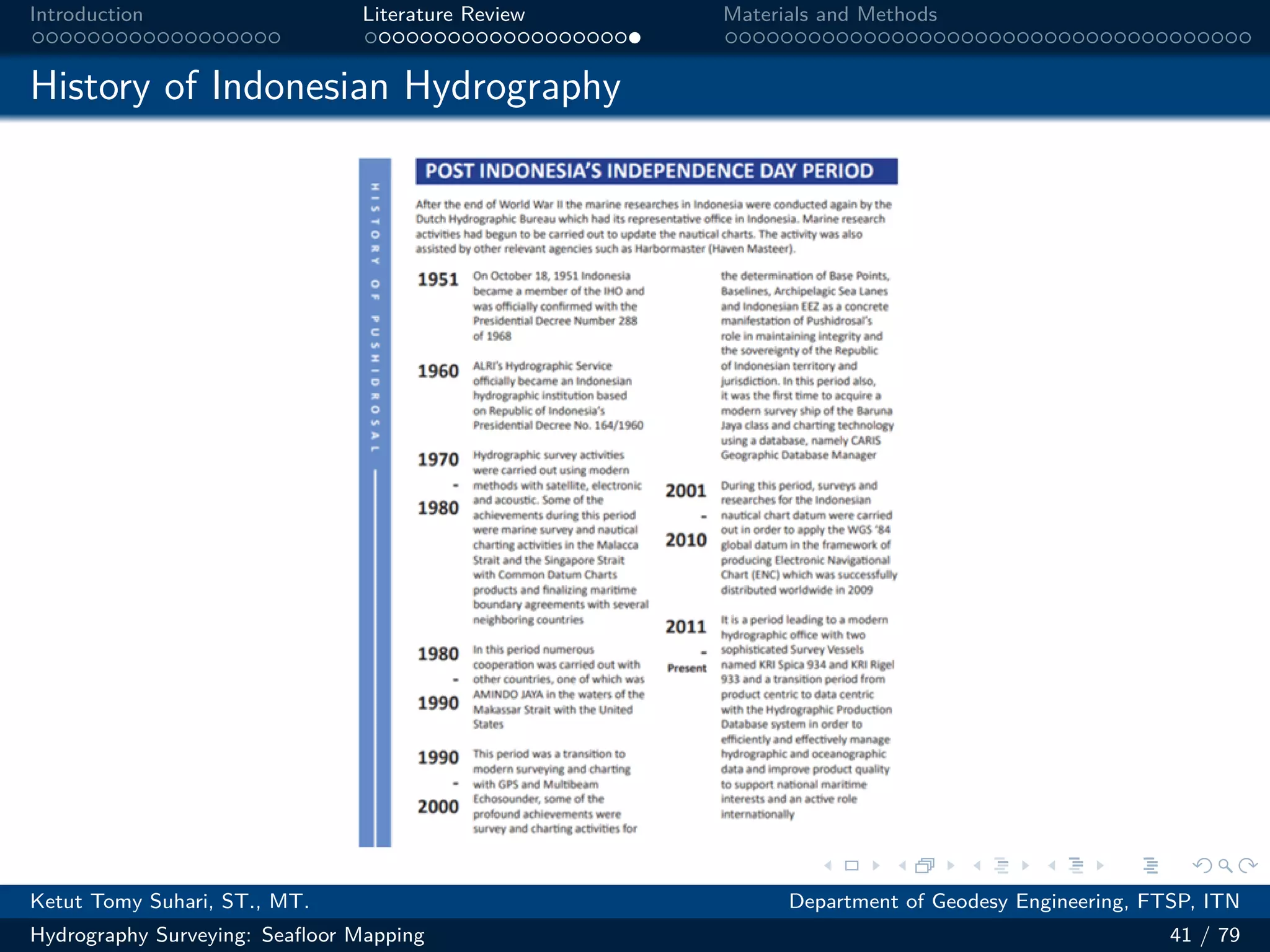
图 20: 图片
Ketut Tomy Suhari, ST., MT. Department of Geodesy Engineering, FTSP, ITN
Hydrography Surveying: Seafloor Mapping 41 / 79
.
.
.
.
.
.
.
.
.
.
.
.
.
.
.
.
.
.
.
.
.
.
.
.
.
.
.
.
.
.
.
.
.
.
.
.
.
.
.
.
Introduction Literature Review Materials and Methods
1 Introduction
2 Literature Review
3 Materials and Methods
Type of Marine
International Hydrographic Organization
Positioning
Sounding Methods
Ketut Tomy Suhari, ST., MT. Department of Geodesy Engineering, FTSP, ITN
Hydrography Surveying: Seafloor Mapping 42 / 79
.
.
.
.
.
.
.
.
.
.
.
.
.
.
.
.
.
.
.
.
.
.
.
.
.
.
.
.
.
.
.
.
.
.
.
.
.
.
.
.
Introduction Literature Review Materials and Methods
1 Introduction
2 Literature Review
3 Materials and Methods
Type of Marine
International Hydrographic Organization
Positioning
Sounding Methods
Ketut Tomy Suhari, ST., MT. Department of Geodesy Engineering, FTSP, ITN
Hydrography Surveying: Seafloor Mapping 43 / 79
.
.
.
.
.
.
.
.
.
.
.
.
.
.
.
.
.
.
.
.
.
.
.
.
.
.
.
.
.
.
.
.
.
.
.
.
.
.
.
.
Introduction Literature Review Materials and Methods
Type of Marine
So what defines a hydrographic survey and how does it differ from
other marine surveys? In this section we examine different types of
surveys.
• Hydrographic,
• Bathymetric,
• Oceanographic, and
• Geophysical
Ketut Tomy Suhari, ST., MT. Department of Geodesy Engineering, FTSP, ITN
Hydrography Surveying: Seafloor Mapping 44 / 79
.
.
.
.
.
.
.
.
.
.
.
.
.
.
.
.
.
.
.
.
.
.
.
.
.
.
.
.
.
.
.
.
.
.
.
.
.
.
.
.
Introduction Literature Review Materials and Methods
Hydrographic
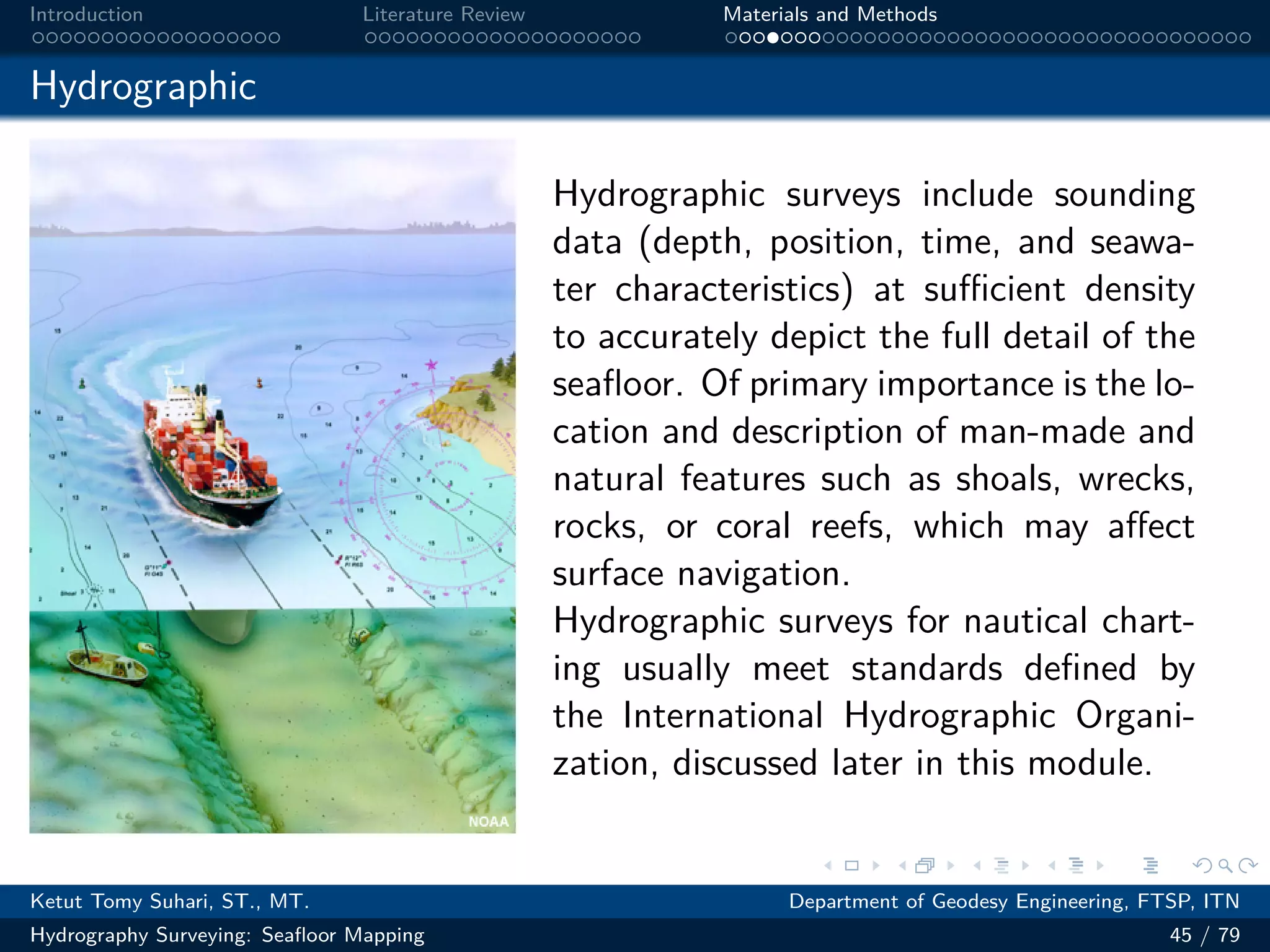
Hydrographic surveys include sounding
data (depth, position, time, and seawa-
ter characteristics) at sufficient density
to accurately depict the full detail of the
seafloor. Of primary importance is the lo-
cation and description of man-made and
natural features such as shoals, wrecks,
rocks, or coral reefs, which may affect
surface navigation.
Hydrographic surveys for nautical chart-
ing usually meet standards defined by
the International Hydrographic Organi-
zation, discussed later in this module.
Ketut Tomy Suhari, ST., MT. Department of Geodesy Engineering, FTSP, ITN
Hydrography Surveying: Seafloor Mapping 45 / 79
.
.
.
.
.
.
.
.
.
.
.
.
.
.
.
.
.
.
.
.
.
.
.
.
.
.
.
.
.
.
.
.
.
.
.
.
.
.
.
.
Introduction Literature Review Materials and Methods
Bathymetric
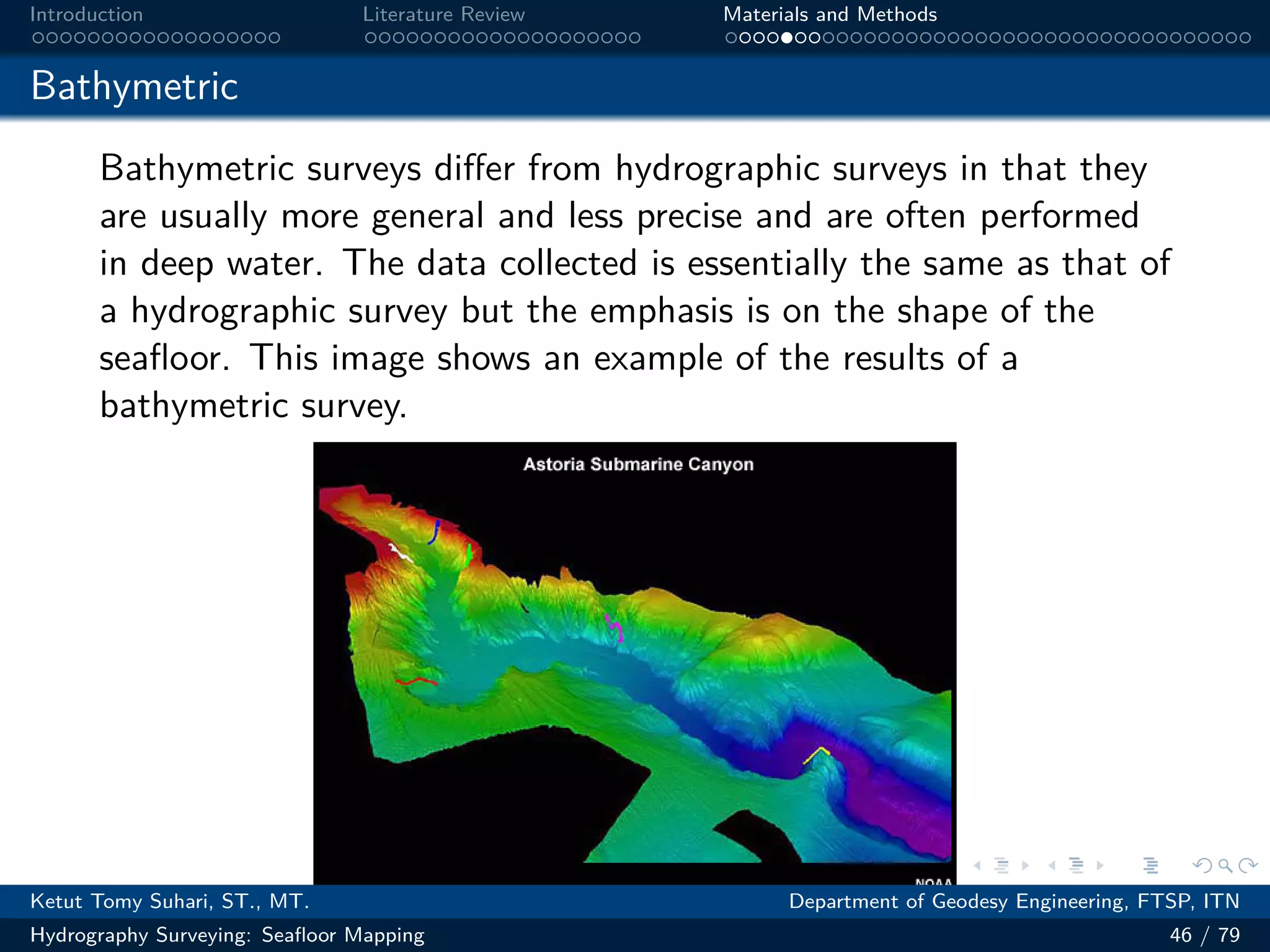
Bathymetric surveys differ from hydrographic surveys in that they
are usually more general and less precise and are often performed
in deep water. The data collected is essentially the same as that of
a hydrographic survey but the emphasis is on the shape of the
seafloor. This image shows an example of the results of a
bathymetric survey.
Ketut Tomy Suhari, ST., MT. Department of Geodesy Engineering, FTSP, ITN
Hydrography Surveying: Seafloor Mapping 46 / 79
.
.
.
.
.
.
.
.
.
.
.
.
.
.
.
.
.
.
.
.
.
.
.
.
.
.
.
.
.
.
.
.
.
.
.
.
.
.
.
.
Introduction Literature Review Materials and Methods
Oceanographic
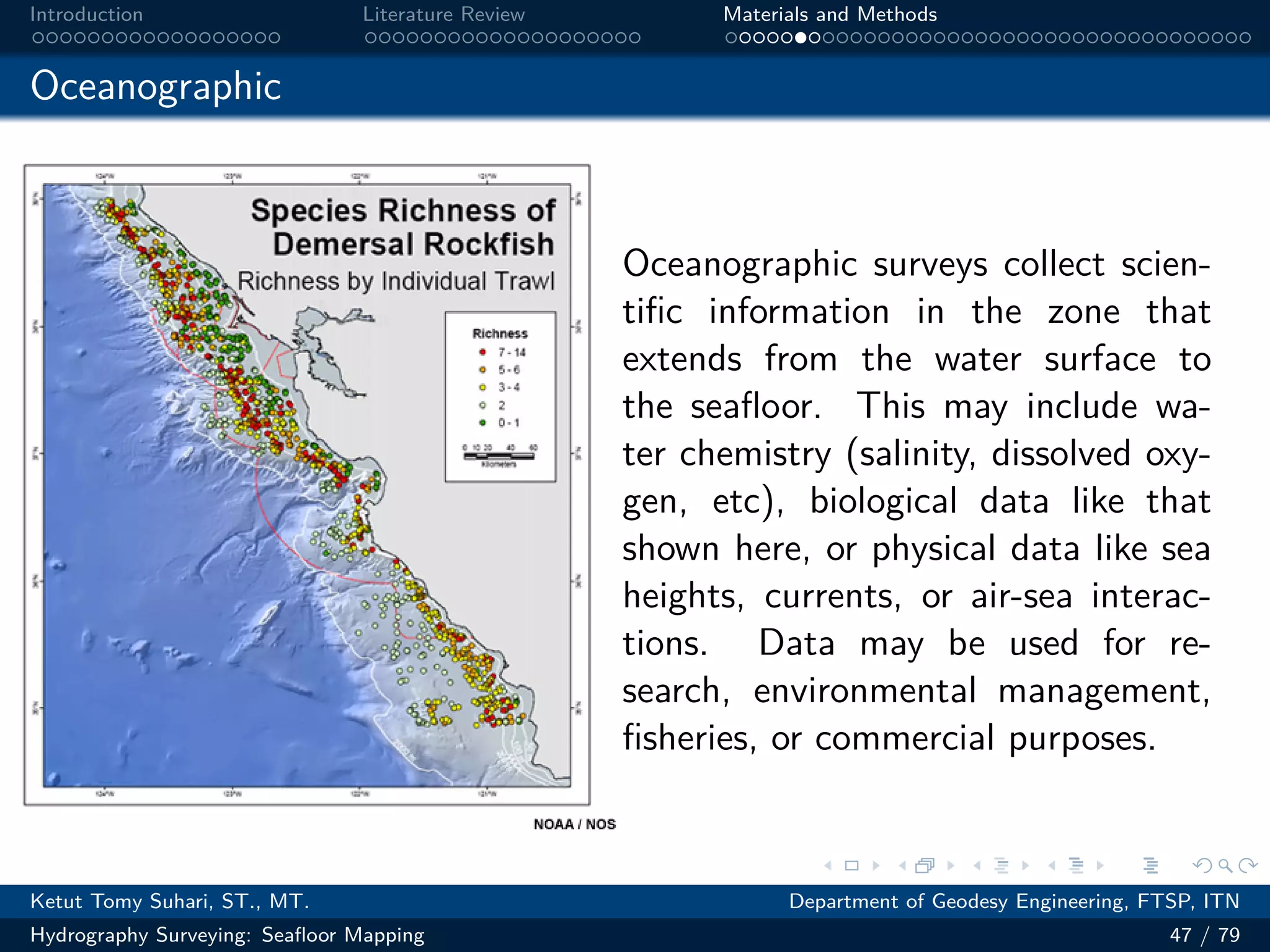
Oceanographic surveys collect scien-
tific information in the zone that
extends from the water surface to
the seafloor. This may include wa-
ter chemistry (salinity, dissolved oxy-
gen, etc), biological data like that
shown here, or physical data like sea
heights, currents, or air-sea interac-
tions. Data may be used for re-
search, environmental management,
fisheries, or commercial purposes.
Ketut Tomy Suhari, ST., MT. Department of Geodesy Engineering, FTSP, ITN
Hydrography Surveying: Seafloor Mapping 47 / 79
.
.
.
.
.
.
.
.
.
.
.
.
.
.
.
.
.
.
.
.
.
.
.
.
.
.
.
.
.
.
.
.
.
.
.
.
.
.
.
.
Introduction Literature Review Materials and Methods
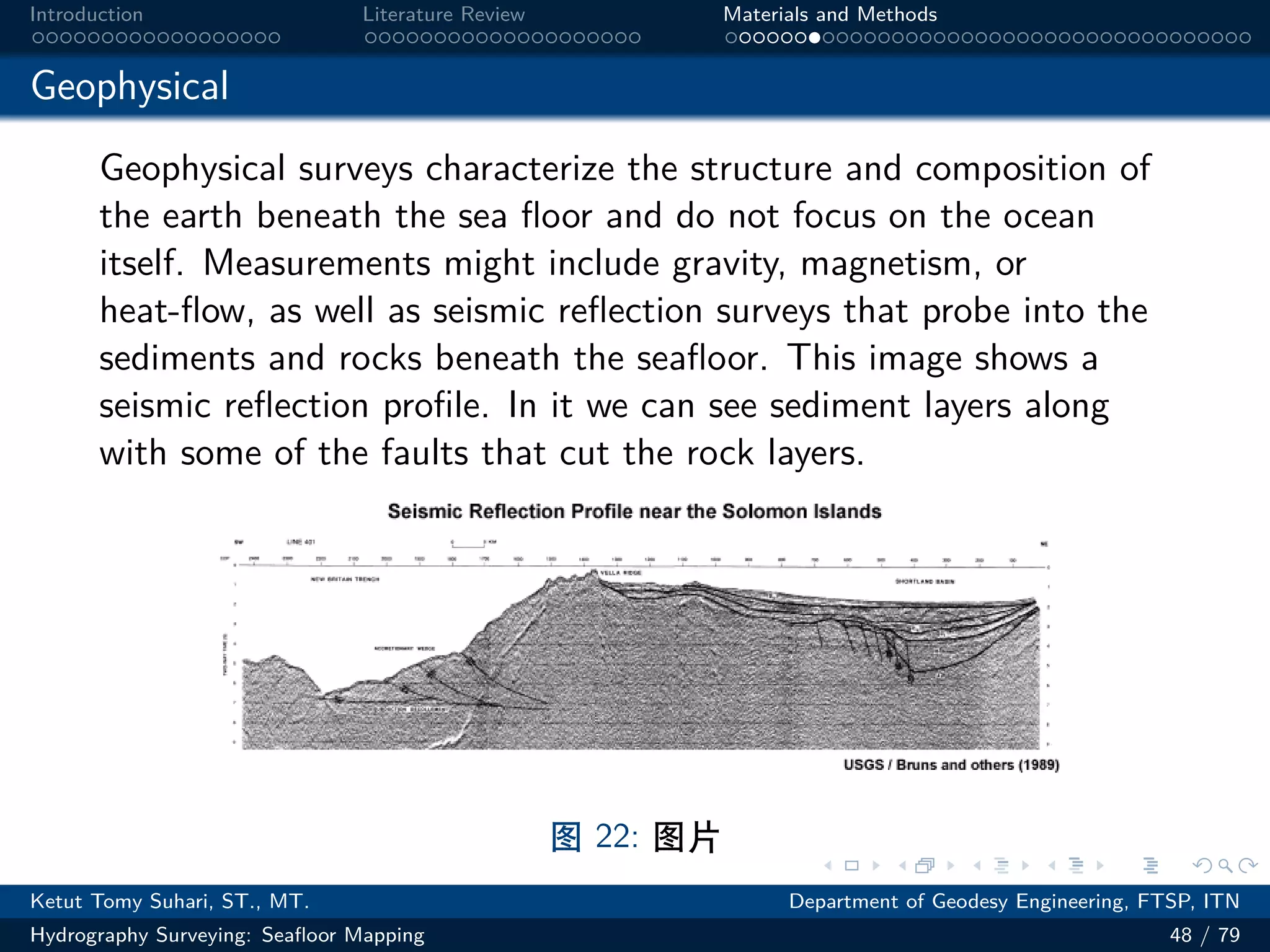
Geophysical
Geophysical surveys characterize the structure and composition of
the earth beneath the sea floor and do not focus on the ocean
itself. Measurements might include gravity, magnetism, or
heat-flow, as well as seismic reflection surveys that probe into the
sediments and rocks beneath the seafloor. This image shows a
seismic reflection profile. In it we can see sediment layers along
with some of the faults that cut the rock layers.
图 22: 图片
Ketut Tomy Suhari, ST., MT. Department of Geodesy Engineering, FTSP, ITN
Hydrography Surveying: Seafloor Mapping 48 / 79
.
.
.
.
.
.
.
.
.
.
.
.
.
.
.
.
.
.
.
.
.
.
.
.
.
.
.
.
.
.
.
.
.
.
.
.
.
.
.
.
Introduction Literature Review Materials and Methods
1 Introduction
2 Literature Review
3 Materials and Methods
Type of Marine
International Hydrographic Organization
Positioning
Sounding Methods
Ketut Tomy Suhari, ST., MT. Department of Geodesy Engineering, FTSP, ITN
Hydrography Surveying: Seafloor Mapping 49 / 79
.
.
.
.
.
.
.
.
.
.
.
.
.
.
.
.
.
.
.
.
.
.
.
.
.
.
.
.
.
.
.
.
.
.
.
.
.
.
.
.
Introduction Literature Review Materials and Methods
International Hydrographic Organization (IHO)
The International Hydrographic Organization is an
intergovernmental consultative and technical organization that was
established in 1921 to support the safety in navigation and the
protection of the marine environment.
The goals of the IHO include the following:
• Coordination of the activities of national hydrographic offices,
• Uniformity in nautical charts and documents,
• Adoption of reliable and efficient methods of carrying out
hydrographic surveys, and
• Development of the science and techniques in the field of
hydrography
Most coastal nations in the world are members of the IHO, though
several in Central America, Southeast Asia, and Africa are not.
IHO Homepage: http://www.iho-ohi.net/english/home/
Ketut Tomy Suhari, ST., MT. Department of Geodesy Engineering, FTSP, ITN
Hydrography Surveying: Seafloor Mapping 50 / 79
.
.
.
.
.
.
.
.
.
.
.
.
.
.
.
.
.
.
.
.
.
.
.
.
.
.
.
.
.
.
.
.
.
.
.
.
.
.
.
.
Introduction Literature Review Materials and Methods
IHO Standard
In an effort to achieve standardization of nautical charts and other
products, the IHO has published standards that cover many
aspects of hydrography. These include:
• S-4: Standard for Nautical Charts
• S-5 and S-8: Competency Standards for Hydrographic
Surveyors and Cartographers
• S-32: Hydrographic Dictionary
• S-44: Standards for Hydrographic Surveys
• S-57: Standards for Electronic Navigational Charts (ENCs)
• S-52: Standards for systems that display ENCs.
• S-100: Universal Hydrographic Data Model
These standards have made it possible for mariners to use charts
compiled by member organizations with confidence. Text Note:
IHO Publications available at
http://www.iho-ohi.net/ihopubs/IHODownload.htm
Ketut Tomy Suhari, ST., MT. Department of Geodesy Engineering, FTSP, ITN
Hydrography Surveying: Seafloor Mapping 51 / 79
.
.
.
.
.
.
.
.
.
.
.
.
.
.
.
.
.
.
.
.
.
.
.
.
.
.
.
.
.
.
.
.
.
.
.
.
.
.
.
.
Introduction Literature Review Materials and Methods
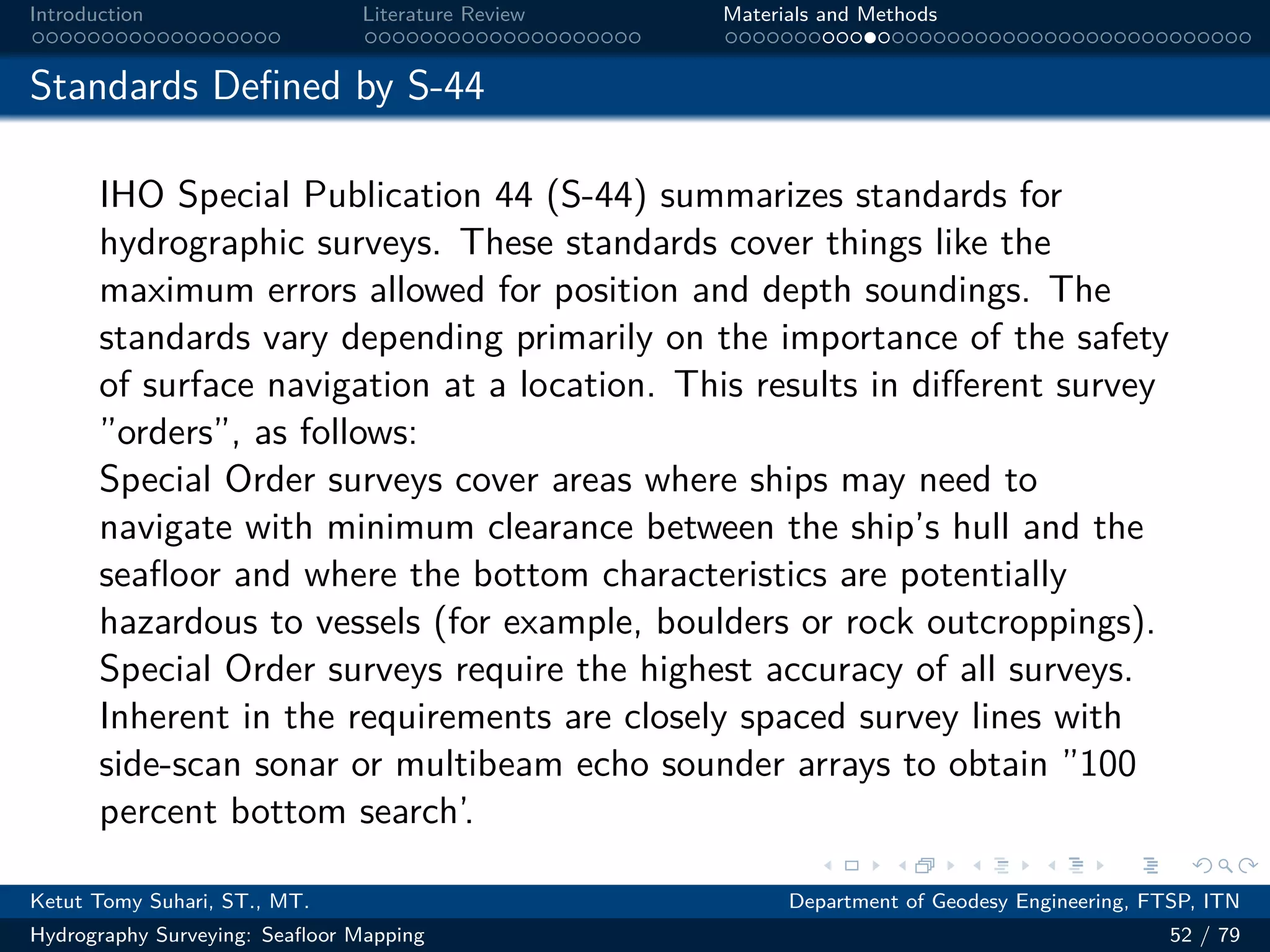
Standards Defined by S-44
IHO Special Publication 44 (S-44) summarizes standards for
hydrographic surveys. These standards cover things like the
maximum errors allowed for position and depth soundings. The
standards vary depending primarily on the importance of the safety
of surface navigation at a location. This results in different survey
”orders”, as follows:
Special Order surveys cover areas where ships may need to
navigate with minimum clearance between the ship’s hull and the
seafloor and where the bottom characteristics are potentially
hazardous to vessels (for example, boulders or rock outcroppings).
Special Order surveys require the highest accuracy of all surveys.
Inherent in the requirements are closely spaced survey lines with
side-scan sonar or multibeam echo sounder arrays to obtain ”100
percent bottom search’.
Ketut Tomy Suhari, ST., MT. Department of Geodesy Engineering, FTSP, ITN
Hydrography Surveying: Seafloor Mapping 52 / 79
.
.
.
.
.
.
.
.
.
.
.
.
.
.
.
.
.
.
.
.
.
.
.
.
.
.
.
.
.
.
.
.
.
.
.
.
.
.
.
.
Introduction Literature Review Materials and Methods
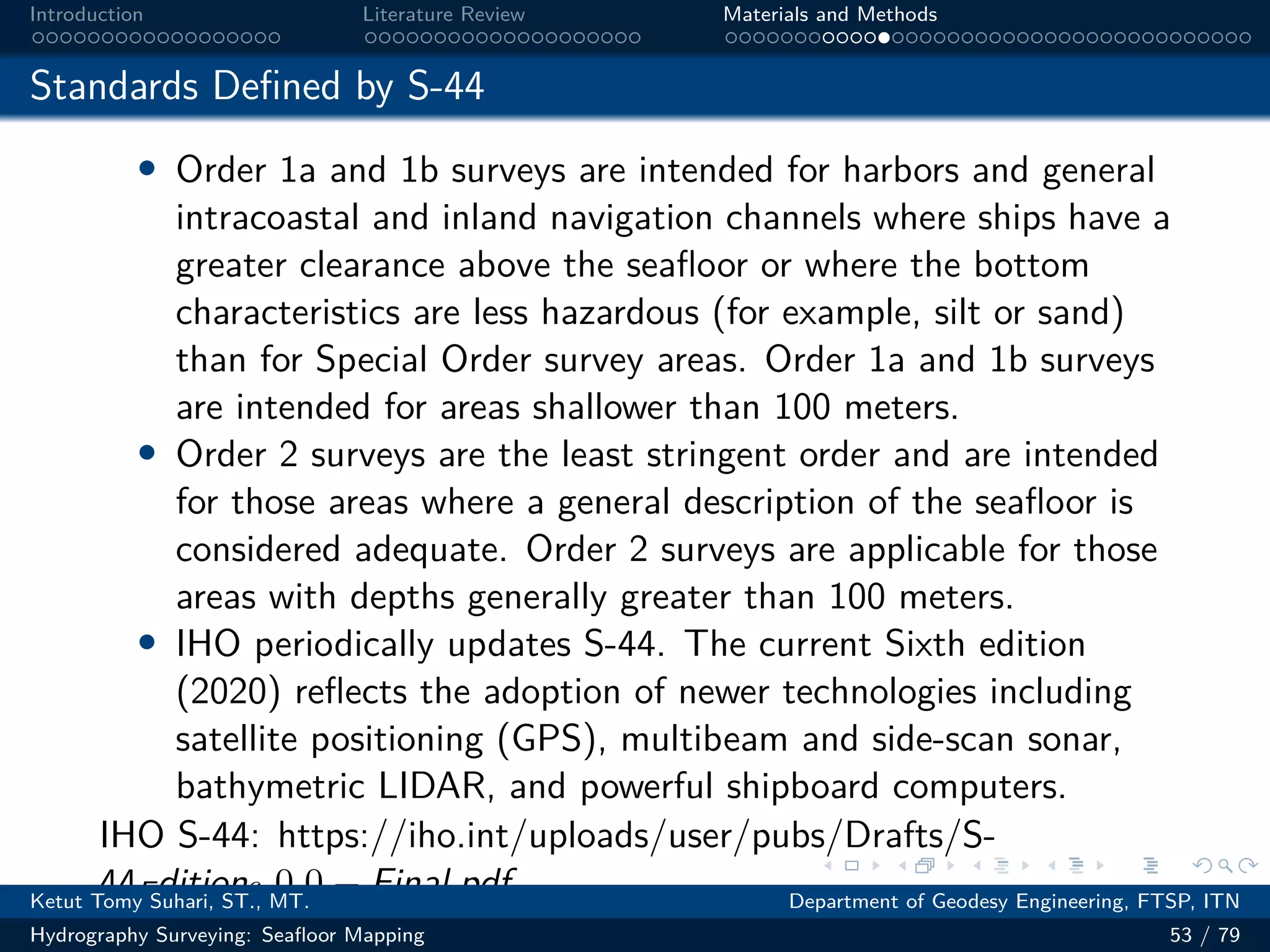
Standards Defined by S-44
• Order 1a and 1b surveys are intended for harbors and general
intracoastal and inland navigation channels where ships have a
greater clearance above the seafloor or where the bottom
characteristics are less hazardous (for example, silt or sand)
than for Special Order survey areas. Order 1a and 1b surveys
are intended for areas shallower than 100 meters.
• Order 2 surveys are the least stringent order and are intended
for those areas where a general description of the seafloor is
considered adequate. Order 2 surveys are applicable for those
areas with depths generally greater than 100 meters.
• IHO periodically updates S-44. The current Sixth edition
(2020) reflects the adoption of newer technologies including
satellite positioning (GPS), multibeam and side-scan sonar,
bathymetric LIDAR, and powerful shipboard computers.
IHO S-44: https://iho.int/uploads/user/pubs/Drafts/S-
44Edition6.0.0 − Final.pdf
Ketut Tomy Suhari, ST., MT. Department of Geodesy Engineering, FTSP, ITN
Hydrography Surveying: Seafloor Mapping 53 / 79
.
.
.
.
.
.
.
.
.
.
.
.
.
.
.
.
.
.
.
.
.
.
.
.
.
.
.
.
.
.
.
.
.
.
.
.
.
.
.
.
Introduction Literature Review Materials and Methods
1 Introduction
2 Literature Review
3 Materials and Methods
Type of Marine
International Hydrographic Organization
Positioning
Sounding Methods
Ketut Tomy Suhari, ST., MT. Department of Geodesy Engineering, FTSP, ITN
Hydrography Surveying: Seafloor Mapping 54 / 79
.
.
.
.
.
.
.
.
.
.
.
.
.
.
.
.
.
.
.
.
.
.
.
.
.
.
.
.
.
.
.
.
.
.
.
.
.
.
.
.
Introduction Literature Review Materials and Methods
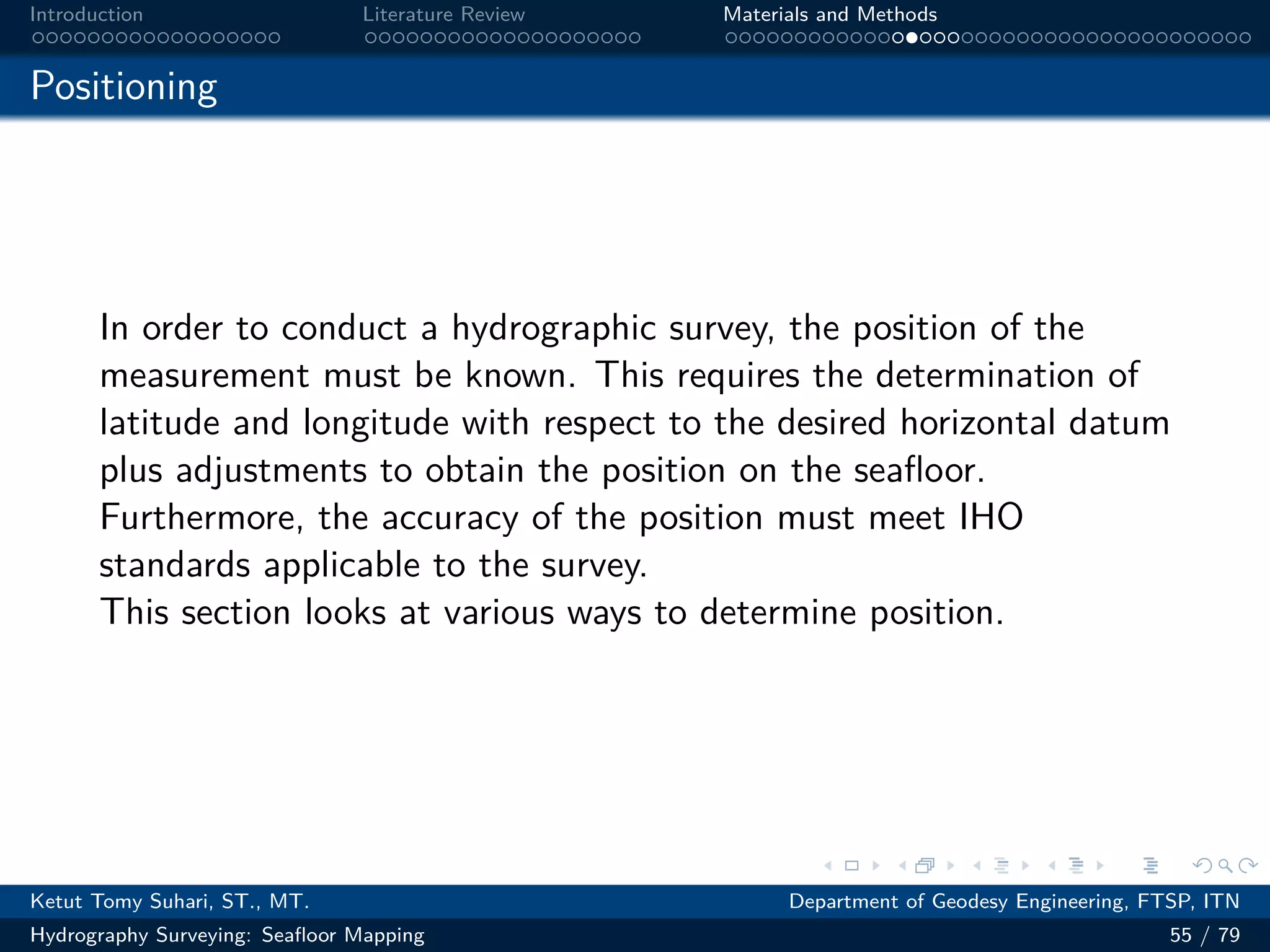
Positioning
In order to conduct a hydrographic survey, the position of the
measurement must be known. This requires the determination of
latitude and longitude with respect to the desired horizontal datum
plus adjustments to obtain the position on the seafloor.
Furthermore, the accuracy of the position must meet IHO
standards applicable to the survey.
This section looks at various ways to determine position.
Ketut Tomy Suhari, ST., MT. Department of Geodesy Engineering, FTSP, ITN
Hydrography Surveying: Seafloor Mapping 55 / 79
.
.
.
.
.
.
.
.
.
.
.
.
.
.
.
.
.
.
.
.
.
.
.
.
.
.
.
.
.
.
.
.
.
.
.
.
.
.
.
.
Introduction Literature Review Materials and Methods
Visual
For over two thousand years navigators have known how to
determine their latitude, initially using strings with knots to
measure the elevation of Polaris, the North Star. Progressively
more sophisticated instruments were developed over the years
(astrolabe, quadrant and cross-staff) that could determine latitude
from the sun or stars. Determining longitude was much more
difficult and depended on the development of precise portable
clocks that could operate aboard ships. This occurred in the
1770’s shortly after the production of the first sextant in 1759. In
1771 it was suggested that sextants be used to measure horizontal
angles between three or more known points on shore to determine
one’s position at sea.
Ketut Tomy Suhari, ST., MT. Department of Geodesy Engineering, FTSP, ITN
Hydrography Surveying: Seafloor Mapping 56 / 79
.
.
.
.
.
.
.
.
.
.
.
.
.
.
.
.
.
.
.
.
.
.
.
.
.
.
.
.
.
.
.
.
.
.
.
.
.
.
.
.
Introduction Literature Review Materials and Methods
Visual
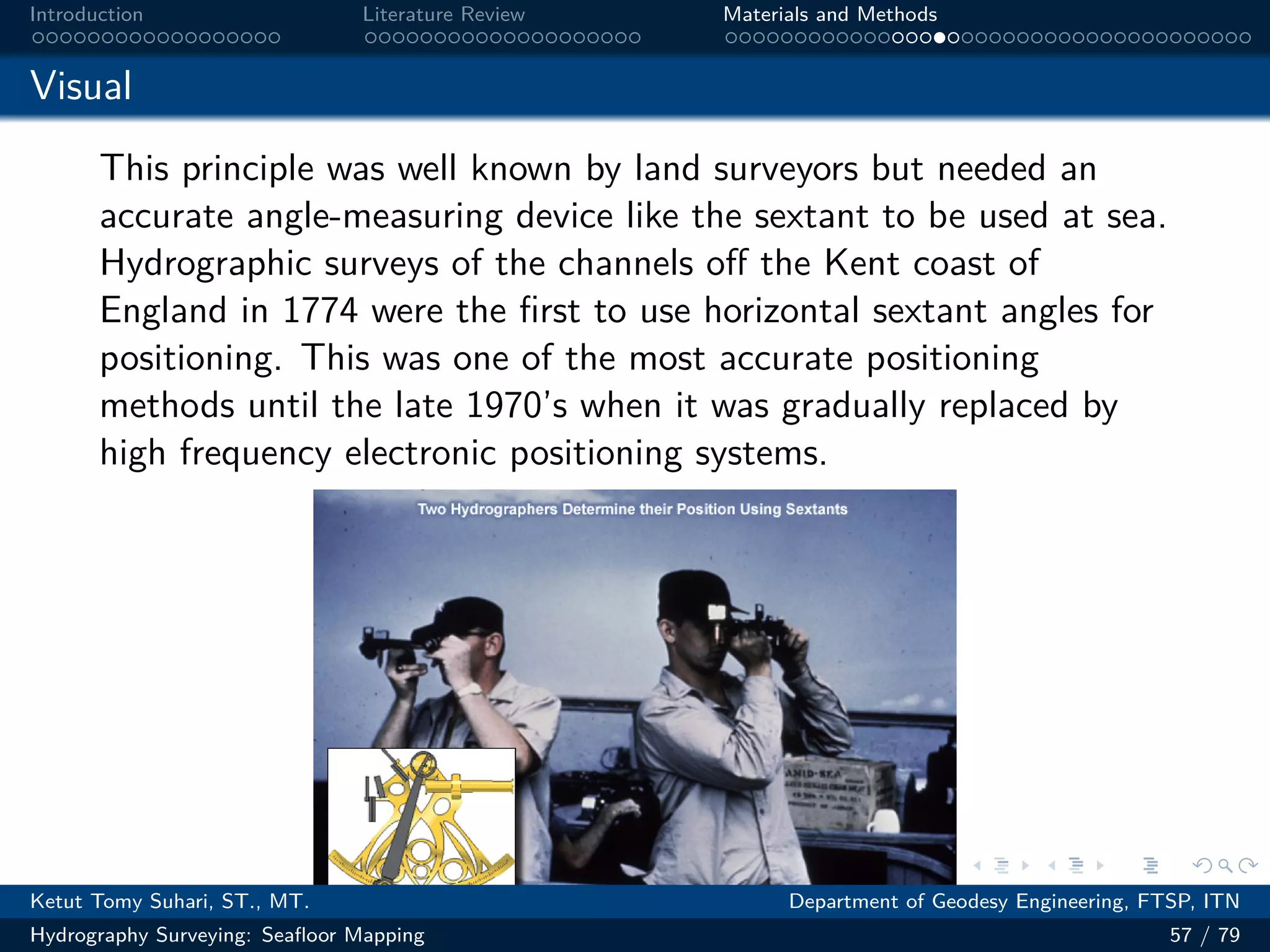
This principle was well known by land surveyors but needed an
accurate angle-measuring device like the sextant to be used at sea.
Hydrographic surveys of the channels off the Kent coast of
England in 1774 were the first to use horizontal sextant angles for
positioning. This was one of the most accurate positioning
methods until the late 1970’s when it was gradually replaced by
high frequency electronic positioning systems.
Ketut Tomy Suhari, ST., MT. Department of Geodesy Engineering, FTSP, ITN
Hydrography Surveying: Seafloor Mapping 57 / 79
.
.
.
.
.
.
.
.
.
.
.
.
.
.
.
.
.
.
.
.
.
.
.
.
.
.
.
.
.
.
.
.
.
.
.
.
.
.
.
.
Introduction Literature Review Materials and Methods
Satellite (GPS)
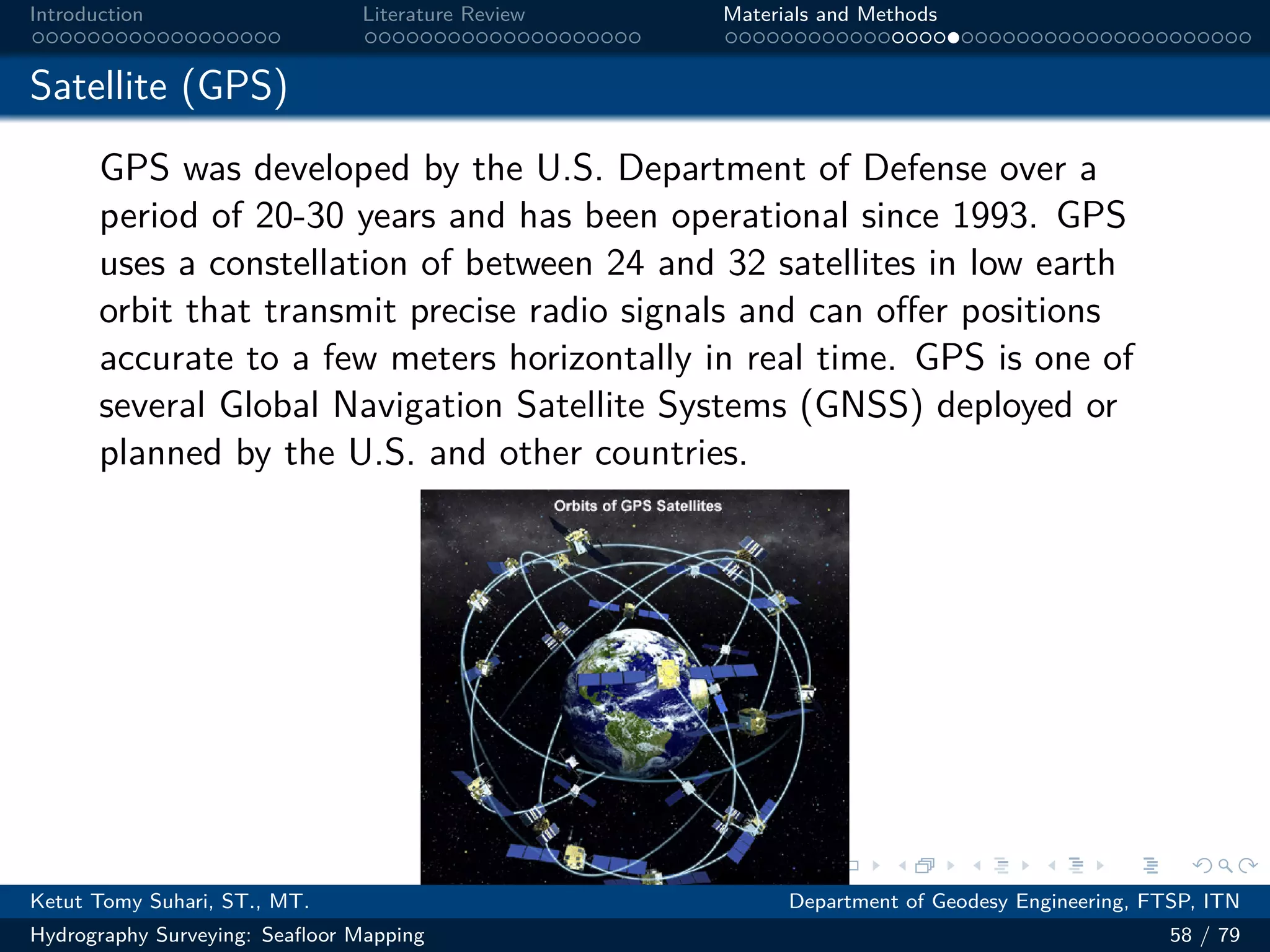
GPS was developed by the U.S. Department of Defense over a
period of 20-30 years and has been operational since 1993. GPS
uses a constellation of between 24 and 32 satellites in low earth
orbit that transmit precise radio signals and can offer positions
accurate to a few meters horizontally in real time. GPS is one of
several Global Navigation Satellite Systems (GNSS) deployed or
planned by the U.S. and other countries.
Ketut Tomy Suhari, ST., MT. Department of Geodesy Engineering, FTSP, ITN
Hydrography Surveying: Seafloor Mapping 58 / 79
.
.
.
.
.
.
.
.
.
.
.
.
.
.
.
.
.
.
.
.
.
.
.
.
.
.
.
.
.
.
.
.
.
.
.
.
.
.
.
.
Introduction Literature Review Materials and Methods
1 Introduction
2 Literature Review
3 Materials and Methods
Type of Marine
International Hydrographic Organization
Positioning
Sounding Methods
Ketut Tomy Suhari, ST., MT. Department of Geodesy Engineering, FTSP, ITN
Hydrography Surveying: Seafloor Mapping 59 / 79
.
.
.
.
.
.
.
.
.
.
.
.
.
.
.
.
.
.
.
.
.
.
.
.
.
.
.
.
.
.
.
.
.
.
.
.
.
.
.
.
Introduction Literature Review Materials and Methods
Sounding Methods
Soundings are measurements of water depth. Soundings paired
with their respective positions allow hydrographers to create
bathymetric maps. And just as positions must conform to IHO
guidelines, soundings must as well.
This section looks at sounding methods, from historical methods
up through the state-of-the-art.
Ketut Tomy Suhari, ST., MT. Department of Geodesy Engineering, FTSP, ITN
Hydrography Surveying: Seafloor Mapping 60 / 79
.
.
.
.
.
.
.
.
.
.
.
.
.
.
.
.
.
.
.
.
.
.
.
.
.
.
.
.
.
.
.
.
.
.
.
.
.
.
.
.
Introduction Literature Review Materials and Methods
Historical Methods: Lead Line / Sounding Pole
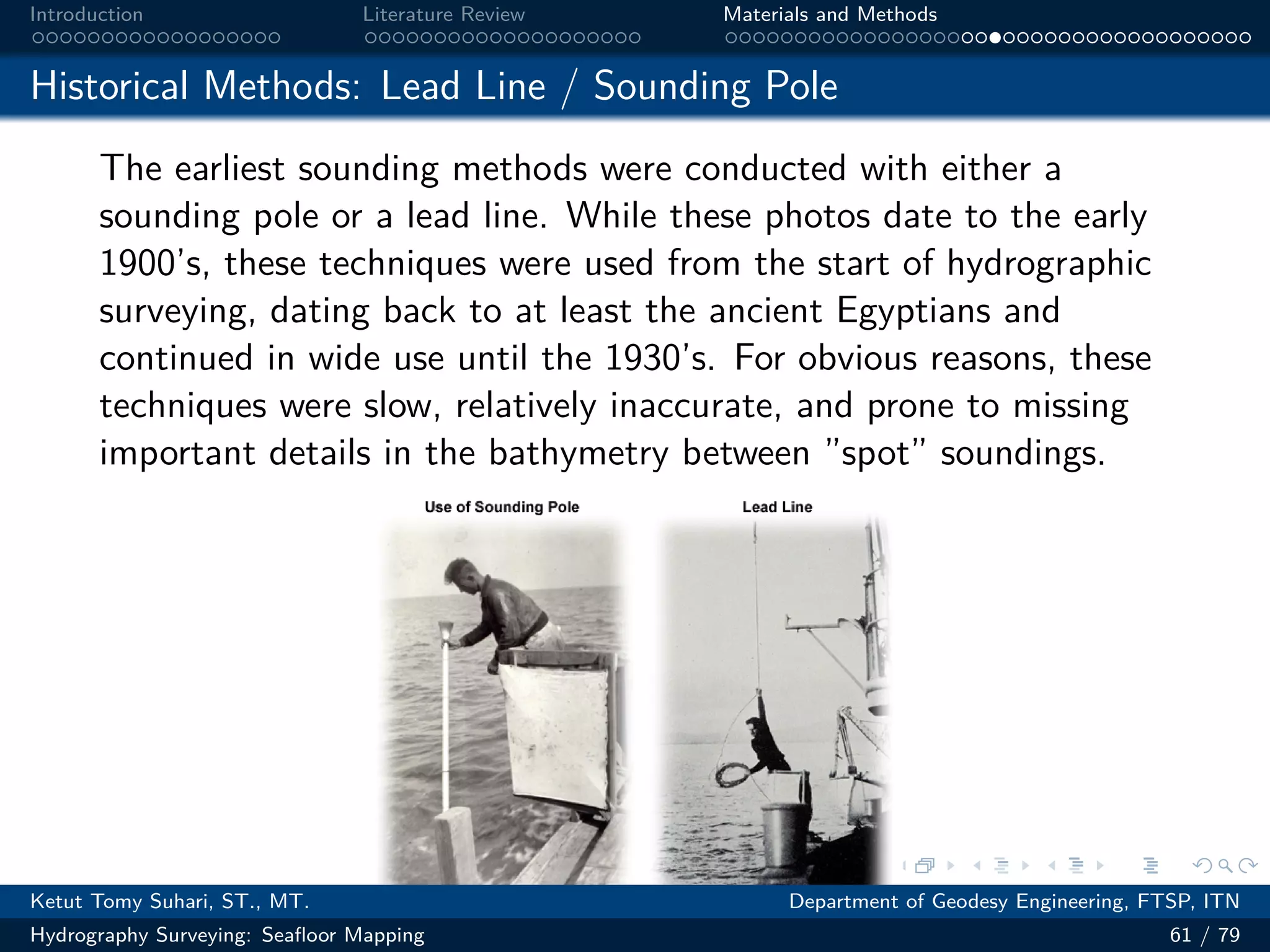
The earliest sounding methods were conducted with either a
sounding pole or a lead line. While these photos date to the early
1900’s, these techniques were used from the start of hydrographic
surveying, dating back to at least the ancient Egyptians and
continued in wide use until the 1930’s. For obvious reasons, these
techniques were slow, relatively inaccurate, and prone to missing
important details in the bathymetry between ”spot” soundings.
Ketut Tomy Suhari, ST., MT. Department of Geodesy Engineering, FTSP, ITN
Hydrography Surveying: Seafloor Mapping 61 / 79
.
.
.
.
.
.
.
.
.
.
.
.
.
.
.
.
.
.
.
.
.
.
.
.
.
.
.
.
.
.
.
.
.
.
.
.
.
.
.
.
Introduction Literature Review Materials and Methods
Historical Methods: Wire Drag
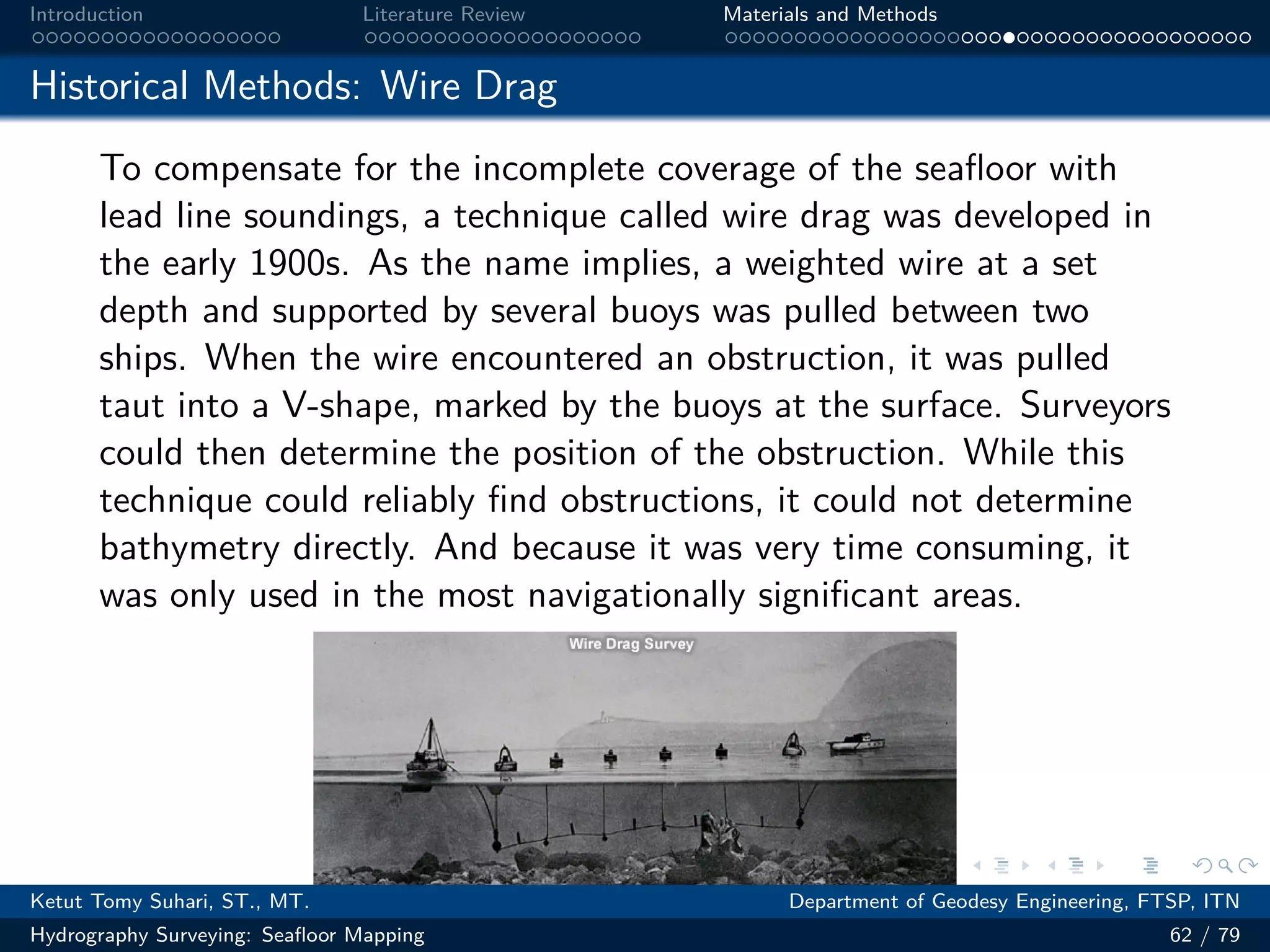
To compensate for the incomplete coverage of the seafloor with
lead line soundings, a technique called wire drag was developed in
the early 1900s. As the name implies, a weighted wire at a set
depth and supported by several buoys was pulled between two
ships. When the wire encountered an obstruction, it was pulled
taut into a V-shape, marked by the buoys at the surface. Surveyors
could then determine the position of the obstruction. While this
technique could reliably find obstructions, it could not determine
bathymetry directly. And because it was very time consuming, it
was only used in the most navigationally significant areas.
Ketut Tomy Suhari, ST., MT. Department of Geodesy Engineering, FTSP, ITN
Hydrography Surveying: Seafloor Mapping 62 / 79
.
.
.
.
.
.
.
.
.
.
.
.
.
.
.
.
.
.
.
.
.
.
.
.
.
.
.
.
.
.
.
.
.
.
.
.
.
.
.
.
Introduction Literature Review Materials and Methods
Historical Methods: Acoustic Methods
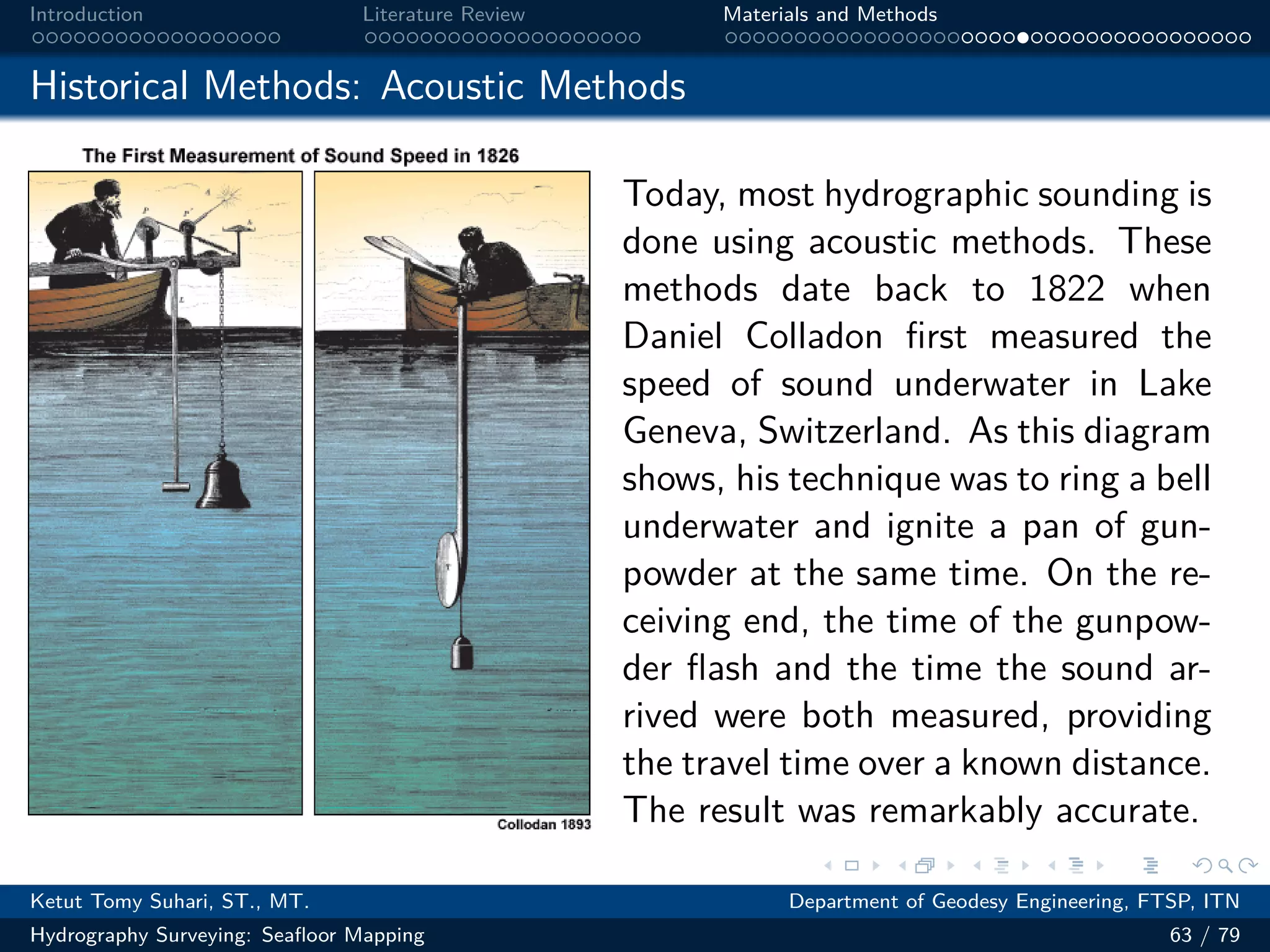
Today, most hydrographic sounding is
done using acoustic methods. These
methods date back to 1822 when
Daniel Colladon first measured the
speed of sound underwater in Lake
Geneva, Switzerland. As this diagram
shows, his technique was to ring a bell
underwater and ignite a pan of gun-
powder at the same time. On the re-
ceiving end, the time of the gunpow-
der flash and the time the sound ar-
rived were both measured, providing
the travel time over a known distance.
The result was remarkably accurate.
Ketut Tomy Suhari, ST., MT. Department of Geodesy Engineering, FTSP, ITN
Hydrography Surveying: Seafloor Mapping 63 / 79
.
.
.
.
.
.
.
.
.
.
.
.
.
.
.
.
.
.
.
.
.
.
.
.
.
.
.
.
.
.
.
.
.
.
.
.
.
.
.
.
Introduction Literature Review Materials and Methods
Historical Methods: Acoustic Methods
Fast-forward about three decades and LT John Mercer Brooke of
the U.S. Navy invented the first successful deep-sea sounding
device in 1850. But it wasn’t until almost a century after Dr.
Colladon measured sound speed underwater that Dr. Harvey Hayes
invented the Sonic Depth Finder in 1919. His instrument consisted
of
• a transmitter to generate and send sound waves to the ocean
floor,
• a receiver to detect the reflected waves, and
• a timer calibrated at the speed of sound in seawater that
directly indicated water depth.
The U.S. Navy installed the Sonic Depth Finder on U.S.S. Stewart
in 1922. This chart shows soundings across the Straits of Gibraltar
measured aboard the U.S.S. Stewart on its first voyage with the
sounder.
Ketut Tomy Suhari, ST., MT. Department of Geodesy Engineering, FTSP, ITN
Hydrography Surveying: Seafloor Mapping 64 / 79
.
.
.
.
.
.
.
.
.
.
.
.
.
.
.
.
.
.
.
.
.
.
.
.
.
.
.
.
.
.
.
.
.
.
.
.
.
.
.
.
Introduction Literature Review Materials and Methods
Single Beam Echo Sounder
With single beam echosounders, the sound is transmitted straight
down in a focused beam, typically a 3-20° cone. This yields a
single depth measurement from somewhere inside the cone. Taken
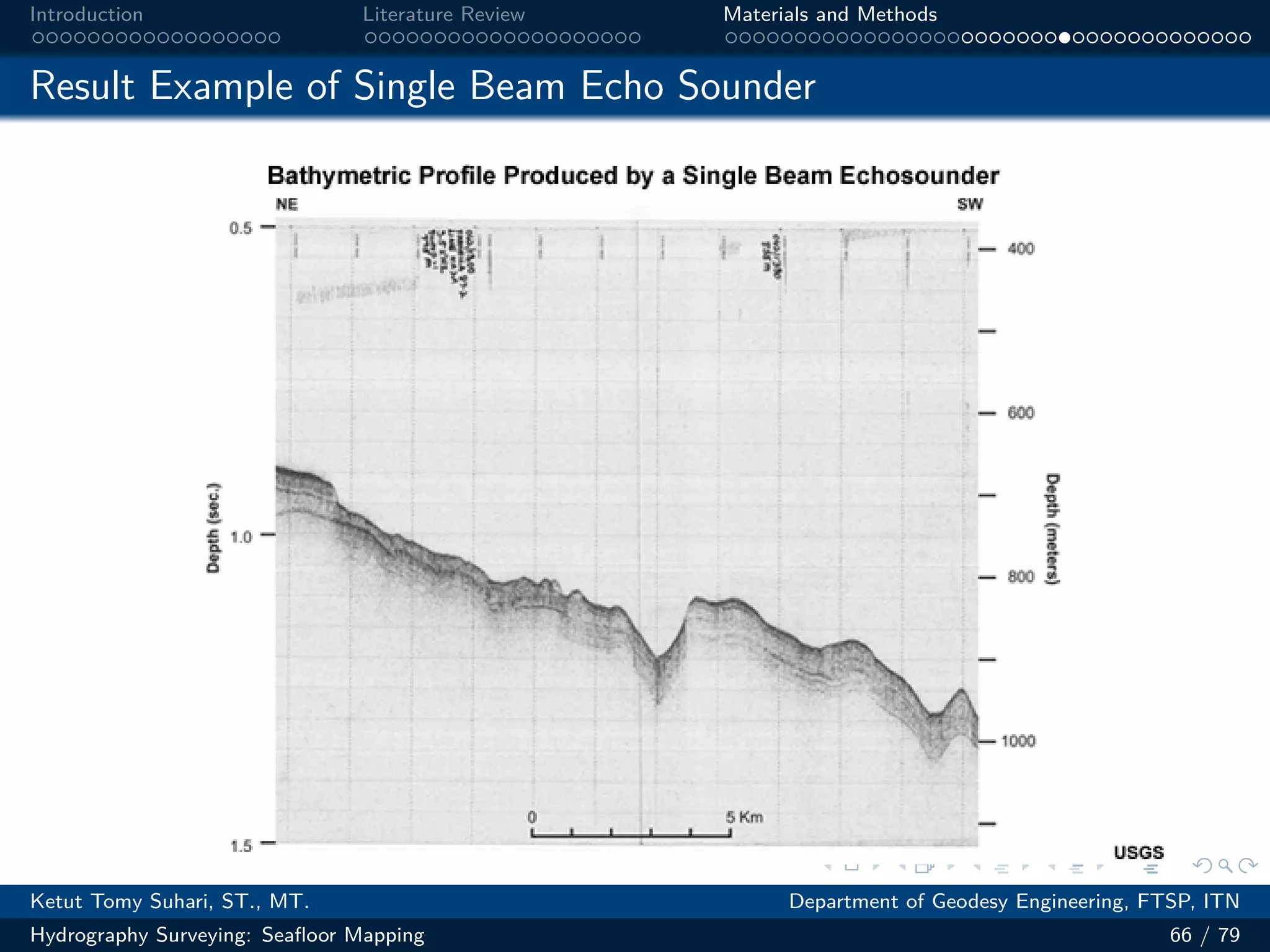
in a continuous string, a single beam echosounder produces a
seafloor profile like that shown here.
One misconception about single beam echosounders is that they
somehow record the average depth within the area of the cone on
the seafloor. Actually, the first sound return for each ”ping” is used
as the depth. Therefore, the shallowest depth within the cone is
recorded. In areas with a rough seafloor and/or large relief, this
means that the ”least depth” within the cone of transmitted sound
is recorded, not the average depth.
Ketut Tomy Suhari, ST., MT. Department of Geodesy Engineering, FTSP, ITN
Hydrography Surveying: Seafloor Mapping 65 / 79
.
.
.
.
.
.
.
.
.
.
.
.
.
.
.
.
.
.
.
.
.
.
.
.
.
.
.
.
.
.
.
.
.
.
.
.
.
.
.
.
Introduction Literature Review Materials and Methods
Result Example of Single Beam Echo Sounder
图 27: 图片
Ketut Tomy Suhari, ST., MT. Department of Geodesy Engineering, FTSP, ITN
Hydrography Surveying: Seafloor Mapping 66 / 79
.
.
.
.
.
.
.
.
.
.
.
.
.
.
.
.
.
.
.
.
.
.
.
.
.
.
.
.
.
.
.
.
.
.
.
.
.
.
.
.
Introduction Literature Review Materials and Methods
Single Beam Echo Sounder
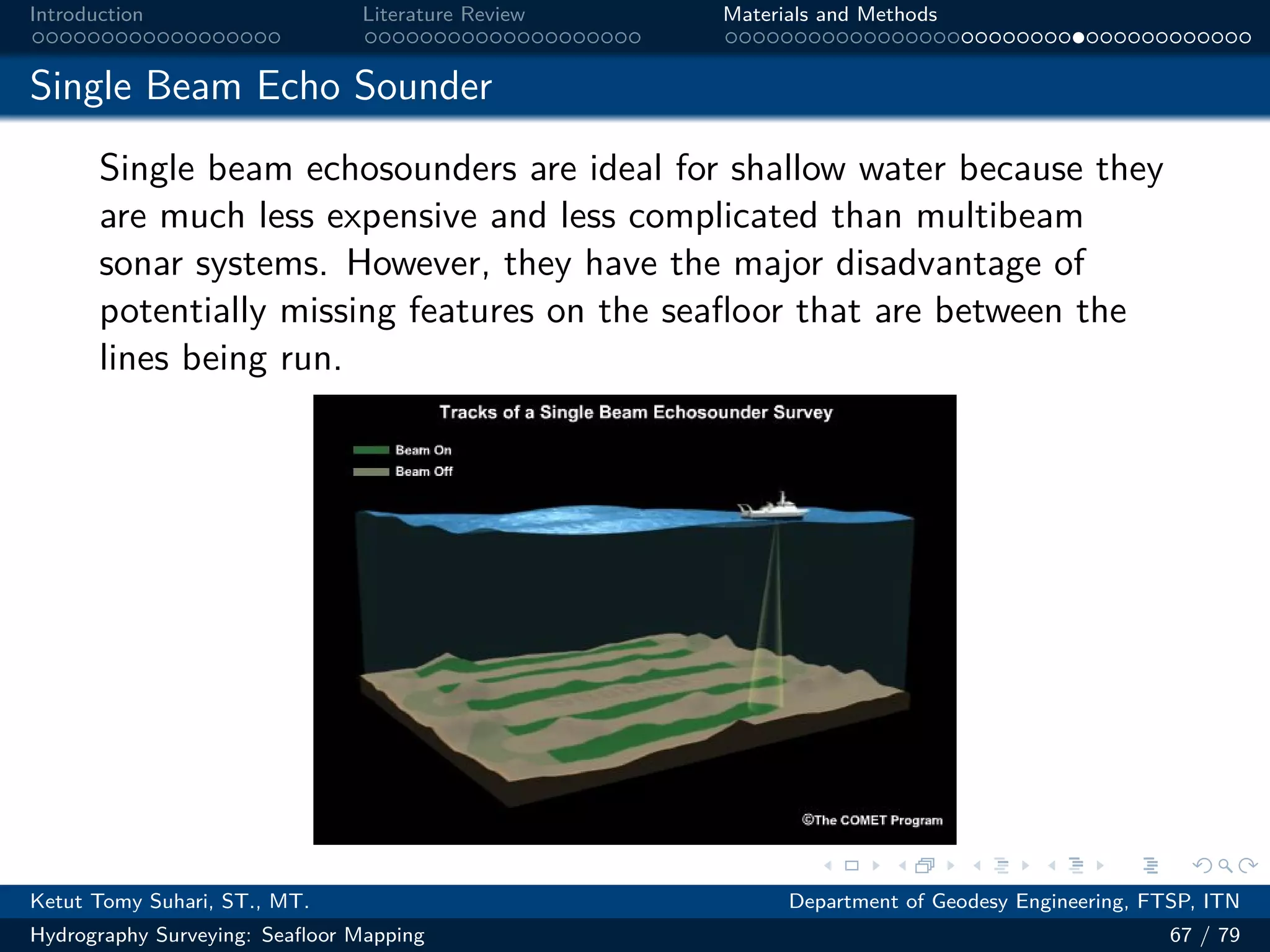
Single beam echosounders are ideal for shallow water because they
are much less expensive and less complicated than multibeam
sonar systems. However, they have the major disadvantage of
potentially missing features on the seafloor that are between the
lines being run.
图 28: 图片
Ketut Tomy Suhari, ST., MT. Department of Geodesy Engineering, FTSP, ITN
Hydrography Surveying: Seafloor Mapping 67 / 79
.
.
.
.
.
.
.
.
.
.
.
.
.
.
.
.
.
.
.
.
.
.
.
.
.
.
.
.
.
.
.
.
.
.
.
.
.
.
.
.
Introduction Literature Review Materials and Methods
Single Beam Corrections
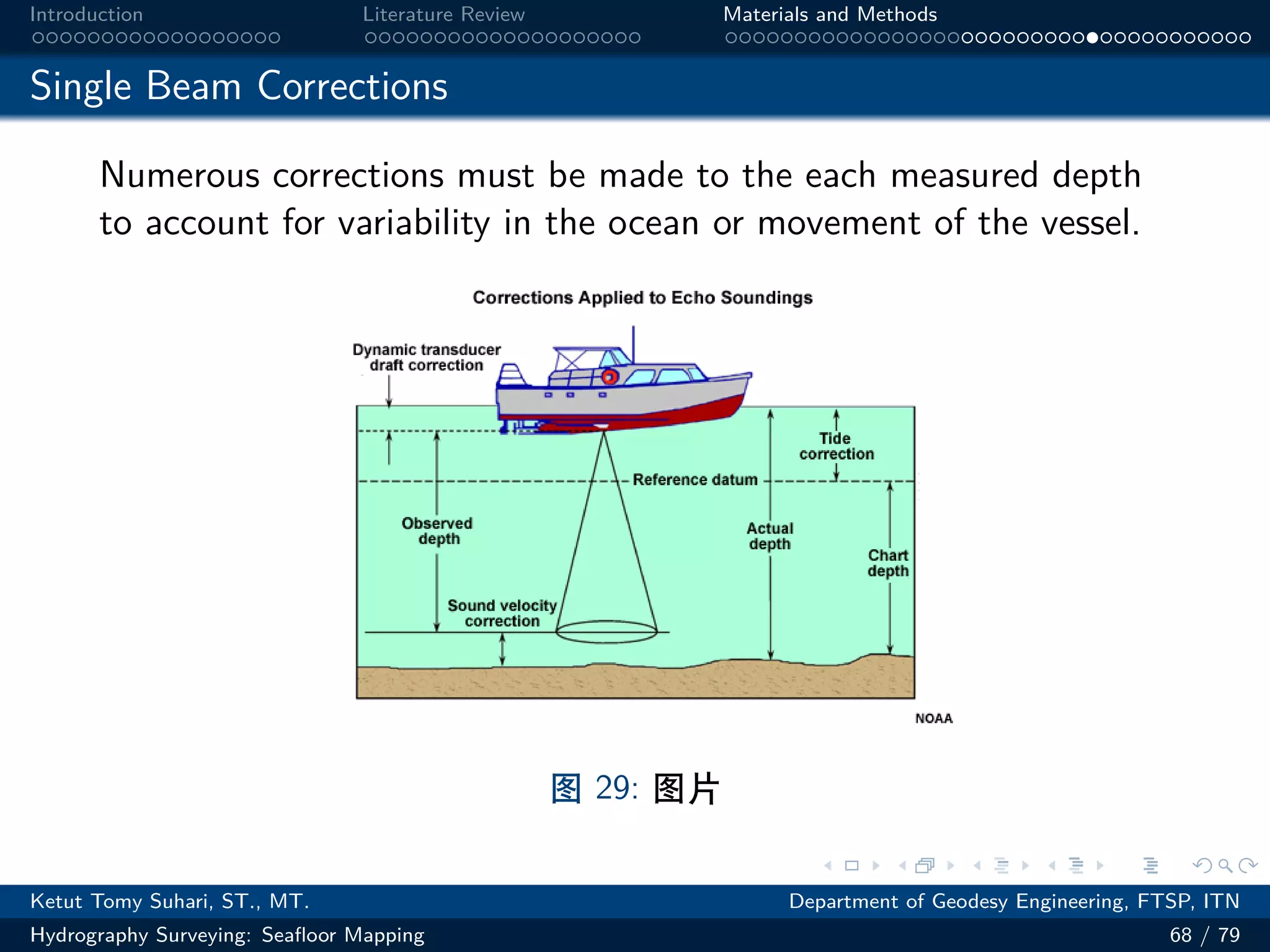
Numerous corrections must be made to the each measured depth
to account for variability in the ocean or movement of the vessel.
图 29: 图片
Ketut Tomy Suhari, ST., MT. Department of Geodesy Engineering, FTSP, ITN
Hydrography Surveying: Seafloor Mapping 68 / 79
.
.
.
.
.
.
.
.
.
.
.
.
.
.
.
.
.
.
.
.
.
.
.
.
.
.
.
.
.
.
.
.
.
.
.
.
.
.
.
.
Introduction Literature Review Materials and Methods
Single Beam Corrections
The raw data recorded for single beam echosounder measurements
consist of the time it takes for a sound pulse to travel to the
seafloor and return (the 2-way travel time). By assuming a fixed
velocity at which sound travels through seawater, this time can be
used to compute the ”Observed Depth” in the above figure. In
reality, unless seas are extremely calm, vessels move up and down
over the waves (called heave) and this movement needs to be
removed to obtain an accurate ”Observed Depth”. Pitch (bow
moving up and down) and roll look like heave on a single beam
record.
Because the sound speed is not constant throughout the water
column, a correction needs to be determined and applied to each
”Observed Depth”. The ”sound velocity profile” is typically
measured with a sound velocimeter, which is lowered through the
water column, or calculated from a temperature/salinity profile.
Ketut Tomy Suhari, ST., MT. Department of Geodesy Engineering, FTSP, ITN
Hydrography Surveying: Seafloor Mapping 69 / 79
.
.
.
.
.
.
.
.
.
.
.
.
.
.
.
.
.
.
.
.
.
.
.
.
.
.
.
.
.
.
.
.
.
.
.
.
.
.
.
.
Introduction Literature Review Materials and Methods
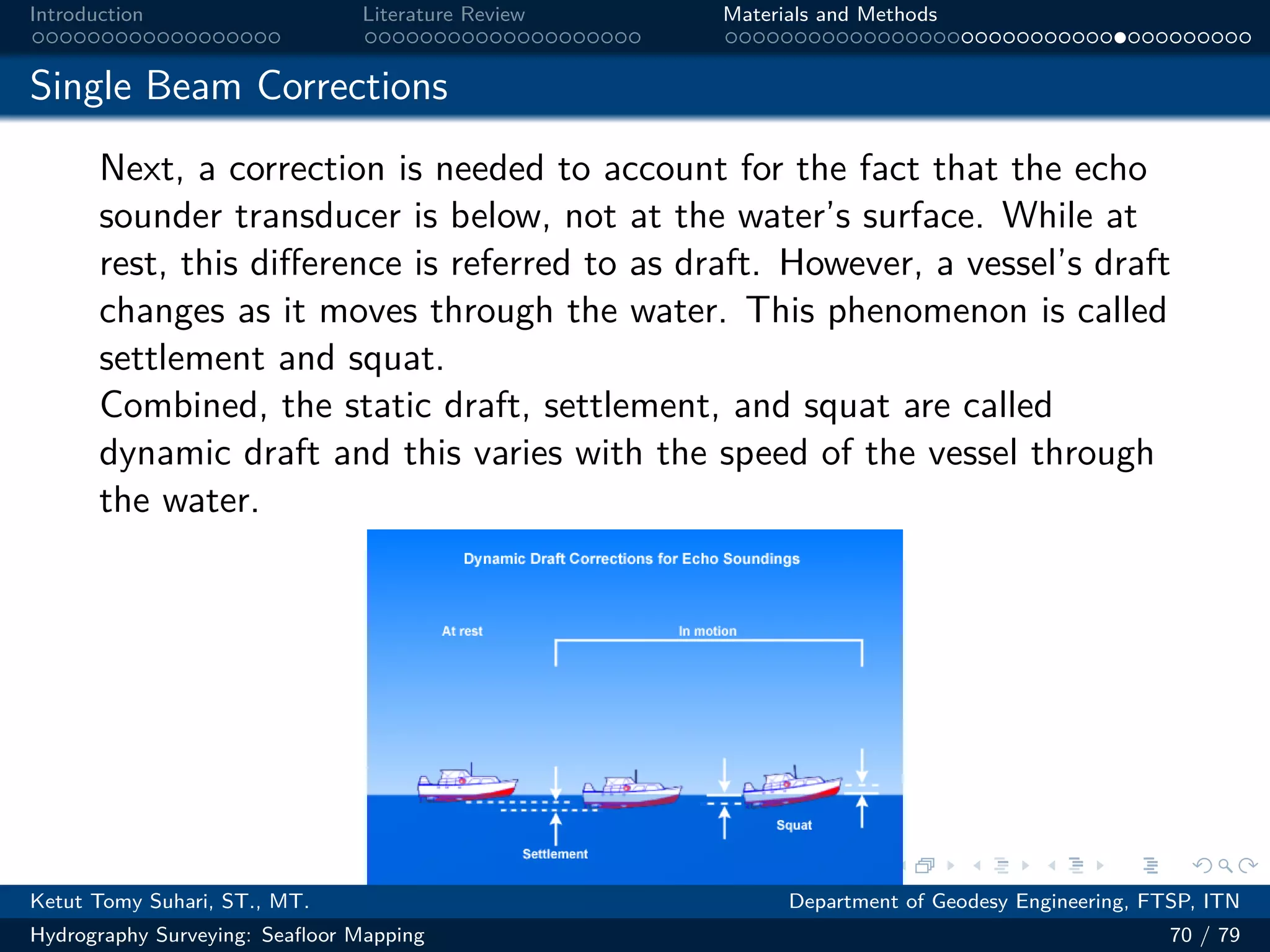
Single Beam Corrections
Next, a correction is needed to account for the fact that the echo
sounder transducer is below, not at the water’s surface. While at
rest, this difference is referred to as draft. However, a vessel’s draft
changes as it moves through the water. This phenomenon is called
settlement and squat.
Combined, the static draft, settlement, and squat are called
dynamic draft and this varies with the speed of the vessel through
the water.
Ketut Tomy Suhari, ST., MT. Department of Geodesy Engineering, FTSP, ITN
Hydrography Surveying: Seafloor Mapping 70 / 79
.
.
.
.
.
.
.
.
.
.
.
.
.
.
.
.
.
.
.
.
.
.
.
.
.
.
.
.
.
.
.
.
.
.
.
.
.
.
.
.
Introduction Literature Review Materials and Methods
Single Beam Corrections
Finally, a correction needs to be made to take into account the rise
and fall of the tide . Tides are discussed separately in a later
section of this module.
Positioning also has corrections. There is a horizontal offset
between the GPS receiver and the sonar transmitter/receiver that
needs to be applied. A time delay exists between the arrival of the
GPS signal and the recording of the position, generally fractions of
a second. Because the vessel is moving, the recorded position
needs to be corrected for the time delay.
Ketut Tomy Suhari, ST., MT. Department of Geodesy Engineering, FTSP, ITN
Hydrography Surveying: Seafloor Mapping 71 / 79
.
.
.
.
.
.
.
.
.
.
.
.
.
.
.
.
.
.
.
.
.
.
.
.
.
.
.
.
.
.
.
.
.
.
.
.
.
.
.
.
Introduction Literature Review Materials and Methods
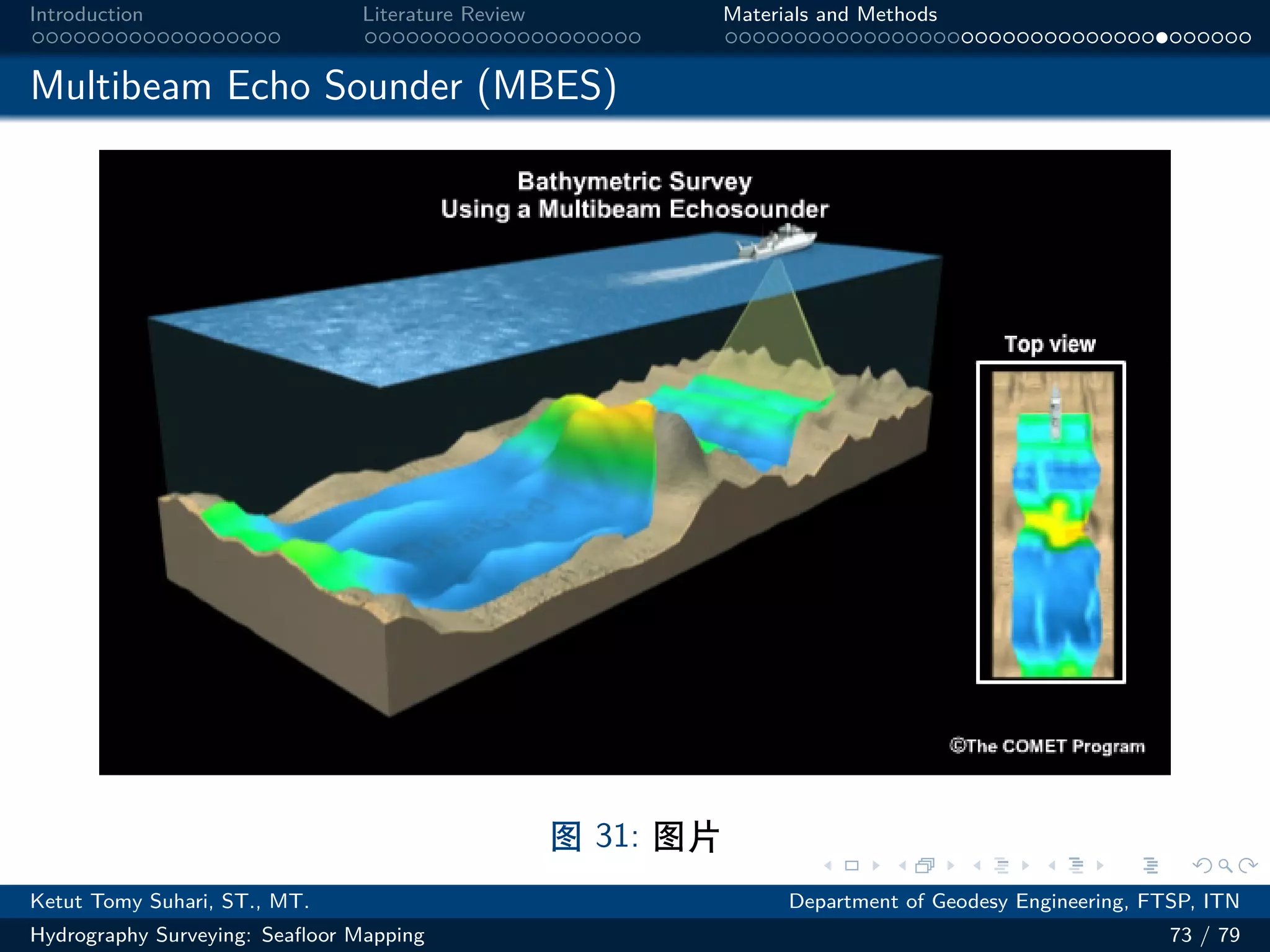
Multibeam Echo Sounder (MBES)
Multibeam echosounders use many narrow, focused beams
(16-1400) to map a swath of seafloor. Each beam returns one
depth measurement. The width of the swath can equal from 2 to
more than 5 times the water depth. This width depends on many
factors including the frequency of the beams, the configuration of
the transmitting and receiving transducers, the water depth, and
the sound velocity profile in the water column.
Multibeam echosounders are most efficient in deep water because
of the wide area of coverage which increases with depth. In shallow
water, many more survey lines must be run to cover the same area.
One complication of multibeam echosounders is that they produce
vast quantities of data and thus require specialized computer
systems and software to collect and analyze that data. Despite
these challenges, multibeam echosounders are used for most
hydrographic surveys when conditions are applicable.
Ketut Tomy Suhari, ST., MT. Department of Geodesy Engineering, FTSP, ITN
Hydrography Surveying: Seafloor Mapping 72 / 79
.
.
.
.
.
.
.
.
.
.
.
.
.
.
.
.
.
.
.
.
.
.
.
.
.
.
.
.
.
.
.
.
.
.
.
.
.
.
.
.
Introduction Literature Review Materials and Methods
Multibeam Echo Sounder (MBES)
图 31: 图片
Ketut Tomy Suhari, ST., MT. Department of Geodesy Engineering, FTSP, ITN
Hydrography Surveying: Seafloor Mapping 73 / 79
.
.
.
.
.
.
.
.
.
.
.
.
.
.
.
.
.
.
.
.
.
.
.
.
.
.
.
.
.
.
.
.
.
.
.
.
.
.
.
.
Introduction Literature Review Materials and Methods
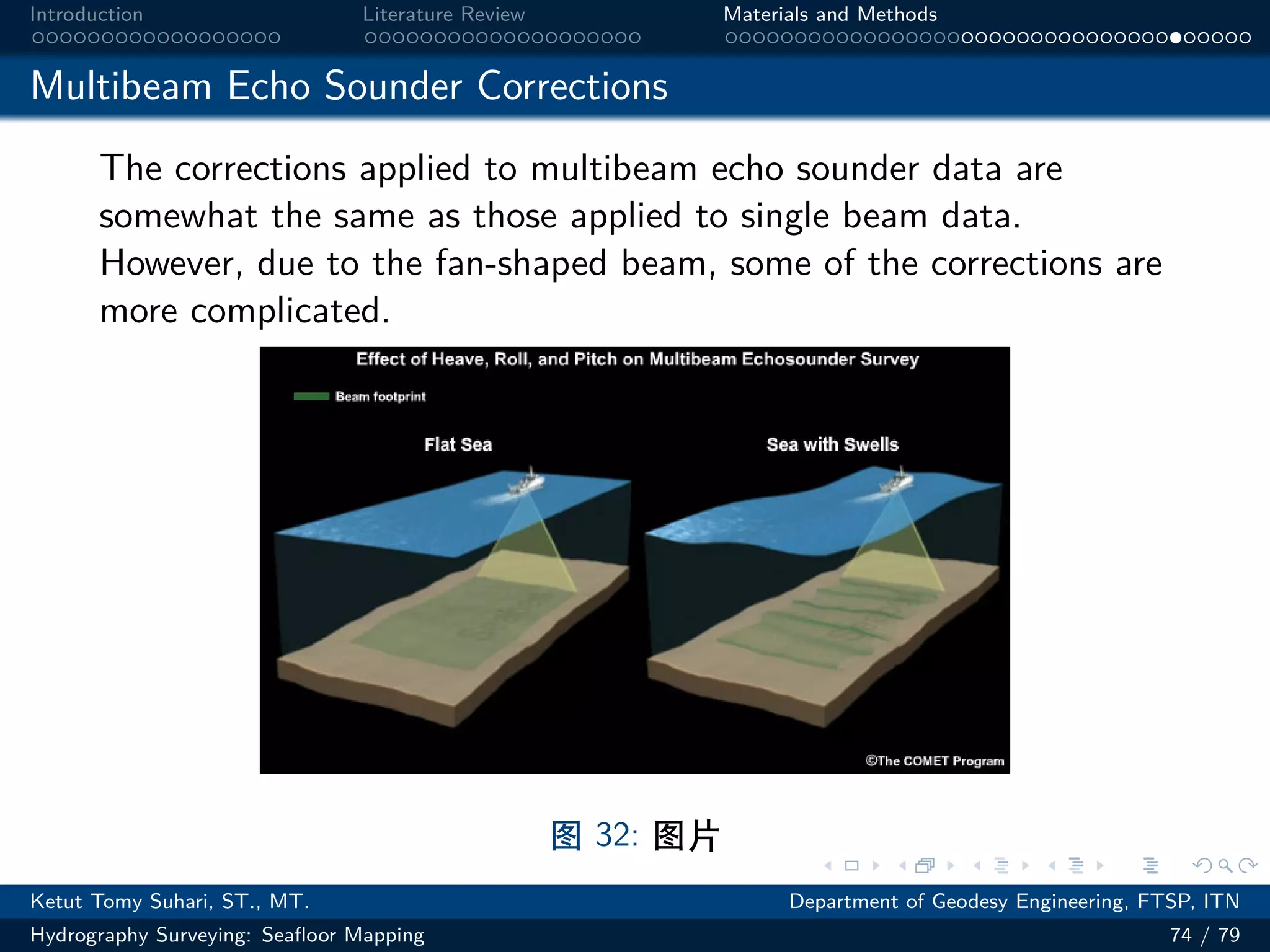
Multibeam Echo Sounder Corrections
The corrections applied to multibeam echo sounder data are
somewhat the same as those applied to single beam data.
However, due to the fan-shaped beam, some of the corrections are
more complicated.
图 32: 图片
Ketut Tomy Suhari, ST., MT. Department of Geodesy Engineering, FTSP, ITN
Hydrography Surveying: Seafloor Mapping 74 / 79
.
.
.
.
.
.
.
.
.
.
.
.
.
.
.
.
.
.
.
.
.
.
.
.
.
.
.
.
.
.
.
.
.
.
.
.
.
.
.
.
Introduction Literature Review Materials and Methods
Multibeam Echo Sounder Corrections
For single beam echo sounders, one beam is pointed down nearly
vertically so vessel orientation is not critical and all corrections due
to vessel motion can be corrected by applying appropriate
correctors for heave, settlement, and squat. For multibeam, the
equipment used to measure vessel motion is called a
Heave-Roll-Pitch (HRP) sensor and it is placed as close as possible
to the vessel’s center of motion and oriented along the ship’s keel.
Measurements are then made to determine the position of the
multibeam sonar and GPS receiver relative to the position of the
HRP sensor. These ”offsets” are applied during data acquisition to
properly orient all of the sensor measurements. Measurements
from the HRP sensor are used to determine the correct position for
each and every sounding in the multibeam fan. This graphic shows
an example of how irregular the multibeam path can be with
heave, roll, and pitch.
Ketut Tomy Suhari, ST., MT. Department of Geodesy Engineering, FTSP, ITN
Hydrography Surveying: Seafloor Mapping 75 / 79
.
.
.
.
.
.
.
.
.
.
.
.
.
.
.
.
.
.
.
.
.
.
.
.
.
.
.
.
.
.
.
.
.
.
.
.
.
.
.
.
Introduction Literature Review Materials and Methods
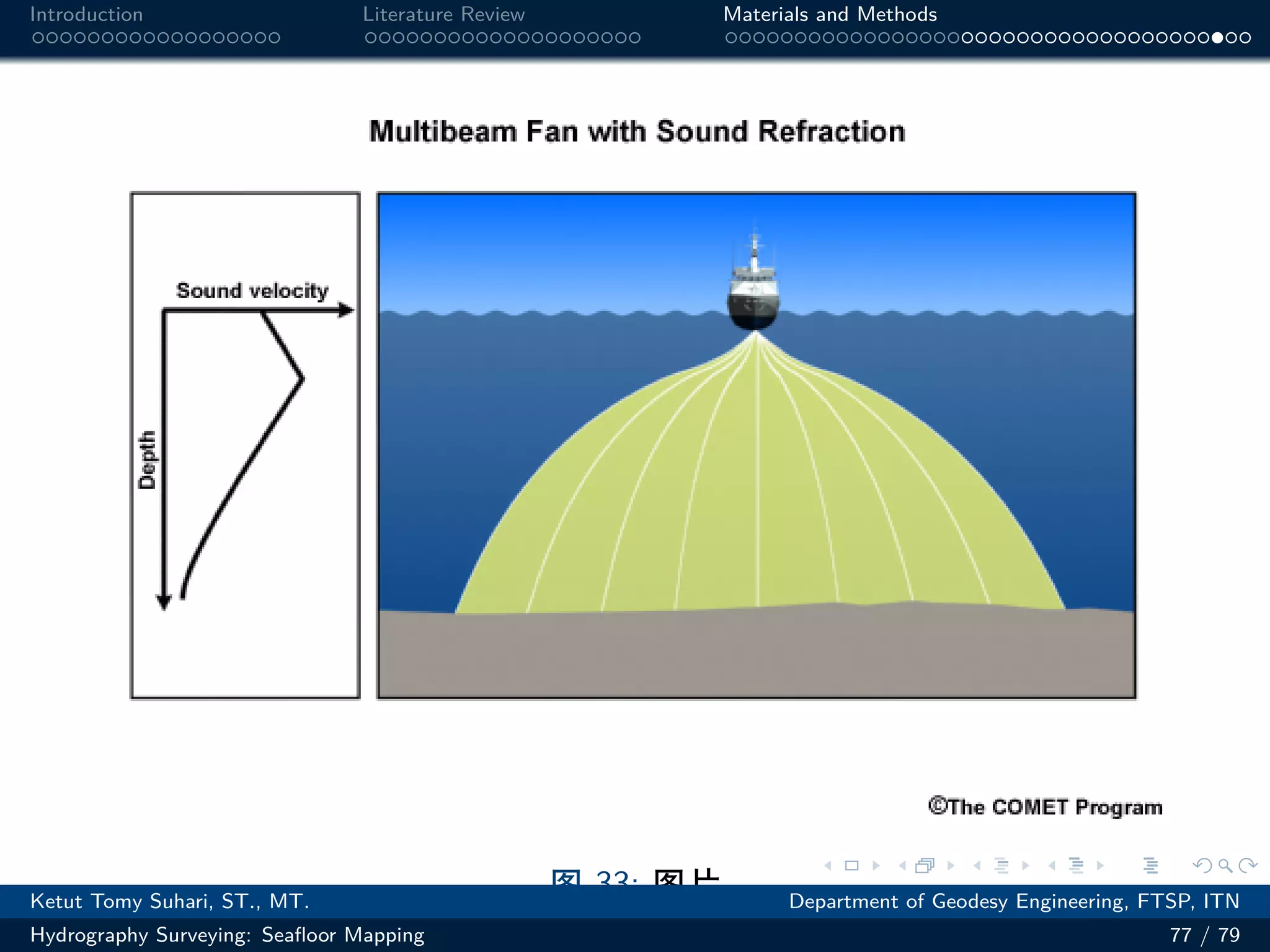
Multibeam Echo Sounder Corrections
The determination of the sound velocity profile is much more
critical for multibeam systems because of the fact that most of the
beams are not vertical –they fan out across a wide range of angles.
The non-vertical beams that pass through the water are bent or
”refracted” due to the changing velocity of sound in the water
column, which if uncorrected, would yield incorrect depths and
positions.
The sound velocity profile can vary significantly over short times
and distances, particularly in shallow water. These variations result
from several causes, including daily heating and cooling, surface
runoff from nearby land, and cold or warm ocean currents. As a
result, sound velocity profiles must be determined frequently
throughout hydrographic surveys.
Ketut Tomy Suhari, ST., MT. Department of Geodesy Engineering, FTSP, ITN
Hydrography Surveying: Seafloor Mapping 76 / 79
.
.
.
.
.
.
.
.
.
.
.
.
.
.
.
.
.
.
.
.
.
.
.
.
.
.
.
.
.
.
.
.
.
.
.
.
.
.
.
.
Introduction Literature Review Materials and Methods
图 33: 图片
Ketut Tomy Suhari, ST., MT. Department of Geodesy Engineering, FTSP, ITN
Hydrography Surveying: Seafloor Mapping 77 / 79
.
.
.
.
.
.
.
.
.
.
.
.
.
.
.
.
.
.
.
.
.
.
.
.
.
.
.
.
.
.
.
.
.
.
.
.
.
.
.
.
Introduction Literature Review Materials and Methods
Example: Multibeam Echo Sounder
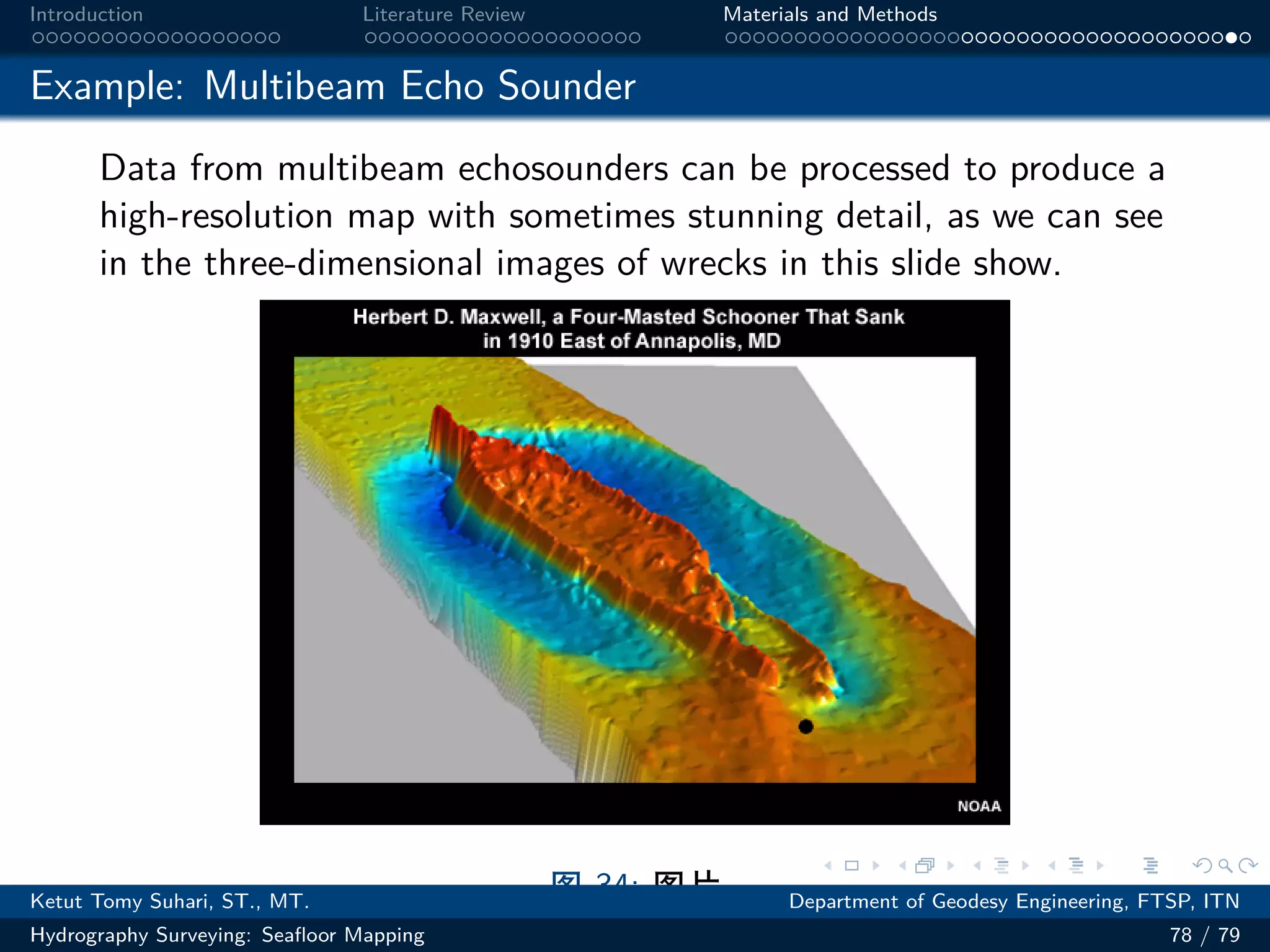
Data from multibeam echosounders can be processed to produce a
high-resolution map with sometimes stunning detail, as we can see
in the three-dimensional images of wrecks in this slide show.
图 34: 图片
Ketut Tomy Suhari, ST., MT. Department of Geodesy Engineering, FTSP, ITN
Hydrography Surveying: Seafloor Mapping 78 / 79
.
.
.
.
.
.
.
.
.
.
.
.
.
.
.
.
.
.
.
.
.
.
.
.
.
.
.
.
.
.
.
.
.
.
.
.
.
.
.
.
Introduction Literature Review Materials and Methods
Thanks!
Ketut Tomy Suhari, ST., MT. Department of Geodesy Engineering, FTSP, ITN
Hydrography Surveying: Seafloor Mapping 79 / 79

KTS-Hydrography Surveying-Introduction.pdf

  • 1.
    . . . . . . . . . . . . . . . . . . . . . . . . . . . . . . . . . . . . . . . . Introduction Literature ReviewMaterials and Methods Hydrography Surveying: Seafloor Mapping Introduction Ketut Tomy Suhari, ST., MT. Department of Geodesy Engineering Institut Teknologi Nasional Malang 2021 年 9 月 30 日 Ketut Tomy Suhari, ST., MT. Department of Geodesy Engineering, FTSP, ITN Hydrography Surveying: Seafloor Mapping 1 / 79
  • 2.
    . . . . . . . . . . . . . . . . . . . . . . . . . . . . . . . . . . . . . . . . Introduction Literature ReviewMaterials and Methods “DI LAUT TERSIMPAN HARAPAN, DI LAUT TERSIMPAN KEJAYAAN, JALESVEVA JAYAMAHE” Ketut Tomy Suhari, ST., MT. Department of Geodesy Engineering, FTSP, ITN Hydrography Surveying: Seafloor Mapping 2 / 79
  • 3.
    . . . . . . . . . . . . . . . . . . . . . . . . . . . . . . . . . . . . . . . . Introduction Literature ReviewMaterials and Methods 1 Introduction 2 Literature Review 3 Materials and Methods Ketut Tomy Suhari, ST., MT. Department of Geodesy Engineering, FTSP, ITN Hydrography Surveying: Seafloor Mapping 3 / 79
  • 4.
    . . . . . . . . . . . . . . . . . . . . . . . . . . . . . . . . . . . . . . . . Introduction Literature ReviewMaterials and Methods 1 Introduction Definition Principal Components Hydrographic Sciences Benefits 2 Literature Review 3 Materials and Methods Ketut Tomy Suhari, ST., MT. Department of Geodesy Engineering, FTSP, ITN Hydrography Surveying: Seafloor Mapping 4 / 79
  • 5.
    . . . . . . . . . . . . . . . . . . . . . . . . . . . . . . . . . . . . . . . . Introduction Literature ReviewMaterials and Methods 1 Introduction Definition Principal Components Hydrographic Sciences Benefits 2 Literature Review 3 Materials and Methods Ketut Tomy Suhari, ST., MT. Department of Geodesy Engineering, FTSP, ITN Hydrography Surveying: Seafloor Mapping 5 / 79
  • 6.
    . . . . . . . . . . . . . . . . . . . . . . . . . . . . . . . . . . . . . . . . Introduction Literature ReviewMaterials and Methods Definition • Hydrography means water mapping. That’s quite a broad definition and in fact has different meanings depending on the scientific discipline to which it refers. Oceanographers use the term to describe and map the physical characteristics of water such as temperature, salinity, and chemical content. Ketut Tomy Suhari, ST., MT. Department of Geodesy Engineering, FTSP, ITN Hydrography Surveying: Seafloor Mapping 6 / 79
  • 7.
    . . . . . . . . . . . . . . . . . . . . . . . . . . . . . . . . . . . . . . . . Introduction Literature ReviewMaterials and Methods Definition • Hydrography means water mapping. That’s quite a broad definition and in fact has different meanings depending on the scientific discipline to which it refers. Oceanographers use the term to describe and map the physical characteristics of water such as temperature, salinity, and chemical content. • Geographers and geologists use hydrography to define the water surface in the U.S. and the direction and volume of water flow between water bodies. Hydrography, as used in nautical charting, is focused on identifying hazards to safe navigation which includes shallow depths, shipwrecks, rocks, or other dangerous objects. The International Hydrographic Organization defines hydrography as follows: Ketut Tomy Suhari, ST., MT. Department of Geodesy Engineering, FTSP, ITN Hydrography Surveying: Seafloor Mapping 6 / 79
  • 8.
    . . . . . . . . . . . . . . . . . . . . . . . . . . . . . . . . . . . . . . . . Introduction Literature ReviewMaterials and Methods Definition • Hydrography is the branch of applied science which deals with the measurement and description of the physical features of oceans, seas, coastal areas, lakes and rivers, as well as with the prediction of their change over time, for the primary purpose of safety of navigation and in support of all other marine activities, including economic development, security and defense, scientific research, and environmental protection. Ketut Tomy Suhari, ST., MT. Department of Geodesy Engineering, FTSP, ITN Hydrography Surveying: Seafloor Mapping 7 / 79
  • 9.
    . . . . . . . . . . . . . . . . . . . . . . . . . . . . . . . . . . . . . . . . Introduction Literature ReviewMaterials and Methods Definition • Hydrography is the branch of applied science which deals with the measurement and description of the physical features of oceans, seas, coastal areas, lakes and rivers, as well as with the prediction of their change over time, for the primary purpose of safety of navigation and in support of all other marine activities, including economic development, security and defense, scientific research, and environmental protection. • The key here is the emphasis on safe navigation and features related to that endeavor. Ketut Tomy Suhari, ST., MT. Department of Geodesy Engineering, FTSP, ITN Hydrography Surveying: Seafloor Mapping 7 / 79
  • 10.
    . . . . . . . . . . . . . . . . . . . . . . . . . . . . . . . . . . . . . . . . Introduction Literature ReviewMaterials and Methods 1 Introduction Definition Principal Components Hydrographic Sciences Benefits 2 Literature Review 3 Materials and Methods Ketut Tomy Suhari, ST., MT. Department of Geodesy Engineering, FTSP, ITN Hydrography Surveying: Seafloor Mapping 8 / 79
  • 11.
    . . . . . . . . . . . . . . . . . . . . . . . . . . . . . . . . . . . . . . . . Introduction Literature ReviewMaterials and Methods Ketut Tomy Suhari, ST., MT. Department of Geodesy Engineering, FTSP, ITN Hydrography Surveying: Seafloor Mapping 9 / 79
  • 12.
    . . . . . . . . . . . . . . . . . . . . . . . . . . . . . . . . . . . . . . . . Introduction Literature ReviewMaterials and Methods Principal Components The end result of a hydrographic survey is a nautical chart: a map that shows the seafloor and other features related to navigation. Thus every hydrographic survey has four major components. • Positioning. This refers to the location of the survey data with respect to latitude and longitude. • Water depth, measured from a vertical reference surface or datum, such as mean lower low water, to the seafloor. • Features, sometimes referred to as targets, which may be hazards to navigation. These include wrecks, shoals, reefs, and other features. • Seafloor characteristics. This refers primarily to the bottom type (for example, mud, sand, bedrock, coral reef). Mariners want to know seafloor characteristics to determine good anchorages or the danger in running aground. Ketut Tomy Suhari, ST., MT. Department of Geodesy Engineering, FTSP, ITN Hydrography Surveying: Seafloor Mapping 10 / 79
  • 13.
    . . . . . . . . . . . . . . . . . . . . . . . . . . . . . . . . . . . . . . . . Introduction Literature ReviewMaterials and Methods 1 Introduction Definition Principal Components Hydrographic Sciences Benefits 2 Literature Review 3 Materials and Methods Ketut Tomy Suhari, ST., MT. Department of Geodesy Engineering, FTSP, ITN Hydrography Surveying: Seafloor Mapping 11 / 79
  • 14.
    . . . . . . . . . . . . . . . . . . . . . . . . . . . . . . . . . . . . . . . . Introduction Literature ReviewMaterials and Methods Hydrographic Sciences While we treat hydrography as a single discipline, it is really composed of parts of several sciences. Ketut Tomy Suhari, ST., MT. Department of Geodesy Engineering, FTSP, ITN Hydrography Surveying: Seafloor Mapping 12 / 79
  • 15.
    . . . . . . . . . . . . . . . . . . . . . . . . . . . . . . . . . . . . . . . . Introduction Literature ReviewMaterials and Methods Hydrographic Sciences Hydrographers use physical oceanography to characterize the properties of the water column, which directly impact ocean acoustics, and to analyze the tidal characteristics of the survey area. Most modern surveys use acoustic soundings to determine the water depth, so a successful survey requires a solid understanding of acoustics. Marine geology is useful in characterizing the seafloor. Determination of the geoid and other vertical reference levels requires geophysical data, primarily gravity. Gathering the data together and producing a nautical chart depends on sound cartography. Thus, hydrography is really a multi-disciplinary science drawing on many fields to gather and process data. Ketut Tomy Suhari, ST., MT. Department of Geodesy Engineering, FTSP, ITN Hydrography Surveying: Seafloor Mapping 13 / 79
  • 16.
    . . . . . . . . . . . . . . . . . . . . . . . . . . . . . . . . . . . . . . . . Introduction Literature ReviewMaterials and Methods 1 Introduction Definition Principal Components Hydrographic Sciences Benefits 2 Literature Review 3 Materials and Methods Ketut Tomy Suhari, ST., MT. Department of Geodesy Engineering, FTSP, ITN Hydrography Surveying: Seafloor Mapping 14 / 79
  • 17.
    . . . . . . . . . . . . . . . . . . . . . . . . . . . . . . . . . . . . . . . . Introduction Literature ReviewMaterials and Methods Social Accurate hydrographic surveys and nautical charts yield many societal benefits. Safety of navigation is the single most important result of hydrography. This allows ships to safely travel in and out of ports, saving lives and property and protecting the environment. 图 3: 图片 Ketut Tomy Suhari, ST., MT. Department of Geodesy Engineering, FTSP, ITN Hydrography Surveying: Seafloor Mapping 15 / 79
  • 18.
    . . . . . . . . . . . . . . . . . . . . . . . . . . . . . . . . . . . . . . . . Introduction Literature ReviewMaterials and Methods National Security National Security requires that navies successfully navigate coastal waterways. 图 4: 图片 Ketut Tomy Suhari, ST., MT. Department of Geodesy Engineering, FTSP, ITN Hydrography Surveying: Seafloor Mapping 16 / 79
  • 19.
    . . . . . . . . . . . . . . . . . . . . . . . . . . . . . . . . . . . . . . . . Introduction Literature ReviewMaterials and Methods Maritime Commerce Maritime commerce drives the global economy and depends on safety of navigation. 图 5: 图片 Ketut Tomy Suhari, ST., MT. Department of Geodesy Engineering, FTSP, ITN Hydrography Surveying: Seafloor Mapping 17 / 79
  • 20.
    . . . . . . . . . . . . . . . . . . . . . . . . . . . . . . . . . . . . . . . . Introduction Literature ReviewMaterials and Methods Marine Environment Environmental management in coastal areas depends on knowledge of changes in the marine environment. Hydrographic surveys determine changes to bathymetry and seafloor characteristics. 图 6: 图片 Ketut Tomy Suhari, ST., MT. Department of Geodesy Engineering, FTSP, ITN Hydrography Surveying: Seafloor Mapping 18 / 79
  • 21.
    . . . . . . . . . . . . . . . . . . . . . . . . . . . . . . . . . . . . . . . . Introduction Literature ReviewMaterials and Methods Mitigation Rute Humanitarian relief in the aftermath of a natural disaster frequently arrives on a ship. Until a clear and safe route to shore is established by hydrographers, supplies cannot reach those in need. 图 7: 图片 Ketut Tomy Suhari, ST., MT. Department of Geodesy Engineering, FTSP, ITN Hydrography Surveying: Seafloor Mapping 19 / 79
  • 22.
    . . . . . . . . . . . . . . . . . . . . . . . . . . . . . . . . . . . . . . . . Introduction Literature ReviewMaterials and Methods Commercial Fishing Commercial fishing uses nautical charts and other hydrographic products to locate fishing grounds and navigate safely. 图 8: 图片 Ketut Tomy Suhari, ST., MT. Department of Geodesy Engineering, FTSP, ITN Hydrography Surveying: Seafloor Mapping 20 / 79
  • 23.
    . . . . . . . . . . . . . . . . . . . . . . . . . . . . . . . . . . . . . . . . Introduction Literature ReviewMaterials and Methods Insurance Cost Lower insurance costs . Updated nautical charting information can lead to a potential reduction in insurance cost for commercial and private shipping companies, marinas, and port and harbor authorities. 图 9: 图片 Ketut Tomy Suhari, ST., MT. Department of Geodesy Engineering, FTSP, ITN Hydrography Surveying: Seafloor Mapping 21 / 79
  • 24.
    . . . . . . . . . . . . . . . . . . . . . . . . . . . . . . . . . . . . . . . . Introduction Literature ReviewMaterials and Methods 1 Introduction 2 Literature Review History of U.S., and Indonesia 3 Materials and Methods Ketut Tomy Suhari, ST., MT. Department of Geodesy Engineering, FTSP, ITN Hydrography Surveying: Seafloor Mapping 22 / 79
  • 25.
    . . . . . . . . . . . . . . . . . . . . . . . . . . . . . . . . . . . . . . . . Introduction Literature ReviewMaterials and Methods 1 Introduction 2 Literature Review History of U.S., and Indonesia 3 Materials and Methods Ketut Tomy Suhari, ST., MT. Department of Geodesy Engineering, FTSP, ITN Hydrography Surveying: Seafloor Mapping 23 / 79
  • 26.
    . . . . . . . . . . . . . . . . . . . . . . . . . . . . . . . . . . . . . . . . Introduction Literature ReviewMaterials and Methods History of U.S. • Hydrography dates back to the sea commerce of ancient Cretans and Phoenicians as early as 3000 B.C. • Nearly 5000 years later, President Thomas Jefferson established the Survey of the Coast in 1807 under Ferdinand Hassler. Hassler proposed building a geodetic triangulation network, like the one shown here, as a framework for both topographic surveys of the shoreline and hydrographic surveys of harbors and nearshore waters. • The Survey of the Coast published its first chart in 1835. Ketut Tomy Suhari, ST., MT. Department of Geodesy Engineering, FTSP, ITN Hydrography Surveying: Seafloor Mapping 24 / 79
  • 27.
    . . . . . . . . . . . . . . . . . . . . . . . . . . . . . . . . . . . . . . . . Introduction Literature ReviewMaterials and Methods History of US This sketch of Anacapa Island, located off of Southern California, was published in 1854. It was drawn by the famed artist James Abbott Whistler, who painted the iconic Whistler’s Mother and was employed for a short time by the U.S. Coast Survey. After several reorganizations over many years, the Survey of the Coast has evolved into the Office of Coast Survey, which is in the National Ocean Service, a part of NOAA. Ketut Tomy Suhari, ST., MT. Department of Geodesy Engineering, FTSP, ITN Hydrography Surveying: Seafloor Mapping 25 / 79
  • 28.
    . . . . . . . . . . . . . . . . . . . . . . . . . . . . . . . . . . . . . . . . Introduction Literature ReviewMaterials and Methods History of U.S. Navy Hydrography The U.S. Navy’s entry into hydrography started in 1830 with establishment of the Depot of Charts and Instruments under the command of LT Charles Wilkes. Among Wilkes’accomplishments, he lead an expedition in 1838 to explore and survey the Southern Ocean and ”determine the existence of all doubtful islands and shoals, as to discover, and accurately fix, the position of those which [lay] in or near the track of our vessels in that quarter.”[J.K. Paulding, Secretary of the Navy, 1838] Ketut Tomy Suhari, ST., MT. Department of Geodesy Engineering, FTSP, ITN Hydrography Surveying: Seafloor Mapping 26 / 79
  • 29.
    . . . . . . . . . . . . . . . . . . . . . . . . . . . . . . . . . . . . . . . . Introduction Literature ReviewMaterials and Methods History of U.S. Navy Hydrography In 1842, the Depot of Charts and In- struments became the U .S. Naval Ob- servatory. Its first Superintendent was CDR Matthew Fontaine Maury, who held that position until he resigned in 1861. Maury produced an extraordinary volume of work. For example, after extensively researching old ships’logs, he published Wind and Current Chart of the North Atlantic, which showed sailors how to use the ocean’s currents and winds to their advantage and drastically reduced the length of ocean voyages. For this and other work, Maury became known as the ”Pathfinder of the Seas.” Ketut Tomy Suhari, ST., MT. Department of Geodesy Engineering, FTSP, ITN Hydrography Surveying: Seafloor Mapping 27 / 79
  • 30.
    . . . . . . . . . . . . . . . . . . . . . . . . . . . . . . . . . . . . . . . . Introduction Literature ReviewMaterials and Methods History of U.S. Army Corps of Engineers After the War of 1812, Congress tasked the USACE with evaluating the coastlines of the U.S. for defensive fort accommodations. Hydrographic survey information of the adjacent harbors, rivers, and shorelines was made available to the local authorities as a matter of recourse. The Survey Act of 1824 expanded the scope of the USACE to include canals and navigation waterways of national interest. 图 12: 图片 Ketut Tomy Suhari, ST., MT. Department of Geodesy Engineering, FTSP, ITN Hydrography Surveying: Seafloor Mapping 28 / 79
  • 31.
    . . . . . . . . . . . . . . . . . . . . . . . . . . . . . . . . . . . . . . . . Introduction Literature ReviewMaterials and Methods U.S. Hydrographic Agencies Several agencies within the U.S. contribute to the production of nautical charts and other hydrographic products, including • the NOAA National Ocean Service, • the Naval Oceanographic Office and its Fleet Survey Team, • the U.S. Army Corps of Engineers (USACE), • National Geospatial-Intelligence Agency (NGA), • U.S. Coast Guard (USCG), and • Private Contractors/Commercial Companies. Ketut Tomy Suhari, ST., MT. Department of Geodesy Engineering, FTSP, ITN Hydrography Surveying: Seafloor Mapping 29 / 79
  • 32.
    . . . . . . . . . . . . . . . . . . . . . . . . . . . . . . . . . . . . . . . . Introduction Literature ReviewMaterials and Methods National Oceanic and Atmospheric Administration (NOAA) Three main offices within the National Ocean Service of NOAA work together to produce nautical charts. The Office of Coast Survey is the national charting authority and is responsible for producing the suite of nautical charts that covers the U.S. EEZ (Exclusive Economic Zone) from shore to 200 nautical miles offshore, including U.S. territories in the Pacific. Charts and other products are available at their website. NOAA also maintains tide, current, and other oceanographic data through the Center for Operational Oceanographic Products and Services (CO-OPS). This data is available through their website. Finally, the National Geodetic Survey maintains the National Spatial Reference System (NSRS), a consistent national coordinate system that specifies latitude, longitude, height, scale, gravity, and orientation throughout the nation, as well as how these values change with time. http://www.nauticalcharts.noaa.gov Ketut Tomy Suhari, ST., MT. Department of Geodesy Engineering, FTSP, ITN Hydrography Surveying: Seafloor Mapping 30 / 79
  • 33.
    . . . . . . . . . . . . . . . . . . . . . . . . . . . . . . . . . . . . . . . . Introduction Literature ReviewMaterials and Methods U.S. Army Corps of Engineers (USACE) Hydrographic surveys at the U.S. Army Corps of Engineers primarily focus on channels, harbors, and inland waterways for construction and to assist in the maintenance of published chart depths. The Corps of Engineers has developed navigation charts for much of the 8,200 miles of rivers in the U.S. Inland River System. Electronic charts are available online. 图 13: 图片 Ketut Tomy Suhari, ST., MT. Department of Geodesy Engineering, FTSP, ITN Hydrography Surveying: Seafloor Mapping 31 / 79
  • 34.
    . . . . . . . . . . . . . . . . . . . . . . . . . . . . . . . . . . . . . . . . Introduction Literature ReviewMaterials and Methods Naval Oceanographic Office / Fleet Survey Team The Naval Oceanographic Office (NAVOCEANO) provides oceanographic and hydrographic products and services to support Department of Defense operations, including humanitarian assistance and disaster relief. NAVOCEANO and the Fleet Survey Team conduct hydrographic surveys in foreign waters, typically in cooperation with a foreign national charting agency. On occasion, they will survey in U.S. waters in cooperation with NOAA. Ketut Tomy Suhari, ST., MT. Department of Geodesy Engineering, FTSP, ITN Hydrography Surveying: Seafloor Mapping 32 / 79
  • 35.
    . . . . . . . . . . . . . . . . . . . . . . . . . . . . . . . . . . . . . . . . Introduction Literature ReviewMaterials and Methods Naval Oceanographic Office / Fleet Survey Team NAVOCEANO uses a variety of survey platforms to conduct hydrographic surveys around the globe, including ships, small boats, unmanned underwater vehicles and LIDAR aircraft. The Fleet Survey Team of the Naval Oceanographic Office is a specialized team of military and civilian experts that provides hydrographic and oceanographic expertise in the littoral environment. Ketut Tomy Suhari, ST., MT. Department of Geodesy Engineering, FTSP, ITN Hydrography Surveying: Seafloor Mapping 33 / 79
  • 36.
    . . . . . . . . . . . . . . . . . . . . . . . . . . . . . . . . . . . . . . . . Introduction Literature ReviewMaterials and Methods National Geospatial-Intelligence Agency (NGA) NGA focuses on international geospatial intelligence. NGA is the U. S. National charting authority for all regions outside the U.S. EEZ. They are responsible for creating and maintaining international nautical charts, Notice to Mariners, Light List, and Sailing Directions. NGA is the primary customer for NAVOCEANO and the Fleet Survey Team for hydrographic information. Ketut Tomy Suhari, ST., MT. Department of Geodesy Engineering, FTSP, ITN Hydrography Surveying: Seafloor Mapping 34 / 79
  • 37.
    . . . . . . . . . . . . . . . . . . . . . . . . . . . . . . . . . . . . . . . . Introduction Literature ReviewMaterials and Methods U.S. Coast Guard (USCG) While the U.S Coast Guard does not con- duct surveys or produce nautical charts, historically they are responsible for main- taining buoys, lighthouses, LORAN, and other aids to navigation. They also pub- lish Local Notice to Mariners and main- tain the coastal Differential GPS refer- ence system. Ketut Tomy Suhari, ST., MT. Department of Geodesy Engineering, FTSP, ITN Hydrography Surveying: Seafloor Mapping 35 / 79
  • 38.
    . . . . . . . . . . . . . . . . . . . . . . . . . . . . . . . . . . . . . . . . Introduction Literature ReviewMaterials and Methods Private Contractors / Commercial Companies Private contractors and commercial com- panies provide specialized hydrographic surveys for activities like dredging, off- shore energy exploration, and laying un- derwater cables and pipelines. They also perform surveys for NOAA and the U.S. Army Corps of Engineers. Ketut Tomy Suhari, ST., MT. Department of Geodesy Engineering, FTSP, ITN Hydrography Surveying: Seafloor Mapping 36 / 79
  • 39.
    . . . . . . . . . . . . . . . . . . . . . . . . . . . . . . . . . . . . . . . . Introduction Literature ReviewMaterials and Methods History of Indonesian Hydrography 图 16: 图片 Ketut Tomy Suhari, ST., MT. Department of Geodesy Engineering, FTSP, ITN Hydrography Surveying: Seafloor Mapping 37 / 79
  • 40.
    . . . . . . . . . . . . . . . . . . . . . . . . . . . . . . . . . . . . . . . . Introduction Literature ReviewMaterials and Methods History of Indonesian Hydrography 图 17: 图片 Ketut Tomy Suhari, ST., MT. Department of Geodesy Engineering, FTSP, ITN Hydrography Surveying: Seafloor Mapping 38 / 79
  • 41.
    . . . . . . . . . . . . . . . . . . . . . . . . . . . . . . . . . . . . . . . . Introduction Literature ReviewMaterials and Methods History of Indonesian Hydrography 图 18: 图片 Ketut Tomy Suhari, ST., MT. Department of Geodesy Engineering, FTSP, ITN Hydrography Surveying: Seafloor Mapping 39 / 79
  • 42.
    . . . . . . . . . . . . . . . . . . . . . . . . . . . . . . . . . . . . . . . . Introduction Literature ReviewMaterials and Methods History of Indonesian Hydrography 图 19: 图片 Ketut Tomy Suhari, ST., MT. Department of Geodesy Engineering, FTSP, ITN Hydrography Surveying: Seafloor Mapping 40 / 79
  • 43.
    . . . . . . . . . . . . . . . . . . . . . . . . . . . . . . . . . . . . . . . . Introduction Literature ReviewMaterials and Methods History of Indonesian Hydrography 图 20: 图片 Ketut Tomy Suhari, ST., MT. Department of Geodesy Engineering, FTSP, ITN Hydrography Surveying: Seafloor Mapping 41 / 79
  • 44.
    . . . . . . . . . . . . . . . . . . . . . . . . . . . . . . . . . . . . . . . . Introduction Literature ReviewMaterials and Methods 1 Introduction 2 Literature Review 3 Materials and Methods Type of Marine International Hydrographic Organization Positioning Sounding Methods Ketut Tomy Suhari, ST., MT. Department of Geodesy Engineering, FTSP, ITN Hydrography Surveying: Seafloor Mapping 42 / 79
  • 45.
    . . . . . . . . . . . . . . . . . . . . . . . . . . . . . . . . . . . . . . . . Introduction Literature ReviewMaterials and Methods 1 Introduction 2 Literature Review 3 Materials and Methods Type of Marine International Hydrographic Organization Positioning Sounding Methods Ketut Tomy Suhari, ST., MT. Department of Geodesy Engineering, FTSP, ITN Hydrography Surveying: Seafloor Mapping 43 / 79
  • 46.
    . . . . . . . . . . . . . . . . . . . . . . . . . . . . . . . . . . . . . . . . Introduction Literature ReviewMaterials and Methods Type of Marine So what defines a hydrographic survey and how does it differ from other marine surveys? In this section we examine different types of surveys. • Hydrographic, • Bathymetric, • Oceanographic, and • Geophysical Ketut Tomy Suhari, ST., MT. Department of Geodesy Engineering, FTSP, ITN Hydrography Surveying: Seafloor Mapping 44 / 79
  • 47.
    . . . . . . . . . . . . . . . . . . . . . . . . . . . . . . . . . . . . . . . . Introduction Literature ReviewMaterials and Methods Hydrographic Hydrographic surveys include sounding data (depth, position, time, and seawa- ter characteristics) at sufficient density to accurately depict the full detail of the seafloor. Of primary importance is the lo- cation and description of man-made and natural features such as shoals, wrecks, rocks, or coral reefs, which may affect surface navigation. Hydrographic surveys for nautical chart- ing usually meet standards defined by the International Hydrographic Organi- zation, discussed later in this module. Ketut Tomy Suhari, ST., MT. Department of Geodesy Engineering, FTSP, ITN Hydrography Surveying: Seafloor Mapping 45 / 79
  • 48.
    . . . . . . . . . . . . . . . . . . . . . . . . . . . . . . . . . . . . . . . . Introduction Literature ReviewMaterials and Methods Bathymetric Bathymetric surveys differ from hydrographic surveys in that they are usually more general and less precise and are often performed in deep water. The data collected is essentially the same as that of a hydrographic survey but the emphasis is on the shape of the seafloor. This image shows an example of the results of a bathymetric survey. Ketut Tomy Suhari, ST., MT. Department of Geodesy Engineering, FTSP, ITN Hydrography Surveying: Seafloor Mapping 46 / 79
  • 49.
    . . . . . . . . . . . . . . . . . . . . . . . . . . . . . . . . . . . . . . . . Introduction Literature ReviewMaterials and Methods Oceanographic Oceanographic surveys collect scien- tific information in the zone that extends from the water surface to the seafloor. This may include wa- ter chemistry (salinity, dissolved oxy- gen, etc), biological data like that shown here, or physical data like sea heights, currents, or air-sea interac- tions. Data may be used for re- search, environmental management, fisheries, or commercial purposes. Ketut Tomy Suhari, ST., MT. Department of Geodesy Engineering, FTSP, ITN Hydrography Surveying: Seafloor Mapping 47 / 79
  • 50.
    . . . . . . . . . . . . . . . . . . . . . . . . . . . . . . . . . . . . . . . . Introduction Literature ReviewMaterials and Methods Geophysical Geophysical surveys characterize the structure and composition of the earth beneath the sea floor and do not focus on the ocean itself. Measurements might include gravity, magnetism, or heat-flow, as well as seismic reflection surveys that probe into the sediments and rocks beneath the seafloor. This image shows a seismic reflection profile. In it we can see sediment layers along with some of the faults that cut the rock layers. 图 22: 图片 Ketut Tomy Suhari, ST., MT. Department of Geodesy Engineering, FTSP, ITN Hydrography Surveying: Seafloor Mapping 48 / 79
  • 51.
    . . . . . . . . . . . . . . . . . . . . . . . . . . . . . . . . . . . . . . . . Introduction Literature ReviewMaterials and Methods 1 Introduction 2 Literature Review 3 Materials and Methods Type of Marine International Hydrographic Organization Positioning Sounding Methods Ketut Tomy Suhari, ST., MT. Department of Geodesy Engineering, FTSP, ITN Hydrography Surveying: Seafloor Mapping 49 / 79
  • 52.
    . . . . . . . . . . . . . . . . . . . . . . . . . . . . . . . . . . . . . . . . Introduction Literature ReviewMaterials and Methods International Hydrographic Organization (IHO) The International Hydrographic Organization is an intergovernmental consultative and technical organization that was established in 1921 to support the safety in navigation and the protection of the marine environment. The goals of the IHO include the following: • Coordination of the activities of national hydrographic offices, • Uniformity in nautical charts and documents, • Adoption of reliable and efficient methods of carrying out hydrographic surveys, and • Development of the science and techniques in the field of hydrography Most coastal nations in the world are members of the IHO, though several in Central America, Southeast Asia, and Africa are not. IHO Homepage: http://www.iho-ohi.net/english/home/ Ketut Tomy Suhari, ST., MT. Department of Geodesy Engineering, FTSP, ITN Hydrography Surveying: Seafloor Mapping 50 / 79
  • 53.
    . . . . . . . . . . . . . . . . . . . . . . . . . . . . . . . . . . . . . . . . Introduction Literature ReviewMaterials and Methods IHO Standard In an effort to achieve standardization of nautical charts and other products, the IHO has published standards that cover many aspects of hydrography. These include: • S-4: Standard for Nautical Charts • S-5 and S-8: Competency Standards for Hydrographic Surveyors and Cartographers • S-32: Hydrographic Dictionary • S-44: Standards for Hydrographic Surveys • S-57: Standards for Electronic Navigational Charts (ENCs) • S-52: Standards for systems that display ENCs. • S-100: Universal Hydrographic Data Model These standards have made it possible for mariners to use charts compiled by member organizations with confidence. Text Note: IHO Publications available at http://www.iho-ohi.net/ihopubs/IHODownload.htm Ketut Tomy Suhari, ST., MT. Department of Geodesy Engineering, FTSP, ITN Hydrography Surveying: Seafloor Mapping 51 / 79
  • 54.
    . . . . . . . . . . . . . . . . . . . . . . . . . . . . . . . . . . . . . . . . Introduction Literature ReviewMaterials and Methods Standards Defined by S-44 IHO Special Publication 44 (S-44) summarizes standards for hydrographic surveys. These standards cover things like the maximum errors allowed for position and depth soundings. The standards vary depending primarily on the importance of the safety of surface navigation at a location. This results in different survey ”orders”, as follows: Special Order surveys cover areas where ships may need to navigate with minimum clearance between the ship’s hull and the seafloor and where the bottom characteristics are potentially hazardous to vessels (for example, boulders or rock outcroppings). Special Order surveys require the highest accuracy of all surveys. Inherent in the requirements are closely spaced survey lines with side-scan sonar or multibeam echo sounder arrays to obtain ”100 percent bottom search’. Ketut Tomy Suhari, ST., MT. Department of Geodesy Engineering, FTSP, ITN Hydrography Surveying: Seafloor Mapping 52 / 79
  • 55.
    . . . . . . . . . . . . . . . . . . . . . . . . . . . . . . . . . . . . . . . . Introduction Literature ReviewMaterials and Methods Standards Defined by S-44 • Order 1a and 1b surveys are intended for harbors and general intracoastal and inland navigation channels where ships have a greater clearance above the seafloor or where the bottom characteristics are less hazardous (for example, silt or sand) than for Special Order survey areas. Order 1a and 1b surveys are intended for areas shallower than 100 meters. • Order 2 surveys are the least stringent order and are intended for those areas where a general description of the seafloor is considered adequate. Order 2 surveys are applicable for those areas with depths generally greater than 100 meters. • IHO periodically updates S-44. The current Sixth edition (2020) reflects the adoption of newer technologies including satellite positioning (GPS), multibeam and side-scan sonar, bathymetric LIDAR, and powerful shipboard computers. IHO S-44: https://iho.int/uploads/user/pubs/Drafts/S- 44Edition6.0.0 − Final.pdf Ketut Tomy Suhari, ST., MT. Department of Geodesy Engineering, FTSP, ITN Hydrography Surveying: Seafloor Mapping 53 / 79
  • 56.
    . . . . . . . . . . . . . . . . . . . . . . . . . . . . . . . . . . . . . . . . Introduction Literature ReviewMaterials and Methods 1 Introduction 2 Literature Review 3 Materials and Methods Type of Marine International Hydrographic Organization Positioning Sounding Methods Ketut Tomy Suhari, ST., MT. Department of Geodesy Engineering, FTSP, ITN Hydrography Surveying: Seafloor Mapping 54 / 79
  • 57.
    . . . . . . . . . . . . . . . . . . . . . . . . . . . . . . . . . . . . . . . . Introduction Literature ReviewMaterials and Methods Positioning In order to conduct a hydrographic survey, the position of the measurement must be known. This requires the determination of latitude and longitude with respect to the desired horizontal datum plus adjustments to obtain the position on the seafloor. Furthermore, the accuracy of the position must meet IHO standards applicable to the survey. This section looks at various ways to determine position. Ketut Tomy Suhari, ST., MT. Department of Geodesy Engineering, FTSP, ITN Hydrography Surveying: Seafloor Mapping 55 / 79
  • 58.
    . . . . . . . . . . . . . . . . . . . . . . . . . . . . . . . . . . . . . . . . Introduction Literature ReviewMaterials and Methods Visual For over two thousand years navigators have known how to determine their latitude, initially using strings with knots to measure the elevation of Polaris, the North Star. Progressively more sophisticated instruments were developed over the years (astrolabe, quadrant and cross-staff) that could determine latitude from the sun or stars. Determining longitude was much more difficult and depended on the development of precise portable clocks that could operate aboard ships. This occurred in the 1770’s shortly after the production of the first sextant in 1759. In 1771 it was suggested that sextants be used to measure horizontal angles between three or more known points on shore to determine one’s position at sea. Ketut Tomy Suhari, ST., MT. Department of Geodesy Engineering, FTSP, ITN Hydrography Surveying: Seafloor Mapping 56 / 79
  • 59.
    . . . . . . . . . . . . . . . . . . . . . . . . . . . . . . . . . . . . . . . . Introduction Literature ReviewMaterials and Methods Visual This principle was well known by land surveyors but needed an accurate angle-measuring device like the sextant to be used at sea. Hydrographic surveys of the channels off the Kent coast of England in 1774 were the first to use horizontal sextant angles for positioning. This was one of the most accurate positioning methods until the late 1970’s when it was gradually replaced by high frequency electronic positioning systems. Ketut Tomy Suhari, ST., MT. Department of Geodesy Engineering, FTSP, ITN Hydrography Surveying: Seafloor Mapping 57 / 79
  • 60.
    . . . . . . . . . . . . . . . . . . . . . . . . . . . . . . . . . . . . . . . . Introduction Literature ReviewMaterials and Methods Satellite (GPS) GPS was developed by the U.S. Department of Defense over a period of 20-30 years and has been operational since 1993. GPS uses a constellation of between 24 and 32 satellites in low earth orbit that transmit precise radio signals and can offer positions accurate to a few meters horizontally in real time. GPS is one of several Global Navigation Satellite Systems (GNSS) deployed or planned by the U.S. and other countries. Ketut Tomy Suhari, ST., MT. Department of Geodesy Engineering, FTSP, ITN Hydrography Surveying: Seafloor Mapping 58 / 79
  • 61.
    . . . . . . . . . . . . . . . . . . . . . . . . . . . . . . . . . . . . . . . . Introduction Literature ReviewMaterials and Methods 1 Introduction 2 Literature Review 3 Materials and Methods Type of Marine International Hydrographic Organization Positioning Sounding Methods Ketut Tomy Suhari, ST., MT. Department of Geodesy Engineering, FTSP, ITN Hydrography Surveying: Seafloor Mapping 59 / 79
  • 62.
    . . . . . . . . . . . . . . . . . . . . . . . . . . . . . . . . . . . . . . . . Introduction Literature ReviewMaterials and Methods Sounding Methods Soundings are measurements of water depth. Soundings paired with their respective positions allow hydrographers to create bathymetric maps. And just as positions must conform to IHO guidelines, soundings must as well. This section looks at sounding methods, from historical methods up through the state-of-the-art. Ketut Tomy Suhari, ST., MT. Department of Geodesy Engineering, FTSP, ITN Hydrography Surveying: Seafloor Mapping 60 / 79
  • 63.
    . . . . . . . . . . . . . . . . . . . . . . . . . . . . . . . . . . . . . . . . Introduction Literature ReviewMaterials and Methods Historical Methods: Lead Line / Sounding Pole The earliest sounding methods were conducted with either a sounding pole or a lead line. While these photos date to the early 1900’s, these techniques were used from the start of hydrographic surveying, dating back to at least the ancient Egyptians and continued in wide use until the 1930’s. For obvious reasons, these techniques were slow, relatively inaccurate, and prone to missing important details in the bathymetry between ”spot” soundings. Ketut Tomy Suhari, ST., MT. Department of Geodesy Engineering, FTSP, ITN Hydrography Surveying: Seafloor Mapping 61 / 79
  • 64.
    . . . . . . . . . . . . . . . . . . . . . . . . . . . . . . . . . . . . . . . . Introduction Literature ReviewMaterials and Methods Historical Methods: Wire Drag To compensate for the incomplete coverage of the seafloor with lead line soundings, a technique called wire drag was developed in the early 1900s. As the name implies, a weighted wire at a set depth and supported by several buoys was pulled between two ships. When the wire encountered an obstruction, it was pulled taut into a V-shape, marked by the buoys at the surface. Surveyors could then determine the position of the obstruction. While this technique could reliably find obstructions, it could not determine bathymetry directly. And because it was very time consuming, it was only used in the most navigationally significant areas. Ketut Tomy Suhari, ST., MT. Department of Geodesy Engineering, FTSP, ITN Hydrography Surveying: Seafloor Mapping 62 / 79
  • 65.
    . . . . . . . . . . . . . . . . . . . . . . . . . . . . . . . . . . . . . . . . Introduction Literature ReviewMaterials and Methods Historical Methods: Acoustic Methods Today, most hydrographic sounding is done using acoustic methods. These methods date back to 1822 when Daniel Colladon first measured the speed of sound underwater in Lake Geneva, Switzerland. As this diagram shows, his technique was to ring a bell underwater and ignite a pan of gun- powder at the same time. On the re- ceiving end, the time of the gunpow- der flash and the time the sound ar- rived were both measured, providing the travel time over a known distance. The result was remarkably accurate. Ketut Tomy Suhari, ST., MT. Department of Geodesy Engineering, FTSP, ITN Hydrography Surveying: Seafloor Mapping 63 / 79
  • 66.
    . . . . . . . . . . . . . . . . . . . . . . . . . . . . . . . . . . . . . . . . Introduction Literature ReviewMaterials and Methods Historical Methods: Acoustic Methods Fast-forward about three decades and LT John Mercer Brooke of the U.S. Navy invented the first successful deep-sea sounding device in 1850. But it wasn’t until almost a century after Dr. Colladon measured sound speed underwater that Dr. Harvey Hayes invented the Sonic Depth Finder in 1919. His instrument consisted of • a transmitter to generate and send sound waves to the ocean floor, • a receiver to detect the reflected waves, and • a timer calibrated at the speed of sound in seawater that directly indicated water depth. The U.S. Navy installed the Sonic Depth Finder on U.S.S. Stewart in 1922. This chart shows soundings across the Straits of Gibraltar measured aboard the U.S.S. Stewart on its first voyage with the sounder. Ketut Tomy Suhari, ST., MT. Department of Geodesy Engineering, FTSP, ITN Hydrography Surveying: Seafloor Mapping 64 / 79
  • 67.
    . . . . . . . . . . . . . . . . . . . . . . . . . . . . . . . . . . . . . . . . Introduction Literature ReviewMaterials and Methods Single Beam Echo Sounder With single beam echosounders, the sound is transmitted straight down in a focused beam, typically a 3-20° cone. This yields a single depth measurement from somewhere inside the cone. Taken in a continuous string, a single beam echosounder produces a seafloor profile like that shown here. One misconception about single beam echosounders is that they somehow record the average depth within the area of the cone on the seafloor. Actually, the first sound return for each ”ping” is used as the depth. Therefore, the shallowest depth within the cone is recorded. In areas with a rough seafloor and/or large relief, this means that the ”least depth” within the cone of transmitted sound is recorded, not the average depth. Ketut Tomy Suhari, ST., MT. Department of Geodesy Engineering, FTSP, ITN Hydrography Surveying: Seafloor Mapping 65 / 79
  • 68.
    . . . . . . . . . . . . . . . . . . . . . . . . . . . . . . . . . . . . . . . . Introduction Literature ReviewMaterials and Methods Result Example of Single Beam Echo Sounder 图 27: 图片 Ketut Tomy Suhari, ST., MT. Department of Geodesy Engineering, FTSP, ITN Hydrography Surveying: Seafloor Mapping 66 / 79
  • 69.
    . . . . . . . . . . . . . . . . . . . . . . . . . . . . . . . . . . . . . . . . Introduction Literature ReviewMaterials and Methods Single Beam Echo Sounder Single beam echosounders are ideal for shallow water because they are much less expensive and less complicated than multibeam sonar systems. However, they have the major disadvantage of potentially missing features on the seafloor that are between the lines being run. 图 28: 图片 Ketut Tomy Suhari, ST., MT. Department of Geodesy Engineering, FTSP, ITN Hydrography Surveying: Seafloor Mapping 67 / 79
  • 70.
    . . . . . . . . . . . . . . . . . . . . . . . . . . . . . . . . . . . . . . . . Introduction Literature ReviewMaterials and Methods Single Beam Corrections Numerous corrections must be made to the each measured depth to account for variability in the ocean or movement of the vessel. 图 29: 图片 Ketut Tomy Suhari, ST., MT. Department of Geodesy Engineering, FTSP, ITN Hydrography Surveying: Seafloor Mapping 68 / 79
  • 71.
    . . . . . . . . . . . . . . . . . . . . . . . . . . . . . . . . . . . . . . . . Introduction Literature ReviewMaterials and Methods Single Beam Corrections The raw data recorded for single beam echosounder measurements consist of the time it takes for a sound pulse to travel to the seafloor and return (the 2-way travel time). By assuming a fixed velocity at which sound travels through seawater, this time can be used to compute the ”Observed Depth” in the above figure. In reality, unless seas are extremely calm, vessels move up and down over the waves (called heave) and this movement needs to be removed to obtain an accurate ”Observed Depth”. Pitch (bow moving up and down) and roll look like heave on a single beam record. Because the sound speed is not constant throughout the water column, a correction needs to be determined and applied to each ”Observed Depth”. The ”sound velocity profile” is typically measured with a sound velocimeter, which is lowered through the water column, or calculated from a temperature/salinity profile. Ketut Tomy Suhari, ST., MT. Department of Geodesy Engineering, FTSP, ITN Hydrography Surveying: Seafloor Mapping 69 / 79
  • 72.
    . . . . . . . . . . . . . . . . . . . . . . . . . . . . . . . . . . . . . . . . Introduction Literature ReviewMaterials and Methods Single Beam Corrections Next, a correction is needed to account for the fact that the echo sounder transducer is below, not at the water’s surface. While at rest, this difference is referred to as draft. However, a vessel’s draft changes as it moves through the water. This phenomenon is called settlement and squat. Combined, the static draft, settlement, and squat are called dynamic draft and this varies with the speed of the vessel through the water. Ketut Tomy Suhari, ST., MT. Department of Geodesy Engineering, FTSP, ITN Hydrography Surveying: Seafloor Mapping 70 / 79
  • 73.
    . . . . . . . . . . . . . . . . . . . . . . . . . . . . . . . . . . . . . . . . Introduction Literature ReviewMaterials and Methods Single Beam Corrections Finally, a correction needs to be made to take into account the rise and fall of the tide . Tides are discussed separately in a later section of this module. Positioning also has corrections. There is a horizontal offset between the GPS receiver and the sonar transmitter/receiver that needs to be applied. A time delay exists between the arrival of the GPS signal and the recording of the position, generally fractions of a second. Because the vessel is moving, the recorded position needs to be corrected for the time delay. Ketut Tomy Suhari, ST., MT. Department of Geodesy Engineering, FTSP, ITN Hydrography Surveying: Seafloor Mapping 71 / 79
  • 74.
    . . . . . . . . . . . . . . . . . . . . . . . . . . . . . . . . . . . . . . . . Introduction Literature ReviewMaterials and Methods Multibeam Echo Sounder (MBES) Multibeam echosounders use many narrow, focused beams (16-1400) to map a swath of seafloor. Each beam returns one depth measurement. The width of the swath can equal from 2 to more than 5 times the water depth. This width depends on many factors including the frequency of the beams, the configuration of the transmitting and receiving transducers, the water depth, and the sound velocity profile in the water column. Multibeam echosounders are most efficient in deep water because of the wide area of coverage which increases with depth. In shallow water, many more survey lines must be run to cover the same area. One complication of multibeam echosounders is that they produce vast quantities of data and thus require specialized computer systems and software to collect and analyze that data. Despite these challenges, multibeam echosounders are used for most hydrographic surveys when conditions are applicable. Ketut Tomy Suhari, ST., MT. Department of Geodesy Engineering, FTSP, ITN Hydrography Surveying: Seafloor Mapping 72 / 79
  • 75.
    . . . . . . . . . . . . . . . . . . . . . . . . . . . . . . . . . . . . . . . . Introduction Literature ReviewMaterials and Methods Multibeam Echo Sounder (MBES) 图 31: 图片 Ketut Tomy Suhari, ST., MT. Department of Geodesy Engineering, FTSP, ITN Hydrography Surveying: Seafloor Mapping 73 / 79
  • 76.
    . . . . . . . . . . . . . . . . . . . . . . . . . . . . . . . . . . . . . . . . Introduction Literature ReviewMaterials and Methods Multibeam Echo Sounder Corrections The corrections applied to multibeam echo sounder data are somewhat the same as those applied to single beam data. However, due to the fan-shaped beam, some of the corrections are more complicated. 图 32: 图片 Ketut Tomy Suhari, ST., MT. Department of Geodesy Engineering, FTSP, ITN Hydrography Surveying: Seafloor Mapping 74 / 79
  • 77.
    . . . . . . . . . . . . . . . . . . . . . . . . . . . . . . . . . . . . . . . . Introduction Literature ReviewMaterials and Methods Multibeam Echo Sounder Corrections For single beam echo sounders, one beam is pointed down nearly vertically so vessel orientation is not critical and all corrections due to vessel motion can be corrected by applying appropriate correctors for heave, settlement, and squat. For multibeam, the equipment used to measure vessel motion is called a Heave-Roll-Pitch (HRP) sensor and it is placed as close as possible to the vessel’s center of motion and oriented along the ship’s keel. Measurements are then made to determine the position of the multibeam sonar and GPS receiver relative to the position of the HRP sensor. These ”offsets” are applied during data acquisition to properly orient all of the sensor measurements. Measurements from the HRP sensor are used to determine the correct position for each and every sounding in the multibeam fan. This graphic shows an example of how irregular the multibeam path can be with heave, roll, and pitch. Ketut Tomy Suhari, ST., MT. Department of Geodesy Engineering, FTSP, ITN Hydrography Surveying: Seafloor Mapping 75 / 79
  • 78.
    . . . . . . . . . . . . . . . . . . . . . . . . . . . . . . . . . . . . . . . . Introduction Literature ReviewMaterials and Methods Multibeam Echo Sounder Corrections The determination of the sound velocity profile is much more critical for multibeam systems because of the fact that most of the beams are not vertical –they fan out across a wide range of angles. The non-vertical beams that pass through the water are bent or ”refracted” due to the changing velocity of sound in the water column, which if uncorrected, would yield incorrect depths and positions. The sound velocity profile can vary significantly over short times and distances, particularly in shallow water. These variations result from several causes, including daily heating and cooling, surface runoff from nearby land, and cold or warm ocean currents. As a result, sound velocity profiles must be determined frequently throughout hydrographic surveys. Ketut Tomy Suhari, ST., MT. Department of Geodesy Engineering, FTSP, ITN Hydrography Surveying: Seafloor Mapping 76 / 79
  • 79.
    . . . . . . . . . . . . . . . . . . . . . . . . . . . . . . . . . . . . . . . . Introduction Literature ReviewMaterials and Methods 图 33: 图片 Ketut Tomy Suhari, ST., MT. Department of Geodesy Engineering, FTSP, ITN Hydrography Surveying: Seafloor Mapping 77 / 79
  • 80.
    . . . . . . . . . . . . . . . . . . . . . . . . . . . . . . . . . . . . . . . . Introduction Literature ReviewMaterials and Methods Example: Multibeam Echo Sounder Data from multibeam echosounders can be processed to produce a high-resolution map with sometimes stunning detail, as we can see in the three-dimensional images of wrecks in this slide show. 图 34: 图片 Ketut Tomy Suhari, ST., MT. Department of Geodesy Engineering, FTSP, ITN Hydrography Surveying: Seafloor Mapping 78 / 79
  • 81.
    . . . . . . . . . . . . . . . . . . . . . . . . . . . . . . . . . . . . . . . . Introduction Literature ReviewMaterials and Methods Thanks! Ketut Tomy Suhari, ST., MT. Department of Geodesy Engineering, FTSP, ITN Hydrography Surveying: Seafloor Mapping 79 / 79