DRILL
Write the letter of the best answer in your
paper.
1. Where should meat products be stored?
A.crisper
B.dry shelf
C.cold shelf
D.freezer
2. What part of the meat has the
greatest amount of quality protein?
A.bone
B. flesh
C. fat
D. ligament
3. What do you call the cooking method when
meat is cooked in steaming liquid in which
bubbles are breaking on the surface?
A.boiling
B.roasting
C.broiling
D.stewing
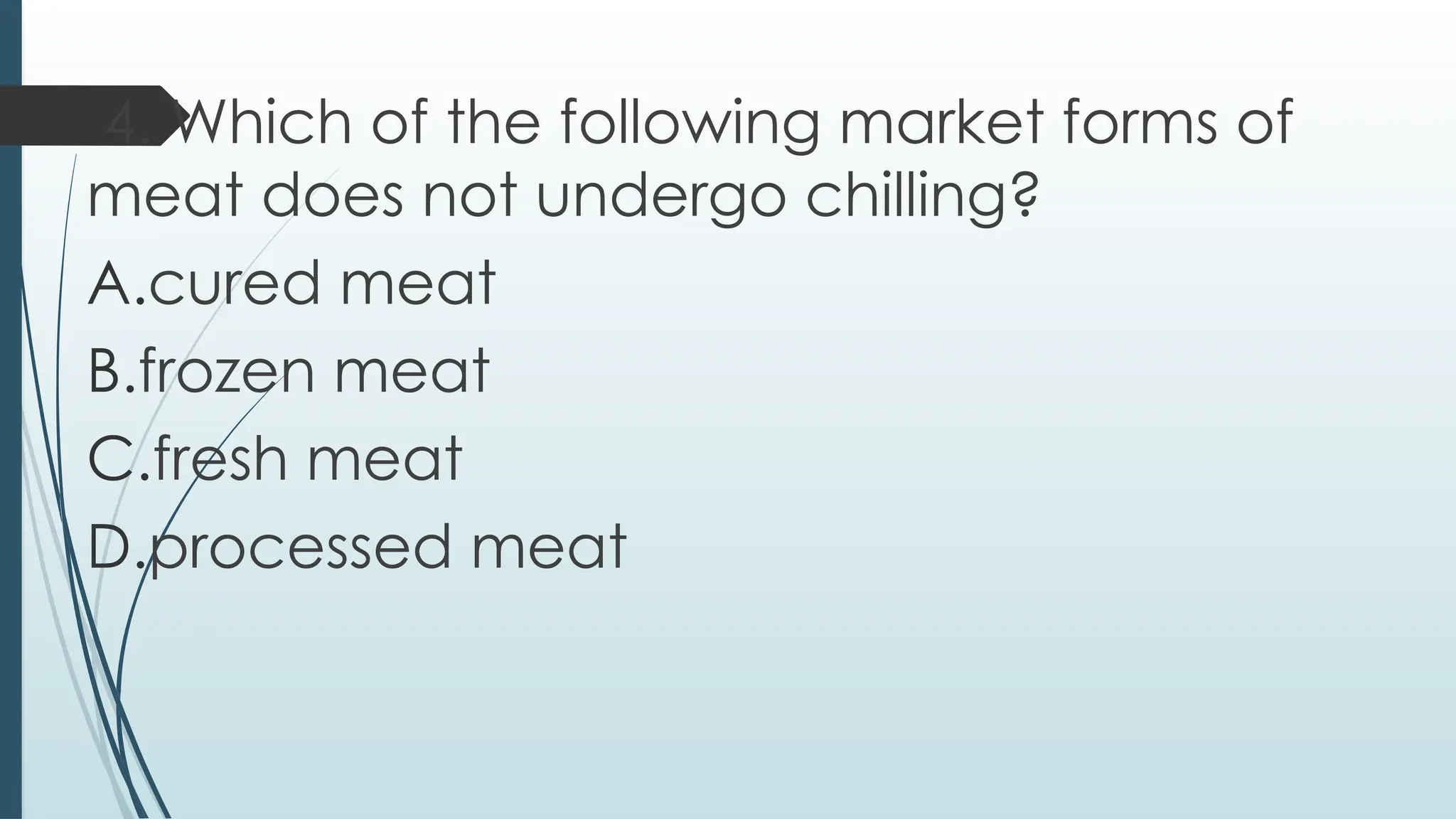
4. Which of the following market forms of
meat does not undergo chilling?
A.cured meat
B.frozen meat
C.fresh meat
D.processed meat
5. In this method, salt, sugar, potassium, or
sodium nitrate, etc. are used in preserving
meat by drying.
A. curing
B. freezing
C. dehydration
D. salting
STORE MEAT
Methods of Preserving Meat
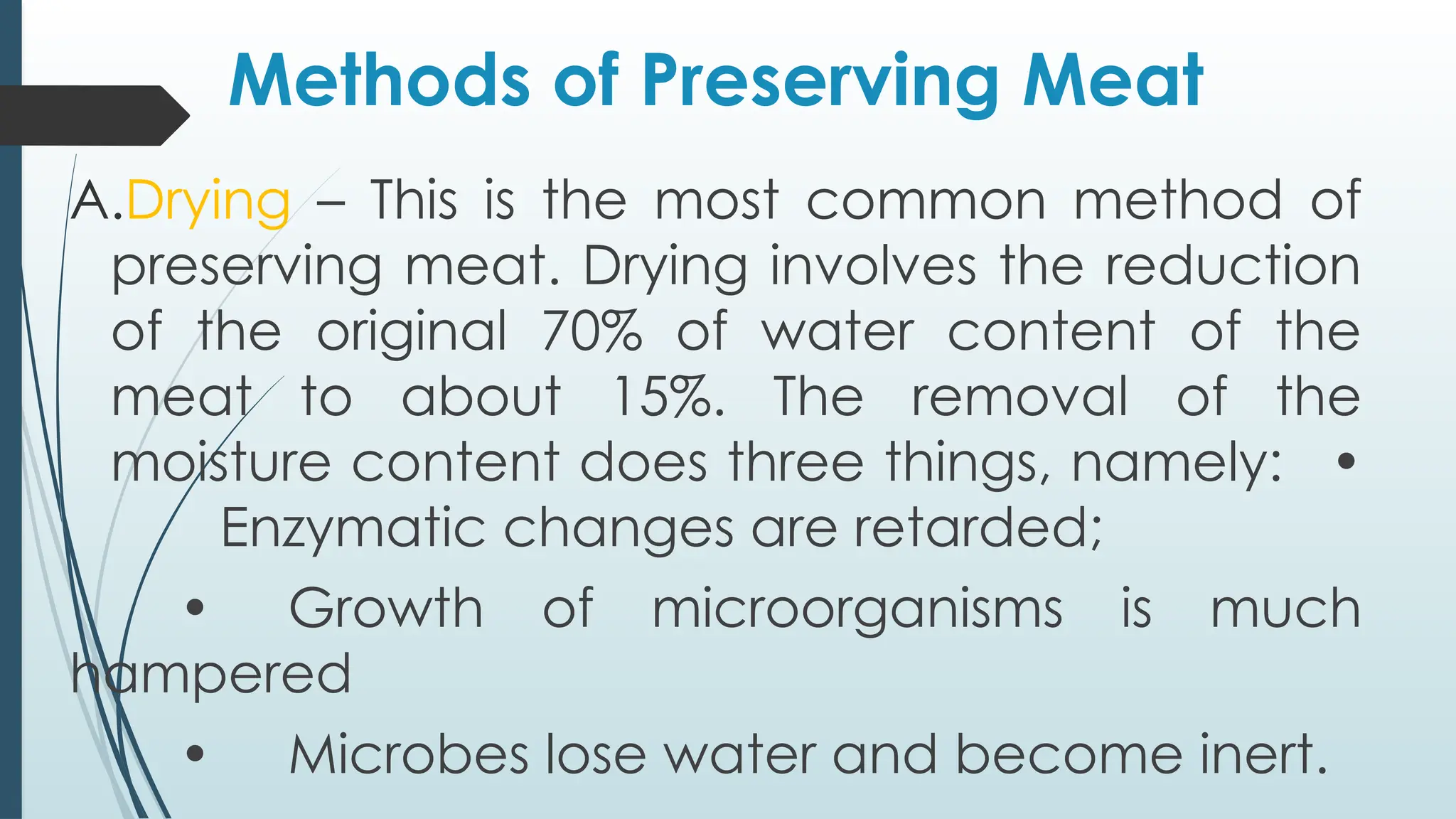
A.Drying – This is the most common method of
preserving meat. Drying involves the reduction
of the original 70% of water content of the
meat to about 15%. The removal of the
moisture content does three things, namely: •
Enzymatic changes are retarded;
• Growth of microorganisms is much
hampered
• Microbes lose water and become inert.
Ways of Drying Meat
1.Natural sun drying – Natural sunlight is used to reduce the
amount of moisture content of meat. Portable solar dyers
can provide sanitary means of drying meat. Dryers with
screen covers are recommended for outdoor use and
lengthens the storage life of meat
2.Dehydration or artificial drying – Oven is used for drying the
meat. Although this is more expensive than sun drying,
dehydration is a more efficient method of removing
moisture from meat. Products dried in this way are of higher
quality and can be sold at better prices.
B. Smoking – Meat is smoked to create a distinctive
color and flavor, thus helping its preservation.
• Cold Smoking – The temperature is held between
26 to 43ºC and the products are smoked over a
period of days or weeks. The products thus pick up a
strong smoked flavor and are dehydrated as well.
• Hot Smoking – The temperature is higher, from 71
to 79ºC.The high temperature speed up the drying
process, giving the product a mild smoked flavor.
C. Salting – Salt improves the keeping quality of
meat. It removes the water from the tissue of
the meat and the cells of spoilage organisms
that may be present in the meat.
D. Curing – In this method, salt, sugar,
potassium or sodium nitrate, and other curing
elements such as ascorbic acid, phosphate
blend, and spices are used to prolong the
keeping quality of meat.
E. Refrigerating – Meat is stored at a
temperature range of 2 to 10ºC to retard mold
and bacterial growth for a limited period.
F. Freezing – Meat is preserved at a temperature
of 10ºC and below. Freezing deactivates
enzymes and bacteria. Meat can be preserved
for two months to one year using this method.
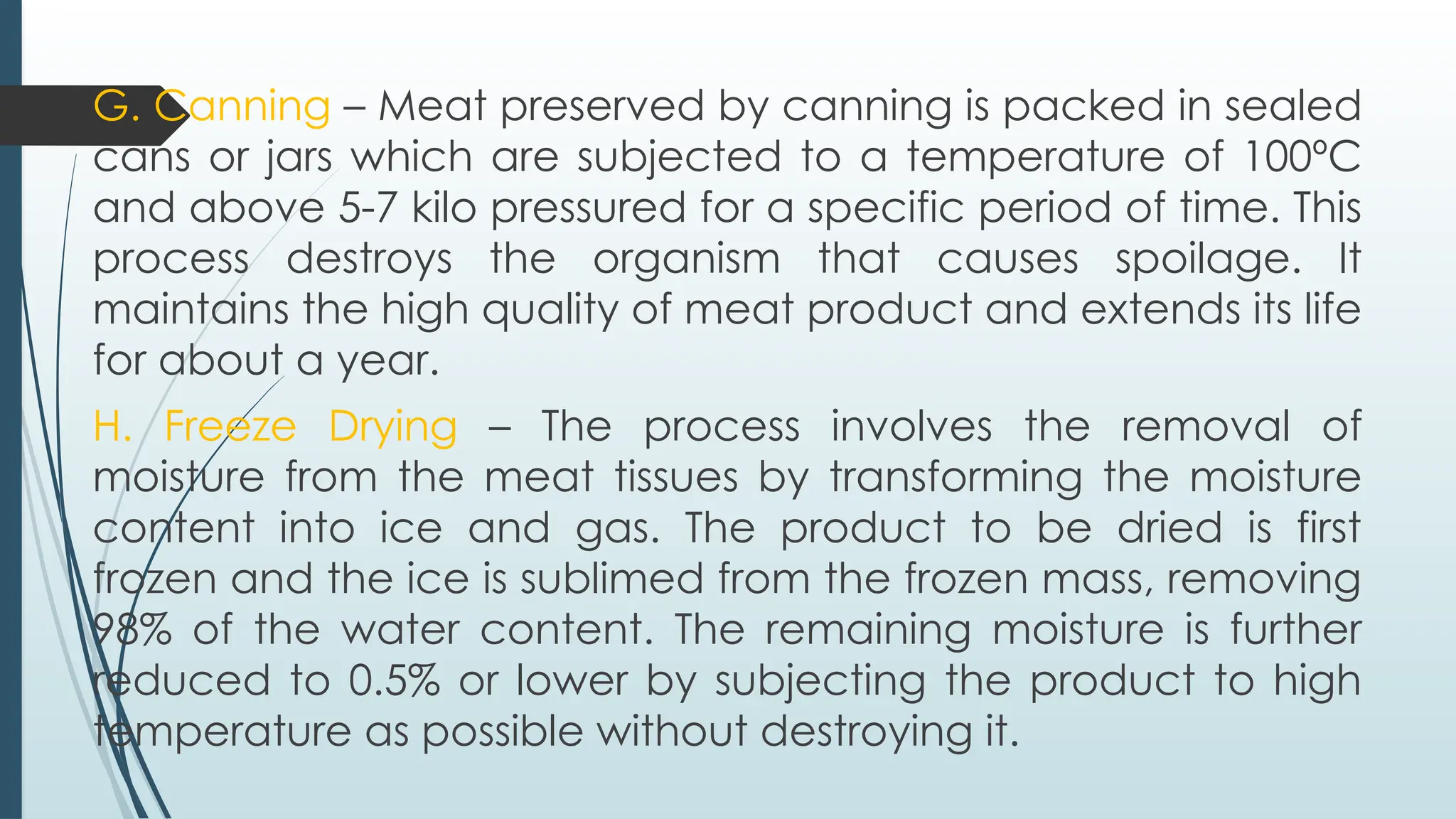
G. Canning – Meat preserved by canning is packed in sealed
cans or jars which are subjected to a temperature of 100ºC
and above 5-7 kilo pressured for a specific period of time. This
process destroys the organism that causes spoilage. It
maintains the high quality of meat product and extends its life
for about a year.
H. Freeze Drying – The process involves the removal of
moisture from the meat tissues by transforming the moisture
content into ice and gas. The product to be dried is first
frozen and the ice is sublimed from the frozen mass, removing
98% of the water content. The remaining moisture is further
reduced to 0.5% or lower by subjecting the product to high
temperature as possible without destroying it.
Evaluating the Quality of Preserved Meat
Products
Good quality pork has less than 1 ¼ cm of golden brown
fat that covers the surface of the meat and a thoroughly
cooked interior where meat has even pinkish color. It has also
a juicy and tender texture, a pleasing aroma and a tender
seasoned and pleasing taste with a slight hint of smoky flavor.
Sausages of good quality are uniform in size and length.
Each sausage in a whole piece has no rupture of casing even
when pricked. The interior has a pinkish color when thoroughly
cooked. A combination of juicy meat with spicy seasoning
marks their flavor.
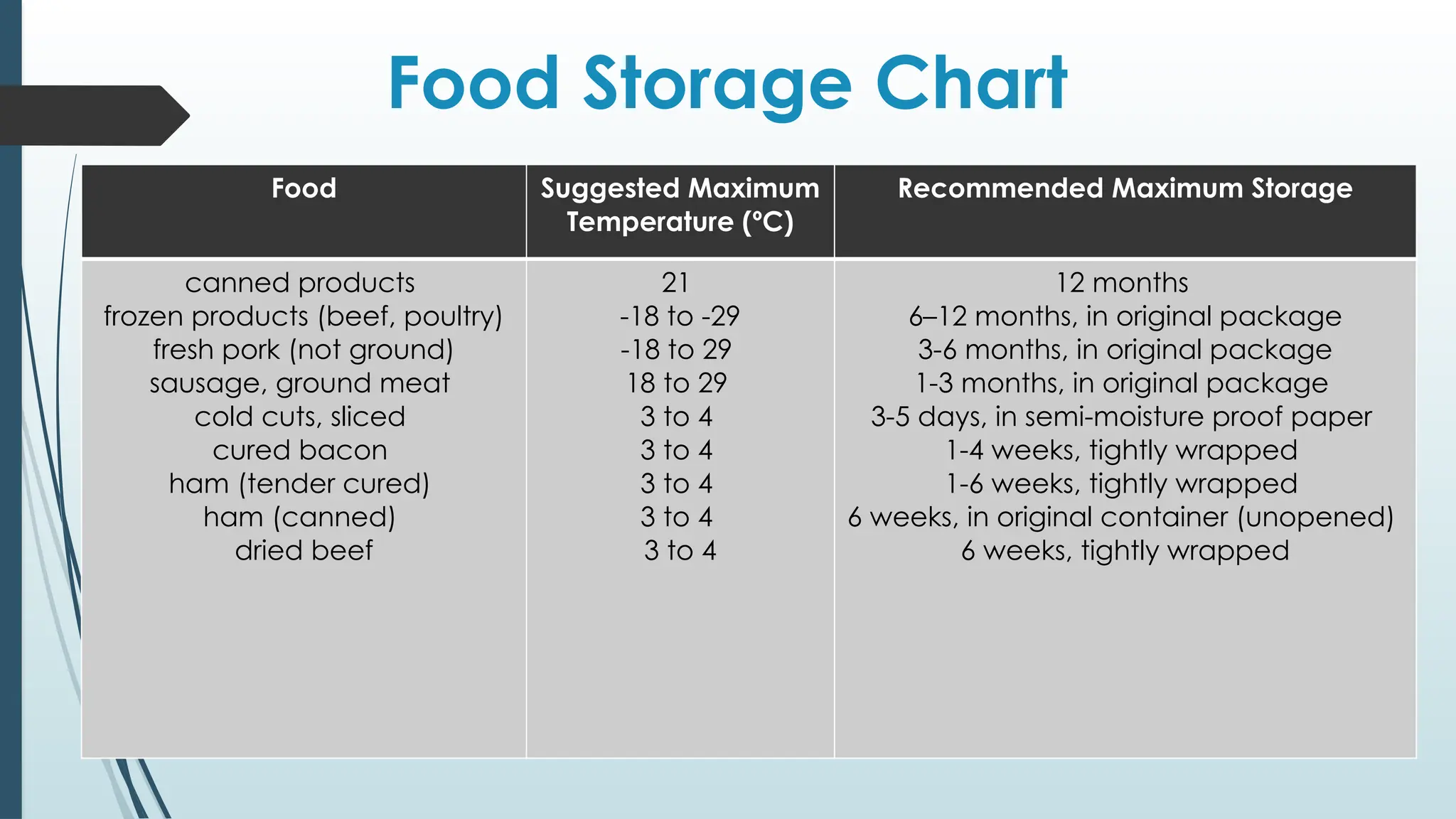
Food Storage Chart
Food Suggested Maximum
Temperature (ºC)
Recommended Maximum Storage
canned products
frozen products (beef, poultry)
fresh pork (not ground)
sausage, ground meat
cold cuts, sliced
cured bacon
ham (tender cured)
ham (canned)
dried beef
21
-18 to -29
-18 to 29
18 to 29
3 to 4
3 to 4
3 to 4
3 to 4
3 to 4
12 months
6–12 months, in original package
3-6 months, in original package
1-3 months, in original package
3-5 days, in semi-moisture proof paper
1-4 weeks, tightly wrapped
1-6 weeks, tightly wrapped
6 weeks, in original container (unopened)
6 weeks, tightly wrapped
Hygiene Practices in Storing Meat Products
To achieve high standards of sanitation, the following measures
should be strictly observed:
1. See to it that physical equipment and layout are
conducive to sanitary practices.
2. Handle, store, and refrigerate food properly to prevent
spoilage and contamination.
3. Safeguard the food during distribution and service.
4. Wash and sanitize dishes, glasses, utensils, and
equipment.
5. Clean floors walls, ceilings, counters, tables, and chairs
regularly.
6. Eliminate vermin and rodents from food areas.
7. Maintain adequate employer supervision and a
constant program of education in sanitation for food
service workers.
8. Make sure that food service employees are in good
health, and are not carriers of communicable diseases.
The three principal groups of communicable diseases that
must be guarded against in public feeding operations are
respiratory, intestinal, and skin diseases. Require medical
examinations for food service employees.
9. Provide a regular employee education on food service
sanitation.
Techniques in Storing Meat
Storing • Take time to store the food items. Store
new purchases behind old ones and always use
the old stock first. It is easy to put new purchases
at the front. However, older stocks are
overlooked and thus cause spoilage. These may
include cereal and cereal products, sweeteners,
oils, seasonings, and unopened cans and jars. Do
not use kitchen cabinets above the refrigerator,
stove, or oven for food storage.
1. Refrigerator
storage
2. Freezer storage
Sanitation is the best preventive measure against
food-borne diseases.
Staphylococcus bacteria are found not only in raw
meat but in food handlers with poor personal
hygiene. The bacteria from food handlers can be
transmitted to the food through sneezing and
coughing.
Bacteria thrive on food, moisture, and the right
temperature in order to grow. With carelessness,
these growing conditions can occur in any kitchen.


STORE MEAT.pptxxxxxxxxxxxxxxxxxxxxxxxxxx

  • 1.
  • 2.
    Write the letterof the best answer in your paper. 1. Where should meat products be stored? A.crisper B.dry shelf C.cold shelf D.freezer
  • 3.
    2. What partof the meat has the greatest amount of quality protein? A.bone B. flesh C. fat D. ligament
  • 4.
    3. What doyou call the cooking method when meat is cooked in steaming liquid in which bubbles are breaking on the surface? A.boiling B.roasting C.broiling D.stewing
  • 5.
    4. Which ofthe following market forms of meat does not undergo chilling? A.cured meat B.frozen meat C.fresh meat D.processed meat
  • 6.
    5. In thismethod, salt, sugar, potassium, or sodium nitrate, etc. are used in preserving meat by drying. A. curing B. freezing C. dehydration D. salting
  • 7.
  • 8.
    Methods of PreservingMeat A.Drying – This is the most common method of preserving meat. Drying involves the reduction of the original 70% of water content of the meat to about 15%. The removal of the moisture content does three things, namely: • Enzymatic changes are retarded; • Growth of microorganisms is much hampered • Microbes lose water and become inert.
  • 9.
    Ways of DryingMeat 1.Natural sun drying – Natural sunlight is used to reduce the amount of moisture content of meat. Portable solar dyers can provide sanitary means of drying meat. Dryers with screen covers are recommended for outdoor use and lengthens the storage life of meat 2.Dehydration or artificial drying – Oven is used for drying the meat. Although this is more expensive than sun drying, dehydration is a more efficient method of removing moisture from meat. Products dried in this way are of higher quality and can be sold at better prices.
  • 10.
    B. Smoking –Meat is smoked to create a distinctive color and flavor, thus helping its preservation. • Cold Smoking – The temperature is held between 26 to 43ºC and the products are smoked over a period of days or weeks. The products thus pick up a strong smoked flavor and are dehydrated as well. • Hot Smoking – The temperature is higher, from 71 to 79ºC.The high temperature speed up the drying process, giving the product a mild smoked flavor.
  • 11.
    C. Salting –Salt improves the keeping quality of meat. It removes the water from the tissue of the meat and the cells of spoilage organisms that may be present in the meat. D. Curing – In this method, salt, sugar, potassium or sodium nitrate, and other curing elements such as ascorbic acid, phosphate blend, and spices are used to prolong the keeping quality of meat.
  • 12.
    E. Refrigerating –Meat is stored at a temperature range of 2 to 10ºC to retard mold and bacterial growth for a limited period. F. Freezing – Meat is preserved at a temperature of 10ºC and below. Freezing deactivates enzymes and bacteria. Meat can be preserved for two months to one year using this method.
  • 13.
    G. Canning –Meat preserved by canning is packed in sealed cans or jars which are subjected to a temperature of 100ºC and above 5-7 kilo pressured for a specific period of time. This process destroys the organism that causes spoilage. It maintains the high quality of meat product and extends its life for about a year. H. Freeze Drying – The process involves the removal of moisture from the meat tissues by transforming the moisture content into ice and gas. The product to be dried is first frozen and the ice is sublimed from the frozen mass, removing 98% of the water content. The remaining moisture is further reduced to 0.5% or lower by subjecting the product to high temperature as possible without destroying it.
  • 14.
    Evaluating the Qualityof Preserved Meat Products Good quality pork has less than 1 ¼ cm of golden brown fat that covers the surface of the meat and a thoroughly cooked interior where meat has even pinkish color. It has also a juicy and tender texture, a pleasing aroma and a tender seasoned and pleasing taste with a slight hint of smoky flavor. Sausages of good quality are uniform in size and length. Each sausage in a whole piece has no rupture of casing even when pricked. The interior has a pinkish color when thoroughly cooked. A combination of juicy meat with spicy seasoning marks their flavor.
  • 15.
    Food Storage Chart FoodSuggested Maximum Temperature (ºC) Recommended Maximum Storage canned products frozen products (beef, poultry) fresh pork (not ground) sausage, ground meat cold cuts, sliced cured bacon ham (tender cured) ham (canned) dried beef 21 -18 to -29 -18 to 29 18 to 29 3 to 4 3 to 4 3 to 4 3 to 4 3 to 4 12 months 6–12 months, in original package 3-6 months, in original package 1-3 months, in original package 3-5 days, in semi-moisture proof paper 1-4 weeks, tightly wrapped 1-6 weeks, tightly wrapped 6 weeks, in original container (unopened) 6 weeks, tightly wrapped
  • 16.
    Hygiene Practices inStoring Meat Products To achieve high standards of sanitation, the following measures should be strictly observed: 1. See to it that physical equipment and layout are conducive to sanitary practices. 2. Handle, store, and refrigerate food properly to prevent spoilage and contamination. 3. Safeguard the food during distribution and service. 4. Wash and sanitize dishes, glasses, utensils, and equipment. 5. Clean floors walls, ceilings, counters, tables, and chairs regularly.
  • 17.
    6. Eliminate verminand rodents from food areas. 7. Maintain adequate employer supervision and a constant program of education in sanitation for food service workers. 8. Make sure that food service employees are in good health, and are not carriers of communicable diseases. The three principal groups of communicable diseases that must be guarded against in public feeding operations are respiratory, intestinal, and skin diseases. Require medical examinations for food service employees. 9. Provide a regular employee education on food service sanitation.
  • 18.
    Techniques in StoringMeat Storing • Take time to store the food items. Store new purchases behind old ones and always use the old stock first. It is easy to put new purchases at the front. However, older stocks are overlooked and thus cause spoilage. These may include cereal and cereal products, sweeteners, oils, seasonings, and unopened cans and jars. Do not use kitchen cabinets above the refrigerator, stove, or oven for food storage.
  • 19.
  • 20.
    Sanitation is thebest preventive measure against food-borne diseases. Staphylococcus bacteria are found not only in raw meat but in food handlers with poor personal hygiene. The bacteria from food handlers can be transmitted to the food through sneezing and coughing. Bacteria thrive on food, moisture, and the right temperature in order to grow. With carelessness, these growing conditions can occur in any kitchen.